
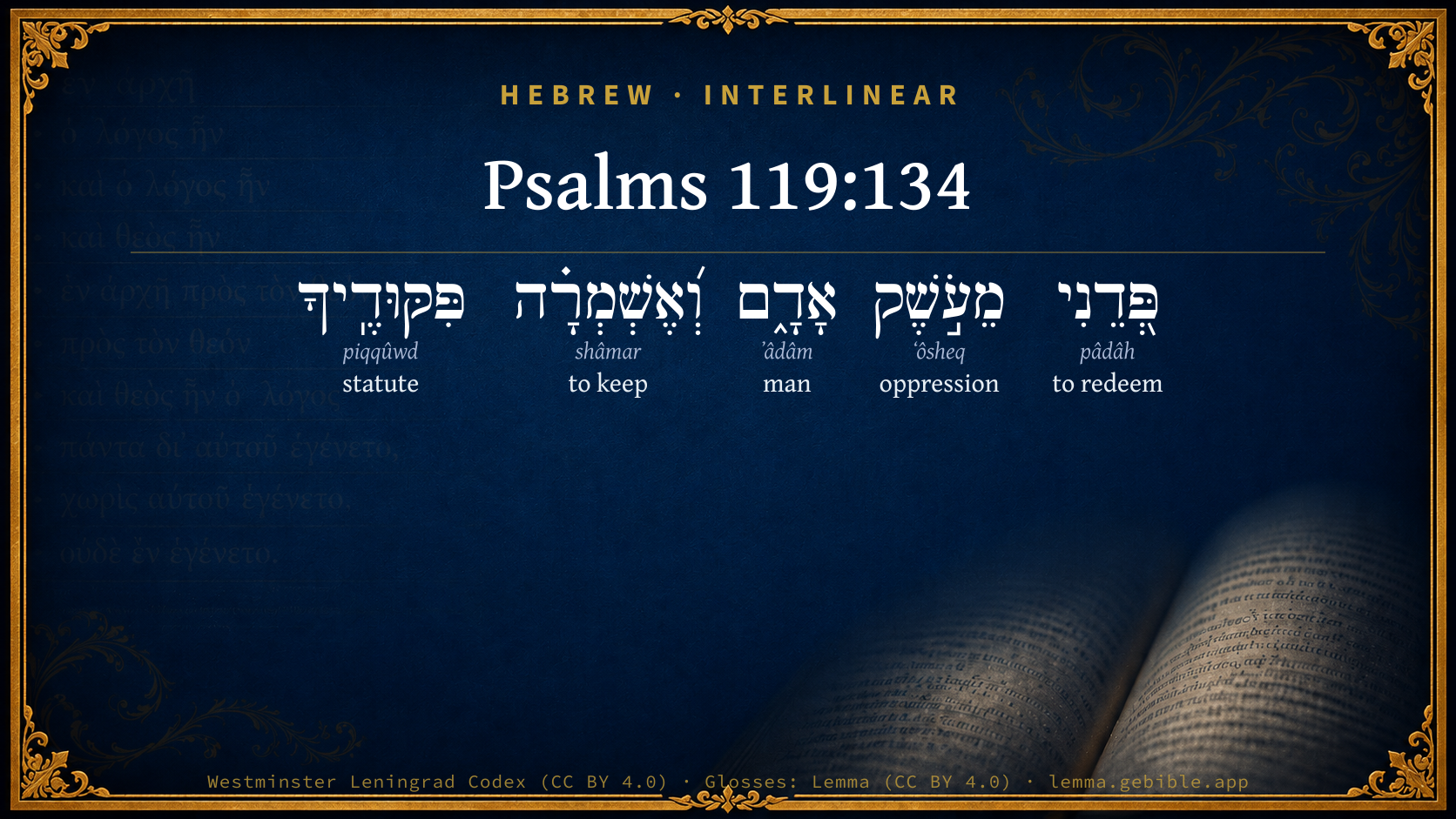
Psalms 119:134

Hebrew (Westminster Leningrad Codex) Psalms 119:134 appears in the Hebrew Old Testament. The text above is from the Westminster Leningrad Codex. Each word links to its Strong’s number, a concise gloss, and parsing drawn from the Open Scriptures Hebrew Bible morphology. Click any word for its full Brown-Driver-Briggs (BDB) entry.
Download image
Cite this verse

Psalms 119:134 (World English Bible). Public Domain. Lemma interlinear Bible study tool, https://lemma.gebible.app/v/psalms/119/134.

Show BibTeX & RIS
BibTeX
RIS
English Translation
Redeem me from the oppression of man, So I will observe your precepts.
World English Bible · Public Domain
Download a study sheet

One document with this verse’s original text, its word-by-word gloss line, the meaning frame, cross-references with their text, attributed commentary, and full source and license credits — printable, and it pastes into notes with its structure intact.

This verse Autodidact and up

Study sheet (.html) Plain text (.txt)

A passage Seminary Student

Up to 50 verses in one chapter. A passage sheet keeps up to 6 commentary sources and 12 cross-references per verse, in the order this page ranks them, and says so on the sheet whenever that leaves anything out. Ask for a single verse and you get the Autodidact verse sheet above.

Everything on this page stays free to read, with no account — the sheet is a download of what is already on screen, not access to it.

Want to remove ads? Support Godless Engineer
Compare translations 3

The same verse in 3 English versions, stacked beneath the original-language interlinear above. Click any original word for its lexicon entry.

Each is an independent rendering of the whole verse — the interlinear is not word-aligned to these translations.

Highlighted words mark where these versions differ — a whole-verse word diff, not a word-by-word alignment.

  • World English Bible Public Domain
    Redeem me from the oppression of man, So I will observe your precepts.
  • King James Version Public Domain
    Deliver me from the oppression of man: so will I keep thy precepts.
  • unfoldingWord Literal Text CC BY-SA 4.0
    Redeem me from the oppression of man, that I may keep your precepts.

unfoldingWord Literal Text — © unfoldingWord, licensed CC BY-SA 4.0. Word-aligned USFM3 via Door43 (git.door43.org/unfoldingWord/en_ult).

Versions to compare (up to 4)

3 of 4 selected

Show all 17 translations

Every available English version of this verse, each an independent rendering of the whole verse.

  • World English Bible Public Domain
    Redeem me from the oppression of man, So I will observe your precepts.
  • Berean Standard Bible Public Domain
    Redeem me from the oppression of man, that I may keep Your precepts.
  • Majority Standard Bible Public Domain
    Redeem me from the oppression of man, that I may keep Your precepts.
  • King James Version Public Domain
    Deliver me from the oppression of man: so will I keep thy precepts.
  • American Standard Version (1901) Public Domain
    Redeem me from the oppression of man: So will I observe thy precepts.
  • Revised Version (1885) Public Domain
    Redeem me from the oppression of man: so will I observe thy precepts.
  • Geneva Bible (1599) Public Domain
    Deliuer mee from the oppression of men, and I will keepe thy precepts.
  • Young's Literal Translation Public Domain
    Ransom me from the oppression of man, And I observe Thy precepts,
  • Literal Standard Version CC BY-SA 4.0
    Ransom me from the oppression of man, || And I observe Your precepts,
  • Unlocked Literal Bible CC BY-SA 4.0
    Redeem me from human oppression so that I may observe your instructions.
  • unfoldingWord Literal Text CC BY-SA 4.0
    Redeem me from the oppression of man, that I may keep your precepts.
  • Darby Bible Public Domain
    Deliver me from the oppression of man; and I will keep thy precepts.
  • World Messianic Bible Public Domain
    Redeem me from the oppression of man, so I will observe your precepts.
  • Webster's Bible Public Domain
    Deliver me from the oppression of man: so will I keep thy precepts.
  • Free Bible Version CC BY-SA 4.0
    Save me from cruel people so I can follow your instructions.
  • Bible in Basic English Public Domain
    Make me free from the cruel rule of man; then I will keep your orders.
  • JPS Tanakh (1917) Public Domain
    Redeem me from the oppression of man, and I will observe Thy precepts.

Literal Standard Version (2020), Covenant Press — licensed CC BY-SA 4.0. Text via the HelloAO Bible API (eBible.org). Unlocked Literal Bible (unfoldingWord) — licensed CC BY-SA 4.0. Text via the HelloAO Bible API (eBible.org). unfoldingWord Literal Text — © unfoldingWord, licensed CC BY-SA 4.0. Word-aligned USFM3 via Door43 (git.door43.org/unfoldingWord/en_ult). Free Bible Version, Dr. Jonathan Gallagher — licensed CC BY-SA 4.0. Text via the HelloAO Bible API (eBible.org).

Word by word

More ways to search: Search by grammar → Find every occurrence → Compare this word →

Practice this passage: Drill this verse → Learn its vocabulary →

About this verse

These counts appear in no published source. They are computed here, from the morphology-tagged text and Lemma’s own curated glosses. What Lemma adds →

5
words
5
distinct lemmas
Wisdom
section

Notable vocabulary

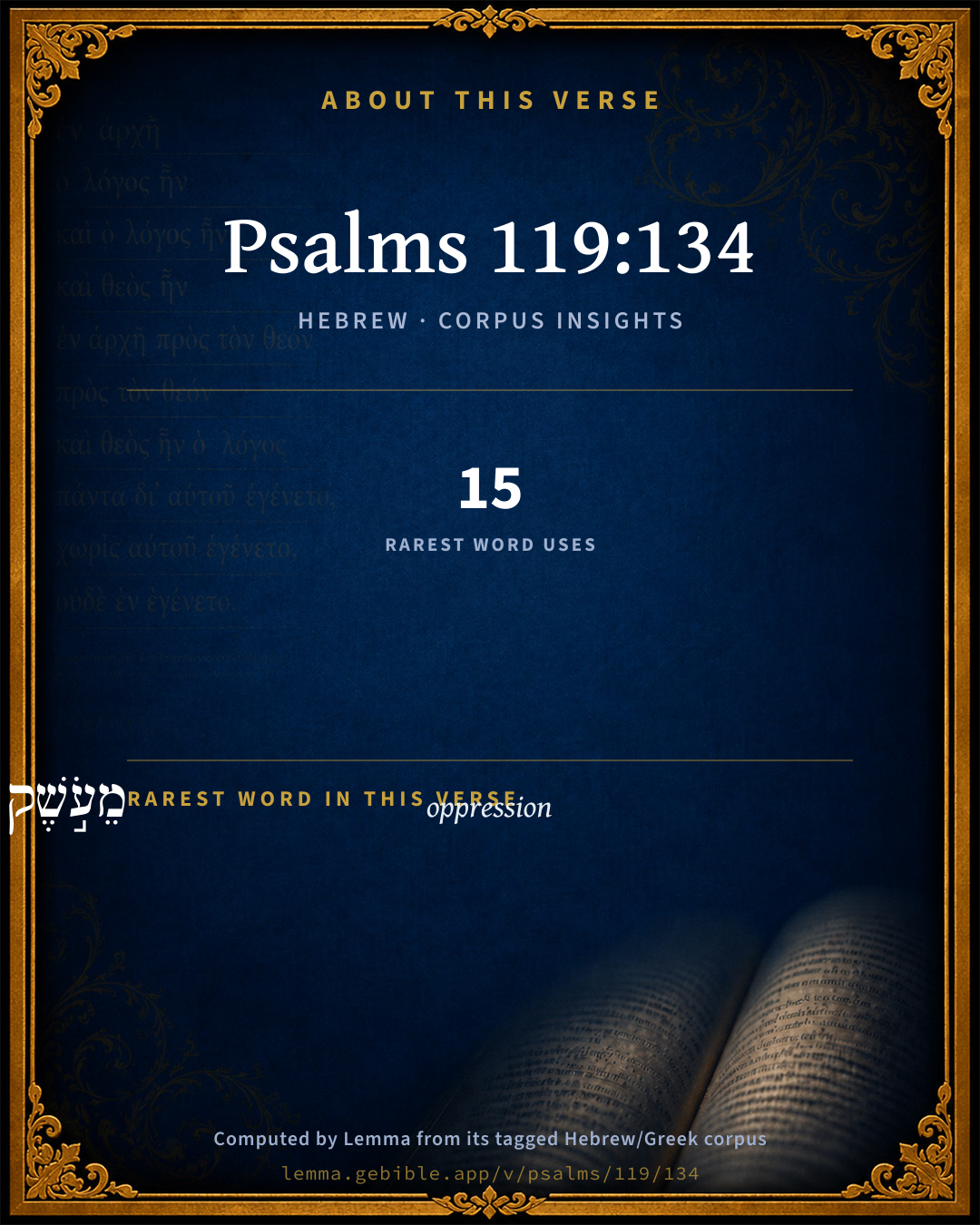
The rarest word here is מֵעֹ֣שֶׁק oppression H6233 — appearing just 15 times in the whole Hebrew Bible.

Shared distinctive vocabulary

מֵעֹ֣שֶׁק oppression H6233 occurs in 15 verses of the Hebrew Bible. Also found in:

Grammatical profile

  • 2 verbs
  • 3 nouns

Verb forms

  • פְּ֭דֵנִי Qal · Imperative
  • וְ֝אֶשְׁמְרָ֗ה Qal · Cohortative

Hebrew & Septuagint length

In English translation the verse runs 13 words from the Hebrew and 14 from the Septuagint (LXX English) — closely comparable.

A rough comparison of the two English renderings, which tokenize alike — not a word-level alignment.

Word counts can differ between the Hebrew and the Greek without any difference in meaning — e.g. the Hebrew direct-object marker אֵת has no separate Greek word, and Greek often adds the article ὁ.

Cross-references

9

Topical passages linked to Psalms 119:134 in the Treasury of Scripture Knowledge — connected by theme and wording, ordered by reader-vote popularity; previews shown in the World English Bible.

  • Psalms 56:1–2 Be merciful to me, God, for man wants to swallow me up. All day long, he attacks and oppresses me.
  • Psalms 119:122 Ensure your servant's well-being. Don't let the proud oppress me.
  • Ezekiel 11:17–20 Therefore say, Thus says the Lord Yahweh: I will gather you from the peoples, and assemble you out of the countries where you have been scattered, and I will give you the land of Israel.
  • Luke 1:74–75 To grant to us that we, being delivered out of the hand of our enemies, should serve him without fear,
  • Psalms 56:13 For you have delivered my soul from death, And prevented my feet from falling, That I may walk before God in the light of the living.
  • Psalms 105:43–45 He brought forth his people with joy, His chosen with singing.
  • Psalms 142:6 Listen to my cry, For I am in desperate need. Deliver me from my persecutors, For they are stronger than me.
  • Ezekiel 36:24–27 For I will take you from among the nations, and gather you out of all the countries, and will bring you into your own land.
  • Acts 9:31 So the assemblies throughout all Judea and Galilee and Samaria had peace, and were built up. They were multiplied, walking in the fear of the Lord and in the comfort of the Holy Spirit.

Cross-references courtesy of OpenBible.info (CC BY 4.0).

Hebrew and Greek witnesses Masoretic Hebrew ↔ Greek Septuagint

The same verse in the two great witnesses to the Old Testament, shown verse-for-verse.

You’re reading Greek Psalm 118 (Hebrew Psalm 119). The Septuagint counts the superscription, so verse numbers can differ from the Hebrew — chapter-level alignment, not verse-by-verse. Numbering follows Rahlfs.

These are two independent witnesses, not word-aligned to each other, and the Septuagint is shown in lemma (dictionary) form.

Hebrew Psalms 119:134 Masoretic · Westminster Leningrad Codex

פְּ֭דֵנִי מֵעֹ֣שֶׁק אָדָ֑ם וְ֝אֶשְׁמְרָ֗ה פִּקּוּדֶֽיךָ

Redeem me from the oppression of man, So I will observe your precepts.

World English Bible · Public Domain

Greek LXX Greek Psalm 118:134 Septuagint · lemma form

λυτρόω ἐγώ ἀπό συκοφαντία ἄνθρωπος καί φυλάσσω ὁ ἐντολή σύ

Deliver me from the false accusation of men: so will I keep your commandments.

LXX2012 (modern English Septuagint) · Public Domain

Hebrew: Westminster Leningrad Codex (CC BY 4.0). Greek: Septuagint (public domain); English from LXX2012 (modern English Septuagint) (Public Domain). How the Septuagint differs from the Hebrew →

Commentary

Notes on Psalms 119:134 from classic Christian and Jewish commentators (each source and its license shown beneath its notes). The classic Christian expositions comment on the surrounding passage and are grouped to its opening verse, so a note may address several verses; the Jewish commentaries on the Tanakh (Rashi and others) are per-verse, so they appear only where the commentator wrote on this verse.

Lemma curates 59 commentaries, every one of them public domain or Creative Commons licensed, each selected and text-cleaned for this edition rather than reprinted as found. About our sources →

Trapp's Complete Commentary

John Trapp

Psa 119:134 Deliver me from the oppression of man: so will I keep thy precepts.

Ver. 134. Deliver me from the oppressions of man] Homo homini lupus. David, besides his corruptions within, met with oppressions and persecutions without; so shall all that will live godly in Christ Jesus; let them never dream of a delicacy in religion.

So will I keep thy precepts] Not say, as those miscreants, Jer 7:10, "We are delivered to do all these abominations"; but as good old Zechariah, Luk 1:74-75, Servati sumus ut serviamus, We have been served so that we may serve. We are delivered that we might serve God without fear, &c.

John Trapp, A Commentary or Exposition upon All the Books of the Old and New Testament (1647–1656) — public domain. Text from a community e-Sword module.

J. A. Alexander on Psalms

Joseph Addison Alexander

134. (Psa 119:134) Redeem me from the oppression of man, and I will keep thy precepts. These two verses are peculiarly appropriate to the trials and temptations of the Jews at the time of the Restoration. The form of the last verb denotes strong desire and determination.

Joseph Addison Alexander, The Psalms Translated and Explained (1850) — public domain. Text from a community e-Sword module.

Matthew Henry's Commentary

Here, 1. David prays that he might live a quiet and peaceable life, and might not be harassed and discomposed by those that studied to be vexatious: "Deliver me from the oppression of man - man, whom God can control, and whose power is limited. Let them know themselves to be but men (Psa 9:20), and let me be delivered out of the hands of my enemies, that I may serve God without fear; so will I keep thy precepts." Not but that he would keep God's precepts, though he should be continued under oppression; "but so shall I keep thy precepts more cheerfully and with more enlargement of heart, my bonds being loosed." Then we may expect temporal blessings when we desire them with this in our eye, that we may serve God the better.

Matthew Henry's Commentary on the Whole Bible (1708–1710) — public domain (CC PDM 1.0). Text via the HelloAO Bible API.

John Calvin's Commentaries

134. Deliver me from the oppression of men. When recounting what had befallen himself, the Prophet shows, by his own example, that all the godly are exposed to rapine and oppression, and that, like sheep in the mouths of wolves, they will be inevitably destroyed unless God defend them. As very few are governed by the Spirit of God, it is no wonder if all love of equity is banished from the world, and if all men are found everywhere rushing into all kinds of wickedness, some impelled by cruelty, In the French version it is “avarice.”

John Calvin's Commentaries (1540-1563) — public domain. Text from the Calvin Translation Society English edition (1840s-50s) via the Christian Classics Ethereal Library (ccel.org). Calvin's coverage is partial (roughly two-thirds of the Bible); uncommented books and verses are honest gaps, never fabricated. The 19th-century editor's footnotes and remarks are omitted so the notes are faithfully Calvin's own voice.

The Cambridge Bible for Schools and Colleges

gen. ed. J. J. S. Perowne

134. Redeem me from the oppression of man,

That I may observe thy precepts.

Cp. Psa_119:121-122.

The Cambridge Bible for Schools and Colleges (gen. ed. J. J. S. Perowne; Cambridge University Press, 1878–1918) — public domain. Text from a community e-Sword module.

John Gill's Exposition

Thy testimonies that thou hast commanded are righteous,.... The Scriptures are holy, just, and good; and what is contained in them are according to godliness; are for instruction in righteousness, and teach men to live soberly, righteously, and godly;

and very faithful; or "true" (u): all the sayings in them are true and faithful sayings; for they are the sayings of God that cannot lie; the promises in them are faithfully performed by him that made them; they are all yea and amen in Christ. The words may be rendered, "thou hast commanded righteousness in thy testimonies, and truth" or faith "exceedingly": so the Arabic version. God in the law requires of men a perfect righteousness, every way agreeable to its demands; and in his Gospel he reveals the complete righteousness of his Son, which he has commanded to be published in it, to be laid hold on and received by faith as a justifying righteousness, as it is to all that believe: this, with every other truth of the Gospel, is made manifest by the Scriptures according to the commandment of the everlasting God, Rom 16:25.

(u) "et verissimae", Vatablus, "veritas valde, i.e. prorsus verissima", Gejerus.

John Gill's Exposition of the Whole Bible (1746–1763) — public domain (CC PDM 1.0). Text via the HelloAO Bible API.

Albert Barnes' Notes on the Bible

Deliver me from the oppression of man - From constraint on the part of man, so that I may be free to act as I please. Give me true religious liberty, and let me not be under any compulsion or constraint. The word rendered “deliver” is that which is usually rendered “redeem.” It is used here in the large sense of deliverance; and the prayer is an expression of what the true friends of religion have always sought, desired, and demanded - “freedom” of opinion - the richest blessing which man can enjoy.

So will I keep thy precepts - My heart inclines to that; I desire it; and, if suffered to act without constraint, I will do it. As it is the purpose and the wish of my soul, I pray that all hindrances to the free exercise of my religion may be removed. How often has this prayer been offered in times of persecution! By how many million of the dwellers on the earth might it even now be offered! What a blessing it is to those who are free from oppressive laws, that they are permitted to carry out the wishes of their hearts, and to worship God according to the dictates of their conscience, with none to molest them or make them afraid.

Albert Barnes' Notes on the Bible (1834–1885) — public domain. Text from a community e-Sword/MySword module.

Matthew Poole's English Annotations

As he prayed against the inward impediment of his obedience, Psa 119:133, so here he prayeth against an external impediment of it, and a common temptation to sin.

Matthew Poole's English Annotations on the Holy Bible (1683–1685) — public domain. Text from a community e-Sword/MySword module.

The Treasury of David

Charles H. Spurgeon

Ver. 134. Deliver me from the oppression of man. David had tasted all the bitterness of this great evil. It had made him an exile from his country, and banished him from the sanctuary of the Lord: therefore he pleads to be saved from it. It is said that oppression makes a wise man mad, and no doubt it has made many a righteous man sinful. Oppression is in itself wicked, and it drives men to wickedness. We little know how much of our virtue is due to our liberty; if we had been in bonds under haughty tyrants we might have yielded to them, and instead of being confessors we might now have been apostates. He who taught us to pray, "Lead us not into temptation, "will sanction this prayer, which is of much the same tenor, since to be oppressed is to be tempted.

So will I keep thy statutes. When the stress of oppression was taken off he would go his own way, and that way would be the way of the Lord. Although we ought not to yield to the threatenings of men, yet many do so; the wife is sometimes compelled by the oppression of her husband to act against her conscience: children and servants, and even whole nations have been brought into the same difficulty. Their sins will be largely laid at the oppressor's door, and it usually pleases God ere long to overthrow these powers and dominions which compel men to do evil. The worst of it is that some persons, when the pressure is taken off from them, follow after unrighteousness of their own accord. These give evidence of being sinners in grain. As for the righteous, it happens to them as it did to the apostles of old, "Being let go, they went to their own company. "When saints are freed from the tyrant they joyfully pay homage to their king.

Ver. 134. Deliver me from the oppression of man. 1. "Man" by way of distinction. There is the oppression and tyranny of the Devil and sin; but the Psalmist doth not mean that now: Heminum non daemonum, saith Hugo. 2. "Man" by way of aggravation. Homo homini lupus:no creatures so ravenous and destructive to one another as man. It is a shame that one man should oppress another. Beasts do not usually devour those of the same kind; but, usually, a man's enemies are those of his own household: Mt 10:36. The nearer we are in bonds of alliance, the greater the hatred. 3. "Man" by way of diminution. And to lessen the fear of this evil, this term Adam is given them, to show their weakness in comparison of God. Thou art God; but they that are so ready and forward to oppress and injure us are but men; thou canst easily overrule their power and break the yoke. I think this consideration chiefest, because of other places. "Who art thou, that thou shouldest be afraid of a man that shall die, and of the son of man which shall be made as grass; and forgettest the Lord thy maker, that hath stretched forth the heavens, and laid the foundations of the earth; and hast feared continually every day because of the fury of the oppressor, as if he were ready to destroy? and where is the fury of the oppressor?" Isa 41:12-13. Thomas Manton.

Ver. 134. From the oppression of man. Some render it, "from the oppression of Adam; "as Jarchi observes; and Arama interprets it of the sin of Adam, and as a prayer to be delivered or redeemed from it; as the Lord's people are by the blood of Christ. John Gill.

Ver. 134. What sins may be produced by oppression. What obedience ought to come from those who are set free.

Ver. 134.

1. The course to he pursued: "thy precepts."

2. The opposition to that course: "the oppression of men."

(a) Human opinions.

(b) Human examples.

3. Human sympathies.

4. Interests.

5. Persecutions.

6. The resistance to that opposition: "Deliver me, so will I, "etc. G.R.

Ver. 134. Hindrances removed.

1. The impeding influence of persecution.

2. The prayer of the persecuted one.

3. The conduct of the delivered one (Lu 1:74, 75). G.A.D.

Ver. 134.

1. How some men oppress their fellows. By the laws they make as statesmen. By the books they write as authors. By the tyranny they exercise as masters. By the lives they live as professors. By the sermons they deliver as ministers!

2. How the prayer of the oppressed may be answered. By the gift of wise and good statesmen. By increase of sound literature. By the conversion or removal of hard masters. By a baptism of the Spirit on the church. W.W.

Psalms 119:135*

Charles H. Spurgeon's The Treasury of David (1869–1885) — public domain. Psalms only. Text from a community e-Sword/MySword module.

The Pulpit Commentary

Deliver me from the oppression of man: so will I keep thy precepts. Out of gratitude for thy interposition.

Freedom in order to be righteous.

The tone of this entire psalm is that of a man who is in some kind of bondage to his fellow-man, either material, mental, or moral. It may reflect the feeling of the exile in Babylon; but perhaps it reflects better the feeling of the restored exile, whose endeavors to resuscitate the Israelite nation and religion were so variously opposed by the neighboring kingdoms, and by political parties. The restored exile, because of his joy in his new-found liberty, felt all the more deeply the way in which he was checked and hindered by fresh forms of the "oppression of man." And true to the Jewish instincts, he saw the oppression chiefly as a hindrance to his hope of restoring the Jehovah-worship.

I THE VALUE OF FREEDOM DEPENDS ON THE USE WE MAKE OF IT. A child had better not be free, because he does not know what to do with freedom. He gradually gains the freedom as he gains the control of himself and the control of his circumstances. Some men never can be free. They are not masters of themselves enough to have so serious a trust. Freedom is a passionate desire of humanity everywhere, and in all its stages. It is God"s gift to man, and his inalienable right. And yet with this passion for his own freedom there goes another passion to hold his brother in bonds. Man would use his freedom to take away his brother"s; or to satisfy his lower animal nature. There is dignity and peril in mental freedom and in moral freedom. They depend on the use we make of the trust.

II WE USE OUR FREEDOM ARIGHT ONLY WHEN WE PUT OURSELVES IN BONDS. The psalmist wants his liberty in order that he may keep God"s precepts. Liberty for man is but license when it is simple freedom from restraint. It is a noble anti intelligent thing only when a man uses it to fix rules for himself, or to put himself into the Divine rule. Men think of freedom as getting rid of the restraints of righteousness, so that they may do what they like. But the true liberty, the only liberty a man can desire who looks aright on life, is getting rid of the restraints of evil, self will, and self-pleasing, so that he may be free to do what God likes. He wants liberty to be righteous. R.T.

The Pulpit Commentary (1880–1919), ed. H.D.M. Spence-Jones & Joseph S. Exell — public domain. Text from a community e-Sword module.

Rashi

Rabbi Shlomo Yitzchaki (Rashi)

Redeem me from the oppression of man From the evil inclination, which oppresses the people (from the good path—Parshandatha). In other commentaries I found: Redeem me from the oppression of man Redeem me so that no man oppress me.

Rashi on the Tanakh — English translations: “The Judaica Press complete Tanach with Rashi, translated by A. J. Rosenberg” (CC BY 4.0); “Pentateuch with Rashi's commentary by M. Rosenbaum and A.M. Silbermann, 1929-1934” (public domain); “The Metsudah Tanach series, Lakewood, N.J” (CC BY 4.0); and “The Book of Joshua, Metsudah Publications, 1997” (CC BY 4.0). Text via Sefaria.

Lesson kit

Teaching starters — assembled from the data on this page, not authored interpretation. Every prompt links to the verse data it draws on. Edit before teaching.

Psalms, in the Wisdom, opens this verse with 5 words (5 distinct Hebrew lemmas). Its most distinctive word is ʻôsheq (“oppression”). A historical commentator’s framing appears above. Read the whole chapter for the surrounding context.

Discussion questions

  1. How does “oppression” (ʻôsheq) shape what this verse is saying?
  2. How does Leviticus 6:4, which shares the word «oppression», read alongside this verse?
  3. The translations on this page render this verse differently — a whole-verse word diff, not a word-by-word alignment. What might account for the different wordings?
  4. «פְּ֭דֵנִי» is a Qal Imperative verb. How does that grammatical form shape the action described?
  5. Compare how Trapp's Complete Commentary and J. A. Alexander on Psalms read this verse. Where do they agree or differ?

Things to notice

Reading settings

Reading text

Shown beneath each verse's original-language words.

Old Testament
Old Testament edition

Read the OT as the Masoretic Hebrew (MT) or the Greek Septuagint (LXX).

English shown for the Greek Septuagint (in the Hebrew ↔ Greek comparison).

Comparing translations? Open the Compare panel on any verse page to stack up to four side by side.