
Psalms 26:11

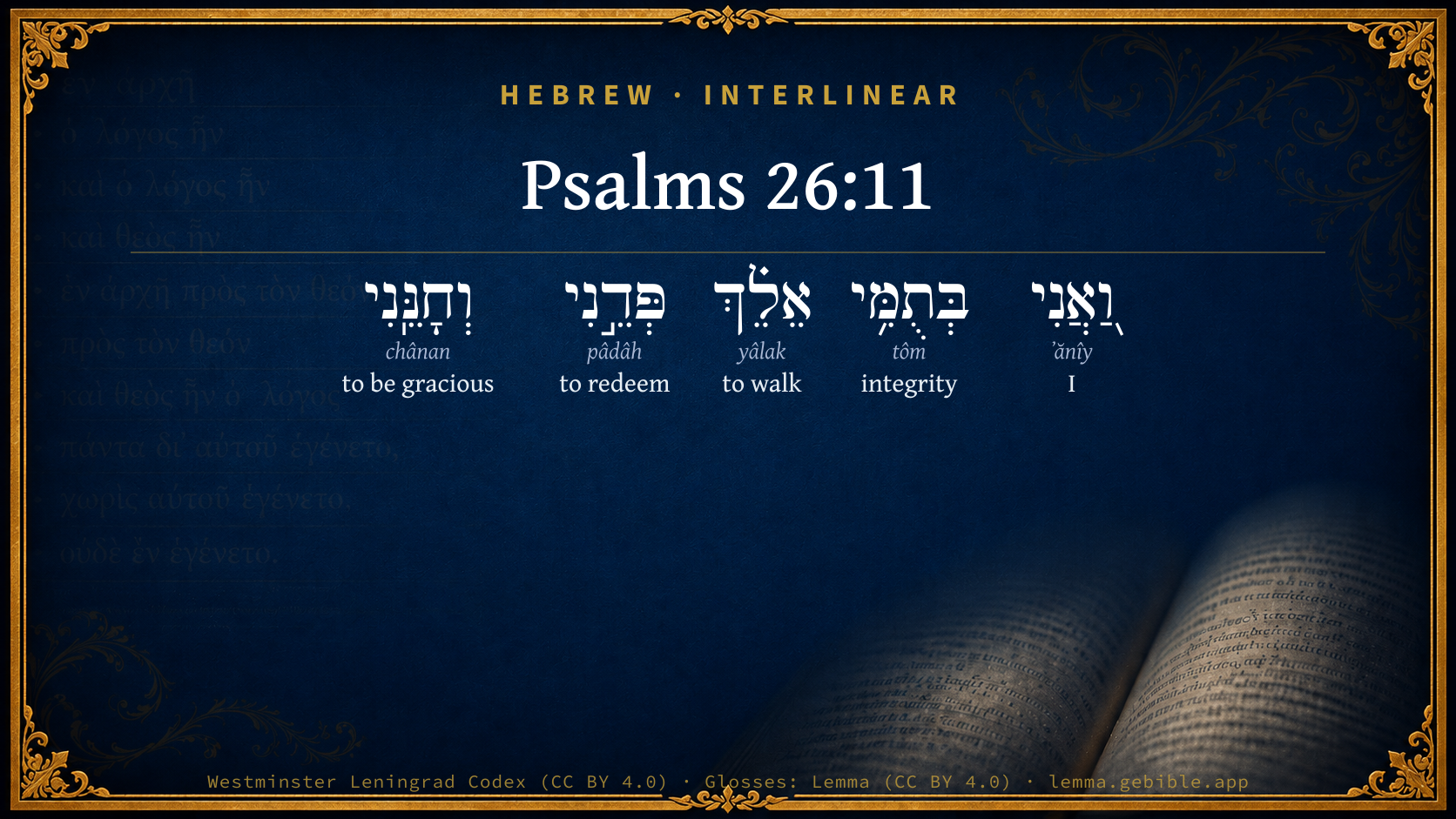
Hebrew (Westminster Leningrad Codex) Psalms 26:11 appears in the Hebrew Old Testament. The text above is from the Westminster Leningrad Codex. Each word links to its Strong’s number, a concise gloss, and parsing drawn from the Open Scriptures Hebrew Bible morphology. Click any word for its full Brown-Driver-Briggs (BDB) entry.
Download image
Cite this verse

Psalms 26:11 (World English Bible). Public Domain. Lemma interlinear Bible study tool, https://lemma.gebible.app/v/psalms/26/11.

Show BibTeX & RIS
BibTeX
RIS
English Translation
But as for me, I will walk in my integrity. Redeem me, and be merciful to me.
World English Bible · Public Domain
Download a study sheet

One document with this verse’s original text, its word-by-word gloss line, the meaning frame, cross-references with their text, attributed commentary, and full source and license credits — printable, and it pastes into notes with its structure intact.

This verse Autodidact and up

Study sheet (.html) Plain text (.txt)

A passage Seminary Student

Up to 50 verses in one chapter. A passage sheet keeps up to 6 commentary sources and 12 cross-references per verse, in the order this page ranks them, and says so on the sheet whenever that leaves anything out. Ask for a single verse and you get the Autodidact verse sheet above.

Everything on this page stays free to read, with no account — the sheet is a download of what is already on screen, not access to it.

Want to remove ads? Support Godless Engineer
Compare translations 3

The same verse in 3 English versions, stacked beneath the original-language interlinear above. Click any original word for its lexicon entry.

Each is an independent rendering of the whole verse — the interlinear is not word-aligned to these translations.

Highlighted words mark where these versions differ — a whole-verse word diff, not a word-by-word alignment.

  • World English Bible Public Domain
    But as for me, I will walk in my integrity. Redeem me, and be merciful to me.
  • King James Version Public Domain
    But as for me, I will walk in mine integrity: redeem me, and be merciful unto me.
  • unfoldingWord Literal Text CC BY-SA 4.0
    But I will walk in my integrity; redeem me and be gracious to me.

unfoldingWord Literal Text — © unfoldingWord, licensed CC BY-SA 4.0. Word-aligned USFM3 via Door43 (git.door43.org/unfoldingWord/en_ult).

Versions to compare (up to 4)

3 of 4 selected

Show all 18 translations

Every available English version of this verse, each an independent rendering of the whole verse.

  • World English Bible Public Domain
    But as for me, I will walk in my integrity. Redeem me, and be merciful to me.
  • Berean Standard Bible Public Domain
    But I will walk with integrity; redeem me and be merciful to me.
  • Majority Standard Bible Public Domain
    But I will walk with integrity; redeem me and be merciful to me.
  • King James Version Public Domain
    But as for me, I will walk in mine integrity: redeem me, and be merciful unto me.
  • American Standard Version (1901) Public Domain
    But as for me, I will walk in mine integrity: Redeem me, and be merciful unto me.
  • Revised Version (1885) Public Domain
    But as for me, I will walk in mine integrity: redeem me, and be merciful unto me.
  • Geneva Bible (1599) Public Domain
    But I will walke in mine innocencie: redeeme me therefore, and be mercifull vnto me.
  • Douay-Rheims (1899) Public Domain
    But as for me, I have walked in my innocence: redeem me, and have mercy on me.
  • Young's Literal Translation Public Domain
    And I, in mine integrity I walk, Redeem me, and favour me.
  • Literal Standard Version CC BY-SA 4.0
    And I walk in my integrity, || Redeem me, and favor me.
  • Unlocked Literal Bible CC BY-SA 4.0
    But as for me, I will walk in integrity; redeem me and have mercy on me.
  • unfoldingWord Literal Text CC BY-SA 4.0
    But I will walk in my integrity; redeem me and be gracious to me.
  • Darby Bible Public Domain
    But as for me, I will walk in mine integrity. Redeem me, and be gracious unto me.
  • World Messianic Bible Public Domain
    But as for me, I will walk in my integrity. Redeem me, and be merciful to me.
  • Webster's Bible Public Domain
    But as for me, I will walk in my integrity: redeem me, and be merciful to me.
  • Free Bible Version CC BY-SA 4.0
    For I don't do that—I act with integrity. Save me and be gracious to me!
  • Bible in Basic English Public Domain
    But as for me, I will go on in my upright ways: be my saviour, and have mercy on me.
  • JPS Tanakh (1917) Public Domain
    But as for me, I will walk in mine integrity; redeem me, and be gracious unto me.

Literal Standard Version (2020), Covenant Press — licensed CC BY-SA 4.0. Text via the HelloAO Bible API (eBible.org). Unlocked Literal Bible (unfoldingWord) — licensed CC BY-SA 4.0. Text via the HelloAO Bible API (eBible.org). unfoldingWord Literal Text — © unfoldingWord, licensed CC BY-SA 4.0. Word-aligned USFM3 via Door43 (git.door43.org/unfoldingWord/en_ult). Free Bible Version, Dr. Jonathan Gallagher — licensed CC BY-SA 4.0. Text via the HelloAO Bible API (eBible.org).

Word by word

More ways to search: Search by grammar → Find every occurrence → Compare this word →

Practice this passage: Drill this verse → Learn its vocabulary →

About this verse

These counts appear in no published source. They are computed here, from the morphology-tagged text and Lemma’s own curated glosses. What Lemma adds →

5
words
5
distinct lemmas
Wisdom
section

Notable vocabulary

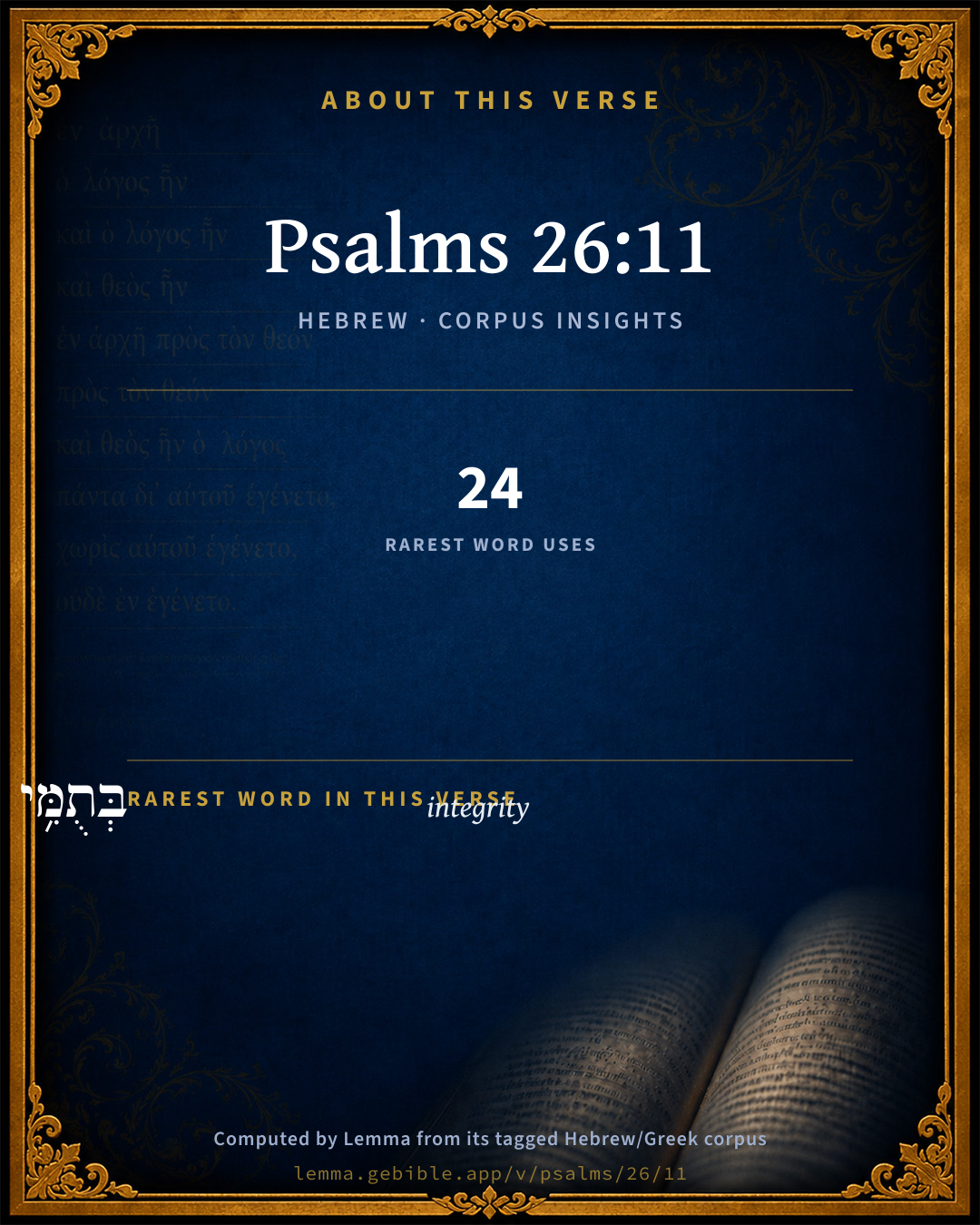
The rarest word here is בְּתֻמִּ֥י integrity H8537 — appearing just 24 times in the whole Hebrew Bible.

Shared distinctive vocabulary

בְּתֻמִּ֥י integrity H8537 occurs in 24 verses of the Hebrew Bible. Also found in:

Grammatical profile

  • 3 verbs
  • 1 noun
  • 1 pronoun

Verb forms

  • אֵלֵ֗ךְ Qal · Imperfect
  • פְּדֵ֣נִי Qal · Imperative
  • וְחָנֵּֽנִי Qal · Imperative

Hebrew & Septuagint length

In English translation the verse runs 17 words from the Hebrew and 14 from the Septuagint (LXX English) — closely comparable.

A rough comparison of the two English renderings, which tokenize alike — not a word-level alignment.

Word counts can differ between the Hebrew and the Greek without any difference in meaning — e.g. the Hebrew direct-object marker אֵת has no separate Greek word, and Greek often adds the article ὁ.

Cross-references

18

Topical passages linked to Psalms 26:11 in the Treasury of Scripture Knowledge — connected by theme and wording, ordered by reader-vote popularity; previews shown in the World English Bible.

  • Psalms 26:1 Judge me, Yahweh, for I have walked in my integrity. I have trusted also in Yahweh without wavering.
  • Psalms 69:18 Draw near to my soul, and redeem it. Ransom me because of my enemies.
  • Isaiah 38:3 and said, Remember now, Yahweh, I beg you, how I have walked before you in truth and with a perfect heart, and have done that which is good in your sight. Hezekiah wept sore.
  • 1 Thessalonians 2:10 You are witnesses with God, how holy, righteously, and blamelessly we behaved ourselves toward you who believe.
  • Titus 2:14 who gave himself for us, that he might redeem us from all iniquity, and purify for himself a people for his own possession, zealous for good works.
  • 1 Peter 1:18–19 knowing that you were redeemed, not with corruptible things, with silver or gold, from the useless way of life handed down from your fathers,
  • 1 Samuel 12:2–5 Now, behold, the king walks before you; and I am old and gray-headed; and, behold, my sons are with you: and I have walked before you from my youth to this day.
  • 2 Chronicles 31:20–21 Thus did Hezekiah throughout all Judah; and he worked that which was good and right and faithful before Yahweh his God.
  • Nehemiah 5:15 But the former governors who were before me were chargeable to the people, and took of them bread and wine, besides forty shekels of silver; yes, even their servants bore rule over the people: but I didn't do so, because of the fear of God.
  • Nehemiah 13:14 Remember me, my God, concerning this, and don't wipe out my good deeds that I have done for the house of my God, and for the observances of it.
  • Nehemiah 13:22 I commanded the Levites that they should purify themselves, and that they should come and keep the gates, to sanctify the Sabbath day. Remember to me, my God, this also, and spare me according to the greatness of your loving kindness.
  • Nehemiah 13:31 and for the wood-offering, at times appointed, and for the first fruits. Remember me, my God, for good.
  • Job 1:1 There was a man in the land of Uz, whose name was Job. That man was blameless and upright, and one who feared God, and turned away from evil.
  • Psalms 49:7 None of them can by any means redeem his brother, Nor give God a ransom for him.
  • Psalms 49:15 But God will redeem my soul from the power of Sheol, For he will receive me. Selah.
  • Psalms 103:3–4 Who forgives all your sins; Who heals all your diseases;
  • Psalms 103:7–8 He made known his ways to Moses, His deeds to the children of Israel.
  • Luke 1:6 They were both righteous before God, walking blamelessly in all the commandments and ordinances of the Lord.

Cross-references courtesy of OpenBible.info (CC BY 4.0).

Hebrew and Greek witnesses Masoretic Hebrew ↔ Greek Septuagint

The same verse in the two great witnesses to the Old Testament, shown verse-for-verse.

You’re reading Greek Psalm 25 (Hebrew Psalm 26). The Septuagint counts the superscription, so verse numbers can differ from the Hebrew — chapter-level alignment, not verse-by-verse. Numbering follows Rahlfs.

These are two independent witnesses, not word-aligned to each other, and the Septuagint is shown in lemma (dictionary) form.

Hebrew Psalms 26:11 Masoretic · Westminster Leningrad Codex

וַ֭אֲנִי בְּתֻמִּ֥י אֵלֵ֗ךְ פְּדֵ֣נִי וְחָנֵּֽנִי

But as for me, I will walk in my integrity. Redeem me, and be merciful to me.

World English Bible · Public Domain

Greek LXX Greek Psalm 25:11 Septuagint · lemma form

ἐγώ δέ ἐν ἀκακία ἐγώ πορεύομαι λυτρόω ἐγώ καί ἐλεέω ἐγώ

But I have walked in my innocence: redeem me, and have mercy upon me.

LXX2012 (modern English Septuagint) · Public Domain

Hebrew: Westminster Leningrad Codex (CC BY 4.0). Greek: Septuagint (public domain); English from LXX2012 (modern English Septuagint) (Public Domain). How the Septuagint differs from the Hebrew →

Commentary

Notes on Psalms 26:11 from classic Christian and Jewish commentators (each source and its license shown beneath its notes). The classic Christian expositions comment on the surrounding passage and are grouped to its opening verse, so a note may address several verses; the Jewish commentaries on the Tanakh (Rashi and others) are per-verse, so they appear only where the commentator wrote on this verse.

Lemma curates 59 commentaries, every one of them public domain or Creative Commons licensed, each selected and text-cleaned for this edition rather than reprinted as found. About our sources →

Trapp's Complete Commentary

John Trapp

Psa 26:11 But as for me, I will walk in mine integrity: redeem me, and be merciful unto me.

Ver. 11. But as for me, I will walk] Whatever others do, their example shall be no rule to me to deviate. See my Righteous Man’s Recompense, D. 1.

Redeem me, &c.] For I am likely to suffer deeply for my singularity.

John Trapp, A Commentary or Exposition upon All the Books of the Old and New Testament (1647–1656) — public domain. Text from a community e-Sword module.

J. A. Alexander on Psalms

Joseph Addison Alexander

11. (Psa 26:11) And I in my integrity will walk; redeem me and be merciful to me. The use of the conjunction and emphatic pronoun is the same as in Psa 2:6 above. Our idiom would require an adversative conjunction, but I, in opposition to the sinners just described, but as for me, I will still walk as I have done in sincerity and simplicity of purpose. The obvious contrast of the tenses here and in Psa 26:1, may serve to shew how seldom they are used promiscuously or confounded.—That the Psalmist's perfection or integrity was neither absolute nor inherent, is clear from the petition of the last clause. He expects still to be perfect, not because he is without sin, but because he hopes to be redeemed from its dominion through the mercy of Jehovah.

Joseph Addison Alexander, The Psalms Translated and Explained (1850) — public domain. Text from a community e-Sword module.

Jamieson, Fausset & Brown

Robert Jamieson, A. R. Fausset & David Brown

But, &c.--He contrasts his character and destiny with that of the wicked (compare Psa 26:1-2).

Jamieson, Fausset & Brown — Commentary Critical and Explanatory on the Whole Bible (1871) — public domain (CC PDM 1.0). Text via the HelloAO Bible API.

Adam Clarke's Commentary

Verse 11. But as for me, I will walk in mine integrity] Whatever I may have to do with public affairs, shall be done with the strictest attention to truth, justice, and mercy.

Redeem me] From all snares and plots laid against my life and my soul.

And be merciful unto me.] I deserve no good, but thou art merciful; deal with me ever in thy mercy.

Adam Clarke's Commentary on the Bible (1810–1826) — public domain. Text from a community e-Sword/MySword module.

John Calvin's Commentaries

11. But I will walk in mine integrity. In this repetition there is to be remarked a circumstance which more clearly illustrates David’s righteousness; namely, that, in the midst of so many temptations, he steadily held on his way. He saw many become suddenly rich by gifts, as we still see those who sit at the helm of affairs accumulating to themselves, in a very brief space, a great abundance of wealth, building sumptuous palaces, and extending their lands far and wide. As no allurements could induce him to imitate their example in this, he gave a proof of rare and heroic virtue. He therefore affirms with truth, that although the world accounted them happy, he had not been seduced from his wonted integrity, that thus it might appear that he ascribed more to the providence of God than to evil practices. He, therefore, beseeches God to redeem him, because, being oppressed with wrongs, and tempted in various ways, he relied only on God, trusting that he would deliver him. From this we may conclude, that he was at this time reduced to great straits. He adds, Be merciful to me, by which he shows that this deliverance flows from the grace of God, as its true source; and we have already seen that the cause is often put for the effect.

John Calvin's Commentaries (1540-1563) — public domain. Text from the Calvin Translation Society English edition (1840s-50s) via the Christian Classics Ethereal Library (ccel.org). Calvin's coverage is partial (roughly two-thirds of the Bible); uncommented books and verses are honest gaps, never fabricated. The 19th-century editor's footnotes and remarks are omitted so the notes are faithfully Calvin's own voice.

The Cambridge Bible for Schools and Colleges

gen. ed. J. J. S. Perowne

11. With such evil-doers the Psalmist contrasts himself. His purpose, if his life is spared, is to shape his conduct as hitherto; and therefore he prays redeem me (Psa_25:22), deliver me from the fate of the wicked, and be gracious unto me (Psa_4:1, note).

The Cambridge Bible for Schools and Colleges (gen. ed. J. J. S. Perowne; Cambridge University Press, 1878–1918) — public domain. Text from a community e-Sword module.

John Gill's Exposition

But as for me, I will walk in mine integrity,.... In which he had hitherto walked, Psa 26:1; or it may express his faith, that after he was gathered by death he should walk in uprightness and righteousness, in purity and perfection, with Christ in white, and behold the face of God in righteousness; see Isa 57:1;

redeem me; from the vain conversation of the wicked, from all troubles, and out of the hands of all enemies;

and be merciful unto me; who was now in distress, being persecuted by Saul, and at a distance from the house of God: this shows that mercy is the source and spring of redemption, both temporal and spiritual; and that the psalmist did not trust in and depend upon his present upright walk and conversation, but in redemption by Christ, and upon the mercy of God in Christ.

John Gill's Exposition of the Whole Bible (1746–1763) — public domain (CC PDM 1.0). Text via the HelloAO Bible API.

Albert Barnes' Notes on the Bible

But as for me - The Hebrew is, “and I.” But there is evidently a contrast between what he purposed to do, and the course of life pursued by those to whom he had just referred; and this is correctly expressed in our translation, “But as for me.” It is a statement of his profession of piety, and of his purpose to lead a religious life. He “meant” - he solemnly “purposed” - to lead a holy life.

I will walk - I will live a life of integrity. See the notes at Psa 1:1.

In mine integrity - Hebrew, in my “perfection.” See Psa 7:8, note; Job 1:1, note. The idea is that he intended to live a life of uprightness.

Redeem me - From sin; from trouble; from death. The word “redeem” here implies that he did not claim to be “perfect” in the most absolute sense, even when he expressed his purpose to lead a life of integrity. He felt still that he was a sinner, and that he was dependent on redeeming mercy for salvation. On the word “redeem,” see Psa 25:22, note; Isa 29:22, note. Compare the notes at Isa 43:3.

And be merciful to me - In connection with redemption. The prayer for mercy is always an acknowledgment of guilt, and the plea here shows that with all his purposes of holy living, and notwithstanding all that he had referred to in the psalm as evidence of uprightness of intention and integrity of life, he still felt that he was a sinner, and that his only hope was in the mercy of God.

Albert Barnes' Notes on the Bible (1834–1885) — public domain. Text from a community e-Sword/MySword module.

The Treasury of David

Charles H. Spurgeon

Ver. 11. Here is the lover of godliness entering his personal protest against unrighteous gain. He is a Nonconformist, and is ready to stand alone in his Nonconformity. Like a live fish, he swims against the stream. Trusting in God, the psalmist resolves that the plain way of righteousness shall be his choice, and those who will, may prefer the tortuous paths of violence and deceit. Yet, he is by no means a boaster, or a self righteous vaunter of his own strength, for he cries for redemption and pleads for mercy. Our integrity is not absolute nor inherent, it is a work of grace in us, and is marred by human infirmity; we must, therefore, resort to the redeeming blood and to the throne of mercy, confessing that though we are saints among men, we must still bow as sinners before God.

Ver. 11. The best men needing redemption and mercy; or the outward walk before men, and the secret walk with God.

Psalms 26:12*

Charles H. Spurgeon's The Treasury of David (1869–1885) — public domain. Psalms only. Text from a community e-Sword/MySword module.

Whedon's Commentary on the Bible

Daniel D. Whedon

11. But as for me—Against all the forms of evil and evil men described hitherto, the psalmist opposes his own purpose and desire to “walk in his integrity.” This is the reason why his prayer should be heard.

Daniel D. Whedon (gen. ed.), Commentary on the Old and New Testaments (1874–1909) — public domain. Text from a community e-Sword module.

The Pulpit Commentary

But as for me, I will walk in mine integrity; i.e. I will continue to walk as I have walked hitherto (see ver. 1) I will be "integer vitae scelerisque purus a brave and good resolve. Had he but kept to it! Redeem me, and be merciful unto me (compare the comment on ver. 1). Though hitherto he has walked innocently, and is resolved still to continue to walk innocently; he nevertheless feels that he has need of redeeming mercy. Though he "knows nothing by himself, yet he is not thereby justified". (1Co_4:4) Many, doubtless, are his "secret sins," which God has "set in the light of his countenance". (Psa_90:8)

The Pulpit Commentary (1880–1919), ed. H.D.M. Spence-Jones & Joseph S. Exell — public domain. Text from a community e-Sword module.

Scofield Reference Notes

C. I. Scofield

redeem

(See Scofield "Isa 59:20") See Scofield "Exo 14:30"

The Scofield Reference Bible (1917 edition), notes by C. I. Scofield — public domain. Text from a community e-Sword module.

unfoldingWord translationNotes

Door43 World Missions Community

But as for me

This phrase shows that the writer is changing from speaking about wicked people to talking about himself.

I will walk in integrity

"Walk" here is a metaphor for behavior. AT: "I will behave with integrity" (See: Metaphor)

My foot stands

Here "foot" represents the whole person. AT: "I stand" (See: Synecdoche)

level ground

Possible meanings are that "level ground" represents 1) a safe place or 2) right behavior (See: Metaphor)

in the assemblies will I bless Yahweh

"when I gather with the people of Israel I will praise you"

translationWords

walk

integrity

redeem

mercy

assembly

bless

unfoldingWord translationNotes — © Distant Shores Media and the Door43 World Missions Community, licensed CC BY-SA 4.0. Source: git.door43.org/Door43/en_tn.

Lesson kit

Teaching starters — assembled from the data on this page, not authored interpretation. Every prompt links to the verse data it draws on. Edit before teaching.

Psalms, in the Wisdom, opens this verse with 5 words (5 distinct Hebrew lemmas). Its most distinctive word is tôm (“integrity”). A historical commentator’s framing appears above. Read the whole chapter for the surrounding context.

Discussion questions

  1. What does “integrity” (tôm) contribute to the verse as a whole?
  2. Genesis 20:5 shares the word «integrity» with this verse. How do the two illuminate each other?
  3. The translations on this page render this verse differently — a whole-verse word diff, not a word-by-word alignment. What might account for the different wordings?
  4. The verb «אֵלֵ֗ךְ» is Qal Imperfect. How does its form color the action?
  5. Reading how Trapp's Complete Commentary and J. A. Alexander on Psalms read this verse, where do the two commentators agree and where do they part?

Things to notice

Reading settings

Reading text

Shown beneath each verse's original-language words.

Old Testament
Old Testament edition

Read the OT as the Masoretic Hebrew (MT) or the Greek Septuagint (LXX).

English shown for the Greek Septuagint (in the Hebrew ↔ Greek comparison).

Comparing translations? Open the Compare panel on any verse page to stack up to four side by side.