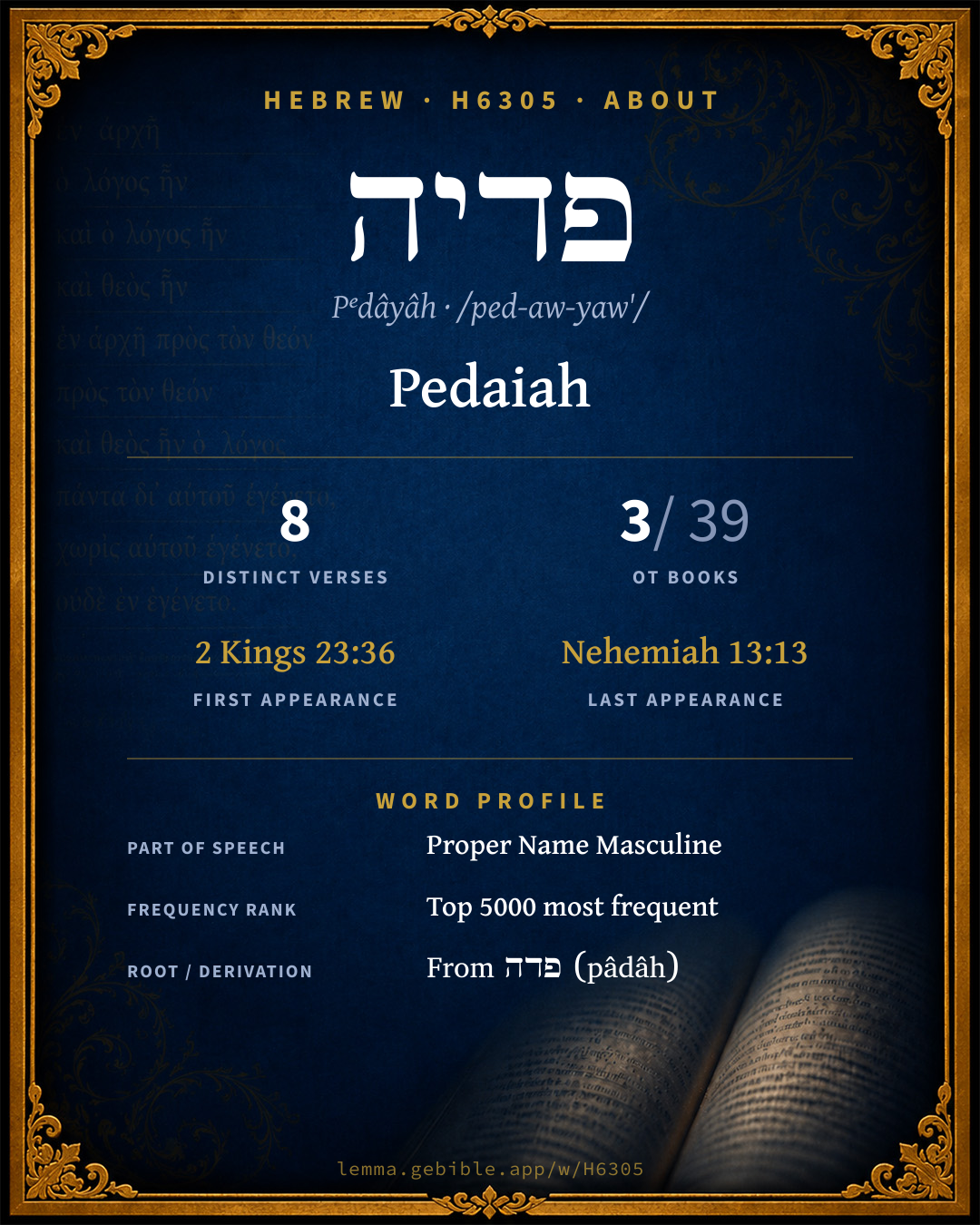
פְּדָיָהוּ
Pedaiah
BDB lists 3 entries for ‘Pedaiah’ fuller range ↓
Full lexicon entry — Brown-Driver-Briggs (BDB)
From Brown-Driver-Briggs (BDB)
Where this word appears
Grammar key — what these labels mean
Part of speech
- Noun
- A naming word — a person, place, thing, or idea.
Noun type
- Proper
- A name of a specific person, place, or people (e.g. Abraham, Zion, Israel).
Every verse where H6305 appears — 8 distinct verses across 3 books. Click any verse to open its interlinear word-by-word view. Verse text shown in the World English Bible for context — . Each verse’s Hebrew form is shown with its reference; the English is not keyword-highlighted, since the data carries no word-level English alignment. Use “Compare translations” on any verse to read it across multiple English versions. This concordance covers the Hebrew Bible; Septuagint (Greek Old Testament) occurrences are not indexed here.
2 Kings 1 verse
1 Chronicles 3 verses
- 1 Chronicles 3:18 וּ/פְדָיָ֖ה conj + n Proper and Malchiram, and Pedaiah, and Shenazzar, Jekamiah, Hoshama, and Nedabiah.
- 1 Chronicles 3:19 פְדָיָ֔ה n Proper The sons of Pedaiah: Zerubbabel, and Shimei. The sons of Zerubbabel: Meshullam, and Hananiah; and Shelomith was their sister;
- 1 Chronicles 27:20 פְּדָיָֽהוּ n Proper of the children of Ephraim, Hoshea the son of Azaziah: of the half-tribe of Manasseh, Joel the son of Pedaiah:
Nehemiah 4 verses
- Nehemiah 3:25 פְּדָיָ֥ה n Proper Palal the son of Uzai [repaired] over against the turning [of the wall], and the tower that stands out from the upper house of the king, which is by the court of the guard. After him Pedaiah the son of Parosh [repaired].
- Nehemiah 8:4 פְּ֠דָיָה n Proper Ezra the scribe stood on a pulpit of wood, which they had made for the purpose; and beside him stood Mattithiah, and Shema, and Anaiah, and Uriah, and Hilkiah, and Maaseiah, on his right hand; and on his left hand, Pedaiah, and Mishael, and Malchijah, and Hashum, and Hashbaddanah, Zechariah, [and] Meshullam.
- Nehemiah 11:7 פְּדָיָה֩ n Proper These are the sons of Benjamin: Sallu the son of Meshullam, the son of Joed, the son of Pedaiah, the son of Kolaiah, the son of Maaseiah, the son of Ithiel, the son of Jeshaiah.
- Nehemiah 13:13 וּ/פְדָיָה֙ conj + n Proper I made treasurers over the treasuries, Shelemiah the priest, and Zadok the scribe, and of the Levites, Pedaiah: and next to them was Hanan the son of Zaccur, the son of Mattaniah; for they were counted faithful, and their business was to distribute to their brothers.
About this entry
At a glance — auto-summarized from this page’s data, not written by a person. Every figure links to its source below. This summary describes the numbers; it doesn’t interpret them.
פדיה — transliterated Pᵉdâyâh — is a Hebrew name carrying the sense “Pedaiah.” Its uses cluster heavily in Nehemiah (50% of all occurrences). Spanning 8 verses in 3 books, it ranks among the uncommon words of the Hebrew Bible. Its earliest occurrence is 2 Kings 23:36. See 8-verse concordance and the renderings breakdown below.
Gloss history
Strong's 1890 vs modern scholarship
About this word
Strong's H6305 catalogs a Hebrew word from the Hebrew Old Testament.
These counts are not copied from any lexicon or concordance. They are computed here, from the morphology-tagged Hebrew Old Testament. What Lemma adds →
- 8
- distinct verses
- The word appears in 8 distinct verses.
- 3 / 39
- OT books
- The word appears in 3 of 39 Old Testament books.
- #2,625
- by frequency
- Top 5000 most frequent Hebrew words (rank 2,625 of 8,640 Hebrew words by occurrence).
View all 8 occurrences in the concordance →
Most concentrated in
- Nehemiah 4 verses 50%
- 1 Chronicles 3 verses 38%
- 2 Kings 1 verse 13%
By section of the Old Testament
By traditional corpus
Conventional, traditional groupings — biblical authorship is debated, so this is a traditional corpus grouping, not an authorship claim. Each share is this word’s portion of its verses in that division of the Hebrew canon. Each figure is a share of the word’s 8 distinct verses.
- Writings (Ketuvim) 7 verses · 88%
- Prophets (Nevi'im) 1 verse · 13%
How translations render this word
Counts come from each version’s own published word-to-Strong’s tagging or interlinear alignment — an approximate guide to how each version renders this word, not a word-level alignment the data otherwise carries. Because each total is that version’s own tagged count, the per-version totals vary from one another and need not match the appearance or distinct-verse counts above. These counts may also differ from a printed concordance because Lemma counts each distinctly tagged rendering and does not collapse phrase taggings into a single head-word total. This is a fixed set of word-tagged versions (KJV, ASV, BSB, ULT) and does not change with the reading translation you choose elsewhere. Each version’s license is shown beside its name below (and on Sources).
- King James Version: Pedaiah 8×
- American Standard Version: Pedaiah 8×
- Berean Standard Bible: Pedaiah 7×
- unfoldingWord Literal Text: Pedaiah 8×
King James Version Public Domain
Renders H6305 across 8 tagged occurrences — most commonly:
American Standard Version Public Domain
Renders H6305 across 8 tagged occurrences — most commonly:
Berean Standard Bible Public Domain
Renders H6305 across 8 tagged occurrences — most commonly:
Plus 1 rendering that appears only once — usually multi-word phrases or single function words the recovered tagging swept in, not distinct renderings.
unfoldingWord Literal Text CC BY-SA 4.0
Renders H6305 across 8 tagged occurrences — most commonly:
7 senses and sub-senses in the full BDB
What do BDB’s symbols mean?
BDB uses these scholarly abbreviations:
| Symbol | Meaning |
|---|---|
| 𝔊 | the Septuagint (the ancient Greek translation, LXX) |
| 𝔙 | the Vulgate (the Latin translation) |
| 𝔖 | the Syriac version (the Peshitta) |
| 𝔗 | the Targum (the Aramaic translation) |
| ψ | the Psalms |
| √ | root (the underlying root or stem) |
| ‖ | parallel passage (a synonymous or contrasted parallel) |
| † | the dagger: every passage where the word occurs is cited |
The 7 senses and sub-senses the full Brown-Driver-Briggs lexicon distinguishes for this word, in lexicon order (not ranked by frequency), with BDB’s own verbatim wording and sub-sense lettering. Shown in Hebrew script with BDB’s own scholarly abbreviations. The condensed entry is in the Lexicon Entry tab. See also the Forms in the corpus table below.
- 1. father-in-law of Josiah 2 K 23:36, but 𝔊 Εδειλ (𝔊L Ιερεμιας, from v 31). e.g. 2 Kings 23:36
- 2. father of Zerub. 1 Ch 3:18, 19. e.g. 1 Chronicles 3:18
- 3.
- a. Ne 3:25. e.g. Nehemiah 3:25
- b. 8:4. e.g. Nehemiah 8:4
- 4. Benjamite Ne 11:7. e.g. Nehemiah 11:7
- 5. Levite Ne 13:13. e.g. Nehemiah 13:13
- 6. פְּדָיָהוּ, Manassite 1 Ch 27:20—𝔊 (except 1) Φα(λ)δαιας, etc. e.g. 1 Chronicles 27:20
Senses from the full Brown-Driver-Briggs lexicon (Brown, Driver, Briggs; Oxford 1906 — public domain), digitized via Sefaria, supplemented by the OpenScriptures HebrewLexicon (CC BY 4.0). Full attribution on Sources.
Word origin
n.pr.m. (י׳ hath ransomed; in late Bab. Padâma, HilprUniv. Pa. Exp. ix. 27, 68);—פְּדָיָה:
— Brown-Driver-Briggs (Oxford 1906, public domain), digitized via Sefaria, supplemented by the OpenScriptures HebrewLexicon (CC BY 4.0). See Sources.
Derived from פדה (pâdâh) (H6299) — to redeem.
Jastrow Dictionary
A second Hebrew/Aramaic lexicon for comparison, covering Aramaic and post-biblical (Talmudic, Targumic, Midrashic) usage that the biblical-Hebrew BDB does not. Matched by lemma rather than by Strong’s number, so a lemma may carry more than one Jastrow headword (shown separately below), and the entries cover usage well beyond the Bible.
פְּדִיָּה
- (preced.) redemption. Bekh. 12ᵇ (ref. to Num. XVIII, 15) לפ׳ הקשיתיו וכ׳ (the text) put it (the first-born ass) on an equal footing (with the first-born son) with regard to the duty of redemption, but to nothing else (any details of the law). Ib. I, 7 מצות פ׳ the duty of redeeming; a. fr.—Pl. פְּדִיּוֹת, פְּדִיּיוֹת. Ber. 55ᵇ שלש פ׳ three Biblical verses in which פדה occurs. e.g. Numbers 18:15
פְּדָיָה
- (b. h.) pr. n. m. P’dayah; בר פ׳ Bar-P’dayah, an Amora. Y. Macc. I, beg. 31ᵃ, v. פָּדָא II. Y. Peah IV, 18ᵇ bot.; Y. Ḥall. III, 59ᵃ bot. רבי פ׳ (corr. acc.). Pesik. Par., p. 37ᵇ; Pesik. R. s. 14 בר פדיון (corr. acc.); Koh. R. to VIII, 1; Yalk. ib. 977. Y. Sabb. I, 3ᵃ bot.; Y. Shek. II, end, 47ᵃ בר פתייא (corr. acc.); a. e.—V. Fr. M’bo, p. 70ᵇ
A Dictionary of the Targumim, the Talmud Babli and Yerushalmi, and the Midrashic Literature (Marcus Jastrow; London, Luzac, 1903) — Public Domain. Digitized via Sefaria. Digitized via Sefaria. Full attribution on Sources.
Forms in the corpus
The 8 distinct written forms H6305 takes in the Hebrew Bible, most frequent first — each parse links to that state’s occurrences in the concordance. Hebrew forms include their vowel points and cantillation, so a single lemma takes many written forms.
| Form | Parsing | Example | Uses |
|---|---|---|---|
| וּ/פְדָיָ֖ה | Noun, Proper | 1 Chronicles 3:18 | 1 |
| וּ/פְדָיָה֙ | Noun, Proper | Nehemiah 13:13 | 1 |
| פְדָיָ֔ה | Noun, Proper | 1 Chronicles 3:19 | 1 |
| פְּ֠דָיָה | Noun, Proper | Nehemiah 8:4 | 1 |
| פְּדָיָ֖ה | Noun, Proper | 2 Kings 23:36 | 1 |
| פְּדָיָ֥ה | Noun, Proper | Nehemiah 3:25 | 1 |
| פְּדָיָֽהוּ | Noun, Proper | 1 Chronicles 27:20 | 1 |
| פְּדָיָה֩ | Noun, Proper | Nehemiah 11:7 | 1 |
Same root — word family
Other BDB entries built from the same root as H6305, grouped by Strong’s listed origin. These share a root / origin per the lexicon — not necessarily a shared meaning. Each links to that word’s own entry.
Derives from
Shares the same root
Proper names from this root
People and places named from this root — a name, not an additional meaning of the word.
- יפדיה Yiphdᵉyâh H3301 Iphedeiah
- פדהאל Pᵉdahʼêl H6300 Pedahel
- פדהצור Pᵉdâhtsûwr H6301 Pedahzur
- פדון Pâdôwn H6303 Padon
Compare all same-root words → Showing 4 of 8 — not the complete family. 4 of the same-root words are proper names (people or places). They share a root, not necessarily a meaning.
Bible dictionary
Public-domain dictionary articles matched to this entry by name (Pedaiah). A biblical name can be shared by more than one person or place, so an article may treat several.
Easton's Bible Dictionary · M. G. Easton, 1897
Redemption of the Lord. (1.) The father of Zebudah, who was the wife of Josiah and mother of king Jehoiakim (2 Kings 23:36).
(2.) The father of Zerubbabel (1 Chr. 3:17-19).
(3.). The father of Joel, ruler of the half-tribe of Manasseh (1 Chr. 27:20).
(4.) Neh. 3:25.
(5.) A Levite (8:4).
(6.) A Benjamite (11:7).
(7.) A Levite (13:13).
Smith's Bible Dictionary · William Smith, 1863
(whom Jehovah redeems).
+ The father of Zebudah, mother of King Jehoiakim. (2 Kings 23:38) (B.C. before 648.) + The brother of Salathiel or Shealtiel and father of Zerubbabel who is usually called the "son of Shealtiel," being, as Lord A. Hervey conjectures, in reality his uncle's successor and heir, in consequence Of the failure of issue in the direct line. (1 Chronicles 3:17-19) (B.C. before 536.) + Son of Parosh, that is, one of the family or that name, who assisted Nehemiah in repairing the walls of Jerusalem. (Nehemiah 3:25) (B.C. about 446.) + Apparently a priest; one of those who stood on the left hand of Ezra when he read the law to the people. (Nehemiah 8:4) (B.C. 445.) + A Benjamite, ancestor of Sallu. (Nehemiah 11:7) + A Levite in the time of Nehemiah, (Nehemiah 13:13) apparently the same as 4. + The father of Joel, prince of the half tribe of Manasseh in the reign of David. (1 Chronicles 27:20) (B.C. before 1013.)
Hitchcock's Bible Names Dictionary · Roswell D. Hitchcock, 1869
redemption of the Lord
Classic public-domain reference works; full attribution on Sources.
Septuagint verse parallels
This word appears in 4 verses that also exist in the Greek Old Testament (Septuagint), out of the 8 Hebrew verses it occurs in. You can read those verses in Greek by switching the Old Testament edition to the Septuagint.
Read these verses in the Septuagint
This is a verse-level parallel only — the same verses exist in both the Hebrew and Greek Old Testaments. No word-level Hebrew↔Greek correspondence is claimed: the data carries no such alignment, so no Greek word is shown as this Hebrew word’s translation. Coverage is not total — the Septuagint omits the deuterocanon and renumbers the Psalms, so some Hebrew verses have no direct Greek parallel.