
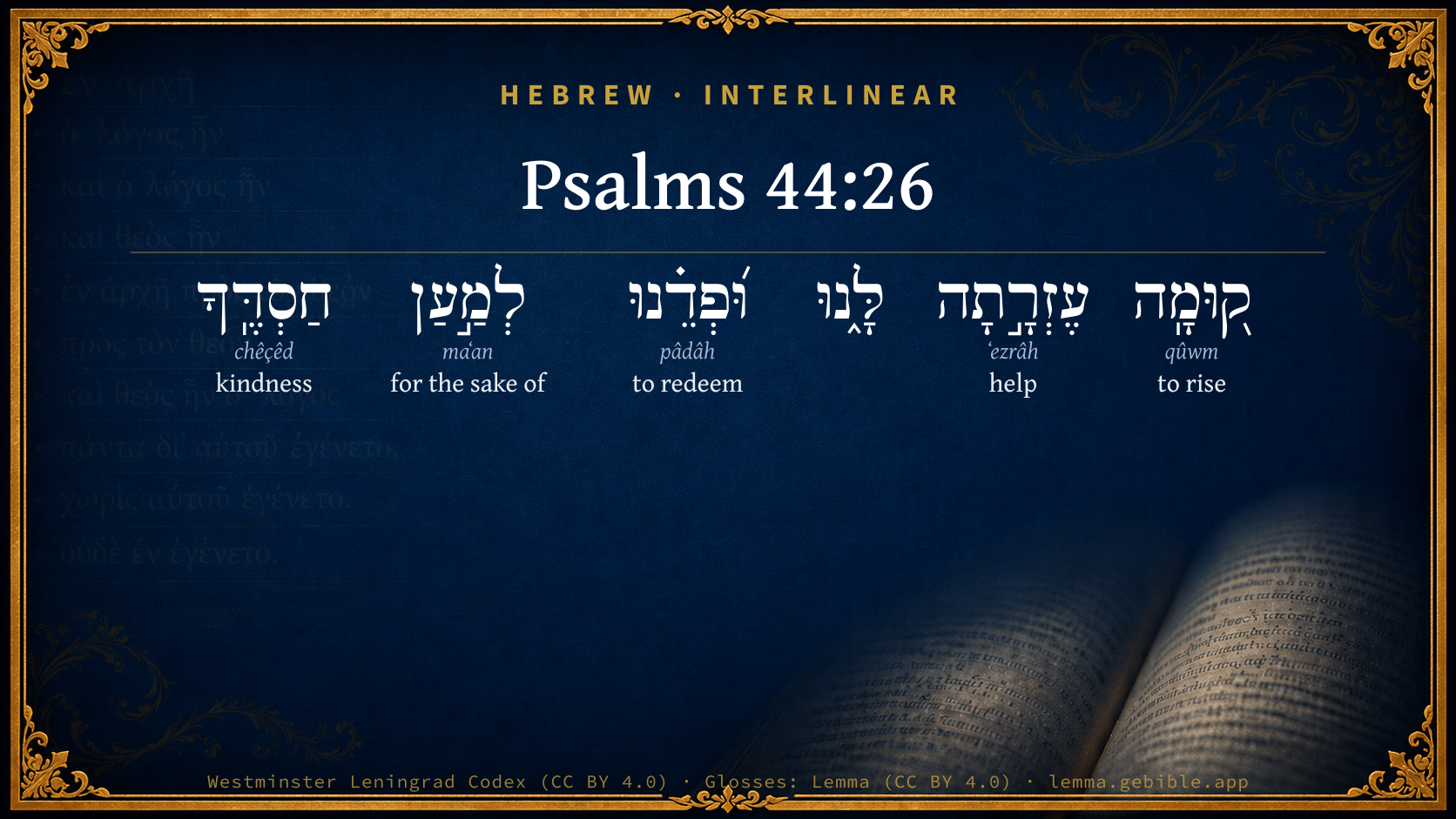
Psalms 44:26

Hebrew (Westminster Leningrad Codex) Psalms 44:26 appears in the Hebrew Old Testament. The text above is from the Westminster Leningrad Codex. Each word links to its Strong’s number, a concise gloss, and parsing drawn from the Open Scriptures Hebrew Bible morphology. Click any word for its full Brown-Driver-Briggs (BDB) entry.
Download image
Cite this verse

Psalms 44:26 (World English Bible). Public Domain. Lemma interlinear Bible study tool, https://lemma.gebible.app/v/psalms/44/26.

Show BibTeX & RIS
BibTeX
RIS
English Translation
Rise up to help us. Redeem us for your loving kindness' sake.
World English Bible · Public Domain
Download a study sheet

One document with this verse’s original text, its word-by-word gloss line, the meaning frame, cross-references with their text, attributed commentary, and full source and license credits — printable, and it pastes into notes with its structure intact.

This verse Autodidact and up

Study sheet (.html) Plain text (.txt)

A passage Seminary Student

Up to 50 verses in one chapter. A passage sheet keeps up to 6 commentary sources and 12 cross-references per verse, in the order this page ranks them, and says so on the sheet whenever that leaves anything out. Ask for a single verse and you get the Autodidact verse sheet above.

Everything on this page stays free to read, with no account — the sheet is a download of what is already on screen, not access to it.

Want to remove ads? Support Godless Engineer
Compare translations 3

The same verse in 3 English versions, stacked beneath the original-language interlinear above. Click any original word for its lexicon entry.

Each is an independent rendering of the whole verse — the interlinear is not word-aligned to these translations.

Highlighted words mark where these versions differ — a whole-verse word diff, not a word-by-word alignment.

  • World English Bible Public Domain
    Rise up to help us. Redeem us for your loving kindness' sake.
  • King James Version Public Domain
    Arise for our help, and redeem us for thy mercies' sake.
  • unfoldingWord Literal Text CC BY-SA 4.0
    Arise a helper to us and redeem us because of your covenant faithfulness.

unfoldingWord Literal Text — © unfoldingWord, licensed CC BY-SA 4.0. Word-aligned USFM3 via Door43 (git.door43.org/unfoldingWord/en_ult).

Versions to compare (up to 4)

3 of 4 selected

Show all 18 translations

Every available English version of this verse, each an independent rendering of the whole verse.

  • World English Bible Public Domain
    Rise up to help us. Redeem us for your loving kindness' sake.
  • Berean Standard Bible Public Domain
    Rise up; be our help! Redeem us on account of Your loving devotion.
  • Majority Standard Bible Public Domain
    Rise up; be our help! Redeem us on account of Your loving devotion.
  • King James Version Public Domain
    Arise for our help, and redeem us for thy mercies' sake.
  • American Standard Version (1901) Public Domain
    Rise up for our help, And redeem us for thy lovingkindness' sake. Psalm 45 For the Chief Musician; set to Shoshannim. `A Psalm' of the sons of Korah. Maschil. A Song of loves.
  • Revised Version (1885) Public Domain
    Rise up for our help, and redeem us for thy lovingkindness’ sake.
  • Geneva Bible (1599) Public Domain
    Rise vp for our succour, and redeeme vs for thy mercies sake.
  • Douay-Rheims (1899) Public Domain
    Arise, O Lord, help us and redeem us for thy name's sake.
  • Young's Literal Translation Public Domain
    Arise, a help to us, And ransom us for thy kindness' sake.
  • Literal Standard Version CC BY-SA 4.0
    Arise, a help to us, || And ransom us for your kindness’ sake.
  • Unlocked Literal Bible CC BY-SA 4.0
    Rise up for our help and redeem us for the sake of your covenant faithfulness.
  • unfoldingWord Literal Text CC BY-SA 4.0
    Arise a helper to us and redeem us because of your covenant faithfulness.
  • Darby Bible Public Domain
    Rise up for our help, and redeem us for thy loving-kindness' sake.
  • World Messianic Bible Public Domain
    Rise up to help us. Redeem us for your loving kindness’ sake.
  • Webster's Bible Public Domain
    \\44:25\\For our soul is bowed down to the dust: our belly cleaveth to the earth.
  • Free Bible Version CC BY-SA 4.0
    Stand up! Come and help us! Save us because of your trustworthy love!
  • Bible in Basic English Public Domain
    Up! and come to our help, and give us salvation because of your mercy.
  • JPS Tanakh (1917) Public Domain
    (44-27) Arise for our help, and redeem us for Thy mercy's sake.

Literal Standard Version (2020), Covenant Press — licensed CC BY-SA 4.0. Text via the HelloAO Bible API (eBible.org). Unlocked Literal Bible (unfoldingWord) — licensed CC BY-SA 4.0. Text via the HelloAO Bible API (eBible.org). unfoldingWord Literal Text — © unfoldingWord, licensed CC BY-SA 4.0. Word-aligned USFM3 via Door43 (git.door43.org/unfoldingWord/en_ult). Free Bible Version, Dr. Jonathan Gallagher — licensed CC BY-SA 4.0. Text via the HelloAO Bible API (eBible.org).

Word by word

More ways to search: Search by grammar → Find every occurrence → Compare this word →

Practice this passage: Drill this verse → Learn its vocabulary →

About this verse

These counts appear in no published source. They are computed here, from the morphology-tagged text and Lemma’s own curated glosses. What Lemma adds →

6
words
5
distinct lemmas
Wisdom
section

Shared distinctive vocabulary

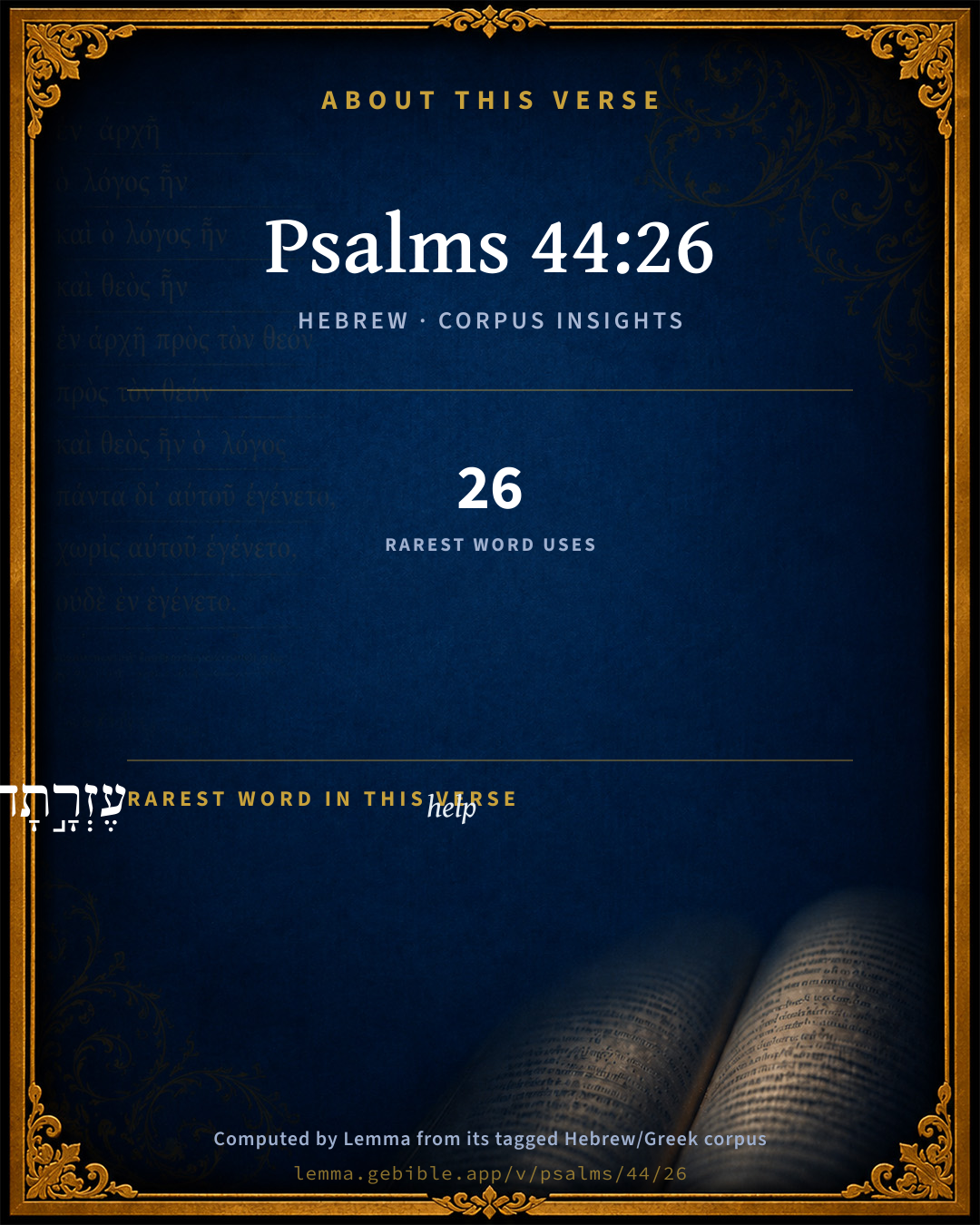
עֶזְרָ֣תָה help H5833 occurs in 25 verses of the Hebrew Bible. Also found in:

Grammatical profile

  • 2 verbs
  • 2 nouns
  • 2 prepositions

Verb forms

  • ק֭וּמָֽה Qal · Imperative
  • וּ֝פְדֵ֗נוּ Qal · Imperative

Hebrew & Septuagint length

In English translation the verse runs 12 words from the Hebrew and 12 from the Septuagint (LXX English) — the same length.

A rough comparison of the two English renderings, which tokenize alike — not a word-level alignment.

Word counts can differ between the Hebrew and the Greek without any difference in meaning — e.g. the Hebrew direct-object marker אֵת has no separate Greek word, and Greek often adds the article ὁ.

Cross-references

4

Topical passages linked to Psalms 44:26 in the Treasury of Scripture Knowledge — connected by theme and wording, ordered by reader-vote popularity; previews shown in the World English Bible.

  • Psalms 130:7–8 Israel, hope in Yahweh, For with Yahweh there is loving kindness. With him is abundant redemption.
  • Psalms 25:22 Redeem Israel, God, Out all of his troubles.
  • Psalms 26:11 But as for me, I will walk in my integrity. Redeem me, and be merciful to me.
  • Psalms 35:2 Take hold of shield and buckler, And stand up for my help.

Cross-references courtesy of OpenBible.info (CC BY 4.0).

Hebrew and Greek witnesses Masoretic Hebrew ↔ Greek Septuagint

The same verse in the two great witnesses to the Old Testament, shown verse-for-verse.

You’re reading Greek Psalm 43 (Hebrew Psalm 44). The Septuagint counts the superscription, so verse numbers can differ from the Hebrew — chapter-level alignment, not verse-by-verse. Numbering follows Rahlfs.

These are two independent witnesses, not word-aligned to each other, and the Septuagint is shown in lemma (dictionary) form.

Hebrew Psalms 44:26 Masoretic · Westminster Leningrad Codex

ק֭וּמָֽה עֶזְרָ֣תָה לָּ֑נוּ וּ֝פְדֵ֗נוּ לְמַ֣עַן חַסְדֶּֽךָ

Rise up to help us. Redeem us for your loving kindness' sake.

World English Bible · Public Domain

Greek LXX Greek Psalm 43:26 Septuagint · lemma form

ὅτι ταπεινόω εἰς χοῦς ὁ ψυχή ἐγώ κολλάω εἰς γῆ ὁ γαστήρ ἐγώ

Arise, O Lord, help us, and redeem us for your name's sake.

LXX2012 (modern English Septuagint) · Public Domain

Hebrew: Westminster Leningrad Codex (CC BY 4.0). Greek: Septuagint (public domain); English from LXX2012 (modern English Septuagint) (Public Domain). How the Septuagint differs from the Hebrew →

Commentary

Notes on Psalms 44:26 from classic Christian and Jewish commentators (each source and its license shown beneath its notes). The classic Christian expositions comment on the surrounding passage and are grouped to its opening verse, so a note may address several verses; the Jewish commentaries on the Tanakh (Rashi and others) are per-verse, so they appear only where the commentator wrote on this verse.

Lemma curates 59 commentaries, every one of them public domain or Creative Commons licensed, each selected and text-cleaned for this edition rather than reprinted as found. About our sources →

Trapp's Complete Commentary

John Trapp

Psa 44:26 Arise for our help, and redeem us for thy mercies’ sake.

Ver. 26. Arise for our help] Heb. A help for us, a sufficient help, proportionable to our necessities. The Hebrew hath a letter more than ordinary. {Hebrew Text Note}

John Trapp, A Commentary or Exposition upon All the Books of the Old and New Testament (1647–1656) — public domain. Text from a community e-Sword module.

Joseph Benson's Commentary

Psa 44:26. Arise, &c., redeem us for thy mercies’ sake — For though we are conscious of being sincere and constant in thy worship and service, we know our obedience and duties have been attended with so many imperfections, that we cannot lay them as the ground of our trust and confidence, as if we merited thy help or deliverance by them, but we implore and expect these blessings only upon account of thy own free and rich mercy.

Joseph Benson's Commentary on the Old and New Testaments (1811–1818) — public domain. Text from a community e-Sword module.

J. A. Alexander on Psalms

Joseph Addison Alexander

27. (Psa 44:26). Rise, a help for us, and redeem us for the sake of thy mercy! This is the conclusion of his arguments, and the sum of his petitions. Arise, from this state of apparent inaction, and exert thy power. Not merely for our help, as in Psa 38:22 (21), but as our help, thou who art thyself our help, its source, its author, a much stronger expression than our helper, though essentially synonymous. See above, Psa 40:17 (16), and below, Psa 63:8 (7). Because of thy mercy, as a ground or reason; according to thy mercy, as a rule or measure; for the sake of thy mercy, i.e. for its honour, as a motive and an end to be accomplished.

Joseph Addison Alexander, The Psalms Translated and Explained (1850) — public domain. Text from a community e-Sword module.

Geneva Bible (1599)

Geneva Bible translators

Which is the only sufficient ransom to deliver both body and soul from all kinds of slavery and misery.

Geneva Bible (1599) marginal notes — public domain. Text via Bolls.life.

Adam Clarke's Commentary

Verse 26. Arise for our help] Show forth thy power in delivering us from the hands of our enemies.

Redeem us] Ransom us from our thraldom.

For thy mercies' sake.] למען חסדך lemaan chasdecha, On account of thy mercy. That we may have that proper view of thy mercy which we should have, and that we may magnify it as we ought to do, redeem us. The Vulgate has, Redime nos, propter nomen tuum, "Redeem us on account of thy name;" which the old Psalter thus paraphrases: "Help us in ryghtwysness, and by us (buy,) that es, delyver us, that we be withouten drede; and al this for thi name Jehsu; noght for oure merite."

ANALYSIS OF THE FORTY-FOURTH PSALM

In this Psalm are livelily expressed the sufferings, the complaints, the assurances, the petitions which are offered to God by good men, who suffer, together with others, in the common afflictions that God brings on his people.

The parts are two: -

I. A petition, Ps 44:24-26.

II. The arguments by which the petition is quickened, Ps 44:1-24.

First, He begins with the arguments, of which the first is drawn from God's goodness, of which he gives in particular, his benefits and miracles done for their fathers; as if he had said, "This thou didst for them; why art thou so estranged from us?"

I. "We have heard with our ears, O God, and our fathers have told us what works thou didst in their days, and in the times of old." The particulars of which are, -

1. "How thou didst drive out the heathen," namely, the Canaanites.

2. "How thou plantedst them."

3. "How thou didst afflict the people, and cast them out," Ps 44:2.

II. This we acknowledge to be thy word; expressed thus: -

1. "How thou didst drive out the heathen;" negatively, by remotion of what some might imagine: "They got not the land in possession by their own sword, neither was it their own arm that helped them," Ps 44:3. "Not unto us, O Lord, not unto us, but unto thy name be the praise."

2. "How thou plantedst them;" positively: "For it was thy right hand and thy arm, and the light of thy countenance." A mere gratuito: "because thou hadst a favour unto them;" no other reason can be assigned but that, Ps 44:3.

3. Upon this consideration, by an apostrophe, he turns his speech to God, and sings a song of triumph, of which the strains are, -

1. An open confession: "Thou art my king, O God."

2. A petition: "Send help unto Jacob," Ps 44:4.

3. A confident persuasion of future victory; but still with God's help and assistance, Ps 44:5-7. 1. "Through thee will we push down our enemies." 2. "Through thee will we tread them under that rise up against us." All through thee; in thy name, by thy power.

4. An abrenunciation of his own power or arm: "For I will not trust in my bow, neither shall my sword save me."

5. A reiteration, or a second ascription of the whole victory to God: "But thou hast saved us from our enemies; thou hast put them to shame that hated us," Ps 44:7.

6. A grateful return of thanks; which is indeed the tribute God expects, and which we are to pay upon our deliverance. "In God we boast all the day long, and praise thy name for ever."

Secondly, The second argument by which he wings his petition is drawn from the condition which, for the present, God's people were in, before he had done wonders for their deliverance; but now he had delivered them to the will of their enemies. This would move a man to think that his good will was changed toward them: "But thou hast cast us off, and put us to shame, and goest not forth with our armies."

Of which the consequences are many and grievous, although we acknowledge that all is from thee, and comes from thy hand and permission.

1. The first is: "Thou makest us to turn back from the enemy," Ps 44:10.

2. The second, We become a prey: "They which hate us spoil for themselves," Ps 44:10.

3. The third, We are devoured: "Thou hast given us as sheep appointed for meat;" killed cruelly, and when they please, Ps 44:11.

4. The fourth, We are driven from our country, and made to dwell where they will plant us: "Thou hast scattered us among the heathen; " (inter gentes,) and that is a great discomfort, to live among people without God in the world.

5. The fifth, We are become slaves, sold and bought as beasts; and that for any price, upon any exchange: "Thou sellest thy people for nought, and dost not increase thy wealth by their price," Ps 44:12; puts them off as worthless things.

6. The sixth, We are made a scorn, a mock; and to whom? To our enemies: but that might be borne; but even to our friends and neighbours: "Thou makest us a reproach to our neighbours, a scorn and derision to them that are round about us."

And this he amplifies: -

1. From the circumstance that they are a proverb of reproach: "Thou makest us a byword among the heathen."

2. That in scorn any one that would, used a scornful gesture toward them: "We are become a shaking of the head among the people."

3. That this insulting is continual: "My confusion is daily before me."

4. It is superlative; shame so great that he had not what to say to it: "The shame of my face hath covered me."

5. It is public; their words and gestures are not concealed; they speak out what they please: "Ashamed I am for the voice of him that reproacheth and blasphemeth; for the enemy and avenger."

Thirdly, And yet he useth a third argument, that the petition may be the more grateful, and more easily granted; drawn from the constancy and perseverance of God's people in the profession of the truth, notwithstanding this heavy loss, persecution, and affliction: "All this is come upon us;" - thus we are oppressed, devoured, banished, sold, derided; yet we continue to be thy servants still, we retain our faith, hope, service.

1. We have not forgotten thee, not forgotten thou art our God. We acknowledge no idols.

2. We have not dealt falsely in thy covenant. We have not juggled in thy service, dealing with any side for our advantage, renouncing our integrity.

3. Our heart is not turned back. Our heart is upright, not turned back to the idols our fathers worshipped.

4. Our steps are not gone out of thy way. Slip we may, but not revolt; no, not though great calamities are come upon us. 1. Broken. 2. Broken in the place of dragons, i.e., enemies fierce as dragons. 3. Though covered with the shadow of death. Now, that all this is true we call our God to witness, who knoweth the very secrets of the heart, and is able to revenge it: "We have not forgotten the name of our God, or stretched out our hands," c. "Shall not God search it out? for he knows the very secret of the heart."

Fourthly. But the last argument is more pressing than the other three. It is not for any thing we have done to those that oppress us that we are thus persecuted by them it is for thee, it is because we profess thy name, and rise up in defence of thy truth: "Yea, for thy sake are we killed all the day long; for thy sake are we counted as sheep for the slaughter." The sum then is: Since thou hast been a good God to our fathers; since we suffered great things under bitter tyrants; since, notwithstanding all our sufferings, we are constant to thy truth; since these our sufferings are for thee, for thy sake, thy truth; therefore awake, arise, help us, for upon these grounds he commences his petition.

II. This is the second part of the Psalm, which begins at Ps 44:23, and continues to the end, in which petition there are these degrees: -

1. That God, who to flesh and blood, in the calamities of his Church, seems to sleep, would awake and put an end to their trouble: "Awake why sleepest thou, O Lord," Ps 44:23.

2. That he would arise and judge their cause, and not seem to neglect them as abjects: "Arise cast us not off for ever," Ps 44:23.

3. That he would show them some favour, and not seem to forget their miseries: "Wherefore hidest thou thy face, and forgettest our affliction and oppression?"

4. Lastly, That he would be their helper, and actually deliver them: "Arise for our help, and redeem us for thy mercies' sake."

And that this petition might be the sooner and more readily granted, he briefly repeats the second argument: "For our soul is bowed down to the dust, our belly cleaveth to the earth," Ps 44:25. Brought we are as low as low may be, even to the dust, to death, to the grave.

Adam Clarke's Commentary on the Bible (1810–1826) — public domain. Text from a community e-Sword/MySword module.

The Cambridge Bible for Schools and Colleges

gen. ed. J. J. S. Perowne

26. Arise] R.V., Rise up. Cp. Psa_3:7; Num_10:35.

for thy mercy’s sake] R.V., for thy lovingkindness’ sake. Jehovah has revealed Himself to be “a God … plenteous in lovingkindness and truth, who keeps lovingkindness for thousands” (Exo_34:7-8), and the Psalmist intreats Him to be true to this central attribute of His character. Cp. Psa_6:4; Mic_7:18; Mic_7:20. On the reading mercies’, found in many editions, see Scrivener, Auth. Ed. of the English Bible, p. 196.

The Cambridge Bible for Schools and Colleges (gen. ed. J. J. S. Perowne; Cambridge University Press, 1878–1918) — public domain. Text from a community e-Sword module.

John Gill's Exposition

Arise for our help,.... Or, "arise our help" (s). God is the help of his people, and he is a present help in time of trouble; and he is the only one; and he can help and does, when none else can;

and redeem us for thy mercies' sake; not for the sake of her integrity and faithfulness; nor for her sufferings for Christ's sake; but for his grace and mercy's sake, which is the source and spring of redemption or deliverance, both temporal and spiritual; and to that the saints ascribe it, and not to any merit of theirs, or works of righteousness done by them.

(s) "auxilium nostrum", Cocceius, Gejerus.

Next: Psalms Chapter 45

John Gill's Exposition of the Whole Bible (1746–1763) — public domain (CC PDM 1.0). Text via the HelloAO Bible API.

Albert Barnes' Notes on the Bible

Arise for our help - Margin, as in Hebrew, “a help for us.” That is, Deliver us from our present calamities and troubles.

And redeem us - Save us; deliver us. See Psa 25:22, note; Psa 31:5, note; Isa 1:27, note; Isa 52:3, note.

For thy mercies’ sake - On account of thy mercies. That is, in order that thy mercy may be manifested; or that thy character, as a God of mercy, may be made known. It was not primarily or mainly on their own account that the psalmist urges this prayer; it was that the character of God might be made known, or that it might be seen that he was a merciful Being. The proper manifestation of the divine character, as showing what God is, is in itself of more importance than our personal salvation - for the welfare of the universe depends on that; and the highest ground of appeal and of hope which we can have, as sinners, when we come before him, is that he would glorify himself in his mercy. To that we may appeal, and on that we may rely. When that is urged as an argument for our salvation, and when that is the sole ground of our confidence, we may be assured that he is ready to hear and to save us. In the New Testament he has told us how that mercy has been manifested, and how it may be made available to us - to wit, through the Lord Jesus, the great Mediator; and hence, we are directed to come in his name, and to make mention of what he has done and suffered in order that the divine mercy may be consistently manifested to mankind. From the beginning of the world - from the time when man apostatized from God, - through all dispensations, and in all ages and lands, the only hope of men for salvation has been the fact that God is a merciful Being; the true ground of successful appeal to him has been, is, and ever will be, that his own name might be glorified and honored in the salvation of lost and ruined sinners - in the displays of his mercy.

Albert Barnes' Notes on the Bible (1834–1885) — public domain. Text from a community e-Sword/MySword module.

Matthew Poole's English Annotations

We mentioned our sincerity and constancy in thy worship only as an argument to move thee to pity, and not as a ground of our trust and confidence, or as if we merited deliverance by it; but that we expect and implore only upon the account of thine own free and rich mercy.

Matthew Poole's English Annotations on the Holy Bible (1683–1685) — public domain. Text from a community e-Sword/MySword module.

The Treasury of David

Charles H. Spurgeon

Ver. 26. Arise for our help. A short, but sweet and comprehensive prayer, much to the point, clear, simple, urgent, as all prayers should be. And redeem us for thy mercies' sake. Here is the final plea. The favour is redemption, the plea is mercy; and this, too, in the case of faithful sufferers who had not forgotten their God. Mercy is always a safe plea, and never will any man find a better.

"Were I a martyr at the stake.

I would plead my Saviour's name,

Intreat a pardon for his sake,

And urge no other claim."

Here ends this memorable Psalm, but in heaven its power ends not, but brings down deliverance for the tried people of God.

None.

Ver. 26. A fit prayer for souls under conviction, for saints under trial or persecution, and for the church under oppression or decay.

Charles H. Spurgeon's The Treasury of David (1869–1885) — public domain. Psalms only. Text from a community e-Sword/MySword module.

The Pulpit Commentary

Arise for our help; literally, arise as a help unto us; i.e. arise, and come to our aid. Help against the enemy is the one object of the entire prayer. And redeem us; or, save us us". (comp. Psa_25:22) For thy mercies" sake. (comp. Psa_6:4 Psa_31:16)

The Pulpit Commentary (1880–1919), ed. H.D.M. Spence-Jones & Joseph S. Exell — public domain. Text from a community e-Sword module.

Scofield Reference Notes

C. I. Scofield

redeem

(See Scofield "Isa 59:20") See Scofield "Exo 14:30"

The Scofield Reference Bible (1917 edition), notes by C. I. Scofield — public domain. Text from a community e-Sword module.

Lesson kit

Teaching starters — assembled from the data on this page, not authored interpretation. Every prompt links to the verse data it draws on. Edit before teaching.

Psalms, in the Wisdom, opens this verse with 6 words (5 distinct Hebrew lemmas). Its most distinctive word is ʻezrâh (“help”). A historical commentator’s framing appears above. Read the whole chapter for the surrounding context.

Discussion questions

  1. The word ʻezrâh carries the sense “help.” How does it shape the verse?
  2. Judges 5:23 shares the word «help» with this verse. How do the two illuminate each other?
  3. The translations on this page render this verse differently — a whole-verse word diff, not a word-by-word alignment. What might account for the different wordings?
  4. The verb «ק֭וּמָֽה» is Qal Imperative. How does its form color the action?
  5. Reading how Trapp's Complete Commentary and Joseph Benson's Commentary read this verse, where do the two commentators agree and where do they part?

Things to notice

Reading settings

Reading text

Shown beneath each verse's original-language words.

Old Testament
Old Testament edition

Read the OT as the Masoretic Hebrew (MT) or the Greek Septuagint (LXX).

English shown for the Greek Septuagint (in the Hebrew ↔ Greek comparison).

Comparing translations? Open the Compare panel on any verse page to stack up to four side by side.