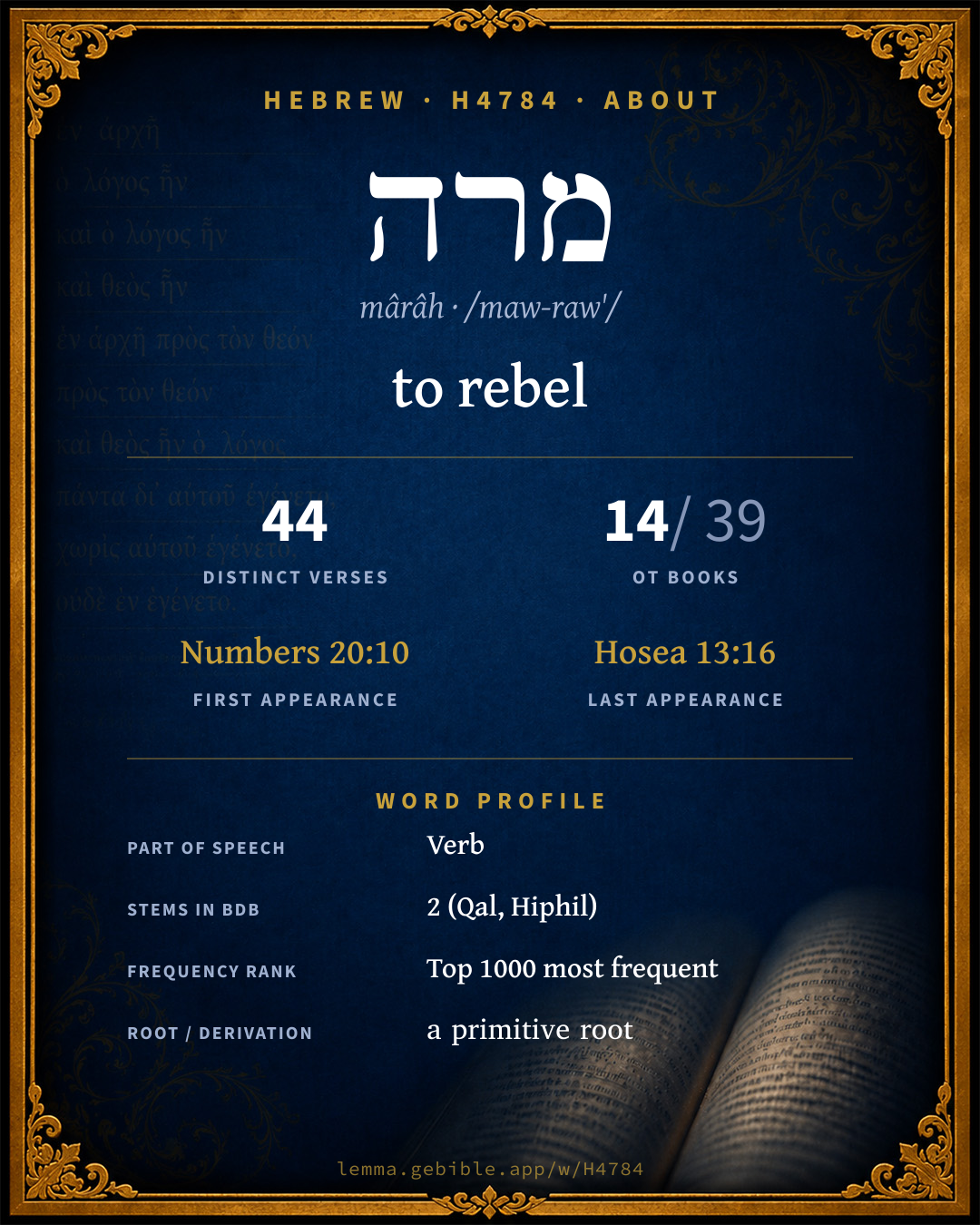
מָרָה
to rebel
‘to rebel’ is one of 3 main senses fuller range ↓
Full lexicon entry — Brown-Driver-Briggs (BDB)
From Brown-Driver-Briggs (BDB)
Where this word appears
See every Hiphil verb in the Hebrew Bible →
Grammar key — what these labels mean
Part of speech
- Verb
- An action or state-of-being word.
Stem
- Hiphil
- The causative active stem (“he caused / brought about”).
- Qal
- The basic, simple active stem — the plain form of the verb (“he wrote”). Here: ‘elsewhere towards God’
Form
- Sequential Imperfect
- An imperfect with prefixed waw — the standard past-narrative form (waw-consecutive imperfect).
- Participle Active
- A verbal adjective expressing ongoing or characteristic action (“writing / one who writes”).
- Perfect
- A completed action or state — Hebrew marks aspect (completeness) more than strict tense (“he wrote”).
- Sequential Perfect
- A perfect with prefixed waw continuing a preceding imperfect or command (waw-consecutive perfect).
- Infinitive Construct
- A bound verbal noun, frequently with prepositions (“to write / in writing”).
- Imperfect
- An incomplete, ongoing, or future action (“he will / would write”).
- Infinitive Absolute
- An unbound verbal noun, often intensifying or standing in for a finite verb.
State
- Absolute
- The independent form of a noun, not bound to a following word.
Person
- 3rd Person
- The one spoken about (“he / she / it / they”).
- 2nd Person
- The one addressed (“you”).
- 1st Person
- The speaker (“I / we”).
Gender
- Masculine
- Grammatically masculine.
- Common
- Either gender — not distinguished for this form.
- Feminine
- Grammatically feminine.
Number
- Plural
- More than one (in Hebrew, generally three or more).
- Singular
- One.
Grammatical forms 20 distinct
- Verb, Hiphil, Sequential Imperfect, 3rd Person, Masculine, Plural 6 times (13%)
- Verb, Qal, Participle Active, Masculine, Singular, Absolute 5 times (11%)
- Verb, Hiphil, Sequential Imperfect, 2nd Person, Masculine, Plural 3 times (7%)
- Verb, Hiphil, Participle Active, Masculine, Plural, Absolute 3 times (7%)
- Verb, Qal, Perfect, 1st Person, Common, Singular 3 times (7%)
- Verb, Qal, Perfect, 3rd Person, Common, Plural 3 times (7%)
- Verb, Qal, Perfect, 3rd Person, Feminine, Singular 3 times (7%)
- Verb, Hiphil, Infinitive Construct 3 times (7%)
+12 more forms (16 occurrences)
Parsed forms decoded from the imported morphology (morphhb / Westminster Leningrad Codex — WLC text public domain, morphhb tagging CC BY 4.0), counted across 45 parsed occurrences — not distinct verses.
Every verse where H4784 appears — 44 distinct verses across 14 books. Click any verse to open its interlinear word-by-word view. Verse text shown in the World English Bible for context — . Each verse’s Hebrew form is shown with its reference; the English is not keyword-highlighted, since the data carries no word-level English alignment. Use “Compare translations” on any verse to read it across multiple English versions. This concordance covers the Hebrew Bible; Septuagint (Greek Old Testament) occurrences are not indexed here.
Numbers 3 verses
- Numbers 20:10 הַ/מֹּרִ֔ים ptcl def.art + Qal ptcp.act mp Moses and Aaron gathered the assembly together before the rock, and he said to them, Hear now, you rebels; shall we bring you forth water out of this rock?
- Numbers 20:24 מְרִיתֶ֥ם Qal pf 2mp Aaron shall be gathered to his people; for he shall not enter into the land which I have given to the children of Israel, because you rebelled against my word at the waters of Meribah.
- Numbers 27:14 מְרִיתֶ֨ם Qal pf 2mp because you rebelled against my word in the wilderness of Zin, in the strife of the congregation, to sanctify me at the waters before their eyes. (These are the waters of Meribah of Kadesh in the wilderness of Zin.)
Deuteronomy 8 verses
- Deuteronomy 1:26 וַ/תַּמְר֕וּ conj + Hiphil wimpf 2mp Yet you wouldn't go up, but rebelled against the commandment of Yahweh your God:
- Deuteronomy 1:43 וַ/תַּמְרוּ֙ conj + Hiphil wimpf 2mp So I spoke to you, and you didn't listen; but you rebelled against the commandment of Yahweh, and were presumptuous, and went up into the hill-country.
- Deuteronomy 9:7 מַמְרִ֥ים Hiphil ptcp.act mp Remember, don't forget, how you provoked Yahweh your God to wrath in the wilderness: from the day that you went forth out of the land of Egypt, until you came to this place, you have been rebellious against Yahweh.
- Deuteronomy 9:23 וַ/תַּמְר֗וּ conj + Hiphil wimpf 2mp When Yahweh sent you from Kadesh-barnea, saying, Go up and possess the land which I have given you; then you rebelled against the commandment of Yahweh your God, and you didn't believe him, nor listen to his voice.
- Deuteronomy 9:24 מַמְרִ֥ים Hiphil ptcp.act mp You have been rebellious against Yahweh from the day that I knew you.
- Deuteronomy 21:18 וּ/מוֹרֶ֔ה conj + Qal ptcp.act ms If a man have a stubborn and rebellious son, who will not obey the voice of his father, or the voice of his mother, and, though they chasten him, will not listen to them;
- Deuteronomy 21:20 וּ/מֹרֶ֔ה conj + Qal ptcp.act ms and they shall tell the elders of his city, This our son is stubborn and rebellious, he will not obey our voice; he is a glutton, and a drunkard.
- Deuteronomy 31:27 מַמְרִ֤ים Hiphil ptcp.act mp For I know your rebellion, and your stiff neck: behold, while I am yet alive with you this day, you have been rebellious against Yahweh; and how much more after my death?
Joshua 1 verse
1 Samuel 3 verses
- 1 Samuel 12:14 תַמְר֖וּ Hiphil impf 2mp If you will fear Yahweh, and serve him, and listen to his voice, and not rebel against the commandment of Yahweh, and both you and also the king who reigns over you are followers of Yahweh your God, [well]:
- 1 Samuel 12:15 וּ/מְרִיתֶ֖ם conj + Qal wpf 2mp but if you will not listen to the voice of Yahweh, but rebel against the commandment of Yahweh, then will the hand of Yahweh be against you, as it was against your fathers.
- 1 Samuel 30:6 מָ֨רָה֙ Qal pf 3fs David was greatly distressed; for the people spoke of stoning him, because the soul of all the people was grieved, every man for his sons and for his daughters: but David strengthened himself in Yahweh his God.
1 Kings 2 verses
- 1 Kings 13:21 מָרִ֨יתָ֙ Qal pf 2ms and he cried to the man of God who came from Judah, saying, Thus says Yahweh, Because you have been disobedient to the mouth of Yahweh, and have not kept the commandment which Yahweh your God commanded you,
- 1 Kings 13:26 מָרָ֖ה Qal pf 3ms When the prophet who brought him back from the way heard of it, he said, It is the man of God, who was disobedient to the mouth of Yahweh: therefore Yahweh has delivered him to the lion, which has torn him, and slain him, according to the word of Yahweh, which he spoke to him.
2 Kings 1 verse
Nehemiah 1 verse
Job 1 verse
Psalms 10 verses
- Psalms 5:10 מָ֥רוּ Qal pf 3cp Hold them guilty, God. Let them fall by their own counsels; Thrust them out in the multitude of their transgressions, For they have rebelled against you.
- Psalms 78:8 וּ/מֹ֫רֶ֥ה conj + Qal ptcp.act ms And might not be as their fathers, A stubborn and rebellious generation, A generation that didn't make their hearts loyal, Whose spirit was not steadfast with God.
- Psalms 78:17 לַֽ/מְר֥וֹת prep + Hiphil inf.cs Yet they still went on to sin against him, To rebel against the Most High in the desert.
- Psalms 78:40 יַמְר֣וּ/הוּ Hiphil impf 3mp + sfx pers 3ms How often they rebelled against him in the wilderness, And grieved him in the desert!
- Psalms 78:56 וַ֭/יַּמְרוּ conj + Hiphil wimpf 3mp Yet they tempted and rebelled against the Most High God, And didn't keep his testimonies;
- Psalms 105:28 מָ֝ר֗וּ Qal pf 3cp He sent darkness, and made it dark. They didn't rebel against his words.
- Psalms 106:7 וַ/יַּמְר֖וּ conj + Hiphil wimpf 3mp Our fathers didn't understand your wonders in Egypt. They didn't remember the multitude of your loving kindnesses, But were rebellious at the sea, even at the Red Sea.
- Psalms 106:33 הִמְר֥וּ Hiphil pf 3cp Because they were rebellious against his spirit, He spoke rashly with his lips.
- Psalms 106:43 יַמְר֣וּ Hiphil impf 3mp Many times he delivered them, But they were rebellious in their counsel, And were brought low in their iniquity.
- Psalms 107:11 הִמְר֥וּ Hiphil pf 3cp Because they rebelled against the words of God, And condemned the counsel of the Most High.
Isaiah 4 verses
- Isaiah 1:20 וּ/מְרִיתֶ֑ם conj + Qal wpf 2mp But if you refuse and rebel, you shall be devoured with the sword; For the mouth of Yahweh has spoken it."
- Isaiah 3:8 לַ/מְר֖וֹת prep + Hiphil inf.cs For Jerusalem is ruined, and Judah is fallen; Because their tongue and their doings are against Yahweh, To provoke the eyes of his glory.
- Isaiah 50:5 מָרִ֑יתִי Qal pf 1cs The Lord Yahweh has opened my ear, and I was not rebellious, neither turned away backward.
- Isaiah 63:10 מָר֥וּ Qal pf 3cp But they rebelled, and grieved his holy Spirit: therefore he was turned to be their enemy, [and] himself fought against them.
Jeremiah 2 verses
Lamentations 3 verses
- Lamentations 1:18 מָרִ֑יתִי Qal pf 1cs Yahweh is righteous; for I have rebelled against his commandment: Please hear all you peoples, and see my sorrow: My virgins and my young men are gone into captivity.
- Lamentations 1:20 מָר֖וֹ מָרִ֑יתִי Qal inf.abs Qal pf 1cs See, Yahweh; for I am in distress; my heart is troubled; My heart is turned within me; for I have grievously rebelled: Abroad the sword bereaves, at home there is as death.
- Lamentations 3:42 וּ/מָרִ֔ינוּ conj + Qal pf 1cp We have transgressed and have rebelled; you have not pardoned.
Ezekiel 4 verses
- Ezekiel 5:6 וַ/תֶּ֨מֶר conj + Hiphil wimpf 3fs She has rebelled against my ordinances in doing wickedness more than the nations, and against my statutes more than the countries that are round about her; for they have rejected my ordinances, and as for my statutes, they have not walked in them.
- Ezekiel 20:8 וַ/יַּמְרוּ conj + Hiphil wimpf 3mp But they rebelled against me, and would not listen to me; they did not every man cast away the abominations of their eyes, neither did they forsake the idols of Egypt. Then I said I would pour out my wrath on them, to accomplish my anger against them in the midst of the land of Egypt.
- Ezekiel 20:13 וַ/יַּמְרוּ conj + Hiphil wimpf 3mp But the house of Israel rebelled against me in the wilderness: they didn't walk in my statutes, and they rejected my ordinances, which if a man keep, he shall live in them; and my Sabbaths they greatly profaned. Then I said I would pour out my wrath on them in the wilderness, to consume them.
- Ezekiel 20:21 וַ/יַּמְרוּ conj + Hiphil wimpf 3mp But the children rebelled against me; they didn't walk in my statutes, neither kept my ordinances to do them, which if a man do, he shall live in them; they profaned my Sabbaths. Then I said I would pour out my wrath on them, to accomplish my anger against them in the wilderness.
Hosea 1 verse
About this entry
At a glance — auto-summarized from this page’s data, not written by a person. Every figure links to its source below. This summary describes the numbers; it doesn’t interpret them.
מרה — transliterated mârâh — is a Hebrew verb carrying the sense “to rebel.” Debuting at Numbers 20:10, it then recurs through the corpus. The Hebrew Bible uses it across 44 verses — moderately common. As a verb its force shifts by stem, across 2 stems (Qal, Hiphil, and more). It shares a root with מרי and מריה. Each statement above links to its evidence; the full detail follows below.
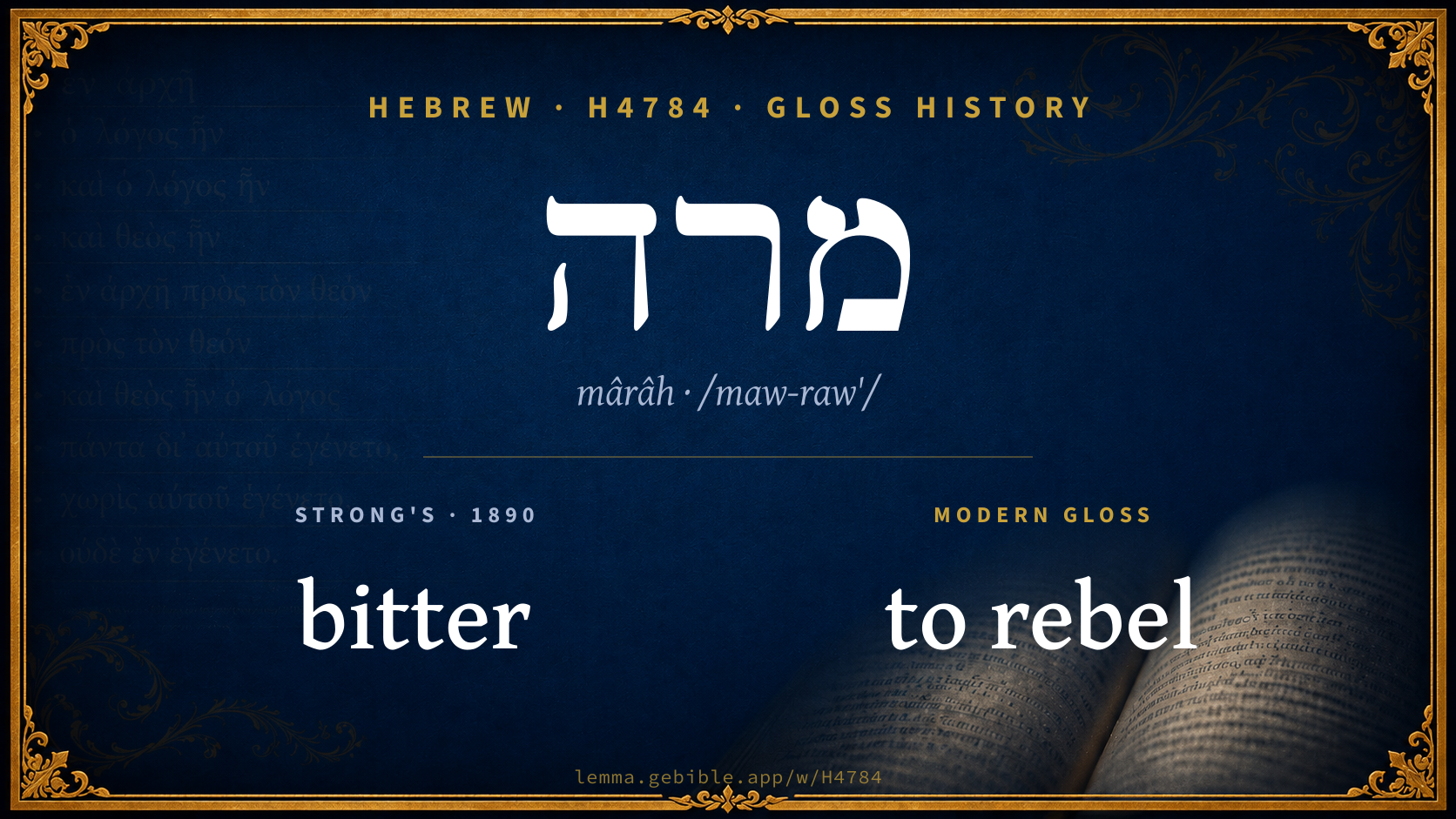
Gloss history
Strong's 1890 vs modern scholarship
About this word
Strong's H4784 catalogs a Hebrew word from the Hebrew Old Testament.
These counts are not copied from any lexicon or concordance. They are computed here, from the morphology-tagged Hebrew Old Testament. What Lemma adds →
- 44
- distinct verses
- The word appears in 44 distinct verses.
- 14 / 39
- OT books
- The word appears in 14 of 39 Old Testament books.
- #810
- by frequency
- Top 1000 most frequent Hebrew words (rank 810 of 8,640 Hebrew words by occurrence).
View all 44 occurrences in the concordance →
Most concentrated in
- Psalms 10 verses 23%
- Deuteronomy 8 verses 18%
- Isaiah 4 verses 9%
By section of the Old Testament
By traditional corpus
Conventional, traditional groupings — biblical authorship is debated, so this is a traditional corpus grouping, not an authorship claim. Each share is this word’s portion of its verses in that division of the Hebrew canon. Each figure is a share of the word’s 44 distinct verses.
- Prophets (Nevi'im) 18 verses · 41%
- Writings (Ketuvim) 15 verses · 34%
- Torah (Pentateuch) 11 verses · 25%
How translations render this word
Counts come from each version’s own published word-to-Strong’s tagging or interlinear alignment — an approximate guide to how each version renders this word, not a word-level alignment the data otherwise carries. Because each total is that version’s own tagged count, the per-version totals vary from one another and need not match the appearance or distinct-verse counts above. These counts may also differ from a printed concordance because Lemma counts each distinctly tagged rendering and does not collapse phrase taggings into a single head-word total. This is a fixed set of word-tagged versions (KJV, ASV, BSB, ULT) and does not change with the reading translation you choose elsewhere. Each version’s license is shown beside its name below (and on Sources).
BDB lists this Strong’s number as 2 distinct words (homographs). Each count above pools all of them and is not split by sense — see the Senses section below. A low-frequency rendering may belong to a different one of those words, not the primary meaning.
- King James Version†: Rebelled 5×, Rebellious 4×, They rebelled 4×
- American Standard Version†: Rebelled 4×, Rebellious 4×, They rebelled 4×
- Berean Standard Bible†: Rebellious 5×, Rebelled 4×, Rebelling 4×
- unfoldingWord Literal Text†: Rebellious 7×, You rebelled against 4×, I have bitterly rebelled 2×
King James Version Public Domain
Renders H4784 across 44† tagged occurrences — most commonly:
Plus 21 renderings that appear only once — usually multi-word phrases or single function words the recovered tagging swept in, not distinct renderings.
American Standard Version Public Domain
Renders H4784 across 44† tagged occurrences — most commonly:
Plus 24 renderings that appear only once — usually multi-word phrases or single function words the recovered tagging swept in, not distinct renderings.
Berean Standard Bible Public Domain
Renders H4784 across 44† tagged occurrences — most commonly:
Plus 17 renderings that appear only once — usually multi-word phrases or single function words the recovered tagging swept in, not distinct renderings. Not rendered by a distinct English word in 1 further occurrence.
unfoldingWord Literal Text CC BY-SA 4.0
Renders H4784 across 50† tagged occurrences — most commonly:
Plus 25 renderings that appear only once — usually multi-word phrases or single function words the recovered tagging swept in, not distinct renderings.
Senses in the full BDB
Hebrew verbs can shift meaning by stem (binyan): Qal is the basic action, Niphal is often passive or reflexive, Piel often intensifies or makes it factitive, and Hiphil is typically causative. The senses below are grouped under the stem BDB assigns to each.
What do BDB’s symbols mean?
BDB uses these scholarly abbreviations:
| Symbol | Meaning |
|---|---|
| 𝔊 | the Septuagint (the ancient Greek translation, LXX) |
| 𝔙 | the Vulgate (the Latin translation) |
| 𝔖 | the Syriac version (the Peshitta) |
| 𝔗 | the Targum (the Aramaic translation) |
| ψ | the Psalms |
| √ | root (the underlying root or stem) |
| ‖ | parallel passage (a synonymous or contrasted parallel) |
| † | the dagger: every passage where the word occurs is cited |
The 4 senses and sub-senses the full Brown-Driver-Briggs lexicon distinguishes for this word, in lexicon order (not ranked by frequency), with BDB’s own verbatim wording and sub-sense lettering. Shown in Hebrew script with BDB’s own scholarly abbreviations. The condensed entry is in the Lexicon Entry tab. See also the Forms in the corpus table below.
מרה I be contentious, refractory, rebellious (NH id., Hiph.
Qal
- Pf. 3 ms. מָרָה 1 K 13:26; f. מָֽרְתָה Ho 14:1; מָרָ֑תָה Je 4:17; 2 ms. מָרִיתָ 1 K 13:21 + 11 times pf.; Inf. abs. מָרוֹ La 1:20; Pt. מֹרֶה 2 K 14:26 (but read מר, √ מרר, Kmp Kau כִּי מַר הוּא); מוֹרֶה Dt 21:18 + 3 times; f. מֹרְאָה Zp 3:1 (read מֹרָה; metapl. form according to Ges§ 75 R. 22); pl. מֹרִים Nu 20:10;—be disobedient, rebellious: e.g. 1 Kings 13:26
- 1. בֵּן סוֹרֵר וּמֹרֶה Dt 21:18, 20 stubborn and rebellious son (towards father). e.g. Deuteronomy 21:18
- 2. elsewhere towards God: דֹּר סוֹרֵר וּמֹרֶה ψ 78:8; לֵב סורר ומ׳ Je 5:23; מוֹרְאָה ונגאלה הָעִיר Zp 3:1; הַמֹּרִים Nu 20:10 ye rebels (P); abs. Is 50:5; 63:10 La 1:20(×2); ‖ מאן Is 1:20; פשׁע La 3:42; c. בְּ pers. Ho 14:1 ψ 5:11, elsewhere acc. pers. Je 4:17; י׳’s words ψ 105:28; פי (את) מרה Nu 20:24; 27:14 (P), 1 S 12:15 1 K 13:21, 26 (D2) La 1:18.—In Ho 4:4 read perhaps מָרוּ בִי have rebelled against me (for MT כִּמְרִיבֵי), so RSProph. iv. n. 8 Che (for other views v. ריב). e.g. Psalms 78:8
Hiphil
- Pf. 3 mpl. הִמְרוּ ψ 106:33; 107:11; Impf. יַמְרֶה Jos 1:18; f. וַתֶּ֫מֶר Ez 5:6; 2 ms. תַּמֵּר (as if √ מרר) Ex 23:21, read תֶּ֫מֶר Di al.; 3 mpl. יַמְרוּ ψ 106:43 + 6 times; sf. יַמְרוּהוּ ψ 78:40; 2 mpl. תַּמְרוּ 1 S 12:14 + 3 times; Inf. cstr. לַמְרוֹת Is 3:8 ψ 78:17; sf. הַמְּרוֹתָם (Ges§ 20. 2 b) Jb 17:2; Pt. pl. מַמְרִים Dt 9:7 + 2 times;—shew disobedience, rebelliousness, always toward God: abs. Ne 9:26 (‖ מרד), ψ 106:7, 43 Jb 17:2; c. בְּ pers. Ex 23:21 Ez 20:8, 13, 21; עִם Dt 9:7, 24; 31:27; elsewhere acc. of God or his commands: Is 3:8 Ez 5:6 ψ 78:17, 40, 56; 107:11; המרה את פי Dt 1:26, 43; 9:23 Jos 1:18 1 S 12:14 (D2), את־רוחוֹ ψ 106:33 (cf. Eph 4:30); perhaps 139:20 (v. אָמַר 1). e.g. Psalms 106:33
מרה II f. of bitter spring in Sinaitic penins. Ex 15
Senses from the full Brown-Driver-Briggs lexicon (Brown, Driver, Briggs; Oxford 1906 — public domain), digitized via Sefaria, supplemented by the OpenScriptures HebrewLexicon (CC BY 4.0). Full attribution on Sources.
Word origin
I. vb. be contentious, refractory, rebellious (NH id., Hiph.; Arabic مَرَىَ iii. dispute with; Syriac ܡܰܪܺܝ Pa. contend with);—
III. n.pr.f. of bitter spring in Sinaitic penins. Ex 15:23(×2) (J), Nu 33:8, 9 (P), + הָ loc. מָרָ֑תָה Ex 15:23 (J); prob. mod. ʿAin Hawwâratun (Cf. RobBR i. 67 PalmerDesert i. 40 EbGS 125 f.)
— Brown-Driver-Briggs (Oxford 1906, public domain), digitized via Sefaria, supplemented by the OpenScriptures HebrewLexicon (CC BY 4.0). See Sources.
Origin: a primitive root
Jastrow Dictionary
A second Hebrew/Aramaic lexicon for comparison, covering Aramaic and post-biblical (Talmudic, Targumic, Midrashic) usage that the biblical-Hebrew BDB does not. Matched by lemma rather than by Strong’s number, so a lemma may carry more than one Jastrow headword (shown separately below), and the entries cover usage well beyond the Bible.
מָרָה I
- (b. h.)
- 1. fem. of מַר II, bitter.
- 2. bitter taste. Y. Ber. VI, 10ᵃ בטלה מָרָתָן their bitter taste is gone.
- 3. drop, poison (v. אֶרֶס). Ter. VIII, 5 המ׳ the serpent’s discharge.—Esp. gall, bile. Ḥull. III, 1; a. fr.—B. Mets. 107ᵇ (ref. to Ex. XXIII, 25) זו מ׳ that means (overflow of) bile, v. חָלָה.—Trnsf. austerity, gravity. Cant. R. to IV, 4 (play on מֹרִיָּה) שממנו יוצאת מ׳ לעולם (not יוצא) from it austerity (responsibility) went forth to the world. Keth. 103ᵇ זרוק מ׳ בתלמידים cast bile among the students (be austere against them). Sifré Deut. 323 (ref. to Deut. XXXII, 32 אשכלת מררת) הגדולים שבכם מָרָתָן פרוסה בכם כאשכל as to the great among you, their bile (austere rebuke) is distributed among you as the juice in the grapes; Yalk. ib. 946 מרתן פרוסה בהן וכ׳ their bile is distributed within them. e.g. Exodus 23:25
מָרָה II
- (b. h.) pr. n. pl. Marah, a station in the desert (so named from its bitter waters). Snh. 56ᵇ; Hor. 8ᵇ; a. e.
מָרָה III
- hoe, v. מָרָא II.
מָרָה IV
- 1. to be fat;
- 2. to be disobedient, v. מרי I, II.
A Dictionary of the Targumim, the Talmud Babli and Yerushalmi, and the Midrashic Literature (Marcus Jastrow; London, Luzac, 1903) — Public Domain. Digitized via Sefaria. Digitized via Sefaria. Full attribution on Sources.
Forms in the corpus
The 39 distinct written forms H4784 takes in the Hebrew Bible, most frequent first — each parse links to that stem’s occurrences in the concordance. Hebrew forms include their vowel points and cantillation, so a single lemma takes many written forms.
Same root — word family
Other BDB entries built from the same root as H4784, grouped by Strong’s listed origin. These share a root / origin per the lexicon — not necessarily a shared meaning. Each links to that word’s own entry.
Derived from this word
Proper names from this root
People and places named from this root — a name, not an additional meaning of the word.
Compare all same-root words → 1 of the same-root words is a proper name (a person or place). They share a root, not necessarily a meaning.
Septuagint verse parallels
This word appears in 39 verses that also exist in the Greek Old Testament (Septuagint), out of the 44 Hebrew verses it occurs in. You can read those verses in Greek by switching the Old Testament edition to the Septuagint.
Read these verses in the Septuagint
- Numbers 20:10
- Deuteronomy 1:26
- Joshua 1:18
- 1 Samuel 12:14
- 1 Kings 13:21
- 2 Kings 14:26
- Job 17:2
- Psalms 5:10
- Isaiah 1:20
- Jeremiah 4:17
- Lamentations 1:18
- Ezekiel 5:6
This is a verse-level parallel only — the same verses exist in both the Hebrew and Greek Old Testaments. No word-level Hebrew↔Greek correspondence is claimed: the data carries no such alignment, so no Greek word is shown as this Hebrew word’s translation. Coverage is not total — the Septuagint omits the deuterocanon and renumbers the Psalms, so some Hebrew verses have no direct Greek parallel.