
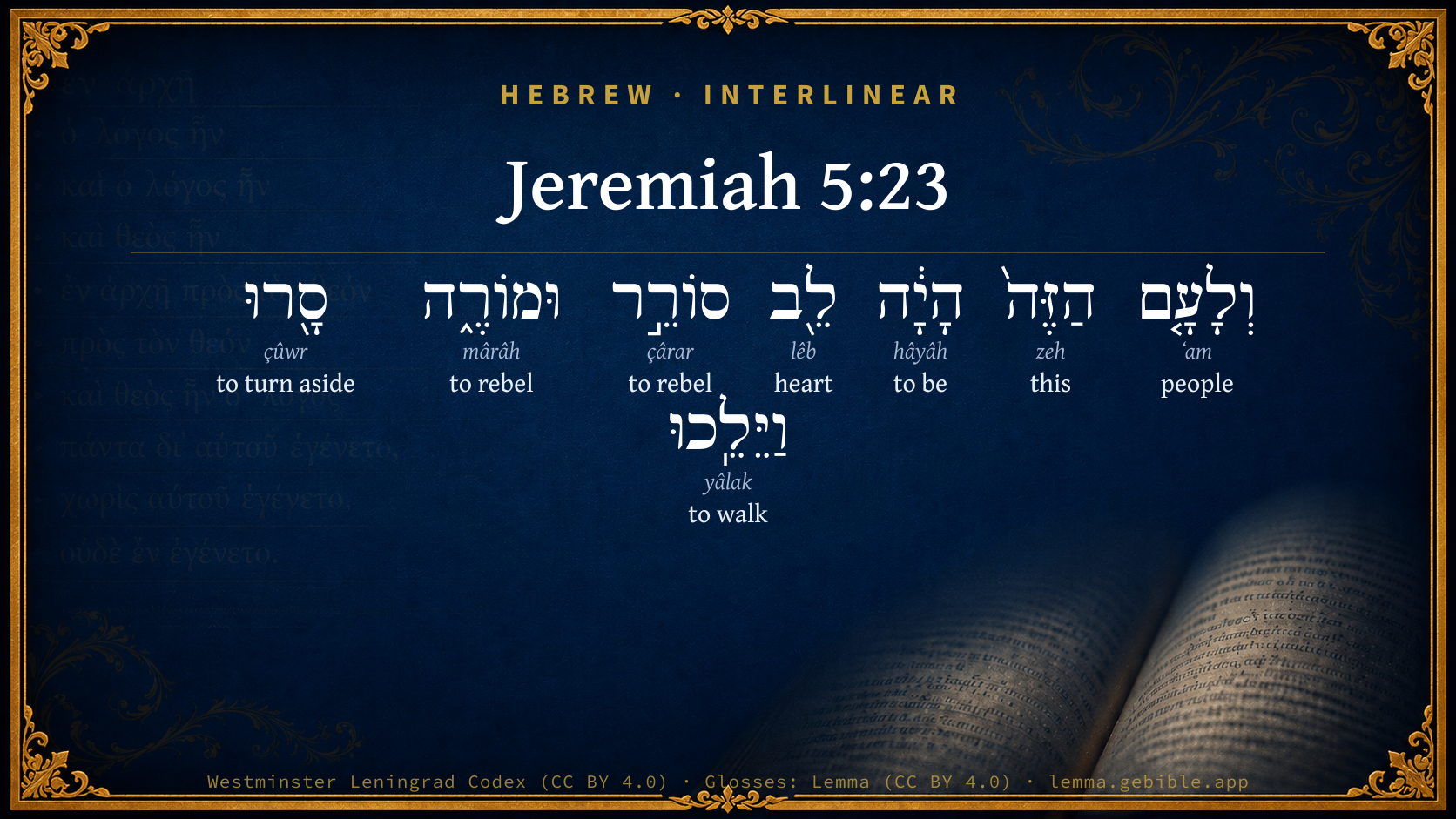
Jeremiah 5:23

Hebrew (Westminster Leningrad Codex) Jeremiah 5:23 appears in the Hebrew Old Testament. The text above is from the Westminster Leningrad Codex. Each word links to its Strong’s number, a concise gloss, and parsing drawn from the Open Scriptures Hebrew Bible morphology. Click any word for its full Brown-Driver-Briggs (BDB) entry.
Download image
Cite this verse

Jeremiah 5:23 (World English Bible). Public Domain. Lemma interlinear Bible study tool, https://lemma.gebible.app/v/jeremiah/5/23.

Show BibTeX & RIS
BibTeX
RIS
English Translation
But this people has a revolting and a rebellious heart; they are revolted and gone.
World English Bible · Public Domain
Download a study sheet

One document with this verse’s original text, its word-by-word gloss line, the meaning frame, cross-references with their text, attributed commentary, and full source and license credits — printable, and it pastes into notes with its structure intact.

This verse Autodidact and up

Study sheet (.html) Plain text (.txt)

A passage Seminary Student

Up to 50 verses in one chapter. A passage sheet keeps up to 6 commentary sources and 12 cross-references per verse, in the order this page ranks them, and says so on the sheet whenever that leaves anything out. Ask for a single verse and you get the Autodidact verse sheet above.

Everything on this page stays free to read, with no account — the sheet is a download of what is already on screen, not access to it.

Want to remove ads? Support Godless Engineer
Compare translations 3

The same verse in 3 English versions, stacked beneath the original-language interlinear above. Click any original word for its lexicon entry.

Each is an independent rendering of the whole verse — the interlinear is not word-aligned to these translations.

Highlighted words mark where these versions differ — a whole-verse word diff, not a word-by-word alignment.

  • World English Bible Public Domain
    But this people has a revolting and a rebellious heart; they are revolted and gone.
  • King James Version Public Domain
    But this people hath a revolting and a rebellious heart; they are revolted and gone.
  • unfoldingWord Literal Text CC BY-SA 4.0
    But this people has a stubborn and rebellious heart. They have turned aside and walked away.

unfoldingWord Literal Text — © unfoldingWord, licensed CC BY-SA 4.0. Word-aligned USFM3 via Door43 (git.door43.org/unfoldingWord/en_ult).

Versions to compare (up to 4)

3 of 4 selected

Show all 18 translations

Every available English version of this verse, each an independent rendering of the whole verse.

  • World English Bible Public Domain
    But this people has a revolting and a rebellious heart; they are revolted and gone.
  • Berean Standard Bible Public Domain
    But these people have stubborn and rebellious hearts. They have turned aside and gone away.
  • Majority Standard Bible Public Domain
    But these people have stubborn and rebellious hearts. They have turned aside and gone away.
  • King James Version Public Domain
    But this people hath a revolting and a rebellious heart; they are revolted and gone.
  • American Standard Version (1901) Public Domain
    But this people hath a revolting and a rebellious heart; they are revolted and gone.
  • Revised Version (1885) Public Domain
    But this people hath a revolting and a rebellious heart; they are revolted and gone.
  • Geneva Bible (1599) Public Domain
    But this people hath an vnfaithfull and rebellious heart: they are departed and gone.
  • Douay-Rheims (1899) Public Domain
    But the heart of this people is become hard of belief and provoking, they are revolted and gone away.
  • Young's Literal Translation Public Domain
    And this people hath an apostate and rebellious heart, They have turned aside, and they go on.
  • Literal Standard Version CC BY-SA 4.0
    And this people has an apostatizing and rebelling heart, || They have turned aside, and they go on.
  • Unlocked Literal Bible CC BY-SA 4.0
    But this people has a stubborn heart. It turns away in rebellion and goes away.
  • unfoldingWord Literal Text CC BY-SA 4.0
    But this people has a stubborn and rebellious heart. They have turned aside and walked away.
  • Darby Bible Public Domain
    But this people hath a stubborn and a rebellious heart; they have turned aside and are gone.
  • World Messianic Bible Public Domain
    “But this people has a revolting and a rebellious heart. They have revolted and gone.
  • Webster's Bible Public Domain
    But this people have a revolting and a rebellious heart; they have revolted and gone.
  • Free Bible Version CC BY-SA 4.0
    But you people have a stubborn and rebellious attitude. You have left me and gone your own way.
  • Bible in Basic English Public Domain
    But the heart of this people is uncontrolled and turned away from me; they are broken loose and gone.
  • JPS Tanakh (1917) Public Domain
    But this people hath a revolting and a rebellious heart; they are revolted, and gone.

Literal Standard Version (2020), Covenant Press — licensed CC BY-SA 4.0. Text via the HelloAO Bible API (eBible.org). Unlocked Literal Bible (unfoldingWord) — licensed CC BY-SA 4.0. Text via the HelloAO Bible API (eBible.org). unfoldingWord Literal Text — © unfoldingWord, licensed CC BY-SA 4.0. Word-aligned USFM3 via Door43 (git.door43.org/unfoldingWord/en_ult). Free Bible Version, Dr. Jonathan Gallagher — licensed CC BY-SA 4.0. Text via the HelloAO Bible API (eBible.org).

Word by word

More ways to search: Search by grammar → Find every occurrence → Compare this word →

Practice this passage: Drill this verse → Learn its vocabulary →

About this verse

These counts appear in no published source. They are computed here, from the morphology-tagged text and Lemma’s own curated glosses. What Lemma adds →

8
words
8
distinct lemmas
Prophets
section

Notable vocabulary

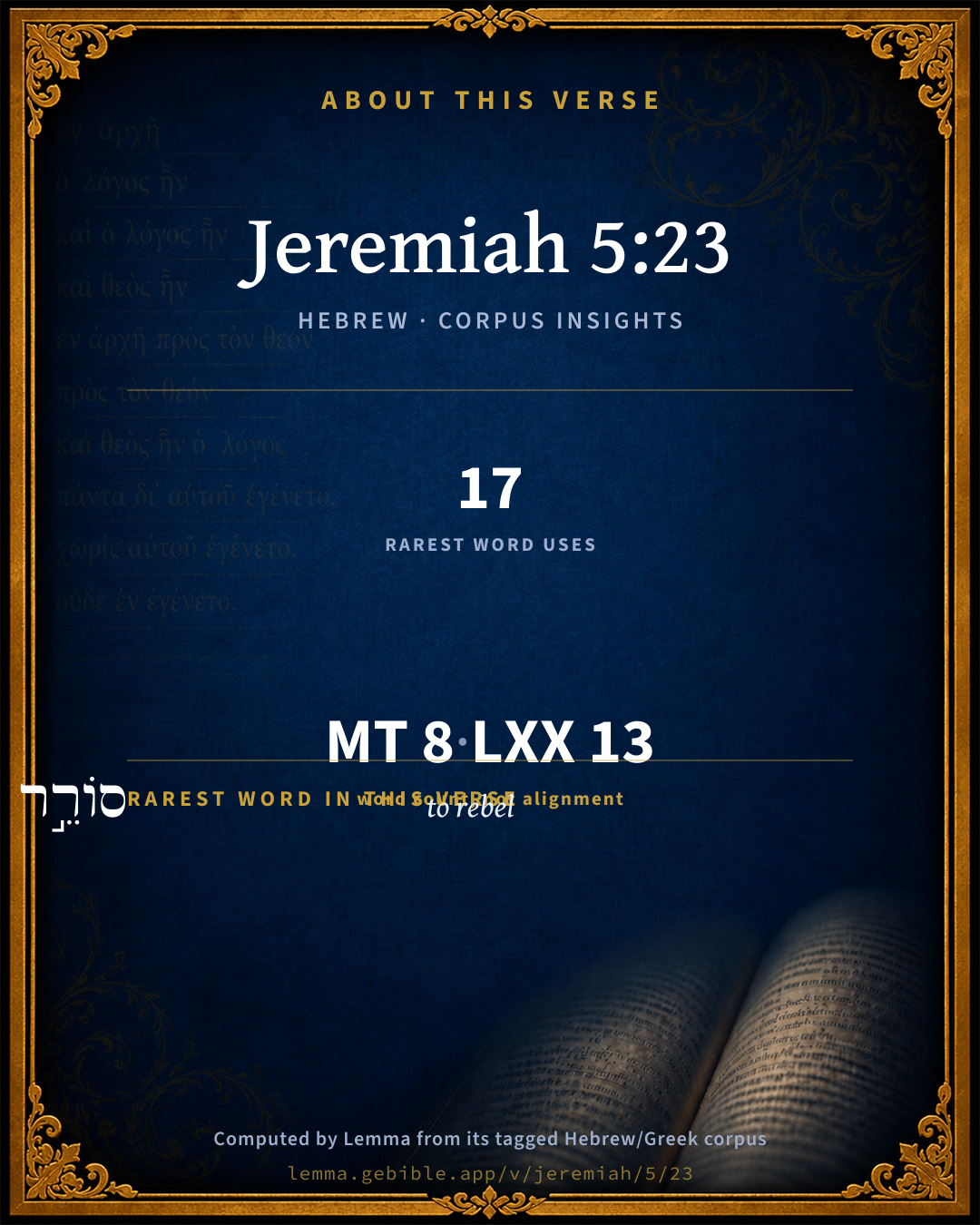
The rarest word here is סוֹרֵ֣ר to rebel H5637 — appearing just 17 times in the whole Hebrew Bible.

Shared distinctive vocabulary

סוֹרֵ֣ר to rebel H5637 occurs in 16 verses of the Hebrew Bible. Also found in:

Grammatical profile

  • 5 verbs
  • 2 nouns
  • 1 pronoun

Verb forms

  • הָיָ֔ה Qal · Perfect
  • סוֹרֵ֣ר Qal · Participle Active
  • וּמוֹרֶ֑ה Qal · Participle Active
  • סָ֖רוּ Qal · Perfect
  • וַיֵּלֵֽכוּ Qal · Sequential Imperfect

Hebrew & Septuagint length

In the original languages it is 8 Hebrew tokens and 13 Greek tokens — but the two are counted differently (Hebrew bundles its prefixes and suffixes into one token; the Greek is in lemma form), so that isn’t a like-for-like length.

Cross-references

10

Topical passages linked to Jeremiah 5:23 in the Treasury of Scripture Knowledge — connected by theme and wording, ordered by reader-vote popularity; previews shown in the World English Bible.

  • Jeremiah 6:28 They are all grievous rebels, going about with slanders; they are brass and iron: they all of them deal corruptly.
  • Deuteronomy 21:18 If a man have a stubborn and rebellious son, who will not obey the voice of his father, or the voice of his mother, and, though they chasten him, will not listen to them;
  • Psalms 95:10 Forty long years I was grieved with that generation, And said, "It is a people that errs in their heart. They have not known my ways."
  • Hosea 11:7 My people are determined to turn from me. Though they call to the Most High, He certainly won't exalt them.
  • Hebrews 3:12 Beware, brothers, lest perhaps there be in any one of you an evil heart of unbelief, in falling away from the living God;
  • Isaiah 1:5 Why should you be beaten more, That you revolt more and more? The whole head is sick, And the whole heart faint.
  • Isaiah 31:6 Turn you to him from whom you have deeply revolted, children of Israel.
  • Jeremiah 5:5 I will get me to the great men, and will speak to them; for they know the way of Yahweh, and the law of their God. But these with one accord have broken the yoke, and burst the bonds.
  • Jeremiah 17:9 The heart is deceitful above all things, and it is exceedingly corrupt: who can know it?
  • Hosea 4:8 They feed on the sin of my people, And set their heart on their iniquity.

Cross-references courtesy of OpenBible.info (CC BY 4.0).

Hebrew and Greek witnesses Masoretic Hebrew ↔ Greek Septuagint

The same verse in the two great witnesses to the Old Testament, shown verse-for-verse.

These are two independent witnesses, not word-aligned to each other, and the Septuagint is shown in lemma (dictionary) form.

Hebrew Jeremiah 5:23 Masoretic · Westminster Leningrad Codex

וְלָעָ֤ם הַזֶּה֙ הָיָ֔ה לֵ֖ב סוֹרֵ֣ר וּמוֹרֶ֑ה סָ֖רוּ וַיֵּלֵֽכוּ

But this people has a revolting and a rebellious heart; they are revolted and gone.

World English Bible · Public Domain

Greek LXX Structure differs

In the Septuagint, Jeremiah is about an eighth shorter than the Hebrew and arranges its material differently — the Oracles Against the Nations (Hebrew chapters 46–51) appear in the middle of the Greek book, after 25:13. Because the chapter and verse boundaries do not line up, a verse-for-verse comparison with the Hebrew is not shown.

A verse-for-verse comparison isn’t shown here because the chapters and verses don’t line up. Switch to the LXX edition with the MT / LXX toggle above to read the Greek directly.

Hebrew: Westminster Leningrad Codex (CC BY 4.0). Greek: Septuagint (public domain); English from a public-domain English Septuagint. How the Septuagint differs from the Hebrew →

Targum (Aramaic paraphrase)

1

The Targum is the ancient Jewish Aramaic paraphrase of the Hebrew Scriptures — an interpretive translation, not the Hebrew text itself. Onkelos (literal) and Pseudo-Jonathan (expansive) render the Torah, and Jonathan the Prophets. Coverage is partial: where no permissively-licensed English translation exists for a verse, only the Aramaic is shown. This is verse-level text, not a word-by-word alignment to the Hebrew.

  1. Targum Jonathan Prophets (Joshua–Malachi)
    וּלְעַמָא הָדֵין הֲוָה לֵב סָטֵי וּמְרִיד עַל דִסְטוֹ מִבָּתַר פּוּלְחָנִי גָלוֹ:

    (no public-domain English translation for this verse)

    Targum Jonathan — Aramaic: “Mikraot Gedolot” (public domain). English: “Sefaria Community Translation” (CC0 1.0 (public-domain dedication)); “London "Chaldee Paraphrase," 1871” (public domain). Text via Sefaria.

Commentary

Notes on Jeremiah 5:23 from classic Christian and Jewish commentators (each source and its license shown beneath its notes). The classic Christian expositions comment on the surrounding passage and are grouped to its opening verse, so a note may address several verses; the Jewish commentaries on the Tanakh (Rashi and others) are per-verse, so they appear only where the commentator wrote on this verse.

Lemma curates 59 commentaries, every one of them public domain or Creative Commons licensed, each selected and text-cleaned for this edition rather than reprinted as found. About our sources →

Trapp's Complete Commentary

John Trapp

Jer 5:23 But this people hath a revolting and a rebellious heart; they are revolted and gone.

Ver. 23. But this people have a revolting and rebellious heart.] {a} Cor recedens et amaricans; gone they are, and return they will not. Apostates are dangerous creatures, and mischievous above others; witness Julian, once a forward professor; Lucian, once a preacher at Antioch; Staphylus and Latomus, once great Lutherans, afterwards eager Popelings. Harding was the target of Popery in England, saith Peter Moulin, against which he had once been a thundering preacher in this land, wishing he could cry out against it as loud as the bells of Oseney. The Lady Jane Grey, whose chaplain he had sometimes been, gave him excellent counsel in a letter; but he was revolted and gone past call. {b}

{a} καρδια ανηκοος και απειθης. - Sept.

{b} Acts and Mon., fol. 1291.

John Trapp, A Commentary or Exposition upon All the Books of the Old and New Testament (1647–1656) — public domain. Text from a community e-Sword module.

The Biblical Illustrator

Joseph S. Exell

Jer_5:23-24

But this people hath a revolting and a rebellious heart; they are revolted and gone.

Israels apostasy

Our state of heart and mind toward God is shown, not by those emotions which are kindled in us on receiving any extraordinary mercy, nor by what we do under the influence of those emotions, but by the habitual condition of our hearts and minds toward God as concerned in His everyday gifts and our everyday doings.

I. The accusation made.

I. God complains of revolt and rebellion against Him. The only rightful ruler over all: whose power is absolute and independent, whose wisdom is unerring, whose justice perfect, and whose goodness infinite: whose statutes are all right, rejoicing the right-hearted, whose commandment is all pure, enlightening the eye that is single.

2. And what thought was it in their hearts, which God construed as rebellion against Him? It took in Israels heart the simple and familiar form of mere unthankfulness to God for common mercies.

II. The proof of their rebellion and revolt.

1. They did not in the gift of a good harvest discern God at all.

2. If, as I feel too much afraid it is, this part of the proof of a rebellious heart be in us, of necessity the other part will not be wanting: and as God saith in the text of His people of old, Neither say they in their hearts, Let us now fear the Lord our God, so neither shall we say the same. The goodness of God is meant to lead men to repentance. (F. C. Clark, B. A.)

Sin is revolt and rebellion against Christ-our King

One day, over in Australia, at Maryboro, an unusually fine-looking man came in and said, I want to talk with you. I dont know about your preaching. I am a moral, upright man, and nobody can deny it. I should like you to tell me what you have got against me. I said, Are you a Christian? No, sir. Well, then, I charge you with high treason against your King. God made Him so, and I charge you--and I looked him right in the eye--with the crime of high treason against your King. An awful cloud came over the mans face. He got up and walked out of the room. Months passed away. We had been over to Tasmania, and got back to Australia, and were preaching at Ballarat, about forty miles, I think, from Maryboro. At the close of one of my meetings, a fine-looking man came and said, Do you remember me? I replied, I have seen you somewhere but 1 cannot trace you. Do you remember charging a man with high treason? I said, I have charged many a man with high treason. He said, Do you remember charging a specific man? and he narrated the circumstances. Yes, I said, I do. He replied, I am the man. You will never charge me with it again. He held out his hand and I held out mine. He took me in his mighty grip, and dropped on his knees and I on mine. He looked up and said, Lord Jesus, I hand in my allegiance; I give up my treason and take Thee as my King. You men ought to do it tonight. (A. Torrey.)

The Biblical Illustrator, edited by Joseph S. Exell (c. 1880s–1900s) — public domain. Text from a community e-Sword module.

Tyndale Open Study Notes

Tyndale Open Resources

5:23-25 The people falsely thought that they could do without the Lord, who provided rain for their crops (Deut 11:14). This wickedness caused them to lose wonderful blessings and good things (Jer 3:3).

Tyndale Open Study Notes — © Tyndale Open Resources, licensed CC BY-SA 4.0. Text via the HelloAO Bible API.

Jamieson, Fausset & Brown

Robert Jamieson, A. R. Fausset & David Brown

(Jer 6:28).

Jamieson, Fausset & Brown — Commentary Critical and Explanatory on the Whole Bible (1871) — public domain (CC PDM 1.0). Text via the HelloAO Bible API.

Adam Clarke's Commentary

Verse 23. They are revolted and gone.] They have abandoned me, and are gone farther and farther into transgression. They are gone entirely away from truth and righteousness.

Adam Clarke's Commentary on the Bible (1810–1826) — public domain. Text from a community e-Sword/MySword module.

John Calvin's Commentaries

Here the previous verse is completed; for what is said here is connected with the question which we have noticed. But God now proves more clearly why he adduced what he said of the sea. The copulative ו, vau, is to be taken here as an adversative, and to be thus rendered, But this people have a perverse heart: for סורר, surer, means “perverse;” some render it “revolting, “but improperly; for it appears from many other passages that it is something more: besides, the other meaning is more suitable to the context here; for he says first, that the people had a perverse heart; and then, that they had a rebellious or an untamable heart. He no doubt compares the obstinacy with the obedience of the sea, or sets one in contrast with the other, and conveys simply this truth, that there was more fury and stupidity in that people than in the raging sea.

And he proves that the people had a perverse heart by the effect; for they had fallen away and departed Had he said only that they had fallen away, the proof would not have been so complete; but by adding “departed, “he points out their obstinacy; as though he had said, that their corruption was permanent, like settled diseases, which can be healed by no remedies. They have then fallen away and departed; that is, “I could not bring them back.” God had indeed often tried by his servants to restore them to a right course; but their perverseness only discovered itself more and more, and shewed itself to be irreclaimable; for they departed, so that there was no prospect of repentance. It follows —

John Calvin's Commentaries (1540-1563) — public domain. Text from the Calvin Translation Society English edition (1840s-50s) via the Christian Classics Ethereal Library (ccel.org). Calvin's coverage is partial (roughly two-thirds of the Bible); uncommented books and verses are honest gaps, never fabricated. The 19th-century editor's footnotes and remarks are omitted so the notes are faithfully Calvin's own voice.

Ellicott's Commentary for English Readers

(23) But this people . . .—The contrast seems to lie in the fact that the elements are subject to God’s will, but that man’s rebellious will, with its fatal gift of freedom, has the power to resist it. The two adjectives “revolting” and “rebellious” (the negative and positive aspects of apostasy) are joined together, as in Deu_21:18; Deu_21:20.

A Bible Commentary for English Readers, edited by Charles John Ellicott (1878–1897) — public domain. Text from a community e-Sword module.

The Cambridge Bible for Schools and Colleges

gen. ed. J. J. S. Perowne

23. The people are rebellious, even as inanimate nature sometimes is. But Jehovah can control both.

The Cambridge Bible for Schools and Colleges (gen. ed. J. J. S. Perowne; Cambridge University Press, 1878–1918) — public domain. Text from a community e-Sword module.

John Gill's Exposition

They are not so obedient as the sea and its waves; nor so firm and stable as the sand that is set for the bound of it. This is a reproof and an aggravation of the revoltings and rebellions of this people:

they are revolted and gone; they had departed from the ways of the Lord, and were gone back from his worship, as the Targum; and were gone into evil ways, and to a false worship; they not only had revolted, but they went on, they continued therein, and went further and further, off from God and his worship.

John Gill's Exposition of the Whole Bible (1746–1763) — public domain (CC PDM 1.0). Text via the HelloAO Bible API.

Matthew Poole's English Annotations

They are not only revolted from me, and gone back, but they continue obstinate, and will not return, Psa 78:8, as the next clause intimates, where God shows their obstinacy by the effect of it.

Gone, viz. from me, they persist in their courses, no reclaiming of them; for they are not only revolted, but they are gone quite away, and are irreclaimable.

Matthew Poole's English Annotations on the Holy Bible (1683–1685) — public domain. Text from a community e-Sword/MySword module.

The Pulpit Commentary

A revolting and a rebellious heart. The heart is the center of the moral life virtually equivalent to "the will;" it. is "revolting" when it "turns back" (so literally here) from God"s Law and service, and "rebellious" when it actively defies and opposes him.

The Pulpit Commentary (1880–1919), ed. H.D.M. Spence-Jones & Joseph S. Exell — public domain. Text from a community e-Sword module.

John Wesley's Explanatory Notes

Gone - From me.

John Wesley, Explanatory Notes Upon the Whole Bible (1754–1765) — public domain. Text via the GEBible commentary corpus.

unfoldingWord translationNotes

Door43 World Missions Community

General Information:

Yahweh continues to speak to the people of Israel.

this people has a stubborn heart. It turns

The people's heart represents their attitude toward God. If Yahweh is speaking to the people, this can also be expressed with the word "you." AT: "but you people have a stubborn heart. You turn" or "but you people are stubborn. You turn" (See: Metaphor and First, Second, or Third Person)

It turns away in rebellion and goes away

The word "it" refers to the people. Here "goes away" represents disobeying God. AT: "They rebel and disobey me" (See: Metaphor)

they do not say in their hearts

Here "their hearts" represent their thoughts, and "say" represents thinking. AT: "they do not think" (See: Metaphor)

keeping the fixed weeks of the harvest for us

Here "keeping the fixed weeks of the harvest" represents making sure that those weeks happen at the right time. AT: "making sure for us that the weeks of harvest happen when they are supposed to" (See: Assumed Knowledge and Implicit Information)

Your iniquities

The word "Your" refers to the descendants of Jacob and the people of Judah.

these things

This refers to the rains and the harvests.

Your sins have stopped good from coming to you

Good things "coming" represents good things happening. "Because of your sins, good things have stopped happening to you" (See: Metaphor)

translationWords

stiff-necked

heart

rebel

fear

Yahweh

God

harvest

iniquity

sin

good

unfoldingWord translationNotes — © Distant Shores Media and the Door43 World Missions Community, licensed CC BY-SA 4.0. Source: git.door43.org/Door43/en_tn.

Lesson kit

Teaching starters — assembled from the data on this page, not authored interpretation. Every prompt links to the verse data it draws on. Edit before teaching.

Jeremiah, in the Prophets, opens this verse with 8 words (8 distinct Hebrew lemmas). Its most distinctive word is çârar (“to rebel”). A historical commentator’s framing appears above. Read the whole chapter for the surrounding context.

Discussion questions

  1. How does “to rebel” (çârar) shape what this verse is saying?
  2. How does Deuteronomy 21:18, which shares the word «to rebel», read alongside this verse?
  3. These translations render this verse differently; the difference is in the English rendering, not the original. What questions does that raise?
  4. «הָיָ֔ה» is a Qal Perfect verb. How does that grammatical form shape the action described?
  5. Compare how Trapp's Complete Commentary and The Biblical Illustrator read this verse. Where do they agree or differ?

Things to notice

Reading settings

Reading text

Shown beneath each verse's original-language words.

Old Testament
Old Testament edition

Read the OT as the Masoretic Hebrew (MT) or the Greek Septuagint (LXX).

English shown for the Greek Septuagint (in the Hebrew ↔ Greek comparison).

Comparing translations? Open the Compare panel on any verse page to stack up to four side by side.