
Lamentations 3:42

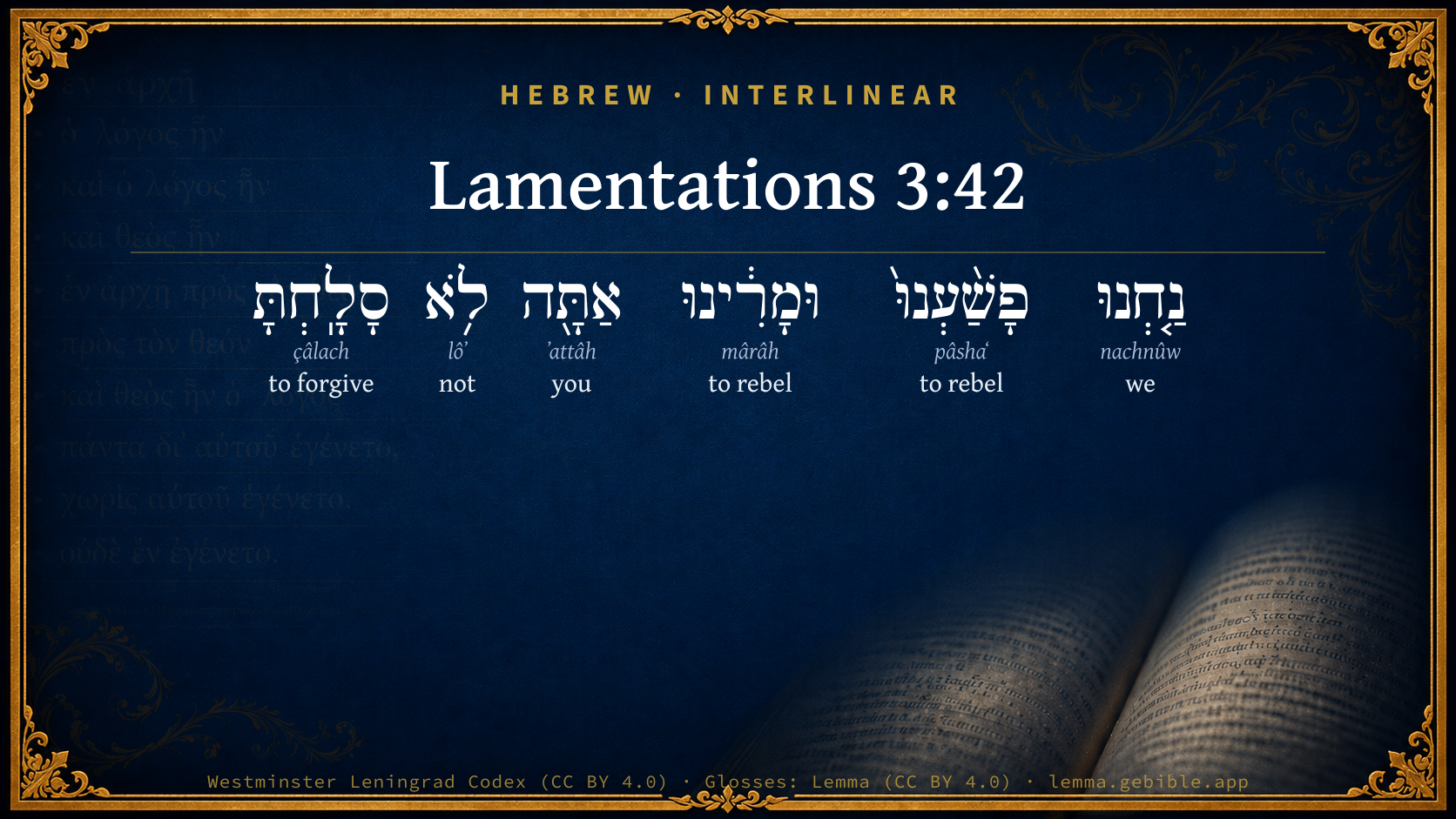
Hebrew (Westminster Leningrad Codex) Lamentations 3:42 appears in the Hebrew Old Testament. The text above is from the Westminster Leningrad Codex. Each word links to its Strong’s number, a concise gloss, and parsing drawn from the Open Scriptures Hebrew Bible morphology. Click any word for its full Brown-Driver-Briggs (BDB) entry.
Download image
Cite this verse

Lamentations 3:42 (World English Bible). Public Domain. Lemma interlinear Bible study tool, https://lemma.gebible.app/v/lamentations/3/42.

Show BibTeX & RIS
BibTeX
RIS
English Translation
We have transgressed and have rebelled; you have not pardoned.
World English Bible · Public Domain
Download a study sheet

One document with this verse’s original text, its word-by-word gloss line, the meaning frame, cross-references with their text, attributed commentary, and full source and license credits — printable, and it pastes into notes with its structure intact.

This verse Autodidact and up

Study sheet (.html) Plain text (.txt)

A passage Seminary Student

Up to 50 verses in one chapter. A passage sheet keeps up to 6 commentary sources and 12 cross-references per verse, in the order this page ranks them, and says so on the sheet whenever that leaves anything out. Ask for a single verse and you get the Autodidact verse sheet above.

Everything on this page stays free to read, with no account — the sheet is a download of what is already on screen, not access to it.

Want to remove ads? Support Godless Engineer
Compare translations 3

The same verse in 3 English versions, stacked beneath the original-language interlinear above. Click any original word for its lexicon entry.

Each is an independent rendering of the whole verse — the interlinear is not word-aligned to these translations.

Highlighted words mark where these versions differ — a whole-verse word diff, not a word-by-word alignment.

  • World English Bible Public Domain
    We have transgressed and have rebelled; you have not pardoned.
  • King James Version Public Domain
    We have transgressed and have rebelled: thou hast not pardoned.
  • unfoldingWord Literal Text CC BY-SA 4.0
    We, we have transgressed and rebelled; you have not forgiven. SAMEKH

unfoldingWord Literal Text — © unfoldingWord, licensed CC BY-SA 4.0. Word-aligned USFM3 via Door43 (git.door43.org/unfoldingWord/en_ult).

Versions to compare (up to 4)

3 of 4 selected

Show all 18 translations

Every available English version of this verse, each an independent rendering of the whole verse.

  • World English Bible Public Domain
    We have transgressed and have rebelled; you have not pardoned.
  • Berean Standard Bible Public Domain
    “We have sinned and rebelled; You have not forgiven.”
  • Majority Standard Bible Public Domain
    “We have sinned and rebelled; You have not forgiven.”
  • King James Version Public Domain
    We have transgressed and have rebelled: thou hast not pardoned.
  • American Standard Version (1901) Public Domain
    We have transgressed and have rebelled; thou hast not pardoned.
  • Revised Version (1885) Public Domain
    We have transgressed and have rebelled; thou hast not pardoned.
  • Geneva Bible (1599) Public Domain
    We haue sinned, and haue rebelled, therefore thou hast not spared.
  • Douay-Rheims (1899) Public Domain
    Nun. We have done wickedly, and provoked thee to wrath: therefore thou art inexorable.
  • Young's Literal Translation Public Domain
    We -- we have transgressed and rebelled, Thou -- Thou hast not forgiven.
  • Literal Standard Version CC BY-SA 4.0
    We have transgressed and been rebellious, || You have not forgiven.
  • Unlocked Literal Bible CC BY-SA 4.0
    “We have transgressed and rebelled, and you have not forgiven.
  • unfoldingWord Literal Text CC BY-SA 4.0
    We, we have transgressed and rebelled; you have not forgiven. SAMEKH
  • Darby Bible Public Domain
    We have transgressed and have rebelled: thou hast not pardoned.
  • World Messianic Bible Public Domain
    “We have transgressed and have rebelled. You have not pardoned.
  • Webster's Bible Public Domain
    We have transgressed and have rebelled: thou hast not pardoned.
  • Free Bible Version CC BY-SA 4.0
    “We are the ones who sinned; we are the ones who rebelled; and you haven't forgiven us!”
  • Bible in Basic English Public Domain
    We have done wrong and gone against your law; we have not had your forgiveness.
  • JPS Tanakh (1917) Public Domain
    We have transgressed and have rebelled; Thou hast not pardoned.

Literal Standard Version (2020), Covenant Press — licensed CC BY-SA 4.0. Text via the HelloAO Bible API (eBible.org). Unlocked Literal Bible (unfoldingWord) — licensed CC BY-SA 4.0. Text via the HelloAO Bible API (eBible.org). unfoldingWord Literal Text — © unfoldingWord, licensed CC BY-SA 4.0. Word-aligned USFM3 via Door43 (git.door43.org/unfoldingWord/en_ult). Free Bible Version, Dr. Jonathan Gallagher — licensed CC BY-SA 4.0. Text via the HelloAO Bible API (eBible.org).

Word by word

More ways to search: Search by grammar → Find every occurrence → Compare this word →

Practice this passage: Drill this verse → Learn its vocabulary →

About this verse

These counts appear in no published source. They are computed here, from the morphology-tagged text and Lemma’s own curated glosses. What Lemma adds →

6
words
6
distinct lemmas
Prophets
section

Notable vocabulary

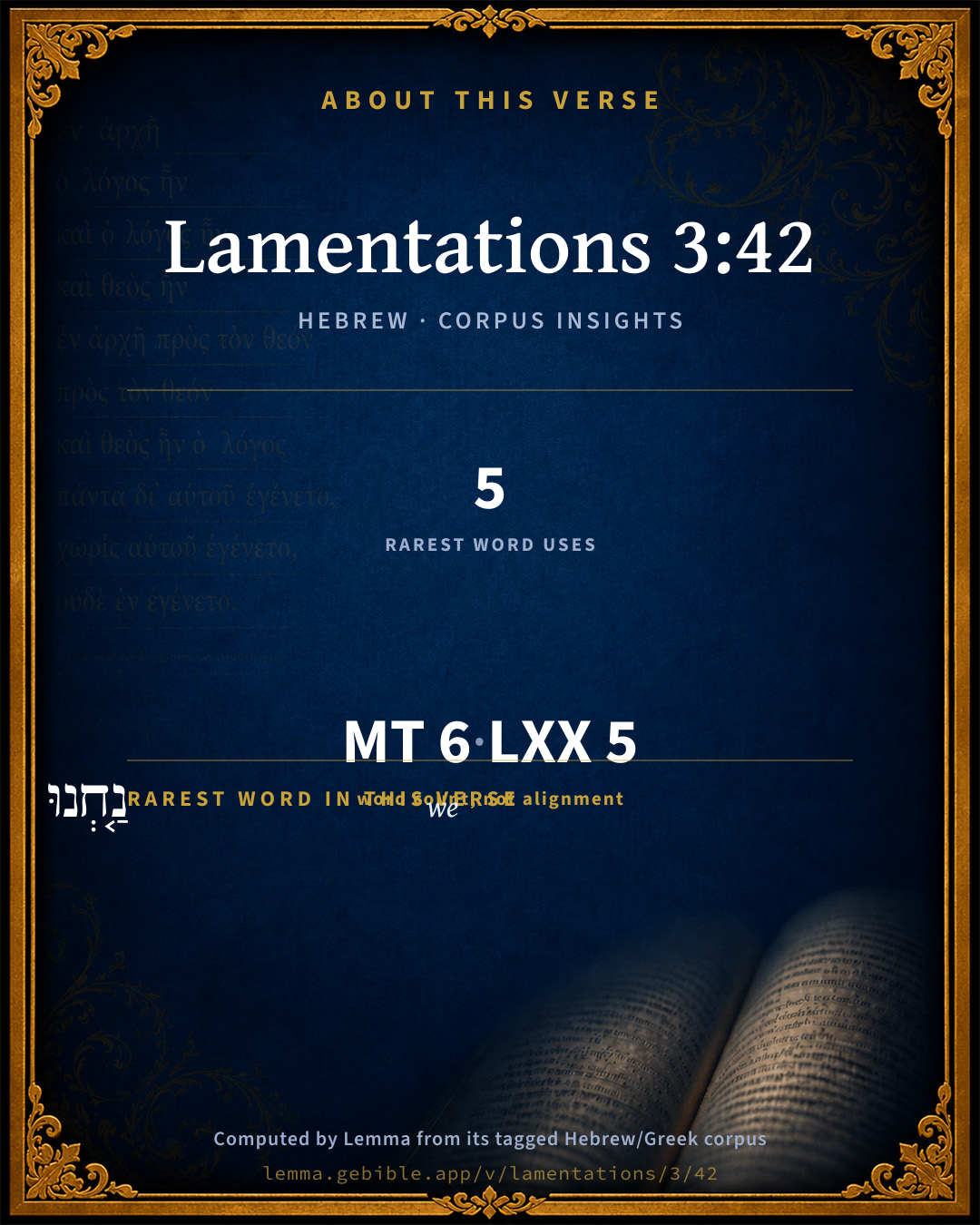
The rarest word here is נַ֤חְנוּ we H5168 — appearing just 5 times in the whole Hebrew Bible.

Shared distinctive vocabulary

נַ֤חְנוּ we H5168 occurs in 5 verses of the Hebrew Bible. Also found in:

Grammatical profile

  • 3 verbs
  • 2 pronouns
  • 1 particle

Verb forms

  • פָשַׁ֨עְנוּ֙ Qal · Perfect
  • וּמָרִ֔ינוּ Qal · Perfect
  • סָלָֽחְתָּ Qal · Perfect

Hebrew & Septuagint length

In English translation the verse runs 10 words from the Hebrew and 11 from the Septuagint (LXX English) — closely comparable.

A rough comparison of the two English renderings, which tokenize alike — not a word-level alignment.

Word counts can differ between the Hebrew and the Greek without any difference in meaning — e.g. the Hebrew direct-object marker אֵת has no separate Greek word, and Greek often adds the article ὁ.

In the original languages it is 6 Hebrew tokens and 5 Greek tokens — but the two are counted differently (Hebrew bundles its prefixes and suffixes into one token; the Greek is in lemma form), so that isn’t a like-for-like length.

Cross-references

11

Topical passages linked to Lamentations 3:42 in the Treasury of Scripture Knowledge — connected by theme and wording, ordered by reader-vote popularity; previews shown in the World English Bible.

  • Nehemiah 9:26 Nevertheless they were disobedient, and rebelled against you, and cast your law behind their back, and killed your prophets that testified against them to turn them again to you, and they committed awful blasphemies.
  • Jeremiah 5:7–9 How can I pardon you? your children have forsaken me, and sworn by them that are no gods: when I had fed them to the full, they committed adultery, and assembled themselves in troops at the prostitutes' houses.
  • Luke 15:18–19 I will get up and go to my father, and will tell him, "Father, I have sinned against heaven, and in your sight.
  • 2 Kings 24:4 and also for the innocent blood that he shed; for he filled Jerusalem with innocent blood: and Yahweh would not pardon.
  • Job 33:27–28 He sings before men, and says, 'I have sinned, and perverted that which was right, And it didn't profit me.
  • Jeremiah 3:13 Only acknowledge your iniquity, that you have transgressed against Yahweh your God, and have scattered your ways to the strangers under every green tree, and you have not obeyed my voice, says Yahweh.
  • Lamentations 1:18 Yahweh is righteous; for I have rebelled against his commandment: Please hear all you peoples, and see my sorrow: My virgins and my young men are gone into captivity.
  • Lamentations 5:16 The crown is fallen from our head: Woe to us! for we have sinned.
  • Ezekiel 24:13 In your filthiness is lewdness: because I have cleansed you and you weren't cleansed, you shall not be cleansed from your filthiness any more, until I have caused my wrath toward you to rest.
  • Daniel 9:5–14 we have sinned, and have dealt perversely, and have done wickedly, and have rebelled, even turning aside from your precepts and from your ordinances;
  • Zechariah 1:5 Your fathers, where are they? And the prophets, do they live forever?

Cross-references courtesy of OpenBible.info (CC BY 4.0).

Hebrew and Greek witnesses Masoretic Hebrew ↔ Greek Septuagint

The same verse in the two great witnesses to the Old Testament, shown verse-for-verse.

These are two independent witnesses, not word-aligned to each other, and the Septuagint is shown in lemma (dictionary) form.

Hebrew Lamentations 3:42 Masoretic · Westminster Leningrad Codex

נַ֤חְנוּ פָשַׁ֨עְנוּ֙ וּמָרִ֔ינוּ אַתָּ֖ה לֹ֥א סָלָֽחְתָּ

We have transgressed and have rebelled; you have not pardoned.

World English Bible · Public Domain

Greek LXX Lamentations 3:42 Septuagint · lemma form

ἁμαρτάνω ἀσεβέω καί οὐ ἱλάσκομαι

We have sinned, we have transgressed; and you have not pardoned.

LXX2012 (modern English Septuagint) · Public Domain

On this verse, Haydock's Catholic Bible Commentary discusses the Septuagint’s reading. Read the note in Commentary ↓

Hebrew: Westminster Leningrad Codex (CC BY 4.0). Greek: Septuagint (public domain); English from LXX2012 (modern English Septuagint) (Public Domain). How the Septuagint differs from the Hebrew →

Commentary

Notes on Lamentations 3:42 from classic Christian and Jewish commentators (each source and its license shown beneath its notes). The classic Christian expositions comment on the surrounding passage and are grouped to its opening verse, so a note may address several verses; the Jewish commentaries on the Tanakh (Rashi and others) are per-verse, so they appear only where the commentator wrote on this verse.

Lemma curates 59 commentaries, every one of them public domain or Creative Commons licensed, each selected and text-cleaned for this edition rather than reprinted as found. About our sources →

Matthew Henry's Commentary

It is easier to chide ourselves for complaining than to chide ourselves out of it. The prophet had owned that a living man should not complain, as if he checked himself for his complaints in the former part of the chapter; and yet here the clouds return after the rain and the wound bleeds afresh; for great pains must be taken with a troubled spirit to bring it into temper.

I. They confess the righteousness of God in afflicting them (Lam 3:42): We have transgressed and have rebelled. Note, It becomes us, when we are in trouble, to justify God, by owning our sins, and laying the load upon ourselves for them. Call sin a transgression, call it a rebellion, and you do not miscall it. This is the result of their searching and trying their ways; the more they enquired into them the worse they found them. Yet,

II. They complain of the afflictions they are under, not without some reflections upon God, which we are not to imitate, but, under the sharpest trials, must always think and speak highly and kindly of him.

1. They complain of his frowns and the tokens of his displeasure against them. Their sins were repented of, and yet (Lam 3:42), Thou hast not pardoned. They had not the assurance and comfort of the pardon; the judgments brought upon them for their sins were not removed, and therefore they thought they could not say the sin was pardoned, which was a mistake, but a common mistake with the people of God when their souls are cast down and disquieted within them. Their case was really pitiable, yet they complain, Thou hast not pitied, Lam 3:43. Their enemies persecuted and slew them, but that was not the worst of it; they were but the instruments in God's hand: "Thou hast persecuted us, and thou hast slain us, though we expected thou wouldst protect and deliver us." They complain that there was a wall of partition between them and God, and, (1.) This hindered God's favours from coming down upon them. The reflected beams of God's kindness to them used to be the beauty of Israel; but now "thou hast covered us with anger, so that our glory is concealed and gone; now God is angry with us, and we do not appear that illustrious people that we have formerly been thought to be." Or, "Thou hast covered us up as men that are buried are covered up and forgotten." (2.) It hindered their prayers from coming up unto God (Lam 3:44): "Thou hast covered thyself with a cloud," not like that bright cloud in which he took possession of the temple, which enabled the worshippers to draw near to him, but like that in which he came down upon Mount Sinai, which obliged the people to stand at a distance. "This cloud is so thick that our prayers seem as if they were lost in it; they cannot pass through; we cannot obtain an audience." Note, The prolonging of troubles is sometimes a temptation, even to praying people, to question whether God be what they have always believed him to be, a prayer-hearing God.

2. They complain of the contempt of their neighbours and the reproach and ignominy they were under (Lam 3:45): "Thou hast made us as the off-scouring, or scrapings, of the first floor, which are thrown to the dunghill." This St. Paul refers to in his account of the sufferings of the apostles. Co1 4:13, We are made as the filth of the world and are the off-scouring of all things. "We are the refuse, or dross, in the midst of the people, trodden upon by every body, and looked upon as the vilest of the nations, and good for nothing but to be cast out as salt which has lost its savour. Our enemies have opened their mouths against us (Lam 3:46), have gaped upon us as roaring lions, to swallow us up, or made mouths at us, or have taken liberty to say what they please of us." These complaints we had before, Lam 2:15, Lam 2:16. Note, It is common for base and ill-natured men to run upon, and run down, those that have fallen into the depths of distress from the height of honour. But this they brought upon themselves by sin. If they had not made themselves vile, their enemies could not have made them so: but therefore men call them reprobate silver, because the Lord has rejected them for rejecting him.

3. They complain of the lamentable destruction that their enemies made of them (Lam 3:47): Fear and a snare have come upon us; the enemies have not only terrified us with those alarms, but prevailed against us by their stratagems, and surprised us with the ambushes they laid for us; and then follows nothing but desolation and destruction, the destruction of the daughter of my people (Lam 3:48), of all the daughters of my city, Lam 3:51. The enemies, having taken some of them like a bird in a snare, chased others as a harmless bird is chased by a bird of prey (Lam 3:52): My enemies chased me sorely like a bird which is beaten from bush to bush, as Saul hunted David like a partridge. Thus restless was the enmity of their persecutors, and yet causeless. They have done it without cause, without any provocation given them. Though God was righteous, they were unrighteous. David often complains of those that hated him without cause; and such are the enemies of Christ and his church, Joh 15:25. Their enemies chased them till they had quite prevailed over them (Lam 3:53): They have cut off my life in the dungeon. They have shut up their captives in close and dark prisons, where they are as it were cut off from the land of the living (as Lam 3:6), or the state and kingdom are sunk and ruined, the life and being of them are gone, and they are as it were thrown into the dungeon or grave and a stone cast upon them, such as used to be rolled to the door of the sepulchres. They look upon the Jewish nation as dead and buried, and imagine that there is not possibility of its resurrection. Thus Ezekiel saw it, in vision, a valley full of dead and dry bones. Their destruction is compared not only to the burying of a dead man, but to the sinking of a living man into the water, who cannot long be a living man there, Lam 3:54. Waters of affliction flowed over my head. The deluge prevailed and quite overwhelmed them. The Chaldean forces broke in upon them as the breaking forth of waters, which rose so high as to flow over their heads; they could not wade, they could not swim, and therefore must unavoidably sink. Note, The distresses of God's people sometimes prevail to such a degree that they cannot find any footing for their faith, nor keep their head above water, with any comfortable expectation.

4. They complain of their own excessive grief and fear upon this account. (1.) The afflicted church is drowned in tears, and the prophet for her (Lam 3:48, Lam 3:49): My eye runs down with rivers of water, so abundant was their weeping; it trickles down and ceases not, so constant was their weeping, without any intermission, there being no relaxation of their miseries. The distemper was in continual extremity, and they had no better day. It is added (Lam 3:51), "My eye affects my heart. My seeing eye affects my heart. The more I look upon the desolation of the city and country the more I am grieved. Which way soever I cast my eye, I see that which renews my sorrow, even because of all the daughters of my city," all the neighbouring towns, which were as daughters to Jerusalem the mother-city. Or, My weeping eye affects my heart; the venting of the grief, instead of easing it, did but increase and exasperate it. Or, My eye melts my soul; I have quite wept away my spirits; not only my eye is consumed with grief, but my soul and my life are spent with it, Psa 31:9, Psa 31:10. Great and long grief exhausts the spirits, and brings not only many a gray head, but many a green head too, to the grave. I weep, ways the prophet, more than all the daughters of my city (so the margin reads it); he outdid even those of the tender sex in the expressions of grief. And it is no diminution to any to be much in tears for the sins of sinners and the sufferings of saints; our Lord Jesus was so; for, when he came near, he beheld this same city and wept over it, which the daughters of Jerusalem did not. (2.) She is overwhelmed with fears, not only grieves for what is, but fears worse, and gives up all for gone (Lam 3:54): "Then I said, I am cut off, ruined, and see no hope of recovery; I am as one dead." Note, Those that are cast down are commonly tempted to think themselves cast off, Psa 31:22; Jon 2:4.

5. In the midst of these sad complaints here is one word of comfort, by which it appears that their case was not altogether so bas as they made it, Lam 3:50. We continue thus weeping till the Lord look down and behold from heaven. This intimates, (1.) That they were satisfied that God's gracious regard to them in their miseries would be an effectual redress of all their grievances. "If God, who now covers himself with a cloud, as if he took no notice of our troubles (Job 22:13), would but shine forth, all would be well; if he look upon us, we shall be saved," Psa 80:19; Dan 9:17. Bad as the case is, one favourable look from heaven will set all to rights. (2.) That they had hopes that he would at length look graciously upon them and relieve them; nay, they take it for granted that he will: "Though he contend long, he will not contend for ever, thou we deserve that he should." (3.) That while they continued weeping they continued waiting, and neither did nor would expect relief and succour from any hand but his; nothing shall comfort them but his gracious returns, nor shall any thing wipe tears from their eyes till he look down. Their eyes, which now run down with water, shall still wait upon the Lord their God until he have mercy upon them, Psa 123:2.

Matthew Henry's Commentary on the Whole Bible (1708–1710) — public domain (CC PDM 1.0). Text via the HelloAO Bible API.

Trapp's Complete Commentary

John Trapp

Lam 3:42 We have transgressed and have rebelled: thou hast not pardoned.

Ver. 42. We have transgressed and have rebelled.] We have committed evil and omitted good, and failed in the manner, and are therefore justly punished. Let God hear such words fall from our mouths, set to work by our hearts, and then we may have anything.

John Trapp, A Commentary or Exposition upon All the Books of the Old and New Testament (1647–1656) — public domain. Text from a community e-Sword module.

Joseph Benson's Commentary

Lam 3:42-47. We have transgressed, &c. — Here the prophet shows what will be the effect of a proper searching and trying of our ways; we shall be convinced of our sinfulness and guilt: and he here teaches us that confession of sin must accompany petition for the pardon of it. For he that would find mercy must confess as well as forsake his sins, Pro 28:13; 1Jn 1:9. Thou hast not pardoned — That is, as the expression seems here to mean, thou hast not removed the judgments brought upon us for our sins. Thou continuest to punish us according to the just desert of our transgressions. Thou hast covered with anger — Either, thou hast covered thyself with anger, hast covered thy face, so as not to look upon us to move thy pity; or, which is more probably the sense, thou hast covered, that is, overwhelmed, us with thy wrath. Thou hast slain, thou hast not pitied — Thou hast pursued us to a fatal ruin, without showing us any pity. Thou hast covered thyself, &c., that our prayer should not pass through — Whereas in our distress we had no other resource but to apply to thee for help, thou didst so hide thy face and withdraw thyself from us, that we could have no access to thee or intercourse with thee. The expression is metaphorical, and signifies no more than that God would not hear their prayers in their distress. Thou hast made us the offscouring, &c. — That is, thou hast made us extremely contemptible in the eyes of all nations, so that they value us no more than the sweepings of their houses, or the most vile refuse, or contemptible things imaginable. All our enemies have opened their mouths — That is, to mock, scoff, and reproach us. Fear and a snare is come upon us — That is, all manner of misery: see the margin.

Joseph Benson's Commentary on the Old and New Testaments (1811–1818) — public domain. Text from a community e-Sword module.

Jamieson, Fausset & Brown

Robert Jamieson, A. R. Fausset & David Brown

not pardoned--The Babylonian captivity had not yet ended.

Jamieson, Fausset & Brown — Commentary Critical and Explanatory on the Whole Bible (1871) — public domain (CC PDM 1.0). Text via the HelloAO Bible API.

John Calvin's Commentaries

The faithful do not here expostulate with God, but on the contrary acknowledge that God’s severity was just. That God then had dealt with them severely, they ascribe to their own sins, This is the substance of what is said.

We hence learn that an ingenuous confession ever accompanies repentance, as also Paul teaches us, (2 Corinthians 7:11.) For when a sinner is either secure or tries to cover his wickedness, and flatters himself, as we see but a few who willingly humble themselves before God, he contracts the hardness of obstinacy. For this reason the Prophet requires confession; nay, he suggests here the words suitable to be used, when we desire to obtain pardon from God. We have done wickedly, he says, and have been rebellious The pronoun, we, is here emphatical, as though the faithful had taken on themselves the blame of all the evils, which the greater part ever sought to disown.

Here then the Prophet shews that there is no other way of being reconciled to God, than by confessing ourselves to be the authors of all our evils; and he also teaches us, that it is an evidence of true repentance, when we do not allege vain pretences as it is commonly done, nor flatter ourselves, but confess that we are guilty. He now shows that guilt ought by no means to be extenuated, so that our confession may be real and complete: but in this respect the world trifle with God. The most wicked are, indeed, ashamed to deny that they are sinners; but as they are forced to make some kind of confession, this they do lightly; and it seems an extorted confession, and is therefore jejune, or at least not complete. But the Prophet here shews that they who seek to be reconciled to God, ought not only in words to acknowledge and confess their guilt, but also ingenuously to open their hearts. Hence he connects perverseness with sin: as though he had said, “We have not sinned simply or in one way, but we have exasperated God himself; and by sinning in many ways and constantly, we have provoked him against us.” He says, in short, that there is then an access open to us to obtain favor, when we do not murmur against God nor contend with him as though he had dealt severely with us, but when we confess that he has been hard and rigid with us, because he had a reason to be so on account of our sins and wickedness. He adds, —

John Calvin's Commentaries (1540-1563) — public domain. Text from the Calvin Translation Society English edition (1840s-50s) via the Christian Classics Ethereal Library (ccel.org). Calvin's coverage is partial (roughly two-thirds of the Bible); uncommented books and verses are honest gaps, never fabricated. The 19th-century editor's footnotes and remarks are omitted so the notes are faithfully Calvin's own voice.

Ellicott's Commentary for English Readers

(42) We have transgressed . . .—The verses that follow (Lam 3;42-47) give the prayer which answers to the call of Lam_3:41. Both pronouns are emphatic: The suppliant has sinned and God has not yet pardoned, in the sense of ceasing to punish.

A Bible Commentary for English Readers, edited by Charles John Ellicott (1878–1897) — public domain. Text from a community e-Sword module.

The Cambridge Bible for Schools and Colleges

gen. ed. J. J. S. Perowne

42. We … thou] The pronouns are emphatic in the original. Thou and we have been at variance.

thou … pardoned] Observe how this clause forms a connecting link with the next group; similarly “mine eye” in Lam_3:48.

The Cambridge Bible for Schools and Colleges (gen. ed. J. J. S. Perowne; Cambridge University Press, 1878–1918) — public domain. Text from a community e-Sword module.

John Gill's Exposition

Fear and a snare is come upon us,.... Or, "fear and a pit" (m); the fear of failing into the pit of ruin and destruction, on the brink of which they saw themselves; or fear seized us, and caused us to flee; and a snare or pit was prepared for us to fall into; so that there was no escaping hence:

desolation and destruction; desolation or devastation of their land; and destruction of their city and temple; and of multitudes of them by the sword, famine, and pestilence; and the rest carried into captivity, excepting a few left desolate in the land.

(m) "pavor et fovea", Calvin, Junius & Tremellius, Piscator, Cocceius, Michaelis.

John Gill's Exposition of the Whole Bible (1746–1763) — public domain (CC PDM 1.0). Text via the HelloAO Bible API.

Haydock's Catholic Bible Commentary

Inexorable. Hebrew and Septuagint, "Thou hast not shewn pity." (Haydock)

George Leo Haydock (1774–1849), Haydock's Catholic Family Bible and Commentary, 1859 edition — public domain. Excludes Psalms (Douay-Rheims chapter numbering differs from Protestant) and Deuterocanonical books (Catholic canon only).

Matthew Poole's English Annotations

The prophet doth not dictate words, but sense to them, teaching them the matter of their prayer; first, by way of confession. Sin is called a transgression, because it is going aside from the way of God’s precepts; it is called rebellion, because it is an act contrary to that allegiance and duty which we owe unto God, and the covenant we have made with him. By pardoning here is meant the discharge of the guilty persons from the temporal punishment due for sin (as it is often taken in Scripture); so it signifies, thou hast plagued us according to the just desert of our sins.

Matthew Poole's English Annotations on the Holy Bible (1683–1685) — public domain. Text from a community e-Sword/MySword module.

Whedon's Commentary on the Bible

Daniel D. Whedon

42. Thou hast not pardoned — As in the preceding triplet, so here, we may have a transition to the section immediately following. The prophet reminds God that the people have been punished and not “pardoned,” which is an appeal for him to stay his hand and fulfil his oft-repeated promise that he would again remember them for good.

Daniel D. Whedon (gen. ed.), Commentary on the Old and New Testaments (1874–1909) — public domain. Text from a community e-Sword module.

The Pulpit Commentary

We... thou. The pronouns are expressed in the Hebrew, and are meant to be spoken with emphasis.

The Pulpit Commentary (1880–1919), ed. H.D.M. Spence-Jones & Joseph S. Exell — public domain. Text from a community e-Sword module.

John Wesley's Explanatory Notes

Thou - Thou hast plagued us according to the just desert of our sins.

John Wesley, Explanatory Notes Upon the Whole Bible (1754–1765) — public domain. Text via the GEBible commentary corpus.

Rashi

Rabbi Shlomo Yitzchaki (Rashi)

We have rebelled and have been disob edient This is our way, [that we sinned] because of the evil inclination.

You have not forgiven And for You, forgiveness is fitting, for so is Your way.

Rashi on the Tanakh — English translations: “The Judaica Press complete Tanach with Rashi, translated by A. J. Rosenberg” (CC BY 4.0); “Pentateuch with Rashi's commentary by M. Rosenbaum and A.M. Silbermann, 1929-1934” (public domain); “The Metsudah Tanach series, Lakewood, N.J” (CC BY 4.0); and “The Book of Joshua, Metsudah Publications, 1997” (CC BY 4.0). Text via Sefaria.

Lesson kit

Teaching starters — assembled from the data on this page, not authored interpretation. Every prompt links to the verse data it draws on. Edit before teaching.

Lamentations, in the Prophets, opens this verse with 6 words (6 distinct Hebrew lemmas). Its most distinctive word is nachnûw (“we”). A historical commentator’s framing appears above. Read the whole chapter for the surrounding context.

Discussion questions

  1. The word nachnûw carries the sense “we.” How does it shape the verse?
  2. Genesis 42:11 shares the word «we» with this verse. How do the two illuminate each other?
  3. The translations on this page render this verse differently — a whole-verse word diff, not a word-by-word alignment. What might account for the different wordings?
  4. The verb «פָשַׁ֨עְנוּ֙» is Qal Perfect. How does its form color the action?
  5. Reading how Matthew Henry's Commentary and Trapp's Complete Commentary read this verse, where do the two commentators agree and where do they part?

Things to notice

Reading settings

Reading text

Shown beneath each verse's original-language words.

Old Testament
Old Testament edition

Read the OT as the Masoretic Hebrew (MT) or the Greek Septuagint (LXX).

English shown for the Greek Septuagint (in the Hebrew ↔ Greek comparison).

Comparing translations? Open the Compare panel on any verse page to stack up to four side by side.