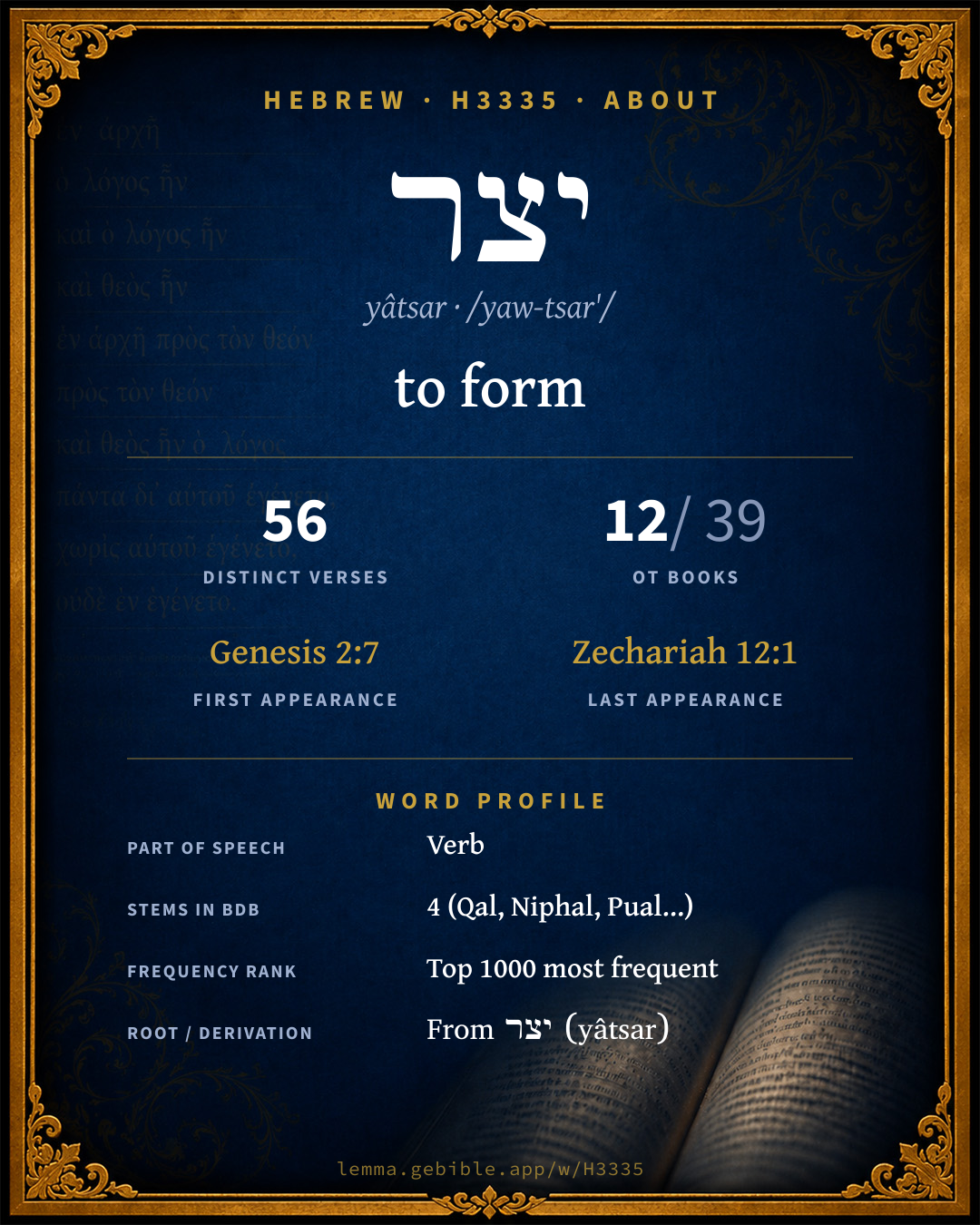
יָצַר
to form
also: fashion, frame fuller range ↓
Full lexicon entry — Brown-Driver-Briggs (BDB)
From Brown-Driver-Briggs (BDB)
Where this word appears
See every Qal verb in the Hebrew Bible →
Grammar key — what these labels mean
Part of speech
- Verb
- An action or state-of-being word.
- Noun
- A naming word — a person, place, thing, or idea.
Noun type
- Common
- A common noun — a general class of person, place, or thing (“king,” “city,” “water”), not a specific name.
Stem
- Qal
- The basic, simple active stem — the plain form of the verb (“he wrote”). Here: ‘of human activity’
- Hophal
- The passive counterpart of the Hiphil (“he was caused to…”).
- Niphal
- Usually the simple passive or reflexive of the Qal (“he was written”).
- Pual
- The passive counterpart of the Piel.
Form
- Participle Active
- A verbal adjective expressing ongoing or characteristic action (“writing / one who writes”).
- Sequential Imperfect
- An imperfect with prefixed waw — the standard past-narrative form (waw-consecutive imperfect).
- Imperfect
- An incomplete, ongoing, or future action (“he will / would write”).
- Perfect
- A completed action or state — Hebrew marks aspect (completeness) more than strict tense (“he wrote”).
- Sequential Perfect
- A perfect with prefixed waw continuing a preceding imperfect or command (waw-consecutive perfect).
State
- Absolute
- The independent form of a noun, not bound to a following word.
- Construct
- A noun bound to a following noun in a possessive / “of” relationship (the construct chain).
Person
- 3rd Person
- The one spoken about (“he / she / it / they”).
- 1st Person
- The speaker (“I / we”).
- 2nd Person
- The one addressed (“you”).
Gender
- Masculine
- Grammatically masculine.
- Common
- Either gender — not distinguished for this form.
Number
- Singular
- One.
- Plural
- More than one (in Hebrew, generally three or more).
Grammatical forms 17 distinct
- Verb, Qal, Participle Active, Masculine, Singular, Absolute 19 times (30%)
- Verb, Qal, Participle Active, Masculine, Singular, Construct 15 times (24%)
- Noun, Common, Masculine, Singular, Absolute 5 times (8%)
- Verb, Qal, Perfect, 1st Person, Common, Singular 5 times (8%)
- Verb, Qal, Sequential Imperfect, 3rd Person, Masculine, Singular 3 times (5%)
- Verb, Qal, Perfect, 3rd Person, Masculine, Singular 3 times (5%)
- Verb, Qal, Imperfect, 1st Person, Common, Singular 2 times (3%)
- Verb, Qal, Perfect, 2nd Person, Masculine, Singular 2 times (3%)
+9 more forms (9 occurrences)
Parsed forms decoded from the imported morphology (morphhb / Westminster Leningrad Codex — WLC text public domain, morphhb tagging CC BY 4.0), counted across 63 parsed occurrences — not distinct verses.
Every verse where H3335 appears — 56 distinct verses across 12 books. Click any verse to open its interlinear word-by-word view. Verse text shown in the World English Bible for context — . Each verse’s Hebrew form is shown with its reference; the English is not keyword-highlighted, since the data carries no word-level English alignment. Use “Compare translations” on any verse to read it across multiple English versions. This concordance covers the Hebrew Bible; Septuagint (Greek Old Testament) occurrences are not indexed here.
Genesis 3 verses
- Genesis 2:7 וַ/יִּיצֶר֩ conj + Qal wimpf 3ms Yahweh God formed man from the dust of the ground, and breathed into his nostrils the breath of life; and man became a living soul.
- Genesis 2:8 יָצָֽר Qal pf 3ms Yahweh God planted a garden eastward, in Eden, and there he put the man whom he had formed.
- Genesis 2:19 וַ/יִּצֶר֩ conj + Qal wimpf 3ms Out of the ground Yahweh God formed every animal of the field, and every bird of the sky, and brought them to the man to see what he would call them. Whatever the man called every living creature, that was its name.
Exodus 1 verse
2 Samuel 1 verse
2 Kings 1 verse
1 Chronicles 1 verse
Psalms 8 verses
- Psalms 2:9 יוֹצֵ֣ר n c ms You shall break them with a rod of iron. You shall dash them in pieces like a potter's vessel."
- Psalms 33:15 הַ/יֹּצֵ֣ר ptcl def.art + Qal ptcp.act ms He who fashions all of their hearts; And he considers all of their works.
- Psalms 74:17 יְצַרְתָּ/ם Qal pf 2ms + sfx pers 3mp You have set all the boundaries of the earth. You have made summer and winter.
- Psalms 94:9 יֹ֥צֵֽר Qal ptcp.act ms cs He who implanted the ear, won't he hear? He who formed the eye, won't he see?
- Psalms 94:20 יֹצֵ֖ר Qal ptcp.act ms Shall the throne of wickedness have fellowship with you, Which brings about mischief by statute?
- Psalms 95:5 יָצָֽרוּ Qal pf 3cp The sea is his, and he made it. His hands formed the dry land.
- Psalms 104:26 יָצַ֥רְתָּ Qal pf 2ms There the ships go, And leviathan, whom you formed to play there.
- Psalms 139:16 יֻצָּ֑רוּ Pual pf 3cp Your eyes saw my body. In your book they were all written, The days that were ordained for me, When as yet there were none of them.
Isaiah 24 verses
- Isaiah 22:11 וְ/יֹצְרָ֥/הּ conj + Qal ptcp.act ms cs + sfx pers 3fs you made also a reservoir between the two walls for the water of the old pool. But you didn't look to him who had done this, neither did you have respect for him who purposed it long ago.
- Isaiah 27:11 וְ/יֹצְר֖/וֹ conj + Qal ptcp.act ms cs + sfx pers 3ms When the boughs of it are withered, they shall be broken off; the women shall come, and set them on fire; for it is a people of no understanding: therefore he who made them will not have compassion on them, and he who formed them will show them no favor.
- Isaiah 29:16 הַ/יֹּצֵ֖ר לְ/יוֹצְר֖/וֹ ptcl def.art + n c ms prep + Qal ptcp.act ms cs + sfx pers 3ms You turn things upside down! Shall the potter be esteemed as clay; that the thing made should say of him who made it, He didn't make me; or the thing formed say of him who formed it, He has no understanding?
- Isaiah 30:14 יוֹצְרִ֛ים n c mp He shall break it as a potter's vessel is broken, breaking it in pieces without sparing; so that there shall not be found among the pieces of it a broken piece with which to take fire from the hearth, or to dip up water out of the cistern."
- Isaiah 37:26 וִ/יצַרְתִּ֑י/הָ conj + Qal wpf 1cs + sfx pers 3fs Have you not heard how I have done it long ago, and formed it of ancient times? now have I brought it to pass, that it should be your to lay waste fortified cities into ruinous heaps.
- Isaiah 41:25 יוֹצֵ֖ר n c ms I have raised up one from the north, and he has come; from the rising of the sun one who calls on my name: and he shall come on rulers as on mortar, and as the potter treads clay.
- Isaiah 43:1 וְ/יֹצֶרְ/ךָ֖ conj + Qal ptcp.act ms cs + sfx pers 2ms But now thus says Yahweh who created you, Jacob, and he who formed you, Israel: Don't be afraid, for I have redeemed you; I have called you by your name, you are mine.
- Isaiah 43:7 יְצַרְתִּ֖י/ו Qal pf 1cs + sfx pers 3ms everyone who is called by my name, and whom I have created for my glory, whom I have formed, yes, whom I have made.
- Isaiah 43:10 נ֣וֹצַר Niphal pf 3ms You are my witnesses, says Yahweh, and my servant whom I have chosen; that you may know and believe me, and understand that I am he: before me there was no God formed, neither shall there be after me.
- Isaiah 43:21 יָצַ֣רְתִּי Qal pf 1cs the people which I formed for myself, that they might set forth my praise.
- Isaiah 44:2 וְ/יֹצֶרְ/ךָ֥ conj + Qal ptcp.act ms cs + sfx pers 2ms Thus says Yahweh who made you, and formed you from the womb, who will help you: Don't be afraid, Jacob my servant; and you, Jeshurun, whom I have chosen.
- Isaiah 44:9 יֹֽצְרֵי Qal ptcp.act mp cs Those who fashion an engraved image are all of them vanity; and the things that they delight in shall not profit; and their own witnesses don't see, nor know: that they may be disappointed.
- Isaiah 44:10 יָצַ֥ר Qal pf 3ms Who has fashioned a god, or molten an image that is profitable for nothing?
- Isaiah 44:12 יִצְּרֵ֑/הוּ Qal impf 3ms + sfx pers 3ms The smith [makes] an axe, and works in the coals, and fashions it with hammers, and works it with his strong arm: yes, he is hungry, and his strength fails; he drinks no water, and is faint.
- Isaiah 44:21 יְצַרְתִּ֤י/ךָ Qal pf 1cs + sfx pers 2ms Remember these things, Jacob, and Israel; for you are my servant: I have formed you; you are my servant: Israel, you shall not be forgotten by me.
- Isaiah 44:24 וְ/יֹצֶרְ/ךָ֖ conj + Qal ptcp.act ms cs + sfx pers 2ms Thus says Yahweh, your Redeemer, and he who formed you from the womb: I am Yahweh, who makes all things; who stretches forth the heavens alone; who spreads abroad the earth (who is with me?);
- Isaiah 45:7 יוֹצֵ֥ר Qal ptcp.act ms I form the light, and create darkness; I make peace, and create evil. I am Yahweh, who does all these things.
- Isaiah 45:9 יֹ֣צְר֔/וֹ לְ/יֹֽצְר/וֹ֙ Qal ptcp.act ms cs + sfx pers 3ms prep + Qal ptcp.act ms cs + sfx pers 3ms Woe to him who strives with his Maker--a potsherd among the potsherds of the earth! Shall the clay ask him who fashions it, "What are you making?" or your work, "He has no hands?"
- Isaiah 45:11 וְ/יֹצְר֑/וֹ conj + Qal ptcp.act ms cs + sfx pers 3ms Thus says Yahweh, the Holy One of Israel, and his Maker: Ask me of the things that are to come; concerning my sons, and concerning the work of my hands, command you me.
- Isaiah 45:18 יֹצֵ֨ר יְצָרָ֑/הּ Qal ptcp.act ms Qal pf 3ms + sfx pers 3fs For thus says Yahweh who created the heavens, the God who formed the earth and made it, who established it and didn't create it a waste, who formed it to be inhabited: I am Yahweh; and there is no one else.
- Isaiah 46:11 יָצַ֖רְתִּי Qal pf 1cs calling a ravenous bird from the east, the man of my counsel from a far country; yes, I have spoken, I will also bring it to pass; I have purposed, I will also do it.
- Isaiah 49:5 יֹצְרִ֤/י Qal ptcp.act ms cs + sfx pers 1cs Now says Yahweh who formed me from the womb to be his servant, to bring Jacob again to him, and that Israel be gathered to him (for I am honorable in the eyes of Yahweh, and my God is become my strength);
- Isaiah 54:17 יוּצַ֤ר Hophal impf 3ms No weapon that is formed against you shall prosper; and every tongue that shall rise against you in judgment you shall condemn. This is the heritage of the servants of Yahweh, and their righteousness which is of me, says Yahweh.
- Isaiah 64:8 יֹצְרֵ֔/נוּ Qal ptcp.act ms cs + sfx pers 1cp But now, Yahweh, you are our Father; we are the clay, and you our potter; and we all are the work of your hand.
Jeremiah 11 verses
- Jeremiah 1:5 אצור/ך אֶצָּרְ/ךָ֤ Qal impf 1cs + sfx pers 2ms Qal impf 1cs + sfx pers 2ms Before I formed you in the belly I knew you, and before you came forth out of the womb I sanctified you; I have appointed you a prophet to the nations.
- Jeremiah 10:16 יוֹצֵ֤ר Qal ptcp.act ms cs The portion of Jacob is not like these; for he is the former of all things; and Israel is the tribe of his inheritance: Yahweh of Hosts is his name.
- Jeremiah 18:2 הַ/יּוֹצֵ֑ר ptcl def.art + Qal ptcp.act ms Arise, and go down to the potter's house, and there I will cause you to hear my words.
- Jeremiah 18:3 הַ/יּוֹצֵ֑ר ptcl def.art + Qal ptcp.act ms Then I went down to the potter's house, and, behold, he was making a work on the wheels.
- Jeremiah 18:4 הַ/יּוֹצֵ֑ר הַ/יּוֹצֵ֖ר ptcl def.art + Qal ptcp.act ms ptcl def.art + Qal ptcp.act ms When the vessel that he made of the clay was marred in the hand of the potter, he made it again another vessel, as seemed good to the potter to make it.
- Jeremiah 18:6 הֲ/כַ/יּוֹצֵ֨ר הַ/יּוֹצֵ֔ר ptcl inter + prep det + Qal ptcp.act ms ptcl def.art + Qal ptcp.act ms House of Israel, can't I do with you as this potter? says Yahweh. Behold, as the clay in the potter's hand, so are you in my hand, house of Israel.
- Jeremiah 18:11 יוֹצֵ֤ר Qal ptcp.act ms Now therefore, speak to the men of Judah, and to the inhabitants of Jerusalem, saying, Thus says Yahweh: Behold, I frame evil against you, and devise a device against you: return you now everyone from his evil way, and amend your ways and your doings.
- Jeremiah 19:1 יוֹצֵ֣ר Qal ptcp.act ms cs Thus said Yahweh, Go, and buy a potter's earthen bottle, and [take] of the elders of the people, and of the elders of the priests;
- Jeremiah 19:11 הַ/יּוֹצֵ֔ר ptcl def.art + Qal ptcp.act ms and shall tell them, Thus says Yahweh of Hosts: Even so will I break this people and this city, as one breaks a potter's vessel, that can't be made whole again; and they shall bury in Topheth, until there be no place to bury.
- Jeremiah 33:2 יוֹצֵ֥ר Qal ptcp.act ms Thus says Yahweh who does it, Yahweh who forms it to establish it; Yahweh is his name:
- Jeremiah 51:19 יוֹצֵ֤ר Qal ptcp.act ms cs The portion of Jacob is not like these; for he is the former of all things; and [Israel] is the tribe of his inheritance: Yahweh of Hosts is his name.
Lamentations 1 verse
Amos 2 verses
- Amos 4:13 יוֹצֵ֨ר Qal ptcp.act ms For, behold, he who forms the mountains, And creates the wind, And declares to man what is his thought; Who makes the morning darkness, And treads on the high places of the Earth: Yahweh, the God of hosts, is his name."
- Amos 7:1 יוֹצֵ֣ר Qal ptcp.act ms Thus the Lord Yahweh showed me: and, behold, he formed locusts in the beginning of the shooting up of the latter growth; and, behold, it was the latter growth after the king's harvest.
Habakkuk 1 verse
Zechariah 2 verses
- Zechariah 11:13 הַ/יּוֹצֵ֔ר הַ/יּוֹצֵֽר ptcl def.art + Qal ptcp.act ms ptcl def.art + Qal ptcp.act ms Yahweh said to me, "Throw it to the potter, the handsome price that I was valued at by them!" I took the thirty pieces of silver, and threw them to the potter, in the house of Yahweh.
- Zechariah 12:1 וְ/יֹצֵ֥ר conj + Qal ptcp.act ms An oracle. The word of Yahweh concerning Israel. Yahweh, who stretches out the heavens, and lays the foundation of the earth, and forms the spirit of man within him says:
About this entry
At a glance — auto-summarized from this page’s data, not written by a person. Every figure links to its source below. This summary describes the numbers; it doesn’t interpret them.
“to form” is the headline sense of the Hebrew verb יצר (yâtsar). The verb spans 4 stems, from Qal to Niphal. With 56 verses in 12 books, it is a moderately common word in the Hebrew Bible. It concentrates in Isaiah, which alone accounts for 43% of its uses. Scripture first uses it in Genesis 2:7. See the sense tree, 56-verse concordance, and the renderings breakdown below.
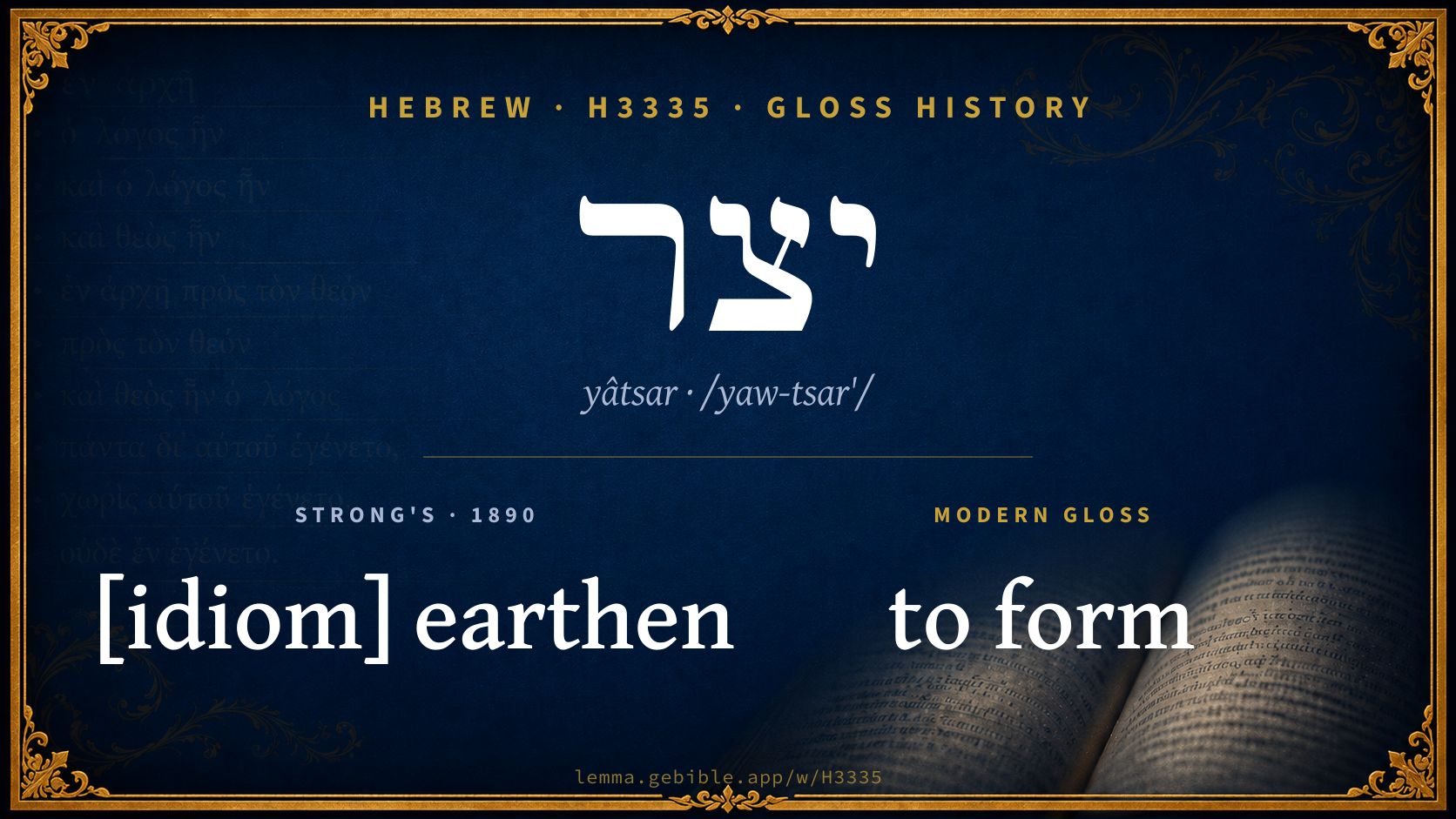
Gloss history
Strong's 1890 vs modern scholarship
About this word
Strong's H3335 catalogs a Hebrew word from the Hebrew Old Testament.
These counts are not copied from any lexicon or concordance. They are computed here, from the morphology-tagged Hebrew Old Testament. What Lemma adds →
- 56
- distinct verses
- The word appears in 56 distinct verses.
- 12 / 39
- OT books
- The word appears in 12 of 39 Old Testament books.
- #611
- by frequency
- Top 1000 most frequent Hebrew words (rank 611 of 8,640 Hebrew words by occurrence).
View all 56 occurrences in the concordance →
By section of the Old Testament
By traditional corpus
Conventional, traditional groupings — biblical authorship is debated, so this is a traditional corpus grouping, not an authorship claim. Each share is this word’s portion of its verses in that division of the Hebrew canon. Each figure is a share of the word’s 56 distinct verses.
- Prophets (Nevi'im) 42 verses · 75%
- Writings (Ketuvim) 10 verses · 18%
- Torah (Pentateuch) 4 verses · 7%
How translations render this word
Counts come from each version’s own published word-to-Strong’s tagging or interlinear alignment — an approximate guide to how each version renders this word, not a word-level alignment the data otherwise carries. Because each total is that version’s own tagged count, the per-version totals vary from one another and need not match the appearance or distinct-verse counts above. These counts may also differ from a printed concordance because Lemma counts each distinctly tagged rendering and does not collapse phrase taggings into a single head-word total. This is a fixed set of word-tagged versions (KJV, ASV, BSB, ULT) and does not change with the reading translation you choose elsewhere. Each version’s license is shown beside its name below (and on Sources).
- King James Version: Formed 6×, Potter 6×, Potter's 5×
- American Standard Version: Potter 10×, Formed 9×, Maker 3×
- Berean Standard Bible: Potter 8×, Formed 7×, Potter’s 5×
- unfoldingWord Literal Text: Potter 12×, Fashioner 7×, Formed 3×
King James Version Public Domain
Renders H3335 across 62 tagged occurrences — most commonly:
Plus 27 renderings that appear only once — usually multi-word phrases or single function words the recovered tagging swept in, not distinct renderings.
American Standard Version Public Domain
Renders H3335 across 62 tagged occurrences — most commonly:
Plus 26 renderings that appear only once — usually multi-word phrases or single function words the recovered tagging swept in, not distinct renderings.
Berean Standard Bible Public Domain
Renders H3335 across 62 tagged occurrences — most commonly:
Plus 31 renderings that appear only once — usually multi-word phrases or single function words the recovered tagging swept in, not distinct renderings.
unfoldingWord Literal Text CC BY-SA 4.0
Renders H3335 across 65 tagged occurrences — most commonly:
Plus 34 renderings that appear only once — usually multi-word phrases or single function words the recovered tagging swept in, not distinct renderings.
11 senses and sub-senses in the full BDB
Hebrew verbs can shift meaning by stem (binyan): Qal is the basic action, Niphal is often passive or reflexive, Piel often intensifies or makes it factitive, and Hiphil is typically causative. The senses below are grouped under the stem BDB assigns to each. This entry also uses Pual (the passive of Piel) and Hophal (the passive of Hiphil).
What do BDB’s symbols mean?
BDB uses these scholarly abbreviations:
| Symbol | Meaning |
|---|---|
| 𝔊 | the Septuagint (the ancient Greek translation, LXX) |
| 𝔙 | the Vulgate (the Latin translation) |
| 𝔖 | the Syriac version (the Peshitta) |
| 𝔗 | the Targum (the Aramaic translation) |
| ψ | the Psalms |
| √ | root (the underlying root or stem) |
| ‖ | parallel passage (a synonymous or contrasted parallel) |
| † | the dagger: every passage where the word occurs is cited |
The 11 senses and sub-senses the full Brown-Driver-Briggs lexicon distinguishes for this word, in lexicon order (not ranked by frequency), with BDB’s own verbatim wording and sub-sense lettering. Shown in Hebrew script with BDB’s own scholarly abbreviations. The condensed entry is in the Lexicon Entry tab. See also the Forms in the corpus table below.
Qal
- Pf. י׳ Is 44:10; יָצָ֑ר Gn 2:8; sf. יְצָרָהּ Is 45:18; 2 m. יָצַרְתָּ ψ 104:26 + 8 times Pf.; Impf. 3 m. וַיִּ֫יצֶר Gn 2:7; וַיִּצֶ֫ר v 19; sf. יִצְּרֵהוּ Is 44:12; 1 s. sf. אֶצָּו֯רְךָ Je 1:5; Pt. יוֹצֵר Is 41:25 + 20 times; יֹצֵר 45:18 + 6 times; sf. יֹצְרִי 49:5 + 11 times sf.; pl. יוֹצְרִים 30:14 1 Ch 4:23; cstr. יֹצְרֵי Is 44:9;— e.g. Isaiah 44:10
- 1. of human activity:
- a. of a potter who forms out of clay a vessel Is 29:16; 41:25 Je 18:4(×2), 6(×2) 1 Ch 4:23 La 4:2 Zc 11:13(×2) (these last two according to Thes SS et al. error for אוֹצָר); כְּלִי (ה)י׳ potter’s vessel 2 S 17:28 ψ 2:9 Je 19:11; חֹמֶר הי׳ potter’s clay Is 29:16; נֵבֶל י׳ 30:14; בַּקְבֻּק י׳ Je 19:1; בית הי׳ 18:2, 3. e.g. Isaiah 29:16
- b. of a carver of wood, graven images Is 44:9, 10, 12 Hb 2:18(×2). e.g. Isaiah 44:9
- c. frame, devise in the mind י׳ עָמָל ψ 94:20. e.g. Psalms 94:20
- 2. of divine activity:
- a. (as a potter) forming Adam out of עפר from אדמה Gn 2:7, 8 (J), beasts and birds, also from אדמה v 19 (J); Israel as a people Is 27:11; 43:1, 21; 44:21; 45:9(×2), 11; 64:7, even from the womb 44:2, 24; the servant of Yahweh from the womb 49:5; of the formation of the individual man 43:7; Jeremiah in the womb Je 1:5; the eye of man ψ 94:9; the locust Am 7:1; Leviathan ψ 104:26; the dry land 95:5; the earth Is 45:18(×2); the mountains Am 4:13; הַכֹּל Je 10:16 = 51:19. Fig. perhaps lost sight of in some of the above, and quite certainly in the forming of light Is 45:7, of summer and winter ψ 74:17, the רוּחַ of man Zc 12:1, and the לב of men ψ 33:15. e.g. Genesis 2:7
- b. fig. for frame, pre-ordain, plan (in divine purpose), of a situation מֵרָחוֹק Is 22:11; of an occurrence מִימֵי קֶדֶם 37:26 = 2 K 19:25; יָצַרְתִּי אַף אֶעֱשֶׂנָּה I have planned, I will also do it 46:11; י׳ רעה על Je 18:11; י׳ לַהֲכִינָהּ devised it to establish it 33:2. e.g. Isaiah 22:11
Niphal
- Pf. לְפָנַי לֹא־נוֹצַר אֵל Is 43:10 before me a god was not formed (created). e.g. Isaiah 43:10
Pual
- Pf. יָמִים יֻצָּ֑רוּ days (that) were pre-ordained (in the divine purpose) ψ 139:16 (cf. Qal, 2 b). e.g. Psalms 139:16
Hophal
- Impf. כָּל־כְּלִי יוּצַר עָלַיִךְ לֹא יִצְלָ֑ח Is 54:17 any weapon that is formed against thee will not prosper. e.g. Isaiah 54:17
Senses from the full Brown-Driver-Briggs lexicon (Brown, Driver, Briggs; Oxford 1906 — public domain), digitized via Sefaria, supplemented by the OpenScriptures HebrewLexicon (CC BY 4.0). Full attribution on Sources.
Word origin
vb. form, fashion (NH in pt. יוֹצֵר potter, creator, and deriv.; Ph. יצר potter; 𝔗 יצר; Syriac ܝܰܨܪܳܐ = יֵצֶר, etc.; Arabic وِصْرٌ covenant, contract; Assyrian êṣêru, as Heb., DlHWB 309)—
— Brown-Driver-Briggs (Oxford 1906, public domain), digitized via Sefaria, supplemented by the OpenScriptures HebrewLexicon (CC BY 4.0). See Sources.
Derived from יצר (yâtsar) (H3334) — to bind.
Jastrow Dictionary
A second Hebrew/Aramaic lexicon for comparison, covering Aramaic and post-biblical (Talmudic, Targumic, Midrashic) usage that the biblical-Hebrew BDB does not. Matched by lemma rather than by Strong’s number, so a lemma may carry more than one Jastrow headword (shown separately below), and the entries cover usage well beyond the Bible.
יָצַר
- to turn, shape, form. Keth. 8ᵃ (marriage benediction) אשר י׳ את וכ׳ who hast formed man in thine image. Ber. 58ᵇ (prayer in a burial place) אשר י׳ אתכם וכ׳ who created you in justice &c.; a. fr.—Part. יוֹצֵר (as noun, v. יוֹצֵר). Ib. 11ᵇ (in the morning prayer) י׳ אור בורא וכ׳ who didst form light and create darkness.—יוֹצֵר אוֹר or יוֹצֵר name of one of the benedictions preceding the reading of the morning Sh’ma. Ib.; ib. 12ᵃ; a. fr.
- to be formed, created; to be fully developed. Gen. R. s. 9 קודם עד שלא נוֹצְרָה מחשבה וכ׳ ere yet a thought is formed in the heart of man &c. Ib. קודם … נ׳ יצור, v. יְצִיר. Ab. II, 8 לכך נוֹצָרְתָּ for that purpose (of studying) thou hast been created. Ib. IV, 22. Gen. R. s. 14, beg.; Y. Yeb. IV, 5ᵈ top נ׳ לשבעה if the embryo was fully developed at seven months, contrad. to נולד, v. יָלַד. Yoma 85ᵃ; Sot. 45ᵇ מהיכן הוולד נ׳ from where does the formation of the embryo start?; a. fr.—V. צוּר.
יְצַר
- Targ. Am. IV, 13 דִּיצַר (some ed. דְּצָר), v. צוּר
- to be created, formed. Yoma 85ᵃ; Sot. 45ᵇ ממציעתיה מִיתְּצַר the formation of the embryo starts from the central portion of the body.
יֵצֶר
- preced.) [shape, formation, whence] (v. Gen. VI, 5) = י׳ מחשבות the formation of thoughts, bent of mind, inclination, desire.—י׳ הטוב or י׳ טוב (abbr. יה"ט or י"ט) the good nature of man, the inclination to do good; (personified) the good genius; י׳ הרע (abbrev. יצה"ר), also only י׳ the evil inclination, worldly desires; (personified) the tempter. Ber. 61ᵃ מיִצְרִי, v. יוֹצֵר. Gen. R. s. 9; Koh. R. to III, 11 אילולי יצה"ר לא בנה וכ׳ but for the worldly desires of man, none would build a house &c. Ab. II, 11 עין הרע ויצה"ר וכ׳ greed, sensual passion and hatred &c. Snh. 103ᵃ; Yalk. Ps. 842 שלא ישלוט בך יצה"ר that temptation may have no power over thee. Succ. 52ᵃ … לעתיד מביאו ליצה"ר וכ׳ in the days to come the Lord shall bring the Tempter and slaughter him &c. Gen. R. s. 22 מפנק את יִצְרוֹ who indulges the senses. Ib. אם בא יִצְרְךָ להשחיקך when thy inclination (Tempter) comes to lead thee to amusement. Cant. R. to VII, 8 י׳ ע"ז the passion for idolatry, י׳ זנות the passion of lust. Ab. IV, 1 הכובש את יצרו who conquers his inclination; a. v. fr. [Yoma 69ᵇ כובש את יצרו, read with Ms. M. כעסו.]—Pl. יְצָרִים. Ber. 61ᵃ (ref. to וייצר, Gen. II, 7, v. יְצִירָה) שני י׳ וכ׳ two natures, the good and the evil. Cant. R. l. c. שני י׳ ברא וכ׳ two passions did God create in this world, v. supra. Snh. 105ᵃ יסרו יצריכם chasten your passions; Yalk. Is. 302.—[יְצָרִים moulds, v. יְצִירִין.] e.g. Genesis 6:5
יֵצֶר ²
- Targ. Gen. VI, 5. Targ. Ps. XIII, 5; a. fr.—Sabb. 156ᵇ אלמיה יִצְרֵיה, v. אֲלַם. Ḥag. 16ᵃ דמצי כייף ליה ליצריה when he can conquer his passion. Kidd. 81ᵇ; Keth. 51ᵇ יצר אלבשה, v. לְבַשׁ. Snh. 64ᵃ היינו י׳ דע"ז this (lion of fire) is the passion for (tempter to) idolatry. Ib. ניבעי רחמי אַיִּ׳ דעבירה let us pray against the sensual desire (the tempter to sexual indulgence); a. fr.
A Dictionary of the Targumim, the Talmud Babli and Yerushalmi, and the Midrashic Literature (Marcus Jastrow; London, Luzac, 1903) — Public Domain. Digitized via Sefaria. Digitized via Sefaria. Full attribution on Sources.
Forms in the corpus
The 53 distinct written forms H3335 takes in the Hebrew Bible, most frequent first — each parse links to that stem’s occurrences in the concordance. Hebrew forms include their vowel points and cantillation, so a single lemma takes many written forms.
Same root — word family
Other BDB entries built from the same root as H3335, grouped by Strong’s listed origin. These share a root / origin per the lexicon — not necessarily a shared meaning. Each links to that word’s own entry.
Derives from
Derived from this word
Proper names from this root
People and places named from this root — a name, not an additional meaning of the word.
Compare all same-root words → Showing 4 of 5 — not the complete family. 1 of the same-root words is a proper name (a person or place). They share a root, not necessarily a meaning.
Septuagint verse parallels
This word appears in 53 verses that also exist in the Greek Old Testament (Septuagint), out of the 56 Hebrew verses it occurs in. You can read those verses in Greek by switching the Old Testament edition to the Septuagint.
Read these verses in the Septuagint
- Genesis 2:7
- Exodus 32:4
- 2 Samuel 17:28
- 2 Kings 19:25
- 1 Chronicles 4:23
- Psalms 2:9
- Isaiah 22:11
- Jeremiah 1:5
- Lamentations 4:2
- Amos 4:13
- Habakkuk 2:18
- Zechariah 11:13
This is a verse-level parallel only — the same verses exist in both the Hebrew and Greek Old Testaments. No word-level Hebrew↔Greek correspondence is claimed: the data carries no such alignment, so no Greek word is shown as this Hebrew word’s translation. Coverage is not total — the Septuagint omits the deuterocanon and renumbers the Psalms, so some Hebrew verses have no direct Greek parallel.