
Isaiah 30:14

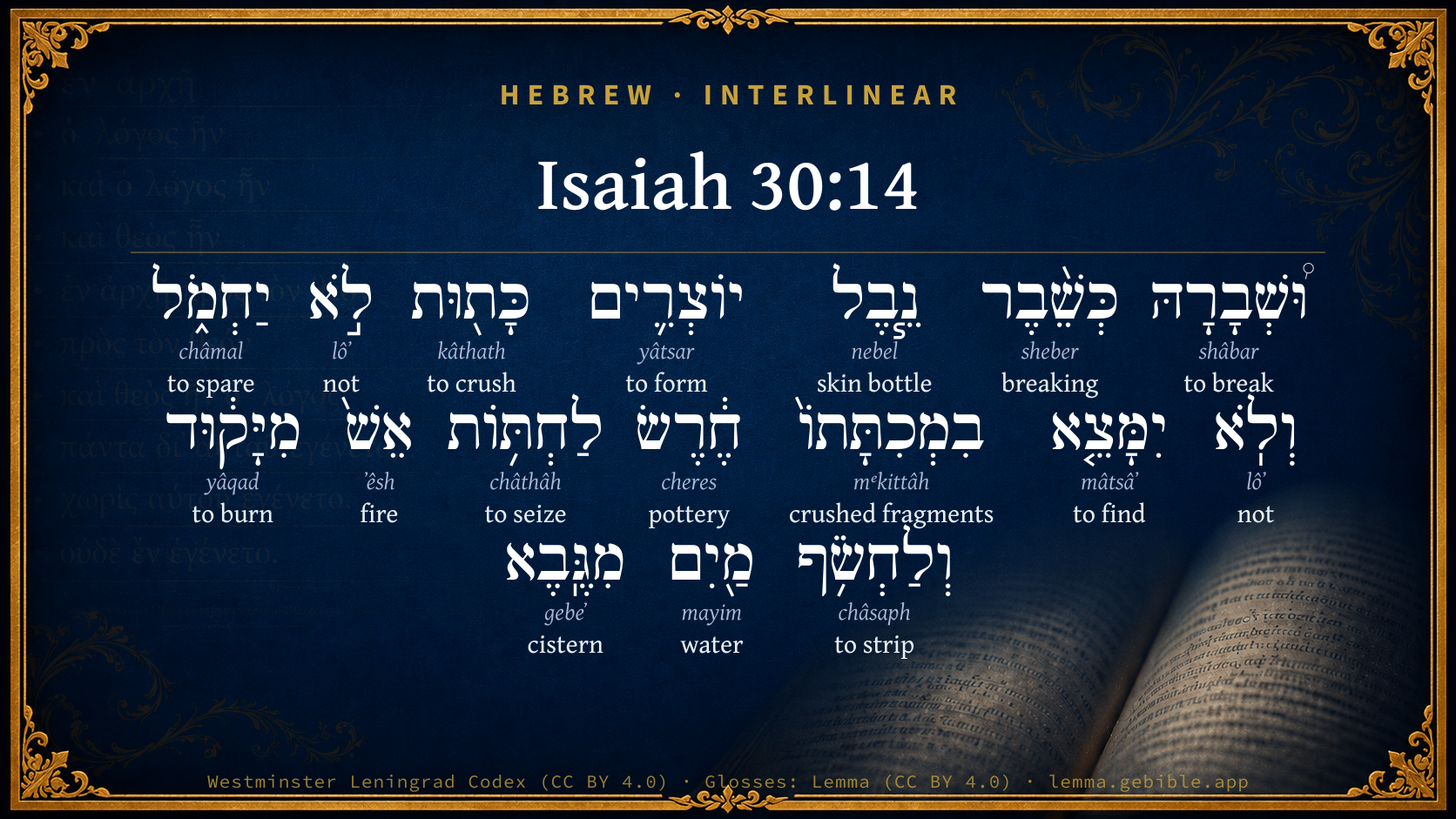
Hebrew (Westminster Leningrad Codex) Isaiah 30:14 appears in the Hebrew Old Testament. The text above is from the Westminster Leningrad Codex. Each word links to its Strong’s number, a concise gloss, and parsing drawn from the Open Scriptures Hebrew Bible morphology. Click any word for its full Brown-Driver-Briggs (BDB) entry.
Download image
Cite this verse

Isaiah 30:14 (World English Bible). Public Domain. Lemma interlinear Bible study tool, https://lemma.gebible.app/v/isaiah/30/14.

Show BibTeX & RIS
BibTeX
RIS
English Translation
He shall break it as a potter's vessel is broken, breaking it in pieces without sparing; so that there shall not be found among the pieces of it a broken piece with which to take fire from the hearth, or to dip up water out of the cistern."
World English Bible · Public Domain
Highlights
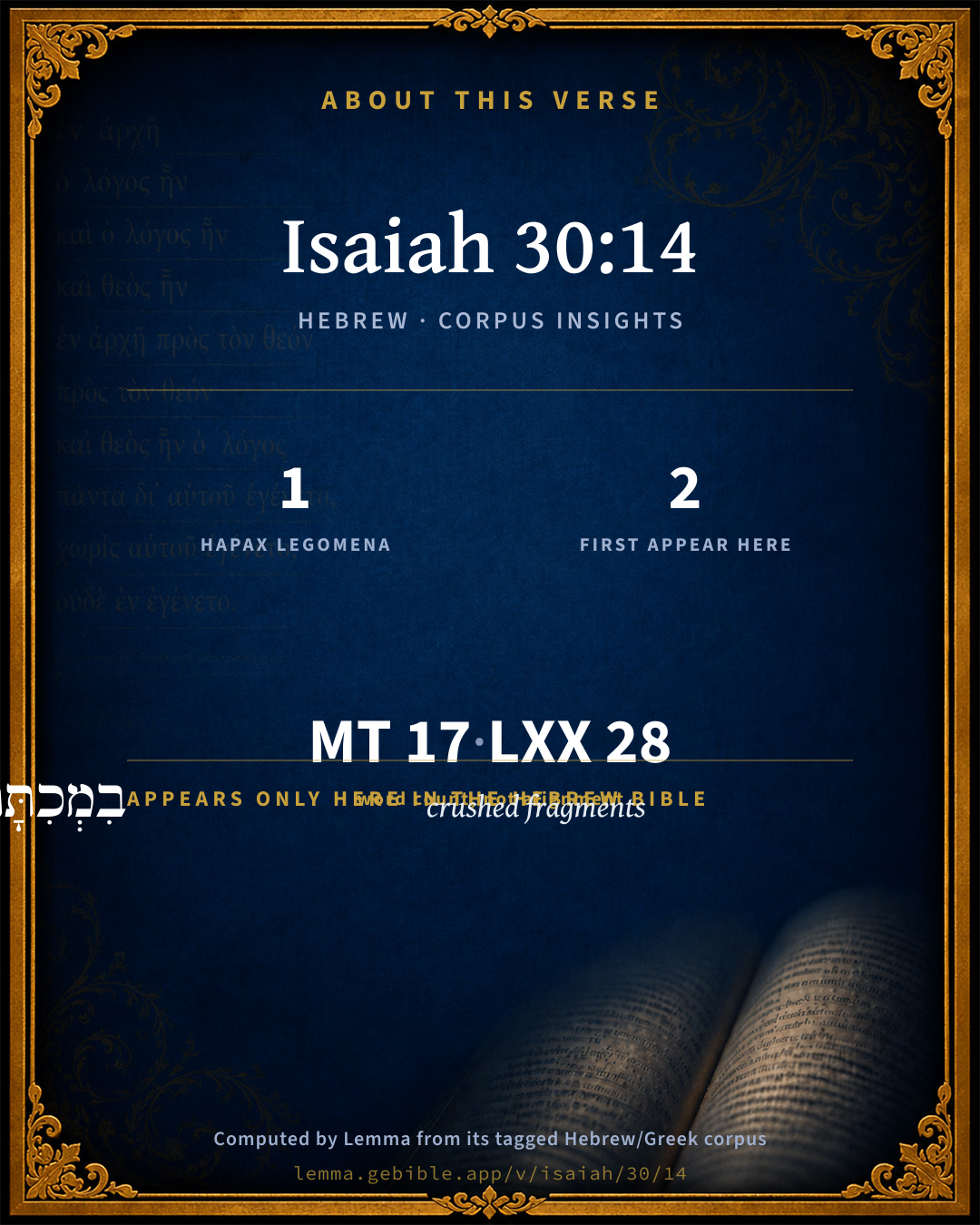
  • 1 hapax legomenon — only here in the Hebrew Bible
  • 2 first appearances in the Hebrew Bible
Full analysis ↓
Download a study sheet

One document with this verse’s original text, its word-by-word gloss line, the meaning frame, cross-references with their text, attributed commentary, and full source and license credits — printable, and it pastes into notes with its structure intact.

This verse Autodidact and up

Study sheet (.html) Plain text (.txt)

A passage Seminary Student

Up to 50 verses in one chapter. A passage sheet keeps up to 6 commentary sources and 12 cross-references per verse, in the order this page ranks them, and says so on the sheet whenever that leaves anything out. Ask for a single verse and you get the Autodidact verse sheet above.

Everything on this page stays free to read, with no account — the sheet is a download of what is already on screen, not access to it.

Want to remove ads? Support Godless Engineer
Compare translations 3

The same verse in 3 English versions, stacked beneath the original-language interlinear above. Click any original word for its lexicon entry.

Each is an independent rendering of the whole verse — the interlinear is not word-aligned to these translations.

Highlighted words mark where these versions differ — a whole-verse word diff, not a word-by-word alignment.

  • World English Bible Public Domain
    He shall break it as a potter's vessel is broken, breaking it in pieces without sparing; so that there shall not be found among the pieces of it a broken piece with which to take fire from the hearth, or to dip up water out of the cistern."
  • King James Version Public Domain
    And he shall break it as the breaking of the potters' vessel that is broken in pieces; he shall not spare: so that there shall not be found in the bursting of it a sherd to take fire from the hearth, or to take water withal out of the pit.
  • unfoldingWord Literal Text CC BY-SA 4.0
    And he will break it like the breaking of a vessel of potters, crushed, one does not spare. And a shard will not be found among its fragments to take fire from a hearth or to scoop water from a cistern.”

unfoldingWord Literal Text — © unfoldingWord, licensed CC BY-SA 4.0. Word-aligned USFM3 via Door43 (git.door43.org/unfoldingWord/en_ult).

Versions to compare (up to 4)

3 of 4 selected

Show all 18 translations

Every available English version of this verse, each an independent rendering of the whole verse.

  • World English Bible Public Domain
    He shall break it as a potter's vessel is broken, breaking it in pieces without sparing; so that there shall not be found among the pieces of it a broken piece with which to take fire from the hearth, or to dip up water out of the cistern."
  • Berean Standard Bible Public Domain
    It will break in pieces like a potter’s jar, shattered so that no fragment can be found. Not a shard will be found in the dust large enough to scoop the coals from a hearth or to skim the water from a cistern.”
  • Majority Standard Bible Public Domain
    It will break in pieces like a potter’s jar, shattered so that no fragment can be found. Not a shard will be found in the dust large enough to scoop the coals from a hearth or to skim the water from a cistern.”
  • King James Version Public Domain
    And he shall break it as the breaking of the potters' vessel that is broken in pieces; he shall not spare: so that there shall not be found in the bursting of it a sherd to take fire from the hearth, or to take water withal out of the pit.
  • American Standard Version (1901) Public Domain
    And he shall break it as a potter's vessel is broken, breaking it in pieces without sparing; so that there shall not be found among the pieces thereof a sherd wherewith to take fire from the hearth, or to dip up water out of the cistern.
  • Revised Version (1885) Public Domain
    And he shall break it as a potter’s vessel is broken, breaking it in pieces without sparing; so that there shall not be found among the pieces thereof a sherd to take fire from the hearth, or to take water withal out of the cistern.
  • Geneva Bible (1599) Public Domain
    And the breaking thereof is like the breaking of a potters pot, which is broken without pitie, and in the breaking thereof is not found a sheard to take fire out of the hearth, or to take water out of the pit.
  • Douay-Rheims (1899) Public Domain
    And it shall be broken small, as the potter's vessel is broken all to pieces with mighty breaking, and there shall not a sherd be found of the pieces thereof, wherein a little fire may be carried from the hearth, or a, little water be drawn out of the pit.
  • Young's Literal Translation Public Domain
    And He hath broken it As the breaking of the potters' bottle, Beaten down -- He doth not spare, Nor is there found, in its beating down, A potsherd to take fire from the burning, And to draw out waters from a ditch.
  • Literal Standard Version CC BY-SA 4.0
    And He has broken it || As the breaking of the potters’ bottle, || Beaten down—He does not spare, || Nor is there found, in its beating down, || A potsherd to take fire from the burning, || And to draw out waters from a ditch.”
  • Unlocked Literal Bible CC BY-SA 4.0
    He will break it as a potter's vessel is broken; he will not spare it, so that there will not be found among its pieces a shard with which to scrape fire from the hearth, or to scoop up water out of the cistern.
  • unfoldingWord Literal Text CC BY-SA 4.0
    And he will break it like the breaking of a vessel of potters, crushed, one does not spare. And a shard will not be found among its fragments to take fire from a hearth or to scoop water from a cistern.”
  • Darby Bible Public Domain
    And he shall break it as the breaking of a potter's vessel, that is broken in pieces unsparingly; and in the pieces of it there shall not be found a sherd to take fire from the hearth, or to scoop water out of the cistern.
  • World Messianic Bible Public Domain
    He will break it as a potter’s vessel is broken, breaking it in pieces without sparing, so that there won’t be found among the broken pieces a piece good enough to take fire from the hearth, or to dip up water out of the cistern.”
  • Webster's Bible Public Domain
    And he shall break it as the breaking of the potter's vessel that is broken in pieces; he shall not spare: so that there shall not be found in the bursting of it a piece to take fire from the hearth, or to take water out of the pit.
  • Free Bible Version CC BY-SA 4.0
    You will be smashed like a clay pot, broken into such tiny pieces that there won't be a big enough piece to pick up coals from a hearth or a little bit of water from a well.
  • Bible in Basic English Public Domain
    And he will let it be broken as a potter's vessel is broken: it will be smashed to bits without mercy; so that there will not be a bit in which one may take fire from the fireplace, or water from the spring.
  • JPS Tanakh (1917) Public Domain
    And He shall break it as a potter's vessel is broken, breaking it in pieces without sparing; so that there shall not be found among the pieces thereof a sherd to take fire from the hearth, or to take water out of the cistern.

Literal Standard Version (2020), Covenant Press — licensed CC BY-SA 4.0. Text via the HelloAO Bible API (eBible.org). Unlocked Literal Bible (unfoldingWord) — licensed CC BY-SA 4.0. Text via the HelloAO Bible API (eBible.org). unfoldingWord Literal Text — © unfoldingWord, licensed CC BY-SA 4.0. Word-aligned USFM3 via Door43 (git.door43.org/unfoldingWord/en_ult). Free Bible Version, Dr. Jonathan Gallagher — licensed CC BY-SA 4.0. Text via the HelloAO Bible API (eBible.org).

Word by word

More ways to search: Search by grammar → Find every occurrence → Compare this word →

Practice this passage: Drill this verse → Learn its vocabulary →

בִמְכִתָּתוֹ֙
mᵉkittâh
H4386
“in/at · crushed fragments · his”
Preposition + Noun, Common, Feminine, Singular, Construct + Suffix, Personal, 3rd Person, Masculine, Singular
Part of Speech
Preposition + Noun
Type
Common
Gender
Feminine
Number
Singular
State
Construct
Full BDB Definition

Origin: from H3807

TWOT: 1062b

crushed or pulverised fragments
  1. וּ֠שְׁבָרָהּ shâbar H7665 “and · to break · her” Conjunction + Verb, Qal, Sequential Perfect, 3rd Person, Masculine, Singular + Suffix, Personal, 3rd Person, Feminine, Singular
  2. כְּשֵׁ֨בֶר sheber H7667 “like/as · breaking of” Preposition + Noun, Common, Masculine, Singular, Construct
  3. נֵ֧בֶל nebel H5035 “skin bottle” Noun, Common, Masculine, Singular, Absolute
  4. יוֹצְרִ֛ים yâtsar H3335 “fashioners” Noun, Common, Masculine, Plural, Absolute
  5. כָּת֖וּת kâthath H3807 “crushed” Verb, Qal, Participle Passive, Masculine, Singular, Absolute
  6. לֹ֣א lôʼ H3808 “not” Particle, Negative
  7. יַחְמֹ֑ל châmal H2550 “to spare” Verb, Qal, Imperfect, 3rd Person, Masculine, Singular
  8. וְלֹֽא lôʼ H3808 “and · not” Conjunction + Particle, Negative
  9. יִמָּצֵ֤א mâtsâʼ H4672 “to find” Verb, Niphal, Imperfect, 3rd Person, Masculine, Singular
  10. חֶ֔רֶשׂ cheres H2789 “pottery” Noun, Common, Masculine, Singular, Absolute
  11. לַחְתּ֥וֹת châthâh H2846 “to seize” Preposition + Verb, Qal, Infinitive Construct
  12. אֵשׁ֙ ʼêsh H784 “fire” Noun, Common, Both, Singular, Absolute
  13. מִיָּק֔וּד yâqad H3344 “from · hearth” Preposition + Noun, Common, Masculine, Singular, Absolute
  14. וְלַחְשֹׂ֥ף châsaph H2834 “and · to strip” Conjunction + Preposition + Verb, Qal, Infinitive Construct
  15. מַ֖יִם mayim H4325 “water(s)” Noun, Common, Masculine, Plural, Absolute
  16. מִגֶּֽבֶא gebeʼ H1360 “from · cistern” Preposition + Noun, Common, Masculine, Singular, Absolute

About this verse

These counts appear in no published source. They are computed here, from the morphology-tagged text and Lemma’s own curated glosses. What Lemma adds →

17
words
16
distinct lemmas
Prophets
section

Notable vocabulary

1 hapax legomenon — a word that appears only here in the entire Hebrew Bible:

  • בִמְכִתָּתוֹ֙ crushed fragments H4386

First appearance in Scripture

These words make their first canonical appearance in the Hebrew Bible here:

  • בִמְכִתָּתוֹ֙ crushed fragments H4386
  • מִגֶּֽבֶא cistern H1360

Shared distinctive vocabulary

מִגֶּֽבֶא cistern H1360 occurs in 2 verses of the Hebrew Bible. Also found in:

Grammatical profile

  • 6 verbs
  • 9 nouns
  • 2 particles

Verb forms

  • וּ֠שְׁבָרָהּ Qal · Sequential Perfect
  • כָּת֖וּת Qal · Participle Passive
  • יַחְמֹ֑ל Qal · Imperfect
  • יִמָּצֵ֤א Niphal · Imperfect
  • לַחְתּ֥וֹת Qal · Infinitive Construct
  • וְלַחְשֹׂ֥ף Qal · Infinitive Construct

Repetition

A word recurs within this verse — often emphatic in Hebrew:

Hebrew & Septuagint length

In English translation the verse runs 48 words from the Hebrew and 45 from the Septuagint (LXX English) — closely comparable.

A rough comparison of the two English renderings, which tokenize alike — not a word-level alignment.

Word counts can differ between the Hebrew and the Greek without any difference in meaning — e.g. the Hebrew direct-object marker אֵת has no separate Greek word, and Greek often adds the article ὁ.

In the original languages it is 17 Hebrew tokens and 28 Greek tokens — but the two are counted differently (Hebrew bundles its prefixes and suffixes into one token; the Greek is in lemma form), so that isn’t a like-for-like length.

Cross-references

21

Topical passages linked to Isaiah 30:14 in the Treasury of Scripture Knowledge — connected by theme and wording, ordered by reader-vote popularity; previews shown in the World English Bible.

  • Psalms 2:9 You shall break them with a rod of iron. You shall dash them in pieces like a potter's vessel."
  • Jeremiah 19:10–11 Then shall you break the bottle in the sight of the men who go with you,
  • 2 Peter 2:4–5 For if God didn't spare angels when they sinned, but cast them down to Tartarus, and committed them to pits of darkness, to be reserved to judgment;
  • Revelation 2:27 He will rule them with a rod of iron, shattering them like clay pots; as I also have received of my Father:
  • Ezekiel 24:14 I, Yahweh, have spoken it: it shall happen, and I will do it: I will not go back, neither will I spare, neither will I repent; according to your ways, and according to your doings, shall they judge you, says the Lord Yahweh.
  • Romans 11:21 for if God didn't spare the natural branches, neither will he spare you.
  • Deuteronomy 29:20 Yahweh will not pardon him, but then the anger of Yahweh and his jealousy will smoke against that man, and all the curse that is written in this book shall lie on him, and Yahweh will blot out his name from under the sky.
  • Job 27:22 For it hurls at him, and does not spare, As he flees away from his hand.
  • Psalms 31:12 I am forgotten from their hearts like a dead man. I am like broken pottery.
  • Isaiah 27:11 When the boughs of it are withered, they shall be broken off; the women shall come, and set them on fire; for it is a people of no understanding: therefore he who made them will not have compassion on them, and he who formed them will show them no favor.
  • Isaiah 47:14 Behold, they shall be as stubble; the fire shall burn them; they shall not deliver themselves from the power of the flame: it shall not be a coal to warm at, nor a fire to sit before.
  • Jeremiah 13:14 I will dash them one against another, even the fathers and the sons together, says Yahweh: I will not pity, nor spare, nor have compassion, that I should not destroy them.
  • Jeremiah 48:38 On all the housetops of Moab and in the streets of it there is lamentation every where; for I have broken Moab like a vessel in which none delights, says Yahweh.
  • Ezekiel 5:11 Therefore, as I live, says the Lord Yahweh, surely, because you have defiled my sanctuary with all your detestable things, and with all your abominations, therefore will I also diminish [you]; neither shall my eye spare, and I also will have no pity.
  • Ezekiel 7:4 My eye shall not spare you, neither will I have pity; but I will bring your ways on you, and your abominations shall be in the midst of you: and you shall know that I am Yahweh.
  • Ezekiel 7:9 My eye shall not spare, neither will I have pity: I will bring on you according to your ways; and your abominations shall be in the midst of you; and you shall know that I, Yahweh, do strike.
  • Ezekiel 8:18 Therefore will I also deal in wrath; my eye shall not spare, neither will I have pity; and though they cry in my ears with a loud voice, yet will I not hear them.
  • Ezekiel 9:10 As for me also, my eye shall not spare, neither will I have pity, but I will bring their way on their head.
  • Ezekiel 15:3–8 Shall wood be taken of it to make any work? or will men take a pin of it to hang any vessel thereon?
  • Luke 4:2 for forty days, being tempted by the devil. He ate nothing in those days. Afterward, when they were completed, he was hungry.
  • Romans 8:32 He who didn't spare his own Son, but delivered him up for us all, how would he not also with him freely give us all things?

Cross-references courtesy of OpenBible.info (CC BY 4.0).

Hebrew and Greek witnesses Masoretic Hebrew ↔ Greek Septuagint

The same verse in the two great witnesses to the Old Testament, shown verse-for-verse.

These are two independent witnesses, not word-aligned to each other, and the Septuagint is shown in lemma (dictionary) form.

Hebrew Isaiah 30:14 Masoretic · Westminster Leningrad Codex

וּ֠שְׁבָרָהּ כְּשֵׁ֨בֶר נֵ֧בֶל יוֹצְרִ֛ים כָּת֖וּת לֹ֣א יַחְמֹ֑ל וְלֹֽא יִמָּצֵ֤א בִמְכִתָּתוֹ֙ חֶ֔רֶשׂ לַחְתּ֥וֹת אֵשׁ֙ מִיָּק֔וּד וְלַחְשֹׂ֥ף מַ֖יִם מִגֶּֽבֶא

He shall break it as a potter's vessel is broken, breaking it in pieces without sparing; so that there shall not be found among the pieces of it a broken piece with which to take fire from the hearth, or to dip up water out of the cistern."

World English Bible · Public Domain

Greek LXX Isaiah 30:14 Septuagint · lemma form

καί ὁ πτῶμα αὐτός εἰμί ὡς σύντριμμα ἀγγεῖον ὀστράκινος ἐκ κεράμιον λεπτός ὥστε μή εὑρίσκω ἐν αὐτός ὄστρακον ἐν ὅς πῦρ αἴρω καί ἐν ὅς ἀποσυρίζω ὕδωρ μικρός

And the fall thereof shall be as the breaking of an earthen vessel, as small fragments of a pitcher, so that you should not find among them a sherd, with which you might take up fire, and with which you should draw a little water.

LXX2012 (modern English Septuagint) · Public Domain

On this verse, Albert Barnes' Notes on the Bible discusses the Septuagint’s reading. Read the note in Commentary ↓

Hebrew: Westminster Leningrad Codex (CC BY 4.0). Greek: Septuagint (public domain); English from LXX2012 (modern English Septuagint) (Public Domain). How the Septuagint differs from the Hebrew →

Targum (Aramaic paraphrase)

1

The Targum is the ancient Jewish Aramaic paraphrase of the Hebrew Scriptures — an interpretive translation, not the Hebrew text itself. Onkelos (literal) and Pseudo-Jonathan (expansive) render the Torah, and Jonathan the Prophets. Coverage is partial: where no permissively-licensed English translation exists for a verse, only the Aramaic is shown. This is verse-level text, not a word-by-word alignment to the Hebrew.

  1. Targum Jonathan Prophets (Joshua–Malachi)
    וְתַבְרָהּ כְּתִבוּר מַן דַחֲסַף דְפַחְרָא דְמִדַקַק לָא בַחֲיָס וְלָא מִשְׁתְּכַח בְּדִיקוּקֵיהּ חֲסַף לְמֶחְתֵי גוּר מִמַבְעוֹר וּלְמִדְלַח מַיִין מִפְצִיר:

    And its breaking shall be as the breaking of a potter's vessel of clay, who is breaking it without compassion, and among its fragments there shall not be found a potsherd to take fire from the hearth, or to draw water from the cistern.

    Targum Jonathan — Aramaic: “Mikraot Gedolot” (public domain). English: “Sefaria Community Translation” (CC0 1.0 (public-domain dedication)); “London "Chaldee Paraphrase," 1871” (public domain). Text via Sefaria.

Commentary

Notes on Isaiah 30:14 from classic Christian and Jewish commentators (each source and its license shown beneath its notes). The classic Christian expositions comment on the surrounding passage and are grouped to its opening verse, so a note may address several verses; the Jewish commentaries on the Tanakh (Rashi and others) are per-verse, so they appear only where the commentator wrote on this verse.

Lemma curates 59 commentaries, every one of them public domain or Creative Commons licensed, each selected and text-cleaned for this edition rather than reprinted as found. About our sources →

Trapp's Complete Commentary

John Trapp

Isa 30:14 And he shall break it as the breaking of the potters’ vessel that is broken in pieces; he shall not spare: so that there shall not be found in the bursting of it a sherd to take fire from the hearth, or to take water [withal] out of the pit.

Ver. 14. And he shall break it as the breaking of a potter’s vessel.] Collige ex hoc loco, saith Oecolampadius, gather we may from this text that remediless ruin will befall such as resist the Holy Ghost, and sin against light.

John Trapp, A Commentary or Exposition upon All the Books of the Old and New Testament (1647–1656) — public domain. Text from a community e-Sword module.

The Biblical Illustrator

Joseph S. Exell

Isa_30:14

He shall break it as the breaking of the potters vessel

A pottery mound

One of the most curious objects in Rome is a huge artificial mound called Monte Testaccio.

It stands near the gate of St. Pauls, between the Aventine Hill and the Tiber . . . It is a conspicuous object, being nearly one-third of a mile in circumference, and about a hundred and fifty feet high, commanding from its top an extensive view of the most desolate and historical parts of the Eternal City, and the Campagna a beyond. It is an easy task to climb it, for on different sides there are well-worn tracks from the base to the summit. The surface covered in a few places with a little sprinkling of soil, and a sparse vegetation of grass and coarse weeds; but a close examination reveals the remarkable fact that the mound is almost entirely composed of fragments of broken earthenware. Specimens of ancient pottery of all kinds may be found lying loosely on the surface of the heap, or by digging a little way into the mass . . . Not one vessel was whole, nor could the broken pieces be united to form even the least important part of any vessel. The mound, from the nature of its materials, is evidently of very ancient origin, nothing having been added to it since the early Christian ages; but it must have taken many centuries to form it by slow accumulation. Various theories have been proposed regarding it; but the most plausible conjecture is that which connects it with the neighbouring emporium or custom house, where all the goods that were landed at the ancient quay of Rome were stored up for a time. It was the practice in those days to import not only wine and oil, and other fluids, but also corn and solid articles of food and of domestic use into the imperial city in earthenware jars for more convenient carriage. In the act of unloading, immense quantities of these fragile vessels would be broken, and the fragments carried away to this spot, where they would accumulate in course of time into the huge heap which now astonishes every spectator. This explanation, however, is only a partial one; for were it complete we should expect to find in the mound only vessels of one kind, fitted for storage purposes. But it contains, as I have said, fragments of the most varied assortment of vessels for household use and for ornamental and even for sepulchral purposes . . . It became, in fact, the general receptacle for the broken pottery of the whole city. That this was carefully collected into this one spot, instead of being thrown out anywhere, and that no other rubbish was allowed, except accidentally, to ruing o with it, shows clearly that the heap was intended for some economical use. We have indeed reason to believe that this broken earthenware, ground into smaller fragments and pulverised, formed an ingredient in the famous Roman cement employed in the construction of buildings whose hardness and durability were proverbial. But it is not in Rome only that such ancient mounds of broken pottery are found. Similar heaps of potsherds, not on quite so large a scale, may be seen outside the walls of Alexandria and Cairo. The sites, indeed, of many ancient towns, especially those built of crude, sun-dried bricks, are often covered with great quantities of such fragments exposed to view and collected together by the disintegrating action of the weather upon the ruins, giving them the appearance of a deserted pottery rather than that of a town. Parti-coloured heaps of broken pottery are common in the neighbourhood of old villages and towns in Palestine. They are especially abundant in one or two places near Jerusalem. (H. Macmillan, D. D.)

The shivering of the potters vessel

The passage is literally, And its shivering שֶׁבֶר shever, from which perhaps comes our shiver) shall be like the shivering of a potters vessel, a shattering unsparingly; so that there shall not be found in the bursting of it a potsherd to take fire from the hearth, or to take water out of the pit. Bearing in mind the size and strength of many potters vessels in Palestine, it is clear, that a mere dashing out of the hand upon the ground would fail to effect a shivering anything like this. To what then do the prophets refer? We think the matter admits of a very clear explanation. One of the most constant features of the land is the well or beer, which, as no rain falls for many months together, and springs and streams are rare, becomes an essential adjunct to every house. In these large underground structures rainwater is collected from surface drainage, and stored for use during the year. The Moabite stone records an act, passed by Mesha, King of Moab, so far back as the days of Jehoshaphat, King of Judah, directing every man to make a beer, or rain cistern, in his house. But such testimony would not be needed to establish the great age of these huge artificial cisterns. They abound everywhere, and many of them, In fine preservation, mark the sites of very ancient cities, where no other structure remains. There are no less than thirty of them, some of vast size, built on piers, and arched like the crypt of a church, to be found within the precincts of the temple area at Jerusalem. They are specially numerous in the fine olive grove to the north of the city, where they are in such a ruinous condition, apparently from extreme age, that they now form a series of dangerous pitfalls. In addition to these wells is to be found a system of immense artificial pools, or rain reservoirs, which are often referred to in the Bible, and of which no less than seven may now be traced in and around Jerusalem itself. To all these cisterns and reservoirs, whether cut in the rock, or built of rough masonry, one thing is common. To render them perfectly watertight, a peculiar cement has to be used. This cement is composed partly of lime and partly of a large admixture of what is called in Arabic, homrah. This homrah is nothing else than broken pottery of every description, ground down generally into very small pieces, and sometimes into powder. It answers excellently the purpose for which it is employed. Every year it grows harder; until, in the case of those wells and pools where it is presumably many hundred years old, it is as firm as the rock to which it adheres. This homrah is consequently an article of daily commerce throughout the country. Its preparation by the peasants still remains the same simple and striking sight that must always have been familiar to the dwellers in every Judean town, but especially to those who lived within the waterless precincts of Zion. (J. Neil, B. A.)

Shivering the potters vessel

It may be seen now every autumn in the valley of the son of Hinnom. Upon the upper terrace, on the side adjoining the city, several fellahin (peasants), both men and women, sit on the ground in front of small brown heaps. They have under their hands a huge stone or rather rough piece of rock slightly rounded, about a foot in diameter, which they push backwards and forwards over the mounds before them. These mounds consist of broken pottery, which they have purchased in the city, or picked up from the heaps outside. Here we may see the whole of this simple but very effective process of shivering or crushing the potters vessel. (J. Neil, B. A.)

The potters vessel

It could hardly be expected that a custom so ancient and so suggestive as this should have remained unutilised by the spiritual teachers of Israel to point a moral. It lent itself so easily and naturally to the peculiar didactic method of instruction which the Orientals affect, that it was early taken advantage of for this purpose. Throughout the Bible there are numerous direct and indirect allusions to it. In the second Psalm it is said of those who oppose the Messianic kingdom of God that they shall be dashed in pieces like a potters vessel; and Isaiah foretells that a similar fate should happen to those who despised Gods Word and placed their confidence in Egypt. They should be like one of those high mud walls--like the cob walls of Devonshire, said to be derived from the East--which so often decline from the perpendicular, and bulge out in different parts. (H. Maxmillan, D. D.)

The Biblical Illustrator, edited by Joseph S. Exell (c. 1880s–1900s) — public domain. Text from a community e-Sword module.

Geneva Bible (1599)

Geneva Bible translators

Signifying, that the destruction of the wicked shall be without recovery.

Geneva Bible (1599) marginal notes — public domain. Text via Bolls.life.

Jamieson, Fausset & Brown

Robert Jamieson, A. R. Fausset & David Brown

he--the enemy; or rather, God (Psa 2:9; Jer 19:11).

It--the Jewish state.

potter's vessel--earthen and fragile.

sherd--a fragment of the vessel large enough to take up a live coal, &c.

pit--cistern or pool. The swell of the wall is at first imperceptible and gradual, but at last it comes to the crisis; so the decay of the Jewish state.

Jamieson, Fausset & Brown — Commentary Critical and Explanatory on the Whole Bible (1871) — public domain (CC PDM 1.0). Text via the HelloAO Bible API.

Adam Clarke's Commentary

Verse 14. He shall not spare - "And spareth it not"] Five MSS. add the conjunction ו vau to the negative; ולא velo.

Adam Clarke's Commentary on the Bible (1810–1826) — public domain. Text from a community e-Sword/MySword module.

Ellicott's Commentary for English Readers

(14) As the breaking of the potters’ vessel . . . Psa_2:9 had given currency to the figure. In Jer_18:4; Jer_19:10, it passes into a parable of action. The schemes of the intriguers were to be not crushed only but pulverised.

A Bible Commentary for English Readers, edited by Charles John Ellicott (1878–1897) — public domain. Text from a community e-Sword module.

The Cambridge Bible for Schools and Colleges

gen. ed. J. J. S. Perowne

14. he shall break it] or: it shall be broken.

that is broken … spare] R.V. “breaking it in pieces without sparing”; better: shivering it unsparingly (Cheyne).

in the bursting of it] among its fragments. So completely will the Jewish state be shattered by the crooked policy of its leaders.

For pit read cistern (as R.V.).

The Cambridge Bible for Schools and Colleges (gen. ed. J. J. S. Perowne; Cambridge University Press, 1878–1918) — public domain. Text from a community e-Sword module.

John Gill's Exposition

And he shall break it as the breaking of the potter's vessel,.... That is, their confidence in an arm of flesh, and they that place it there; and this either God shall do, or the enemy, and God by him; or rather it may he rendered impersonally, "it shall be broken"; and may refer to the wall to which the ruin of this people is compared, that that when it falls shall be broke to pieces, as a potter's vessel is when it falls upon a pavement, or is dashed against anything, or, struck with a rod of iron:

that is broken in pieces; he shall not spare; or that is broken in pieces without mercy, as the Targum; no pity shall be shown by the enemy, nor mercy from the Lord:

so that there shall not be found in the bursting of it a sherd to take fire from the hearth, or to take water withal out of the pit; as poor people are wont to do, to take fire from the hearth, and water out of a well, in a piece of a broken pitcher (n); but this vessel should be broke into so many shivers, that there should not be such a piece left of it as could be made use of for such purposes. This denotes the utter and irreparable ruin and destruction of these people, which, though it was not at this time, yet afterwards by the Babylonians, and especially by the Romans.

(n) Vid. Misn. Sabbat, c. 8. sect. 7.

John Gill's Exposition of the Whole Bible (1746–1763) — public domain (CC PDM 1.0). Text via the HelloAO Bible API.

Albert Barnes' Notes on the Bible

And he shall break it as the breaking - That is, its breaking shall be like the breaking of a potter’s vessel. The Septuagint reads it, ‘And its fall (τὸ πτῶμα to ptōma) shall be like the breaking of an earthen vessel,’

As the breaking of the potter’s vessel - That is, as an earthen, fragile vessel, which is easily dashed to pieces. The image here is all drawn from the bursting forth, or the complete ruin of the swelling wall; but the sense is, that the Jewish republic would be entirely broken, scattered, demolished.

He shall not spare in the bursting of it - Figuratively in the bursting of the wall; literally in the destruction of the Jewish state and polity.

A sherd - A piece of pottery; a fragment.

To take fire from the hearth - Large enough to carry coals on.

Or to take water withal out of the pit - Out of the fountain, or pool; that is, it shall be broken into small fragments, and the ruin shall be complete - as when a wall tumbles down and is completely broken up. The sense is, that the republic of Israel would be completely ruined, so that there should not be found a man of any description who could aid them. The prophet does not specify when this would be. It is not necessary to suppose that it would occur on the invasion of Sennacherib, or that it would be the immediate consequence of seeking the aid of Egypt, but that it would be a consequence, though a remote one. Perhaps the figure used would lead us to look to some remote period. A high wall will begin to give way many years before its fall. The swell will be gradual, and perhaps almost imperceptible. For some time it may appear to be stationary; then perhaps some new cause will produce an increase of the projecting part, until it can no longer sustain itself, and then the ruin will be sudden and tremendous. So it would be with the Jews. The seeking of the alliance with Egypt was “one” cause - though a remote one - of their final ruin. Their forsaking God and seeking human aid, was gradually but certainly “undermining” the foundations of the state - as a wall may be gradually undermined. Frequent repetitions of that would more and more impair the real strength of the republic, until, for their accumulated acts of want of confidence, the patience of God would be exhausted, and the state would fall like a mighty, bursting wall. The prophecy was fulfilled in the invasion of Jerusalem by the Chaldeans; it had a more signal and awful fulfillment in its destruction by the Romans.

Albert Barnes' Notes on the Bible (1834–1885) — public domain. Text from a community e-Sword/MySword module.

Matthew Poole's English Annotations

He shall break it; he, either God, or he whom God shall send against them. Or, it shall be broken; for such phrases are oft taken indefinitely and passively; it, this iniquity last mentioned, Isa 30:13, your carnal confidence and all the grounds of it, and you that lean upon it.

Matthew Poole's English Annotations on the Holy Bible (1683–1685) — public domain. Text from a community e-Sword/MySword module.

The Pulpit Commentary

And he shall break it as the breaking of the potters" vessel that is broken in pieces. Isaiah is fond of mixed metaphors, and of superseding one metaphor by another. From comparing Judah"s fall and ruin to the shattering of a lofty wall, he suddenly turns to a comparison of it with the breaking to pieces of an earthen pitcher. Judah shall be so broken as when the pitcher is crushed into minute fragments, so that there is no piece large enough to convey a coal from one fire for the lighting of another, or to be of even the least use for drawing water from a well. A complete dissolution of the political fabric is foreshadowed, such as did not actually take effect till the conquest of Jerusalem by Nebuchadnezzar.

The Pulpit Commentary (1880–1919), ed. H.D.M. Spence-Jones & Joseph S. Exell — public domain. Text from a community e-Sword module.

John Wesley's Explanatory Notes

He - God.

John Wesley, Explanatory Notes Upon the Whole Bible (1754–1765) — public domain. Text via the GEBible commentary corpus.

J. A. Alexander on Isaiah

Joseph Addison Alexander

“And it (the wall) is broken like the breaking of a potter’s vessel, broken unsparingly (or without mercy), so that there is not found in its fracture (or among its fragments) a sherd to take up fire from a hearth, and to skim (or dip up) water from a pool.” A potter’s vessel, literally, vessel of the potters. Sherd is an old English word, now seldom used, meaning a broken piece of pottery or earthenware, and found more frequently in the compound form of potsherd.

Joseph Addison Alexander, The Prophecies of Isaiah (1846–1847; New York: Scribner, 1870–1878) — public domain. Text from a community e-Sword module.

unfoldingWord translationNotes

Door43 World Missions Community

General Information:

Isaiah describes how Yahweh will destroy the people of Judah. (See: Isaiah 30:12-13)

He will break it

Here "it" refers to the part in the wall that is about to fall. The part in the wall is a metaphor that represents the people of Judah and their sin mentioned in Isaiah 30:12-13. (See: Metaphor)

as a potter's vessel is broken

This simile means that the piece of wall will break as quickly and completely as a clay jar that falls to the ground. (See: Simile)

potter

A potter is a person who makes pots and jars out of clay.

there will not be found

This can be stated in active form. AT: "no one will be able to find" or "there will not be" (See: Active or Passive)

a shard with which to scrape

"a shard big enough to scrape"

fire from the hearth

The word "fire" here refers here to ashes. AT: "ashes from the fireplace" (See: Metonymy)

unfoldingWord translationNotes — © Distant Shores Media and the Door43 World Missions Community, licensed CC BY-SA 4.0. Source: git.door43.org/Door43/en_tn.

Rashi

Rabbi Shlomo Yitzchaki (Rashi)

a potter’s jug An earthenware jug.

shall not be found in the crushing of its fragments a shard large enough to scoop fire from a hearth, to pick up fire from a hearth. All scooping up of fire is referred to with an expression of חֲתִיָּה.

or to scoop water Or to draw. Comp. (Haggai 2:16): “To draw off (לַחְשׂף) fifty measures.” Also (below 47:2): “Draw off (חֶשְׂפִּי) the path.” Draw water from your path, Epuyse in O.F.

from a cistern (מִגֶּבֶא) A pit full of water.

Rashi on the Tanakh — English translations: “The Judaica Press complete Tanach with Rashi, translated by A. J. Rosenberg” (CC BY 4.0); “Pentateuch with Rashi's commentary by M. Rosenbaum and A.M. Silbermann, 1929-1934” (public domain); “The Metsudah Tanach series, Lakewood, N.J” (CC BY 4.0); and “The Book of Joshua, Metsudah Publications, 1997” (CC BY 4.0). Text via Sefaria.

Ibn Ezra

Rabbi Abraham ibn Ezra

נבל Vessel.

He shall not spare, to break it.

לחתות אש To take fire. Comp. יחתה אש he takes fire (Prov. 6:27). גחלים אתה חותה thou shalt heap coals of fire (ib. 25:22). במכתתו In the bursting of it. Derived from כתת, a verb ע׳ע.

ולחשוף מים And to take water. Lit., to reveal the water, which is hidden. Comp. מחשוף to make appear (Gen. 30:37); חשף he made bare, (52:10).

גבא Pit. Comp. וגבאיו and its pits. (Ez. 42:11), and גבא, the Chaldæan translation of בור (14:15). This prophecy refers to those that went down to Egypt for assistance.

Ibn Ezra on the Tanakh — English translations: “Sefaria Community Translation” (CC0 1.0 (public-domain dedication)); “Yalkut, Sifsei Chachomim Chumash, Metsudah Publications, 2009” (CC BY 4.0); and “Commentary of Ibn Ezra on Isaiah - trans. by M. Friedlander, 1873” (public domain). Text via Sefaria.

Lesson kit

Teaching starters — assembled from the data on this page, not authored interpretation. Every prompt links to the verse data it draws on. Edit before teaching.

Isaiah, in the Prophets, opens this verse with 17 words (16 distinct Hebrew lemmas). Its most distinctive word is mᵉkittâh (“crushed fragments”). A historical commentator’s framing appears above. Read the whole chapter for the surrounding context.

Discussion questions

  1. What does “crushed fragments” (mᵉkittâh) contribute to the verse as a whole?
  2. 1 word here appears nowhere else in the Hebrew Bible. Why might the author reach for such rare wording?
  3. 2 words make their first appearance in Scripture here. What does this debut establish?
  4. How does Ezekiel 47:11, which shares the word «cistern», read alongside this verse?
  5. What does the repetition of “not” (2× in this one verse) do in this verse?
  6. These translations render this verse differently; the difference is in the English rendering, not the original. What questions does that raise?
  7. «וּ֠שְׁבָרָהּ» is a Qal Sequential Perfect verb. How does that grammatical form shape the action described?
  8. Compare how Trapp's Complete Commentary and The Biblical Illustrator read this verse. Where do they agree or differ?

Things to notice

  • 1 word in this verse appears nowhere else in the Hebrew Bible.
  • 2 words make their first canonical appearance in Scripture here.
  • This verse counts 17 Hebrew ↔ 28 Greek words.
  • These translations choose different wording for 28 words in this verse.
  • “not” occurs 2× in this single verse.

Reading settings

Reading text

Shown beneath each verse's original-language words.

Old Testament
Old Testament edition

Read the OT as the Masoretic Hebrew (MT) or the Greek Septuagint (LXX).

English shown for the Greek Septuagint (in the Hebrew ↔ Greek comparison).

Comparing translations? Open the Compare panel on any verse page to stack up to four side by side.