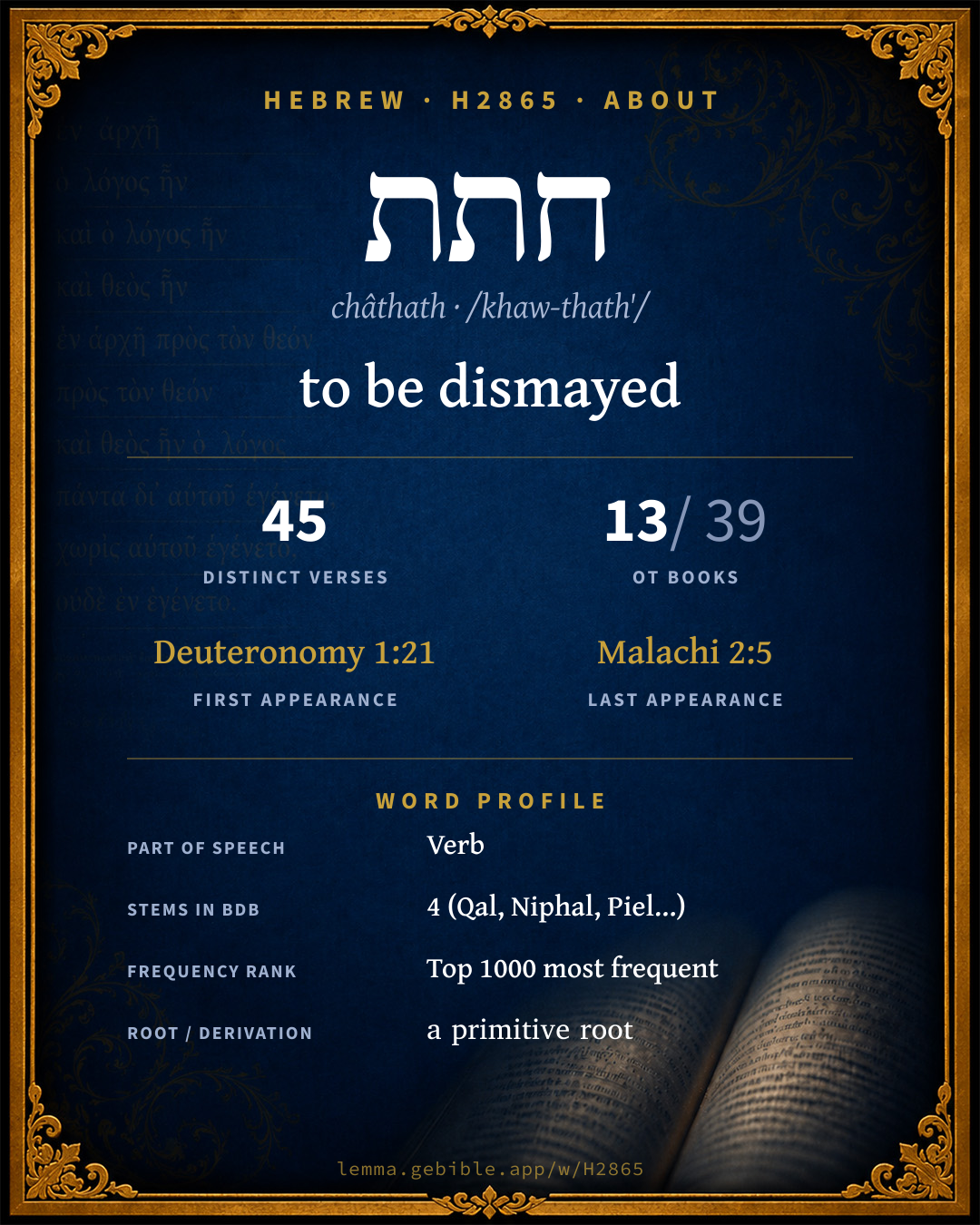
חָתַת
to be dismayed
‘to be dismayed’ is one of 3 main senses fuller range ↓
Full lexicon entry — Brown-Driver-Briggs (BDB)
From Brown-Driver-Briggs (BDB)
Where this word appears
See every Niphal verb in the Hebrew Bible →
Grammar key — what these labels mean
Part of speech
- Verb
- An action or state-of-being word.
Stem
- Niphal
- Usually the simple passive or reflexive of the Qal (“he was written”). Here: ‘only 3 ms.’
- Qal
- The basic, simple active stem — the plain form of the verb (“he wrote”). Here: ‘be shattered’
- Hiphil
- The causative active stem (“he caused / brought about”). Here: ‘shatter c. acc. Is 9’
- Piel
- An intensive or resultative active stem. Here: ‘dismay’
Form
- Jussive
- A third- or second-person volitional form expressing wish or command (“let him write”).
- Perfect
- A completed action or state — Hebrew marks aspect (completeness) more than strict tense (“he wrote”).
- Sequential Perfect
- A perfect with prefixed waw continuing a preceding imperfect or command (waw-consecutive perfect).
- Imperative
- A direct command (“write!”).
- Imperfect
- An incomplete, ongoing, or future action (“he will / would write”).
- Sequential Imperfect
- An imperfect with prefixed waw — the standard past-narrative form (waw-consecutive imperfect).
- Cohortative
- A first-person volitional form expressing wish or resolve (“let me / let us write”).
Person
- 2nd Person
- The one addressed (“you”).
- 3rd Person
- The one spoken about (“he / she / it / they”).
- 1st Person
- The speaker (“I / we”).
Gender
- Masculine
- Grammatically masculine.
- Common
- Either gender — not distinguished for this form.
- Feminine
- Grammatically feminine.
Number
- Singular
- One.
- Plural
- More than one (in Hebrew, generally three or more).
Grammatical forms 22 distinct
- Verb, Niphal, Jussive, 2nd Person, Masculine, Singular 9 times (18%)
- Verb, Niphal, Jussive, 2nd Person, Masculine, Plural 6 times (12%)
- Verb, Qal, Perfect, 3rd Person, Common, Plural 5 times (10%)
- Verb, Qal, Sequential Perfect, 3rd Person, Common, Plural 4 times (8%)
- Verb, Qal, Perfect, 3rd Person, Feminine, Singular 4 times (8%)
- Verb, Qal, Imperative, 2nd Person, Masculine, Plural 3 times (6%)
- Verb, Niphal, Imperfect, 3rd Person, Masculine, Singular 3 times (6%)
- Verb, Niphal, Imperfect, 2nd Person, Masculine, Singular 2 times (4%)
+14 more forms (15 occurrences)
Parsed forms decoded from the imported morphology (morphhb / Westminster Leningrad Codex — WLC text public domain, morphhb tagging CC BY 4.0), counted across 51 parsed occurrences — not distinct verses.
Every verse where H2865 appears — 45 distinct verses across 13 books. Click any verse to open its interlinear word-by-word view. Verse text shown in the World English Bible for context — . Each verse’s Hebrew form is shown with its reference; the English is not keyword-highlighted, since the data carries no word-level English alignment. Use “Compare translations” on any verse to read it across multiple English versions. This concordance covers the Hebrew Bible; Septuagint (Greek Old Testament) occurrences are not indexed here.
Deuteronomy 2 verses
- Deuteronomy 1:21 תֵּחָֽת Niphal juss 2ms Behold, Yahweh your God has set the land before you: go up, take possession, as Yahweh, the God of your fathers, has spoken to you; don't be afraid, neither be dismayed.
- Deuteronomy 31:8 תֵחָֽת Niphal impf 2ms Yahweh, he it is who does go before you; he will be with you, he will not fail you, neither forsake you: don't be afraid, neither be dismayed.
Joshua 3 verses
- Joshua 1:9 תֵּחָ֑ת Niphal juss 2ms Haven't I commanded you? Be strong and of good courage; don't be afraid, neither be dismayed: for Yahweh your God is with you wherever you go.
- Joshua 8:1 תֵּחָ֔ת Niphal juss 2ms Yahweh said to Joshua, Don't be afraid, neither be dismayed: take all the people of war with you, and arise, go up to Ai; behold, I have given into your hand the king of Ai, and his people, and his city, and his land;
- Joshua 10:25 תֵּחָ֑תּוּ Niphal juss 2mp Joshua said to them, Don't be afraid, nor be dismayed; be strong and of good courage: for thus shall Yahweh do to all your enemies against whom you fight.
1 Samuel 1 verse
2 Kings 1 verse
1 Chronicles 2 verses
- 1 Chronicles 22:13 תֵּחָֽת Niphal juss 2ms Then shall you prosper, if you observe to do the statutes and the ordinances which Yahweh gave Moses concerning Israel. Be strong, and of good courage. Don't be afraid, neither be dismayed.
- 1 Chronicles 28:20 תֵּחָ֑ת Niphal juss 2ms David said to Solomon his son, Be strong and of good courage, and do it: don't be afraid, nor be dismayed; for Yahweh God, even my God, is with you; he will not fail you, nor forsake you, until all the work for the service of the house of Yahweh is finished.
2 Chronicles 3 verses
- 2 Chronicles 20:15 תֵּחַ֨תּוּ֙ Niphal juss 2mp and he said, Listen you, all Judah, and you inhabitants of Jerusalem, and you king Jehoshaphat: Thus says Yahweh to you, Don't be afraid you, neither be dismayed by reason of this great multitude; for the battle is not yours, but God's.
- 2 Chronicles 20:17 תֵּחַ֔תּוּ Niphal juss 2mp You shall not need to fight in this [battle]: set yourselves, stand you still, and see the salvation of Yahweh with you, O Judah and Jerusalem; don't be afraid, nor be dismayed: tomorrow go out against them: for Yahweh is with you.
- 2 Chronicles 32:7 תֵּחַ֗תּוּ Niphal juss 2mp Be strong and of good courage, don't be afraid nor dismayed for the king of Assyria, nor for all the multitude who is with him; for there is a greater with us than with him:
Job 4 verses
- Job 7:14 וְ/חִתַּתַּ֥/נִי conj + Piel wpf 2ms + sfx pers 1cs Then you scar me with dreams, And terrify me through visions:
- Job 31:34 יְחִתֵּ֑/נִי Hiphil impf 3ms + sfx pers 1cs Because I feared the great multitude, And the contempt of families terrified me, So that I kept silence, and didn't go out of the door--
- Job 32:15 חַ֭תּוּ Qal pf 3cp "They are amazed. They answer no more. They don't have a word to say.
- Job 39:22 יֵחָ֑ת Niphal impf 3ms He mocks at fear, and is not dismayed; Neither does he turn back from the sword.
Isaiah 9 verses
- Isaiah 8:9 וָ/חֹ֔תּוּ וָ/חֹ֔תּוּ וָ/חֹֽתּוּ conj + Qal impv 2mp conj + Qal impv 2mp conj + Qal impv 2mp Make an uproar, O you peoples, and be broken in pieces! And give ear, all you of far countries: gird yourselves, and be broken in pieces! Gird yourselves, and be broken in pieces!
- Isaiah 9:4 הַחִתֹּ֖תָ Hiphil pf 2ms For the yoke of his burden, and the staff of his shoulder, the rod of his oppressor, you have broken as in the day of Midian.
- Isaiah 20:5 וְ/חַתּ֖וּ conj + Qal wpf 3cp They shall be dismayed and confounded, because of Ethiopia their expectation, and of Egypt their glory.
- Isaiah 30:31 יֵחַ֣ת Niphal impf 3ms For through the voice of Yahweh shall the Assyrian be dismayed; with his rod will he strike [him].
- Isaiah 31:4 יֵחָ֔ת Niphal impf 3ms For thus says Yahweh to me, As the lion and the young lion growling over his prey, if a multitude of shepherds are called forth against him, will not be dismayed at their voice, nor abase himself for the noise of them: so will Yahweh of Hosts come down to fight on Mount Zion, and on the hill of it.
- Isaiah 31:9 וְ/חַתּ֥וּ conj + Qal wpf 3cp His rock shall pass away by reason of terror, and his princes shall be dismayed at the ensign, says Yahweh, whose fire is in Zion, and his furnace in Jerusalem.
- Isaiah 37:27 חַ֖תּוּ Qal pf 3cp Therefore their inhabitants were of small power, they were dismayed and confounded; they were as the grass of the field, and as the green herb, as the grass on the housetops, and as a field [of grain] before it is grown up.
- Isaiah 51:6 תֵחָֽת Niphal impf 3fs Lift up your eyes to the heavens, and look on the earth beneath; for the heavens shall vanish away like smoke, and the earth shall wax old like a garment; and those who dwell therein shall die in like manner: but my salvation shall be forever, and my righteousness shall not be abolished.
- Isaiah 51:7 תֵּחָֽתּוּ Niphal juss 2mp Listen to me, you who know righteousness, the people in whose heart is my law; don't you fear the reproach of men, neither be you dismayed at their insults.
Jeremiah 15 verses
- Jeremiah 1:17 תֵּחַת֙ אֲחִתְּ/ךָ֖ Niphal juss 2ms Hiphil impf 1cs + sfx pers 2ms You therefore gird up your loins, and arise, and speak to them all that I command you: don't be dismayed at them, lest I dismay you before them.
- Jeremiah 8:9 חַ֖תּוּ Qal pf 3cp The wise men are disappointed, they are dismayed and taken: behold, they have rejected the word of Yahweh; and what manner of wisdom is in them?
- Jeremiah 10:2 תֵּחָ֑תּוּ יֵחַ֥תּוּ Niphal juss 2mp Qal impf 3mp Thus says Yahweh, "Don't learn the way of the nations, and don't be dismayed at the signs of the sky; for the nations are dismayed at them.
- Jeremiah 14:4 חַ֔תָּה Qal pf 3fs Because of the ground which is cracked, because no rain has been in the land, the plowmen are disappointed, they cover their heads.
- Jeremiah 17:18 יֵחַ֣תּוּ אֵחַ֖תָּה Niphal juss 3mp Niphal coh 1cs Let them be disappointed who persecute me, but let not me be disappointed; let them be dismayed, but don't let me be dismayed; bring on them the day of evil, and destroy them with double destruction.
- Jeremiah 23:4 יֵחַ֛תּוּ Niphal impf 3mp I will set up shepherds over them, who shall feed them; and they shall fear no more, nor be dismayed, neither shall any be lacking, says Yahweh.
- Jeremiah 30:10 תֵּחַ֣ת Niphal juss 2ms Therefore don't you be afraid, O Jacob my servant, says Yahweh; neither be dismayed, Israel: for, behold, I will save you from afar, and your seed from the land of their captivity; and Jacob shall return, and shall be quiet and at ease, and none shall make him afraid.
- Jeremiah 46:27 תֵּחַ֣ת Niphal juss 2ms But don't be afraid you, Jacob my servant, neither be dismayed, Israel: for, behold, I will save you from afar, and your seed from the land of their captivity; and Jacob shall return, and shall be quiet and at ease, and none shall make him afraid.
- Jeremiah 48:1 וָ/חָֽתָּה conj + Qal pf 3fs Of Moab. Thus says Yahweh of Hosts, the God of Israel: Woe to Nebo! for it is laid waste; Kiriathaim is disappointed, it is taken; Misgab is put to shame and broken down.
- Jeremiah 48:20 חַ֖תָּה Qal pf 3fs Moab is disappointed; for it is broken down: wail and cry; tell you it by the Arnon, that Moab is laid waste.
- Jeremiah 48:39 חַ֨תָּה֙ Qal pf 3fs How is it broken down! [how] do they wail! how has Moab turned the back with shame! so shall Moab become a derision and a terror to all who are round about him.
- Jeremiah 49:37 וְ/הַחְתַּתִּ֣י conj + Hiphil wpf 1cs I will cause Elam to be dismayed before their enemies, and before those who seek their life; and I will bring evil on them, even my fierce anger, says Yahweh; and I will send the sword after them, until I have consumed them;
- Jeremiah 50:2 חַ֣ת חַ֖תּוּ Qal pf 3ms Qal pf 3cp Declare you among the nations and publish, and set up a standard; publish, and don't conceal: say, Babylon is taken, Bel is disappointed, Merodach is dismayed; her images are disappointed, her idols are dismayed.
- Jeremiah 50:36 וָ/חָֽתּוּ conj + Qal wpf 3cp A sword is on the boasters, and they shall become fools; a sword is on her mighty men, and they shall be dismayed.
- Jeremiah 51:56 חִתְּתָ֖ה Piel pf 3fs for the destroyer is come on her, even on Babylon, and her mighty men are taken, their bows are broken in pieces; for Yahweh is a God of recompenses, he will surely requite.
Ezekiel 2 verses
- Ezekiel 2:6 תֵּחָ֔ת Niphal juss 2ms You, son of man, don't be afraid of them, neither be afraid of their words, though briers and thorns are with you, and you do dwell among scorpions: don't be afraid of their words, nor be dismayed at their looks, though they are a rebellious house.
- Ezekiel 3:9 תֵחַ֣ת Niphal impf 2ms As an adamant harder than flint have I made your forehead: don't be afraid of them, neither be dismayed at their looks, though they are a rebellious house.
Obadiah 1 verse
Habakkuk 1 verse
Malachi 1 verse
About this entry
At a glance — auto-summarized from this page’s data, not written by a person. Every figure links to its source below. This summary describes the numbers; it doesn’t interpret them.
חתת — transliterated châthath — is a Hebrew verb carrying the sense “to be dismayed.” Translators differ — “be dismayed” in the King James Version, then “or discouraged” (Berean Standard Bible), as the renderings breakdown shows. With 45 verses in 13 books, it is a moderately common word in the Hebrew Bible. Its uses concentrate in Jeremiah (33% of all occurrences). As a verb its force shifts by stem, across 4 stems (Qal, Niphal, and more). See the sense tree, 45-verse concordance, and the renderings breakdown below.
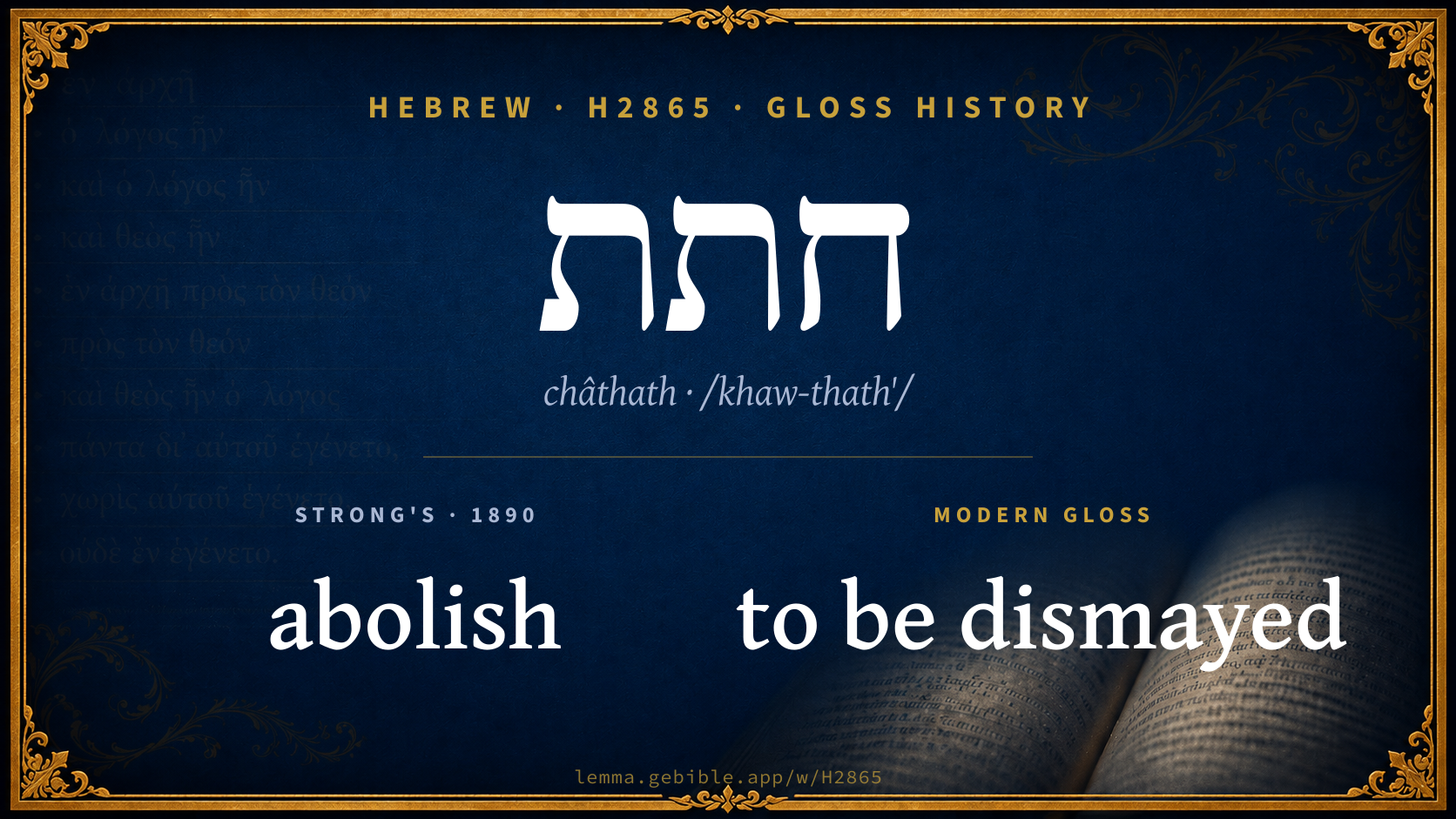
Gloss history
Strong's 1890 vs modern scholarship
About this word
Strong's H2865 catalogs a Hebrew word from the Hebrew Old Testament.
These counts are not copied from any lexicon or concordance. They are computed here, from the morphology-tagged Hebrew Old Testament. What Lemma adds →
- 45
- distinct verses
- The word appears in 45 distinct verses.
- 13 / 39
- OT books
- The word appears in 13 of 39 Old Testament books.
- #723
- by frequency
- Top 1000 most frequent Hebrew words (rank 723 of 8,640 Hebrew words by occurrence).
View all 45 occurrences in the concordance →
By section of the Old Testament
By traditional corpus
Conventional, traditional groupings — biblical authorship is debated, so this is a traditional corpus grouping, not an authorship claim. Each share is this word’s portion of its verses in that division of the Hebrew canon. Each figure is a share of the word’s 45 distinct verses.
- Prophets (Nevi'im) 34 verses · 76%
- Writings (Ketuvim) 9 verses · 20%
- Torah (Pentateuch) 2 verses · 4%
How translations render this word
Counts come from each version’s own published word-to-Strong’s tagging or interlinear alignment — an approximate guide to how each version renders this word, not a word-level alignment the data otherwise carries. Because each total is that version’s own tagged count, the per-version totals vary from one another and need not match the appearance or distinct-verse counts above. These counts may also differ from a printed concordance because Lemma counts each distinctly tagged rendering and does not collapse phrase taggings into a single head-word total. This is a fixed set of word-tagged versions (KJV, ASV, BSB, ULT) and does not change with the reading translation you choose elsewhere. Each version’s license is shown beside its name below (and on Sources).
- King James Version: Be dismayed 9×, Dismayed 3×, They were dismayed 3×
- American Standard Version: Be dismayed 5×, Fear not 4×, Not 4×
- Berean Standard Bible: Or discouraged 8×, Are dismayed 3×, Be shattered 3×
- unfoldingWord Literal Text: Be dismayed 16×, Do 9×, May you 3×
King James Version Public Domain
Renders H2865 across 54 tagged occurrences — most commonly:
Plus 33 renderings that appear only once — usually multi-word phrases or single function words the recovered tagging swept in, not distinct renderings.
American Standard Version Public Domain
Renders H2865 across 54 tagged occurrences — most commonly:
Plus 32 renderings that appear only once — usually multi-word phrases or single function words the recovered tagging swept in, not distinct renderings.
Berean Standard Bible Public Domain
Renders H2865 across 52 tagged occurrences — most commonly:
Plus 29 renderings that appear only once — usually multi-word phrases or single function words the recovered tagging swept in, not distinct renderings.
unfoldingWord Literal Text CC BY-SA 4.0
Renders H2865 across 63 tagged occurrences — most commonly:
Plus 20 renderings that appear only once — usually multi-word phrases or single function words the recovered tagging swept in, not distinct renderings.
11 senses and sub-senses in the full BDB
Hebrew verbs can shift meaning by stem (binyan): Qal is the basic action, Niphal is often passive or reflexive, Piel often intensifies or makes it factitive, and Hiphil is typically causative. The senses below are grouped under the stem BDB assigns to each.
What do BDB’s symbols mean?
BDB uses these scholarly abbreviations:
| Symbol | Meaning |
|---|---|
| 𝔊 | the Septuagint (the ancient Greek translation, LXX) |
| 𝔙 | the Vulgate (the Latin translation) |
| 𝔖 | the Syriac version (the Peshitta) |
| 𝔗 | the Targum (the Aramaic translation) |
| ψ | the Psalms |
| √ | root (the underlying root or stem) |
| ‖ | parallel passage (a synonymous or contrasted parallel) |
| † | the dagger: every passage where the word occurs is cited |
The 11 senses and sub-senses the full Brown-Driver-Briggs lexicon distinguishes for this word, in lexicon order (not ranked by frequency), with BDB’s own verbatim wording and sub-sense lettering. Shown in Hebrew script with BDB’s own scholarly abbreviations. The condensed entry is in the Lexicon Entry tab. See also the Forms in the corpus table below.
Qal
- Pf. 3 ms. חַת Je 50:2; 3 fs. חַ֫תָּה Je 14:4 + 2 times, וָחָ֑תָּה Je 48:1; 3 pl. חַ֫תּוּ Is 37:27 + 4 times, וְחַתּ֫וּ consec. Is 20:5 + 2 times, וָחָ֑תּוּ consec. Je 50:36; Impf. (Köi. 366) יֵחַת Is 7:8; 30:31, יֵחַ֑ת Jb 39:22, יֵחָ֑ת Is 31:4, אֵחַ֫תָּה Je 17:18, יֵחַ֫תּוּ 1 S 2:10 + 3 times—On יֵחַ֑תּוּ Jb 21:13 v. נָחַת;—תֵּחָ֑תּוּ Jos 10:25 + 2 times, etc.; Imv. וָחֹ֫תּוּ Is 8:9(×3);— e.g. Jeremiah 50:2
- 1. be shattered, broken, fig. of nations under divine judgment Is 7:8; 30:31; so prob. also Is 8:9(×3) (but del. in v a), and perhaps (of י׳’s foes in gen.) 1 S 2:10 (song;—others render dismayed in all except Is 7:8); fig. of י׳’s righteousness Is 51:6 (= be abolished, annihilated); lit. of bows Je 51:56, according to Gie’s reading חַתָּה v. Pi. e.g. Isaiah 7:8
- 2. be dismayed, usually
- a. abs.: | יָרֵא Dt 1:21; 31:8 Jos 8:1; 10:25 (all D), 1 S 17:11 Je 23:4; 30:10; 46:27 Ez 2:6; 3:9 1 Ch 22:13; 28:20 2 Ch 20:15, 17; 32:7; ‖ בּוֹשׁ Is 20:5; 37:27 = 2 K 19:26 Je 8:9; 17:18(×2); 48:1, 20, 39; 50:2(×2) (others assign 48:20, 39; 50:2(×2) to 1); fig. of the ground הָאֲדָמָה, dismayed for lack of rain Je 14:4 (‖ בּוֹשׁ of the husband-men); in Je 14:4 read prob. with Du (after 𝔊) Co Dr וְעֹבְדֵי הא׳ חַתּוּ. ‖ערץ Jos 1:9 no ‖ Je 50:36 Ob 9 Jb 32:15; 39:22. e.g. Deuteronomy 1:21
- b. be dismayed at, sq. מִן Is 31:4, 9; 51:7 (‖ יָרֵא) Je 1:17; 10:2(×2). e.g. Isaiah 31:4
Niphal
- Pf. only 3 ms. וּמִפְּנֵי שְׁמִי נִחַח Mal 2:5 and at my name he is put in awe (‖ יָרֵא). e.g. Malachi 2:5
Piel
- Pf. dismay, scare, 2 ms. sf. וְחִתַּתַּ֫נִי בַחֲלֹמוֹת (Köi. 372) consec. Jb 7:14 and thou scarest me with dreams (‖ בִּעֵת); 3 fs. חִתְּתָה Je 51:56 (of bows) is intrans. [inchoat. Ew§ 120, 2 d], Gf. al., be shattered, but text prob. erron. Gie חַתָּה (v. Qal 1). e.g. Job 7:14
Hiphil
- Pf. 2 ms. הַחִתֹּתָ Is 9:3; 1 s. וְהַחְתַּתִּ֫י Je 49:37 (Köi. 372); Impf. 3 ms. sf. יְחִתֵּנִי Jb 31:34, sf. 3 fpl. יְחִיתַ֑ן Hb 2:17 (Köi. 374; but 𝔊 𝔗 𝔖 Ew Ol Sta We יְחִתֶּ֑ךָ); 1 s. sf. אֲחִתְּךָ Je 1:17 (sq. לפניהם).— e.g. Isaiah 9:3
- 1. shatter c. acc. Is 9:3. e.g. Isaiah 9:3
- 2.
- a. cause to be dismayed Je 49:37 sq. לִפְנֵי. e.g. Jeremiah 49:37
- b. dismay, terrify, sq. sf. Jb 31:34 Hb 2:17. e.g. Job 31:34
Senses from the full Brown-Driver-Briggs lexicon (Brown, Driver, Briggs; Oxford 1906 — public domain), digitized via Sefaria, supplemented by the OpenScriptures HebrewLexicon (CC BY 4.0). Full attribution on Sources.
Word origin
vb. be shattered, dismayed (Assyrian ḫattu, terror, DlHWB 296; Talm. חִתִּית id.; Ethiopic ሐተተ is scrutari, examinare, v. DiLex. 105)—
— Brown-Driver-Briggs (Oxford 1906, public domain), digitized via Sefaria, supplemented by the OpenScriptures HebrewLexicon (CC BY 4.0). See Sources.
Origin: a primitive root
Jastrow Dictionary
A second Hebrew/Aramaic lexicon for comparison, covering Aramaic and post-biblical (Talmudic, Targumic, Midrashic) usage that the biblical-Hebrew BDB does not. Matched by lemma rather than by Strong’s number, so a lemma may carry more than one Jastrow headword (shown separately below), and the entries cover usage well beyond the Bible.
חָתַת
- (b. h.) to break, shatter. Ḥull. 27ᵃ (play on וז̇ב̇ח̇ת̇ Deut. XII, 21) ממקום שז̇ב̇ חָ֗תֵּ֗הוּ from where the blood flows, break it (the animal’s life); ממאי דהאי חתהו לישנא דמתבר הוא what proof have you, that this ḥottehu has the meaning of breaking? (Answ. ref. to תחת, Deut. I, 2. [Ib. חִתּוּי formed fr. חָתָה Pi., sec. r. of חתת.] e.g. Deuteronomy 12:21
A Dictionary of the Targumim, the Talmud Babli and Yerushalmi, and the Midrashic Literature (Marcus Jastrow; London, Luzac, 1903) — Public Domain. Digitized via Sefaria. Digitized via Sefaria. Full attribution on Sources.
Forms in the corpus
The 40 distinct written forms H2865 takes in the Hebrew Bible, most frequent first — each parse links to that stem’s occurrences in the concordance. Hebrew forms include their vowel points and cantillation, so a single lemma takes many written forms.
Same root — word family
Other BDB entries built from the same root as H2865, grouped by Strong’s listed origin. These share a root / origin per the lexicon — not necessarily a shared meaning. Each links to that word’s own entry.
Derived from this word
- חת chath H2844 terror
- חתה chittâh H2847 terror
- חתית chittîyth H2851 terror
- חתת chăthath H2866 terror
Proper names from this root
People and places named from this root — a name, not an additional meaning of the word.
Compare all same-root words → Showing 4 of 6 — not the complete family. 1 of the same-root words is a proper name (a person or place). They share a root, not necessarily a meaning.
Septuagint verse parallels
This word appears in 39 verses that also exist in the Greek Old Testament (Septuagint), out of the 45 Hebrew verses it occurs in. You can read those verses in Greek by switching the Old Testament edition to the Septuagint.
Read these verses in the Septuagint
- Deuteronomy 1:21
- Joshua 1:9
- 1 Samuel 17:11
- 2 Kings 19:26
- 1 Chronicles 22:13
- 2 Chronicles 20:15
- Job 7:14
- Isaiah 8:9
- Jeremiah 1:17
- Ezekiel 2:6
- Obadiah 1:9
- Habakkuk 2:17
This is a verse-level parallel only — the same verses exist in both the Hebrew and Greek Old Testaments. No word-level Hebrew↔Greek correspondence is claimed: the data carries no such alignment, so no Greek word is shown as this Hebrew word’s translation. Coverage is not total — the Septuagint omits the deuterocanon and renumbers the Psalms, so some Hebrew verses have no direct Greek parallel.