
Jeremiah 1:17

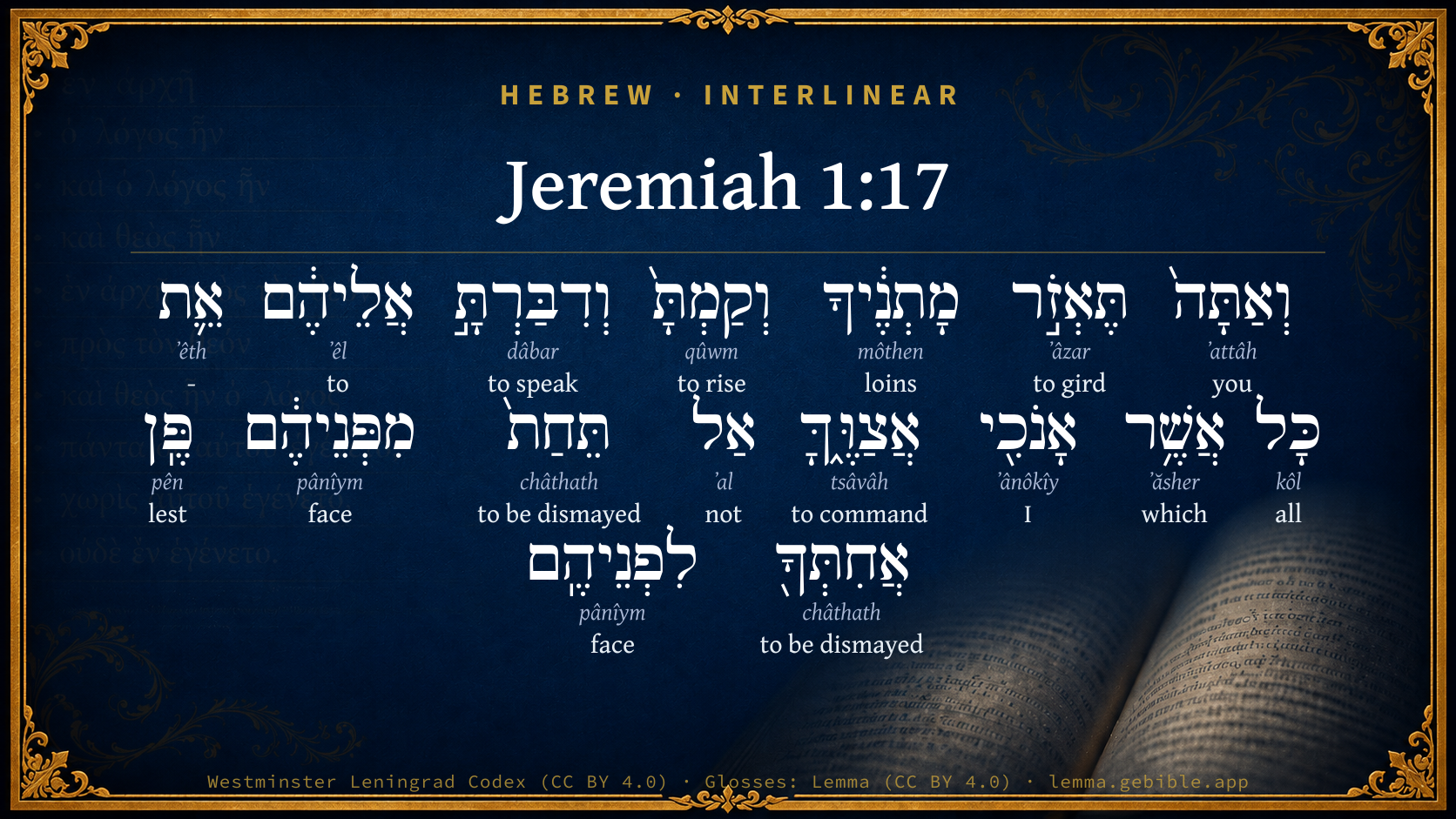
Hebrew (Westminster Leningrad Codex) Jeremiah 1:17 appears in the Hebrew Old Testament. The text above is from the Westminster Leningrad Codex. Each word links to its Strong’s number, a concise gloss, and parsing drawn from the Open Scriptures Hebrew Bible morphology. Click any word for its full Brown-Driver-Briggs (BDB) entry.
Download image
Cite this verse

Jeremiah 1:17 (World English Bible). Public Domain. Lemma interlinear Bible study tool, https://lemma.gebible.app/v/jeremiah/1/17.

Show BibTeX & RIS
BibTeX
RIS
English Translation
You therefore gird up your loins, and arise, and speak to them all that I command you: don't be dismayed at them, lest I dismay you before them.
World English Bible · Public Domain
Download a study sheet

One document with this verse’s original text, its word-by-word gloss line, the meaning frame, cross-references with their text, attributed commentary, and full source and license credits — printable, and it pastes into notes with its structure intact.

This verse Autodidact and up

Study sheet (.html) Plain text (.txt)

A passage Seminary Student

Up to 50 verses in one chapter. A passage sheet keeps up to 6 commentary sources and 12 cross-references per verse, in the order this page ranks them, and says so on the sheet whenever that leaves anything out. Ask for a single verse and you get the Autodidact verse sheet above.

Everything on this page stays free to read, with no account — the sheet is a download of what is already on screen, not access to it.

Want to remove ads? Support Godless Engineer
Compare translations 3

The same verse in 3 English versions, stacked beneath the original-language interlinear above. Click any original word for its lexicon entry.

Each is an independent rendering of the whole verse — the interlinear is not word-aligned to these translations.

Highlighted words mark where these versions differ — a whole-verse word diff, not a word-by-word alignment.

  • World English Bible Public Domain
    You therefore gird up your loins, and arise, and speak to them all that I command you: don't be dismayed at them, lest I dismay you before them.
  • King James Version Public Domain
    Thou therefore gird up thy loins, and arise, and speak unto them all that I command thee: be not dismayed at their faces, lest I confound thee before them.
  • unfoldingWord Literal Text CC BY-SA 4.0
    So you yourself shall gird your loins, and stand up and say to them all that I myself shall command you! Do not be dismayed from before their faces lest I dismay you before their faces!

unfoldingWord Literal Text — © unfoldingWord, licensed CC BY-SA 4.0. Word-aligned USFM3 via Door43 (git.door43.org/unfoldingWord/en_ult).

Versions to compare (up to 4)

3 of 4 selected

Show all 18 translations

Every available English version of this verse, each an independent rendering of the whole verse.

  • World English Bible Public Domain
    You therefore gird up your loins, and arise, and speak to them all that I command you: don't be dismayed at them, lest I dismay you before them.
  • Berean Standard Bible Public Domain
    Get yourself ready. Stand up and tell them everything that I command you. Do not be intimidated by them, or I will terrify you before them.
  • Majority Standard Bible Public Domain
    Get yourself ready. Stand up and tell them everything that I command you. Do not be intimidated by them, or I will terrify you before them.
  • King James Version Public Domain
    Thou therefore gird up thy loins, and arise, and speak unto them all that I command thee: be not dismayed at their faces, lest I confound thee before them.
  • American Standard Version (1901) Public Domain
    Thou therefore gird up thy loins, and arise, and speak unto them all that I command thee: be not dismayed at them, lest I dismay thee before them.
  • Revised Version (1885) Public Domain
    Thou therefore gird up thy loins, and arise, and speak unto them all that I command thee: be not dismayed at them, lest I dismay thee before them.
  • Geneva Bible (1599) Public Domain
    Thou therefore trusse vp thy loynes, and arise and speake vnto them all that I commaund thee: be not afraide of their faces, lest I destroy thee before them.
  • Douay-Rheims (1899) Public Domain
    Thou therefore gird up thy loins, and arise, and speak to them all that I command thee. Be not afraid at their presence: for I will make thee not to fear their countenance.
  • Young's Literal Translation Public Domain
    `And thou, thou dost gird up thy loins, and hast arisen, and spoken unto them all that I command thee: be not affrighted because of them, lest I affright thee before them.
  • Literal Standard Version CC BY-SA 4.0
    And you, you gird up your loins, and have arisen, and spoken to them all that I command you: do not be frightened because of them, lest I frighten you before them.
  • Unlocked Literal Bible CC BY-SA 4.0
    Get yourself ready! Stand up and say to them whatever I command you. Do not be shattered before them, or I will shatter you before them!
  • unfoldingWord Literal Text CC BY-SA 4.0
    So you yourself shall gird your loins, and stand up and say to them all that I myself shall command you! Do not be dismayed from before their faces lest I dismay you before their faces!
  • Darby Bible Public Domain
    Thou, therefore, gird up thy loins, and arise, and speak unto them all that I shall command thee: be not dismayed at them, lest I cause thee to be dismayed before them.
  • World Messianic Bible Public Domain
    “You therefore put your belt on your waist, arise, and say to them all that I command you. Don’t be dismayed at them, lest I dismay you before them.
  • Webster's Bible Public Domain
    Thou therefore gird up thy loins, and arise, and speak to them all that I command thee: be not dismayed at their faces, lest I confound thee before them.
  • Free Bible Version CC BY-SA 4.0
    You need to get yourself ready. You are going to stand before the people and tell them everything that I order you to say. Don't be scared by them, or I will scare you in front of them.
  • Bible in Basic English Public Domain
    So make yourself ready, and go and say to them everything I give you orders to say: do not be overcome by fear of them, or I will send fear on you before them.
  • JPS Tanakh (1917) Public Domain
    Thou therefore gird up thy loins, and arise, and speak unto them all that I command thee; be not dismayed at them, lest I dismay thee before them.

Literal Standard Version (2020), Covenant Press — licensed CC BY-SA 4.0. Text via the HelloAO Bible API (eBible.org). Unlocked Literal Bible (unfoldingWord) — licensed CC BY-SA 4.0. Text via the HelloAO Bible API (eBible.org). unfoldingWord Literal Text — © unfoldingWord, licensed CC BY-SA 4.0. Word-aligned USFM3 via Door43 (git.door43.org/unfoldingWord/en_ult). Free Bible Version, Dr. Jonathan Gallagher — licensed CC BY-SA 4.0. Text via the HelloAO Bible API (eBible.org).

Word by word

More ways to search: Search by grammar → Find every occurrence → Compare this word →

Practice this passage: Drill this verse → Learn its vocabulary →

תֶּאְזֹ֣ר
ʼâzar
H247
“to gird”
Verb, Qal, Imperfect, 2nd Person, Masculine, Singular
Part of Speech
Verb
Stem
Qal
Form
Imperfect
Person
2nd Person
Gender
Masculine
Number
Singular
Full BDB Definition

Origin: a primitive root

TWOT: 59

gird, encompass, equip, clothe - (Qal) to gird, gird on (metaphorical of strength) - (Niphal) be girded - (Piel) hold close, clasp - (Hithpael) gird oneself (for war)
  1. וְאַתָּה֙ ʼattâh H859 “and · you” Conjunction + Pronoun, Personal, 2nd Person, Masculine, Singular
  2. מָתְנֶ֔יךָ môthen H4975 “loins · your” Noun, Common, Masculine, Dual, Construct + Suffix, Personal, 2nd Person, Masculine, Singular
  3. וְקַמְתָּ֙ qûwm H6965 “and · to rise” Conjunction + Verb, Qal, Sequential Perfect, 2nd Person, Masculine, Singular
  4. וְדִבַּרְתָּ֣ dâbar H1696 “and · to speak” Conjunction + Verb, Piel, Sequential Perfect, 2nd Person, Masculine, Singular
  5. אֲלֵיהֶ֔ם ʼêl H413 “to · them” Preposition + Suffix, Personal, 3rd Person, Masculine, Plural
  6. אֵ֛ת ʼêth H853 “-” Particle, Direct Object
  7. כָּל kôl H3605 “all of” Noun, Common, Masculine, Singular, Construct
  8. אֲשֶׁ֥ר ʼăsher H834 “which” Particle, Relative
  9. אָנֹכִ֖י ʼânôkîy H595 “I” Pronoun, Personal, 1st Person, Common, Singular
  10. אֲצַוֶּ֑ךָּ tsâvâh H6680 “to command · you” Verb, Piel, Imperfect, 1st Person, Common, Singular + Suffix, Personal, 2nd Person, Masculine, Singular
  11. אַל ʼal H408 “not” Particle, Negative
  12. תֵּחַת֙ châthath H2865 “to be dismayed” Verb, Niphal, Jussive, 2nd Person, Masculine, Singular
  13. מִפְּנֵיהֶ֔ם pânîym H6440 “from · face(s) · their” Preposition + Noun, Common, Both, Plural, Construct + Suffix, Personal, 3rd Person, Masculine, Plural
  14. פֶּֽן pên H6435 “lest” Conjunction
  15. אֲחִתְּךָ֖ châthath H2865 “to be dismayed · you” Verb, Hiphil, Imperfect, 1st Person, Common, Singular + Suffix, Personal, 2nd Person, Masculine, Singular
  16. לִפְנֵיהֶֽם pânîym H6440 “to/for · face(s) · their” Preposition + Noun, Common, Both, Plural, Construct + Suffix, Personal, 3rd Person, Masculine, Plural

About this verse

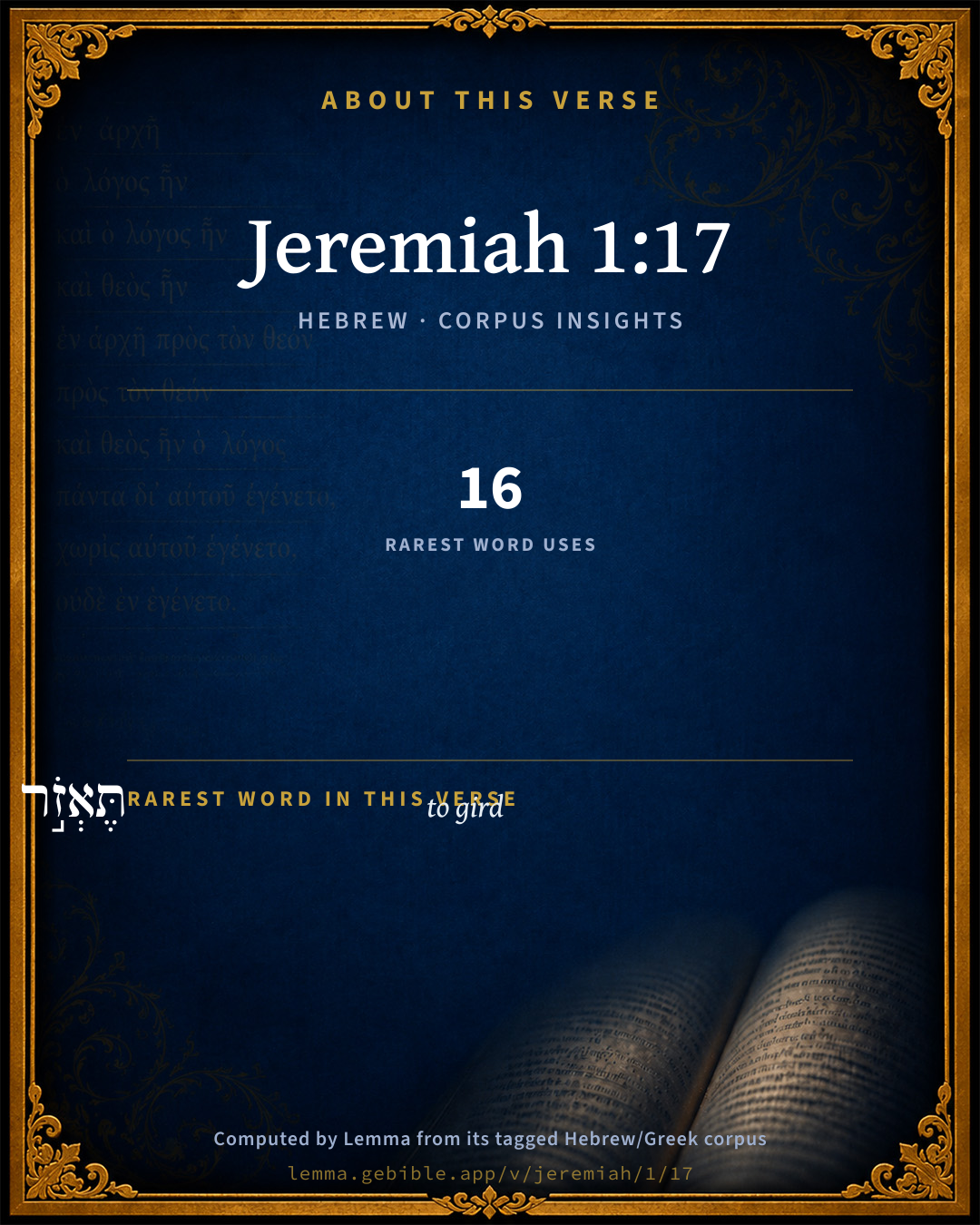
These counts appear in no published source. They are computed here, from the morphology-tagged text and Lemma’s own curated glosses. What Lemma adds →

17
words
15
distinct lemmas
Prophets
section

Notable vocabulary

The rarest word here is תֶּאְזֹ֣ר to gird H247 — appearing just 16 times in the whole Hebrew Bible.

Shared distinctive vocabulary

תֶּאְזֹ֣ר to gird H247 occurs in 15 verses of the Hebrew Bible. Also found in:

Grammatical profile

  • 6 verbs
  • 4 nouns
  • 2 pronouns
  • 1 preposition
  • 1 conjunction
  • 3 particles

Verb forms

  • תֶּאְזֹ֣ר Qal · Imperfect
  • וְקַמְתָּ֙ Qal · Sequential Perfect
  • וְדִבַּרְתָּ֣ Piel · Sequential Perfect
  • אֲצַוֶּ֑ךָּ Piel · Imperfect
  • תֵּחַת֙ Niphal · Jussive
  • אֲחִתְּךָ֖ Hiphil · Imperfect

Repetition

Words recur within this verse — often emphatic in Hebrew:

  • תֵּחַת֙ to be dismayed H2865 ×2
  • מִפְּנֵיהֶ֔ם face H6440 ×2

Cross-references

20

Topical passages linked to Jeremiah 1:17 in the Treasury of Scripture Knowledge — connected by theme and wording, ordered by reader-vote popularity; previews shown in the World English Bible.

  • 1 Kings 18:46 and the hand of Yahweh was on Elijah; and he girded up his loins, and ran before Ahab to the entrance of Jezreel.
  • Jeremiah 1:7–8 But Yahweh said to me, Don't say, I am a child; for to whoever I shall send you, you shall go, and whatever I shall command you, you shall speak.
  • Luke 12:35 "Let your loins be girded and your lamps burning.
  • 1 Peter 1:13 Therefore, prepare your minds for action, be sober and set your hope fully on the grace that will be brought to you at the revelation of Jesus Christ--
  • Ezekiel 3:14–18 So the Spirit lifted me up, and took me away; and I went in bitterness, in the heat of my spirit; and the hand of Yahweh was strong on me.
  • Exodus 7:2 You shall speak all that I command you; and Aaron your brother shall speak to Pharaoh, that he let the children of Israel go out of his land.
  • Jeremiah 23:28 The prophet who has a dream, let him tell a dream; and he who has my word, let him speak my word faithfully. What is the straw to the wheat? says Yahweh.
  • Job 38:3 Brace yourself like a man, For I will question you, then you answer me!
  • Ezekiel 3:10–11 Moreover he said to me, Son of man, all my words that I shall speak to you receive in your heart, and hear with your ears.
  • Exodus 3:12 He said, "Certainly I will be with you. This will be the token to you, that I have sent you: when you have brought forth the people out of Egypt, you shall serve God on this mountain."
  • Ezekiel 33:6–8 But if the watchman sees the sword come, and doesn't blow the trumpet, and the people aren't warned, and the sword comes, and take any person from among them; he is taken away in his iniquity, but his blood will I require at the watchman's hand.
  • Acts 20:20 how I didn't shrink from declaring to you anything that was profitable, teaching you publicly and from house to house,
  • Acts 20:27 for I didn't shrink from declaring to you the whole counsel of God.
  • 2 Kings 4:29 Then he said to Gehazi, Gird up your loins, and take my staff in your hand, and go your way: if you meet any man, Don't greet him; and if anyone greets you, don't answer him again: and lay my staff on the face of the child.
  • Jeremiah 17:18 Let them be disappointed who persecute me, but let not me be disappointed; let them be dismayed, but don't let me be dismayed; bring on them the day of evil, and destroy them with double destruction.
  • Ezekiel 2:6–7 You, son of man, don't be afraid of them, neither be afraid of their words, though briers and thorns are with you, and you do dwell among scorpions: don't be afraid of their words, nor be dismayed at their looks, though they are a rebellious house.
  • Jonah 3:2 "Arise, go to Nineveh, that great city, and preach to it the message that I give you."
  • 1 Corinthians 9:16 For if I preach the Gospel, I have nothing to boast about; for necessity is laid on me; but woe is to me, if I don't preach the Gospel.
  • 2 Kings 9:1 Elisha the prophet called one of the sons of the prophets, and said to him, Gird up your loins, and take this vial of oil in your hand, and go to Ramoth-gilead.
  • 1 Thessalonians 2:2 but having suffered before and been shamefully treated, as you know, at Philippi, we grew bold in our God to tell you the Gospel of God in much conflict.

Cross-references courtesy of OpenBible.info (CC BY 4.0).

Hebrew and Greek witnesses Masoretic Hebrew ↔ Greek Septuagint

The same verse in the two great witnesses to the Old Testament, shown verse-for-verse.

These are two independent witnesses, not word-aligned to each other, and the Septuagint is shown in lemma (dictionary) form.

Hebrew Jeremiah 1:17 Masoretic · Westminster Leningrad Codex

וְאַתָּה֙ תֶּאְזֹ֣ר מָתְנֶ֔יךָ וְקַמְתָּ֙ וְדִבַּרְתָּ֣ אֲלֵיהֶ֔ם אֵ֛ת כָּל אֲשֶׁ֥ר אָנֹכִ֖י אֲצַוֶּ֑ךָּ אַל תֵּחַת֙ מִפְּנֵיהֶ֔ם פֶּֽן אֲחִתְּךָ֖ לִפְנֵיהֶֽם

You therefore gird up your loins, and arise, and speak to them all that I command you: don't be dismayed at them, lest I dismay you before them.

World English Bible · Public Domain

Greek LXX Structure differs

In the Septuagint, Jeremiah is about an eighth shorter than the Hebrew and arranges its material differently — the Oracles Against the Nations (Hebrew chapters 46–51) appear in the middle of the Greek book, after 25:13. Because the chapter and verse boundaries do not line up, a verse-for-verse comparison with the Hebrew is not shown.

A verse-for-verse comparison isn’t shown here because the chapters and verses don’t line up. Switch to the LXX edition with the MT / LXX toggle above to read the Greek directly.

On this verse, John Gill's Exposition discusses the Septuagint’s reading. Read the note in Commentary ↓

Hebrew: Westminster Leningrad Codex (CC BY 4.0). Greek: Septuagint (public domain); English from a public-domain English Septuagint. How the Septuagint differs from the Hebrew →

Targum (Aramaic paraphrase)

1

The Targum is the ancient Jewish Aramaic paraphrase of the Hebrew Scriptures — an interpretive translation, not the Hebrew text itself. Onkelos (literal) and Pseudo-Jonathan (expansive) render the Torah, and Jonathan the Prophets. Coverage is partial: where no permissively-licensed English translation exists for a verse, only the Aramaic is shown. This is verse-level text, not a word-by-word alignment to the Hebrew.

  1. Targum Jonathan Prophets (Joshua–Malachi)
    וְאַתְּ תִּתְקֵף חַרְצָךְ וּתְקוֹף וְתִתְנַבֵּי לְהוֹן יַת כָּל דַאֲנָא מְפַקֵיד לָךְ לָא תִתְמְנַע מִלְאוֹכָחוּתְהוֹן דִלְמָא אֲתַבְּרִינָךְ קָדָמֵיהוֹן:

    (no public-domain English translation for this verse)

    Targum Jonathan — Aramaic: “Mikraot Gedolot” (public domain). English: “Sefaria Community Translation” (CC0 1.0 (public-domain dedication)); “London "Chaldee Paraphrase," 1871” (public domain). Text via Sefaria.

Commentary

Notes on Jeremiah 1:17 from classic Christian and Jewish commentators (each source and its license shown beneath its notes). The classic Christian expositions comment on the surrounding passage and are grouped to its opening verse, so a note may address several verses; the Jewish commentaries on the Tanakh (Rashi and others) are per-verse, so they appear only where the commentator wrote on this verse.

Lemma curates 59 commentaries, every one of them public domain or Creative Commons licensed, each selected and text-cleaned for this edition rather than reprinted as found. About our sources →

Trapp's Complete Commentary

John Trapp

Jer 1:17 Thou therefore gird up thy loins, and arise, and speak unto them all that I command thee: be not dismayed at their faces, lest I confound thee before them.

Ver. 17. Thou therefore gird up thy loins,] q.d., Thou hast, I must needs say, a hard task of it. But hard or not hard, it must be done, {a} or thou art undone. About it therefore and play the man, plucking up thy best heart, as we say, and acting vigorously. Stir up the gifts of God that are in thee, and exercise thy talents committed unto thee. Verbi minister es: hoc age.

Be not dismayed at their faces, lest.] Ne conteritor, ne te conteram. {b} Be net afraid of them, lest I fright thee worse, to thy ruth and utter ruin. Excellently Bernard, If I deal not faithfully with you, you will be damnified, but I shall be damned. Let me suffer anything rather than be guilty of a sinful silence, said that heroic Luther. But Melanchthon, his colleague, was so timorous, that Luther was fain to chide him many times. And Calvin, in an epistle of his to John Sleidan, prayeth God to furnish him with a more noble spirit, ne gravem ex eius timiditate iacturam sentiat posteritas, lest posterity should rue for his timidity. Calvin himself, in his last speech to his fellow ministers on his death bed, speaketh thus: When I first came to this city (Geneva), the gospel indeed was here preached, but things were very far out of order, as if Christianity consisted wholly in the casting down of images, &c. There were also not a few wicked fellows who put me hard to, setting themselves against me to their utmost. But the Lord our good God did so steel me and strengthen me, who am naturally fearful and dastardly, that I stoutly withstood them, and went on with the work of reformation; to his glory alone be it spoken. {c} Melanchthon also admired that courage in Luther that he could not find in himself; for besides many passages of his in his epistles that way tending, one time when he saw Luther’s picture, he uttered this verse immediately,

“ Fulminia erant linguae singulae verba tuae. ”

{a} Perquam difficile est, sed ita lex iubet.

{b} Antanaclasis.

{c} Melc. Ad. in Vit. Calvin, p. 106.

John Trapp, A Commentary or Exposition upon All the Books of the Old and New Testament (1647–1656) — public domain. Text from a community e-Sword module.

The Biblical Illustrator

Joseph S. Exell

Jer_1:17

Thou therefore gird up thy loins, and arise, and speak unto them all that I command thee.

Gods witness

I. Must be quick.

II. Busy.

III. Bold.

IV. Faithful. For--

1. He must speak all that he is charged with.

2. He must speak to all that he is charged against.

(1) Because he has reason to fear the wrath of God if he should be false.

(2) Because he has no reason to fear the wrath of man if he is faithful. (M. Henry, D. D.)

Service requires concentration

The girdle is often yards in length, and is a significant part of a mans apparel when in full dress; and the first sign that a man is in earnest about any work would be that he would gather his skirts about him and tuck them into his girdle; so as to be unhampered and free. The idea for us is that Christian service demands concentration. It needs the fixing of a mans power upon one thing, and the gathering together of all the strength of ones nature until its softest and loosest particles are knit together and become strong. You may take a handful of cotton down and squeeze it tight enough to make it hard and as heavy as a bullet, or you may stretch it out into tissue paper. The reason why some men hit and make no dint is because they are not gathered together, compacted--their loins are not girded. (A. Maclaren, D. D.)

The Biblical Illustrator, edited by Joseph S. Exell (c. 1880s–1900s) — public domain. Text from a community e-Sword module.

Joseph Benson's Commentary

Jer 1:17. Thou therefore gird up thy loins — Prepare to do the work to which I call and appoint thee. For, it being the custom of the eastern people to wear long garments, which they girded about their loins when any business required great activity or expedition; by thus speaking the Lord enjoins his prophet to use all possible vigour and intention of mind as well as of body, that he might execute, with diligence and despatch, the office which God had assigned him. And arise — Another expression of the same meaning. And speak all that I command thee — Hebrew, shall command thee. Be not dismayed at their faces — Discover no fear, and conceal no message; lest I confound thee — The Hebrew verb is the same in both parts of the sentence, which may be literally rendered thus: Be not confounded at their faces, (namely, when thou appearest in their presence,)

lest I confound thee before them. God exhorts him not to be dismayed at the scoffs and ill treatment he should meet with from hardened sinners, especially from those who thought their power and authority set them above reproof, and would bear them out in whatsoever they did: see Eze 11:6. He tells him it is better to bear the reproaches of men than the reproofs of God, who would call him to a strict account how he discharged his duty.

Joseph Benson's Commentary on the Old and New Testaments (1811–1818) — public domain. Text from a community e-Sword module.

Tyndale Open Study Notes

Tyndale Open Resources

1:17 Jeremiah was afraid of looking foolish as the Lord’s messenger (see Jeremiah Book Introduction, “Literary Features: The Messenger System”). In reality, it would be foolish of Jeremiah to refuse to do as God commanded.

Tyndale Open Study Notes — © Tyndale Open Resources, licensed CC BY-SA 4.0. Text via the HelloAO Bible API.

Geneva Bible (1599)

Geneva Bible translators

Which declareth that God’s vengeance is prepared against them, which dare not execute their duty faithfully, either for fear of man, or for any other cause, 1 Cor. 9:16.

Geneva Bible (1599) marginal notes — public domain. Text via Bolls.life.

Jamieson, Fausset & Brown

Robert Jamieson, A. R. Fausset & David Brown

gird . . . loins--resolutely prepare for thy appointed task. Metaphor from the flowing robes worn in the East, which have to be girt up with a girdle, so as not to incommode one, when undertaking any active work (Job 38:3; Luk 12:35; Pe1 1:13).

dismayed . . . confound--the same Hebrew word; literally, "to break." Be not dismayed at their faces (before them), lest I make thee dismayed before their faces (before them), that is, "lest I should permit thee to be overcome by them" (compare Jer 49:37).

Jamieson, Fausset & Brown — Commentary Critical and Explanatory on the Whole Bible (1871) — public domain (CC PDM 1.0). Text via the HelloAO Bible API.

Adam Clarke's Commentary

Verse 17. Gird up thy loins] Take courage and be ready, lest I confound thee; take courage and be resolute, פן pen, lest by their opposition thou be terrified and confounded. God is often represented as doing or causing to be done, what he only permits or suffers to be done. Or, do not fear them, I will not suffer thee to be confounded. So Dahler, Ne crains pas que je te confonde a leurs yeux, "Do not fear that I shall confound thee before them." It is well known that the phrase, gird up thy reins, is a metaphor taken from the long robes of the Asiatics; which, on going a journey, or performing their ordinary work, they were obliged to truss up under their girdles, that the motions of the body might not be impeded.

Adam Clarke's Commentary on the Bible (1810–1826) — public domain. Text from a community e-Sword/MySword module.

John Calvin's Commentaries

God first bids his Prophet to be the herald of the dreadful judgment, which we have already noticed: for it was not his purpose to speak only as it were in a corner, or secretly, to Jeremiah, but he committed to him what he intended should be proclaimed audibly to the whole people. It hence follows, And thou, etc. We therefore see that the Prophet had been taught by the Lord, that he might confidently and boldly declare what we shall hereafter see. These things should then be connected, — that God would ascend his tribunal to execute the vengeance he had deferred, — and also that Jeremiah would be the herald of that vengeance he was prepared to inflict. Thou then, — an illative is to be added here, for the copulative is to be thus taken in this place, — Thou then; that is, as thou hast heard that I shall be now the avenger of the people’s sins, and that the time of vengeance is at hand; and also as thou knowest that this has been told thee, that thou mightest warn them to render them more inexcusable, — Thou then, gird thy loins We see why God addressed his servant Jeremiah privately; it was, that he might publicly exercise his office as a teacher.

And hence we learn, that all who are called to rule the Church of God cannot be exempt from blame, unless they honestly and boldly proclaim what has been committed to them. Hence Paul says that he was free from the blood of all men, because he had from house to house and publicly declared whatever he had received from the Lord, (Acts 20:26, 27;) and he says in another place,

“Woe is to me if I preach not the Gospel, for it has been committed to me.” (1 Corinthians 9:16)

God bids the Prophet to gird his loins This is to be understood of the kind of dress which the Orientals used and continue to use, for they wear long garments; and when they undertake any work, or when they proceed on a journey, they gird themselves. Hence he says, gird thy loins, that is, undertake this expetition which I devolve on thee. At the same time he requires activity, so that the work might be expeditiously undertaken. Arise, he says, and speak to them whatsoever I shall command thee In short, God intimates in these words, that he was unwilling to proceed to extremes, until he had still tried whether there was any hope of repentance as to the people. He indeed knew that they were wholly irreclaimable; but he intended to discover more fully their perverseness in bidding Jeremiah, in the last place, to pronounce the extreme sentence of condemnation.

He now again repeats what he had before said, Fear not their face And this exhortation was very needful, as Jeremiah undertook an office in no small degree disliked; for it was the same as though he was an herald, to proclaim war in the name of God. As, then, Jeremiah had distinctly to declare that it was all over with the people, because their perverseness had been so great that God would no longer be entreated, it was a very hard message, not likely to be attended to, especially when we consider what great pride the Jews had. They gloried in their holy descent, and also thought, as we shall hereafter see, that the Temple was an impregnable fortress even against God himself. Since, then, their temper was so refractory, it was needful that the Prophet should be more than once confirmed by God, so that he might boldly undertake his office. The exhortation is, therefore, repeated, Fear not before them.

He afterwards adds, lest I make thee to fear But the word חת, chet, means sometimes to fear, and sometimes to break in pieces. Jerome perverts the meaning of the Prophet, by rendering the phrase, “I shall never make thee to fear.” It is indeed a godly truth, that God would give courage to his Prophet so as to render him invincible against his enemies; and doubtless he would exhort us in vain, were he not to supply us with fortitude by his Spirit. This is, indeed, true; but the word פן, pen, will not allow us thus to explain the passage. What then does God mean? We must either render the verb to break or to fear. The verb אחתך achetak, is transitive; and either meaning would be suitable. For God, after having bidden the Prophet to be of a courageous and invincible mind, now adds,

“Take heed to thyself; for if thou be timid, I will cause thee really to fear, or, I will break thee down before them.”

He then intimates, in these words, that the Prophet ought to be sufficiently fortified, as he knew that he was sent by God, and thus acted as it were under the authority of the highest power, and that he should not fear any mortal man. There is also to be understood here a threatening, “See, if thou conductest thyself courageously I shall be present with thee, and however formidable at the first view thy opponents may be, they shall not yet prevail; but if thou be timid and faint — hearted, I will render thee an object of contempt: thou shalt not only be timid in heart; but I will make thee to be despised by all, so that thou shalt be contemptuously treated; for in that case thou wilt not be worthy that I should fight for thee and supply thee with any courage and power to put thine enemies to flight.”

We hence see what this means, Fear not, lest I should make thee to fear; that is, “Be of a good courage and of a ready mind, lest thou be justly exposed to shame; and fear them not, lest thou shouldest really fear them, and lest they should even tear thee to pieces and tread thee under their feet: for in case thou fearest them, thou wilt be unworthy of being supported by the strength of my Spirit.”

This passage contains a useful doctrine, from which we learn that strength shall never be wanting to God’s servants, while they derive courage from the conviction that God himself is the author of their calling and become thus magnanimous; for God will then supply them with strength and courage invincible, so as to render them formidable to the whole world: but if they be unhinged and timid, and turn here and there, and be influenced by the fear of men, God will render them base and contemptible, and make them to tremble at the least breath of air, and they shall be wholly broken down; — and why? because they are unworthy that God should help them, that he should stretch forth his hand and fortify them by his power, and supply them, as it has been already said, with that fortitude, by which they might terrify both the Devil and the whole world.

John Calvin's Commentaries (1540-1563) — public domain. Text from the Calvin Translation Society English edition (1840s-50s) via the Christian Classics Ethereal Library (ccel.org). Calvin's coverage is partial (roughly two-thirds of the Bible); uncommented books and verses are honest gaps, never fabricated. The 19th-century editor's footnotes and remarks are omitted so the notes are faithfully Calvin's own voice.

Ellicott's Commentary for English Readers

(17) Gird up thy loins.—Be as the messenger who prepares to be swift on his errand, and to go whithersoever he is sent (1Ki_18:46; 2Ki_4:29; 2Ki_9:1). The vivid image of intense activity re-appears in the New Testament (Luk_12:35; 1Pe_1:13), and has become proverbial in the speech of Christendom.

Be not dismayed.—The repeated calls to courage appear to indicate—like St. Paul’s exhortations to Timothy (1Ti_4:12; 1Ti_6:13; 2Ti_2:3)—a constitutional timidity. We must remember, as some excuse for this, that the reign of Manasseh had shown that the work of the prophet might easily lead to the fate of the martyr (2Ki_21:16). Even Ezekiel, among the remnant of exiles on the banks of Chebar, needed a like encouragement (Eze_2:6).

Lest I confound thee.—The Hebrew emphasises the command by repeating the same words: Be not dismayed, lest I dismay thee.

A Bible Commentary for English Readers, edited by Charles John Ellicott (1878–1897) — public domain. Text from a community e-Sword module.

The Cambridge Bible for Schools and Colleges

gen. ed. J. J. S. Perowne

17–19. Words of encouragement

17. Thou therefore gird up thy loins] obviously metaphorical. Prepare for energetic action or strenuous conflict. The lower part of the flowing Eastern robe was gathered up in preparation for (i) a journey (Exo_12:11; 2Ki_4:29; 2Ki_9:1), (ii) a race (1Ki_18:46), (iii) a conflict (Job_38:3; Job_40:7).

be not dismayed, etc.] be not dismayed (lit. broken down, shattered) before them, lest I dismay thee before them. Be not a coward, lest I leave thee to the consequences of thy cowardice. Quail not, lest I let thee quail. Cp. Jer_17:17.

The Cambridge Bible for Schools and Colleges (gen. ed. J. J. S. Perowne; Cambridge University Press, 1878–1918) — public domain. Text from a community e-Sword module.

John Gill's Exposition

Thou therefore gird up thy loins,.... The loins both of his mind and body. The allusion is to the custom of the eastern countries in wearing long garments, who, when they went about business, girt them about them for quicker dispatch; and here it designs haste and expedition in doing the Lord's work, as well as courage and resolution of mind:

and arise; and go from Anathoth to Jerusalem:

and speak unto them all that I command thee; See Gill on Jer 1:7,

be not dismayed at their faces; See Gill on Jer 1:8,

lest I confound thee before them; show resentment at him in some way or another, which would make him ashamed before them. The Septuagint and Arabic versions add, "for I am with thee to deliver thee, saith the Lord", as in Jer 1:8.

John Gill's Exposition of the Whole Bible (1746–1763) — public domain (CC PDM 1.0). Text via the HelloAO Bible API.

Albert Barnes' Notes on the Bible

Gird up thy loins - A symbol of preparation for earnest exertion, and implying also firm purpose, and some degree of alacrit

Be not dismayed ... - literally, “be not dismayed at their faces, lest I dismay thee before their faces.” Naturally despondent and self-distrustful, there was yet no feebleness in Jeremiah’s character. There was in him a moral superiority of the will, which made him, at any cost to himself, faithfully discharge whatever his conscience told him was his duty.

Albert Barnes' Notes on the Bible (1834–1885) — public domain. Text from a community e-Sword/MySword module.

Haydock's Catholic Bible Commentary

Loins. Make haste, and take courage, Job xxxviii. 3. (Menochius)

George Leo Haydock (1774–1849), Haydock's Catholic Family Bible and Commentary, 1859 edition — public domain. Excludes Psalms (Douay-Rheims chapter numbering differs from Protestant) and Deuterocanonical books (Catholic canon only).

Matthew Poole's English Annotations

Gird up thy loins: by this expression God quickens and hastens him upon his work, not to stand hesitating, but to be doing; prepare thyself: for it is a speech taken from the custom of the countries where they did wear long garments; and therefore they did gird them up about them, that they might not hinder them in any work that required expedition. See the phrase and practice Exo 12:11; 2Ki 4:29, and in many other texts. It implies two things:

1. Speed and despatch.

2. Courage and resolution, Job 38.

Arise; another expression to the same purpose, to speed him about his work; the like Jer 13.

Command thee, Heb. shall command thee. Be not dismayed at their faces; discover no fear, and conceal no message. See Jer 1:8.

Confound thee, Heb. break thee in pieces; either lest thou prove confused and shattered in thy notions, and unable to deliver thy message, lest I leave thee and forsake thee; or lest I terrify thee worse than they are able to do, even to ruin thee. See Mat 10:28.

Before them: it seems to be spoken by way of aggravation; God would shame him, or destroy him, even in their sight, to become their reproach. Or, Think not to escape any more than Urijah, Jer 26:23.

Matthew Poole's English Annotations on the Holy Bible (1683–1685) — public domain. Text from a community e-Sword/MySword module.

Whedon's Commentary on the Bible

Daniel D. Whedon

17, 18. Gird up thy loins — Fasten up the outer garment with the girdle, so as to be ready for vigorous exertion. Thus was Jeremiah to address himself to his great and urgent work. In God’s promise to him, as given in the concluding portion of this verse, we have a paronomasia which is imperfectly shown in our Version. It is literally, Be not dismayed, (Niphal,) lest I dismay thee, (Hiphil.) If thou, Jeremiah, shalt give way to cowardice or tear, I, Jehovah, will throw thee into terror and dismay; but if thou shall stand firm in the strength of God, I will make thee a defenced city, strong to resist all assaults; an iron pillar, which the storm cannot shatter; and brazen walls, which no missiles can batter down or penetrate. Thou shalt stand against the whole land — its kings, its princes, its priests, and its people. All these, with infernal unanimity, shall conspire against thee, but shall not prevail.

Daniel D. Whedon (gen. ed.), Commentary on the Old and New Testaments (1874–1909) — public domain. Text from a community e-Sword module.

The Pulpit Commentary

Gird up thy loins, as an Oriental does before making any kind of physical exertion, whether walking, (Exo_12:11 2Ki_4:29) running, (1Ki_18:46) or fighting. (Job_12:21) Be not dismayed. A want of confidence on Jeremiah"s part will issue in his utter discomfiture by his enemies. "Dismay" in Hebrew has a twofold reference, subjective ("dismay") and objective ("ruin," "discomfiture"). Both references can be illustrated from this verse. (Comp. the command and ver. 18 premise to Jeremiah with the command and promise to Eze_3:8, Eze_3:9)

Vers. 17-19. Encouragements to fidelity.

It was no easy matter for Jeremiah, young, modest, and sensitive, to come boldly forward and threaten the judgment of God against his country. But if God calls a man to any task, he will help him through with it, and Jeremiah receives encouragements proportionate to his duty.

I THE DUTY. Consider what the duty of faithful service laid upon the prophet included.

1. Energy. He is to gird up his loins, and arise. God is not satisfied with passive submission to his will God cannot be faithfully served by the indolent. All our powers are required for his service, and they must be employed without distraction.

2. Obedience. Jeremiah is to speak just what God commands him. Fidelity is not simply devotion to God, it is devotion according to his will the devotion of servants, not that of patrons.

3. Thoroughness. The prophet is to speak "all" that God commands him. It is treason for the ambassador to suppress those elements of his commission which are displeasing to himself. The servant of God must not select from the revelation of Divine truth the words which suit his purpose and neglect the rest. He is not to shun to declare "the whole counsel of God threats as well as promises, difficult sayings and mysteries as well as plainly acceptable doctrines.

4. Fearlessness. "Be not dismayed." Fear is not only painful; it is injurious by paralyzing effort. Cowardice is sin.

II THE ENCOURAGEMENTS. It is our duty to be faithful, though fidelity should bring our ruin; but such a result will not follow it. Consider the various inducements Jeremiah receives to a faithful discharge of his difficult task.

1. A revelation of momentous truths. God says, "Thou therefore gird up thy loins," etc. The word "therefore " carries us back to the visions of the almond rod and the seething pot. The truths revealed in these visions themselves furnish a motive for the prophet to declare them. The seer should become a prophet. Truth is not the private property of the few; it is the rightful heritage of all. It is the duty of him who knows to enlighten the ignorant. More especially is this the case in regard to spiritual truths, practical truths, and truths which concern the highest welfare of mankind.

2. A warning of Divine displeasure. "Be not dismayed at them, lest I make thee indeed dismayed." The fear of God is a safeguard against the fear of man. Cowardice provokes danger. The Christian has no armor provided for his back.

3. An assurance of Divine protection. This is given in a succession of strong images, that it may be felt in all its certainty and importance. For we need not only to know that God will protect us, but to realize this if we are to be brave and strong. Thus Jeremiah is made to feel that, in spite of his youth and sensitiveness, he will be strong as a fortress and firm as brazen walls, none are so independent before men as they who are wholly dependent on God.

4. A promise of victory over opposition. The young prophet is taught to expect opposition.

a. It is foolish to ignore the approach of trouble. A surprise sometimes leads to a defeat from very inferior foes. Danger foreseen is danger half overcome. The Bible never makes light of the difficulties and hardships of Luk_10:3).

b. No ground of confidence is more inspiring than the knowledge that the danger clearly, fully apprehended will yet be certainly overcome. This was the assurance given to Jeremiah. The same assurance is offered to every faithful servant of God. (Isa_43:1)

The consequence of unreasonable fear.

God has already exhorted. Jeremiah courage, and given him the strongest assurances of his own unfading presence. But now he adds warning. Fear of the enemies of God will bring not only suffering but shame. The man who goes out to fight for his country, and turns in cowardice on the day of battle, only escapes the enemy to die a disgraceful death at the hands of his own people. To meet the threatenings of men, we must have in our hearts not only the strength of God but the fear of God. Those who turn from the weapons of God"s enemies, whom in God"s strength they should meet and conquer, find God himself in arms against them. He himself visibly and signally confounds the unfaithful, and thus even in the unfaithfulness of the messenger he who sends him is all the more honored. As yet, of course, Jeremiah had not been tried, and all through his prophecies there is no sign that personal fear ever entered his mind. He had a very sensitive nature; he was often, almost continually one may say, the subject of depressing emotion, but the fear of no man, however dignified and powerful that man might be, deterred him from a plain exposure of his misdoings. And yet, although the prophet did not fall into unfaithfulness, it was well to warn him beforehand. Warning never comes unsuitably to any servant of God. He who stands should never take it amiss if he be exhorted to take heed lest he fall. And all the securing words with which God follows up the warning here do not make that warning one whir less needful. The prophet was to become like a fortress, as far as God could surround him with protection; but all the protection would avail him nothing, if he became careless as to his own believing connection with God. When faith fails, the whole spiritual man becomes vulnerable, and to become vulnerable soon leads to being actually wounded. Y.

The Pulpit Commentary (1880–1919), ed. H.D.M. Spence-Jones & Joseph S. Exell — public domain. Text from a community e-Sword module.

John Wesley's Explanatory Notes

Gird up - It is a speech taken from the custom of the countries where they wore long garments; and therefore they girt them up about them, that they might not hinder them in any work that required expedition. Consume thee - Lest I destroy thee even in their sight, to become their reproach.

John Wesley, Explanatory Notes Upon the Whole Bible (1754–1765) — public domain. Text via the GEBible commentary corpus.

Keil & Delitzsch

C. F. Keil & F. Delitzsch

The interpretation of the symbols is followed by a charge to Jeremiah to address himself stoutly to his duties, and to discharge them fearlessly, together with still further and fuller assurance of powerful divine assistance.

"But thou, gird up thy loins, and arise, and speak to them all that I command thee: be not dismayed before them, lest I dismay thee before them. Jer 1:18. And I, behold I make thee this day a strong city, an iron pillar, a brazen wall against the whole land, the kings of Judah its princes, its priests, and the people of the land. Jer 1:19. They shall strive against thee, but not prevail against thee; for I am with thee, saith Jahveh, to save thee." To gird up the loins, i.e., to fasten or tuck up with the girdle the long wide garment, in order to make oneself fit and ready for labour, for a journey, or a race (Exo 12:11; Kg1 18:46; Kg2 4:29; Kg2 9:1), or for battle (Job 38:3; Job 40:7). Meaning: equip thyself and arise to preach my words to the inhabitants of the land. In 'אל־תּחת and ' אחתּך לthere is a play on words. The Niph. sig. broken in spirit by terror and anxiety; the Hiph. to throw into terror and anguish. If Jeremiah appears before his adversaries in terror, then he will have cause to be terrified for them; only if by unshaken confidence in the power of the word he preaches in the name of the Lord, will he be able to accomplish anything. Such confidence he has reason to cherish, for God will furnish him with the strength necessary for making a stand, will make him strong and not to be vanquished. This is the meaning of the pictorial statement in Jer 1:18. A strong city resists the assaults of the foes; the storm cannot shatter an iron pillar; and walls of brass defy the enemy's missiles. Instead of the plural חמות, the parallel passage Jer 15:20 has the sing. חומת, the plural being used as frequently as the singular to indicate the wall encircling the city; cf. Kg2 25:10 with Kg1 3:1; Neh 2:13; Neh 4:1 with Neh 1:3, and Neh 2:17; Neh 4:10. With such invincible power will God equip His prophet "against the whole land," i.e., so that he will be able to hold his own against the whole land. The mention of the component parts of "all the land," i.e., the several classes of the population, is introduced by למלכי, so that "the kings," etc., is to be taken as an apposition to "against all the land." Kings in the plural are mentioned, because the prophet's labours are to extend over several reigns. שׂרים are the chiefs of the people, the heads of families and clans, and officers, civil and military. "The people of the land" is the rest of the population not included in these three classes, elsewhere called men of Judah and inhabitants of Jerusalem, Jer 17:25; Jer 32:32, and frequently. אליך for עליך; so in Jer 15:20, and often. With the promise in Jer 15:19, cf. Jer 1:8.

Keil & Delitzsch — Biblical Commentary on the Old Testament (1861–1891) — public domain (CC PDM 1.0). Text via the HelloAO Bible API. (Old Testament only.)

unfoldingWord translationNotes

Door43 World Missions Community

Connecting Statement:

Yahweh continues speaking to Jeremiah.

Do not be shattered ... I will shatter you

Here "be shattered" represents being extremely afraid, and "shatter" represents causing Jeremiah to be extremely afraid. AT: "Do not be terrified ... I will terrify you" (See: Metaphor)

Behold!

"Pay attention!"

Today I have made you a fortified city, an iron pillar, and bronze walls against the whole land

Being strong like these things represents being confident and unchanging in saying what God had told him to say. AT: "I have made you strong against the whole land like a fortified city, an iron pillar, and bronze walls" (See: Metaphor)

iron ... bronze

These were the strongest materials known at that time. (See: Metaphor)

the whole land

This represents all the people of the land. (See: Metonymy)

They will fight against you

This refers to the people of Judah.

this is Yahweh's declaration

Yahweh speaks of himself by name to express the certainty of what he is declaring. See how you translated this in Jeremiah 1:8. AT: "this is what Yahweh has declared" or "this is what I, Yahweh, have declared" (See: First, Second, or Third Person)

translationWords

command

column

bronze

unfoldingWord translationNotes — © Distant Shores Media and the Door43 World Missions Community, licensed CC BY-SA 4.0. Source: git.door43.org/Door43/en_tn.

Rashi

Rabbi Shlomo Yitzchaki (Rashi)

And you shall gird your loins This is an expression of quickening like a man of valor.

Rashi on the Tanakh — English translations: “The Judaica Press complete Tanach with Rashi, translated by A. J. Rosenberg” (CC BY 4.0); “Pentateuch with Rashi's commentary by M. Rosenbaum and A.M. Silbermann, 1929-1934” (public domain); “The Metsudah Tanach series, Lakewood, N.J” (CC BY 4.0); and “The Book of Joshua, Metsudah Publications, 1997” (CC BY 4.0). Text via Sefaria.

Lesson kit

Teaching starters — assembled from the data on this page, not authored interpretation. Every prompt links to the verse data it draws on. Edit before teaching.

Jeremiah, in the Prophets, opens this verse with 17 words (15 distinct Hebrew lemmas). Its most distinctive word is ʼâzar (“to gird”). A historical commentator’s framing appears above. Read the whole chapter for the surrounding context.

Discussion questions

  1. What does “to gird” (ʼâzar) contribute to the verse as a whole?
  2. 1 Samuel 2:4 shares the word «to gird» with this verse. How do the two illuminate each other?
  3. “to be dismayed” occurs 2× in this one verse. What is the effect of the repetition?
  4. The translations on this page render this verse differently — a whole-verse word diff, not a word-by-word alignment. What might account for the different wordings?
  5. The verb «תֶּאְזֹ֣ר» is Qal Imperfect. How does its form color the action?
  6. Reading how Trapp's Complete Commentary and The Biblical Illustrator read this verse, where do the two commentators agree and where do they part?

Things to notice

  • These translations choose different wording for 14 words in this verse.
  • “to be dismayed” occurs 2× in this single verse.
  • 15 distinct Hebrew lemmas span 17 words in this verse.

Reading settings

Reading text

Shown beneath each verse's original-language words.

Old Testament
Old Testament edition

Read the OT as the Masoretic Hebrew (MT) or the Greek Septuagint (LXX).

English shown for the Greek Septuagint (in the Hebrew ↔ Greek comparison).

Comparing translations? Open the Compare panel on any verse page to stack up to four side by side.