
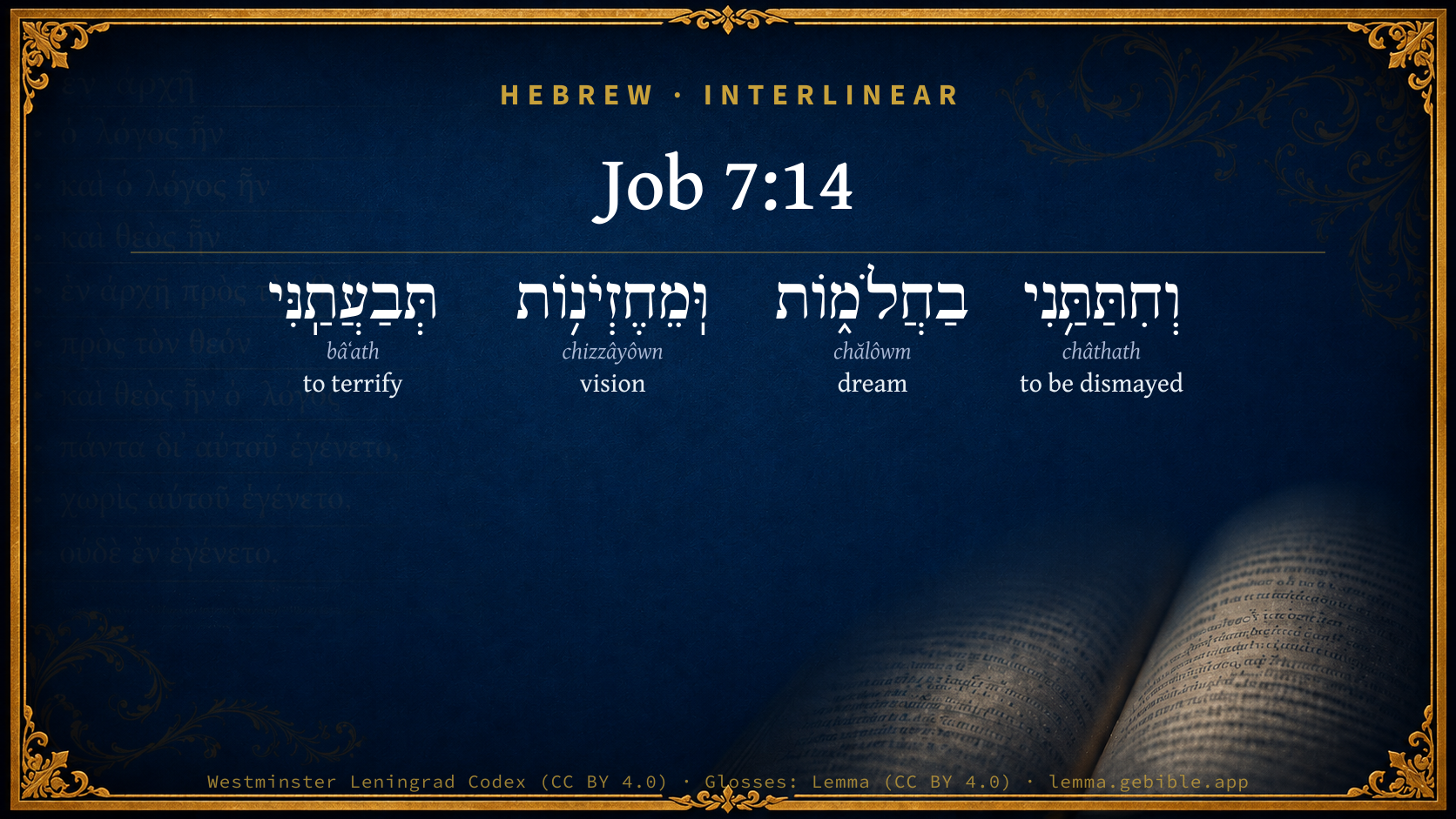
Job 7:14

Hebrew (Westminster Leningrad Codex) Job 7:14 appears in the Hebrew Old Testament. The text above is from the Westminster Leningrad Codex. Each word links to its Strong’s number, a concise gloss, and parsing drawn from the Open Scriptures Hebrew Bible morphology. Click any word for its full Brown-Driver-Briggs (BDB) entry.
Download image
Cite this verse

Job 7:14 (World English Bible). Public Domain. Lemma interlinear Bible study tool, https://lemma.gebible.app/v/job/7/14.

Show BibTeX & RIS
BibTeX
RIS
English Translation
Then you scar me with dreams, And terrify me through visions:
World English Bible · Public Domain
Download a study sheet

One document with this verse’s original text, its word-by-word gloss line, the meaning frame, cross-references with their text, attributed commentary, and full source and license credits — printable, and it pastes into notes with its structure intact.

This verse Autodidact and up

Study sheet (.html) Plain text (.txt)

A passage Seminary Student

Up to 50 verses in one chapter. A passage sheet keeps up to 6 commentary sources and 12 cross-references per verse, in the order this page ranks them, and says so on the sheet whenever that leaves anything out. Ask for a single verse and you get the Autodidact verse sheet above.

Everything on this page stays free to read, with no account — the sheet is a download of what is already on screen, not access to it.

Want to remove ads? Support Godless Engineer
Compare translations 3

The same verse in 3 English versions, stacked beneath the original-language interlinear above. Click any original word for its lexicon entry.

Each is an independent rendering of the whole verse — the interlinear is not word-aligned to these translations.

Highlighted words mark where these versions differ — a whole-verse word diff, not a word-by-word alignment.

  • World English Bible Public Domain
    Then you scar me with dreams, And terrify me through visions:
  • King James Version Public Domain
    Then thou scarest me with dreams, and terrifiest me through visions:
  • unfoldingWord Literal Text CC BY-SA 4.0
    then you scare me with dreams and you terrify me through visions,

unfoldingWord Literal Text — © unfoldingWord, licensed CC BY-SA 4.0. Word-aligned USFM3 via Door43 (git.door43.org/unfoldingWord/en_ult).

Versions to compare (up to 4)

3 of 4 selected

Show all 18 translations

Every available English version of this verse, each an independent rendering of the whole verse.

  • World English Bible Public Domain
    Then you scar me with dreams, And terrify me through visions:
  • Berean Standard Bible Public Domain
    then You frighten me with dreams and terrify me with visions,
  • Majority Standard Bible Public Domain
    then You frighten me with dreams and terrify me with visions,
  • King James Version Public Domain
    Then thou scarest me with dreams, and terrifiest me through visions:
  • American Standard Version (1901) Public Domain
    Then thou scarest me with dreams, And terrifiest me through visions:
  • Revised Version (1885) Public Domain
    Then thou scarest me with dreams, and terrifiest me through visions:
  • Geneva Bible (1599) Public Domain
    Then fearest thou me with dreames, and astonishest me with visions.
  • Douay-Rheims (1899) Public Domain
    Thou wilt frighten me with dreams and terrify me with visions.
  • Young's Literal Translation Public Domain
    And thou hast affrighted me with dreams, And from visions thou terrifiest me,
  • Literal Standard Version CC BY-SA 4.0
    And You have frightened me with dreams, || And You terrify me from visions,
  • Unlocked Literal Bible CC BY-SA 4.0
    then you scare me with dreams and terrify me through visions,
  • unfoldingWord Literal Text CC BY-SA 4.0
    then you scare me with dreams and you terrify me through visions,
  • Darby Bible Public Domain
    Then thou scarest me with dreams, and terrifiest me through visions;
  • World Messianic Bible Public Domain
    then you scare me with dreams and terrify me through visions,
  • Webster's Bible Public Domain
    Then thou scarest me with dreams, and terrifiest me through visions:
  • Free Bible Version CC BY-SA 4.0
    then you scare me so much with dreams and terrify me with visions
  • Bible in Basic English Public Domain
    Then you send dreams to me, and visions of fear;
  • JPS Tanakh (1917) Public Domain
    Then Thou scarest me with dreams, and terrifiest me through visions;

Literal Standard Version (2020), Covenant Press — licensed CC BY-SA 4.0. Text via the HelloAO Bible API (eBible.org). Unlocked Literal Bible (unfoldingWord) — licensed CC BY-SA 4.0. Text via the HelloAO Bible API (eBible.org). unfoldingWord Literal Text — © unfoldingWord, licensed CC BY-SA 4.0. Word-aligned USFM3 via Door43 (git.door43.org/unfoldingWord/en_ult). Free Bible Version, Dr. Jonathan Gallagher — licensed CC BY-SA 4.0. Text via the HelloAO Bible API (eBible.org).

Word by word

More ways to search: Search by grammar → Find every occurrence → Compare this word →

Practice this passage: Drill this verse → Learn its vocabulary →

About this verse

These counts appear in no published source. They are computed here, from the morphology-tagged text and Lemma’s own curated glosses. What Lemma adds →

4
words
4
distinct lemmas
Wisdom
section

Notable vocabulary

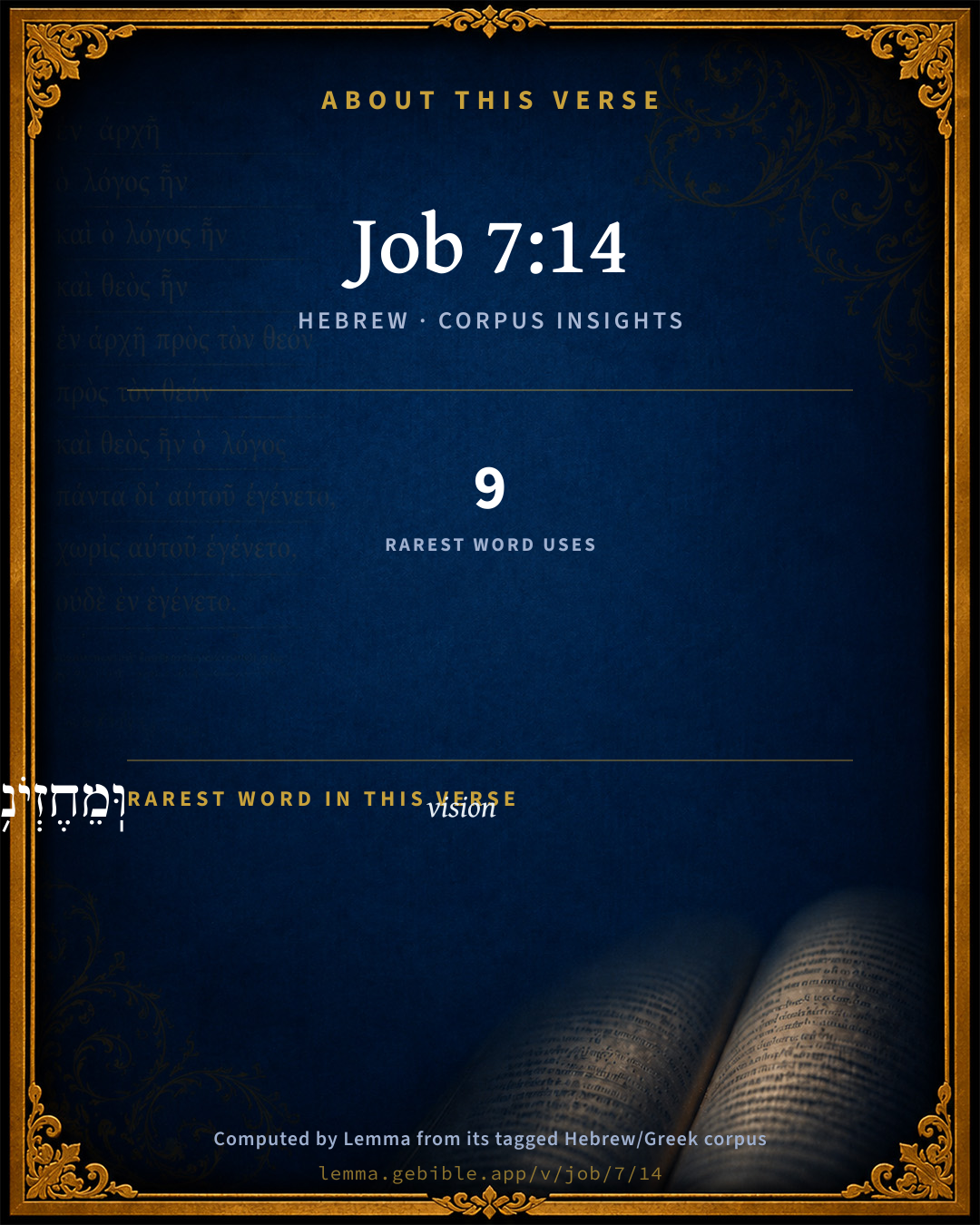
The rarest word here is וּֽמֵחֶזְיֹנ֥וֹת vision H2384 — appearing just 9 times in the whole Hebrew Bible.

Shared distinctive vocabulary

וּֽמֵחֶזְיֹנ֥וֹת vision H2384 occurs in 9 verses of the Hebrew Bible. Also found in:

Grammatical profile

  • 2 verbs
  • 2 nouns

Verb forms

  • וְחִתַּתַּ֥נִי Piel · Sequential Perfect
  • תְּבַעֲתַֽנִּי Piel · Imperfect

Hebrew & Septuagint length

In English translation the verse runs 11 words from the Hebrew and 11 from the Septuagint (LXX English) — the same length.

A rough comparison of the two English renderings, which tokenize alike — not a word-level alignment.

Word counts can differ between the Hebrew and the Greek without any difference in meaning — e.g. the Hebrew direct-object marker אֵת has no separate Greek word, and Greek often adds the article ὁ.

Cross-references

5

Topical passages linked to Job 7:14 in the Treasury of Scripture Knowledge — connected by theme and wording, ordered by reader-vote popularity; previews shown in the World English Bible.

  • Genesis 40:5–7 They both dreamed a dream, each man his dream, in one night, each man according to the interpretation of his dream, the cupbearer and the baker of the king of Egypt, who were bound in the prison.
  • Genesis 41:8 It happened in the morning that his spirit was troubled, and he sent and called for all the magicians of Egypt, and all the wise men of it. Pharaoh told them his dream, but there was no one who could interpret them to Pharaoh.
  • Daniel 2:1 In the second year of the reign of Nebuchadnezzar, Nebuchadnezzar dreamed dreams; and his spirit was troubled, and his sleep went from him.
  • Judges 7:13–14 When Gideon had come, behold, there was a man telling a dream to his fellow; and he said, Behold, I dreamed a dream; and, behold, a cake of barley bread tumbled into the camp of Midian, and came to the tent, and struck it so that it fell, and turned it upside down, so that the tent lay flat.
  • Matthew 27:19 While he was sitting on the judgment seat, his wife sent to him, saying, "Have nothing to do with that righteous man, for I have suffered many things this day in a dream because of him."

Cross-references courtesy of OpenBible.info (CC BY 4.0).

Hebrew and Greek witnesses Masoretic Hebrew ↔ Greek Septuagint

The same verse in the two great witnesses to the Old Testament, shown verse-for-verse.

These are two independent witnesses, not word-aligned to each other, and the Septuagint is shown in lemma (dictionary) form.

Hebrew Job 7:14 Masoretic · Westminster Leningrad Codex

וְחִתַּתַּ֥נִי בַחֲלֹמ֑וֹת וּֽמֵחֶזְיֹנ֥וֹת תְּבַעֲתַֽנִּי

Then you scar me with dreams, And terrify me through visions:

World English Bible · Public Domain

Greek LXX Job 7:14 Septuagint · lemma form

ἐκφοβέω ἐγώ ἐνύπνιον καί ἐν ὅραμα ἐγώ καταπλήσσω

You scare me with dreams, and do terrify me with visions.

LXX2012 (modern English Septuagint) · Public Domain

Hebrew: Westminster Leningrad Codex (CC BY 4.0). Greek: Septuagint (public domain); English from LXX2012 (modern English Septuagint) (Public Domain). How the Septuagint differs from the Hebrew →

Commentary

Notes on Job 7:14 from classic Christian and Jewish commentators (each source and its license shown beneath its notes). The classic Christian expositions comment on the surrounding passage and are grouped to its opening verse, so a note may address several verses; the Jewish commentaries on the Tanakh (Rashi and others) are per-verse, so they appear only where the commentator wrote on this verse.

Lemma curates 59 commentaries, every one of them public domain or Creative Commons licensed, each selected and text-cleaned for this edition rather than reprinted as found. About our sources →

Trapp's Complete Commentary

John Trapp

Job 7:14 Then thou scarest me with dreams, and terrifiest me through visions:

Ver. 14. Then thou scarest me with dreams] Extremam tentationem describit, saith Vatablus; and the devil doubtless had a great hand in this business (for it was within his commission, and he would not neglect any part of it); but Job taketh notice of none but God, the chief agent, and to him he applieth himself. His providence is exercised even about dreams, which, in melancholy people, happen (especially when they are sick) to be oftentimes very horrid and hideous; as that they fall down from some high place, commit some capital offence, are slain, torn in pieces by devils, &c. Bishop Foliot’s terrible night vision was before mentioned. Richard III, after the murder of his two innocent nephews, and Charles IX of France, after the Parisian Massacre, had such dreadful dreams, that they became a terror to themselves and to all about them. But to instance in better men: Calvin in the year of grace 1562, being sick of the gout, dreamed that he heard a great noise of drums beaten up most vehemently, as they use to be in warlike marches (Beza in Vita). Pareua also, A.D. 1618, saw in a dream the city of Heidelberg set on fire in many places, and the prince elector’s palace all on a light flame: this he set down the next morning in his dairy, and added these words, O Deus clementissime, averte sinistrum omen, &c., O most merciful God, turn aside this evil omen. (Philip Par. in Vita Patris). Such fearful dreams cause a sick sleep, and a worse waking. This Job complaineth of here; and yet more fully in the next words.

John Trapp, A Commentary or Exposition upon All the Books of the Old and New Testament (1647–1656) — public domain. Text from a community e-Sword module.

Geneva Bible (1599)

Geneva Bible translators

So that I can have no rest, night nor day.

Geneva Bible (1599) marginal notes — public domain. Text via Bolls.life.

Jamieson, Fausset & Brown

Robert Jamieson, A. R. Fausset & David Brown

The frightful dreams resulting from elephantiasis he attributes to God; the common belief assigned all night visions to God.

Jamieson, Fausset & Brown — Commentary Critical and Explanatory on the Whole Bible (1871) — public domain (CC PDM 1.0). Text via the HelloAO Bible API.

Adam Clarke's Commentary

Verse 14. Thou sparest me with dreams] There is no doubt that Satan was permitted to haunt his imagination with dreadful dreams and terrific appearances; so that, as soon as he fell asleep, he was suddenly roused and alarmed by those appalling images. He needed rest by sleep, but was afraid to close his eyes because of the horrid images which were presented to his imagination. Could there be a state more deplorable than this?

Adam Clarke's Commentary on the Bible (1810–1826) — public domain. Text from a community e-Sword/MySword module.

John Gill's Exposition

Then thou scarest me with dreams,.... Not with dreams and visions being told him, as were by Eliphaz, Job 4:13; but with dreams he himself dreamed; and which might arise from the force of his distemper, and the pain of his body, whereby his sleep was broken, his imagination disturbed, and his fancy roving, which led him to objects as seemed to him very terrible and dreadful; or from a melancholy disposition his afflictions had brought upon him; and hence in his dreams he had dismal apprehensions of things very distressing and terrifying; or from Satan, in whose hands he was, and who was permitted to distress and disturb him at such seasons; all which he ascribes to God, because he suffered it so to be: and now these dreams not only hindered sound sleep, and getting that ease and refreshment he hoped for from thence, but even they were frightful and scaring to him, so that instead of being the better for his bed and his couch, he was the worse; these dreams added to his afflictions, and in them he suffered much, as Pilate's wife is said to do, Mat 27:19,

and terrifiest me through visions; spectres, apparitions, and such like things, being presented to his fancy, while sleeping and dreaming, which filled him with terror, and sorely distressed him, so that he could receive no benefit hereby, but rather was more fatigued and weakened.

John Gill's Exposition of the Whole Bible (1746–1763) — public domain (CC PDM 1.0). Text via the HelloAO Bible API.

Albert Barnes' Notes on the Bible

Then thou scarest me - This is an address to God. He regarded him as the source of his sorrows, and he expresses his sense of this in language indeed very beautiful, but far from reverence.

With dreams - see Job 7:4. A similar expression occurs in Ovid:

Ut puto, cam requies medicinaque publica curae,

Somnus adest, soliris nox venit orba malis,

Somnia me terrent. veros imitantia casus,

Et vigilant sensus in mea damna mei.

Do Ponto, Lib. i. Eleg. 2.

And terrifiest me through visions - See the notes at Job 4:13. This refers to the visions of the fancy, or to frightful appearances in the night. The belief of such night-visions was common in the early ages, and Job regarded them as under the direction of God, and as being designed to alarm him.

Albert Barnes' Notes on the Bible (1834–1885) — public domain. Text from a community e-Sword/MySword module.

Matthew Poole's English Annotations

With sad and dreadful dreams, arising either from that melancholy humour which is now so fixed in me, and predominant over me, or from the devil’s malice, who by thy permission disturbs me in this manner; so that I am afraid to go to sleep, and my remedy proves as bad as my disease.

Visions are the same thing with dreams; for there were not only day visions, which were offered to men’s sight when they were awake; but also night visions, which were presented to men’s fancy in their sleep and dreams. See Gen 28:12; 41:1,2; Da 2:1,31; 4:5,10.

Matthew Poole's English Annotations on the Holy Bible (1683–1685) — public domain. Text from a community e-Sword/MySword module.

Whedon's Commentary on the Bible

Daniel D. Whedon

14. Dreams — According to Avicenna, those afflicted with elephantiasis suffer from frequent melancholy dreams.

Daniel D. Whedon (gen. ed.), Commentary on the Old and New Testaments (1874–1909) — public domain. Text from a community e-Sword module.

The Pulpit Commentary

Scared with dreams.

This seems to be one of the symptoms of Job"s terrible disease, elephantiasis. Sleep even does not give him rest from his sufferings. The bodily torments of the day only give place to horrible dreams and alarming visions at night.

I DREAM-TERRORS ARE REAL IN EXPERIENCE. Look at the man in a nightmare, how he groans and shrieks! We smile at his fancied troubles. Yet to him, while he endures them, they are very real. We feel according to our subjective state, not according to our objective circumstances. Souls are tortured by day-dreams which have no better foundation than those of the night, yet are not their distresses the less acute. Superstition peoples the heavens with dream-fancies of horror. There are no corresponding realities. Yet the victims of superstition are in real agony. An enormous amount of terrible mental suffering seems to be experienced by the heathen in their superstitious terrors of malignant divinities. One happy result of Christian missionary work is to sweep away those gloomy dreams, and bring the peace and confidence of Christian daylight to the benighted regions of the world.

II SOME OF OUR WORST DISTRESSES HAVE NO BETTER FOUNDATION THAN IDLE DREAMS. They are terrible so long as we are under their spell; but if we only knew they were but fancies of the diseased mind, we should be relieved of their incubus. Note some of these.

1. The idea that God is opposed to us. This was Job"s thought. He thought that even his ill dreams came from God, and that it was God who was scaring him. The too common notion in religion was and is that God is averse to us, and that we have to do something to win his favour, whereas the Scriptures tell us that he loves us and seeks us to be reconciled to him, and that, instead of our needing to do something to make him gracious, he has given his Son to redeem us to himself.

2. The notion that our sins are incurable. People will not believe that holiness is possible; therefore of course they do not have it, because they have not the heart of hope to seek it. We scare ourselves with ugly dreams of our own irretrievably ruined condition. Our sin is not a dream, but our despair is one.

3. The terror of death. To the Christian this is but an idle dream. Death is no hideous Miltonic monster, but the servant of Christ, Dying is the advent of Christ to the soul that lives in Christ"s service.

III CHRIST HAS COME TO DISPEL IDLE DREAMS. We are troubled about God"s dealings with us because we do not know him. We have but to acquaint ourselves with him in order to be at peace. (Job_22:21) Christ reveals God in his Fatherhood. There are reasonable fears that are no dreams, but which spring from our consciousness of guilt. Often the dream is found in the illusion that ignores or excuses sin. Christ dispels that dream by revealing a dread reality, but only that he may lead us through repentance to pardon. Then all terrors of the night flee away in the glad daylight of God"s love. W.F.A.

The Pulpit Commentary (1880–1919), ed. H.D.M. Spence-Jones & Joseph S. Exell — public domain. Text from a community e-Sword module.

Lesson kit

Teaching starters — assembled from the data on this page, not authored interpretation. Every prompt links to the verse data it draws on. Edit before teaching.

Job, in the Wisdom, opens this verse with 4 words (4 distinct Hebrew lemmas). Its most distinctive word is chizzâyôwn (“vision”). A historical commentator’s framing appears above. Read the whole chapter for the surrounding context.

Discussion questions

  1. How does “vision” (chizzâyôwn) shape what this verse is saying?
  2. How does 2 Samuel 7:17, which shares the word «vision», read alongside this verse?
  3. The translations on this page render this verse differently — a whole-verse word diff, not a word-by-word alignment. What might account for the different wordings?
  4. «וְחִתַּתַּ֥נִי» is a Piel Sequential Perfect verb. How does that grammatical form shape the action described?
  5. Compare how Trapp's Complete Commentary and Geneva Bible (1599) read this verse. Where do they agree or differ?

Things to notice

Reading settings

Reading text

Shown beneath each verse's original-language words.

Old Testament
Old Testament edition

Read the OT as the Masoretic Hebrew (MT) or the Greek Septuagint (LXX).

English shown for the Greek Septuagint (in the Hebrew ↔ Greek comparison).

Comparing translations? Open the Compare panel on any verse page to stack up to four side by side.