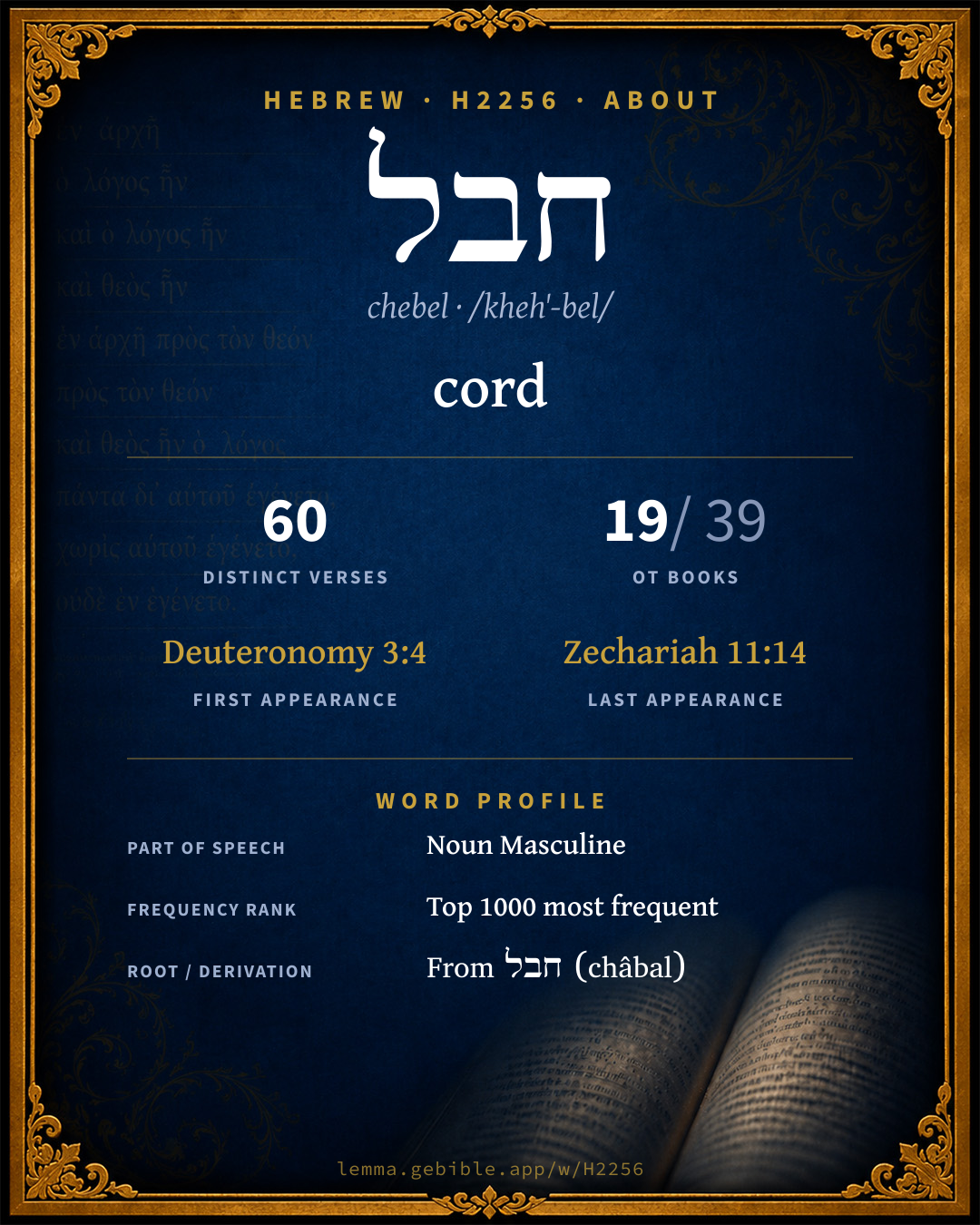
חבל
cord
also: rope, territory, band, company fuller range ↓
Full lexicon entry — Brown-Driver-Briggs (BDB)
From Brown-Driver-Briggs (BDB)
Where this word appears
Grammar key — what these labels mean
Part of speech
- Noun
- A naming word — a person, place, thing, or idea.
Noun type
- Common
- A common noun — a general class of person, place, or thing (“king,” “city,” “water”), not a specific name.
State
- Construct
- A noun bound to a following noun in a possessive / “of” relationship (the construct chain).
- Absolute
- The independent form of a noun, not bound to a following word.
Gender
- Both
- Attested as both masculine and feminine.
- Masculine
- Grammatically masculine.
Number
- Singular
- One.
- Plural
- More than one (in Hebrew, generally three or more).
Every verse where H2256 appears in the Book of Amos — 1 distinct verse. Click any verse to open its interlinear word-by-word view. Verse text shown in the World English Bible for context — . Each verse’s Hebrew form is shown with its reference; the English is not keyword-highlighted, since the data carries no word-level English alignment. Use “Compare translations” on any verse to read it across multiple English versions. This concordance covers the Hebrew Bible; Septuagint (Greek Old Testament) occurrences are not indexed here.
Amos
About this entry
At a glance — auto-summarized from this page’s data, not written by a person. Every figure links to its source below. This summary describes the numbers; it doesn’t interpret them.
חבל — transliterated chebel — is a Hebrew noun carrying the sense “cord.” The King James Version usually renders it “cords,” while modern versions prefer “cords of” (unfoldingWord Literal Text) — see the renderings breakdown. With 60 verses in 19 books, it is a moderately common word in the Hebrew Bible. Debuting at Deuteronomy 3:4, it then recurs through the corpus. Alongside “cord” the lexicon also lists “rope”, “territory”, and “band” — part of its full sense range. See the sense tree, 60-verse concordance, and the renderings breakdown below.
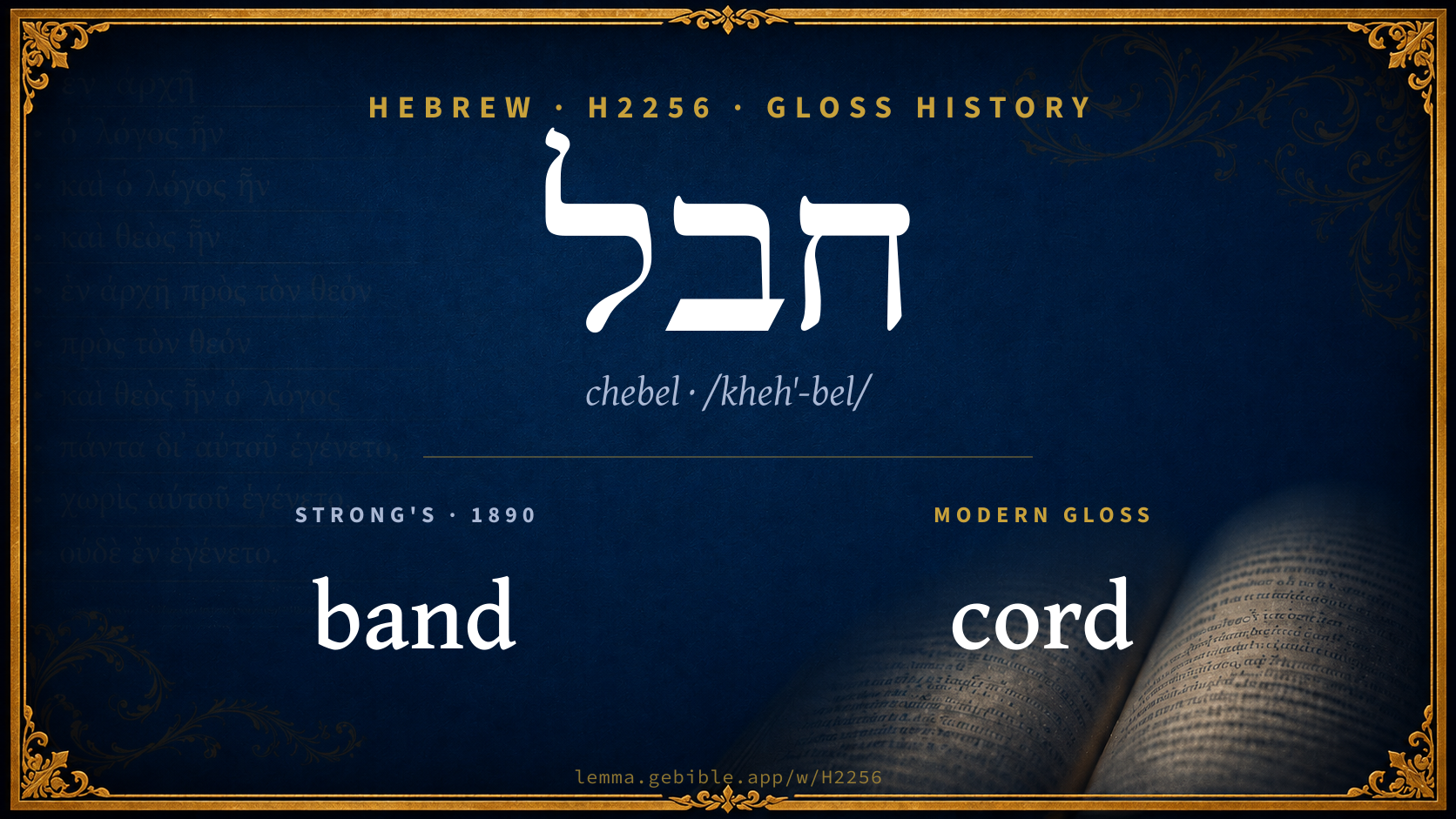
Gloss history
Strong's 1890 vs modern scholarship
About this word
Strong's H2256 catalogs a Hebrew word from the Hebrew Old Testament.
These counts are not copied from any lexicon or concordance. They are computed here, from the morphology-tagged Hebrew Old Testament. What Lemma adds →
- 60
- distinct verses
- The word appears in 60 distinct verses.
- 19 / 39
- OT books
- The word appears in 19 of 39 Old Testament books.
- #623
- by frequency
- Top 1000 most frequent Hebrew words (rank 623 of 8,640 Hebrew words by occurrence).
View all 60 occurrences in the concordance →
By section of the Old Testament
By traditional corpus
Conventional, traditional groupings — biblical authorship is debated, so this is a traditional corpus grouping, not an authorship claim. Each share is this word’s portion of its verses in that division of the Hebrew canon. Each figure is a share of the word’s 60 distinct verses.
- Prophets (Nevi'im) 39 verses · 65%
- Writings (Ketuvim) 17 verses · 28%
- Torah (Pentateuch) 4 verses · 7%
How translations render this word
Counts come from each version’s own published word-to-Strong’s tagging or interlinear alignment — an approximate guide to how each version renders this word, not a word-level alignment the data otherwise carries. Because each total is that version’s own tagged count, the per-version totals vary from one another and need not match the appearance or distinct-verse counts above. These counts may also differ from a printed concordance because Lemma counts each distinctly tagged rendering and does not collapse phrase taggings into a single head-word total. This is a fixed set of word-tagged versions (KJV, ASV, BSB, ULT) and does not change with the reading translation you choose elsewhere. Each version’s license is shown beside its name below (and on Sources).
BDB lists this Strong’s number as 4 distinct words (homographs). Each count above pools all of them and is not split by sense — see the Senses section below. A low-frequency rendering may belong to a different one of those words, not the primary meaning.
- King James Version†: Cords 10×, Sorrows 9×, Line 5×
- American Standard Version†: Cords 14×, Line 6×, All the region 3×
- Berean Standard Bible†: Cords 10×, Ropes 9×, Region 4×
- unfoldingWord Literal Text†: Cords of 8×, Rope 6×, Region of 5×
King James Version Public Domain
Renders H2256 across 60† tagged occurrences — most commonly:
Plus 18 renderings that appear only once — usually multi-word phrases or single function words the recovered tagging swept in, not distinct renderings.
American Standard Version Public Domain
Renders H2256 across 58† tagged occurrences — most commonly:
Plus 22 renderings that appear only once — usually multi-word phrases or single function words the recovered tagging swept in, not distinct renderings.
Berean Standard Bible Public Domain
Renders H2256 across 60† tagged occurrences — most commonly:
Plus 21 renderings that appear only once — usually multi-word phrases or single function words the recovered tagging swept in, not distinct renderings. Not rendered by a distinct English word in 2 further occurrences.
unfoldingWord Literal Text CC BY-SA 4.0
Renders H2256 across 62† tagged occurrences — most commonly:
Plus 20 renderings that appear only once — usually multi-word phrases or single function words the recovered tagging swept in, not distinct renderings.
8 senses and sub-senses in the full BDB
What do BDB’s symbols mean?
BDB uses these scholarly abbreviations:
| Symbol | Meaning |
|---|---|
| 𝔊 | the Septuagint (the ancient Greek translation, LXX) |
| 𝔙 | the Vulgate (the Latin translation) |
| 𝔖 | the Syriac version (the Peshitta) |
| 𝔗 | the Targum (the Aramaic translation) |
| ψ | the Psalms |
| √ | root (the underlying root or stem) |
| ‖ | parallel passage (a synonymous or contrasted parallel) |
| † | the dagger: every passage where the word occurs is cited |
The 8 senses and sub-senses the full Brown-Driver-Briggs lexicon distinguishes for this word, in lexicon order (not ranked by frequency), with BDB’s own verbatim wording and sub-sense lettering. Shown in Hebrew script with BDB’s own scholarly abbreviations. The condensed entry is in the Lexicon Entry tab. See also the Forms in the corpus table below.
חבל I Jos 2
- 1. cord, rope, by which men were lowered Jos 2:15 (JE), Je 38:6, 11, 12, 13, or stones dragged 2 S 17:13; of tents Is 33:20; tackling of ship v 23; for binding Ez 27:24 Jb 40:25 Est 1:6; symbol of captivity or subjection 1 K 20:31, 32; fig. of snare for wicked Jb 18:10 (‖ מַלְכֻּדְתּוֹ), set by wicked ψ 140:6 (‖ פַּח); ψ 119:61 cords of wicked men have surrounded me; of wicked held בחבלי חַטָּאתוֹ Pr 5:22; ח׳ הַשָּׁ֑וְא Is 5:18 cords (ropes) of wickedness (‖ כַּעֲבוֹת הָעֲגָלָה); of cords of distress (עֹ֑נִי) Jb 36:8 (‖ זִקִּים); so חֶבְלֵי מָוֶת (prob.) ψ 116:3, חֶבְלֵי שׁאוֹל ψ 18:6 = 2 S 22:6 (‖ מוֹקְשֵׁי מָוֶת);—for חֶבְלֵי מות ψ 18:5 read מִשְׁבְּרֵי, v. 2 S 22:5 and ‖ נַחֲלֵי בְלִיַּעַל, De Che Bae; to draw בְּחַבְלֵי אָדָם Ho 11:4 (i.e. humanely, kindly); of cord of life חֶבֶל הַכֶּסֶף Ec 12:6. e.g. Joshua 2:15
- 2. measuring-cord, line ח׳ מִדָּה Zc 2:5; so ח׳ alone 2 S 8:2(×3) Am 7:17 Mi 2:5 ψ 78:55; fig. (of favoured life) ψ 16:6; in gen. of one’s portion, fortune Jb 21:17 according to 𝔗 Thes Add. Ew Di al., but חֵבֶל. Thence e.g. Zechariah 2:5
- 3. measured portion, lot, part, region, ח׳ נַחֲלָה inherited portion Dt 32:9 1 Ch 16:18 = ψ 105:11; also ח׳ alone Jos 17:5, 14; 19:9 Ez 47:13 (חבלים; 𝔙 𝔗 read as dual, v. Ew Sm Da al.; Co del. on intern. grounds); of particular regions ח׳ אַרְגֹּב Dt 3:4, 13, 14 1 K 4:13; ח׳ אַכְזִיב Jos 19:29 (si vera l., v. WMMAsien 194); ח׳ הַיָּם Zp 2:5; also v 6, but היתה ח׳ here dub.; Sta proposes 2 fs. הָיִת, and del. ח׳ הים; without היס, v 7. e.g. Deuteronomy 32:9
- 4. band, company of prophets 1 S 10:5, 10.—ii. חֶבֶל v. sub ii. חָבַל. e.g. 1 Samuel 10:5
חבל II
- 1. pains of travail:
- a. obj. of תְּשַׁלַּחְנָה Jb 39:3 meton. for offspring (‖ יַלְדֵיהֶן; v. Di; of goats and hinds). e.g. Job 39:3
- b. sim. of distress of exiles Is 26:17; fig. of anguish of nations צִירִים וַחֲבָלִים יֹאחֵזוּן Is 13:8 (‖ כַּיּוֹלֵדָה יְחִילוּן), also Je 13:21; 22:23; 49:24; of crisis of redemption Ho 13:13 (‖ חֶבְלֵי יוֹלֵדָה), of birth of new Isr. Is 66:7. e.g. Isaiah 26:17
- 2. of other than birth-pangs only חבלים Jb 21:17; pains, pangs, sorrows (so 𝔊 𝔙 Thes,—otherwise Add.—RobGes Hi Da al.; ‖ נֵר יִדְעָ֑ךְ, יָבֹא אֵידָם); > others, portion, fortune, v. חֶבֶל. e.g. Job 21:17
חבל III [m.]pl. union (lit. binders) name of Zec.’s second symbolic staff Zc 11
חבל IV destruction
Senses from the full Brown-Driver-Briggs lexicon (Brown, Driver, Briggs; Oxford 1906 — public domain), digitized via Sefaria, supplemented by the OpenScriptures HebrewLexicon (CC BY 4.0). Full attribution on Sources.
Word origin
I. n.m. Jos 2:14 f. †Zp 2:6 (but v. infr.) cord, territory, band; ח׳ abs. Jos 2:15 +; cstr. Dt 3:4 +, חֵ֫בֶל Jos 19:29; sf. חַבְלוֹ Jb 18:10; pl. חֲבָלִים 2 S 8:2 + 10 times + Ez 47:13 Jb 21:7 v. infr.; cstr. חַבְלֵי Jos 17:5 + 5 times; חֶבְלֵי ψ 116:3 + 4 times + ψ 18:5 (read משׁברי v. infr.); sf. חֲבָלָ֑יִךְ Is 33:23; חֲבָלָיו Is 33:20;—
I. n.m. Is 66:7 (but v. Je 49:24) pain, pang;—ח׳ abs. Is 66:7; elsewhere pl. חֲבָלִים Is 13:8 + 3 times + Jb 21:17 v. infr.; cstr. חֶבְלֵי Ho 13:13; sf. חֲבָלֶיהָ Is 26:17; חֶבְלֵיהֶם Jb 39:3 (on sf. v. Ges§ 135, 5, R 1);—pain, pang:
I. n.[m.]pl. union (lit. binders) name of Zec.’s second symbolic staff Zc 11:7 and c. art. v 14. See חָבַל 1.
II. n.m. destruction—חֶבֶל נִמְרָץ Mi 2:10; cf. ii. חָבַל Pi.
— Brown-Driver-Briggs (Oxford 1906, public domain), digitized via Sefaria, supplemented by the OpenScriptures HebrewLexicon (CC BY 4.0). See Sources.
Derived from חבל (châbal) (H2254) — to bind.
Jastrow Dictionary
A second Hebrew/Aramaic lexicon for comparison, covering Aramaic and post-biblical (Talmudic, Targumic, Midrashic) usage that the biblical-Hebrew BDB does not. Matched by lemma rather than by Strong’s number, so a lemma may carry more than one Jastrow headword (shown separately below), and the entries cover usage well beyond the Bible.
חָבַל
- 1. to seize, to take a pledge. Mekh. B’shall., Vayassa, s. 1, a. e., v. חֲבוֹלָה.—B. Mets. IX, 13 (115ᵃ) החוֹבֵל את הריחים he who seizes millstones (for his debt); a. fr.
- 2. to twist (v. חֶבֶל); to do violence, unshape; to inflict a wound, to hurt (followed by ב of the object). B. Kam. VIII, 1 החוֹבֵל בחבירו he who injures his neighbor. Sabb. XIV, 1. Ib. 106ᵃ חובל בצריך לכלבו one who wounds (an animal on the Sabbath is guilty) when he needs the blood for his dog. Ib. חובל בעלמא one who wounds generally (not for a purpose); a. fr.
- 3. to writhe, travail, v. Pi.
- 1. to be seized. Yalk. Ex. 351 שניתן לֵיחָבֵל ביום (B. Mets. 114ᵇ לַחֲבוֹל) which may be seized as a pledge in day time.
- 2. to be injured. Tosef. B. Kam. IX, 29 אע"פ שלא … מן הנֶחְבָּל וכ׳ although the injurer does not ask the injured (to pray for him), the injured must pray &c.; a. fr.
- 1. to injure, wound; to unshape, ruin, spoil. Ber. 51ᵃ יש לי … לחַבֵּל I have permission to injure (kill). B. Kam. 91ᵇ לחַבֵּל בעצמו to mutilate one’s self.—Kel. XIV, 2 משיְחַבֵּל from the moment he batters (the tube, for fitting it into the top of the staff); Tosef. Kel. B. Mets. IV, 5 משיִחְבּוֹל, v. חָבַר. Num. R. s. 10 (play on חִבֵּל, Prov. XXIII, 34) שחִבְּלָתוֹ יעל וכ׳ whom Jael mutilated on his head. Yalk. Ex. 301 חִבַּלְתֶּם מעשיכם you have ruined (turned to evil) your deeds. Snh. 24ᵃ מְחַבְּלִין זה לזה וכ׳ (Ms. K. זה את זה) wound each other’s feelings in discussions; a. fr. e.g. Proverbs 23:34
- 2. to travail. Taan. 8ᵃ bot. מְחַבֶּלֶת ואינה יולדת (Rashi: חוֹבֶלֶת) travails but cannot give birth.—Pass. pass. מְחוּבָּל ruined. Ex. R. s. 30.
- to be spoiled, ruined. Mekh. B’shall., Vayassa, s. 1 נותן דבר המְחַבֵּל לתוך דבר המִתְחַבֵּל he puts a thing which spoils (the taste) into a thing which is spoiled.
חֲבַל I
- , fut. יַחְבּוֹל same, to wrong, be violent. Targ. Job XXXIV, 31.
- 1. to injure; to ruin, destroy &c. (corresp. to b. h. הִשְׁחִית). Targ. O. Lev. XIX, 27. Targ. Gen. VI, 12; a. fr.—Part. pass. מְחַבַּל mutilated, blemished. Targ. O. Deut. XXIII, 2. Targ. Mal. I, 14.—B. Kam. 87ᵃ אי בעי מְחַבֵּל בה לא מצי חַבֵּיל Ms. M. (ed. מתח׳, incorr.) if he desired to wound her (his daughter), he dared not.
- 2. to travail. Denom. מְחַבַּלְתָּא.
- to be corrupted, destroyed. Targ. Gen. VI, 11, sq. Targ. Job XVII, 1; a. e. [Targ. Ps. LXII, 11, v. הֲבַל.]—Ithpe. אִיחֲבַל to get sick. B. Mets. 97ᵃ ואי׳ ומית Ms. H. (ed. חֲבִיל).
חֲבַל II
- (preced.)
- 1. injury, v. חַבְלָא I. I.
- 2. woe!, Oh! (cmp. בִּיָּיא II). Targ. Job X, 15 (Var. חֲבֵיל, חֲבוֹל); a. e.—[Also in Hebr. diction] Ned. 74ᵇ ח׳ עליך וכ׳ woe unto thee! (a pity) that &c. Snh. 111ᵃ; Ex. R. s. 6, a. e. ח׳ על דאבדין וכ׳ Oh, for those who are gone and cannot be replaced! Ex. R. s. 26; Mekh. B’shall., Vayassa, s. 6 (prov.) נפל ביתא ח׳ לכוותא (not אבל) when the house falls, woe to the windows!; a. fr.
- 3. (adv.) to ruin. Pes. 20ᵇ תשפך ח׳ (v. Rabb. D. S. a. l. note 9) it must be poured out (and go) to ruin; B. Kam. 116ᵃ (ed. הכל, corr. acc., v. Rabb. D. S. a. l. note 30), opp. to תעשה זילוף, v. זִילּוּף.
חֲבֵל
- , v. חֲבֵיל
חֶבֶל
- 1. rope, a measure of dimensions, rope’s length. Gen. R. s. 93 קשר ח׳ בח׳ tied rope to rope, v. נִימָא; Cant. R. to I, 1. Erub. V, 4 וכ׳ אין מודדין אלא בח׳ Sabbath distances must be measured with a rope of fifty cubits’ length. Ib. 58ᵃ, v. אַפְסְקִימָא. B. Bath. VII, 2 (103ᵇ) מדה בח׳ measured with the rope (exact dimensions). Peah IV, 5 על הח׳ in a straight line, v. לָקַט; a. fr.—Pl. חֲבָלִים. Erub. l. c. ג׳ ח׳ הם וכ׳ there are three kinds of ropes (used for legal purposes).—Trnsf. share, possession. Sifré Deut. 312 אין ח׳ אלא גורל ḥebel means lot; a. e.
חֵבֶל
- 1. writhing, throes of birth, agony. Snh. 98ᵇ, a. e. חֶבְלוֹ של משיח the sufferings which are to precede the advent of the Messiah.—Pl. חֲבָלִים, constr. חֶבְלֵי. Nidd. 31ᵃ ח׳ נקבה the pains at giving birth to a female. Ib. חבלי של נקבה (read: חבלים). Ib. וזהו ח׳ אשה and this is the cause of woman’s throes.
- 2. damage, injury. Mekh. Mishp., N’zikin, s. 8 ח׳ אשה לבעל the damages for a wife’s injury belong to her husband.
חִיבּוּל
- 1. wound, injury. Targ. Lev. XIX, 28; XXI, 5.—M. Kat. 28ᵇ, v. חֲבִילָא I.
- 2. moral defect, corruption. Targ. Job XI, 15. Ib. XXXI, 7; a. e.
A Dictionary of the Targumim, the Talmud Babli and Yerushalmi, and the Midrashic Literature (Marcus Jastrow; London, Luzac, 1903) — Public Domain. Digitized via Sefaria. Digitized via Sefaria. Full attribution on Sources.
Forms in the corpus
The 48 distinct written forms H2256 takes in the Hebrew Bible, most frequent first — each parse links to that state’s occurrences in the concordance. Hebrew forms include their vowel points and cantillation, so a single lemma takes many written forms.
Same root — word family
Other BDB entries built from the same root as H2256, grouped by Strong’s listed origin. These share a root / origin per the lexicon — not necessarily a shared meaning. Each links to that word’s own entry.
Derives from
Shares the same root
- חבל chăbal H2255 to destroy
- חבל chăbôl H2258 pledge
- חבל chôbêl H2259 sailor
- חבל chibbêl H2260 mast
- תחבלה tachbulâh H8458 counsel
Compare all same-root words → Showing 4 of 7 — not the complete family. They share a root, not necessarily a meaning.
Septuagint verse parallels
This word appears in 54 verses that also exist in the Greek Old Testament (Septuagint), out of the 60 Hebrew verses it occurs in. You can read those verses in Greek by switching the Old Testament edition to the Septuagint.
Read these verses in the Septuagint
- Deuteronomy 3:4
- Joshua 2:15
- 1 Samuel 10:5
- 2 Samuel 8:2
- 1 Kings 4:13
- 1 Chronicles 16:18
- Esther 1:6
- Job 18:10
- Psalms 16:6
- Proverbs 5:22
- Ecclesiastes 12:6
- Isaiah 5:18
This is a verse-level parallel only — the same verses exist in both the Hebrew and Greek Old Testaments. No word-level Hebrew↔Greek correspondence is claimed: the data carries no such alignment, so no Greek word is shown as this Hebrew word’s translation. Coverage is not total — the Septuagint omits the deuterocanon and renumbers the Psalms, so some Hebrew verses have no direct Greek parallel.