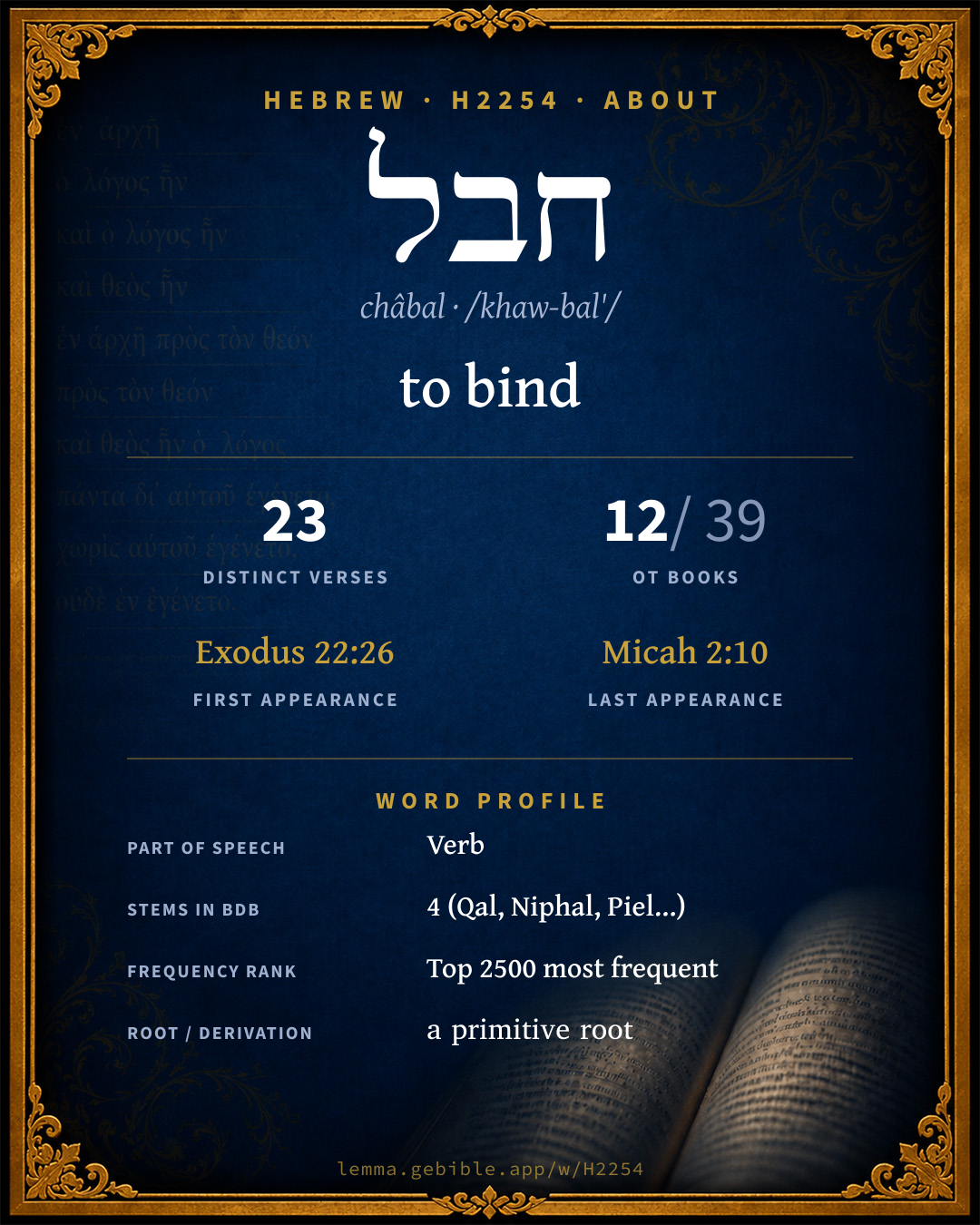
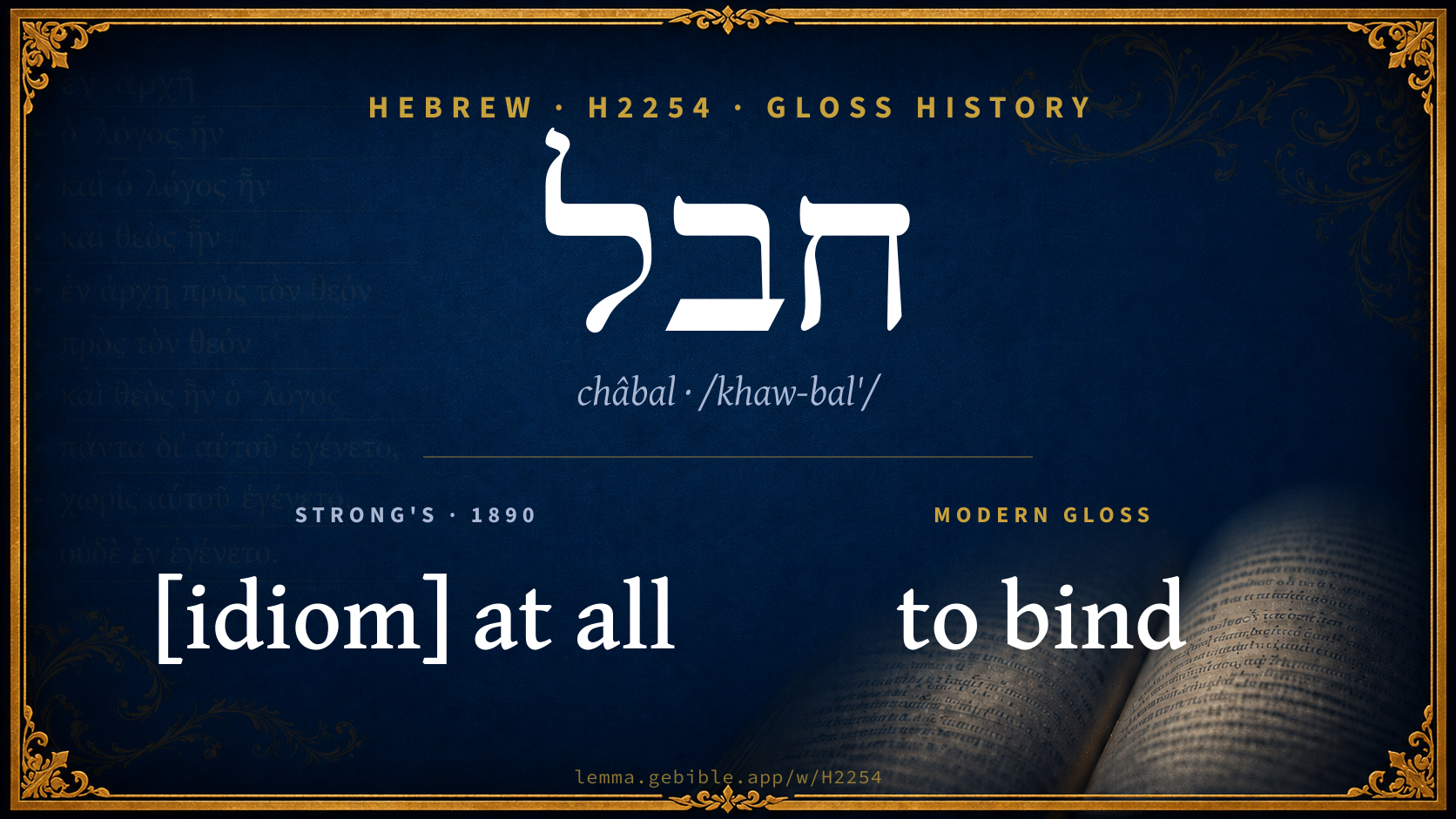
חָבַל
to bind
‘to bind’ is one of 4 main senses fuller range ↓
Full lexicon entry — Brown-Driver-Briggs (BDB)
From Brown-Driver-Briggs (BDB)
Where this word appears
See every Qal verb in the Hebrew Bible →
Grammar key — what these labels mean
Part of speech
- Verb
- An action or state-of-being word.
Stem
- Piel
- An intensive or resultative active stem. Here: ‘ruin’
- Qal
- The basic, simple active stem — the plain form of the verb (“he wrote”). Here: ‘bind’
- Pual
- The passive counterpart of the Piel.
- Niphal
- Usually the simple passive or reflexive of the Qal (“he was written”).
Form
- Infinitive Construct
- A bound verbal noun, frequently with prepositions (“to write / in writing”).
- Imperfect
- An incomplete, ongoing, or future action (“he will / would write”).
- Imperative
- A direct command (“write!”).
- Sequential Perfect
- A perfect with prefixed waw continuing a preceding imperfect or command (waw-consecutive perfect).
- Perfect
- A completed action or state — Hebrew marks aspect (completeness) more than strict tense (“he wrote”).
- Participle Active
- A verbal adjective expressing ongoing or characteristic action (“writing / one who writes”).
- Infinitive Absolute
- An unbound verbal noun, often intensifying or standing in for a finite verb.
- Participle Passive
- A verbal adjective expressing action received (“written”).
State
- Absolute
- The independent form of a noun, not bound to a following word.
Person
- 2nd Person
- The one addressed (“you”).
- 3rd Person
- The one spoken about (“he / she / it / they”).
- 1st Person
- The speaker (“I / we”).
Gender
- Masculine
- Grammatically masculine.
- Feminine
- Grammatically feminine.
- Common
- Either gender — not distinguished for this form.
Number
- Singular
- One.
- Plural
- More than one (in Hebrew, generally three or more).
Grammatical forms 20 distinct
- Verb, Piel, Infinitive Construct 3 times (11%)
- Verb, Qal, Imperfect, 2nd Person, Masculine, Singular 3 times (11%)
- Verb, Qal, Imperfect, 3rd Person, Masculine, Plural 2 times (7%)
- Verb, Qal, Imperative, 2nd Person, Masculine, Singular 2 times (7%)
- Verb, Piel, Perfect, 3rd Person, Feminine, Singular 2 times (7%)
- Verb, Pual, Sequential Perfect, 3rd Person, Masculine, Singular 1 time (4%)
- Verb, Piel, Sequential Perfect, 3rd Person, Masculine, Singular 1 time (4%)
- Verb, Niphal, Imperfect, 3rd Person, Masculine, Singular 1 time (4%)
+12 more forms (12 occurrences)
Parsed forms decoded from the imported morphology (morphhb / Westminster Leningrad Codex — WLC text public domain, morphhb tagging CC BY 4.0), counted across 27 parsed occurrences — not distinct verses.
Every verse where H2254 appears — 23 distinct verses across 12 books. Click any verse to open its interlinear word-by-word view. Verse text shown in the World English Bible for context — . Each verse’s Hebrew form is shown with its reference; the English is not keyword-highlighted, since the data carries no word-level English alignment. Use “Compare translations” on any verse to read it across multiple English versions. This concordance covers the Hebrew Bible; Septuagint (Greek Old Testament) occurrences are not indexed here.
Exodus 1 verse
Deuteronomy 2 verses
- Deuteronomy 24:6 יַחֲבֹ֥ל חֹבֵֽל Qal impf 3ms Qal ptcp.act ms No man shall take the mill or the upper millstone to pledge; for he takes [a man's] life to pledge.
- Deuteronomy 24:17 תַחֲבֹ֔ל Qal impf 2ms You shall not wrest the justice [due] to the foreigner, [or] to the fatherless, nor take the widow's clothing to pledge;
Nehemiah 1 verse
Job 5 verses
- Job 17:1 חֻ֭בָּלָה Pual pf 3fs "My spirit is consumed, my days are extinct, And the grave is ready for me.
- Job 22:6 תַחְבֹּ֣ל Qal impf 2ms For you have taken pledges from your brother for nothing, And stripped the naked of their clothing.
- Job 24:3 יַ֝חְבְּל֗וּ Qal impf 3mp They drive away the donkey of the fatherless, And they take the widow's ox for a pledge.
- Job 24:9 יַחְבֹּֽלוּ Qal impf 3mp There are those who pluck the fatherless from the breast, And take a pledge of the poor,
- Job 34:31 אֶחְבֹּֽל Qal impf 1cs "For has any said to God, 'I am guilty, but I will not offend any more.
Psalms 1 verse
Proverbs 3 verses
- Proverbs 13:13 יֵחָ֣בֶל Niphal impf 3ms Whoever despises instruction will pay for it, But he who respects a command will be rewarded.
- Proverbs 20:16 חַבְלֵֽ/הוּ Qal impv 2ms + sfx pers 3ms Take the garment of one who puts up collateral for a stranger; And hold him in pledge for a wayward woman.
- Proverbs 27:13 חַבְלֵֽ/הוּ Qal impv 2ms + sfx pers 3ms Take his garment when he puts up collateral for a stranger; Hold it for a wayward woman!
Ecclesiastes 1 verse
Song of Solomon 2 verses
- Song of Solomon 2:15 מְחַבְּלִ֣ים Piel ptcp.act mp Catch for us the foxes, The little foxes that spoil the vineyards; For our vineyards are in blossom. Beloved
- Song of Solomon 8:5 חִבְּלַ֣תְ/ךָ חִבְּלָ֥ה Piel pf 3fs + sfx pers 2ms Piel pf 3fs Who is this who comes up from the wilderness, Leaning on her beloved? Under the apple tree I aroused you. There your mother conceived you. There she was in labor and bore you.
Isaiah 4 verses
- Isaiah 10:27 וְ/חֻבַּ֥ל conj + Pual wpf 3ms It shall happen in that day, that his burden shall depart from off your shoulder, and his yoke from off your neck, and the yoke shall be destroyed by reason of fatness.
- Isaiah 13:5 לְ/חַבֵּ֖ל prep + Piel inf.cs They come from a far country, from the uttermost part of heaven, even Yahweh, and the weapons of his indignation, to destroy the whole land.
- Isaiah 32:7 לְ/חַבֵּ֤ל prep + Piel inf.cs The instruments of the churl are evil: he devises wicked devices to destroy the humble with lying words, even when the needy speaks right.
- Isaiah 54:16 לְ/חַבֵּֽל prep + Piel inf.cs Behold, I have created the smith who blows the fire of coals, and brings forth a weapon for his work; and I have created the waster to destroy.
Ezekiel 1 verse
Amos 1 verse
Micah 1 verse
About this entry
At a glance — auto-summarized from this page’s data, not written by a person. Every figure links to its source below. This summary describes the numbers; it doesn’t interpret them.
חבל (châbal) is a Hebrew verb most often rendered “to bind.” As a verb its force shifts by stem, across 4 stems (Qal, Niphal, and more). Spanning 23 verses in 12 books, it ranks among the uncommon words of the Hebrew Bible. It first appears in Exodus 22:26. Related forms include חבל, חבל and חבל. The sections below give every sense, occurrence, and version rendering.
Gloss history
Strong's 1890 vs modern scholarship
About this word
Strong's H2254 catalogs a Hebrew word from the Hebrew Old Testament.
These counts are not copied from any lexicon or concordance. They are computed here, from the morphology-tagged Hebrew Old Testament. What Lemma adds →
- 23
- distinct verses
- The word appears in 23 distinct verses.
- 12 / 39
- OT books
- The word appears in 12 of 39 Old Testament books.
- #1,226
- by frequency
- Top 2500 most frequent Hebrew words (rank 1,226 of 8,640 Hebrew words by occurrence).
View all 23 occurrences in the concordance →
By section of the Old Testament
By traditional corpus
Conventional, traditional groupings — biblical authorship is debated, so this is a traditional corpus grouping, not an authorship claim. Each share is this word’s portion of its verses in that division of the Hebrew canon. Each figure is a share of the word’s 23 distinct verses.
- Writings (Ketuvim) 13 verses · 57%
- Prophets (Nevi'im) 7 verses · 30%
- Torah (Pentateuch) 3 verses · 13%
How translations render this word
Counts come from each version’s own published word-to-Strong’s tagging or interlinear alignment — an approximate guide to how each version renders this word, not a word-level alignment the data otherwise carries. Because each total is that version’s own tagged count, the per-version totals vary from one another and need not match the appearance or distinct-verse counts above. These counts may also differ from a printed concordance because Lemma counts each distinctly tagged rendering and does not collapse phrase taggings into a single head-word total. This is a fixed set of word-tagged versions (KJV, ASV, BSB, ULT) and does not change with the reading translation you choose elsewhere. Each version’s license is shown beside its name below (and on Sources).
BDB lists this Strong’s number as 2 distinct words (homographs). Each count above pools all of them and is not split by sense — see the Senses section below. A low-frequency rendering may belong to a different one of those words, not the primary meaning.
- King James Version†: Pledge 5×, Destroy 4×, Take a pledge 3×
- American Standard Version†: Destroy 4×, Pledge 4×, Bands 2×
- Berean Standard Bible†: Destroy 3×, Get collateral 2×, Security 2×
- unfoldingWord Literal Text†: Destroy 4×, Pledge 4×, Hold it in pledge 2×
King James Version Public Domain
Renders H2254 across 34† tagged occurrences — most commonly:
Plus 16 renderings that appear only once — usually multi-word phrases or single function words the recovered tagging swept in, not distinct renderings.
American Standard Version Public Domain
Renders H2254 across 35† tagged occurrences — most commonly:
Plus 21 renderings that appear only once — usually multi-word phrases or single function words the recovered tagging swept in, not distinct renderings.
Berean Standard Bible Public Domain
Renders H2254 across 25† tagged occurrences — most commonly:
Plus 18 renderings that appear only once — usually multi-word phrases or single function words the recovered tagging swept in, not distinct renderings. Not rendered by a distinct English word in 2 further occurrences.
unfoldingWord Literal Text CC BY-SA 4.0
Renders H2254 across 36† tagged occurrences — most commonly:
Plus 22 renderings that appear only once — usually multi-word phrases or single function words the recovered tagging swept in, not distinct renderings.
9 senses and sub-senses in the full BDB
Hebrew verbs can shift meaning by stem (binyan): Qal is the basic action, Niphal is often passive or reflexive, Piel often intensifies or makes it factitive, and Hiphil is typically causative. The senses below are grouped under the stem BDB assigns to each. This entry also uses Pual (the passive of Piel).
What do BDB’s symbols mean?
BDB uses these scholarly abbreviations:
| Symbol | Meaning |
|---|---|
| 𝔊 | the Septuagint (the ancient Greek translation, LXX) |
| 𝔙 | the Vulgate (the Latin translation) |
| 𝔖 | the Syriac version (the Peshitta) |
| 𝔗 | the Targum (the Aramaic translation) |
| ψ | the Psalms |
| √ | root (the underlying root or stem) |
| ‖ | parallel passage (a synonymous or contrasted parallel) |
| † | the dagger: every passage where the word occurs is cited |
The 9 senses and sub-senses the full Brown-Driver-Briggs lexicon distinguishes for this word, in lexicon order (not ranked by frequency), with BDB’s own verbatim wording and sub-sense lettering. Shown in Hebrew script with BDB’s own scholarly abbreviations. The condensed entry is in the Lexicon Entry tab. See also the Forms in the corpus table below.
חבל I bind, pledge (Arabic حَبَلَ bind
Qal
- Pf. חָבָ֑ל Ez 18:16 Impf. יַחֲבֹל Dt 24:6; 2 ms. תַּחֲבֹל Dt 24:17; תַּחְבֹּל Ex 22:25 Jb 22:6; יַחְבְּלוּ Jb 24:3; יַחְבֹּ֑לוּ Jb 24:9; Imv. sf. חַבְלֵהוּ Pr 20:16; 27:13; Inf. abs. חָבֹל Ex 22:25; Pt. act. חֹבֵל Dt 24:6, cf. חֹבְלִים Zc 11:7, 14 (name of מַקֵּל); pass. חֲבֻלִים Am 2:8;— e.g. Ezekiel 18:16
- 1. bind, only in חֹבְלִים, name of one of Zec.’s symbolic staves, Zc 11:7, 14 symbol. of fraternity. Especially e.g. Zechariah 11:7
- 2. bind by taking a pledge of, hold by a pledge, sq. acc. pers. Pr 20:16; 27:13 Jb 22:6; take or hold in pledge, sq. acc. rei Ex 22:25 (JE), Dt 24:6(×2), 17 Jb 24:3; sq. acc. cogn. חֲבֹל Ez 18:16; עַל־עָנִי יַחְבֹּ֑לוּ Jb 24:9 prob. pregn. (v. Di) take pledges (getting power) over the poor; בְּגָדִים חֲבֻלִים Am 2:8 garments taken in pledge. e.g. Proverbs 20:16
Niphal
- Impf. יֵחָ֫בֶל לוֹ Pr 13:13 becometh pledged to it (i.e. pledged to pay the penalty, opp. יְשֻׁלָּ֑ם), so Ew Hi De Now Str RVm VB. > sub II. חָבַל q.v. e.g. Proverbs 13:13
Piel
- Pf. 3 fs. חִבְּלָה Ct 8:5; חִבְּלַתְךָ Ct 8:5; Impf. יְחַבֶּל־ ψ 7:15;—writhe, twist, hence travail; of mother Ct 8:5(×2) (c. acc. of child; ‖ יְלָדָ֑תְךָ); metaph. of wicked man יְחַבֶּל־אָ֑וֶן וְהָרָה עָמָל וְיָלַד שָֽׁקֶר׃ ψ 7:15. e.g. Song of Solomon 8:5
חבל II act (ruinously) corruptly (NH id. wound, injure
Qal
- Pf. 1 pl. חָבַלְנוּ Ne 1:7; Impf. 1 s. אֶחְבֹּל Jb 34:31; Inf. cstr. (used as abs.) Ne 1:7;—act corruptly against, חֲבֹל חבלנו לְ Ne 1:7; abs. Jb 34:31. e.g. Nehemiah 1:7
Niphal
- Impf. יֵחָ֫בֶל לוֹ Pr 13:13 shall be ruined (לֵ reflex.), Thes RobGes AV RV, but חָבַל (v. p. 286). e.g. Proverbs 13:13
Piel
- ruin, destroy: Pf. 3 ms. consec. וְחִבֵּל את מעשׂה ידיך Ec 5:5, subj. God. Impf. 3 fs. תְּחַבֵּל וְחֶבֶל נִמְרָץ Mi 2:10 that destroyeth, even with sore destruction; but read rather תְּחֻבְּלוּ ח׳ נ׳ ye shall be destroyed with etc., so 𝔊 Roorda Che. Inf. cstr. לְחַבֵּל c. acc., the poor Is 32:7, the land 13:5; abs. 54:16; cf. Pt. pl. מְחַבְּלִים Ct 2:15 c. acc. of foxes ruining vineyards. e.g. Ecclesiastes 5:5
Pual
- Pf. 3 ms. וְחֻבַּל consec. Is 10:27 of yoke, be ruined, broken, si vera l.; RSJPh. xiii. 1885, p. 62 proposes יחדל, cf. also Checrit. n.; and rem. by Di Du; 3 fs. חֻבָּ֑לָה Jb 17:1 my spirit is broken (‖ יָמַי נִזְעָ֑כוּ); Impf. 2 mpl. תְּחֻבְּלוּ Mi 2:10 (emend.: v. supr.) e.g. Isaiah 10:27
Senses from the full Brown-Driver-Briggs lexicon (Brown, Driver, Briggs; Oxford 1906 — public domain), digitized via Sefaria, supplemented by the OpenScriptures HebrewLexicon (CC BY 4.0). Full attribution on Sources.
Word origin
I. vb. bind, pledge (Arabic حَبَلَ bind; cf. Aramaic ܚܒܰܠ, ܚܰܒܶܠ travail; חֲבַל pledge (but rare and dub.); especially ܚܰܒܠܴܐ cord, field, חַבְלָא cord, ܚܶܒܠܴܐ, חֶבְלָא pain, especially of travail; Sab. חבל border-territory, or field, Sab, Denkm 48.49; Ethiopic ጠበለ ZimBP 93 n., comp. Assyrian naḫbalu, rope, snare)—
II. vb. act (ruinously) corruptly (NH id. wound, injure; Arabic خَبَلَ corrupt or render unsound (the mind, a limb, etc.), خَبِلَ be deranged (in mind); Assyrian ḫabâlu, injure, VR62, 11; Aramaic ܚܰܒܶܠ, חַבֵּל corrupt, ruin; Ethiopic ተሐበለ be arrogant, audacious; Sab. חֿבל DHMEpigr. Denkm. 48; cf. Palm. חבל mortuus VogNo. 161 and often)—
— Brown-Driver-Briggs (Oxford 1906, public domain), digitized via Sefaria, supplemented by the OpenScriptures HebrewLexicon (CC BY 4.0). See Sources.
Origin: a primitive root
Jastrow Dictionary
A second Hebrew/Aramaic lexicon for comparison, covering Aramaic and post-biblical (Talmudic, Targumic, Midrashic) usage that the biblical-Hebrew BDB does not. Matched by lemma rather than by Strong’s number, so a lemma may carry more than one Jastrow headword (shown separately below), and the entries cover usage well beyond the Bible.
חָבַל
- 1. to seize, to take a pledge. Mekh. B’shall., Vayassa, s. 1, a. e., v. חֲבוֹלָה.—B. Mets. IX, 13 (115ᵃ) החוֹבֵל את הריחים he who seizes millstones (for his debt); a. fr.
- 2. to twist (v. חֶבֶל); to do violence, unshape; to inflict a wound, to hurt (followed by ב of the object). B. Kam. VIII, 1 החוֹבֵל בחבירו he who injures his neighbor. Sabb. XIV, 1. Ib. 106ᵃ חובל בצריך לכלבו one who wounds (an animal on the Sabbath is guilty) when he needs the blood for his dog. Ib. חובל בעלמא one who wounds generally (not for a purpose); a. fr.
- 3. to writhe, travail, v. Pi.
- 1. to be seized. Yalk. Ex. 351 שניתן לֵיחָבֵל ביום (B. Mets. 114ᵇ לַחֲבוֹל) which may be seized as a pledge in day time.
- 2. to be injured. Tosef. B. Kam. IX, 29 אע"פ שלא … מן הנֶחְבָּל וכ׳ although the injurer does not ask the injured (to pray for him), the injured must pray &c.; a. fr.
- 1. to injure, wound; to unshape, ruin, spoil. Ber. 51ᵃ יש לי … לחַבֵּל I have permission to injure (kill). B. Kam. 91ᵇ לחַבֵּל בעצמו to mutilate one’s self.—Kel. XIV, 2 משיְחַבֵּל from the moment he batters (the tube, for fitting it into the top of the staff); Tosef. Kel. B. Mets. IV, 5 משיִחְבּוֹל, v. חָבַר. Num. R. s. 10 (play on חִבֵּל, Prov. XXIII, 34) שחִבְּלָתוֹ יעל וכ׳ whom Jael mutilated on his head. Yalk. Ex. 301 חִבַּלְתֶּם מעשיכם you have ruined (turned to evil) your deeds. Snh. 24ᵃ מְחַבְּלִין זה לזה וכ׳ (Ms. K. זה את זה) wound each other’s feelings in discussions; a. fr. e.g. Proverbs 23:34
- 2. to travail. Taan. 8ᵃ bot. מְחַבֶּלֶת ואינה יולדת (Rashi: חוֹבֶלֶת) travails but cannot give birth.—Pass. pass. מְחוּבָּל ruined. Ex. R. s. 30.
- to be spoiled, ruined. Mekh. B’shall., Vayassa, s. 1 נותן דבר המְחַבֵּל לתוך דבר המִתְחַבֵּל he puts a thing which spoils (the taste) into a thing which is spoiled.
חֲבַל I
- , fut. יַחְבּוֹל same, to wrong, be violent. Targ. Job XXXIV, 31.
- 1. to injure; to ruin, destroy &c. (corresp. to b. h. הִשְׁחִית). Targ. O. Lev. XIX, 27. Targ. Gen. VI, 12; a. fr.—Part. pass. מְחַבַּל mutilated, blemished. Targ. O. Deut. XXIII, 2. Targ. Mal. I, 14.—B. Kam. 87ᵃ אי בעי מְחַבֵּל בה לא מצי חַבֵּיל Ms. M. (ed. מתח׳, incorr.) if he desired to wound her (his daughter), he dared not.
- 2. to travail. Denom. מְחַבַּלְתָּא.
- to be corrupted, destroyed. Targ. Gen. VI, 11, sq. Targ. Job XVII, 1; a. e. [Targ. Ps. LXII, 11, v. הֲבַל.]—Ithpe. אִיחֲבַל to get sick. B. Mets. 97ᵃ ואי׳ ומית Ms. H. (ed. חֲבִיל).
חֲבַל II
- (preced.)
- 1. injury, v. חַבְלָא I. I.
- 2. woe!, Oh! (cmp. בִּיָּיא II). Targ. Job X, 15 (Var. חֲבֵיל, חֲבוֹל); a. e.—[Also in Hebr. diction] Ned. 74ᵇ ח׳ עליך וכ׳ woe unto thee! (a pity) that &c. Snh. 111ᵃ; Ex. R. s. 6, a. e. ח׳ על דאבדין וכ׳ Oh, for those who are gone and cannot be replaced! Ex. R. s. 26; Mekh. B’shall., Vayassa, s. 6 (prov.) נפל ביתא ח׳ לכוותא (not אבל) when the house falls, woe to the windows!; a. fr.
- 3. (adv.) to ruin. Pes. 20ᵇ תשפך ח׳ (v. Rabb. D. S. a. l. note 9) it must be poured out (and go) to ruin; B. Kam. 116ᵃ (ed. הכל, corr. acc., v. Rabb. D. S. a. l. note 30), opp. to תעשה זילוף, v. זִילּוּף.
חֲבֵל
- , v. חֲבֵיל
חֶבֶל
- 1. rope, a measure of dimensions, rope’s length. Gen. R. s. 93 קשר ח׳ בח׳ tied rope to rope, v. נִימָא; Cant. R. to I, 1. Erub. V, 4 וכ׳ אין מודדין אלא בח׳ Sabbath distances must be measured with a rope of fifty cubits’ length. Ib. 58ᵃ, v. אַפְסְקִימָא. B. Bath. VII, 2 (103ᵇ) מדה בח׳ measured with the rope (exact dimensions). Peah IV, 5 על הח׳ in a straight line, v. לָקַט; a. fr.—Pl. חֲבָלִים. Erub. l. c. ג׳ ח׳ הם וכ׳ there are three kinds of ropes (used for legal purposes).—Trnsf. share, possession. Sifré Deut. 312 אין ח׳ אלא גורל ḥebel means lot; a. e.
חֵבֶל
- 1. writhing, throes of birth, agony. Snh. 98ᵇ, a. e. חֶבְלוֹ של משיח the sufferings which are to precede the advent of the Messiah.—Pl. חֲבָלִים, constr. חֶבְלֵי. Nidd. 31ᵃ ח׳ נקבה the pains at giving birth to a female. Ib. חבלי של נקבה (read: חבלים). Ib. וזהו ח׳ אשה and this is the cause of woman’s throes.
- 2. damage, injury. Mekh. Mishp., N’zikin, s. 8 ח׳ אשה לבעל the damages for a wife’s injury belong to her husband.
חִיבּוּל
- 1. wound, injury. Targ. Lev. XIX, 28; XXI, 5.—M. Kat. 28ᵇ, v. חֲבִילָא I.
- 2. moral defect, corruption. Targ. Job XI, 15. Ib. XXXI, 7; a. e.
A Dictionary of the Targumim, the Talmud Babli and Yerushalmi, and the Midrashic Literature (Marcus Jastrow; London, Luzac, 1903) — Public Domain. Digitized via Sefaria. Digitized via Sefaria. Full attribution on Sources.
Forms in the corpus
The 26 distinct written forms H2254 takes in the Hebrew Bible, most frequent first — each parse links to that stem’s occurrences in the concordance. Hebrew forms include their vowel points and cantillation, so a single lemma takes many written forms.
Same root — word family
Other BDB entries built from the same root as H2254, grouped by Strong’s listed origin. These share a root / origin per the lexicon — not necessarily a shared meaning. Each links to that word’s own entry.
Derived from this word
- חבל chăbal H2255 to destroy
- חבל chebel H2256 cord
- חבל chăbôl H2258 pledge
- חבל chôbêl H2259 sailor
- חבל chibbêl H2260 mast
- תחבלה tachbulâh H8458 counsel
Compare all same-root words → Showing 4 of 7 — not the complete family. They share a root, not necessarily a meaning.
Septuagint verse parallels
This word appears in 22 verses that also exist in the Greek Old Testament (Septuagint), out of the 23 Hebrew verses it occurs in. You can read those verses in Greek by switching the Old Testament edition to the Septuagint.
Read these verses in the Septuagint
- Exodus 22:26
- Deuteronomy 24:6
- Job 17:1
- Psalms 7:14
- Proverbs 13:13
- Ecclesiastes 5:6
- Song of Solomon 2:15
- Isaiah 10:27
- Ezekiel 18:16
- Amos 2:8
- Micah 2:10
This is a verse-level parallel only — the same verses exist in both the Hebrew and Greek Old Testaments. No word-level Hebrew↔Greek correspondence is claimed: the data carries no such alignment, so no Greek word is shown as this Hebrew word’s translation. Coverage is not total — the Septuagint omits the deuterocanon and renumbers the Psalms, so some Hebrew verses have no direct Greek parallel.