
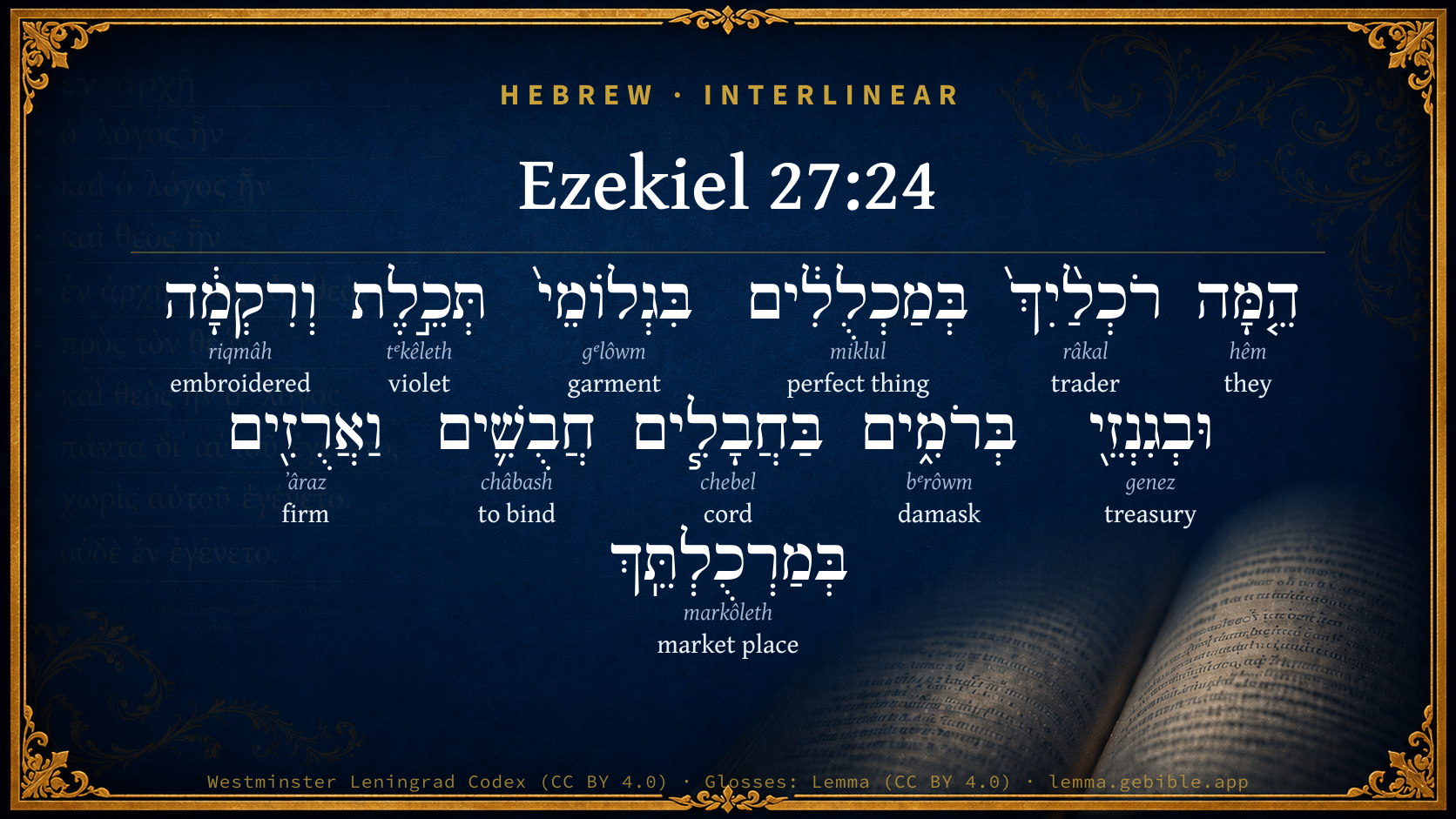
Ezekiel 27:24

Hebrew (Westminster Leningrad Codex) Ezekiel 27:24 appears in the Hebrew Old Testament. The text above is from the Westminster Leningrad Codex. Each word links to its Strong’s number, a concise gloss, and parsing drawn from the Open Scriptures Hebrew Bible morphology. Click any word for its full Brown-Driver-Briggs (BDB) entry.
Download image
Cite this verse

Ezekiel 27:24 (World English Bible). Public Domain. Lemma interlinear Bible study tool, https://lemma.gebible.app/v/ezekiel/27/24.

Show BibTeX & RIS
BibTeX
RIS
English Translation
These were your traffickers in choice wares, in wrappings of blue and embroidered work, and in chests of rich clothing, bound with cords and made of cedar, among your merchandise.
World English Bible · Public Domain
Highlights Full analysis ↓
Download a study sheet

One document with this verse’s original text, its word-by-word gloss line, the meaning frame, cross-references with their text, attributed commentary, and full source and license credits — printable, and it pastes into notes with its structure intact.

This verse Autodidact and up

Study sheet (.html) Plain text (.txt)

A passage Seminary Student

Up to 50 verses in one chapter. A passage sheet keeps up to 6 commentary sources and 12 cross-references per verse, in the order this page ranks them, and says so on the sheet whenever that leaves anything out. Ask for a single verse and you get the Autodidact verse sheet above.

Everything on this page stays free to read, with no account — the sheet is a download of what is already on screen, not access to it.

Want to remove ads? Support Godless Engineer
Compare translations 3

The same verse in 3 English versions, stacked beneath the original-language interlinear above. Click any original word for its lexicon entry.

Each is an independent rendering of the whole verse — the interlinear is not word-aligned to these translations.

Highlighted words mark where these versions differ — a whole-verse word diff, not a word-by-word alignment.

  • World English Bible Public Domain
    These were your traffickers in choice wares, in wrappings of blue and embroidered work, and in chests of rich clothing, bound with cords and made of cedar, among your merchandise.
  • King James Version Public Domain
    These were thy merchants in all sorts of things, in blue clothes, and broidered work, and in chests of rich apparel, bound with cords, and made of cedar, among thy merchandise.
  • unfoldingWord Literal Text CC BY-SA 4.0
    These were your dealers in ornate robes of violet cloths with woven colors, and in blankets of multicolored, embroidered, and well-woven cloth in your marketplaces.

unfoldingWord Literal Text — © unfoldingWord, licensed CC BY-SA 4.0. Word-aligned USFM3 via Door43 (git.door43.org/unfoldingWord/en_ult).

Versions to compare (up to 4)

3 of 4 selected

Show all 18 translations

Every available English version of this verse, each an independent rendering of the whole verse.

  • World English Bible Public Domain
    These were your traffickers in choice wares, in wrappings of blue and embroidered work, and in chests of rich clothing, bound with cords and made of cedar, among your merchandise.
  • Berean Standard Bible Public Domain
    In your marketplace they traded with you fine garments of blue, embroidered work, and multicolored rugs with cords tightly twisted and knotted.
  • Majority Standard Bible Public Domain
    In your marketplace they traded with you fine garments of blue, embroidered work, and multicolored rugs with cords tightly twisted and knotted.
  • King James Version Public Domain
    These were thy merchants in all sorts of things, in blue clothes, and broidered work, and in chests of rich apparel, bound with cords, and made of cedar, among thy merchandise.
  • American Standard Version (1901) Public Domain
    These were thy traffickers in choice wares, in wrappings of blue and broidered work, and in chests of rich apparel, bound with cords and made of cedar, among thy merchandise.
  • Revised Version (1885) Public Domain
    These were thy traffickers in choice wares, in wrappings of blue and broidered work, and in chests of rich apparel, bound with cords and made of cedar, among thy merchandise.
  • Geneva Bible (1599) Public Domain
    These were thy marchants in all sortes of things, in raiment of blewe silke, and of broydred woorke, and in coffers for the rich apparell, which were bound with cordes: chaines also were among thy marchandise.
  • Douay-Rheims (1899) Public Domain
    They were thy merchants in divers manners, with bales of blue cloth, and of embroidered work, and of precious riches, which were wrapped up and bound with cords: they had cedars also in thy merchandise.
  • Young's Literal Translation Public Domain
    They `are' thy merchants for perfect things, For wrappings of blue, and embroidery, And for treasuries of rich apparel, With cords bound and girded, for thy merchandise,
  • Literal Standard Version CC BY-SA 4.0
    They [are] your merchants for perfect things, || For wrappings of blue, and embroidery, || And for treasuries of rich apparel, || With cords bound and girded, for your merchandise,
  • Unlocked Literal Bible CC BY-SA 4.0
    These were your dealers in ornate robes of violet cloths with woven colors, and in blankets of multicolored, embroidered, and well-woven cloth in your marketplaces.
  • unfoldingWord Literal Text CC BY-SA 4.0
    These were your dealers in ornate robes of violet cloths with woven colors, and in blankets of multicolored, embroidered, and well-woven cloth in your marketplaces.
  • Darby Bible Public Domain
    these traded with thee in sumptuous clothes, in wrappings of blue and broidered work, and in chests full of variegated stuffs, bound with cords and made of cedar-wood, amongst thy merchandise.
  • World Messianic Bible Public Domain
    These were your traders in choice wares, in wrappings of blue and embroidered work, and in cedar chests of rich clothing bound with cords, among your merchandise.
  • Webster's Bible Public Domain
    These were thy merchants in all sorts of things, in blue clothes, and broidered work, and in chests of rich apparel, bound with cords, and made of cedar, among thy merchandise.
  • Free Bible Version CC BY-SA 4.0
    In your marketplaces they traded with you, providing the finest blue clothing, embroidery, carpets made with different colored threads, and strong ropes of twisted strands.
  • Bible in Basic English Public Domain
    These were your traders in beautiful robes, in rolls of blue and needlework, and in chests of coloured cloth, corded with cords and made of cedar-wood, in them they did trade with you.
  • JPS Tanakh (1917) Public Domain
    These were thy traffickers in gorgeous fabrics, in wrappings of blue and richly woven work, and in chests of rich apparel, bound with cords and cedar-lined, among thy merchandise.

Literal Standard Version (2020), Covenant Press — licensed CC BY-SA 4.0. Text via the HelloAO Bible API (eBible.org). Unlocked Literal Bible (unfoldingWord) — licensed CC BY-SA 4.0. Text via the HelloAO Bible API (eBible.org). unfoldingWord Literal Text — © unfoldingWord, licensed CC BY-SA 4.0. Word-aligned USFM3 via Door43 (git.door43.org/unfoldingWord/en_ult). Free Bible Version, Dr. Jonathan Gallagher — licensed CC BY-SA 4.0. Text via the HelloAO Bible API (eBible.org).

Word by word

More ways to search: Search by grammar → Find every occurrence → Compare this word →

Practice this passage: Drill this verse → Learn its vocabulary →

בְּמַכְלֻלִ֔ים
miklul
H4360
“in/at · perfect things”
Preposition + Noun, Common, Masculine, Plural, Absolute
Part of Speech
Preposition + Noun
Type
Common
Gender
Masculine
Number
Plural
State
Absolute
Full BDB Definition

Origin: from H3634

TWOT: 985d

a thing made perfect, perfect thing, gorgeous garment or stuff - (TWOT) all sorts of things
  1. הֵ֤מָּה hêm H1992 “they” Pronoun, Personal, 3rd Person, Masculine, Plural
  2. רֹכְלַ֨יִךְ֙ râkal H7402 “trader · you” Verb, Qal, Participle Active, Masculine, Plural, Construct + Suffix, Personal, 2nd Person, Feminine, Singular
  3. בִּגְלוֹמֵי֙ gᵉlôwm H1545 “in/at · garments of” Preposition + Noun, Common, Masculine, Plural, Construct
  4. תְּכֵ֣לֶת tᵉkêleth H8504 “violet” Noun, Common, Feminine, Singular, Absolute
  5. וְרִקְמָ֔ה riqmâh H7553 “and · embroidered” Conjunction + Noun, Common, Feminine, Singular, Absolute
  6. וּבְגִנְזֵ֖י genez H1595 “and · in/at · treasuries of” Conjunction + Preposition + Noun, Common, Masculine, Plural, Construct
  7. בְּרֹמִ֑ים bᵉrôwm H1264 “damask” Noun, Common, Masculine, Plural, Absolute
  8. בַּחֲבָלִ֧ים chebel H2256 “in/at · cords” Preposition + Noun, Common, Both, Plural, Absolute
  9. חֲבֻשִׁ֛ים châbash H2280 “bound” Verb, Qal, Participle Passive, Masculine, Plural, Absolute
  10. וַאֲרֻזִ֖ים ʼâraz H729 “and · firm” Conjunction + Adjective, Adjective, Masculine, Plural, Absolute
  11. בְּמַרְכֻלְתֵּֽךְ markôleth H4819 “in/at · market place · your” Preposition + Noun, Common, Feminine, Singular, Construct + Suffix, Personal, 2nd Person, Feminine, Singular

About this verse

These counts appear in no published source. They are computed here, from the morphology-tagged text and Lemma’s own curated glosses. What Lemma adds →

12
words
12
distinct lemmas
Prophets
section

Notable vocabulary

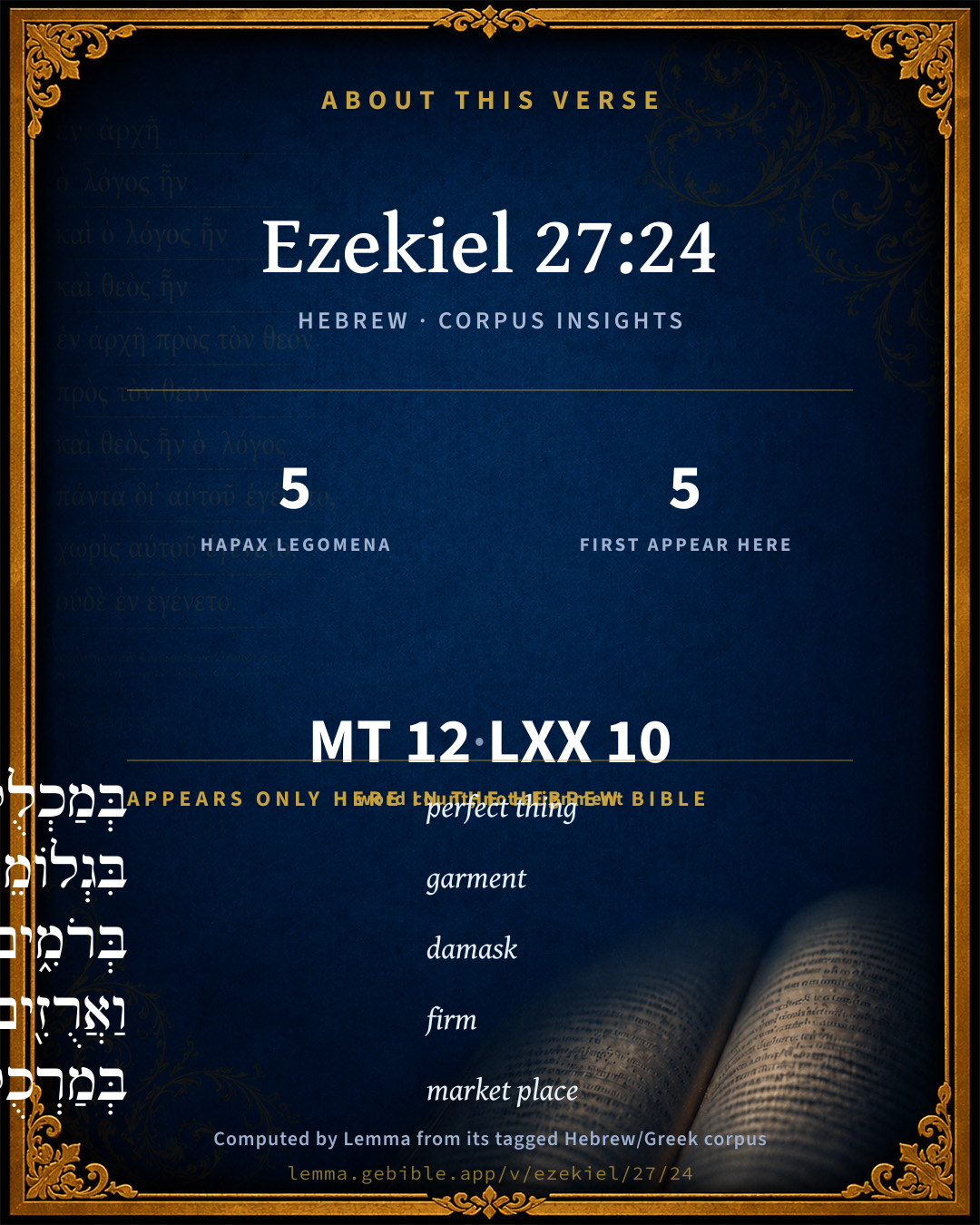
5 hapax legomena — words that appear only here in the entire Hebrew Bible:

  • בְּמַכְלֻלִ֔ים perfect thing H4360
  • בִּגְלוֹמֵי֙ garment H1545
  • בְּרֹמִ֑ים damask H1264
  • וַאֲרֻזִ֖ים firm H729
  • בְּמַרְכֻלְתֵּֽךְ market place H4819

First appearance in Scripture

These words make their first canonical appearance in the Hebrew Bible here:

  • בְּמַכְלֻלִ֔ים perfect thing H4360
  • בִּגְלוֹמֵי֙ garment H1545
  • בְּרֹמִ֑ים damask H1264
  • וַאֲרֻזִ֖ים firm H729
  • בְּמַרְכֻלְתֵּֽךְ market place H4819

Shared distinctive vocabulary

וּבְגִנְזֵ֖י treasury H1595 occurs in 3 verses of the Hebrew Bible. Also found in:

Grammatical profile

  • 2 verbs
  • 8 nouns
  • 1 adjective
  • 1 pronoun

Verb forms

  • רֹכְלַ֨יִךְ֙ Qal · Participle Active
  • חֲבֻשִׁ֛ים Qal · Participle Passive

Hebrew & Septuagint length

In English translation the verse runs 30 words from the Hebrew and 13 from the Septuagint (LXX English) — the Septuagint runs noticeably shorter here. See the side-by-side →

A rough comparison of the two English renderings, which tokenize alike — not a word-level alignment.

Word counts can differ between the Hebrew and the Greek without any difference in meaning — e.g. the Hebrew direct-object marker אֵת has no separate Greek word, and Greek often adds the article ὁ.

In the original languages it is 12 Hebrew tokens and 10 Greek tokens — but the two are counted differently (Hebrew bundles its prefixes and suffixes into one token; the Greek is in lemma form), so that isn’t a like-for-like length.

Cross-references

1

Topical passages linked to Ezekiel 27:24 in the Treasury of Scripture Knowledge — connected by theme and wording, ordered by reader-vote popularity; previews shown in the World English Bible.

  • 2 Kings 2:8 Elijah took his mantle, and wrapped it together, and struck the waters, and they were divided here and there, so that they two went over on dry ground.

Cross-references courtesy of OpenBible.info (CC BY 4.0).

Hebrew and Greek witnesses Masoretic Hebrew ↔ Greek Septuagint

The same verse in the two great witnesses to the Old Testament, shown verse-for-verse.

Here the Septuagint runs noticeably shorter than the Hebrew — LXX2012 (modern English Septuagint) 13 words vs World English Bible 30. A rough length comparison of the two English translations, not a word-level alignment — read both below.

These are two independent witnesses, not word-aligned to each other, and the Septuagint is shown in lemma (dictionary) form.

Hebrew Ezekiel 27:24 Masoretic · Westminster Leningrad Codex

הֵ֤מָּה רֹכְלַ֨יִךְ֙ בְּמַכְלֻלִ֔ים בִּגְלוֹמֵי֙ תְּכֵ֣לֶת וְרִקְמָ֔ה וּבְגִנְזֵ֖י בְּרֹמִ֑ים בַּחֲבָלִ֧ים חֲבֻשִׁ֛ים וַאֲרֻזִ֖ים בְּמַרְכֻלְתֵּֽךְ

These were your traffickers in choice wares, in wrappings of blue and embroidered work, and in chests of rich clothing, bound with cords and made of cedar, among your merchandise.

World English Bible · Public Domain

Greek LXX Ezekiel 27:24 Septuagint · lemma form

φέρω ἐμπορία ὑάκινθος καί θησαυρός ἐκλεκτός δέω σχοινίον καί κυπαρίσσινος

bringing for merchandise blue, and choice stores bound with cords, and cypress wood.

LXX2012 (modern English Septuagint) · Public Domain

Hebrew: Westminster Leningrad Codex (CC BY 4.0). Greek: Septuagint (public domain); English from LXX2012 (modern English Septuagint) (Public Domain). How the Septuagint differs from the Hebrew →

Targum (Aramaic paraphrase)

1

The Targum is the ancient Jewish Aramaic paraphrase of the Hebrew Scriptures — an interpretive translation, not the Hebrew text itself. Onkelos (literal) and Pseudo-Jonathan (expansive) render the Torah, and Jonathan the Prophets. Coverage is partial: where no permissively-licensed English translation exists for a verse, only the Aramaic is shown. This is verse-level text, not a word-by-word alignment to the Hebrew.

  1. Targum Jonathan Prophets (Joshua–Malachi)
    אִינוּן תַּגָרֵיךְ בִּגְמַר מִינֵי כָּל תּוּשְׁבַּחְתָא בְגוֹזְזִין דְתִכְלָא וְכוּשְׁפִין דְאַרְזָא בְּאִימְלִין דִי זָהְרָיִתָא דְמָחֲתִין בְּקוֹמְטְרִין חֲפַן גִלְדִין מְאַסְרִין בְּאַטוּנִין דִי בוּצָא חֲתִימִין בְּעִזְקַת גְלַף עֱבִידַת יַמָא מָחֲתִין בְּמִגְדָלֵי אָעֵי הֲדַסִין בְּהוֹן הֲוַת סְחוֹרְתִּיךְ:

    (no public-domain English translation for this verse)

    Targum Jonathan — Aramaic: “Mikraot Gedolot” (public domain). English: “Sefaria Community Translation” (CC0 1.0 (public-domain dedication)); “London "Chaldee Paraphrase," 1871” (public domain). Text via Sefaria.

Commentary

Notes on Ezekiel 27:24 from classic Christian and Jewish commentators (each source and its license shown beneath its notes). The classic Christian expositions comment on the surrounding passage and are grouped to its opening verse, so a note may address several verses; the Jewish commentaries on the Tanakh (Rashi and others) are per-verse, so they appear only where the commentator wrote on this verse.

Lemma curates 59 commentaries, every one of them public domain or Creative Commons licensed, each selected and text-cleaned for this edition rather than reprinted as found. About our sources →

Trapp's Complete Commentary

John Trapp

Eze 27:24 These [were] thy merchants in all sorts [of things], in blue clothes, and broidered work, and in chests of rich apparel, bound with cords, and made of cedar, among thy merchandise.

Ver. 24. In all sorts of things.] In omnibus perfectissimis; in the very best commodities, whether for worth or workmanship.

John Trapp, A Commentary or Exposition upon All the Books of the Old and New Testament (1647–1656) — public domain. Text from a community e-Sword module.

The Biblical Illustrator

Joseph S. Exell

Eze_27:24

These were thy merchants in all sorts of things.

Business troubles

Many of our business men are suffering trials and temptations from small and limited capital in business. This temptation of limited capital has ruined men in two ways. Sometimes they have sunk down under the temptation. They have yielded the battle before the first shot was fired. They blanched at the financial peril. The gloom of their countenances overshadowed even their dry goods and groceries. Despondency, coming from limited capital, blasted them. Others have felt it in a different way. They have said: Here I have been trudging along. I have been trying to be honest, all these years. I find it is of no use. Now it is make or break. The small craft that could have stood the stream is put out beyond the lighthouse, on the great sea of speculation. After a while the bubble bursts. Creditors rush in. The law clutches, but finds nothing in its grasp. The men who were swindled say: I dont know how I could ever have been deceived by that man; and the pictorials, in handsome woodcuts, set forth the hero who in ten years had genius enough to fail for 150,000 dollars!

2. Many of our business men are tempted to over-anxiety and care. From January to December the struggle goes on. Even the Sabbath cannot dam back the tide of anxiety; for this wave of worldliness dashes clear over the churches, and leaves its foam on Bibles and prayer books. This excitement of the brain, this corroding care of the heart, this strain of effort that exhausts the spirit, sends a great many of our best men, in middle life, into the grave. Oh, I wish I could, today, rub out some of these lines of care; that I could lift some of the burdens from the heart; that I could give relaxation to some of these worn muscles! It is time for you to begin to take it a little easier. Do your best, and then trust God for the rest.

3. Many of our business men are tempted to neglect their home duties. It is often the case that the father is the mere treasurer of the family, a sort of agent to see that they have dry goods and groceries. The work of family government he does not touch. A man has more responsibilities than those which are discharged by putting competent instructors over his children, and giving them a drawing master and a music teacher.

4. Many of our business men are tempted to put the attainment of money above the value of the soul. There are men in all occupations who seem to act as though they thought that a pack of bonds and mortgages could be traded off for a title to heaven, and as though gold would be a lawful tender in that place where it is so common that they make pavements out of it. Salvation by Christ is the only salvation. Treasures in heaven are the only incorruptible treasures. (T. De Witt Talmage.)

The Biblical Illustrator, edited by Joseph S. Exell (c. 1880s–1900s) — public domain. Text from a community e-Sword module.

Jamieson, Fausset & Brown

Robert Jamieson, A. R. Fausset & David Brown

all sorts of things--Hebrew, "perfections"; exquisite articles of finery [GROTIUS].

clothes--rather, "mantles" or "cloaks"; literally, "wrappings." For "blue," HENDERSON translates, "purple."

chests of rich apparel, bound with cords--treasures or repositories of damask stuffs, consisting of variegated threads woven together in figures [HENDERSON].

cedar--The "chests" were made of cedar, in order to last the longer; and it also keeps off decay and has a sweet odor.

Jamieson, Fausset & Brown — Commentary Critical and Explanatory on the Whole Bible (1871) — public domain (CC PDM 1.0). Text via the HelloAO Bible API.

Adam Clarke's Commentary

Verse 24. These were thy merchants in all sorts of things] The above people traded with the Tyrians in a great variety of the most valuable merchandise: blue or purple cloth, boxes of cedar, covered with skins, and bound with silken cords, and sealed with an engraved seal, finely cut, &c. See the Chaldee.

Adam Clarke's Commentary on the Bible (1810–1826) — public domain. Text from a community e-Sword/MySword module.

Ellicott's Commentary for English Readers

(24) All sorts of things.—The margin, excellent things, is better. The word means “that which is perfect.” In Eze_23:12 it is “most gorgeously,” and in Eze_38:4, as here, “all sorts.” In all “excellent” or “excellently” is the true sense. “Clothes”—literally, foldings—refers to the purple embroidered cloaks for which Babylonia was famous.

Chests of rich apparel.—Rather, treasures of twisted yarn; and for “made of cedar” read strong. An extensive trade in yarns was kept up from Babylonia to Tyre, where they were dyed and woven, or sold for weaving.

A Bible Commentary for English Readers, edited by Charles John Ellicott (1878–1897) — public domain. Text from a community e-Sword module.

The Cambridge Bible for Schools and Colleges

gen. ed. J. J. S. Perowne

24. The first half of the verse may read: These were thy merchants with splendid apparel, cloaks of purple and broidered work. The second half is obscure owing to the occurrence of some words not found elsewhere.

in chests of rich apparel] The term rendered “chests” occurs Est_3:9; Est_4:7 in the sense of “treasures,” from root to hide, lay up, a sense common to all the dialects. In Eth. it means to wind in grave-clothes for purposes of burial, but has no special reference to clothing or textile fabrics. The sense “chests” is without evidence. A term virtually the same as that rendered “rich apparel” occurs in Assyrian of stuffs for clothing (Schr. KAT. pp. 213–16); and a similar word is used of the night heavens, according to Jensen (Babylonian Cosmog. p. 6 seq.) from the mixed colour, blue-gray. It appears used of fabrics woven of differently coloured materials.

bound with cords] This would refer to the “chests,” but this is not probable. More likely: with cords twined and durable, the “cords” themselves being the article of commerce. “Cords” can hardly be thread. The rendering “made of cedar” is altogether unlikely, some sense like strong, firm or durable is more probable. The cords were probably of wool as well as of flax, of divers colours, and used for fastening hangings or other purposes, Est_1:6. The Babylonian weaving was very celebrated, cf. Eze_16:10, Eze_23:6, also the “Babylonish garment,” Jos_7:21.

The Cambridge Bible for Schools and Colleges (gen. ed. J. J. S. Perowne; Cambridge University Press, 1878–1918) — public domain. Text from a community e-Sword module.

John Gill's Exposition

The ships of Tarshish did sing of thee in market,.... The ships of the sea in general; for Tarshish is used for the sea; these from all parts came to Tyre with their several wares, the product of their country from whence they came, and, finding a good market for them at Tyre, spoke greatly in her praise, or, "were thy princes", or "thy chief ones, in thy market" (f); these brought the principal things into it, and took off the chief that were in it, which were of the produce of Tyre:

and thou wast replenished; with goods from all parts, with every thing for their necessity, convenience, pleasure, and delight, and to carry on a traffic with all nations:

and made very glorious in the midst of the seas; with great riches, stately towers and buildings. Here ends the account of Tyre's greatness; next follows her ruin and destruction.

(f) "principes", V. L. Montanus, Castalio, Starckius; "praecipuae", Tigurine version, Grotius. So some in Vatablus.

John Gill's Exposition of the Whole Bible (1746–1763) — public domain (CC PDM 1.0). Text via the HelloAO Bible API.

Haydock's Catholic Bible Commentary

Cords, in boxes, which had then no locks.

George Leo Haydock (1774–1849), Haydock's Catholic Family Bible and Commentary, 1859 edition — public domain. Excludes Psalms (Douay-Rheims chapter numbering differs from Protestant) and Deuterocanonical books (Catholic canon only).

Matthew Poole's English Annotations

These, either last named, or all that have been mentioned, though I conjecture the first is the true meaning, those rich, stately, and sumptuous nations traded with Tyre.

All sorts of things, of rich, precious things.

Blue clothes, which those nations delighted in, especially the Chaldeans and Assyrians, Eze 23:6.

Broidered work; bought of Egyptians, sold to Assyrians, &c.

Chests of cedar, curious yet strong, made on purpose to carry sumptuous apparel, bought up at Tyre, and in those chests conveyed to all parts of the Assyrian empire, and to the northern nations.

Bound with cords; it may refer to the chests mentioned, or to other sort of rich wares neatly made up, and bound for security with cords.

Among thy merchandise: by this it should seem these chests were not like our ordinary boxes, but as choice cabinets, and good merchandise.

Matthew Poole's English Annotations on the Holy Bible (1683–1685) — public domain. Text from a community e-Sword/MySword module.

Whedon's Commentary on the Bible

Daniel D. Whedon

24. All sorts of things — Rather, fabrics of beauty. R.V., “choice wares.”

Blue clothes — R.V., “wrappings [bales] of blue.” (Compare Eze_23:12.) The description is so vivid as to give the impression that Ezekiel had seen the merchants of Sheba unloading their camels and bringing out their treasures as they arrived at Tyre (Plumptre). Davidson translates chests by “treasures,” and shows that the term corresponding to rich apparel is used by the Assyrians of fabrics woven of different colored materials. In this case the “cords twined and durable” (bound with cords, and made of cedar) would be one of the articles of commerce. (See Eze_16:10; Eze_23:6; Est_1:6; Jos_7:21.) Toy translates “strangely bound skeins.”

Daniel D. Whedon (gen. ed.), Commentary on the Old and New Testaments (1874–1909) — public domain. Text from a community e-Sword module.

The Pulpit Commentary

In all sorts of things; better, with the Revised Version, in choice wares. Hebrew, articles of beauty; or, as in margin of the Authorized Version, "excellent things." The words have been variously interpreted,

(1) by Ewald, as "suits of armor;

(2) by Keil, as "stately dresses;

by Havernick, as "works of art" generally. The description in detail that follows is so vivid as to give the impression that Ezekiel had seen the merchants of Sheba unloading their camels and bringing out their treasures as they arrived at Tyro. The blue clothes (wrappings of blue, as in the Revised Version) were the purple robes of Babylon, which were famous all over the world. The words that follow are somewhat obscure, but are probably rightly translated by Keil, "embroidered of twisted yarn, in-wound, and strong cords for thy wares." The yarn may have been used for the cordage of the Tyrian ships. The words, made of cedar, are in this rendering taken as an adjective, equivalent to "firm" or "strong" (so Furst).

The Pulpit Commentary (1880–1919), ed. H.D.M. Spence-Jones & Joseph S. Exell — public domain. Text from a community e-Sword module.

unfoldingWord translationNotes

Door43 World Missions Community

Connecting Statement:

Yahweh continues giving Ezekiel his message to Tyre.

General Information:

The words "you" and "your" in these verses refer to Tyre.

These were your dealers

"They traded with you"

ornate robes of violet cloths with woven colors

"purple robes with many different colors"

blankets of multicolored, embroidered, and well-woven cloth

"blankets with many colors that had designs and were of high quality"

The ships of Tarshish were the transporters of your merchandise

This can be stated in active form. AT: "The ships of Tarshish carried your merchandise" (See: Active or Passive)

you were filled up, heavily laden with cargo

Tyre's abundance is spoken of as if it was a ship that was full of cargo. (See: Metaphor)

heart of the seas

"middle of the seas." See how you translated this in Ezekiel 27:4.

translationWords

robe

Tarshish

unfoldingWord translationNotes — © Distant Shores Media and the Door43 World Missions Community, licensed CC BY-SA 4.0. Source: git.door43.org/Door43/en_tn.

Rashi

Rabbi Shlomo Yitzchaki (Rashi)

with adornments [Heb. בְּמַכְלֻלִים,] with things that are for adornment (מכלול), paramenz in Old French, adornments, jewelry, and what are the adornments? Wraps of embroidered blue cloth.

and with treasures kept in chests With beautiful adornments that are kept in chests called escrin in Old French, (ecrin in modern French). They are covered with leather and decorated for beauty with sorts of nails forming rows and pictures, and they are called קַמְטְרַיָא in Aramaic and בְּרוֹמִים in Hebrew, and they are tied and bound with linen ropes for beauty.

and [enclosed in] myrtle wood Jonathan renders: myrtle wood. Those chests were placed in chests of myrtle wood, and they would bring them into the outer chests and the chest within them, and so too, the ornaments that were inside the chests; everything all together for merchandising. This is the meaning of the wording in brief: and with treasures [kept] in chests, tied with ropes and [enclosed in] cedar wood, for the בְּרוֹמִים are the chests, and they were tied with ropes and placed in chests of myrtle, which is a species of cedar. And the adornments that were inside the chests, Jonathan calls וְכוּשּׁפִּין דְאַרְזָא בְּאִימְלִין דִּי זָהְרָיִתָא adornments that require good watching (זְהִירוּת), [i.e.,] דְמֲחֲתִין בְּקוֹמְטְרִין that were placed in chests. And the word מִגְדָּל in the Targum is like what we learn: a box and a chest (מִגְדָּל) schafreite in Middle High German, clothes chest, cupboard. [In some editions] armaise in Old French.

Rashi on the Tanakh — English translations: “The Judaica Press complete Tanach with Rashi, translated by A. J. Rosenberg” (CC BY 4.0); “Pentateuch with Rashi's commentary by M. Rosenbaum and A.M. Silbermann, 1929-1934” (public domain); “The Metsudah Tanach series, Lakewood, N.J” (CC BY 4.0); and “The Book of Joshua, Metsudah Publications, 1997” (CC BY 4.0). Text via Sefaria.

Lesson kit

Teaching starters — assembled from the data on this page, not authored interpretation. Every prompt links to the verse data it draws on. Edit before teaching.

Ezekiel, in the Prophets, opens this verse with 12 words (12 distinct Hebrew lemmas). Its most distinctive word is miklul (“perfect thing”). The Greek Septuagint runs shorter here. A historical commentator’s framing appears above. Read the whole chapter for the surrounding context.

Discussion questions

  1. The word miklul carries the sense “perfect thing.” How does it shape the verse?
  2. This verse holds 5 words here found nowhere else in the Hebrew Bible. What might the rare words draw attention to?
  3. 5 words here appear for the first time in Scripture. What is being introduced at this debut?
  4. Esther 3:9 shares the word «treasury» with this verse. How do the two illuminate each other?
  5. Compared with the Hebrew, the Septuagint runs shorter here. What questions does that raise?
  6. The translations on this page render this verse differently — a whole-verse word diff, not a word-by-word alignment. What might account for the different wordings?
  7. The verb «רֹכְלַ֨יִךְ֙» is Qal Participle Active. How does its form color the action?
  8. Reading how Trapp's Complete Commentary and The Biblical Illustrator read this verse, where do the two commentators agree and where do they part?

Things to notice

Reading settings

Reading text

Shown beneath each verse's original-language words.

Old Testament
Old Testament edition

Read the OT as the Masoretic Hebrew (MT) or the Greek Septuagint (LXX).

English shown for the Greek Septuagint (in the Hebrew ↔ Greek comparison).

Comparing translations? Open the Compare panel on any verse page to stack up to four side by side.