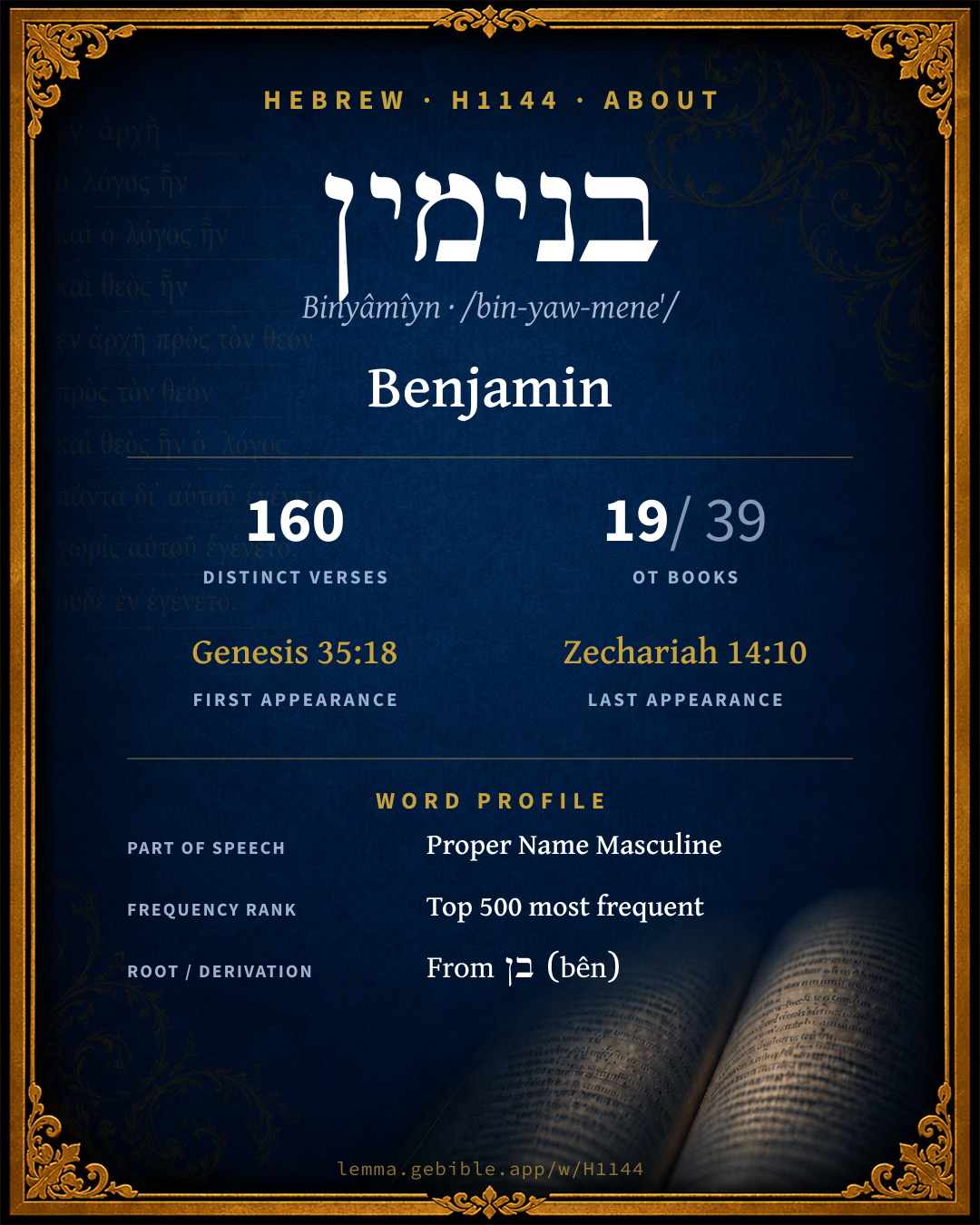
בִּנְיָמִין
Benjamin
BDB lists 5 entries for ‘Benjamin’ fuller range ↓
Full lexicon entry — Brown-Driver-Briggs (BDB)
From Brown-Driver-Briggs (BDB)
Where this word appears
Grammar key — what these labels mean
Part of speech
- Noun
- A naming word — a person, place, thing, or idea.
Noun type
- Proper
- A name of a specific person, place, or people (e.g. Abraham, Zion, Israel).
Every verse where H1144 appears in the Book of 1 Kings — 4 distinct verses. Click any verse to open its interlinear word-by-word view. Verse text shown in the World English Bible for context — . Each verse’s Hebrew form is shown with its reference; the English is not keyword-highlighted, since the data carries no word-level English alignment. Use “Compare translations” on any verse to read it across multiple English versions. This concordance covers the Hebrew Bible; Septuagint (Greek Old Testament) occurrences are not indexed here.
1 Kings
- 1 Kings 4:18 בְּ/בִנְיָמִֽן prep + n Proper Shimei the son of Ela, in Benjamin;
- 1 Kings 12:21 בִּנְיָמִ֗ן n Proper When Rehoboam was come to Jerusalem, he assembled all the house of Judah, and the tribe of Benjamin, a hundred and eighty thousand chosen men, who were warriors, to fight against the house of Israel, to bring the kingdom again to Rehoboam the son of Solomon.
- 1 Kings 12:23 וּ/בִנְיָמִ֑ין conj + n Proper Speak to Rehoboam the son of Solomon, king of Judah, and to all the house of Judah and Benjamin, and to the rest of the people, saying,
- 1 Kings 15:22 בִּנְיָמִ֖ן n Proper Then king Asa made a proclamation to all Judah; none was exempted: and they carried away the stones of Ramah, and the timber of it, with which Baasha had built; and king Asa built therewith Geba of Benjamin, and Mizpah.
About this entry
At a glance — auto-summarized from this page’s data, not written by a person. Every figure links to its source below. This summary describes the numbers; it doesn’t interpret them.
“Benjamin” is the headline sense of the Hebrew name בנימין (Binyâmîyn). First canonically at Genesis 35:18, it enters the text early. With 160 verses in 19 books, it is a common word in the Hebrew Bible. It concentrates in Judges, which alone accounts for 26% of its uses. The sections below give every occurrence and version rendering.
Gloss history
Strong's 1890 vs modern scholarship
About this word
Strong's H1144 catalogs a Hebrew word from the Hebrew Old Testament.
These counts are not copied from any lexicon or concordance. They are computed here, from the morphology-tagged Hebrew Old Testament. What Lemma adds →
- 160
- distinct verses
- The word appears in 160 distinct verses.
- 19 / 39
- OT books
- The word appears in 19 of 39 Old Testament books.
- #273
- by frequency
- Top 500 most frequent Hebrew words (rank 273 of 8,640 Hebrew words by occurrence).
View all 160 occurrences in the concordance →
Most concentrated in
- Judges 42 verses 26%
- Genesis 16 verses 10%
- 1 Chronicles 16 verses 10%
By section of the Old Testament
By traditional corpus
Conventional, traditional groupings — biblical authorship is debated, so this is a traditional corpus grouping, not an authorship claim. Each share is this word’s portion of its verses in that division of the Hebrew canon. Each figure is a share of the word’s 160 distinct verses.
- Prophets (Nevi'im) 89 verses · 56%
- Writings (Ketuvim) 42 verses · 26%
- Torah (Pentateuch) 29 verses · 18%
How translations render this word
Counts come from each version’s own published word-to-Strong’s tagging or interlinear alignment — an approximate guide to how each version renders this word, not a word-level alignment the data otherwise carries. Because each total is that version’s own tagged count, the per-version totals vary from one another and need not match the appearance or distinct-verse counts above. These counts may also differ from a printed concordance because Lemma counts each distinctly tagged rendering and does not collapse phrase taggings into a single head-word total. This is a fixed set of word-tagged versions (KJV, ASV, BSB, ULT) and does not change with the reading translation you choose elsewhere. Each version’s license is shown beside its name below (and on Sources).
- King James Version: Benjamin 147×, Benjamin's 3×, Against benjamin 2×
- American Standard Version: Benjamin 146×, Against benjamin 2×, Belongeth to benjamin 2×
- Berean Standard Bible: Benjamin 114×, Benjamites 11×, Benjamite 5×
- unfoldingWord Literal Text: Benjamin 156×, Is to benjamin 2×
King James Version Public Domain
Renders H1144 across 161 tagged occurrences — most commonly:
Plus 7 renderings that appear only once — usually multi-word phrases or single function words the recovered tagging swept in, not distinct renderings.
American Standard Version Public Domain
Renders H1144 across 160 tagged occurrences — most commonly:
Plus 8 renderings that appear only once — usually multi-word phrases or single function words the recovered tagging swept in, not distinct renderings.
Berean Standard Bible Public Domain
Renders H1144 across 139 tagged occurrences — most commonly:
Plus 7 renderings that appear only once — usually multi-word phrases or single function words the recovered tagging swept in, not distinct renderings. Not rendered by a distinct English word in 28 further occurrences.
unfoldingWord Literal Text CC BY-SA 4.0
Renders H1144 across 161 tagged occurrences — most commonly:
Plus 3 renderings that appear only once — usually multi-word phrases or single function words the recovered tagging swept in, not distinct renderings.
Senses in the full BDB
What do BDB’s symbols mean?
BDB uses these scholarly abbreviations:
| Symbol | Meaning |
|---|---|
| 𝔊 | the Septuagint (the ancient Greek translation, LXX) |
| 𝔙 | the Vulgate (the Latin translation) |
| 𝔖 | the Syriac version (the Peshitta) |
| 𝔗 | the Targum (the Aramaic translation) |
| ψ | the Psalms |
| √ | root (the underlying root or stem) |
| ‖ | parallel passage (a synonymous or contrasted parallel) |
| † | the dagger: every passage where the word occurs is cited |
The 3 senses and sub-senses the full Brown-Driver-Briggs lexicon distinguishes for this word, in lexicon order (not ranked by frequency), with BDB’s own verbatim wording and sub-sense lettering. Shown in Hebrew script with BDB’s own scholarly abbreviations. The condensed entry is in the Lexicon Entry tab. See also the Forms in the corpus table below.
- 1. youngest son of Jacob, so called by him, but by Rachel, the mother, who died at Benjamin’s birth, called בֶּן־אוֹנִי (q.v.) Gn 35:18; own brother of Joseph Gn 35:24; 42:4; 43:29; 45:12; cf. 42:36; 45:15, 34 +; name of tribe of Benjamin Nu 1:11 Dt 27:12; 33:12 Ju 5:14 + 23 times Ju; 32 times S K Chr; Ho 5:8 Ez 48:23 Ob 19 ψ 68:28; 80:3; בְּנֵי בנימן (lit. Gn 46:21) of tribe Nu 1:36; 2:22; 7:60; 26:38, 41 Jos 18:20, 28 Ju 20:3, 14, 15, 18, 21, 23, 24, 28, 30, 31, 32, 36, 48; 21:13, 20, 23 2 S 2:25; 4:2; 23:29 1 Ch 8:40; 9:3, 7; 11:31; 12:17, 30 Ne 11:4, 7, 31 Je 6:1; Ju 21(×2) (but בני יהודה in ‖ Jos 15:63 cf. BuRS 7); explicitly מַטֵּה בִנְיָמִן Nu 1:37; 2:22; 13:9; 34:21 Jos 21:4 1 Ch 6:45 cf. Jos 21:17; מַטֵּה בְנֵי ב׳ Nu 10:24 Jos 18:11, 21 1 Ch 6:50; שֵׁבֶט ב׳ 1 S 10:20, 21 1 K 12:21; observe also כָּל־שִׁבְטֵי ב׳ Ju 20:12 cf. 1 S 9:21; אִישׁ בִּנְיָמִן Ju 20:41 1 S 4:12 cf. אִישׁ מִבִּן־יָ֯מִין 1 S 9:1; אֶרֶץ בִּנְיָמִן Ju 21:21 1 S 9:16 2 S 21:14 Je 1:1; 17:26; 32:44; 33:13; 37:12 cf. 32:8; גְּבוּל ב׳ 1 S 10:2 Ez 48:22 (del. Co) v 24; בֵּית בִּנְיָמִן 2 S 3:19; בֵּית יְהוּדָה וּב׳ 1 K 12:23 2 Ch 11:1; in name of a temple-gate שַׁעַר ב׳ הָעֶלְיוֹן Je 20:2 cf. 37:13; 38:7 Ez 48:32 Zc 14:10. e.g. Genesis 35:18
- 2. a son of Bilhan and great-grandson of Benjamin 1. 1 Ch 7:10. e.g. 1 Chronicles 7:10
- 3. a Jew of Ezra’s time Ezr 10:32 cf. Ne 3:23; 12:34—בנימן בני קרץ 1 Ch 9:4 Kt read with Qr בָּנִי מִן־בְּנֵי פ׳. e.g. Ezra 10:32
Senses from the full Brown-Driver-Briggs lexicon (Brown, Driver, Briggs; Oxford 1906 — public domain), digitized via Sefaria, supplemented by the OpenScriptures HebrewLexicon (CC BY 4.0). Full attribution on Sources.
Word origin
Gn 35:18 +; usually בִּנְיָמִן n.pr.m.166 (son of (the) right hand)—
— Brown-Driver-Briggs (Oxford 1906, public domain), digitized via Sefaria, supplemented by the OpenScriptures HebrewLexicon (CC BY 4.0). See Sources.
Derived from בן (bên) (H1121) — son.
Forms in the corpus
The 69 distinct written forms H1144 takes in the Hebrew Bible, most frequent first — each parse links to that state’s occurrences in the concordance. Hebrew forms include their vowel points and cantillation, so a single lemma takes many written forms.
| Form | Parsing | Example | Uses |
|---|---|---|---|
| בִנְיָמִ֖ן | Noun, Proper | Joshua 18:11 | 12 |
| בִנְיָמִ֑ן | Noun, Proper | 1 Chronicles 6:65 | 11 |
| בִנְיָמִ֔ן | Noun, Proper | 1 Chronicles 11:31 | 10 |
| בִּנְיָמִ֑ן | Noun, Proper | Genesis 43:15 | 9 |
| בִּנְיָמִ֗ן | Noun, Proper | Ezekiel 48:24 | 7 |
| בִּנְיָמִֽן | Noun, Proper | Genesis 44:12 | 7 |
| בִּנְיָמִן֙ | Noun, Proper | Ezekiel 48:32 | 7 |
| וּ/בִנְיָמִ֔ן | Noun, Proper | Ezra 1:5 | 7 |
| בִנְיָמִן֙ | Noun, Proper | 1 Chronicles 12:16 | 6 |
| בִּנְיָמִ֔ן | Noun, Proper | Ezekiel 48:22 | 5 |
| וּ/בִנְיָמִ֑ן | Noun, Proper | Ezra 4:1 | 5 |
| וּ/בִנְיָמִֽן | Noun, Proper | Deuteronomy 27:12 | 4 |
| בִנְיָמִֽן | Noun, Proper | Genesis 45:14 | 3 |
| בִּנְיָמִ֖ן | Noun, Proper | 1 Kings 15:22 | 3 |
| בִּנְיָמִ֛ן | Noun, Proper | Genesis 43:34 | 3 |
| לְ/בִנְיָמִ֔ן | Noun, Proper | 1 Chronicles 27:21 | 3 |
| מִ/בִּנְיָמִ֔ן | Noun, Proper | 2 Samuel 2:31 | 3 |
| בִנְיָמִ֑ין | Noun, Proper | Genesis 45:12 | 2 |
| בִנְיָמִ֗ן | Noun, Proper | Genesis 46:21 | 2 |
| בִנְיָמִ֛ן | Noun, Proper | 1 Chronicles 12:29 | 2 |
| בִּנְיָמִ֑ין | Noun, Proper | Genesis 43:14 | 2 |
| בִּנְיָמִ֜ן | Noun, Proper | 2 Samuel 21:14 | 2 |
| בִּנְיָמִין֙ | Noun, Proper | Genesis 42:4 | 2 |
| וּ/בִנְיָמִ֖ן | Noun, Proper | 2 Chronicles 11:3 | 2 |
| וּ/בִנְיָמִ֗ן | Noun, Proper | 2 Chronicles 11:1 | 2 |
| לְ/בִנְיָמִ֑ן | Noun, Proper | Judges 21:15 | 2 |
| לְ/בִנְיָמִֽן | Noun, Proper | Judges 19:14 | 2 |
| בִנְיָמִ֖ין | Noun, Proper | Judges 5:14 | 1 |
| בִנְיָמִ֜ן | Noun, Proper | Judges 20:15 | 1 |
| בִנְיָמִ֥ן | Noun, Proper | Judges 20:28 | 1 |
| בִנְיָמִ֧ן | Noun, Proper | Joshua 18:20 | 1 |
| בִנְיָמִ֨ן | Noun, Proper | Judges 20:25 | 1 |
| בִנְיָמִֽין | Noun, Proper | Genesis 35:18 | 1 |
| בִנְיָמִן֮ | Noun, Proper | Numbers 26:38 | 1 |
| בִניָמִ֗ן | Noun, Proper | Jeremiah 6:1 | 1 |
| בְּ/בִנְיָמִֽן | Noun, Proper | 1 Kings 4:18 | 1 |
| בְּ/בִנְיָמִן֙ | Noun, Proper | Judges 20:35 | 1 |
| בְּנְיָמִ֥ן | Noun, Proper | Ezra 10:32 | 1 |
| בִּנְיָמִ֗ין | Noun, Proper | Jeremiah 32:8 | 1 |
| בִּנְיָמִ֣ין | Noun, Proper | Genesis 43:29 | 1 |
| בִּנְיָמִ֣ן | Noun, Proper | Genesis 42:36 | 1 |
| בִּנְיָמִ֥ן | Noun, Proper | Ezekiel 48:23 | 1 |
| בִּנְיָמִ֨ן | Noun, Proper | Psalms 68:27 | 1 |
| בִּנְיָמִֽין | Noun, Proper | Hosea 5:8 | 1 |
| בִּנְיָמִין֒ | Noun, Proper | Genesis 43:16 | 1 |
| בִּנְיָמִן֮ | Noun, Proper | Judges 20:35 | 1 |
| בני/מן | Preposition | 1 Chronicles 9:4 | 1 |
| וּ/בְ/בִנְיָמִ֑ן | Noun, Proper | 2 Chronicles 11:10 | 1 |
| וּ/בְ/בִנְיָמִ֖ין | Noun, Proper | Judges 10:9 | 1 |
| וּ/בְנְיָמִֽן | Noun, Proper | Exodus 1:3 | 1 |
| וּ/בִ֨נְיָמִ֔ן | Noun, Proper | 1 Chronicles 8:1 | 1 |
| וּ/בִנְיָ֘מִ֤ן | Noun, Proper | Psalms 80:2 | 1 |
| וּ/בִנְיָמִ֑ין | Noun, Proper | 1 Kings 12:23 | 1 |
| וּ/בִנְיָמִ֛ן | Noun, Proper | 2 Chronicles 31:1 | 1 |
| וּ/בִנְיָמִ֡ן | Noun, Proper | Judges 20:39 | 1 |
| וּ/בִנְיָמִ֨ן | Noun, Proper | Ezra 10:9 | 1 |
| וּ/לְ/בִנְיָמִ֤ן | Noun, Proper | Genesis 45:22 | 1 |
| וּ/מִ/בִּנְיָמִ֗ן | Noun, Proper | 2 Chronicles 14:8 | 1 |
| וּ֠/בִנְיָמִן | Noun, Proper | 1 Chronicles 7:10 | 1 |
| לְ/בִ֨נְיָמִ֔ן | Noun, Proper | Numbers 1:11 | 1 |
The 60 most common forms are shown; 9 rarer forms follow in the full concordance.
Same root — word family
Other BDB entries built from the same root as H1144, grouped by Strong’s listed origin. These share a root / origin per the lexicon — not necessarily a shared meaning. Each links to that word’s own entry.
Derives from
Shares the same root
Proper names from this root
People and places named from this root — a name, not an additional meaning of the word.
- בן Bên H1122 Ben
- בןאבינדב Ben-ʼĂbîynâdâb H1125 Ben-Abinadab
- בןאוני Ben-ʼÔwnîy H1126 Ben-oni
- בןגבר Ben-Geber H1127 Ben-geber
- בןדקר Ben-Deqer H1128 Ben-dekar
- בןהדד Ben-Hădad H1130 Ben-hadad
- בןזוחת Ben-Zôwchêth H1132 Ben-zoheth
- בןחור Ben-Chûwr H1133 Ben-hur
- בןחיל Ben-Chayil H1134 Ben-hail
- בןחנן Ben-Chânân H1135 Ben-hanan
- בןחסד Ben-Cheçed H1136 Ben-hesed
- בניברק Bᵉnêy-Bᵉraq H1139 Bene-barak
- בני יעקן Bᵉnêy Yaʻăqân H1142 Bene-jaakan
- בנינו Bᵉnîynûw H1148 Beninu
- בןעמי Ben-ʻAmmîy H1151 Ben-ami
- Βενιαμιν Beniamín G958 Benjamin
Compare all same-root words → Showing 4 of 20 — not the complete family. 16 of the same-root words are proper names (people or places). They share a root, not necessarily a meaning.
Bible dictionary
Public-domain dictionary articles matched to this entry by name (Benjamin). A biblical name can be shared by more than one person or place, so an article may treat several.
Easton's Bible Dictionary · M. G. Easton, 1897
Son of my right hand. (1.) The younger son of Jacob by Rachel (Gen. 35:18). His birth took place at Ephrath, on the road between Bethel and Bethlehem, at a short distance from the latter place. His mother died in giving him birth, and with her last breath named him Ben-oni, son of my pain, a name which was changed by his father into Benjamin. His posterity are called Benjamites (Gen. 49:27; Deut. 33:12; Josh. 18:21).
The tribe of Benjamin at the Exodus was the smallest but one (Num. 1:36, 37; Ps. 68:27). During the march its place was along with Manasseh and Ephraim on the west of the tabernacle. At the entrance into Canaan it counted 45,600 warriors. It has been inferred by some from the words of Jacob (Gen. 49:27) that the figure of a wolf was on the tribal standard. This tribe is mentioned in Rom. 11:1; Phil. 3:5.
The inheritance of this tribe lay immediately to the south of that of Ephraim, and was about 26 miles in length and 12 in breadth. Its eastern boundary was the Jordan. Dan intervened between it and the Philistines. Its chief towns are named in Josh. 18:21-28.
The history of the tribe contains a sad record of a desolating civil war in which they were engaged with the other eleven tribes. By it they were almost exterminated (Judg. 20:20, 21; 21:10). (See GIBEAH.)
The first king of the Jews was Saul, a Benjamite. A close alliance was formed between this tribe and that of Judah in the time of David (2 Sam. 19:16, 17), which continued after his death (1 Kings 11:13; 12:20). After the Exile these two tribes formed the great body of the Jewish nation (Ezra 1:5; 10:9).
The tribe of Benjamin was famous for its archers (1 Sam. 20:20, 36; 2 Sam. 1:22; 1 Chr. 8:40; 12:2) and slingers (Judge. 20:6).
The gate of Benjamin, on the north side of Jerusalem (Jer. 37:13; 38:7; Zech. 14:10), was so called because it led in the direction of the territory of the tribe of Benjamin. It is called by Jeremiah (20:2) "the high gate of Benjamin;" also "the gate of the children of the people" (17:19). (Comp. 2 Kings 14:13.)
Smith's Bible Dictionary · William Smith, 1863
(son of the right hand, fortunate).
+ The youngest of the children of Jacob. His birth took place on the road between Bethel and Bethlehem, near the latter, B.C. 1729. His mother, Rachel, died in the act of giving him birth, naming him with her last breath Ben-oni (son of my sorrow). This was by Jacob changed into Benjamin. (Genesis 35:16,18) Until the journeys of Jacob's sons and Jacob himself into Egypt we hear nothing of Benjamin. Nothing personal is known of him. Henceforward the history of Benjamin is the history of the tribe. + A man of the tribe of Benjamin, son of bilhan, and the head of a family of warriors. (1 Chronicles 7:10) + One of the "sons of Harim," an Israelite in the time of Ezra who had married a foreign wife. (Ezra 10:32)
Hitchcock's Bible Names Dictionary · Roswell D. Hitchcock, 1869
son of the right hand
Classic public-domain reference works; full attribution on Sources.
Septuagint verse parallels
This word appears in 153 verses that also exist in the Greek Old Testament (Septuagint), out of the 160 Hebrew verses it occurs in. You can read those verses in Greek by switching the Old Testament edition to the Septuagint.
Read these verses in the Septuagint
- Genesis 35:18
- Exodus 1:3
- Numbers 1:11
- Deuteronomy 27:12
- Joshua 18:11
- Judges 1:21
- 1 Samuel 4:12
- 2 Samuel 2:9
- 1 Kings 4:18
- 1 Chronicles 2:2
- 2 Chronicles 11:1
- Ezra 1:5
This is a verse-level parallel only — the same verses exist in both the Hebrew and Greek Old Testaments. No word-level Hebrew↔Greek correspondence is claimed: the data carries no such alignment, so no Greek word is shown as this Hebrew word’s translation. Coverage is not total — the Septuagint omits the deuterocanon and renumbers the Psalms, so some Hebrew verses have no direct Greek parallel.