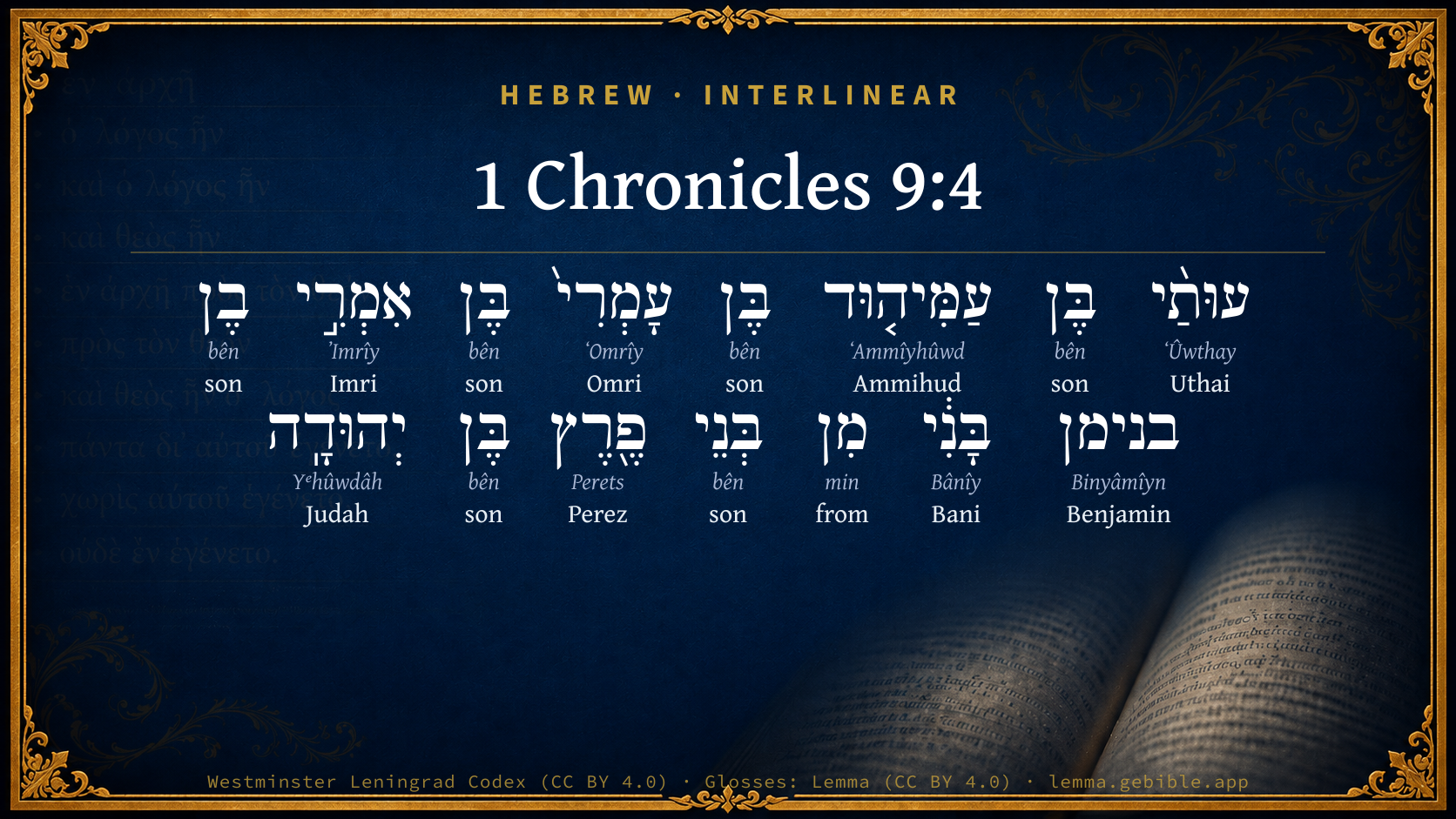
1 Chronicles 9:4

Hebrew (Westminster Leningrad Codex) 1 Chronicles 9:4 appears in the Hebrew Old Testament. The text above is from the Westminster Leningrad Codex. Each word links to its Strong’s number, a concise gloss, and parsing drawn from the Open Scriptures Hebrew Bible morphology. Click any word for its full Brown-Driver-Briggs (BDB) entry.
Download image
Cite this verse

1 Chronicles 9:4 (World English Bible). Public Domain. Lemma interlinear Bible study tool, https://lemma.gebible.app/v/1-chronicles/9/4.

Show BibTeX & RIS
BibTeX
RIS
English Translation
Uthai the son of Ammihud, the son of Omri, the son of Imri, the son of Bani, of the children of Perez the son of Judah.
World English Bible · Public Domain
Highlights
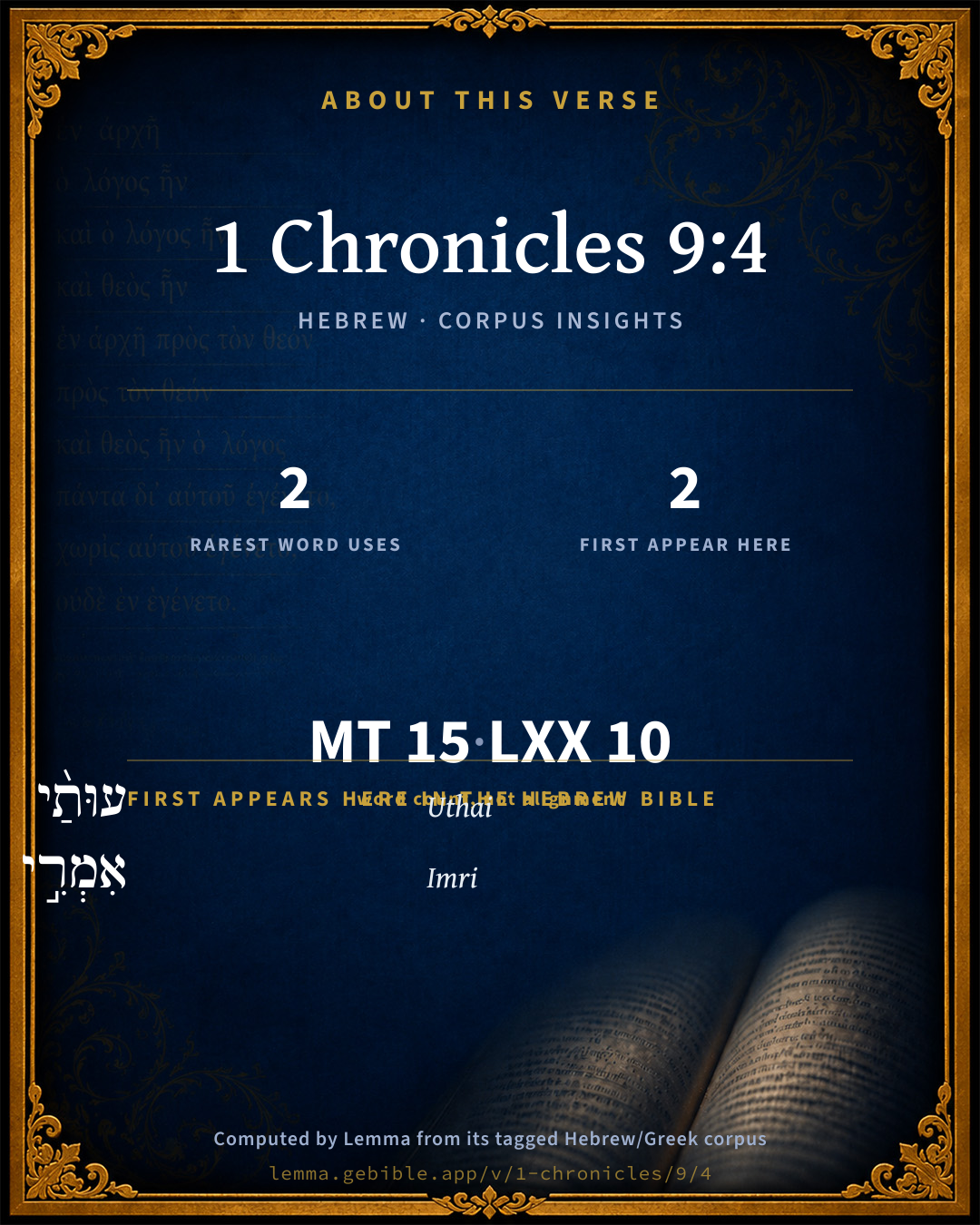
  • 2 first appearances in the Hebrew Bible
Full analysis ↓
Download a study sheet

One document with this verse’s original text, its word-by-word gloss line, the meaning frame, cross-references with their text, attributed commentary, and full source and license credits — printable, and it pastes into notes with its structure intact.

This verse Autodidact and up

Study sheet (.html) Plain text (.txt)

A passage Seminary Student

Up to 50 verses in one chapter. A passage sheet keeps up to 6 commentary sources and 12 cross-references per verse, in the order this page ranks them, and says so on the sheet whenever that leaves anything out. Ask for a single verse and you get the Autodidact verse sheet above.

Everything on this page stays free to read, with no account — the sheet is a download of what is already on screen, not access to it.

Want to remove ads? Support Godless Engineer
Compare translations 3

The same verse in 3 English versions, stacked beneath the original-language interlinear above. Click any original word for its lexicon entry.

Each is an independent rendering of the whole verse — the interlinear is not word-aligned to these translations.

Highlighted words mark where these versions differ — a whole-verse word diff, not a word-by-word alignment.

  • World English Bible Public Domain
    Uthai the son of Ammihud, the son of Omri, the son of Imri, the son of Bani, of the children of Perez the son of Judah.
  • King James Version Public Domain
    Uthai the son of Ammihud, the son of Omri, the son of Imri, the son of Bani, of the children of Pharez the son of Judah.
  • unfoldingWord Literal Text CC BY-SA 4.0
    Uthai, the son of Ammihud, the son of Omri, the son of Imri, the son of Bani from the sons of Perez, the son of Judah.

unfoldingWord Literal Text — © unfoldingWord, licensed CC BY-SA 4.0. Word-aligned USFM3 via Door43 (git.door43.org/unfoldingWord/en_ult).

Versions to compare (up to 4)

3 of 4 selected

Show all 18 translations

Every available English version of this verse, each an independent rendering of the whole verse.

  • World English Bible Public Domain
    Uthai the son of Ammihud, the son of Omri, the son of Imri, the son of Bani, of the children of Perez the son of Judah.
  • Berean Standard Bible Public Domain
    Uthai son of Ammihud, the son of Omri, the son of Imri, the son of Bani, a descendant of Perez son of Judah.
  • Majority Standard Bible Public Domain
    Uthai son of Ammihud, the son of Omri, the son of Imri, the son of Bani, a descendant of Perez son of Judah.
  • King James Version Public Domain
    Uthai the son of Ammihud, the son of Omri, the son of Imri, the son of Bani, of the children of Pharez the son of Judah.
  • American Standard Version (1901) Public Domain
    Uthai the son of Ammihud, the son of Omri, the son of Imri, the son of Bani, of the children of Perez the son of Judah.
  • Revised Version (1885) Public Domain
    Uthai the son of Ammihud, the son of Omri, the son of Imri, the son of Bani, of the children of Perez the son of Judah.
  • Geneva Bible (1599) Public Domain
    Vthai the sonne of Amihud the sonne of Omri, the sonne of Imri, the sonne of Bani: of the children of Pharez, the sonne of Iudah.
  • Douay-Rheims (1899) Public Domain
    Othei the son of Ammiud, the son of Amri, the son of Omrai, the son of Bonni, of the sons of Phares the son of Juda.
  • Young's Literal Translation Public Domain
    Uthai son of Ammihud, son of Omri, son of Imri, son of Bani, of the sons of Pharez, son of Judah.
  • Literal Standard Version CC BY-SA 4.0
    Uthai son of Ammihud, son of Omri, son of Imri, son of Bani, of the sons of Perez, son of Judah.
  • Unlocked Literal Bible CC BY-SA 4.0
    The settlers included Uthai son of Ammihud son of Omri son of Imri son of Bani, one of the descendants of Perez son of Judah.
  • unfoldingWord Literal Text CC BY-SA 4.0
    Uthai, the son of Ammihud, the son of Omri, the son of Imri, the son of Bani from the sons of Perez, the son of Judah.
  • Darby Bible Public Domain
    Uthai the son of Ammihud, the son of Omri, the son of Imri, the son of Bani, of the children of Pherez the son of Judah.
  • World Messianic Bible Public Domain
    Uthai the son of Ammihud, the son of Omri, the son of Imri, the son of Bani, of the children of Perez the son of Judah.
  • Webster's Bible Public Domain
    Uthai the son of Ammihud, the son of Omri, the son of Imri, the son of Bani, of the children of Pharez the son of Judah.
  • Free Bible Version CC BY-SA 4.0
    Uthai son of Ammihud, son of Omri, son of Imri, son of Bani, a descendant of Perez, son of Judah.
  • Bible in Basic English Public Domain
    Uthai, the son of Ammihud, the son of Omri, the son of Imri, the son of Bani, of the sons of Perez, the son of Judah.
  • JPS Tanakh (1917) Public Domain
    Uthai the son of Ammihud, the son of Omri, the son of Imri, the son of Bani, of the children of Perez the son of Judah.

Literal Standard Version (2020), Covenant Press — licensed CC BY-SA 4.0. Text via the HelloAO Bible API (eBible.org). Unlocked Literal Bible (unfoldingWord) — licensed CC BY-SA 4.0. Text via the HelloAO Bible API (eBible.org). unfoldingWord Literal Text — © unfoldingWord, licensed CC BY-SA 4.0. Word-aligned USFM3 via Door43 (git.door43.org/unfoldingWord/en_ult). Free Bible Version, Dr. Jonathan Gallagher — licensed CC BY-SA 4.0. Text via the HelloAO Bible API (eBible.org).

Word by word

More ways to search: Search by grammar → Find every occurrence → Compare this word →

Practice this passage: Drill this verse → Learn its vocabulary →

עוּתַ֨י
ʻÛwthay
H5793
“Uthai”
Noun, Proper
Part of Speech
Noun
Type
Proper
Full BDB Definition

Origin: from H5790

TWOT: None

Uthai = "helpful" - son of Ammihud and a descendant of Pharez of Judah - one of the sons of Bigvai who returned from exile with the 2nd caravan with Ezra
  1. בֶּן bên H1121 “son of” Noun, Common, Masculine, Singular, Construct
  2. עַמִּיה֤וּד ʻAmmîyhûwd H5989 “Ammihud” Noun, Proper
  3. בֶּן bên H1121 “son of” Noun, Common, Masculine, Singular, Construct
  4. עָמְרִי֙ ʻOmrîy H6018 “Omri” Noun, Proper
  5. בֶּן bên H1121 “son of” Noun, Common, Masculine, Singular, Construct
  6. אִמְרִ֣י ʼImrîy H566 “Imri” Noun, Proper
  7. בֶן bên H1121 “son of” Noun, Common, Masculine, Singular, Construct
  8. בנימן Binyâmîyn H1144 “Benjamin of” Noun, Common, Masculine, Plural, Construct + Preposition
  9. בָּנִ֔י Bânîy H1137 “Bani” Noun, Proper
  10. מִן min H4480 “from” Preposition
  11. בְּנֵי bên H1121 “sons of” Noun, Common, Masculine, Plural, Construct
  12. פֶ֖רֶץ Perets H6557 “Perez” Noun, Proper
  13. בֶּן bên H1121 “son of” Noun, Common, Masculine, Singular, Construct
  14. יְהוּדָֽה Yᵉhûwdâh H3063 “Judah” Noun, Proper

About this verse

These counts appear in no published source. They are computed here, from the morphology-tagged text and Lemma’s own curated glosses. What Lemma adds →

15
words
10
distinct lemmas
Historical
section

Notable vocabulary

The rarest word here is עוּתַ֨י Uthai H5793 — appearing just 2 times in the whole Hebrew Bible.

First appearance in Scripture

These words make their first canonical appearance in the Hebrew Bible here:

  • עוּתַ֨י Uthai H5793
  • אִמְרִ֣י Imri H566

Shared distinctive vocabulary

עוּתַ֨י Uthai H5793 occurs in 2 verses of the Hebrew Bible. Also found in:

Grammatical profile

  • 13 nouns
  • 2 prepositions

Repetition

A word recurs within this verse — often emphatic in Hebrew:

Hebrew & Septuagint length

In English translation the verse runs 26 words from the Hebrew and 29 from the Septuagint (LXX English) — closely comparable.

A rough comparison of the two English renderings, which tokenize alike — not a word-level alignment.

Word counts can differ between the Hebrew and the Greek without any difference in meaning — e.g. the Hebrew direct-object marker אֵת has no separate Greek word, and Greek often adds the article ὁ.

In the original languages it is 15 Hebrew tokens and 10 Greek tokens — but the two are counted differently (Hebrew bundles its prefixes and suffixes into one token; the Greek is in lemma form), so that isn’t a like-for-like length.

Cross-references

8

Topical passages linked to 1 Chronicles 9:4 in the Treasury of Scripture Knowledge — connected by theme and wording, ordered by reader-vote popularity; previews shown in the World English Bible.

  • Genesis 46:12 The sons of Judah: Er, Onan, Shelah, Perez, and Zerah; but Er and Onan died in the land of Canaan. The sons of Perez were Hezron and Hamul.
  • Numbers 26:20 The sons of Judah after their families were: of Shelah, the family of the Shelanites; of Perez, the family of the Perezites; of Zerah, the family of the Zerahites.
  • 1 Chronicles 2:5 The sons of Perez: Hezron, and Hamul.
  • 1 Chronicles 4:1 The sons of Judah: Perez, Hezron, and Carmi, and Hur, and Shobal.
  • Nehemiah 8:7 Also Jeshua, and Bani, and Sherebiah, Jamin, Akkub, Shabbethai, Hodiah, Maaseiah, Kelita, Azariah, Jozabad, Hanan, Pelaiah, and the Levites, caused the people to understand the law: and the people [stood] in their place.
  • Nehemiah 10:13 Hodiah, Bani, Beninu.
  • Nehemiah 11:4 In Jerusalem lived certain of the children of Judah, and of the children of Benjamin. Of the children of Judah: Athaiah the son of Uzziah, the son of Zechariah, the son of Amariah, the son of Shephatiah, the son of Mahalalel, of the children of Perez;
  • Nehemiah 11:6 All the sons of Perez who lived in Jerusalem were four hundred sixty-eight valiant men.

Cross-references courtesy of OpenBible.info (CC BY 4.0).

Hebrew and Greek witnesses Masoretic Hebrew ↔ Greek Septuagint

The same verse in the two great witnesses to the Old Testament, shown verse-for-verse.

These are two independent witnesses, not word-aligned to each other, and the Septuagint is shown in lemma (dictionary) form.

Hebrew 1 Chronicles 9:4 Masoretic · Westminster Leningrad Codex

עוּתַ֨י בֶּן עַמִּיה֤וּד בֶּן עָמְרִי֙ בֶּן אִמְרִ֣י בֶן בנימן בָּנִ֔י מִן בְּנֵי פֶ֖רֶץ בֶּן יְהוּדָֽה

Uthai the son of Ammihud, the son of Omri, the son of Imri, the son of Bani, of the children of Perez the son of Judah.

World English Bible · Public Domain

Greek LXX 1 Chronicles 9:4 Septuagint · lemma form

γωθι υἱός αμμιουδ υἱός αμρι υἱός υἱός φαρες υἱός ἰουδά

And Gnothi, and the son of Samiud, the son of Amri, the son of Ambraim, the son of Buni, son of the sons of Phares, the son of Juda.

LXX2012 (modern English Septuagint) · Public Domain

Hebrew: Westminster Leningrad Codex (CC BY 4.0). Greek: Septuagint (public domain); English from LXX2012 (modern English Septuagint) (Public Domain). How the Septuagint differs from the Hebrew →

Commentary

Notes on 1 Chronicles 9:4 from classic Christian and Jewish commentators (each source and its license shown beneath its notes). The classic Christian expositions comment on the surrounding passage and are grouped to its opening verse, so a note may address several verses; the Jewish commentaries on the Tanakh (Rashi and others) are per-verse, so they appear only where the commentator wrote on this verse.

Lemma curates 59 commentaries, every one of them public domain or Creative Commons licensed, each selected and text-cleaned for this edition rather than reprinted as found. About our sources →

The Cambridge Bible for Schools and Colleges

gen. ed. J. J. S. Perowne

4. Uthai] In Neh. Athaiah. The two words are more alike in Heb. than in English and are perhaps to be regarded as various readings of one name.

Pharez] R.V. Perez, as in 1Ch_2:4-5 (R.V.); Gen_38:29 (R.V.); and Neh_11:4 (A.V. also). We have here (1Ch_9:4-6) a threefold division of the tribe of Judah into the descendants of Perez, Shelah, and Zerah, just as in Num_26:20.

The Cambridge Bible for Schools and Colleges (gen. ed. J. J. S. Perowne; Cambridge University Press, 1878–1918) — public domain. Text from a community e-Sword module.

Trapp's Complete Commentary

John Trapp

1Ch 9:4 Uthai the son of Ammihud, the son of Omri, the son of Imri, the son of Bani, of the children of Pharez the son of Judah.

Ver. 4. Uthai, &c.] See the same catalogue in Neh 11:4-36, though with some alteration of names, as before often.

John Trapp, A Commentary or Exposition upon All the Books of the Old and New Testament (1647–1656) — public domain. Text from a community e-Sword module.

Joseph Benson's Commentary

1Ch 9:4. Ammihud — That there is so great a diversity of names between this catalogue and that Nehemiah 11., may be ascribed to two causes. 1st, To the custom of the Hebrews, who used frequently to give several names to one person. And, 2d, To the change of times; for here they are named who came up at the first return: but many of those in Nehemiah might be such as returned afterward, and came and dwelt, either instead of the persons here named, or with them.

Joseph Benson's Commentary on the Old and New Testaments (1811–1818) — public domain. Text from a community e-Sword module.

Adam Clarke's Commentary

Verse 4. Uthai the son of Ammihud] The list here is nearly the same with those found in Ezra and Nehemiah, and contains those who returned to Jerusalem with Zerubbabel; but the list in Nehemiah is more ample, probably because it contains those who came afterwards. The object of the sacred writer here was to give the list of those who came first. Now the first inhabitants, &c.

Adam Clarke's Commentary on the Bible (1810–1826) — public domain. Text from a community e-Sword/MySword module.

Ellicott's Commentary for English Readers

(4) Uthai the son of Ammihud, the son of Omri, the son of Imri, the son of Bani.—Neh_11:4 traces this line thus: “Athaiah son of Uzjiah, son of Zechariah, son of Amariah, son of Shephatiah, son of Mahalaleel, of the children of Perez.” Uthai is equivalent to Athaiah, and Imri to Amariah, by a common contraction. The other intermediate names in the two series do not coincide; but this does not prove that Uthai and Athaiah are different clans. Many more than five or six members would obviously be required to constitute a complete genealogical stem, reaching from post-exilic times to the age of the tribal patriarchs. We may therefore conclude that the compiler has chosen to select different names in each case from a longer list, which comprised both series.

A Bible Commentary for English Readers, edited by Charles John Ellicott (1878–1897) — public domain. Text from a community e-Sword module.

John Gill's Exposition

Uthai, the son of Ammihud,.... Called Athaiah, Neh 11:4 though his ancestors there are differently reckoned here; his genealogy here is traced from his father Ammihud, through Omri, Imri, Bani, Pharez, to Judah.

though his ancestors there are differently reckoned here; his genealogy here is traced from his father Ammihud, through Omri, Imri, Bani, Pharez, to Judah.

1 Chronicles 9:5

ch1 9:5

ch1 9:5

ch1 9:5And of the Shilonites,.... Not called so from the city of Shiloh, which was in Ephraim; whereas these here intended were of the tribe of Judah, and were either the descendants of a man whose name was Shiloni, Neh 11:5 or rather these are the same with the Shelanites, Num 26:20 so called from Shelah the son of Judah; and so the Targum here is,"and of the tribe of Shelah:"

Asaiah the firstborn, and his sons; the same with Maaseiah, Neh 11:5.

John Gill's Exposition of the Whole Bible (1746–1763) — public domain (CC PDM 1.0). Text via the HelloAO Bible API.

Haydock's Catholic Bible Commentary

Othei; perhaps Hathaia, son of Husias. The Hebrew names are differently pronounced. (Calmet)

George Leo Haydock (1774–1849), Haydock's Catholic Family Bible and Commentary, 1859 edition — public domain. Excludes Psalms (Douay-Rheims chapter numbering differs from Protestant) and Deuterocanonical books (Catholic canon only).

Matthew Poole's English Annotations

That there is so great a diversity of names between this catalogue and that Ne 11, may be ascribed to two causes:

1. To the custom of the Hebrews, who used very frequently to give two or three several names to one person; and,

2. To the change of times; for here they are named who came up at the first return; but many of those in Nehemiah might be such as returned afterward, and came and dwelt either instead of the persons here named, who might be then dead, or gone from Jerusalem, or with them.

Matthew Poole's English Annotations on the Holy Bible (1683–1685) — public domain. Text from a community e-Sword/MySword module.

The Pulpit Commentary

This verse contains a short list, with many links wanting, of descendants of Judah through Pharez, six in number, and in reverse order. 4. similar list as regards its extreme terms is that which we find in Neh_11:4, but only three (Uthai, Imri, Pharez) of the six names here can be considered identical with a like number (Athaiah, Amariah, Perez) out of the seven found there. Neh_11:6 adds, "The number of the sons of Perez that dwelt at Jerusalem four hundred three score and eight valiant men. "

The Pulpit Commentary (1880–1919), ed. H.D.M. Spence-Jones & Joseph S. Exell — public domain. Text from a community e-Sword module.

John Wesley's Explanatory Notes

Ammihud - That there is so great a diversity of names between this catalogue and that of Nehem xi, 4-36, may be ascribed to two causes:

1. to the custom of the Hebrew, who used frequently to give several names to one person: and,

2. to the change of times; for here they are named who came up at the first return but many of those in Nehemiah might be such as returned afterward, and came and dwelt either instead of the persons here named, or with them.

John Wesley, Explanatory Notes Upon the Whole Bible (1754–1765) — public domain. Text via the GEBible commentary corpus.

Keil & Delitzsch

C. F. Keil & F. Delitzsch

Uthai, the son of Ammihud,.... Called Athaiah, Neh 11:4 though his ancestors there are differently reckoned here; his genealogy here is traced from his father Ammihud, through Omri, Imri, Bani, Pharez, to Judah.

though his ancestors there are differently reckoned here; his genealogy here is traced from his father Ammihud, through Omri, Imri, Bani, Pharez, to Judah.

1 Chronicles 9:5

ch1 9:5

ch1 9:5

ch1 9:5And of the Shilonites,.... Not called so from the city of Shiloh, which was in Ephraim; whereas these here intended were of the tribe of Judah, and were either the descendants of a man whose name was Shiloni, Neh 11:5 or rather these are the same with the Shelanites, Num 26:20 so called from Shelah the son of Judah; and so the Targum here is,"and of the tribe of Shelah:"

Asaiah the firstborn, and his sons; the same with Maaseiah, Neh 11:5.

Keil & Delitzsch — Biblical Commentary on the Old Testament (1861–1891) — public domain (CC PDM 1.0). Text via the HelloAO Bible API. (Old Testament only.)

unfoldingWord translationNotes

Door43 World Missions Community

General Information:

All of the names here are the names of men. (See: How to Translate Names)

Shelanites

This is the name of a people group descended from Shelah.

numbered 690

"numbered six hundred ninety people" (See: Numbers and Ellipsis)

translationWords

descend

firstborn

son

unfoldingWord translationNotes — © Distant Shores Media and the Door43 World Missions Community, licensed CC BY-SA 4.0. Source: git.door43.org/Door43/en_tn.

Lesson kit

Teaching starters — assembled from the data on this page, not authored interpretation. Every prompt links to the verse data it draws on. Edit before teaching.

1 Chronicles, in the Historical, opens this verse with 15 words (10 distinct Hebrew lemmas). Its most distinctive word is ʻÛwthay (“Uthai”). A historical commentator’s framing appears above. Read the whole chapter for the surrounding context.

Discussion questions

  1. The word ʻÛwthay carries the sense “Uthai.” How does it shape the verse?
  2. 2 words here appear for the first time in Scripture. What is being introduced at this debut?
  3. Ezra 8:14 shares the word «Uthai» with this verse. How do the two illuminate each other?
  4. “son” occurs 6× in this one verse. What is the effect of the repetition?
  5. These translations render this verse differently; the difference is in the English rendering, not the original. What questions does that raise?
  6. Reading how The Cambridge Bible for Schools and Colleges and Trapp's Complete Commentary read this verse, where do the two commentators agree and where do they part?

Things to notice

Reading settings

Reading text

Shown beneath each verse's original-language words.

Old Testament
Old Testament edition

Read the OT as the Masoretic Hebrew (MT) or the Greek Septuagint (LXX).

English shown for the Greek Septuagint (in the Hebrew ↔ Greek comparison).

Comparing translations? Open the Compare panel on any verse page to stack up to four side by side.