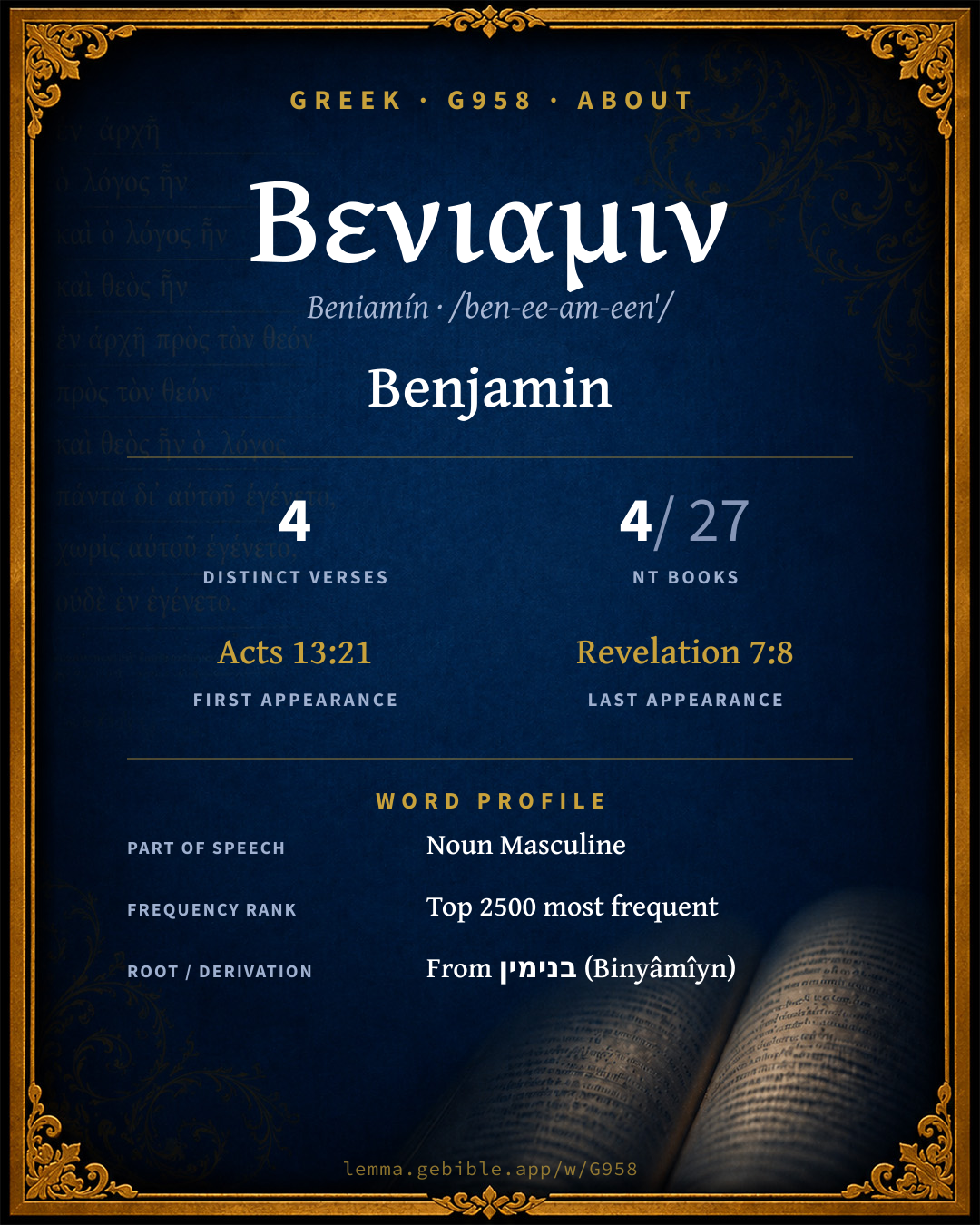
Βενιαμίν
Benjamin
Thayer's lists 3 entries for ‘Benjamin’ fuller range ↓
Full lexicon entry — Thayer's Greek Lexicon
From Thayer's Greek Lexicon
Where this word appears
Every verse where G958 appears — 4 distinct verses across 4 books. Click any verse to open its interlinear word-by-word view. Verse text shown in the World English Bible for context — . Each verse’s Greek form is shown with its reference; the English is not keyword-highlighted, since the data carries no word-level English alignment. Use “Compare translations” on any verse to read it across multiple English versions. This concordance covers the Greek New Testament; Septuagint (Greek Old Testament) occurrences of this word are not indexed here.
Acts 1 verse
Romans 1 verse
Philippians 1 verse
Revelation 1 verse
About this entry
At a glance — auto-summarized from this page’s data, not written by a person. Every figure links to its source below. This summary describes the numbers; it doesn’t interpret them.
At its core, Βενιαμιν (Beniamín) means “Benjamin.” With only 4 verses it sits in the long tail of Greek New Testament vocabulary. The word gravitates to Acts (25%), then Romans and Philippians. Scripture first uses it in Acts 13:21. Each statement above links to its evidence; the full detail follows below.
Gloss history
Strong's 1890 vs modern scholarship
About this word
Strong's G958 catalogs a Greek word from the Greek New Testament.
These counts are not copied from any lexicon or concordance. They are computed here, from the morphology-tagged Greek New Testament. What Lemma adds →
- 4
- distinct verses
- The word appears in 4 distinct verses.
- 4 / 27
- NT books
- The word appears in 4 of 27 New Testament books.
- #1,877
- by frequency
- Top 2500 most frequent Greek words (rank 1,877 of 5,347 Greek words by occurrence).
View all 4 occurrences in the concordance →
Most concentrated in
- Acts 1 verse 25%
- Romans 1 verse 25%
- Philippians 1 verse 25%
By section of the New Testament
By traditional corpus
Conventional, traditional groupings — biblical authorship is debated, so this is a traditional corpus grouping, not an authorship claim. Some books belong to more than one corpus (Luke is in both the Gospels and the Lukan corpus, and so on), so these shares overlap and need not total 100%. Each figure is a share of the word’s 4 distinct verses.
- Pauline corpus 2 verses · 50%
- Lukan (Luke–Acts) 1 verse · 25%
- Johannine 1 verse · 25%
- Revelation 1 verse · 25%
How translations render this word
Counts come from each version’s own published word-to-Strong’s tagging or interlinear alignment — an approximate guide to how each version renders this word, not a word-level alignment the data otherwise carries. Because each total is that version’s own tagged count, the per-version totals vary from one another and need not match the appearance or distinct-verse counts above. These counts may also differ from a printed concordance because Lemma counts each distinctly tagged rendering and does not collapse phrase taggings into a single head-word total. This is a fixed set of word-tagged versions (KJV, ASV, BSB, ULT) and does not change with the reading translation you choose elsewhere. Each version’s license is shown beside its name below (and on Sources).
- King James Version: Benjamin 4×
- American Standard Version: Benjamin 4×
- Berean Standard Bible: Benjamin 4×
- unfoldingWord Literal Text: Benjamin 4×
King James Version Public Domain
Renders G958 across 4 tagged occurrences — most commonly:
American Standard Version Public Domain
Renders G958 across 4 tagged occurrences — most commonly:
Berean Standard Bible Public Domain
Renders G958 across 4 tagged occurrences — most commonly:
unfoldingWord Literal Text CC BY-SA 4.0
Renders G958 across 4 tagged occurrences — most commonly:
Senses in Thayer's
The 3 senses Thayer's distinguishes for this word, in lexicon order (not ranked by frequency or importance). The full entry — with sub-senses — is in the Lexicon Entry tab.
- Benjamin = "son of the right hand" or, "son of good fortune"
- Jacob's twelfth son
- the tribe of Benjamin
Word origin
Derived from בנימין (Binyâmîyn) (H1144) — Benjamin.
Of hebrew origin [ H1144 ]; Benjamin an Israelite : - Benjamin.
— Strong’s Exhaustive Concordance (1890), public domain.
Forms in the corpus
The 2 distinct written forms G958 takes in the Greek New Testament, most frequent first — each parse links to that case’s occurrences in the concordance.
| Form | Parsing | Example | Uses |
|---|---|---|---|
| Βενιαμείν Beniameín | Noun, Proper, indeclinable | Acts 13:21 | 3 |
| Βενιαμεὶν Beniameìn | Noun, Proper, indeclinable | Revelation 7:8 | 1 |
Bible dictionary
Public-domain dictionary articles matched to this entry by name (Benjamin). A biblical name can be shared by more than one person or place, so an article may treat several.
Easton's Bible Dictionary · M. G. Easton, 1897
Son of my right hand. (1.) The younger son of Jacob by Rachel (Gen. 35:18). His birth took place at Ephrath, on the road between Bethel and Bethlehem, at a short distance from the latter place. His mother died in giving him birth, and with her last breath named him Ben-oni, son of my pain, a name which was changed by his father into Benjamin. His posterity are called Benjamites (Gen. 49:27; Deut. 33:12; Josh. 18:21).
The tribe of Benjamin at the Exodus was the smallest but one (Num. 1:36, 37; Ps. 68:27). During the march its place was along with Manasseh and Ephraim on the west of the tabernacle. At the entrance into Canaan it counted 45,600 warriors. It has been inferred by some from the words of Jacob (Gen. 49:27) that the figure of a wolf was on the tribal standard. This tribe is mentioned in Rom. 11:1; Phil. 3:5.
The inheritance of this tribe lay immediately to the south of that of Ephraim, and was about 26 miles in length and 12 in breadth. Its eastern boundary was the Jordan. Dan intervened between it and the Philistines. Its chief towns are named in Josh. 18:21-28.
The history of the tribe contains a sad record of a desolating civil war in which they were engaged with the other eleven tribes. By it they were almost exterminated (Judg. 20:20, 21; 21:10). (See GIBEAH.)
The first king of the Jews was Saul, a Benjamite. A close alliance was formed between this tribe and that of Judah in the time of David (2 Sam. 19:16, 17), which continued after his death (1 Kings 11:13; 12:20). After the Exile these two tribes formed the great body of the Jewish nation (Ezra 1:5; 10:9).
The tribe of Benjamin was famous for its archers (1 Sam. 20:20, 36; 2 Sam. 1:22; 1 Chr. 8:40; 12:2) and slingers (Judge. 20:6).
The gate of Benjamin, on the north side of Jerusalem (Jer. 37:13; 38:7; Zech. 14:10), was so called because it led in the direction of the territory of the tribe of Benjamin. It is called by Jeremiah (20:2) "the high gate of Benjamin;" also "the gate of the children of the people" (17:19). (Comp. 2 Kings 14:13.)
Smith's Bible Dictionary · William Smith, 1863
(son of the right hand, fortunate).
+ The youngest of the children of Jacob. His birth took place on the road between Bethel and Bethlehem, near the latter, B.C. 1729. His mother, Rachel, died in the act of giving him birth, naming him with her last breath Ben-oni (son of my sorrow). This was by Jacob changed into Benjamin. (Genesis 35:16,18) Until the journeys of Jacob's sons and Jacob himself into Egypt we hear nothing of Benjamin. Nothing personal is known of him. Henceforward the history of Benjamin is the history of the tribe. + A man of the tribe of Benjamin, son of bilhan, and the head of a family of warriors. (1 Chronicles 7:10) + One of the "sons of Harim," an Israelite in the time of Ezra who had married a foreign wife. (Ezra 10:32)
Hitchcock's Bible Names Dictionary · Roswell D. Hitchcock, 1869
son of the right hand
Classic public-domain reference works; full attribution on Sources.
Septuagint usage
The same Greek word Βενιαμιν appears 175 times in the Greek Old Testament (Septuagint), across 165 verses in 19 books.
- 175
- LXX occurrences
- Tagged occurrences of this Greek word in the Septuagint.
- 165
- verses
- Distinct Septuagint verses containing this word.
- 19 / 39
- OT books
- The word appears in 19 of the 39 Old Testament books.
Sample Septuagint occurrences
- Genesis 35:18 βενιαμίν
- Exodus 1:3 βενιαμίν
- Numbers 1:11 βενιαμίν
- Deuteronomy 27:12 βενιαμίν
- Joshua 18:11 βενιαμίν
- Judges 1:21 βενιαμίν
- 1 Samuel 9:1 βενιαμίν
- 2 Samuel 2:9 βενιαμίν
- 1 Kings 4:17 βενιαμίν
- 1 Chronicles 2:2 βενιαμίν
- 2 Chronicles 11:1 βενιαμίν
- Ezra 1:5 βενιαμίν
Septuagint occurrences (same lexeme)
Every verse where the same Strong’s number (G958) appears in the Greek Septuagint — showing the first 50 of 165. Verse text shown in the World English Bible for context; the Greek form is the matched word — the English is not keyword-highlighted.
- Genesis 35:18 βενιαμίν It happened, as her soul was departing (for she died), that she named him Ben-oni, but his father named him Benjamin.
- Genesis 35:24 βενιαμίν The sons of Rachel: Joseph and Benjamin.
- Genesis 42:4 βενιαμίν But Jacob didn't send Benjamin, Joseph's brother, with his brothers; for he said, "Lest perhaps harm happen to him."
- Genesis 42:36 βενιαμίν Jacob, their father, said to them, "You have bereaved me of my children! Joseph is no more, Simeon is no more, and you want to take Benjamin away. All these things are against me."
- Genesis 43:14 βενιαμίν May God Almighty give you mercy before the man, that he may release to you your other brother and Benjamin. If I am bereaved of my children, I am bereaved."
- Genesis 43:15 βενιαμίν The men took that present, and they took double money in their hand, and Benjamin; and rose up, went down to Egypt, and stood before Joseph.
- Genesis 43:16 βενιαμίν When Joseph saw Benjamin with them, he said to the steward of his house, "Bring the men into the house, and butcher an animal, and make ready; for the men will dine with me at noon."
- Genesis 43:29 βενιαμίν He lifted up his eyes, and saw Benjamin, his brother, his mother's son, and said, "Is this your youngest brother, of whom you spoke to me?" He said, "God be gracious to you, my son."
- Genesis 43:34 βενιαμίν He sent portions to them from before him, but Benjamin's portion was five times as much as any of theirs. They drank, and were merry with him.
- Genesis 44:12 βενιαμίν He searched, beginning with the eldest, and ending at the youngest. The cup was found in Benjamin's sack.
- Genesis 45:12 βενιαμίν Behold, your eyes see, and the eyes of my brother Benjamin, that it is my mouth that speaks to you.
- Genesis 45:14 βενιαμίν He fell on his brother Benjamin's neck, and wept, and Benjamin wept on his neck.
- Genesis 45:22 βενιαμίν To all of them he gave each man changes of clothing, but to Benjamin he gave three hundred pieces of silver and five changes of clothing.
- Genesis 46:19 βενιαμίν The sons of Rachel, Jacob's wife: Joseph and Benjamin.
- Genesis 46:21 βενιαμίν The sons of Benjamin: Bela, Becher, Ashbel, Gera, Naaman, Ehi, Rosh, Muppim, Huppim, and Ard.
- Genesis 49:27 βενιαμίν "Benjamin is a ravenous wolf. In the morning he will devour the prey. At evening he will divide the spoil."
- Exodus 1:3 βενιαμίν Issachar, Zebulun, and Benjamin,
- Numbers 1:11 βενιαμίν Of Benjamin: Abidan the son of Gideoni.
- Numbers 1:34 βενιαμίν Of the children of Manasseh, their generations, by their families, by their fathers' houses, according to the number of the names, from twenty years old and upward, all who were able to go out to war;
- Numbers 1:35 βενιαμίν those who were numbered of them, of the tribe of Manasseh, were thirty-two thousand two hundred.
- Numbers 2:22 βενιαμίν "The tribe of Benjamin: and the prince of the children of Benjamin shall be Abidan the son of Gideoni.
- Numbers 7:60 βενιαμίν On the ninth day Abidan the son of Gideoni, prince of the children of Benjamin
- Numbers 10:24 βενιαμίν Over the host of the tribe of the children of Benjamin was Abidan the son of Gideoni.
- Numbers 13:9 βενιαμίν Of the tribe of Benjamin, Palti the son of Raphu.
- Numbers 26:42 βενιαμίν These are the sons of Dan after their families: of Shuham, the family of the Shuhamites. These are the families of Dan after their families.
- Numbers 26:45 βενιαμίν Of the sons of Beriah: of Heber, the family of the Heberites; of Malchiel, the family of the Malchielites.
- Numbers 34:21 βενιαμίν Of the tribe of Benjamin, Elidad the son of Chislon.
- Deuteronomy 27:12 βενιαμίν These shall stand on Mount Gerizim to bless the people, when you are passed over the Jordan: Simeon, and Levi, and Judah, and Issachar, and Joseph, and Benjamin.
- Deuteronomy 33:12 βενιαμίν Of Benjamin he said, The beloved of Yahweh shall dwell in safety by him; He covers him all the day long, He dwells between his shoulders.
- Joshua 18:11 βενιαμίν The lot of the tribe of the children of Benjamin came up according to their families: and the border of their lot went out between the children of Judah and the children of Joseph.
- Joshua 18:20 βενιαμίν The Jordan was the border of it on the east quarter. This was the inheritance of the children of Benjamin, by the borders of it round about, according to their families.
- Joshua 18:21 βενιαμίν Now the cities of the tribe of the children of Benjamin according to their families were Jericho, and Beth Hoglah, and Emek Keziz,
- Joshua 18:28 βενιαμίν and Zelah, Eleph, and the Jebusite (the same is Jerusalem), Gibeath, [and] Kiriath; fourteen cities with their villages. This is the inheritance of the children of Benjamin according to their families.
- Joshua 21:4 βενιαμίν The lot came out for the families of the Kohathites: and the children of Aaron the priest, who were of the Levites, had by lot out of the tribe of Judah, and out of the tribe of the Simeonites, and out of the tribe of Benjamin, thirteen cities.
- Joshua 21:9 βενιαμίν They gave out of the tribe of the children of Judah, and out of the tribe of the children of Simeon, these cities which are [here] mentioned by name:
- Joshua 21:17 βενιαμίν Out of the tribe of Benjamin, Gibeon with its suburbs, Geba with its suburbs,
- Judges 1:21 βενιαμίν The children of Benjamin did not drive out the Jebusites who inhabited Jerusalem; but the Jebusites dwell with the children of Benjamin in Jerusalem to this day.
- Judges 5:14 βενιαμίν Out of Ephraim [came down] they whose root is in Amalek; After you, Benjamin, among your peoples; Out of Machir came down governors, Out of Zebulun those who handle the marshal's staff.
- Judges 10:9 βενιαμίν The children of Ammon passed over the Jordan to fight also against Judah, and against Benjamin, and against the house of Ephraim; so that Israel was sore distressed.
- Judges 19:14 βενιαμίν So they passed on and went their way; and the sun went down on them near to Gibeah, which belongs to Benjamin.
- Judges 19:16 βενιαμίν Behold, there came an old man from his work out of the field at even: now the man was of the hill-country of Ephraim, and he sojourned in Gibeah; but the men of the place were Benjamites.
- Judges 20:3 βενιαμίν (Now the children of Benjamin heard that the children of Israel had gone up to Mizpah.) The children of Israel said, Tell us, how was this wickedness brought to pass?
- Judges 20:4 βενιαμίν The Levite, the husband of the woman who was murdered, answered, I came into Gibeah that belongs to Benjamin, I and my concubine, to lodge.
- Judges 20:10 βενιαμίν and we will take ten men of one hundred throughout all the tribes of Israel, and one hundred of one thousand, and a thousand out of ten thousand, to get food for the people, that they may do, when they come to Gibeah of Benjamin, according to all the folly that they have worked in Israel.
- Judges 20:12 βενιαμίν The tribes of Israel sent men through all the tribe of Benjamin, saying, What wickedness is this that is happen among you?
- Judges 20:13 βενιαμίν Now therefore deliver up the men, the base fellows, who are in Gibeah, that we may put them to death, and put away evil from Israel. But Benjamin would not listen to the voice of their brothers the children of Israel.
- Judges 20:14 βενιαμίν The children of Benjamin gathered themselves together out of the cities to Gibeah, to go out to battle against the children of Israel.
- Judges 20:15 βενιαμίν The children of Benjamin were numbered on that day out of the cities twenty-six thousand men who drew the sword, besides the inhabitants of Gibeah, who were numbered seven hundred chosen men.
- Judges 20:17 βενιαμίν The men of Israel, besides Benjamin, were numbered four hundred thousand men who drew sword: all these were men of war.
- Judges 20:18 βενιαμίν The children of Israel arose, and went up to Bethel, and asked counsel of God; and they said, Who shall go up for us first to battle against the children of Benjamin? Yahweh said, Judah [shall go up] first.
These are occurrences of the same Greek lexeme (G958) in the Septuagint — not a translation of any one Hebrew word. The store carries no word-level Hebrew↔Greek alignment, so no Hebrew original is asserted here. Counts come from the recovered LXX Strong's tagging — high-frequency vocabulary is well covered, while rare or late forms may be untagged — so they reflect tagged occurrences and may slightly undercount.