Psalms 68:27

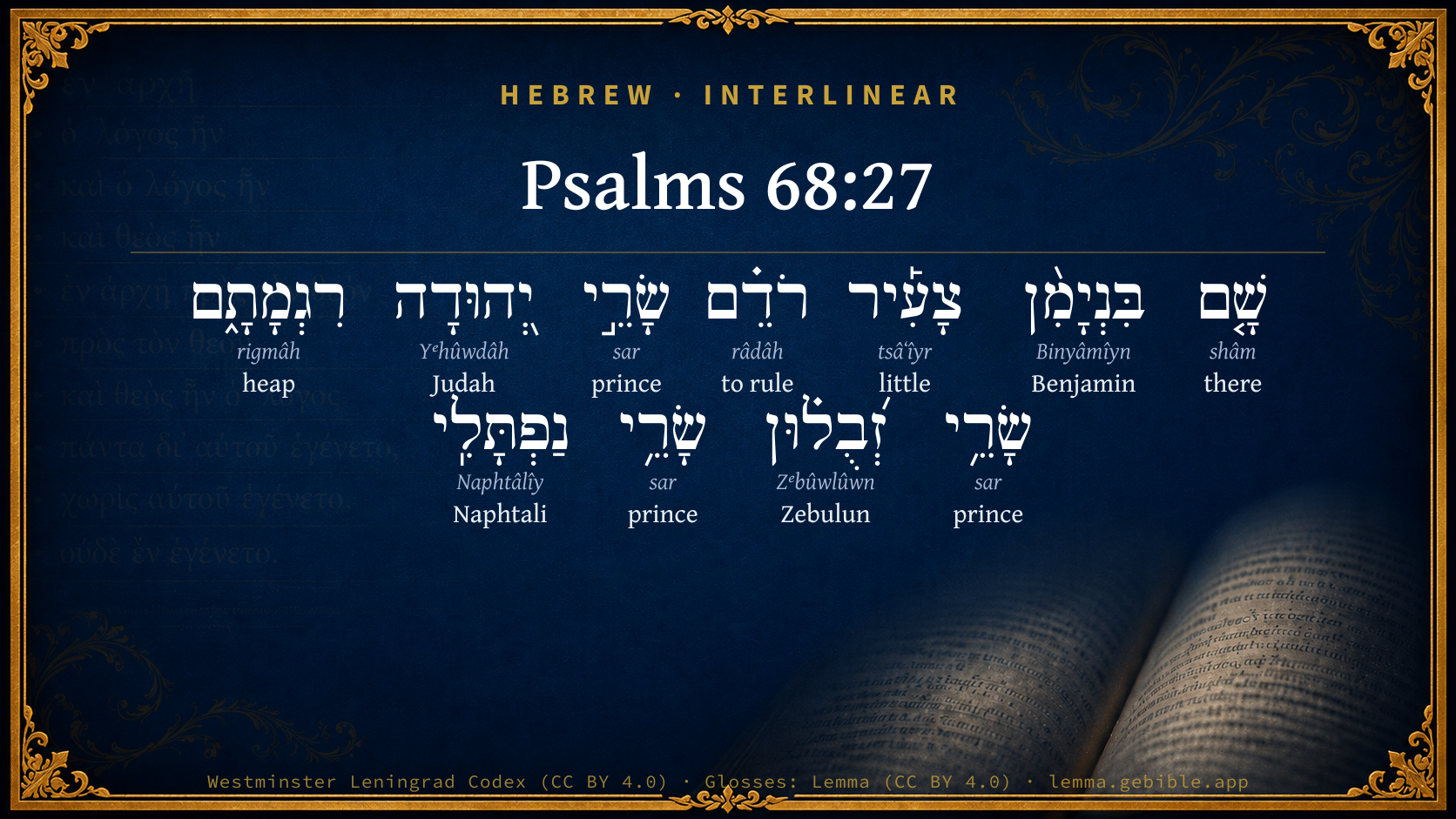
Hebrew (Westminster Leningrad Codex) Psalms 68:27 appears in the Hebrew Old Testament. The text above is from the Westminster Leningrad Codex. Each word links to its Strong’s number, a concise gloss, and parsing drawn from the Open Scriptures Hebrew Bible morphology. Click any word for its full Brown-Driver-Briggs (BDB) entry.
Download image
Cite this verse

Psalms 68:27 (World English Bible). Public Domain. Lemma interlinear Bible study tool, https://lemma.gebible.app/v/psalms/68/27.

Show BibTeX & RIS
BibTeX
RIS
English Translation
There is little Benjamin, their ruler, The princes of Judah, their council, The princes of Zebulun, and the princes of Naphtali.
World English Bible · Public Domain
Highlights
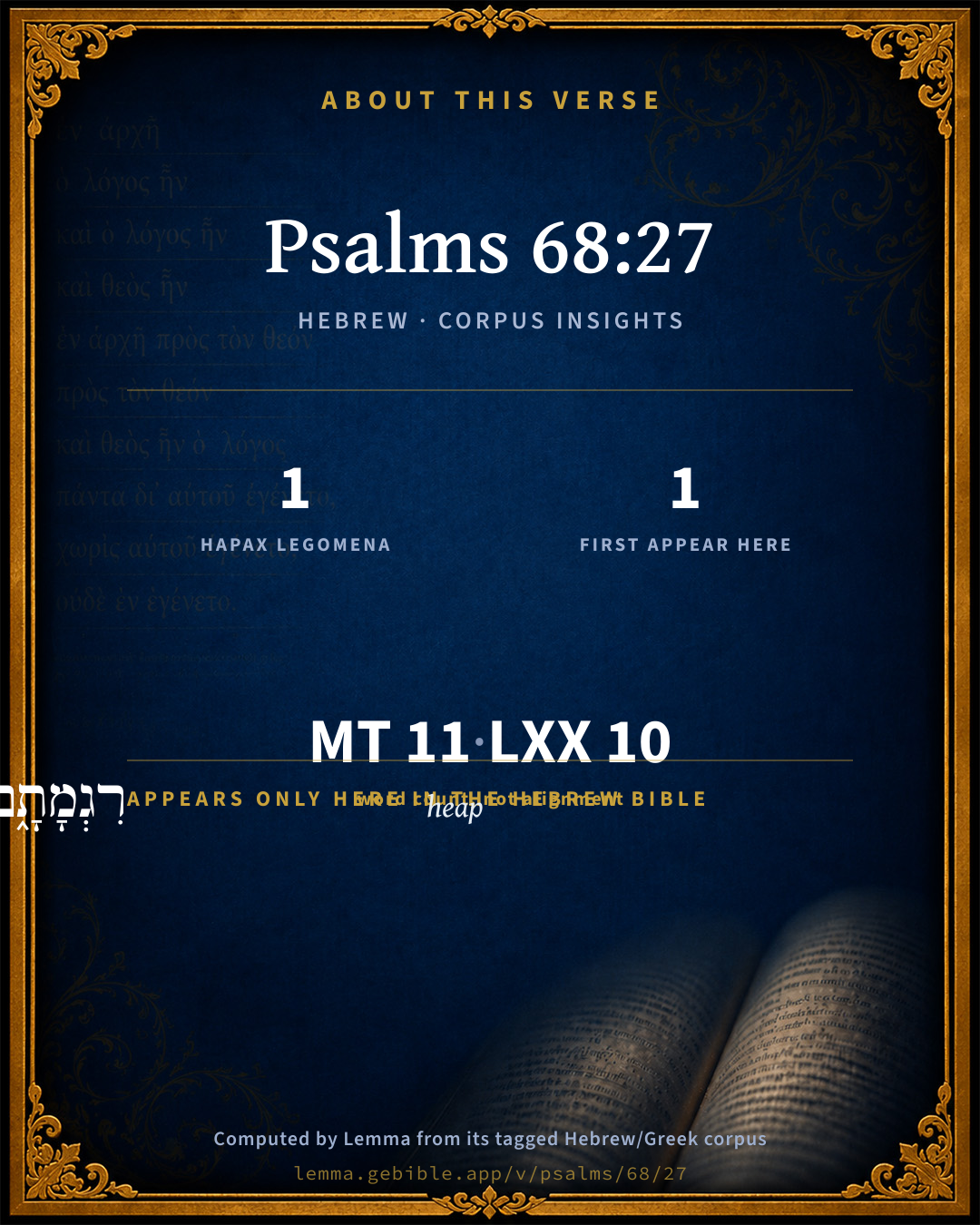
  • 1 hapax legomenon — only here in the Hebrew Bible
  • 1 first appearance in the Hebrew Bible
Full analysis ↓
Download a study sheet

One document with this verse’s original text, its word-by-word gloss line, the meaning frame, cross-references with their text, attributed commentary, and full source and license credits — printable, and it pastes into notes with its structure intact.

This verse Autodidact and up

Study sheet (.html) Plain text (.txt)

A passage Seminary Student

Up to 50 verses in one chapter. A passage sheet keeps up to 6 commentary sources and 12 cross-references per verse, in the order this page ranks them, and says so on the sheet whenever that leaves anything out. Ask for a single verse and you get the Autodidact verse sheet above.

Everything on this page stays free to read, with no account — the sheet is a download of what is already on screen, not access to it.

Want to remove ads? Support Godless Engineer
Compare translations 3

The same verse in 3 English versions, stacked beneath the original-language interlinear above. Click any original word for its lexicon entry.

Each is an independent rendering of the whole verse — the interlinear is not word-aligned to these translations.

Highlighted words mark where these versions differ — a whole-verse word diff, not a word-by-word alignment.

  • World English Bible Public Domain
    There is little Benjamin, their ruler, The princes of Judah, their council, The princes of Zebulun, and the princes of Naphtali.
  • King James Version Public Domain
    There is little Benjamin with their ruler, the princes of Judah and their council, the princes of Zebulun, and the princes of Naphtali.
  • unfoldingWord Literal Text CC BY-SA 4.0
    There Benjamin, the littlest, ruling them; the princes of Judah, their throngs; the princes of Zebulun, the princes of Naphtali.

unfoldingWord Literal Text — © unfoldingWord, licensed CC BY-SA 4.0. Word-aligned USFM3 via Door43 (git.door43.org/unfoldingWord/en_ult).

Versions to compare (up to 4)

3 of 4 selected

Show all 18 translations

Every available English version of this verse, each an independent rendering of the whole verse.

  • World English Bible Public Domain
    There is little Benjamin, their ruler, The princes of Judah, their council, The princes of Zebulun, and the princes of Naphtali.
  • Berean Standard Bible Public Domain
    There is Benjamin, the youngest, ruling them, the princes of Judah in their company, the princes of Zebulun and of Naphtali.
  • Majority Standard Bible Public Domain
    There is Benjamin, the youngest, ruling them, the princes of Judah in their company, the princes of Zebulun and of Naphtali.
  • King James Version Public Domain
    There is little Benjamin with their ruler, the princes of Judah and their council, the princes of Zebulun, and the princes of Naphtali.
  • American Standard Version (1901) Public Domain
    There is little Benjamin their ruler, The princes of Judah `and' their council, The princes of Zebulun, the princes of Naphtali.
  • Revised Version (1885) Public Domain
    There is little Benjamin their ruler, the princes of Judah and their council, the princes of Zebulun, the princes of Naphtali.
  • Geneva Bible (1599) Public Domain
    There was litle Beniamin with their ruler, and the princes of Iudah with their assemblie, the princes of Zebulun, and the princes of Naphtali.
  • Douay-Rheims (1899) Public Domain
    In the churches bless ye God the Lord, from the fountains of Israel.
  • Young's Literal Translation Public Domain
    There `is' little Benjamin their ruler, Heads of Judah their defence, Heads of Zebulun -- heads of Naphtali.
  • Literal Standard Version CC BY-SA 4.0
    There [is] little Benjamin, their ruler, || Heads of Judah their defense, || Heads of Zebulun—heads of Naphtali.
  • Unlocked Literal Bible CC BY-SA 4.0
    There is first Benjamin, the smallest tribe, then the leaders of Judah and their multitudes, the leaders of Zebulun and the leaders of Naphtali.
  • unfoldingWord Literal Text CC BY-SA 4.0
    There Benjamin, the littlest, ruling them; the princes of Judah, their throngs; the princes of Zebulun, the princes of Naphtali.
  • Darby Bible Public Domain
    There is little Benjamin, their ruler; the princes of Judah, their company; the princes of Zebulun, the princes of Naphtali.
  • World Messianic Bible Public Domain
    There is little Benjamin, their ruler, the princes of Judah, their council, the princes of Zebulun, and the princes of Naphtali.
  • Webster's Bible Public Domain
    \\68:26\\Bless ye God in the congregations, even the Lord, from the fountain of Israel.
  • Free Bible Version CC BY-SA 4.0
    There is the little tribe of Benjamin, followed by the many leaders from Judah; then come the leaders of Zebulun and Naphtali.
  • Bible in Basic English Public Domain
    There is little Benjamin ruling them, the chiefs of Judah and their army, the rulers of Zebulun and the rulers of Naphtali.
  • JPS Tanakh (1917) Public Domain
    (68-28) There is Benjamin, the youngest, ruling them, the princes of Judah their council, the princes of Zebulun, the princes of Naphtali.

Literal Standard Version (2020), Covenant Press — licensed CC BY-SA 4.0. Text via the HelloAO Bible API (eBible.org). Unlocked Literal Bible (unfoldingWord) — licensed CC BY-SA 4.0. Text via the HelloAO Bible API (eBible.org). unfoldingWord Literal Text — © unfoldingWord, licensed CC BY-SA 4.0. Word-aligned USFM3 via Door43 (git.door43.org/unfoldingWord/en_ult). Free Bible Version, Dr. Jonathan Gallagher — licensed CC BY-SA 4.0. Text via the HelloAO Bible API (eBible.org).

Word by word

More ways to search: Search by grammar → Find every occurrence → Compare this word →

Practice this passage: Drill this verse → Learn its vocabulary →

רִגְמָתָ֑ם
rigmâh
H7277
“heap · their”
Noun, Common, Feminine, Singular, Construct + Suffix, Personal, 3rd Person, Masculine, Plural
Part of Speech
Noun
Type
Common
Gender
Feminine
Number
Singular
State
Construct
Full BDB Definition

Origin: from the same as H7276

TWOT: 2114a

heap (of stones) - of crowd (figuratively)
  1. שָׁ֤ם shâm H8033 “there” Adverb
  2. בִּנְיָמִ֨ן Binyâmîyn H1144 “Benjamin” Noun, Proper
  3. צָעִ֡יר tsâʻîyr H6810 “little” Adjective, Adjective, Masculine, Singular, Absolute
  4. רֹדֵ֗ם râdâh H7287 “ruling · them” Verb, Qal, Participle Active, Masculine, Singular, Construct + Suffix, Personal, 3rd Person, Masculine, Plural
  5. שָׂרֵ֣י sar H8269 “princes of” Noun, Common, Masculine, Plural, Construct
  6. יְ֭הוּדָה Yᵉhûwdâh H3063 “Judah” Noun, Proper
  7. שָׂרֵ֥י sar H8269 “princes of” Noun, Common, Masculine, Plural, Construct
  8. זְ֝בֻל֗וּן Zᵉbûwlûwn H2074 “Zebulun” Noun, Proper
  9. שָׂרֵ֥י sar H8269 “princes of” Noun, Common, Masculine, Plural, Construct
  10. נַפְתָּלִֽי Naphtâlîy H5321 “Naphtali” Noun, Proper

About this verse

These counts appear in no published source. They are computed here, from the morphology-tagged text and Lemma’s own curated glosses. What Lemma adds →

11
words
9
distinct lemmas
Wisdom
section

Notable vocabulary

1 hapax legomenon — a word that appears only here in the entire Hebrew Bible:

  • רִגְמָתָ֑ם heap H7277

First appearance in Scripture

This word makes its first canonical appearance in the Hebrew Bible here:

  • רִגְמָתָ֑ם heap H7277

Shared distinctive vocabulary

צָעִ֡יר little H6810 occurs in 22 verses of the Hebrew Bible. Also found in:

Grammatical profile

  • 1 verb
  • 8 nouns
  • 1 adjective
  • 1 adverb

Verb forms

  • רֹדֵ֗ם Qal · Participle Active

Repetition

A word recurs within this verse — often emphatic in Hebrew:

  • שָׂרֵ֣י prince H8269 ×3

Hebrew & Septuagint length

In English translation the verse runs 21 words from the Hebrew and 22 from the Septuagint (LXX English) — closely comparable.

A rough comparison of the two English renderings, which tokenize alike — not a word-level alignment.

Word counts can differ between the Hebrew and the Greek without any difference in meaning — e.g. the Hebrew direct-object marker אֵת has no separate Greek word, and Greek often adds the article ὁ.

In the original languages it is 11 Hebrew tokens and 10 Greek tokens — but the two are counted differently (Hebrew bundles its prefixes and suffixes into one token; the Greek is in lemma form), so that isn’t a like-for-like length.

Cross-references

13

Topical passages linked to Psalms 68:27 in the Treasury of Scripture Knowledge — connected by theme and wording, ordered by reader-vote popularity; previews shown in the World English Bible.

  • 1 Samuel 9:21 Saul answered, Am I not a Benjamite, of the smallest of the tribes of Israel? and my family the least of all the families of the tribe of Benjamin? why then speak you to me after this manner?
  • 1 Chronicles 12:16 There came of the children of Benjamin and Judah to the stronghold to David.
  • Psalms 60:7 Gilead is mine, and Manasseh is mine. Ephraim also is the defense of my head. Judah is my scepter.
  • Isaiah 11:13 The envy also of Ephraim shall depart, and those who vex Judah shall be cut off: Ephraim shall not envy Judah, and Judah shall not vex Ephraim.
  • Genesis 42:32 We are twelve brothers, sons of our father; one is no more, and the youngest is this day with our father in the land of Canaan.'
  • Judges 5:18 Zebulun was a people that jeopardized their lives to the death, Naphtali, on the high places of the field.
  • Judges 20:35 Yahweh struck Benjamin before Israel; and the children of Israel destroyed of Benjamin that day twenty-five thousand one hundred men: all these drew the sword.
  • Judges 21:6–25 The children of Israel repented them for Benjamin their brother, and said, There is one tribe cut off from Israel this day.
  • 1 Chronicles 12:29 Of the children of Benjamin, the brothers of Saul, three thousand: for hitherto the greatest part of them had kept their allegiance to the house of Saul.
  • 1 Chronicles 15:3 David assembled all Israel at Jerusalem, to bring up the ark of Yahweh to its place, which he had prepared for it.
  • 1 Chronicles 27:12 The ninth [captain] for the ninth month was Abiezer the Anathothite, of the Benjamites: and in his division were twenty-four thousand.
  • Psalms 47:9 The princes of the peoples are gathered together, The people of the God of Abraham. For the shields of the earth belong to God. He is greatly exalted!
  • Ezekiel 37:19–27 tell them, Thus says the Lord Yahweh: Behold, I will take the stick of Joseph, which is in the hand of Ephraim, and the tribes of Israel his companions; and I will put them with it, [even] with the stick of Judah, and make them one stick, and they shall be one in my hand.

Cross-references courtesy of OpenBible.info (CC BY 4.0).

Hebrew and Greek witnesses Masoretic Hebrew ↔ Greek Septuagint

The same verse in the two great witnesses to the Old Testament, shown verse-for-verse.

You’re reading Greek Psalm 67 (Hebrew Psalm 68). The Septuagint counts the superscription, so verse numbers can differ from the Hebrew — chapter-level alignment, not verse-by-verse. Numbering follows Rahlfs.

These are two independent witnesses, not word-aligned to each other, and the Septuagint is shown in lemma (dictionary) form.

Hebrew Psalms 68:27 Masoretic · Westminster Leningrad Codex

שָׁ֤ם בִּנְיָמִ֨ן צָעִ֡יר רֹדֵ֗ם שָׂרֵ֣י יְ֭הוּדָה רִגְמָתָ֑ם שָׂרֵ֥י זְ֝בֻל֗וּן שָׂרֵ֥י נַפְתָּלִֽי

There is little Benjamin, their ruler, The princes of Judah, their council, The princes of Zebulun, and the princes of Naphtali.

World English Bible · Public Domain

Greek LXX Greek Psalm 67:27 Septuagint · lemma form

ἐν ἐκκλησία εὐλογέω ὁ θεός ὁ κύριος ἐκ πηγή ἰσραήλ

There is Benjamin the younger one in ecstasy, the princes of Juda their rulers, the princes of Zabulon, the princes of Nephthali.

LXX2012 (modern English Septuagint) · Public Domain

On this verse, John Gill's Exposition discusses the Septuagint’s reading. Read the note in Commentary ↓

Hebrew: Westminster Leningrad Codex (CC BY 4.0). Greek: Septuagint (public domain); English from LXX2012 (modern English Septuagint) (Public Domain). How the Septuagint differs from the Hebrew →

Commentary

Notes on Psalms 68:27 from classic Christian and Jewish commentators (each source and its license shown beneath its notes). The classic Christian expositions comment on the surrounding passage and are grouped to its opening verse, so a note may address several verses; the Jewish commentaries on the Tanakh (Rashi and others) are per-verse, so they appear only where the commentator wrote on this verse.

Lemma curates 59 commentaries, every one of them public domain or Creative Commons licensed, each selected and text-cleaned for this edition rather than reprinted as found. About our sources →

Trapp's Complete Commentary

John Trapp

Psa 68:27 There [is] little Benjamin [with] their ruler, the princes of Judah [and] their council, the princes of Zebulun, [and] the princes of Naphtali.

Ver. 27. There is little Benjamin with their ruler] Though before they had stood out for Saul and his house, yet now they bore a part in this solemn celebrity, as being next unto the sanctuary. Of this tribe was St Paul, Tricubitalis ille homuncio, sed insatiabilis Dei cultor, as Chrysostom calleth him, little in stature, but in labours more abundant. The first precious stone in the foundation of the New Jerusalem is a jasper, Rev 21:19, which in Aaron’s breastplate was the last, Exo 28:20, on which Benjamin’s name was graven. This intimateth, saith Ainsworth, the last now to be first, and chief in Christian Churches.

The princes of Judah and their council] Or company, or purple-arrayed ones. Beza rendereth it, Lapidatores eorum, the stoners of the enemies. The word is found here only; and Forsterus thinketh that our Saviour alludeth to it when, as Mar 3:17, he calleth James and John Boanerges.

The princes of Zebulun] Sic absolvitur pompa triumphalis. These are mentioned as most remote, bringing up the rear. In those tribes Christ walked, and therehence he called sundry of his disciples.

John Trapp, A Commentary or Exposition upon All the Books of the Old and New Testament (1647–1656) — public domain. Text from a community e-Sword module.

The Treasury of David

Charles H. Spurgeon

Ver. 27. There is little Benjamin with their ruler. The tribe was small, having been greatly reduced in numbers, but it had the honour of including Zion within its territory. "And of Benjamin he said, The beloved of the Lord shall dwell in safety by him; and the Lord shall cover him all the day long, and he shall dwell between his shoulders." Little Benjamin had been Jacob's darling, and now the tribe is made to march first in the procession, and to dwell nearest to the holy place.

The princes of Judah and their council. Judah was a large and powerful tribe, not with one governor, like Benjamin, but with many princes "and their company, "for so the margin has it. "From thence is the shepherd, the stone of Israel, "and the tribe was a quarry of stones wherewith to build up the nations: some such truth is hinted at in the Hebrew.

The princes of Zebulun, and the princes of Naphtali. Israel was there, as well as Judah; there was no schism among the people. The north sent a representative contingent as well as the south, and so the long procession set forth the hearty loyalty of all the tribes to their Lord and King. O happy day, when all believers shall be one around the ark of the Lord; striving for nothing but the glory of the God of grace.

Ver. 27. Benjamin, Judah, Zebulun, Naphtali. The two royal tribes,

1. That of Benjamin, from which the first king sprang;

2. That of Judah, from which the second; and the two learned tribes, Zebulun and Naphtali. And we may note, that the kingdom of the Messiah should at length be submitted to by all the potentates and learned men in the world. Henry Hammond.

Ver. 27. Benjamin, Judah, Zebulun, Naphtali. The same tribes are prominent in the New Testament, as foremost in the battle of the church against the world. Paul, the "least" of the apostles (1Co 15:8-10), was by origin Saul of Benjamin (Php 3:5). Christ, "the Lion of the tribe of Judah, "James and John, the brothers, the other James, Thaddaeus, and Simon, were from Judah, and the other apostles were from Nephthalim and Zabulon, or Galilee (Mt 4:13). A. R. Fausset.

Ver. 27. Their ruler. The prince of that tribe. The Greek version saith, in a trance; taking the Hebrew Mdr to be of Mdr, though it be not found elsewhere in this form; yet rare words but once used are sundry times found in this and other Psalms. These things applied to Christ's times and after are very mystical. Benjamin, the least, is put here first; so in the heavenly Jerusalem, the first foundation is a jasper (Re 21:19), which was the last precious stone in Aaron's breastplate, on which Benjamin's name was graven (Ex 28:10, 20-21). In this tribe Paul excelled as a prince of God, though one of the least of the apostles (1Co 15:8-10), who was converted in a trance or ecstasy (Ac 9:3-4, etc.); and in ecstasies he and other apostles saw the mysteries of Christ's kingdom. Henry Ainsworth.

Ver. 27. Their council; or, their stone, the Messiah, that sprang from Judah, Ge 49:24 Ps 118:22. John Gill.

Ver. 27-28. There are all the twelve tribes of Israel with their rulers present, to conduct the ark of God to the hill, in which it pleaseth him to dwell; for, though all the tribes are not mentioned, these which are named, include the whole, since Zebulun and Naphtali are the most remote, and Judah and Benjamin the nearest tribes to Zion. Benjamin was a dwindled family through the signal depopulation of that tribe, from which it never entirely recovered. Jud 20:43-48 1Ch 12:29. Edward Garrard Marsh, in "The Book of Psalms translated into English Verse... with Practical and Explanatory Notes." 1832.

Ver. 27.

I. The variety of song.

1. The royal tribe of Benjamin in the time of Saul.

2. The princely tribe of Judah, as David was prince regent in the time of Saul.

3. The literary tribe of Zebulun: "Out of Zebulun" they that handle the pen of the writer.

4. The eloquent tribe: "Naphtali giveth goodly words." II. The harmony of song. Let all unite in praising the Lord, the fountain of Israel. "Ten thousand thousand are their tongues, "etc. G. R.

Psalms 68:28*

The prophet now puts into the mouth of the assembly a song, foretelling the future conquests of Jehovah.

Ver. 27-28. See Psalms on "Ps 68:27" for further information.

Charles H. Spurgeon's The Treasury of David (1869–1885) — public domain. Psalms only. Text from a community e-Sword/MySword module.

Joseph Benson's Commentary

Psa 68:27. There is little Benjamin — Present in this solemn pomp of carrying the ark to Zion, under the conduct of David their king. That tribe is called little, partly because it was the youngest, as being descended from Jacob’s youngest son, and principally because it was exceedingly diminished, and almost annihilated under the judges. And he notices it particularly here, both because it was nearest to Judah, and to the place to which the ark was now carried; and also to signify their reconciliation and submission to David, against whom they had stood out with more obstinacy than any other tribe, as having been so long used to govern, and unwilling to part with the regal dignity, which was, by God’s appointment, first seated among them. With their ruler — With the prince of their tribe, who marched at the head of them. Hebrew, Benjamin their ruler; the tribe which had lately swayed the sceptre, but now submitted to David. The princes of Judah — It is no wonder that he should mention the princes of this tribe, because he was elected by them to be their king; their council — “This tribe was certainly the council or chief support of the Israelitish constitution, both in the cabinet and the field; in the former it had the lead. The princes of Zebulun and Naphtali are added, as the most remote, to show the unanimity of the whole nation, and of all the tribes far and near, in attending this solemnity; to testify their willing acknowledgment of David for their king, and their consent, that henceforward Jerusalem, the city of David, should be declared and esteemed the capital of the whole nation.”

Joseph Benson's Commentary on the Old and New Testaments (1811–1818) — public domain. Text from a community e-Sword module.

J. A. Alexander on Psalms

Joseph Addison Alexander

28. (Psa 68:27.) There is little Benjamin, subduing them; the chiefs of Judah, stoning them; the chiefs of Zebulon; the chiefs of Naphtali. These are named as representatives of all the tribes supposed to be there, i. e. in the triumphal march. They seem to be selected, partly with reference to their local habitation, as the northern and southern extremities of Israel; partly because the most remarkable exploits, from the time of Moses to the time of David, were performed by these tribes. See Jdg 5:18, 1Sa 18:7. Little Benjamin, so called in allusion to Jacob's partial fondness for his youngest son. See Gen 43:33, and compare 1Sa 9:21. Their conqueror, or subduing them as Saul did the surrounding nations. See 1Sa 14:47-48. Stoning them, literally their stoning, from a verb which invariably means to stone. The allusion may be to their skill as slingers, or more specifically to the means by which David killed Goliath (1Sa 17:49-50). The suffix refers to the enemy, as in the clause preceding. Some interpreters have noted, as an observable coincidence, that our Lord and several of his apostles were of Judah, Paul was of Benjamin (Php 3:5), and the remaining apostles of Galilee, in which lay the domain of Zebulon and Naphtali (Mat 4:13).

Joseph Addison Alexander, The Psalms Translated and Explained (1850) — public domain. Text from a community e-Sword module.

Geneva Bible (1599)

Geneva Bible translators

Benjamin is called little, because he was the youngest son of Jacob.

Who was some chief ruler of the tribe.

Geneva Bible (1599) marginal notes — public domain. Text via Bolls.life.

Adam Clarke's Commentary

Verse 27. There is little Benjamin] This is a description of another part of the procession.

Adam Clarke's Commentary on the Bible (1810–1826) — public domain. Text from a community e-Sword/MySword module.

Ellicott's Commentary for English Readers

(27) There is . . .—The procession is apparently a representative one. and the conjecture is probable which refers the selection of Zebulun and Naphtali to their prominence in Deborah’s song. Benjamin may owe its position to the fact that it gave the nation its first king, and Judah would naturally figure in the pomp as the tribe of David. But other considerations besides may have had weight. The selection may have been made as representative of the two kingdoms.

Their ruler.—The Hebrew word has always a sense of a high-handed conqueror’s rule, with the possible exception of Jer_5:31. There is probably still a reference to Saul and his conquests—“little Benjamin who conquered for thee,” or, possibly, here Benjamin takes the victor’s place as leader of the procession.

Their council.—The reading must certainly be changed in accordance with Psa_55:14. Their crowd, or company.

A Bible Commentary for English Readers, edited by Charles John Ellicott (1878–1897) — public domain. Text from a community e-Sword module.

The Cambridge Bible for Schools and Colleges

gen. ed. J. J. S. Perowne

27. The representatives of four tribes are specified as taking part in the procession. Judah and Benjamin naturally represent the South. Jerusalem was on the boundary between them; and the Temple was in the territory assigned to Benjamin (Deu_33:12; Jos_18:16), which may account for the place of honour being assigned to it. But why are Zebulun and Naphtali selected to represent the North? Is it as a recognition of their heroic patriotism commemorated in the Song of Deborah (Jdg_5:18) of which this Psalm contains so many reminiscences? or is it (on the assumption of the exilic date of the Psalm) an allusion to the prophecy of Isaiah (Isa_11:1), that just those tribes which had suffered most severely from the first Assyrian invasion should be restored to honour? This, if the exilic date of the Psalm is adopted, is the most obvious explanation. The prophets from Amos (Amo_9:11 ff.) and Hosea (Hos_3:5) onward, foretold the restoration of Israel as well as Judah, and their reunion into one state, and the Psalmist sees this hope visibly fulfilled in the festal procession. It may be noted that in Jer_3:17-18, the restoration of the reunited people is placed in close connexion with the conflux of the nations to worship at Jerusalem of which the Psalmist goes on to speak in Psa_68:28 ff. It is important to remember that the Israelites who returned from Babylon regarded themselves as representing the whole nation, and not the kingdom of Judah only. Cp. Ezr_8:35; Psa_122:4.

little Benjamin with their ruler] Omit with. Benjamin is called little as the youngest of the sons of Jacob, and the smallest of the tribes in population and territory (1Sa_9:21). Their ruler is explained by the Targ. as an allusion to Saul’s kingship; “There was Benjamin, small among the tribes, who first went down into the [Red] Sea, and therefore first received the kingdom”: by others it is supposed to mean ‘conducting them.’ The word is obscure and possibly corrupt.

and their council] Or, company.

The Cambridge Bible for Schools and Colleges (gen. ed. J. J. S. Perowne; Cambridge University Press, 1878–1918) — public domain. Text from a community e-Sword module.

John Gill's Exposition

There is little Benjamin, with their ruler,.... Or who is "their ruler" (y); that is, in the congregations or churches, where he was a ruler; or in the procession, the triumphal progress of Christ in Judea, and in the Gentile world, by the ministry of the word; where the singers and players of instruments, and damsels with timbrels, went in order: for not the tribe of Benjamin is meant, called "little", because Benjamin was Jacob's younger son; or because it was greatly weakened and reduced at Gibeah, Jdg 20:48; and was one of the smallest tribes in Israel; and Saul's family, who was the first king of Israel, the least in that tribe, Sa1 9:21; though the Targum interprets it of the tribe; and so Jarchi; but the Apostle Paul is here meant, who was of the tribe of Benjamin, Rom 11:1; was a young man when he was converted, Act 7:58; as the Septuagint and Vulgate Latin versions have it here; was "little" in stature, as is generally reported of him, and as his name "Paul" may be thought to signify, and might be given him on that account; see Co2 10:10; and was little in his own eyes, less than the least of all saints, and the chief of sinners; one born out of due time, and unworthy to be called an apostle; as well as he was little and contemptible in the eyes of others; yet he was greatly honoured by Christ, had an authority from him, was a "ruler" in his churches; set in the first place there, made an apostle, and was an apostle of the Gentiles, and not a whit behind the very chief of the apostles; and he was a principal in this progress, and therefore is named first: he was a chosen vessel to bear the name of Christ, and carry it into the Gentile world; he travelled and laboured more abundantly than the rest, and preached the Gospel fully from Jerusalem round about to Illyricum. The Septuagint and Vulgate Latin versions, render it, "there was Benjamin the younger in an ecstasy", or trance, as the Apostle Paul was, Act 9:9; but our version is best;

the princes of Judah, and their council; or "company", as Kimchi; their churches, or congregations over which they presided, or were the means of gathering; these were the apostles, some of which were of the tribe of Judah, of which tribe Christ was, and so must be those that are called his brethren, Mat 13:55; these were "princes", not only in common with other Christians, by adoption and regeneration, but by their office, being apostles, and over others in the Lord; and besides the church at Jerusalem, where James presided, there were other churches in Judea, which had spiritual guides and governors over them; see Heb 13:7; and so the Septuagint version, and those that follow it, render the words, "the princes of Judah, their governors"; and so Aben Ezra interprets them, and observes that "regem", in Zac 7:2 so signifies; to which the sense of R. Menachem in Jarchi agrees, who renders it "their purpled ones"; so Cocceius; but Gussetius (z) renders it "their stoning"; who stoned those that preached the Gospel to them; see Mat 21:35; or stoned their enemies, conquered them; or "their stone" (a), the Messiah, that sprung from Judah, Gen 49:24;

the princes of Zebulun, and the princes of Naphtali; the rest of the apostles, who were of Galilee, in which country lay the tribes of Zebulun and Naphtali: such as Peter, Andrew, James and John, Philip and Nathaniel, see Mat 4:13.

(y) "dominans eos", Pagninus, Montanus, Gejerus; "dominator eorum", Musculus: so Tigurine version, Cocceius. (z) Ebr. Comment. p. 777. (a) Vid. Teelman. Explic. Parabol. p. 312.

John Gill's Exposition of the Whole Bible (1746–1763) — public domain (CC PDM 1.0). Text via the HelloAO Bible API.

Albert Barnes' Notes on the Bible

There is little Benjamin - In that solemn procession. That is, the tribe of Benjamin is “represented” there; or, there are in the procession those who are connected with that tribe. The name “little” is given to the tribe either because Benjamin was the youngest of the sons of Jacob, or, more probably, because that tribe was among the smallest of the tribes of Israel. In fact, the tribe was so small, as compared with that of Judah, for instance, that, after the revolt of the ten tribes, the name of Benjamin was lost, and the whole nation was called, after the tribe of Judah, “Jews.”

With their ruler - The word “with” is not in the original. The Hebrew is literally “ruling them.” This would seem to mean that, on the occasion referred to, Benjamin, or those who were connected with that tribe, had the oversight, or the direction of those who were engaged in this solemn procession. Though small, it had the preeminence on this occasion. To it was committed the important duty of presiding over these solemnities; that is, those who were prominent in the arrangements for the occasion were of the tribe of Benjamin. This seems to me to be a better explanation than to suppose, as Professor Alexander does, that it has reference to the enemies of the people of God, and that Benjamin had “conquered” or “subdued” them.

The princes of Judah - The principal men of the tribe of Judah.

And “their council - Margin, “with their company.” The Hebrew word here, - רגמה rigmâh - means crowd, throng, band. It never means “council.” The idea is, evidently, that large numbers of the tribe of Judah attended - that the “princes” or leaders were accompanied by throngs of their own people; in allusion to the fact that Judah was one of the largest of the tribes of Israel - and in contrast with Benjamin, which was few in number, and yet thus occupied the most honorable place as having “charge” of the arrangements.

The princes of Zebulun, and the princes of Naphtali - These were remote or border tribes, and they seem to be mentioned here to show that all the tribes were represented; that is, that this was a national celebration. The fact that these tribes are mentioned as being represented on the occasion, proves that this psalm was composed before the revolt of the ten tribes, and the formation of the kingdom of Israel; that is, as “early” as the time of Solomon. This increases the probability that the psalm was written by David.

Albert Barnes' Notes on the Bible (1834–1885) — public domain. Text from a community e-Sword/MySword module.

Matthew Poole's English Annotations

There is present in this solemn pomp of carrying the ark to Zion, under the conduct of David their king,

little Benjamin. That tribe is called little, partly because it was the youngest, as being descended from Jacob’s youngest son Benjamin; and principally because it was exceedingly diminished, and almost extinguished, under the judges, Jdg 20; Jdg 21. He mentions this tribe, partly because they were nearest unto Judah, and to the place whither the ark was going; and partly to note their reconciliation and submission to David, against whom they had stood out with more obstinacy than any other tribe, as having been so long used to govern, and loth to part with the regal dignity which was by God’s appointment first seated among them.

With their ruler; with the prince of their tribe, who marched in the head of them. Heb. the ruler, i.e. the tribe which had lately swayed the sceptre, but now submitted themselves to David, and waited upon him in this expedition. But the first sense seems the truest, because the princes of all the following tribes are here mentioned.

Their council; their counsellors; or rather, their company, as it is in the margin, the people of that tribe who waited upon them in that action; which may seem to be here noted, to intimate that though the princes only of the following tribes be yet the people are comprehended under them, and were present with them in that solemnity. Zebulun and Naphtali: he mentions these tribes, either,

1. Because they excelled in learning and knowledge, as is gathered from Gen 49:21; Deu 33:19; Jdg 5:14. Or,

2. Because they were more hearty and forward in complying with David and in his service than the rest, as may seem from the great number of them which came from the ends of the land to David in Hebron, 1Ch 12:33,34. Or,

3. Because they lived in the remotest parts of the land of Canaan. And so by naming two of the nearest tribes, and two of the furthest, he leaves it to be understood that the other tribes also did come upon this occasion, as is manifest from 2Sa 6:15,19; 1Ch 13:2,5,6,8; 15:3,28.

Matthew Poole's English Annotations on the Holy Bible (1683–1685) — public domain. Text from a community e-Sword/MySword module.

Whedon's Commentary on the Bible

Daniel D. Whedon

27. Little Benjamin—Or, Benjamin the younger, as the word often signifies, (Gen_43:33; Gen_48:13;) or it may here denote “little” or few as to numbers, compared with other tribes, and from the cause mentioned Jdg_20:47. This also would contrast with Judah, if we take רגמה, (rigmah,) council, in the more obvious sense of multitude, thus: “Little Benjamin… the princes of Judah, their multitude.” The tribes mentioned represent not only the extreme parts of the land, but such as had distinguished themselves by their valour, strength, or dominion.

There—In the procession.

Benjamin with their ruler—Compliment to Saul, who had signalized himself by conquest. 1Sa_14:46-48.

Princes of Judah—See Gen_49:8-10; Psa_60:7.

With their council— With their throng of population, as above.

Zebulun, and… Naphtali— Two of the most distinguished of the northern tribes. Jdg_5:18

Daniel D. Whedon (gen. ed.), Commentary on the Old and New Testaments (1874–1909) — public domain. Text from a community e-Sword module.

The Pulpit Commentary

There is little Benjamin with their ruler. "With" is wrongly supplied by our translators. "Little Benjamin" the "smallest of the tribes of Israel" (1Sa_9:21) is called "their ruler," as having furnished the first king, and the one who began the conquests celebrated in vers. 11, 23. If the psalm is to be accounted as David"s, we may note it as a graceful act on his part that he places Saul"s tribe first. The princes of Judah and their council. Again "and" is wrongly supplied. "The princes of Judah" are called "their council," or "their bulwark" (Kay), as holding the most important position in Israel at the time. The reading, however, is doubtful. The princes of Zebulun, and the princes of Naphtali. Four tribes only are mentioned, not because no more than four took part in the processions, but as representatives of the whole number. The tribes selected for mention are from the two ends of the land the extreme south and the extreme north. Zebulun and Naphtali were the most important of the northern tribes, (see Jud_1:4:6, 10 5:18) as Judah and Benjamin were of the southern ones.

The Pulpit Commentary (1880–1919), ed. H.D.M. Spence-Jones & Joseph S. Exell — public domain. Text from a community e-Sword module.

John Wesley's Explanatory Notes

There is - Present in this solemn pomp of carrying the ark to Zion. Little - Called little, because it was exceedingly diminished, and almost extinguished under the Judges, Judg. xx, 35; xxi, 3 &c. Ruler - The tribe which had lately swayed the scepter, but now submitted to David. Company - The people of that tribe who waited upon them. Zebulun, &c. - He mentions these tribes, because they lived in the remotest parts of the land of Canaan. And so by naming two of the nearest tribes, and two of the farthest, he intimates that the other tribes also came upon this occasion, as is manifest from 2 Sam. vi, 15-19.

John Wesley, Explanatory Notes Upon the Whole Bible (1754–1765) — public domain. Text via the GEBible commentary corpus.

Rashi

Rabbi Shlomo Yitzchaki (Rashi)

In congregations bless God, the Lord, from the womb of Israel Even the fetuses in their mothers’ wombs recited the Song.

Rashi on the Tanakh — English translations: “The Judaica Press complete Tanach with Rashi, translated by A. J. Rosenberg” (CC BY 4.0); “Pentateuch with Rashi's commentary by M. Rosenbaum and A.M. Silbermann, 1929-1934” (public domain); “The Metsudah Tanach series, Lakewood, N.J” (CC BY 4.0); and “The Book of Joshua, Metsudah Publications, 1997” (CC BY 4.0). Text via Sefaria.

Lesson kit

Teaching starters — assembled from the data on this page, not authored interpretation. Every prompt links to the verse data it draws on. Edit before teaching.

Psalms, in the Wisdom, opens this verse with 11 words (9 distinct Hebrew lemmas). Its most distinctive word is rigmâh (“heap”). A historical commentator’s framing appears above. Read the whole chapter for the surrounding context.

Discussion questions

  1. The word rigmâh carries the sense “heap.” How does it shape the verse?
  2. 1 word here appears nowhere else in the Hebrew Bible. Why might the author reach for such rare wording?
  3. This is the first place “heap” appears in Scripture (first appears here). What does its debut here establish?
  4. How does Genesis 19:31, which shares the word «little», read alongside this verse?
  5. What does the repetition of “prince” (3× in this one verse) do in this verse?
  6. The translations on this page render this verse differently — a whole-verse word diff, not a word-by-word alignment. What might account for the different wordings?
  7. «רֹדֵ֗ם» is a Qal Participle Active verb. How does that grammatical form shape the action described?
  8. Compare how Trapp's Complete Commentary and The Treasury of David read this verse. Where do they agree or differ?

Things to notice

  • 1 word in this verse appears nowhere else in the Hebrew Bible.
  • 1 word makes its first canonical appearance in Scripture here.
  • This verse counts 11 Hebrew ↔ 10 Greek words.
  • These translations choose different wording for 6 words in this verse.
  • “prince” occurs 3× in this single verse.

Reading settings

Reading text

Shown beneath each verse's original-language words.

Old Testament
Old Testament edition

Read the OT as the Masoretic Hebrew (MT) or the Greek Septuagint (LXX).

English shown for the Greek Septuagint (in the Hebrew ↔ Greek comparison).

Comparing translations? Open the Compare panel on any verse page to stack up to four side by side.