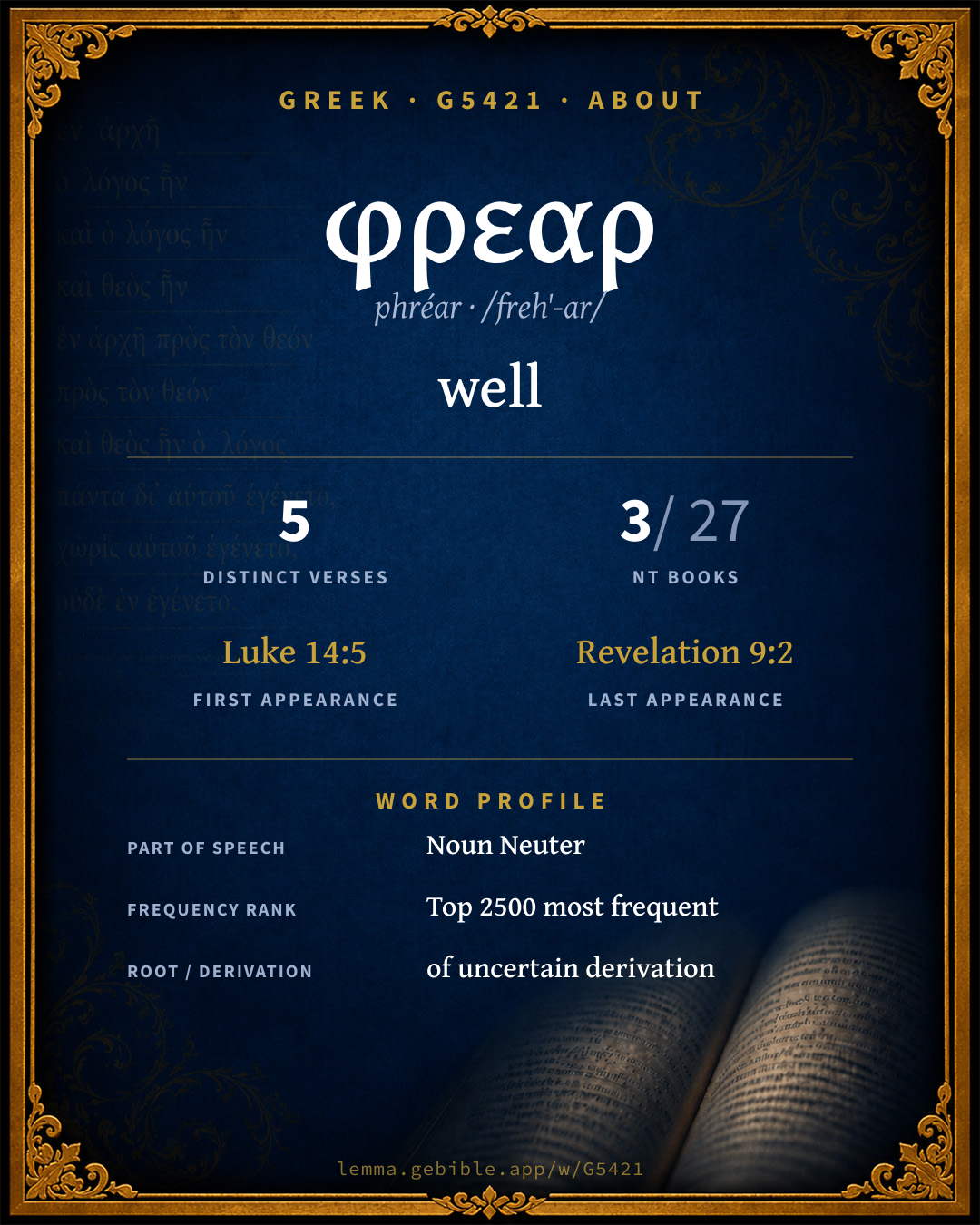
φρέαρ
well
‘well’ is one of 2 main senses fuller range ↓
Full lexicon entry — Thayer's Greek Lexicon
From Thayer's Greek Lexicon
Where this word appears
See every Genitive-case word in the Greek New Testament →
Grammar key — what these labels mean
Part of speech
- Noun
- A naming word — a person, place, thing, or idea.
Case
- Accusative
- The case of the direct object and of extent.
- Genitive
- The case of source, possession, or “of” — answers “whose / from what.”
- Nominative
- The case of the subject (and the predicate nominative).
Gender
- Neuter
- Grammatically neuter.
Number
- Singular
- One.
1 verse where G5421 appears in the Accusative case in the Book of Revelation. Filtered view — show all forms. Click any verse to open its interlinear word-by-word view. Verse text shown in the World English Bible for context — . Each verse’s Greek form is shown with its reference; the English is not keyword-highlighted, since the data carries no word-level English alignment. Use “Compare translations” on any verse to read it across multiple English versions. This concordance covers the Greek New Testament; Septuagint (Greek Old Testament) occurrences of this word are not indexed here.
Revelation
About this entry
At a glance — auto-summarized from this page’s data, not written by a person. Every figure links to its source below. This summary describes the numbers; it doesn’t interpret them.
φρεαρ — transliterated phréar — is a Greek noun carrying the sense “well.” It occurs a mere 5 verses across Scripture. More than a third of its appearances fall in John. It first appears in Luke 14:5. Its lexical range runs to 2 senses. Each statement above links to its evidence; the full detail follows below.
Gloss history
Strong's 1890 vs modern scholarship

About this word
Strong's G5421 catalogs a Greek word from the Greek New Testament.
These counts are not copied from any lexicon or concordance. They are computed here, from the morphology-tagged Greek New Testament. What Lemma adds →
- 5
- distinct verses
- The word appears in 5 distinct verses.
- 3 / 27
- NT books
- The word appears in 3 of 27 New Testament books.
- #1,358
- by frequency
- Top 2500 most frequent Greek words (rank 1,358 of 5,347 Greek words by occurrence).
View all 5 occurrences in the concordance →
Most concentrated in
- John 2 verses 40%
- Revelation 2 verses 40%
- Luke 1 verse 20%
By section of the New Testament
By traditional corpus
Conventional, traditional groupings — biblical authorship is debated, so this is a traditional corpus grouping, not an authorship claim. Some books belong to more than one corpus (Luke is in both the Gospels and the Lukan corpus, and so on), so these shares overlap and need not total 100%. Each figure is a share of the word’s 5 distinct verses.
- Johannine 4 verses · 80%
- Gospels 3 verses · 60%
- Revelation 2 verses · 40%
- Lukan (Luke–Acts) 1 verse · 20%
How translations render this word
Counts come from each version’s own published word-to-Strong’s tagging or interlinear alignment — an approximate guide to how each version renders this word, not a word-level alignment the data otherwise carries. Because each total is that version’s own tagged count, the per-version totals vary from one another and need not match the appearance or distinct-verse counts above. These counts may also differ from a printed concordance because Lemma counts each distinctly tagged rendering and does not collapse phrase taggings into a single head-word total. This is a fixed set of word-tagged versions (KJV, ASV, BSB, ULT) and does not change with the reading translation you choose elsewhere. Each version’s license is shown beside its name below (and on Sources).
- King James Version: Pit 5×, Well 2×
- American Standard Version: Pit 4×, Well 3×
- Berean Standard Bible: Pit 4×, Well 2×
- unfoldingWord Literal Text: Shaft 4×, Well 3×
King James Version Public Domain
Renders G5421 across 7 tagged occurrences — most commonly:
American Standard Version Public Domain
Renders G5421 across 7 tagged occurrences — most commonly:
Berean Standard Bible Public Domain
Renders G5421 across 6 tagged occurrences — most commonly:
Not rendered by a distinct English word in 1 further occurrence.
unfoldingWord Literal Text CC BY-SA 4.0
Renders G5421 across 7 tagged occurrences — most commonly:
Senses in Thayer's
The 2 senses Thayer's distinguishes for this word, in lexicon order (not ranked by frequency or importance). The full entry — with sub-senses — is in the Lexicon Entry tab.
- a well
- the pit of the abyss (because the nether world is thought to increase in size the further it extends from the surface of…
Word origin
Origin: of uncertain derivation
Of uncertain derivation; a hole in the ground (dug for obtaining or holding water or other purposes) that is a cistern or well ; figuratively an abyss (as a prison ): - well pit.
— Strong’s Exhaustive Concordance (1890), public domain.
Forms in the corpus
The 2 distinct written forms G5421 takes in the Greek New Testament, most frequent first — each parse links to that case’s occurrences in the concordance.
| Form | Parsing | Example | Uses |
|---|---|---|---|
| φρέαρ phréar | Noun, Accusative, Singular, Neuter | Luke 14:5 | 4 |
| φρέατος phréatos | Noun, Genitive, Singular, Neuter | Revelation 9:1 | 3 |
Septuagint usage
The same Greek word φρεαρ appears 56 times in the Greek Old Testament (Septuagint), across 47 verses in 11 books.
- 56
- LXX occurrences
- Tagged occurrences of this Greek word in the Septuagint.
- 47
- verses
- Distinct Septuagint verses containing this word.
- 11 / 39
- OT books
- The word appears in 11 of the 39 Old Testament books.
Sample Septuagint occurrences
- Genesis 14:10 φρέαρ
- Exodus 2:15 φρέαρ
- Numbers 21:16 φρέαρ
- 1 Samuel 19:22 φρέαρ
- 2 Samuel 3:26 φρέαρ
- Psalms 54:24 φρέαρ
- Proverbs 5:15 φρέαρ
- Song of Solomon 4:15 φρέαρ
- Isaiah 15:8 φρέαρ
- Jeremiah 14:3 φρέαρ
- Amos 5:5 φρέαρ
Septuagint occurrences (same lexeme)
Every verse where the same Strong’s number (G5421) appears in the Greek Septuagint. Verse text shown in the World English Bible for context; the Greek form is the matched word — the English is not keyword-highlighted.
- Genesis 14:10 φρέαρ Now the valley of Siddim was full of tar pits; and the kings of Sodom and Gomorrah fled, and they fell there, and those who remained fled to the mountain.
- Genesis 16:14 φρέαρ Therefore the well was called Beer Lahai Roi. Behold, it is between Kadesh and Bered.
- Genesis 21:14 φρέαρ Abraham rose up early in the morning, and took bread and a bottle of water, and gave it to Hagar, putting it on her shoulder, and gave her the child, and sent her away. She departed, and wandered in the wilderness of Beersheba.
- Genesis 21:19 φρέαρ God opened her eyes, and she saw a well of water. She went, filled the bottle with water, and gave the boy drink.
- Genesis 21:25 φρέαρ Abraham complained to Abimelech because of a water well, which Abimelech's servants had violently taken away.
- Genesis 21:30 φρέαρ He said, "You shall take these seven ewe lambs from my hand, that it may be a witness to me, that I have dug this well."
- Genesis 21:31 φρέαρ Therefore he called that place Beersheba, because they both swore there.
- Genesis 21:32 φρέαρ So they made a covenant at Beersheba. Abimelech rose up with Phicol, the captain of his host, and they returned into the land of the Philistines.
- Genesis 21:33 φρέαρ Abraham planted a tamarisk tree in Beersheba, and called there on the name of Yahweh, the Everlasting God.
- Genesis 22:19 φρέαρ So Abraham returned to his young men, and they rose up and went together to Beersheba. Abraham lived at Beersheba.
- Genesis 24:11 φρέαρ He made the camels kneel down outside the city by the well of water at the time of evening, the time that women go out to draw water.
- Genesis 24:20 φρέαρ She hurried, and emptied her pitcher into the trough, and ran again to the well to draw, and drew for all his camels.
- Genesis 24:62 φρέαρ Isaac came from the way of Beer Lahai Roi. For he lived in the land of the South.
- Genesis 25:11 φρέαρ It happened after the death of Abraham, that God blessed Isaac, his son. Isaac lived by Beer Lahai Roi.
- Genesis 26:15 φρέαρ Now all the wells which his father's servants had dug in the days of Abraham his father, the Philistines had stopped, and filled with earth.
- Genesis 26:18 φρέαρ Isaac dug again the wells of water, which they had dug in the days of Abraham his father. For the Philistines had stopped them after the death of Abraham. He called their names after the names by which his father had called them.
- Genesis 26:19 φρέαρ Isaac's servants dug in the valley, and found there a well of springing water.
- Genesis 26:20 φρέαρ The herdsmen of Gerar argued with Isaac's herdsmen, saying, "The water is ours." He called the name of the well Esek, because they contended with him.
- Genesis 26:21 φρέαρ They dug another well, and they argued over that, also. He called the name of it Sitnah.
- Genesis 26:22 φρέαρ He left that place, and dug another well. They didn't argue over that one. He called it Rehoboth. He said, "For now Yahweh has made room for us, and we will be fruitful in the land."
- Genesis 26:23 φρέαρ He went up from there to Beersheba.
- Genesis 26:25 φρέαρ He built an altar there, and called on the name of Yahweh, and pitched his tent there. There Isaac's servants dug a well.
- Genesis 26:32 φρέαρ It happened the same day, that Isaac's servants came, and told him concerning the well which they had dug, and said to him, "We have found water."
- Genesis 26:33 φρέαρ He called it Shibah. Therefore the name of the city is Beersheba to this day.
- Genesis 28:10 φρέαρ Jacob went out from Beersheba, and went toward Haran.
- Genesis 29:2 φρέαρ He looked, and behold, a well in the field, and, behold, three flocks of sheep lying there by it. For out of that well they watered the flocks. The stone on the well's mouth was great.
- Genesis 29:3 φρέαρ There all the flocks were gathered. They rolled the stone from the well's mouth, and watered the sheep, and put the stone again on the well's mouth in its place.
- Genesis 29:8 φρέαρ They said, "We can't, until all the flocks are gathered together, and they roll the stone from the well's mouth. Then we water the sheep."
- Genesis 29:10 φρέαρ It happened, when Jacob saw Rachel the daughter of Laban, his mother's brother, and the sheep of Laban, his mother's brother, that Jacob went near, and rolled the stone from the well's mouth, and watered the flock of Laban his mother's brother.
- Genesis 46:1 φρέαρ Israel traveled with all that he had, and came to Beersheba, and offered sacrifices to the God of his father, Isaac.
- Genesis 46:5 φρέαρ Jacob rose up from Beersheba, and the sons of Israel carried Jacob, their father, their little ones, and their wives, in the wagons which Pharaoh had sent to carry him.
- Exodus 2:15 φρέαρ Now when Pharaoh heard this thing, he sought to kill Moses. But Moses fled from the face of Pharaoh, and lived in the land of Midian, and he sat down by a well.
- Numbers 21:16 φρέαρ From there they traveled to Beer: that is the well of which Yahweh said to Moses, Gather the people together, and I will give them water.
- Numbers 21:18 φρέαρ The well, which the princes dug, Which the nobles of the people dug, With the scepter, [and] with their poles. From the wilderness [they traveled] to Mattanah;
- Numbers 21:22 φρέαρ Let me pass through your land: we will not turn aside into field, or into vineyard; we will not drink of the water of the wells: we will go by the king's highway, until we have passed your border.
- 1 Samuel 19:22 φρέαρ Then went he also to Ramah, and came to the great well that is in Secu: and he asked and said, Where are Samuel and David? One said, Behold, they are at Naioth in Ramah.
- 2 Samuel 3:26 φρέαρ When Joab was come out from David, he sent messengers after Abner, and they brought him back from the well of Sirah: but David didn't know it.
- Psalms 54:24 φρέαρ
- Psalms 68:16 φρέαρ Why do you look in envy, you rugged mountains, At the mountain where God chooses to reign? Yes, Yahweh will dwell there forever.
- Proverbs 5:15 φρέαρ Drink water out of your own cistern, Running water out of your own well.
- Proverbs 23:27 φρέαρ For a prostitute is a deep pit; And a wayward wife is a narrow well.
- Song of Solomon 4:15 φρέαρ A fountain of gardens, A well of living waters, Flowing streams from Lebanon. Beloved
- Isaiah 15:8 φρέαρ For the cry is gone round about the borders of Moab; the wailing of it to Eglaim, and the wailing of it to Beer-elim.
- Jeremiah 14:3 φρέαρ Their nobles send their little ones to the waters: they come to the cisterns, and find no water; they return with their vessels empty; they are disappointed and confounded, and cover their heads.
- Jeremiah 48:7 φρέαρ For, because you have trusted in your works and in your treasures, you also shall be taken: and Chemosh shall go forth into captivity, his priests and his princes together.
- Jeremiah 48:9 φρέαρ Give wings to Moab, that she may fly and get her away: and her cities shall become a desolation, without any to dwell therein.
- Amos 5:5 φρέαρ But don't seek Bethel, Nor enter into Gilgal, And don't pass to Beersheba: For Gilgal shall surely go into captivity, And Bethel shall come to nothing.
These are occurrences of the same Greek lexeme (G5421) in the Septuagint — not a translation of any one Hebrew word. The store carries no word-level Hebrew↔Greek alignment, so no Hebrew original is asserted here. Counts come from the recovered LXX Strong's tagging — high-frequency vocabulary is well covered, while rare or late forms may be untagged — so they reflect tagged occurrences and may slightly undercount.