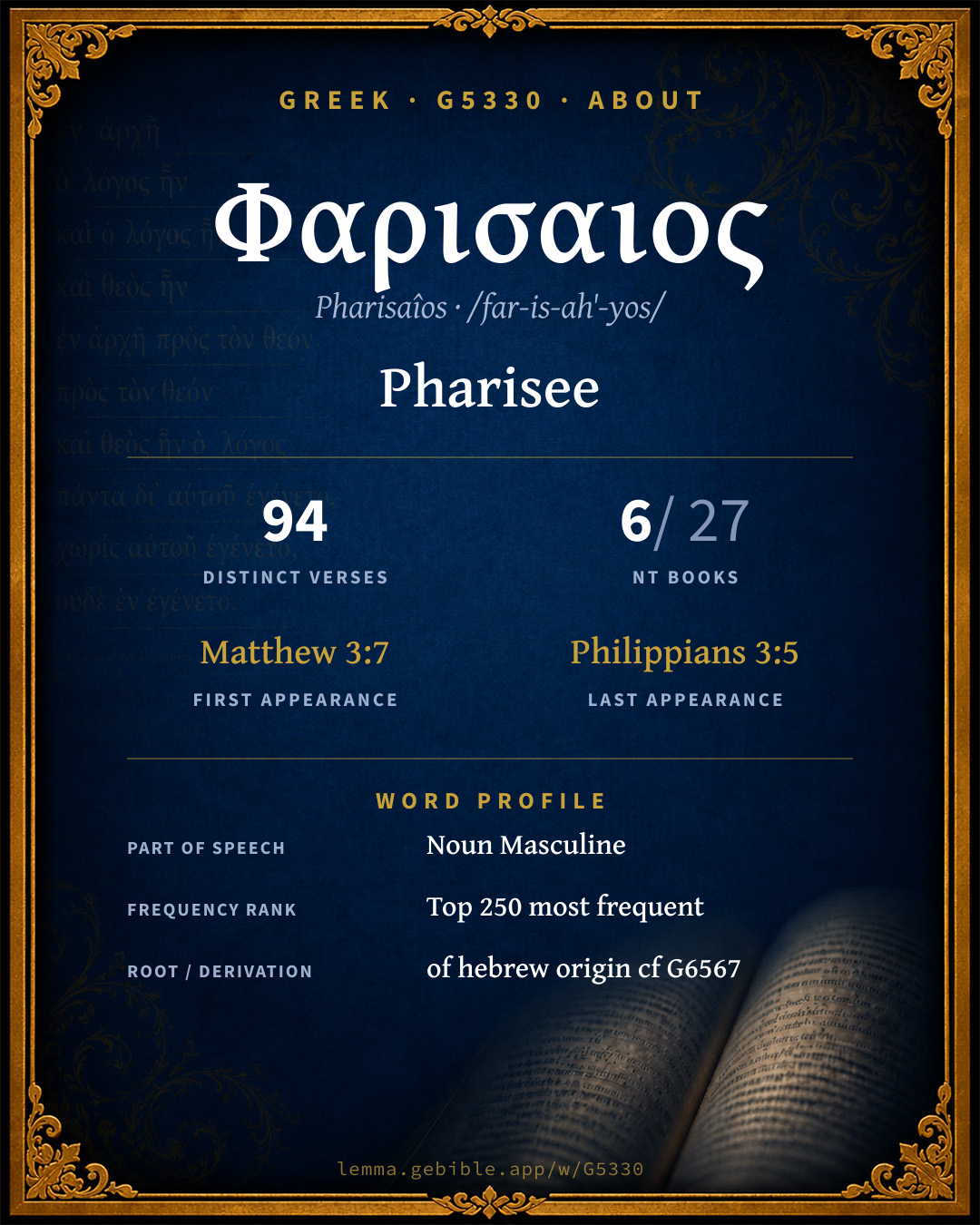
Φαρισαῖος
Pharisee
Full lexicon entry — Thayer's Greek Lexicon
From Thayer's Greek Lexicon
Where this word appears
See every Nominative-case word in the Greek New Testament →
Grammar key — what these labels mean
Part of speech
- Noun
- A naming word — a person, place, thing, or idea.
Case
- Nominative
- The case of the subject (and the predicate nominative).
- Genitive
- The case of source, possession, or “of” — answers “whose / from what.”
- Vocative
- The case of direct address (“O Lord”).
- Accusative
- The case of the direct object and of extent.
- Dative
- The case of the indirect object, means, or location — “to / for / with / in.”
Gender
- Masculine
- Grammatically masculine.
Number
- Plural
- More than one.
- Singular
- One.
Grammatical forms
- Noun, Nominative, Plural, Masculine 45 times (45%)
- Noun, Genitive, Plural, Masculine 30 times (30%)
- Noun, Nominative, Singular, Masculine 9 times (9%)
- Noun, Vocative, Plural, Masculine 6 times (6%)
- Noun, Accusative, Plural, Masculine 5 times (5%)
- Noun, Dative, Plural, Masculine 2 times (2%)
- Noun, Genitive, Singular, Masculine 2 times (2%)
- Noun, Vocative, Singular, Masculine 1 time (1%)
Parsed forms decoded from the imported morphology (Robinson–Tischendorf, public domain), counted across 100 parsed occurrences — not distinct verses.
Every verse where G5330 appears — 94 distinct verses across 6 books. Click any verse to open its interlinear word-by-word view. Verse text shown in the World English Bible for context — . Each verse’s Greek form is shown with its reference; the English is not keyword-highlighted, since the data carries no word-level English alignment. Use “Compare translations” on any verse to read it across multiple English versions. This concordance covers the Greek New Testament; Septuagint (Greek Old Testament) occurrences of this word are not indexed here.
Matthew 29 verses
- Matthew 3:7 Φαρισαίων n gen pl masc But when he saw many of the Pharisees and Sadducees coming for his baptism, he said to them, "You offspring of vipers, who warned you to flee from the wrath to come?
- Matthew 5:20 Φαρισαίων n gen pl masc For I tell you that unless your righteousness exceeds that of the scribes and Pharisees, there is no way you will enter into the Kingdom of Heaven.
- Matthew 9:11 Φαρισαῖοι n nom pl masc When the Pharisees saw it, they said to his disciples, "Why does your teacher eat with tax collectors and sinners?"
- Matthew 9:14 Φαρισαῖοι n nom pl masc Then John's disciples came to him, saying, "Why do we and the Pharisees fast often, but your disciples don't fast?"
- Matthew 9:34 Φαρισαῖοι n nom pl masc But the Pharisees said, "By the prince of the demons, he casts out demons."
- Matthew 12:2 Φαρισαῖοι n nom pl masc But the Pharisees, when they saw it, said to him, "Behold, your disciples do what is not lawful to do on the Sabbath."
- Matthew 12:14 Φαρισαῖοι n nom pl masc But the Pharisees went out, and conspired against him, how they might destroy him.
- Matthew 12:24 Φαρισαῖοι n nom pl masc But when the Pharisees heard it, they said, "This man does not cast out demons, except by Beelzebul, the prince of the demons."
- Matthew 12:38 Φαρισαίων n gen pl masc Then certain of the scribes and Pharisees answered, "Teacher, we want to see a sign from you."
- Matthew 15:1 Φαρισαῖοι n nom pl masc Then Pharisees and scribes came to Jesus from Jerusalem, saying,
- Matthew 15:12 Φαρισαῖοι n nom pl masc Then the disciples came, and said to him, "Do you know that the Pharisees were offended, when they heard this saying?"
- Matthew 16:1 Φαρισαῖοι n nom pl masc The Pharisees and Sadducees came, and testing him, asked him to show them a sign from heaven.
- Matthew 16:6 Φαρισαίων n gen pl masc Jesus said to them, "Take heed and beware of the yeast of the Pharisees and Sadducees."
- Matthew 16:11 Φαρισαίων n gen pl masc How is it that you don't perceive that I didn't speak to you concerning bread? But beware of the yeast of the Pharisees and Sadducees."
- Matthew 16:12 Φαρισαίων Φαρισαίων n gen pl masc n gen pl masc Then they understood that he didn't tell them to beware of the yeast of bread, but of the teaching of the Pharisees and Sadducees.
- Matthew 19:3 Φαρισαῖοι n nom pl masc Pharisees came to him, testing him, and saying, "Is it lawful for a man to divorce his wife for any reason?"
- Matthew 21:45 Φαρισαῖοι n nom pl masc When the chief priests and the Pharisees heard his parables, they perceived that he spoke about them.
- Matthew 22:15 Φαρισαῖοι n nom pl masc Then the Pharisees went and took counsel how they might entrap him in his talk.
- Matthew 22:34 Φαρισαῖοι n nom pl masc But the Pharisees, when they heard that he had put the Sadducees to silence, gathered themselves together.
- Matthew 22:41 Φαρισαίων n gen pl masc Now while the Pharisees were gathered together, Jesus asked them a question,
- Matthew 23:2 Φαρισαῖοι n nom pl masc saying, "The scribes and the Pharisees sat on Moses' seat.
- Matthew 23:13 Φαρισαῖοι n voc pl masc "Woe to you, scribes and Pharisees, hypocrites! For you devour widows' houses, and as a pretense you make long prayers. Therefore you will receive greater condemnation.
- Matthew 23:15 Φαρισαῖοι n voc pl masc Woe to you, scribes and Pharisees, hypocrites! For you travel around by sea and land to make one proselyte; and when he becomes one, you make him twice as much of a son of Gehenna as yourselves.
- Matthew 23:23 Φαρισαῖοι n voc pl masc "Woe to you, scribes and Pharisees, hypocrites! For you tithe mint, dill, and cumin, and have left undone the weightier matters of the law: justice, mercy, and faith. But you ought to have done these, and not to have left the other undone.
- Matthew 23:25 Φαρισαῖοι n voc pl masc "Woe to you, scribes and Pharisees, hypocrites! For you clean the outside of the cup and of the platter, but within they are full of extortion and unrighteousness.
- Matthew 23:26 Φαρισαῖε n voc sg masc You blind Pharisee, first clean the inside of the cup and of the platter, that the outside of it may become clean also.
- Matthew 23:27 Φαρισαῖοι n voc pl masc "Woe to you, scribes and Pharisees, hypocrites! For you are like whitened tombs, which outwardly appear beautiful, but inwardly are full of dead men's bones, and of all uncleanness.
- Matthew 23:29 Φαρισαῖοι n voc pl masc "Woe to you, scribes and Pharisees, hypocrites! For you build the tombs of the prophets, and decorate the tombs of the righteous,
- Matthew 27:62 Φαρισαῖοι n nom pl masc Now on the next day, which was the day after the Preparation Day, the chief priests and the Pharisees were gathered together to Pilate,
Mark 12 verses
- Mark 2:16 Φαρισαίων n gen pl masc The scribes and the Pharisees, when they saw that he was eating with the sinners and tax collectors, said to his disciples, "Why is it that he eats and drinks with tax collectors and sinners?"
- Mark 2:18 Φαρισαῖοι Φαρισαίων n nom pl masc n gen pl masc John's disciples and the Pharisees were fasting, and they came and asked him, "Why do John's disciples and the disciples of the Pharisees fast, but your disciples don't fast?"
- Mark 2:24 Φαρισαῖοι n nom pl masc The Pharisees said to him, "Behold, why do they do that which is not lawful on the Sabbath day?"
- Mark 3:6 Φαρισαῖοι n nom pl masc The Pharisees went out, and immediately conspired with the Herodians against him, how they might destroy him.
- Mark 7:1 Φαρισαῖοι n nom pl masc Then the Pharisees, and some of the scribes gathered together to him, having come from Jerusalem.
- Mark 7:3 Φαρισαῖοι n nom pl masc (For the Pharisees, and all the Jews, don't eat unless they wash their hands and forearms, holding to the tradition of the elders.
- Mark 7:5 Φαρισαῖοι n nom pl masc The Pharisees and the scribes asked him, "Why don't your disciples walk according to the tradition of the elders, but eat their bread with unwashed hands?"
- Mark 8:11 Φαρισαῖοι n nom pl masc The Pharisees came out and began to question him, seeking from him a sign from heaven, and testing him.
- Mark 8:15 Φαρισαίων n gen pl masc He charged them, saying, "Take heed: beware of the yeast of the Pharisees and the yeast of Herod."
- Mark 9:11 Φαρισαῖοι n nom pl masc They asked him, saying, "Why do the scribes say that Elijah must come first?"
- Mark 10:2 Φαρισαῖοι n nom pl masc Pharisees came to him testing him, and asked him, "Is it lawful for a man to divorce his wife?"
- Mark 12:13 Φαρισαίων n gen pl masc They sent some of the Pharisees and of the Herodians to him, that they might trap him with words.
Luke 26 verses
- Luke 5:17 Φαρισαῖοι n nom pl masc It happened on one of those days, that he was teaching; and there were Pharisees and teachers of the law sitting by, who had come out of every village of Galilee, Judea, and Jerusalem. The power of the Lord was with him to heal them.
- Luke 5:21 Φαρισαῖοι n nom pl masc The scribes and the Pharisees began to reason, saying, "Who is this that speaks blasphemies? Who can forgive sins, but God alone?"
- Luke 5:30 Φαρισαῖοι n nom pl masc Their scribes and the Pharisees murmured against his disciples, saying, "Why do you eat and drink with the tax collectors and sinners?"
- Luke 5:33 Φαρισαίων n gen pl masc They said to him, "Why do John's disciples often fast and pray, likewise also the disciples of the Pharisees, but yours eat and drink?"
- Luke 6:2 Φαρισαίων n gen pl masc But some of the Pharisees said to them, "Why do you do that which is not lawful to do on the Sabbath day?"
- Luke 6:7 Φαρισαῖοι n nom pl masc The scribes and the Pharisees watched him, to see whether he would heal on the Sabbath, that they might find an accusation against him.
- Luke 7:30 Φαρισαῖοι n nom pl masc But the Pharisees and the lawyers rejected the counsel of God, not being baptized by him themselves.
- Luke 7:36 Φαρισαίων Φαρισαίου n gen pl masc n gen sg masc One of the Pharisees invited him to eat with him. He entered into the Pharisee's house, and sat at the table.
- Luke 7:37 Φαρισαίου n gen sg masc Behold, a woman in the city who was a sinner, when she knew that he was reclining in the Pharisee's house, she brought an alabaster jar of ointment.
- Luke 7:39 Φαρισαῖος n nom sg masc Now when the Pharisee who had invited him saw it, he said to himself, "This man, if he were a prophet, would have perceived who and what kind of woman this is who touches him, that she is a sinner."
- Luke 11:37 Φαρισαῖος n nom sg masc Now as he spoke, a certain Pharisee asked him to dine with him. He went in, and sat at the table.
- Luke 11:38 Φαρισαῖος n nom sg masc When the Pharisee saw it, he marveled that he had not first washed himself before dinner.
- Luke 11:39 Φαρισαῖοι n nom pl masc The Lord said to him, "Now you Pharisees cleanse the outside of the cup and of the platter, but your inward part is full of extortion and wickedness.
- Luke 11:42 Φαρισαίοις n dat pl masc But woe to you Pharisees! For you tithe mint and rue and every herb, but you bypass justice and the love of God. You ought to have done these, and not to have left the other undone.
- Luke 11:43 Φαρισαίοις n dat pl masc Woe to you Pharisees! For you love the best seats in the synagogues, and the greetings in the marketplaces.
- Luke 11:53 Φαρισαῖοι n nom pl masc As he said these things to them, the scribes and the Pharisees began to be terribly angry, and to draw many things out of him;
- Luke 12:1 Φαρισαίων n gen pl masc Meanwhile, when a multitude of many thousands had gathered together, so much so that they trampled on each other, he began to tell his disciples first of all, "Beware of the yeast of the Pharisees, which is hypocrisy.
- Luke 13:31 Φαρισαῖοι n nom pl masc On that same day, some Pharisees came, saying to him, "Get out of here, and go away, for Herod wants to kill you."
- Luke 14:1 Φαρισαίων n gen pl masc It happened, when he went into the house of one of the rulers of the Pharisees on a Sabbath to eat bread, that they were watching him.
- Luke 14:3 Φαρισαίους n acc pl masc Jesus, answering, spoke to the lawyers and Pharisees, saying, "Is it lawful to heal on the Sabbath?"
- Luke 15:2 Φαρισαῖοι n nom pl masc The Pharisees and the scribes murmured, saying, "This man welcomes sinners, and eats with them."
- Luke 16:14 Φαρισαῖοι n nom pl masc The Pharisees, who were lovers of money, also heard all these things, and they scoffed at him.
- Luke 17:20 Φαρισαίων n gen pl masc Being asked by the Pharisees when the Kingdom of God would come, he answered them, "The Kingdom of God doesn't come with observation;
- Luke 18:10 Φαρισαῖος n nom sg masc "Two men went up into the temple to pray; one was a Pharisee, and the other was a tax collector.
- Luke 18:11 Φαρισαῖος n nom sg masc The Pharisee stood and prayed to himself like this: 'God, I thank you, that I am not like the rest of men, extortioners, unrighteous, adulterers, or even like this tax collector.
- Luke 19:39 Φαρισαίων n gen pl masc Some of the Pharisees from the multitude said to him, "Teacher, rebuke your disciples!"
John 19 verses
- John 1:24 Φαρισαίων n gen pl masc The ones who had been sent were from the Pharisees.
- John 3:1 Φαρισαίων n gen pl masc Now there was a man of the Pharisees named Nicodemus, a ruler of the Jews.
- John 4:1 Φαρισαῖοι n nom pl masc Therefore when the Lord knew that the Pharisees had heard that Jesus was making and baptizing more disciples than John
- John 7:32 Φαρισαῖοι Φαρισαῖοι n nom pl masc n nom pl masc The Pharisees heard the multitude murmuring these things concerning him, and the chief priests and the Pharisees sent officers to arrest him.
- John 7:45 Φαρισαίους n acc pl masc The officers therefore came to the chief priests and Pharisees, and they said to them, "Why didn't you bring him?"
- John 7:47 Φαρισαῖοι n nom pl masc The Pharisees therefore answered them, "You aren't also led astray, are you?
- John 7:48 Φαρισαίων n gen pl masc Have any of the rulers believed in him, or of the Pharisees?
- John 8:3 Φαρισαῖοι n nom pl masc The scribes and the Pharisees brought a woman taken in adultery. Having set her in the midst,
- John 8:13 Φαρισαῖοι n nom pl masc The Pharisees therefore said to him, "You testify about yourself. Your testimony is not valid."
- John 9:13 Φαρισαίους n acc pl masc They brought him who had been blind to the Pharisees.
- John 9:15 Φαρισαῖοι n nom pl masc Again therefore the Pharisees also asked him how he received his sight. He said to them, "He put mud on my eyes, I washed, and I see."
- John 9:16 Φαρισαίων n gen pl masc Some therefore of the Pharisees said, "This man is not from God, because he doesn't keep the Sabbath." Others said, "How can a man who is a sinner do such signs?" There was division among them.
- John 9:40 Φαρισαίων n gen pl masc Those of the Pharisees who were with him heard these things, and said to him, "Are we also blind?"
- John 11:46 Φαρισαίους n acc pl masc But some of them went away to the Pharisees, and told them the things which Jesus had done.
- John 11:47 Φαρισαῖοι n nom pl masc The chief priests therefore and the Pharisees gathered a council, and said, "What are we doing? For this man does many signs.
- John 11:57 Φαρισαῖοι n nom pl masc Now the chief priests and the Pharisees had commanded that if anyone knew where he was, he should report it, that they might seize him.
- John 12:19 Φαρισαῖοι n nom pl masc The Pharisees therefore said among themselves, "See how you accomplish nothing. Behold, the world has gone after him."
- John 12:42 Φαρισαίους n acc pl masc Nevertheless even of the rulers many believed in him, but because of the Pharisees they didn't confess it, so that they wouldn't be put out of the synagogue,
- John 18:3 Φαρισαίων n gen pl masc Judas then, having taken a detachment of soldiers and officers from the chief priests and the Pharisees, came there with lanterns, torches, and weapons.
Acts 7 verses
- Acts 5:34 Φαρισαῖος n nom sg masc But one stood up in the council, a Pharisee named Gamaliel, a teacher of the law, honored by all the people, and commanded to put the apostles out for a little while.
- Acts 15:5 Φαρισαίων n gen pl masc But some of the sect of the Pharisees who believed rose up, saying, "It is necessary to circumcise them, and to charge them to keep the law of Moses."
- Acts 23:6 Φαρισαίων Φαρισαῖός Φαρισαίων n gen pl masc n nom sg masc n gen pl masc But when Paul perceived that the one part were Sadducees and the other Pharisees, he cried out in the council, "Men and brothers, I am a Pharisee, a son of Pharisees. Concerning the hope and resurrection of the dead I am being judged!"
- Acts 23:7 Φαρισαίων n gen pl masc When he had said this, an argument arose between the Pharisees and Sadducees, and the assembly was divided.
- Acts 23:8 Φαρισαῖοι n nom pl masc For the Sadducees say that there is no resurrection, nor angel, nor spirit; but the Pharisees confess all of these.
- Acts 23:9 Φαρισαίων n gen pl masc A great clamor arose, and some of the scribes of the Pharisees part stood up, and contended, saying, "We find no evil in this man. But if a spirit or angel has spoken to him, let's not fight against God!"
- Acts 26:5 Φαρισαῖος n nom sg masc having known me from the first, if they are willing to testify, that after the strictest sect of our religion I lived a Pharisee.
Philippians 1 verse
About this entry
At a glance — auto-summarized from this page’s data, not written by a person. Every figure links to its source below. This summary describes the numbers; it doesn’t interpret them.
The Greek name Φαρισαιος centers on the idea of “Pharisee.” First canonically at Matthew 3:7, it enters the text early. It turns up in 94 verses across 6 books, a moderately common footprint. The word gravitates to Matthew (31%), then Luke and John. Dig into 94-verse concordance and the renderings breakdown below.
Gloss history
Strong's 1890 vs modern scholarship
About this word
Strong's G5330 catalogs a Greek word from the Greek New Testament.
These counts are not copied from any lexicon or concordance. They are computed here, from the morphology-tagged Greek New Testament. What Lemma adds →
- 94
- distinct verses
- The word appears in 94 distinct verses.
- 6 / 27
- NT books
- The word appears in 6 of 27 New Testament books.
- #165
- by frequency
- Top 250 most frequent Greek words (rank 165 of 5,347 Greek words by occurrence).
View all 94 occurrences in the concordance →
By section of the New Testament
By traditional corpus
Conventional, traditional groupings — biblical authorship is debated, so this is a traditional corpus grouping, not an authorship claim. Some books belong to more than one corpus (Luke is in both the Gospels and the Lukan corpus, and so on), so these shares overlap and need not total 100%. Each figure is a share of the word’s 94 distinct verses.
- Gospels 86 verses · 91%
- Lukan (Luke–Acts) 33 verses · 35%
- Johannine 19 verses · 20%
- Pauline corpus 1 verse · 1%
How translations render this word
Counts come from each version’s own published word-to-Strong’s tagging or interlinear alignment — an approximate guide to how each version renders this word, not a word-level alignment the data otherwise carries. Because each total is that version’s own tagged count, the per-version totals vary from one another and need not match the appearance or distinct-verse counts above. These counts may also differ from a printed concordance because Lemma counts each distinctly tagged rendering and does not collapse phrase taggings into a single head-word total. This is a fixed set of word-tagged versions (KJV, ASV, BSB, ULT) and does not change with the reading translation you choose elsewhere. Each version’s license is shown beside its name below (and on Sources).
- King James Version: Pharisees 85×, Pharisee 11×, Pharisee's 2×
- American Standard Version: Pharisees 83×, Pharisee 12×
- Berean Standard Bible: Pharisees 83×, Pharisee 12×
- unfoldingWord Literal Text: Pharisees 87×, Pharisee 12×
King James Version Public Domain
Renders G5330 across 100 tagged occurrences — most commonly:
Plus 2 renderings that appear only once — usually multi-word phrases or single function words the recovered tagging swept in, not distinct renderings.
American Standard Version Public Domain
Renders G5330 across 98 tagged occurrences — most commonly:
Plus 3 renderings that appear only once — usually multi-word phrases or single function words the recovered tagging swept in, not distinct renderings.
Berean Standard Bible Public Domain
Renders G5330 across 96 tagged occurrences — most commonly:
Plus 1 rendering that appears only once — usually multi-word phrases or single function words the recovered tagging swept in, not distinct renderings. Not rendered by a distinct English word in 1 further occurrence.
unfoldingWord Literal Text CC BY-SA 4.0
Renders G5330 across 100 tagged occurrences — most commonly:
Plus 1 rendering that appears only once — usually multi-word phrases or single function words the recovered tagging swept in, not distinct renderings.
Senses in Thayer's
The 1 sense Thayer's distinguishes for this word, in lexicon order (not ranked by frequency or importance). The full entry — with sub-senses — is in the Lexicon Entry tab.
- A sect that seems to have started after the Jewish exile. In addition to OT books the Pharisees recognised in oral…
Word origin
Origin: of hebrew origin cf G6567
Of hebrew origin (compare [ H6567 ]); a separatist that is exclusively religious ; a Pharisaean that is Jewish sectary : - Pharisee.
— Strong’s Exhaustive Concordance (1890), public domain.
Forms in the corpus
The 8 distinct written forms G5330 takes in the Greek New Testament, most frequent first — each parse links to that case’s occurrences in the concordance.
| Form | Parsing | Example | Uses |
|---|---|---|---|
| Φαρισαῖοι Pharisaîoi | Noun, Nominative, Plural, Masculine | Matthew 9:11 | 51 |
| Φαρισαίων Pharisaíōn | Noun, Genitive, Plural, Masculine | Matthew 3:7 | 30 |
| Φαρισαῖος Pharisaîos | Noun, Nominative, Singular, Masculine | Luke 7:39 | 8 |
| Φαρισαίους Pharisaíous | Noun, Accusative, Plural, Masculine | Luke 14:3 | 5 |
| Φαρισαίοις Pharisaíois | Noun, Dative, Plural, Masculine | Luke 11:42 | 2 |
| Φαρισαίου Pharisaíou | Noun, Genitive, Singular, Masculine | Luke 7:36 | 2 |
| Φαρισαῖε Pharisaîe | Noun, Vocative, Singular, Masculine | Matthew 23:26 | 1 |
| Φαρισαῖός Pharisaîós | Noun, Nominative, Singular, Masculine | Acts 23:6 | 1 |