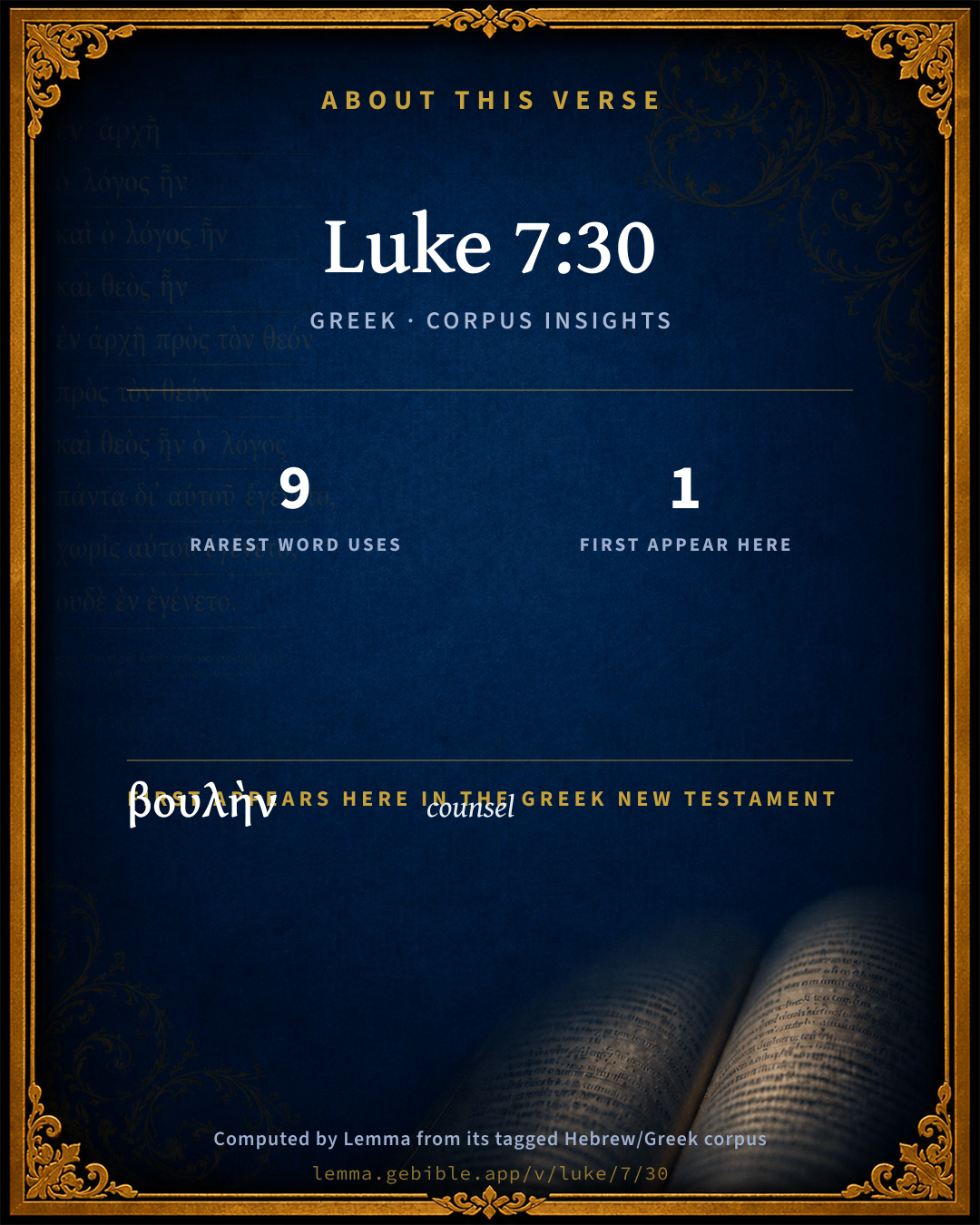
Luke 7:30

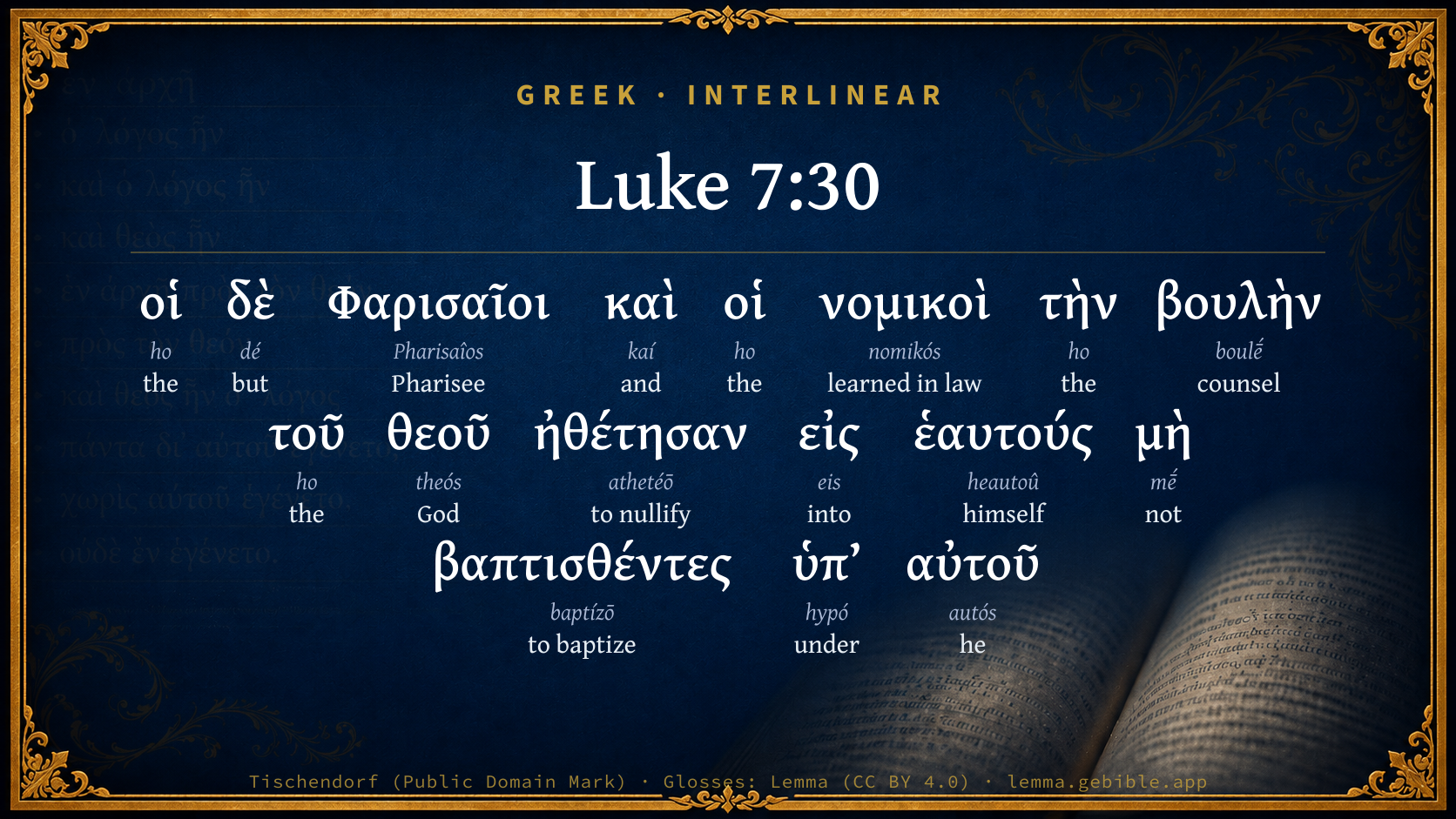
Greek (Tischendorf 8th ed.) Luke 7:30 appears in the Greek New Testament. The text above is from the Tischendorf 8th edition. Each word links to its Strong’s number and a concise gloss. Click any word for its full Thayer’s Greek Lexicon entry.
Download image
Cite this verse

Luke 7:30 (World English Bible). Public Domain. Lemma interlinear Bible study tool, https://lemma.gebible.app/v/luke/7/30.

Show BibTeX & RIS
BibTeX
RIS
English Translation
But the Pharisees and the lawyers rejected the counsel of God, not being baptized by him themselves.
World English Bible · Public Domain
Highlights
  • 1 first appearance in the Greek New Testament
Full analysis ↓
Download a study sheet

One document with this verse’s original text, its word-by-word gloss line, the meaning frame, cross-references with their text, attributed commentary, and full source and license credits — printable, and it pastes into notes with its structure intact.

This verse Autodidact and up

Study sheet (.html) Plain text (.txt)

A passage Seminary Student

Up to 50 verses in one chapter. A passage sheet keeps up to 6 commentary sources and 12 cross-references per verse, in the order this page ranks them, and says so on the sheet whenever that leaves anything out. Ask for a single verse and you get the Autodidact verse sheet above.

Everything on this page stays free to read, with no account — the sheet is a download of what is already on screen, not access to it.

Want to remove ads? Support Godless Engineer
Compare translations 3

The same verse in 3 English versions, stacked beneath the original-language interlinear above. Click any original word for its lexicon entry.

Each is an independent rendering of the whole verse — the interlinear is not word-aligned to these translations.

Highlighted words mark where these versions differ — a whole-verse word diff, not a word-by-word alignment.

  • World English Bible Public Domain
    But the Pharisees and the lawyers rejected the counsel of God, not being baptized by him themselves.
  • King James Version Public Domain
    But the Pharisees and lawyers rejected the counsel of God against themselves, being not baptized of him.
  • unfoldingWord Literal Text CC BY-SA 4.0
    But the Pharisees and the lawyers rejected the purpose of God for themselves, not having been baptized by him.)

unfoldingWord Literal Text — © unfoldingWord, licensed CC BY-SA 4.0. Word-aligned USFM3 via Door43 (git.door43.org/unfoldingWord/en_ult).

Versions to compare (up to 4)

3 of 4 selected

Show all 19 translations

Every available English version of this verse, each an independent rendering of the whole verse.

  • World English Bible Public Domain
    But the Pharisees and the lawyers rejected the counsel of God, not being baptized by him themselves.
  • Berean Standard Bible Public Domain
    But the Pharisees and experts in the law rejected God’s purpose for themselves, because they had not been baptized by John.
  • Majority Standard Bible Public Domain
    But the Pharisees and experts in the law rejected God’s purpose for themselves, because they had not been baptized by John.
  • King James Version Public Domain
    But the Pharisees and lawyers rejected the counsel of God against themselves, being not baptized of him.
  • American Standard Version (1901) Public Domain
    But the Pharisees and the lawyers rejected for themselves the counsel of God, being not baptized of him.
  • Revised Version (1885) Public Domain
    But the Pharisees and the lawyers rejected for themselves the counsel of God, being not baptized of him.
  • Geneva Bible (1599) Public Domain
    But the Pharises and the expounders of the Law despised the counsell of God against themselues, and were not baptized of him.
  • Douay-Rheims (1899) Public Domain
    But the Pharisees and the lawyers despised the counsel of God against themselves, being not baptized by him.
  • Young's Literal Translation Public Domain
    but the Pharisees, and the lawyers, the counsel of God did put away for themselves, not having been baptized by him.
  • Literal Standard Version CC BY-SA 4.0
    but the Pharisees and the lawyers put away the counsel of God for themselves, having not been immersed by him.
  • Unlocked Literal Bible CC BY-SA 4.0
    But the Pharisees and the experts in Jewish law rejected God's purpose for themselves, because they had not been baptized by John.)
  • unfoldingWord Literal Text CC BY-SA 4.0
    But the Pharisees and the lawyers rejected the purpose of God for themselves, not having been baptized by him.)
  • Darby Bible Public Domain
    but the Pharisees and the lawyers rendered null as to themselves the counsel of God, not having been baptised by him.)
  • World Messianic Bible Public Domain
    But the Pharisees and the Torah scholars rejected the counsel of God, not being immersed by him themselves.
  • Webster's Bible Public Domain
    But the Pharisees and lawyers rejected the counsel of God against themselves, being not baptized by him.
  • Free Bible Version CC BY-SA 4.0
    But the Pharisees and the religious teachers rejected what God wanted them to do, for they had refused to be baptized by John.
  • Bible in Basic English Public Domain
    But the Pharisees and the teachers of the law were against the purpose of God for themselves, not having had his baptism.)
  • Text-Critical English NT CC BY 4.0
    But the Pharisees and the lawyers rejected the will of God for themselves, because they had not been baptized by John.)
  • Tyndale New Testament (1534) Public Domain
    But the pharises and scribes despised the counsell of god agaynst them selves and were not baptised of him.

Literal Standard Version (2020), Covenant Press — licensed CC BY-SA 4.0. Text via the HelloAO Bible API (eBible.org). Unlocked Literal Bible (unfoldingWord) — licensed CC BY-SA 4.0. Text via the HelloAO Bible API (eBible.org). unfoldingWord Literal Text — © unfoldingWord, licensed CC BY-SA 4.0. Word-aligned USFM3 via Door43 (git.door43.org/unfoldingWord/en_ult). Free Bible Version, Dr. Jonathan Gallagher — licensed CC BY-SA 4.0. Text via the HelloAO Bible API (eBible.org).

Word by word

More ways to search: Search by grammar → Find every occurrence → Compare this word →

Practice this passage: Drill this verse → Learn its vocabulary →

νομικοὶ
nomikós
G3544
“learned in law”
Adjective, Nominative, Plural, Masculine
Part of Speech
Adjective
Case
Nominative
Number
Plural
Gender
Masculine
Full Thayer's Definition

Origin: from G3551

TDNT: 22:08,6

1. pertaining to the law, one learned in the law 2. in the NT an interpreter and teacher of the Mosaic law
  1. οἱ ho G3588 “the” Article, Nominative, Plural, Masculine
  2. δὲ dé G1161 “but” Conjunction
  3. Φαρισαῖοι Pharisaîos G5330 “Pharisee” Noun, Nominative, Plural, Masculine
  4. καὶ kaí G2532 “and” Conjunction
  5. οἱ ho G3588 “the” Article, Nominative, Plural, Masculine
  6. τὴν ho G3588 “the” Article, Accusative, Singular, Feminine
  7. βουλὴν boulḗ G1012 “counsel” Noun, Accusative, Singular, Feminine
  8. τοῦ ho G3588 “the” Article, Genitive, Singular, Masculine
  9. θεοῦ theós G2316 “God” Noun, Genitive, Singular, Masculine
  10. ἠθέτησαν athetéō G114 “to nullify” Verb, Aorist, Active, Indicative, 3rd person, Plural
  11. εἰς eis G1519 “into” Preposition
  12. ἑαυτούς heautoû G1438 “himself” Reflexive pronoun, 3rd person, Accusative, Plural, Masculine
  13. μὴ mḗ G3361 “not” Particle, Negative
  14. βαπτισθέντες baptízō G907 “to baptize” Verb, Aorist, Passive, Participle, Nominative, Plural, Masculine
  15. ὑπ’ hypó G5259 “under” Preposition
  16. αὐτοῦ autós G846 “he” Personal pronoun, Genitive, Singular, Masculine

About this verse

These counts appear in no published source. They are computed here, from the morphology-tagged text and Lemma’s own curated glosses. What Lemma adds →

17
words
14
distinct lemmas
Gospels
section

Notable vocabulary

The rarest word here is νομικοὶ learned in law G3544 — appearing just 9 times in the whole Greek New Testament.

First appearance in Scripture

This word makes its first canonical appearance in the Greek New Testament here:

  • βουλὴν counsel G1012

Shared distinctive vocabulary

νομικοὶ learned in law G3544 occurs in 9 verses of the Greek New Testament. Also found in:

Repetition

A word recurs within this verse:

Cross-references

8

Topical passages linked to Luke 7:30 in the Treasury of Scripture Knowledge — connected by theme and wording, ordered by reader-vote popularity; previews shown in the World English Bible.

  • Luke 13:34 "Jerusalem, Jerusalem, that kills the prophets, and stones those who are sent to her! How often I wanted to gather your children together, like a hen gathers her own brood under her wings, and you refused!
  • Jeremiah 8:8 How do you say, We are wise, and the law of Yahweh is with us? But, behold, the false pen of the scribes has worked falsely.
  • Matthew 22:35 One of them, a lawyer, asked him a question, testing him.
  • 2 Corinthians 6:1 Working together, we entreat also that you not receive the grace of God in vain,
  • Acts 20:27 for I didn't shrink from declaring to you the whole counsel of God.
  • Romans 10:21 But as to Israel he says, "All day long I stretched out my hands to a disobedient and contrary people."
  • Galatians 2:21 I don't make void the grace of God. For if righteousness is through the law, then Christ died for nothing!"
  • Ephesians 1:11 in whom also we were assigned an inheritance, having been foreordained according to the purpose of him who works all things after the counsel of his will;

Cross-references courtesy of OpenBible.info (CC BY 4.0).

Commentary

Notes on Luke 7:30 from classic Christian and Jewish commentators (each source and its license shown beneath its notes). The classic Christian expositions comment on the surrounding passage and are grouped to its opening verse, so a note may address several verses; the Jewish commentaries on the Tanakh (Rashi and others) are per-verse, so they appear only where the commentator wrote on this verse.

Lemma curates 59 commentaries, every one of them public domain or Creative Commons licensed, each selected and text-cleaned for this edition rather than reprinted as found. About our sources →

The Biblical Illustrator

Joseph S. Exell

Luk_7:30

Rejected the counsel of God against themselves

The rejection of the counsel of God by the Pharisees

There they stood on the banks of Jordan, self-complacency written on their countenances, the calm peace of death upon their hearts; whispering to one another as they heard the fervid words of the preacher, Never mind; you and I know better than that; we are not to allow ourselves to be carried away by this hot-headed enthusiast; we are too intelligent people for that; we are educated people; we have a certain refinement which, of itself, precludes our being so influenced.

That is not the man for us; we will go back to our synagogue. I like to hear the calm, quiet exposition which Rabbi So-and-so gives of the Book of the Law; it is very interesting to listen to him, but this enthusiastic fanatic does us no good: come away, come away; we have had enough. He calls us a generation of vipers. You cannot listen to a man that insults you. But the Pharisees and the lawyers rejected, &c. Yes, and that very moment the axe was laid at the root of the tree. Yet another moment, and that axe should be lifted up by the hand of Divine judgment; a few short moments more, and that stroke should fall; only a few years were to pass over their heads, and the city they gloried in, and the temple they prided themselves about, were to lie strewn along the dust. Their name was to be obliterated from the roll of the nations of the earth; their national existence was to be trampled upon; their streets were to be drenched with blood; they themselves, as a den of robbers or a gang of murderers, were to be crucified round the wall of their own city, or dragged into captivity to adorn the triumphs of a foreign conqueror. All this was already in store; the edge of the axe was already sharp, and the hand of justice was already grasping it; and, all the while, these poor self-complacent men were flattering themselves that the message was not for them. We have Abraham to our father; we are the children of privilege; what have we to fear? And so they slept their sleep; and so they rejected the counsel of God against their own souls. There are plenty of Pharisees in our own day, and they are just as true to the instincts of their own life as were the Pharisees of eighteen hundred years ago. What was the characteristic of these Pharisees? Self-complacency. They were satisfied with themselves. They had not yet found out the plague of their own hearts. (W. H. M. H. Aitken, M. A.)

The Biblical Illustrator, edited by Joseph S. Exell (c. 1880s–1900s) — public domain. Text from a community e-Sword module.

MacLaren's Expositions of Holy Scripture

Alexander MacLaren

Luke

THWARTING GOD’S PURPOSE

Luk 7:30.

Our Lord has just been pouring unstinted praise on the head of John the Baptist. The eulogium was tenderly timed, for it followed, and was occasioned by the expression, through messengers, of John’s doubts of Christ’s Messiahship. Lest these should shake the people’s confidence in the Forerunner, and make them think of him as weak and shifting, Christ speaks of him in the glowing words which precede my text, and declares that he is no ‘reed shaken with the wind.’

But what John was was of less moment to Christ’s listeners than was what they had done with John’s message. So our Lord swiftly passes from His eulogium upon John to the sharp thrust of the personal application to His hearers. In the context He describes the twofold treatment which that message had received; and so describes it as, in the description, to lay bare the inmost characteristics of the reception or rejection of the message. As to the former, He says that the mass of the common people, and the outcast publicans, ‘justified God’; by which remarkable expression seems to be meant that their reception of John’s message and baptism acknowledged God’s righteousness in accusing them of sin and demanding from them penitence.

On the other hand, the official class, the cultivated people, the orthodox respectable people-that is to say, the dead formalists-’rejected the counsel of God against themselves.’

Now the word ‘rejected’ would be more adequately rendered ‘frustrated,’ thwarted, made void, or some such expression, as indeed it is employed in other places of Scripture, where it is translated ‘disannulled,’ ‘made void,’ and the like. And if we take that meaning, there emerge from this great word of the Master’s two thoughts, that to disbelieve God’s word is to thwart God’s purpose, and that to thwart His purpose is to harm ourselves.

I. And I remark, first, that the sole purpose which God has in view in speaking to us men is our blessing.

I suppose I need not point out to you that ‘counsel’ here does not mean advice, but intention. In regard to the matter immediately in hand, God’s purpose or counsel in sending the Forerunner was, first of all, to produce in the minds of the people a true consciousness of their own sinfulness and need of cleansing; and so to prepare the way for the coming of the Messiah, who should bring the inward gift which they needed, and so secure their salvation. The intention was, first, to bring to repentance, but that was a preparation for bringing to them full forgiveness and cleansing. And so we may fairly widen the thought into the far greater and nobler one which applies especially to the message of God in Jesus Christ, and say that the only design which God has in view, in the gospel of His Son, is the highest blessing-that is, the salvation-of every man to whom it is spoken.

Now, by the gospel, which, as I say, has thus one single design in the divine mind, I mean, what I think the New Testament means, the whole body of truths which underlie and flow from the fact of Christ’s Death, Resurrection, and Ascension, which in brief are these-man’s sin, man’s helplessness, the Incarnation of the Son of God, the Death of Christ as the sacrifice for the world’s sin; Faith, as the one hand by which we grasp the blessing, and the gift of a Divine Spirit which follows upon our faith, and bestows upon us sonship and likeness to God, purity of life and character, and heaven at last. That, as I take it, is in the barest outline what is meant by the gospel of Jesus Christ.

And now I want to press upon you, dear friends, that that great and sublime body of truths made known to us, as I believe, from God Himself, has one sole object in view and none beside-viz. that every man who hears it may partake of the salvation and the hope which it brings. It has a twofold effect, alas! but the twofold effect does not imply a twofold purpose. There have been schemes of so-called Christian theology which have darkened the divine character in this respect, and have obscured the great thought that God has one end in view, and one only, when He speaks to us in all good faith, desiring nothing else but only that we shall be gathered into His heart, and made partakers of His love. He is not willing that any should perish, but that all should come to the knowledge of the truth.

If so, the question comes very sharp and direct to each of us, Is that gospel fulfilling its purpose in me? There are many subordinate good things flowing from the Christian revelation, such as blessings for social outward life, which are as flowers that spring up in its path; but unless it has effected its one purpose in regard to you and me, it has failed altogether. God meant His word to save your soul. Has it done so? It is a question that any man can answer if he-will be honest with himself.

Further, this single purpose of the divine speech embraces in its intention each of the hearers of that message. I want to gather the wide-flowing generality, ‘God so loved the world that He sent His Son that whosoever believeth,’ into this sharp point, ‘God so loved me, that He sent His Son that I, believing, might have life eternal.’ We shall never understand the universality of Christianity until we have appreciated the personality and the individuality of its message to each of us. God does not lose thee in the crowd, do not thou lose thyself in it, nor fail to apprehend that thou art personally meant by His broadest declarations. It is thy salvation that Christ had in view when He became man and died on the Cross; and it is thy salvation that He had in view when He said to His servants, ‘Go into all the world’-there is universality-’and preach the Gospel to every creature’-there is individuality.

Then, further, God is verily seeking to accomplish this purpose even now, by my lips, in so far as I am true to my Master and my message. The outward appearance of what we are about now is that I am trying, lamely enough, to speak to you. You may judge this service by rules of rhetoric, or anything else you like. But you have not got to the bottom of things unless you feel, as I am praying that every one of you may feel, that even with all my imperfections on my head-and I know them better than you can tell me them-I, like all true men who are repeating God’s message as they have caught it, neither more nor less, and have sunk themselves in it, may venture to say, as the Apostle said: ‘Now, then, we are ambassadors for God, as though God did beseech by us, we pray in Christ’s stead.’ John’s voice was a revelation of God’s purpose, and the voice of every true preacher of Jesus Christ is no less so.

II. Secondly, this single divine purpose, or ‘counsel,’ may be thwarted.

‘They frustrated the counsel of God.’ Of all the mysteries of this inexplicable world, the deepest, the mother-mystery of all, is, that given an infinite will and a creature, the creature can thwart the infinite. I said that was the mystery of mysteries: ‘Our wills are ours we know not how,’-No! indeed we don’t!-’Our wills are ours to make them Thine.’ But that purpose necessarily requires the possibility of the alternative that our wills are ours, and we refuse ‘to make them Thine.’ The possibility is mysterious; the reality of the fact is tragic and bewildering. We need no proof except our own consciousness; and if that were silenced we should have the same fact abundantly verified in the condition of the world around us, which sadly shows that not yet is God’s ‘will’ done ‘on earth as it is in heaven,’ but that men can and do lift themselves up against God and set themselves in antagonism to His most gracious purposes. And whosoever refuses to accept God’s message in Christ and God’s salvation revealed in that message is thus setting himself in battle array against the infinite, and so far as in him lies {that is to say, in regard to his own personal condition and character} is thwarting God’s most holy will.

Now, brethren, I said that there was only one thought in the divine heart when He sent His Son, and that was to save you and me and all of us. But that thought cannot but be frustrated, and made of none effect, as far as the individual is concerned, by unbelief. For there is no way by which any human being can become participant of the spiritual blessings which are included in that great word ‘salvation,’ except by simple trust in Jesus Christ. I cannot too often and earnestly insist upon this plain truth, which, plain as it is, is often obscured, and by many people is never apprehended at all, that when the Apostle says ‘It is the power of God unto salvation to every one that believeth,’ he is laying down no limitation of the universality or of the adequacy of that power, but is only setting forth the plain condition, inherent in the very nature of things and in the nature of the blessings bestowed, that if a man does not trust God he cannot get them, and God cannot give him them, though His heart yearns to give him them He cannot do it. How can any man get any good out of a medicine if he locks his teeth and won’t take it? How can any truth that I refuse to believe produce any effect upon me? How is it possible for the blessings of forgiveness and cleansing to be bestowed upon men who neither know their need of forgiveness nor desire to be washed from their sins? How can there be the flowing of the Divine Spirit into a heart which is tightly barred against His entrance? In a word, how a man can be saved with the salvation that the Gospel offers, except on condition of his simple trust in Christ the Giver, I, for my part, fail to see. And so I remind you that the thwarting of God’s counsel is the awful prerogative of unbelief.

Then, note that, in accordance with the context, you do not need to put yourselves to much effort in order to bring to nought God’s gracious intention about you. ‘They thwarted the counsel of God, being not baptized of Him.’ They did not do anything. They simply did nothing, and that was enough. There is no need for violent antagonism to the counsel. Fold your hands in your lap, and the gift will not come into them. Clench them tightly, and put them behind your back, and it cannot come. A negation is enough to ruin a man. You do not need to do anything to slay yourselves. In the ocean, when the lifebelt is within reach, simply forbear to put out your hand to it, and down you will go, like a stone, to the very bottom. ‘They rejected the counsel,’ ‘being not’-and that was all.

Further, the people who are in most danger of frustrating God’s gracious purpose are not blackguards, not men and women steeped to the eyebrows in the stagnant pool of sensuous sin, but clean, respectable church-and-chapel-going, sermon-hearing, doctrine-criticising Pharisees. The man or woman who is led away by the passions that are lodged in his or her members is not so hopeless as the man into whose spiritual nature there has come the demon of self-complacent righteousness, or who, as is the case with many a man and woman sitting in these pews now, has listened to, or at all events, has heard, men preaching, as I am trying to preach, ever since childhood, and has never done anything in consequence. These are the hopeless people. The Pharisees-and there are hosts of their great-great-grandchildren in all our congregations-’the Pharisees . . . frustrated the counsel of God.’

III. Lastly, this thwarting brings self-inflicted harm.

A little skiff of a boat comes athwart the bows of a six thousand ton steamer, with triple-expansion engines, that can make twenty knots an hour. What will become of the skiff, do you think? You can thwart God’s purpose about yourself, but the great purpose goes on and on. And ‘Who hath hardened himself against Him and prospered?’ You can thwart the purpose, but it is kicking against the pricks.

Consider what you lose when you will have nothing to do with that divine counsel of salvation. Consider not only what you lose, but what you bring upon yourself; how you bind your sin upon your hearts; how you put out your hands, and draw disease and death nearer to yourselves; how you cannot turn away from, or be indifferent to, the gracious, sweet, pleading voice that speaks to you from the Cross and the Throne, without doing damage-in many more ways than I have time to enlarge upon now-to your own character and inward nature. And consider how there lie behind dark and solemn results about which it does not become me to speak, but which it still less becomes me-believing as I do-to suppress. ‘After death the judgment’; and what will become of the thwarters of the divine counsel then?

These wounds, many, deep, deadly as they are, are self-inflicted. There do follow, on God’s message and unbelief of it, awful consequences; but these are not His intention. They are the results of our misuse of His gracious word. ‘Oh, Israel!’ wailed the prophet, ‘thou hast destroyed thyself’ Man’s happiness or woe is his own making, and his own making only. There is no creature in heaven or earth or hell that is chargeable with your loss but yourself. We are our own betrayers, our own murderers, our own accusers, our own avengers, and-I was going to say, and it is true -our own hell.

Dear friends! this message comes to you once more now, that Jesus Christ has died for your sins, and that if you will trust Him as your Saviour, and obey Him as your Sovereign, you will he saved with an everlasting salvation. Even through my lips God speaks to you. What are you going to do with His message? Are you going to receive it, and ‘justify’ Him, or are you going to reject it, and thwart Him? You thwart Him if you treat my words now as a mere sermon to be criticised and forgotten; you thwart Him if you do anything with His message except take it to your heart and rest wholly upon it. Unless you do you are suicides; and neither God, nor man, nor devil is responsible for your destruction. He can say to you, as His servant said: ‘Your blood be upon your own heads; I am clean.’ Jesus Christ is calling to every one of us, ‘Turn ye! turn ye! Why will ye die? As I live, I have no pleasure in the death of the wicked.’

Alexander MacLaren, Expositions of Holy Scripture (1904–1910) — public domain. Text from a community e-Sword module.

Bengel's Gnomon

Johann Albrecht Bengel

Luk 7:30. Νομικοὶ, the lawyers) Luke departs further from the Hebrew idiom than Matthew and Mark; for instance, he says even ἀληθῶς for ἀμήν. So often he says νομικοὺς, meaning the same persons, I imagine, as are elsewhere called γραμματεῖς, Hebr. ספרים, scribes.[75]—εἰς ἑαυτοὺς) εἰς has the effect of limiting; as far as they themselves were concerned [But Engl. Vers. against themselves]: for they were not able to set aside the counsel of God itself, [however they might frustrate the loving provision of grace in their own case.]

[75] S. B. D. Crusius, Hypomn. P. I., pp. 509, 510, has given many proofs to show that these terms νομικοὶ, νομοδιδάσκαλοι, γραμματεὶς, were used indiscriminately, so as to be defined at times from the context and scope of the speaker.—E. B. Though in Mat 28:3-5, Luk 10:25, ‘lawyer’ answers to γραμματεὺς, Mar 12:28, it does not follow the two are identical; for the person may have been both a lawyer and a scribe. All that is definitely known is, that the lawyers were expounders of the law, whether publicly or privately, or both.—ED. and TRANSL.

Bengel's Gnomon of the New Testament — English translation (T&T Clark, Edinburgh, 1860) — public domain. Text from a community e-Sword module.

Geneva Bible (1599)

Geneva Bible translators

To their own hurt.

Geneva Bible (1599) marginal notes — public domain. Text via Bolls.life.

Adam Clarke's Commentary

Verse 30. Rejected the counsel of God] Or, frustrated the will of God - την βουλην του Θεου ηθετησαν. Kypke says the verb αθετειν has two meanings: - 1, to disbelieve; 2, despise, or disobey: and that both senses may be properly conjoined here. The will of God was that all the inhabitants of Judea should repent at the preaching of John, be baptized, and believe in Christ Jesus. Now as they did not repent, &c., at John's preaching, so they did not believe his testimony concerning Christ: thus the will, gracious counsel, or design of God, relative to their salvation, was annulled or frustrated. They disbelieved his promises, despised the Messiah, and disobeyed his precepts.

Adam Clarke's Commentary on the Bible (1810–1826) — public domain. Text from a community e-Sword/MySword module.

Ellicott's Commentary for English Readers

(30) Rejected the counsel of God against themselves.—The English is unhappily ambiguous, admitting the construction that the counsel which the Pharisees rejected had been “against” them. Better, as in Gal_2:21, frustrated for themselves the counsel of God.

Being not baptized . . .—We read in Mat_3:7 that Pharisees and Sadducees came at first to the baptism of John, but they were repelled by the sternness of his reproof, and could not bring themselves either to confess their sins or to bring forth fruits meet for repentance.

A Bible Commentary for English Readers, edited by Charles John Ellicott (1878–1897) — public domain. Text from a community e-Sword module.

The Cambridge Bible for Schools and Colleges

gen. ed. J. J. S. Perowne

30. rejected the counsel of God against themselves] i.e. nullified (Gal_2:21; Pro_1:24) the purpose of God, to their own ruin, or better, ‘with reference to themselves.’ The “purpose of God” (Act_20:27) had been their salvation (1Ti_2:4).

being not baptized of him] They seem to have gone to the ministry of John partly out of curiosity, partly as spies (Mat_3:7); and they consistently refused to recognize him as a Prophet, although they were prevented from shewing open hostility by fear of the people (Mar_11:32).

The Cambridge Bible for Schools and Colleges (gen. ed. J. J. S. Perowne; Cambridge University Press, 1878–1918) — public domain. Text from a community e-Sword module.

John Gill's Exposition

For John the Baptist,.... Who is designed by the children that mourned in the above simile, with whom his character and conduct agree; he preached very mournful doctrine, delivered it in a very solemn and awful manner, and lived a very austere life, and fasted much, as did also his disciples. The word "Baptist" is here added by Luke, which Matthew has not, to distinguish him from others; and it may be, because he had just spoke of his baptism. The Persic version only reads, "the Baptist"; of him our Lord says, that he

came neither eating bread, nor drinking wine; which were the common food and drink of men, but his diet were locusts and wild honey, and from this he often abstained; nor would he attend festivals and entertainments, or be free and sociable with men: "bread" and "wine" are here mentioned, which are not in Matthew:

and ye say, he hath a devil; is mad, or melancholy; for madness and melancholy, or the hypochondriac disorder, was by them sometimes imputed to a diabolical possession, and influence, as the cause of it; and though these men pretended to great austerity of life, and frequent fastings, yet John was too abstemious for them, and they could not agree with his doctrine nor method of living; See Gill on Mat 12:18.

John Gill's Exposition of the Whole Bible (1746–1763) — public domain (CC PDM 1.0). Text via the HelloAO Bible API.

Trapp's Complete Commentary

John Trapp

30 But the Pharisees and lawyers rejected the counsel of God against themselves, being not baptized of him.

Ver. 30. Rejected the counsel of God] Being ingrati gratiae Dei, as Ambrose speaketh, and so much the further off, for having seen the people so forward.

John Trapp, A Commentary or Exposition upon All the Books of the Old and New Testament (1647–1656) — public domain. Text from a community e-Sword module.

The Pulpit Commentary

But the Pharisees and lawyers rejected the counsel of God against themselves, being not baptized of him. The ruling classes and the highly cultured in Israel, turned a deaf ear to the fervent preaching of the gospel; as a class, they came not to his baptism. The result of the refusal of these powerful and learned men to hear the reformer"s voice was that John"s mission failed to bring about a national reformation. Rejected the counsel of God against themselves, being not baptized of him. The English Version here is not happy, and might lead to a false conception of the words of the original. The Greek would be better and more accurately rendered, "rejected for themselves the counsel of God."

The Pulpit Commentary (1880–1919), ed. H.D.M. Spence-Jones & Joseph S. Exell — public domain. Text from a community e-Sword module.

John Wesley's Explanatory Notes

But the Pharisees and scribes - The good, learned, honourable men: made void the counsel, the gracious design, of God toward them - They disappointed all these methods of his love, and would receive no benefit from them.

John Wesley, Explanatory Notes Upon the Whole Bible (1754–1765) — public domain. Text via the GEBible commentary corpus.

Cambridge Greek Testament for Schools and Colleges

30. ἠθέτησαν εἰς ἑαυτούς. ‘Nullified (Gal 2:21; Pro 1:24) the purpose of God, to their own ruin,’ or better, ‘with reference to themselves.’ The “purpose of God” (Act 20:27) had been their salvation (1Ti 2:4). They could not nullify this purpose towards others, but they did so as far as it referred to themselves. Had the meaning been they rejected it ‘to the best of their own power’ we should have τὸ εἰς ἑαυτούς.

μὴ βαπτισθέντες. They seem to have gone to the ministry of John partly out of curiosity, partly as spies (Mat 3:7); and they consistently refused to recognize him as a Prophet, although they were prevented from shewing open hostility by fear of the people (Mar 11:32).

Cambridge Greek Testament for Schools and Colleges (Cambridge University Press, 1896; 21 vols, various authors incl. Carr, Maclear, Plummer, Farrar, Lumby, Moule, M. R. James, Simcox) — public domain. Text from a community e-Sword module.

Alford’s Greek Testament

Henry Alford

30.] It has been imagined that these words are a continuation of our Lord’s discourse, (Grot., De Wette, Meyer, Bp. Wordsworth,) but surely they would thus be most unnatural. They are evidently a parenthetical insertion of the Evangelist, expressive not of what had taken place during John’s baptism, but of the present effect of our Lord’s discourse on the then assembled multitude. Their whole diction and form is historical, not belonging to discourse. Besides, if ἀκούσας were meant to signify ‘when they heard him’ (John), then βαπτισθ. should be βαπτιζόμενοι.

Henry Alford, The Greek Testament (1849–1861) — public domain. Text from a community e-Sword module.

International Critical Commentary

30. οἱ νομικοί. Lk. often uses this expression instead of οἱ γραμματεῖς, which might be misleading to Gentile readers (10:25, 11:45, 46, 52, 14:3). Elsewhere in N.T. the word occurs only Mat 22:35; Tit 3:9, Tit 3:13. Comp. 4 Mac. 5:4; Corp. Inscr. 2787, 8. Hastings, D.C.G. art. “Lawyer.”

τὴν βουλὴν τοῦ Θεοῦ ἠθέτησαν εἰς ἑαυτούς . “They frustrated the counsel of God concerning themselves”: comp. εἰς ὑμᾶς in 1Th 5:18. The rendering, “for themselves, so far as they were concerned, they rendered the counsel of God effectless,” would require τὸ εἰς ἐαυτούς. The verb is a strong one: “render ἄθετον, placeless, inefficacious” (Gal 2:21, Gal 2:3:15; Joh 12:48; Luk 10:16). Free will enables each man to annul God’s purpose for his salvation. The phrase τὴν βουλὴν τοῦ Θεοῦ is peculiar to Lk. in N.T. (Act 13:36, Act 13:20:27; Comp. 2:23, 4:28). It occurs Wisd. 6:4; comp. Psa 32:11, 106:11; Pro 19:21. With μὴ βαπτισθέντες comp. the case of Nicodemus (Joh 3:4, Joh 3:5).

International Critical Commentary — older volumes (1896–1929), various authors — public domain. Text from a community e-Sword module.

Vincent's Word Studies in the New Testament

Marvin R. Vincent

Lawyers [νομικοι] . Not legal practitioners, but interpreters and doctors of the Mosaic law.

Rejected [ηθετησαν] . Set aside, or annulled; made it vain through their disobedience.

Against themselves [εισ εαυτους] . More strictly, with reference to themselves.

Marvin R. Vincent, Word Studies in the New Testament (1887–1900) — public domain. Text from a community e-Sword/MySword module.

Lesson kit

Teaching starters — assembled from the data on this page, not authored interpretation. Every prompt links to the verse data it draws on. Edit before teaching.

Luke, in the Gospels, opens this verse with 17 words (14 distinct Greek lemmas). Its most distinctive word is nomikós (“learned in law”). A historical commentator’s framing appears above. Read the whole chapter for the surrounding context.

Discussion questions

  1. How does “learned in law” (nomikós) shape what this verse is saying?
  2. This is the first place “counsel” appears in Scripture (first appears here). What does its debut here establish?
  3. How does Matthew 22:35, which shares the word «learned in law», read alongside this verse?
  4. What does the repetition of “the” (4× in this one verse) do in this verse?
  5. The translations on this page render this verse differently — a whole-verse word diff, not a word-by-word alignment. What might account for the different wordings?
  6. Compare how The Biblical Illustrator and MacLaren's Expositions of Holy Scripture read this verse. Where do they agree or differ?

Things to notice

  • 1 word makes its first canonical appearance in Scripture here.
  • These translations choose different wording for 6 words in this verse.
  • “the” occurs 4× in this single verse.
  • 14 distinct Greek lemmas span 17 words in this verse.

Reading settings

Reading text

Shown beneath each verse's original-language words.

Old Testament
Old Testament edition

Read the OT as the Masoretic Hebrew (MT) or the Greek Septuagint (LXX).

English shown for the Greek Septuagint (in the Hebrew ↔ Greek comparison).

Comparing translations? Open the Compare panel on any verse page to stack up to four side by side.