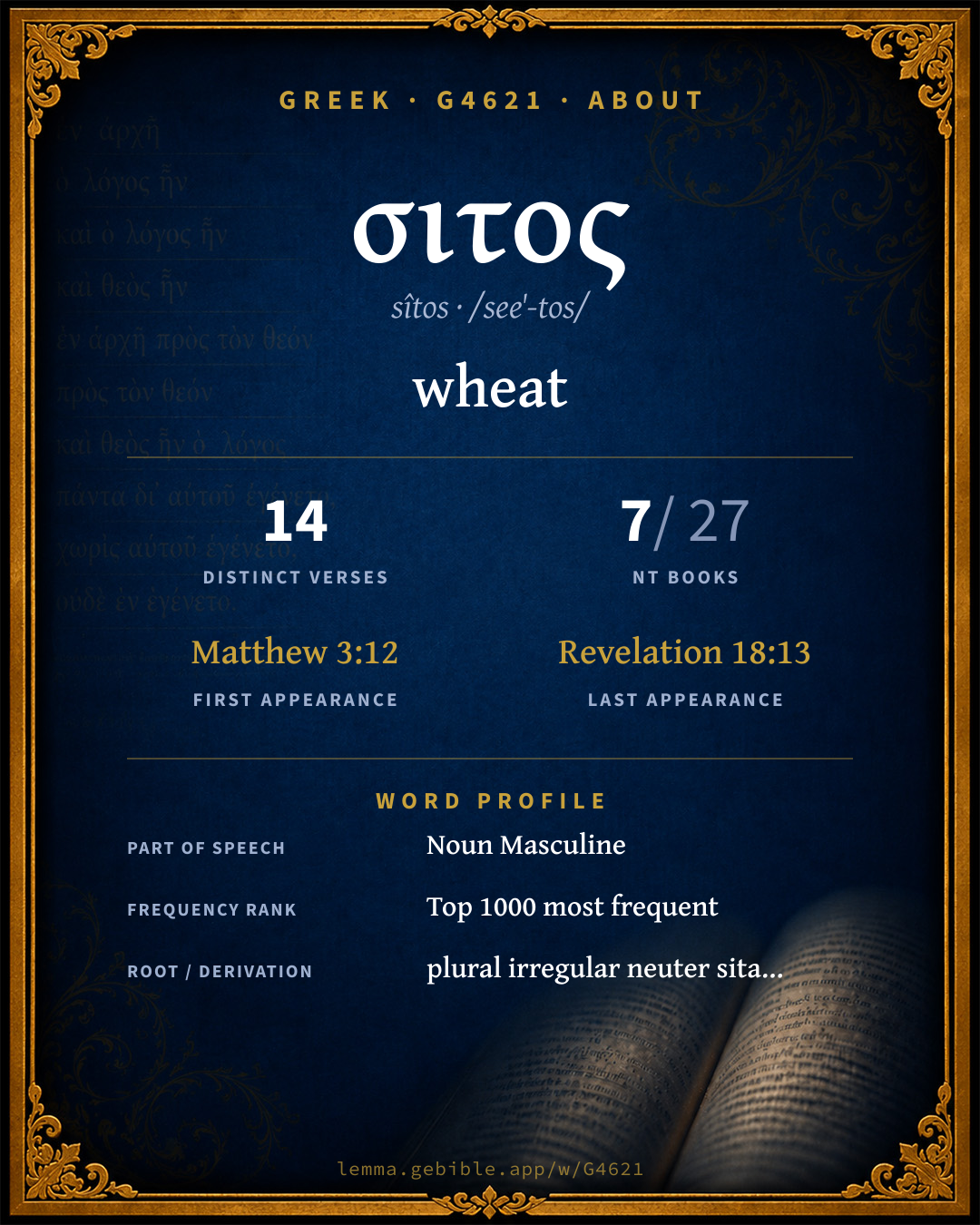
σῖτος
wheat
Full lexicon entry — Thayer's Greek Lexicon
From Thayer's Greek Lexicon
Where this word appears
See every Accusative-case word in the Greek New Testament →
Grammar key — what these labels mean
Part of speech
- Noun
- A naming word — a person, place, thing, or idea.
Case
- Accusative
- The case of the direct object and of extent.
- Genitive
- The case of source, possession, or “of” — answers “whose / from what.”
- Nominative
- The case of the subject (and the predicate nominative).
Gender
- Masculine
- Grammatically masculine.
- Neuter
- Grammatically neuter.
Number
- Singular
- One.
- Plural
- More than one.
Every verse where G4621 appears in the Book of Matthew — 4 distinct verses. Click any verse to open its interlinear word-by-word view. Verse text shown in the World English Bible for context — . Each verse’s Greek form is shown with its reference; the English is not keyword-highlighted, since the data carries no word-level English alignment. Use “Compare translations” on any verse to read it across multiple English versions. This concordance covers the Greek New Testament; Septuagint (Greek Old Testament) occurrences of this word are not indexed here.
Matthew
- Matthew 3:12 σῖτον n acc sg masc His winnowing fork is in his hand, and he will thoroughly cleanse his threshing floor. He will gather his wheat into the barn, but the chaff he will burn up with unquenchable fire."
- Matthew 13:25 σίτου n gen sg masc but while people slept, his enemy came and sowed darnel also among the wheat, and went away.
- Matthew 13:29 σῖτον n acc sg masc "But he said, 'No, lest perhaps while you gather up the darnel, you root up the wheat with them.
- Matthew 13:30 σῖτον n acc sg masc Let both grow together until the harvest, and in the harvest time I will tell the reapers, "First, gather up the darnel, and bind them in bundles to burn them; but gather the wheat into my barn."'"
About this entry
At a glance — auto-summarized from this page’s data, not written by a person. Every figure links to its source below. This summary describes the numbers; it doesn’t interpret them.
The Greek noun σιτος centers on the idea of “wheat.” First canonically at Matthew 3:12, it enters the text early. It turns up in 14 verses across 7 books, an uncommon footprint. The word gravitates to Matthew (29%), then Luke and Acts. It clusters with σιτευτος, σιτιστος and σιτομετρον under a shared root. Dig into 14-verse concordance and the renderings breakdown below.
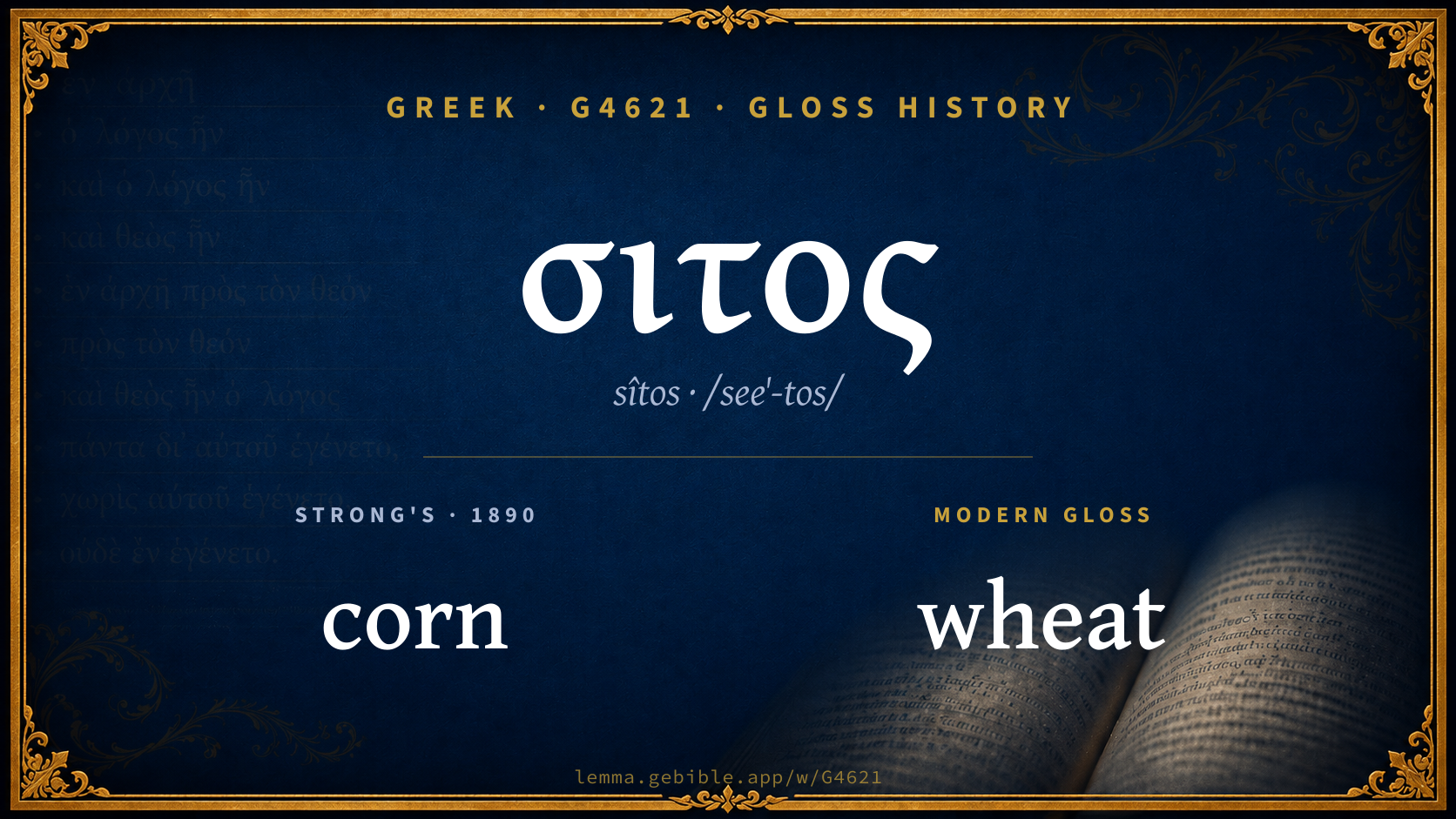
Gloss history
Strong's 1890 vs modern scholarship
About this word
Strong's G4621 catalogs a Greek word from the Greek New Testament.
These counts are not copied from any lexicon or concordance. They are computed here, from the morphology-tagged Greek New Testament. What Lemma adds →
- 14
- distinct verses
- The word appears in 14 distinct verses.
- 7 / 27
- NT books
- The word appears in 7 of 27 New Testament books.
- #814
- by frequency
- Top 1000 most frequent Greek words (rank 814 of 5,347 Greek words by occurrence).
View all 14 occurrences in the concordance →
By section of the New Testament
By traditional corpus
Conventional, traditional groupings — biblical authorship is debated, so this is a traditional corpus grouping, not an authorship claim. Some books belong to more than one corpus (Luke is in both the Gospels and the Lukan corpus, and so on), so these shares overlap and need not total 100%. Each figure is a share of the word’s 14 distinct verses.
- Gospels 9 verses · 64%
- Lukan (Luke–Acts) 5 verses · 36%
- Johannine 3 verses · 21%
- Revelation 2 verses · 14%
- Pauline corpus 1 verse · 7%
How translations render this word
Counts come from each version’s own published word-to-Strong’s tagging or interlinear alignment — an approximate guide to how each version renders this word, not a word-level alignment the data otherwise carries. Because each total is that version’s own tagged count, the per-version totals vary from one another and need not match the appearance or distinct-verse counts above. These counts may also differ from a printed concordance because Lemma counts each distinctly tagged rendering and does not collapse phrase taggings into a single head-word total. This is a fixed set of word-tagged versions (KJV, ASV, BSB, ULT) and does not change with the reading translation you choose elsewhere. Each version’s license is shown beside its name below (and on Sources).
- King James Version: Wheat 12×, Corn 2×
- American Standard Version: Wheat 12×, Grain 2×, The 2×
- Berean Standard Bible: Wheat 11×, Grain 4×
- unfoldingWord Literal Text: Wheat 12×, Grain 2×
King James Version Public Domain
Renders G4621 across 14 tagged occurrences — most commonly:
American Standard Version Public Domain
Renders G4621 across 16 tagged occurrences — most commonly:
Berean Standard Bible Public Domain
Renders G4621 across 15 tagged occurrences — most commonly:
unfoldingWord Literal Text CC BY-SA 4.0
Renders G4621 across 16 tagged occurrences — most commonly:
Plus 2 renderings that appear only once — usually multi-word phrases or single function words the recovered tagging swept in, not distinct renderings.
Senses in Thayer's
The 1 sense Thayer's distinguishes for this word, in lexicon order (not ranked by frequency or importance). The full entry — with sub-senses — is in the Lexicon Entry tab.
- wheat, grain
Word origin
Origin: plural irregular neuter sita see'-tah, of uncertain derivation
σῖτα sita see'-tah is the plural irregular neuter of the first form. Of uncertain derivation; grain especially wheat : - corn wheat.
— Strong’s Exhaustive Concordance (1890), public domain.
Forms in the corpus
The 4 distinct written forms G4621 takes in the Greek New Testament, most frequent first — each parse links to that case’s occurrences in the concordance.
| Form | Parsing | Example | Uses |
|---|---|---|---|
| σῖτον sîton | Noun, Accusative, Singular, Masculine | Matthew 3:12 | 7 |
| σίτου sítou | Noun, Genitive, Singular, Masculine | Matthew 13:25 | 5 |
| σιτία sitía | Noun, Accusative, Plural, Neuter | Acts 7:12 | 1 |
| σῖτος sîtos | Noun, Nominative, Singular, Masculine | Mark 4:28 | 1 |
Same root — word family
Other Thayer's entries built from the same root as G4621, grouped by Strong’s listed origin. These share a root / origin per the lexicon — not necessarily a shared meaning. Each links to that word’s own entry.
Derived from this word
- σιτευτος siteutós G4618 fattened
- σιτιστος sitistós G4619 fattened
- σιτομετρον sitómetron G4620 grain measure
Compare all same-root words → They share a root, not necessarily a meaning.
Septuagint usage
The same Greek word σιτος appears 76 times in the Greek Old Testament (Septuagint), across 76 verses in 21 books.
- 76
- LXX occurrences
- Tagged occurrences of this Greek word in the Septuagint.
- 76
- verses
- Distinct Septuagint verses containing this word.
- 21 / 39
- OT books
- The word appears in 21 of the 39 Old Testament books.
Sample Septuagint occurrences
- Genesis 27:28 σῖτος
- Numbers 18:12 σῖτος
- Deuteronomy 7:13 σῖτος
- Joshua 5:11 σῖτος
- Judges 6:11 σῖτος
- 2 Kings 18:32 σῖτος
- 1 Chronicles 21:23 σῖτος
- 2 Chronicles 2:9 σῖτος
- Ezra 15:2 σῖτος
- Job 3:24 σῖτος
- Psalms 4:8 σῖτος
- Proverbs 3:10 σῖτος
Septuagint occurrences (same lexeme)
Every verse where the same Strong’s number (G4621) appears in the Greek Septuagint — showing the first 50 of 76. Verse text shown in the World English Bible for context; the Greek form is the matched word — the English is not keyword-highlighted.
- Genesis 27:28 σῖτος God give you of the dew of the sky, of the fatness of the earth, and plenty of grain and new wine.
- Genesis 27:37 σῖτος Isaac answered Esau, "Behold, I have made him your lord, and all his brothers have I given to him for servants. With grain and new wine have I sustained him. What then will I do for you, my son?"
- Genesis 41:35 σῖτος Let them gather all the food of these good years that come, and lay up grain under the hand of Pharaoh for food in the cities, and let them keep it.
- Genesis 41:49 σῖτος Joseph laid up grain as the sand of the sea, very much, until he stopped counting, for it was without number.
- Genesis 42:2 σῖτος He said, "Behold, I have heard that there is grain in Egypt. Go down there, and buy for us from there, so that we may live, and not die."
- Genesis 42:3 σῖτος Joseph's ten brothers went down to buy grain from Egypt.
- Genesis 42:25 σῖτος Then Joseph commanded to fill their bags with grain, and to restore every man's money into his sack, and to give them food for the way. So it done to them.
- Genesis 42:26 σῖτος They loaded their donkeys with their grain, and departed from there.
- Genesis 43:2 σῖτος It happened, when they had eaten up the grain which they had brought out of Egypt, their father said to them, "Go again, buy us a little more food."
- Genesis 44:2 σῖτος Put my cup, the silver cup, in the sack's mouth of the youngest, with his grain money." He did according to the word that Joseph had spoken.
- Genesis 47:12 σῖτος Joseph nourished his father, his brothers, and all of his father's household, with bread, according to their families.
- Genesis 47:13 σῖτος There was no bread in all the land; for the famine was very severe, so that the land of Egypt and the land of Canaan fainted by reason of the famine.
- Genesis 47:14 σῖτος Joseph gathered up all the money that was found in the land of Egypt, and in the land of Canaan, for the grain which they bought: and Joseph brought the money into Pharaoh's house.
- Numbers 18:12 σῖτος All the best of the oil, and all the best of the vintage, and of the grain, the first fruits of them which they give to Yahweh, to you have I given them.
- Numbers 18:27 σῖτος Your heave-offering shall be reckoned to you, as though it were the grain of the threshing floor, and as the fullness of the winepress.
- Deuteronomy 7:13 σῖτος and he will love you, and bless you, and multiply you; he will also bless the fruit of your body and the fruit of your ground, your grain and your new wine and your oil, the increase of your cattle and the young of your flock, in the land which he swore to your fathers to give you.
- Deuteronomy 11:14 σῖτος that I will give the rain of your land in its season, the former rain and the latter rain, that you may gather in your grain, and your new wine, and your oil.
- Deuteronomy 12:17 σῖτος You may not eat within your gates the tithe of your grain, or of your new wine, or of your oil, or the firstborn of your herd or of your flock, nor any of your vows which you vow, nor your freewill-offerings, nor the heave-offering of your hand;
- Deuteronomy 14:23 σῖτος You shall eat before Yahweh your God, in the place which he shall choose, to cause his name to dwell there, the tithe of your grain, of your new wine, and of your oil, and the firstborn of your herd and of your flock; that you may learn to fear Yahweh your God always.
- Deuteronomy 15:14 σῖτος you shall furnish him liberally out of your flock, and out of your threshing floor, and out of your winepress; as Yahweh your God has blessed you, you shall give to him.
- Deuteronomy 18:4 σῖτος The first fruits of your grain, of your new wine, and of your oil, and the first of the fleece of your sheep, shall you give him.
- Deuteronomy 28:51 σῖτος and shall eat the fruit of your cattle, and the fruit of your ground, until you are destroyed; that also shall not leave you grain, new wine, or oil, the increase of your cattle, or the young of your flock, until they have caused you to perish.
- Deuteronomy 33:28 σῖτος Israel dwells in safety, The fountain of Jacob alone, In a land of grain and new wine; Yes, his heavens drop down dew.
- Joshua 5:11 σῖτος They ate of the produce of the land on the next day after the Passover, unleavened cakes and parched grain, in the same day.
- Joshua 5:12 σῖτος The manna ceased on the next day, after they had eaten of the produce of the land; neither had the children of Israel manna any more; but they ate of the fruit of the land of Canaan that year.
- Judges 6:11 σῖτος The angel of Yahweh came, and sat under the oak which was in Ophrah, that pertained to Joash the Abiezrite: and his son Gideon was beating out wheat in the winepress, to hide it from the Midianites.
- 2 Kings 18:32 σῖτος Until I come and take you away to a land like your own land, a land of grain and new wine, a land of bread and vineyards, a land of olive trees and of honey, that you may live, and not die: and don't listen to Hezekiah, when he persuades you, saying, Yahweh will deliver us.
- 1 Chronicles 21:23 σῖτος Ornan said to David, Take it to you, and let my lord the king do that which is good in his eyes: behold, I give [you] the oxen for burnt offerings, and the threshing instruments for wood, and the wheat for the meal-offering; I give it all.
- 2 Chronicles 2:9 σῖτος even to prepare me timber in abundance; for the house which I am about to build shall be great and wonderful.
- 2 Chronicles 2:14 σῖτος the son of a woman of the daughters of Dan; and his father was a man of Tyre, skillful to work in gold, and in silver, in brass, in iron, in stone, and in timber, in purple, in blue, and in fine linen, and in crimson, also to engrave any manner of engraving, and to devise any device; that there may be [a place] appointed to him with your skillful men, and with the skillful men of my lord David your father.
- 2 Chronicles 31:5 σῖτος As soon as the commandment came abroad, the children of Israel gave in abundance the first fruits of grain, new wine, and oil, and honey, and of all the increase of the field; and the tithe of all things brought they in abundantly.
- 2 Chronicles 32:28 σῖτος store-houses also for the increase of grain and new wine and oil; and stalls for all manner of animals, and flocks in folds.
- Ezra 15:2 σῖτος
- Ezra 15:3 σῖτος
- Ezra 15:10 σῖτος
- Ezra 15:11 σῖτος
- Ezra 20:38 σῖτος
- Ezra 20:40 σῖτος
- Ezra 23:5 σῖτος
- Job 3:24 σῖτος For my sighing comes before I eat, My groanings are poured out like water.
- Job 5:26 σῖτος You shall come to your grave in a full age, Like a shock of grain comes in its season.
- Job 6:5 σῖτος Does the wild donkey bray when he has grass? Or does the ox low over his fodder?
- Job 6:7 σῖτος My soul refuses to touch them; They are as loathsome food to me.
- Job 12:11 σῖτος Doesn't the ear try words, Even as the palate tastes its food?
- Job 15:23 σῖτος He wanders abroad for bread, saying, 'Where is it?' He knows that the day of darkness is ready at his hand.
- Job 30:4 σῖτος They pluck salt herbs by the bushes. The roots of the broom are their food.
- Job 33:20 σῖτος So that his life abhors bread, And his soul dainty food.
- Job 38:41 σῖτος Who provides for the raven his prey, When his young ones cry to God, And wander for lack of food?
- Job 39:29 σῖτος From there he spies out the prey. His eyes see it afar off.
- Psalms 4:8 σῖτος In peace I will both lay myself down and sleep, For you, Yahweh alone, make me live in safety.
These are occurrences of the same Greek lexeme (G4621) in the Septuagint — not a translation of any one Hebrew word. The store carries no word-level Hebrew↔Greek alignment, so no Hebrew original is asserted here. Counts come from the recovered LXX Strong's tagging — high-frequency vocabulary is well covered, while rare or late forms may be untagged — so they reflect tagged occurrences and may slightly undercount.