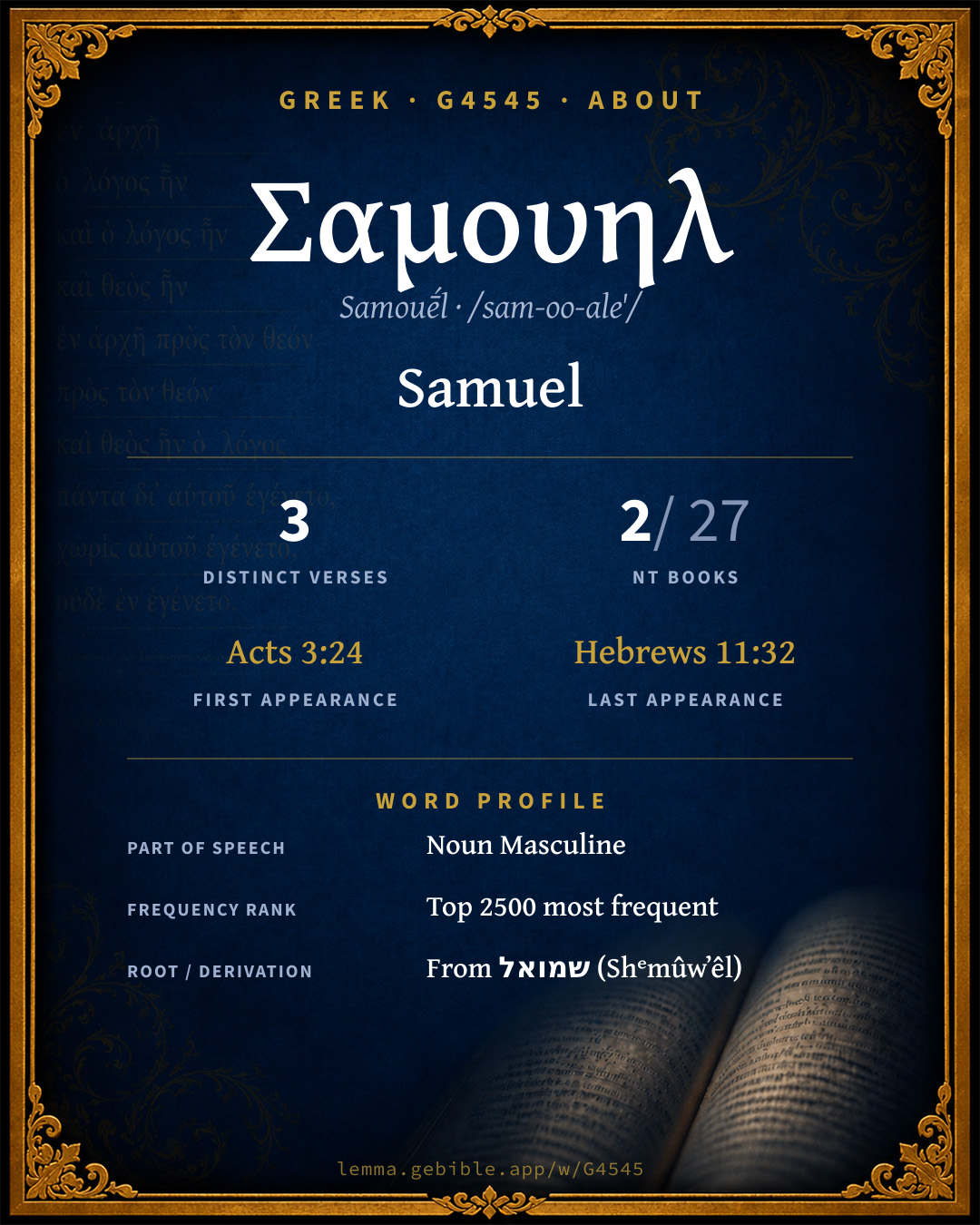
Σαμουήλ
Samuel
Thayer's lists 2 entries for ‘Samuel’ fuller range ↓
Full lexicon entry — Thayer's Greek Lexicon
From Thayer's Greek Lexicon
Where this word appears
Every verse where G4545 appears in the Book of Hebrews — 1 distinct verse. Click any verse to open its interlinear word-by-word view. Verse text shown in the World English Bible for context — . Each verse’s Greek form is shown with its reference; the English is not keyword-highlighted, since the data carries no word-level English alignment. Use “Compare translations” on any verse to read it across multiple English versions. This concordance covers the Greek New Testament; Septuagint (Greek Old Testament) occurrences of this word are not indexed here.
Hebrews
About this entry
At a glance — auto-summarized from this page’s data, not written by a person. Every figure links to its source below. This summary describes the numbers; it doesn’t interpret them.
“Samuel” is the headline sense of the Greek name Σαμουηλ (Samouḗl). A scarce word — 3 verses in all of the Greek New Testament. It clusters heavily in Acts, which alone accounts for 67% of its uses. First canonically at Acts 3:24, it enters the text early. See 3-verse concordance and the renderings breakdown below.
Gloss history
Strong's 1890 vs modern scholarship
About this word
Strong's G4545 catalogs a Greek word from the Greek New Testament.
These counts are not copied from any lexicon or concordance. They are computed here, from the morphology-tagged Greek New Testament. What Lemma adds →
- 3
- distinct verses
- The word appears in 3 distinct verses.
- 2 / 27
- NT books
- The word appears in 2 of 27 New Testament books.
- #2,203
- by frequency
- Top 2500 most frequent Greek words (rank 2,203 of 5,347 Greek words by occurrence).
View all 3 occurrences in the concordance →
By traditional corpus
Conventional, traditional groupings — biblical authorship is debated, so this is a traditional corpus grouping, not an authorship claim. Some books belong to more than one corpus (Luke is in both the Gospels and the Lukan corpus, and so on), so these shares overlap and need not total 100%. Each figure is a share of the word’s 3 distinct verses.
- Lukan (Luke–Acts) 2 verses · 67%
- Hebrews 1 verse · 33%
How translations render this word
Counts come from each version’s own published word-to-Strong’s tagging or interlinear alignment — an approximate guide to how each version renders this word, not a word-level alignment the data otherwise carries. Because each total is that version’s own tagged count, the per-version totals vary from one another and need not match the appearance or distinct-verse counts above. These counts may also differ from a printed concordance because Lemma counts each distinctly tagged rendering and does not collapse phrase taggings into a single head-word total. This is a fixed set of word-tagged versions (KJV, ASV, BSB, ULT) and does not change with the reading translation you choose elsewhere. Each version’s license is shown beside its name below (and on Sources).
- King James Version: Samuel 3×
- American Standard Version: Samuel 3×
- Berean Standard Bible: Samuel 2×
- unfoldingWord Literal Text: Samuel 3×
King James Version Public Domain
Renders G4545 across 3 tagged occurrences — most commonly:
American Standard Version Public Domain
Renders G4545 across 3 tagged occurrences — most commonly:
Berean Standard Bible Public Domain
Renders G4545 across 3 tagged occurrences — most commonly:
Plus 1 rendering that appears only once — usually multi-word phrases or single function words the recovered tagging swept in, not distinct renderings.
unfoldingWord Literal Text CC BY-SA 4.0
Renders G4545 across 3 tagged occurrences — most commonly:
Senses in Thayer's
The 2 senses Thayer's distinguishes for this word, in lexicon order (not ranked by frequency or importance). The full entry — with sub-senses — is in the Lexicon Entry tab.
- Samuel = "his name is of God"
- the son of Elkanah and Hannah…
Word origin
Derived from שמואל (Shᵉmûwʼêl) (H8050) — Samuel.
Of hebrew origin [ H8050 ]; Samuel (that is Shemuel ) an Israelite : - Samuel.
— Strong’s Exhaustive Concordance (1890), public domain.
Bible dictionary
Public-domain dictionary articles matched to this entry by name (Samuel). A biblical name can be shared by more than one person or place, so an article may treat several.
Easton's Bible Dictionary · M. G. Easton, 1897
Heard of God. The peculiar circumstances connected with his birth are recorded in 1 Sam. 1:20. Hannah, one of the two wives of Elkanah, who came up to Shiloh to worship before the Lord, earnestly prayed to God that she might become the mother of a son. Her prayer was graciously granted; and after the child was weaned she brought him to Shiloh nd consecrated him to the Lord as a perpetual Nazarite (1:23-2:11). Here his bodily wants and training were attended to by the women who served in the tabernacle, while Eli cared for his religious culture. Thus, probably, twelve years of his life passed away. "The child Samuel grew on, and was in favour both with the Lord, and also with men" (2:26; comp. Luke 2:52). It was a time of great and growing degeneracy in Israel (Judg. 21:19-21; 1 Sam. 2:12-17, 22). The Philistines, who of late had greatly increased in number and in power, were practically masters of the country, and kept the people in subjection (1 Sam. 10:5; 13:3).
At this time new communications from God began to be made to the pious child. A mysterious voice came to him in the night season, calling him by name, and, instructed by Eli, he answered, "Speak, Lord; for thy servant heareth." The message that came from the Lord was one of woe and ruin to Eli and his profligate sons. Samuel told it all to Eli, whose only answer to the terrible denunciations (1 Sam. 3:11-18) was, "It is the Lord; let him do what seemeth him good", the passive submission of a weak character, not, in his case, the expression of the highest trust and faith. The Lord revealed himself now in divers manners to Samuel, and his fame and his influence increased throughout the land as of one divinely called to the prophetical office. A new period in the history of the kingdom of God now commenced.
The Philistine yoke was heavy, and the people, groaning under the wide-spread oppression, suddenly rose in revolt, and "went out against the Philistines to battle." A fierce and disastrous battle was fought at Aphek, near to Ebenezer (1 Sam. 4:1, 2). The Israelites were defeated, leaving 4,000 dead "in the field." The chiefs of the people thought to repair this great disaster by carrying with them the ark of the covenant as the symbol of Jehovah's presence. They accordingly, without consulting Samuel, fetched it out of Shiloh to the camp near Aphek. At the sight of the ark among them the people "shouted with a great shout, so that the earth rang again." A second battle was fought, and again the Philistines defeated the Israelites, stormed their camp, slew 30,000 men, and took the sacred ark. The tidings of this fatal battle was speedily conveyed to Shiloh; and so soon as the aged Eli heard that the ark of God was taken, he fell backward from his seat at the entrance of the sanctuary, and his neck brake, and he died. The tabernacle with its furniture was probably, by the advice of Samuel, now about twenty years of age, removed from Shiloh to some place of safety, and finally to Nob, where it remained many years (21:1).
The Philistines followed up their advantage, and marched upon Shiloh, which they plundered and destroyed (comp. Jer. 7:12; Ps. 78:59). This was a great epoch in the history of Israel. For twenty years after this fatal battle at Aphek the whole land lay under the oppression of the Philistines. During all these dreary years Samuel was a spiritual power in the land. From Ramah, his native place, where he resided, his influence went forth on every side among the people. With unwearied zeal he went up and down from place to place, reproving, rebuking, and exhorting the people, endeavouring to awaken in them a sense of their sinfulness, and to lead them to repentance. His labours were so far successful that "all the house of Israel lamented after the Lord." Samuel summoned the people to Mizpeh, one of the loftiest hills in Central Palestine, where they fasted and prayed, and prepared themselves there, under his direction, for a great war against the Philistines, who now marched their whole force toward Mizpeh, in order to crush the Israelites once for all. At the intercession of Samuel God interposed in behalf of Israel. Samuel himself was their leader, the only occasion in which he acted as a leader in war. The Philistines were utterly routed. They fled in terror before the army of Israel, and a great slaughter ensued. This battle, fought probably about B.C. 1095, put an end to the forty years of Philistine oppression. In memory of this great deliverance, and in token of gratitude for the help vouchsafed, Samuel set up a great stone in the battlefield, and called it "Ebenezer," saying, "Hitherto hath the Lord helped us" (1 Sam. 7:1-12). This was the spot where, twenty years before, the Israelites had suffered a great defeat, when the ark of God was taken.
This victory over the Philistines was followed by a long period of peace for Israel (1 Sam. 7:13, 14), during which Samuel exercised the functions of judge, going "from year to year in circuit" from his home in Ramah to Bethel, thence to Gilgal (not that in the Jordan valley, but that which lay to the west of Ebal and Gerizim), and returning by Mizpeh to Ramah. He established regular services at Shiloh, where he built an altar; and at Ramah he gathered a company of young men around him and established a school of the prophets. The schools of the prophets, thus originated, and afterwards established also at Gibeah, Bethel, Gilgal, and Jericho, exercised an important influence on the national character and history of the people in maintaining pure religion in the midst of growing corruption. They continued to the end of the Jewish commonwealth.
Many years now passed, during which Samuel exercised the functions of his judicial office, being the friend and counsellor of the people in all matters of private and public interest. He was a great statesman as well as a reformer, and all regarded him with veneration as the "seer," the prophet of the Lord. At the close of this period, when he was now an old man, the elders of Israel came to him at Ramah (1 Sam. 8:4, 5, 19-22); and feeling how great was the danger to which the nation was exposed from the misconduct of Samuel's sons, whom he had invested with judicial functions as his assistants, and had placed at Beersheba on the Philistine border, and also from a threatened invasion of the Ammonites, they demanded that a king should be set over them. This request was very displeasing to Samuel. He remonstrated with them, and warned them of the consequences of such a step. At length, however, referring the matter to God, he acceded to their desires, and anointed Saul (q.v.) to be their king (11:15). Before retiring from public life he convened an assembly of the people at Gilgal (ch. 12), and there solemnly addressed them with reference to his own relation to them as judge and prophet.
The remainder of his life he spent in retirement at Ramah, only occasionally and in special circumstances appearing again in public (1 Sam. 13, 15) with communications from God to king Saul. While mourning over the many evils which now fell upon the nation, he is suddenly summoned (ch. 16) to go to Bethlehem and anoint David, the son of Jesse, as king over Israel instead of Saul. After this little is known of him till the time of his death, which took place at Ramah when he was probably about eighty years of age. "And all Israel gathered themselves together, and lamented him, and buried him in his house at Ramah" (25:1), not in the house itself, but in the court or garden of his house. (Comp. 2 Kings 21:18; 2 Chr. 33:20; 1 Kings 2:34; John 19:41.)
Samuel's devotion to God, and the special favour with which God regarded him, are referred to in Jer. 15:1 and Ps. 99:6.
Smith's Bible Dictionary · William Smith, 1863
was the son of Elkanah and Hannah, and was born at Ramathaim-zophim, among the hills of Ephraim. [Ramah No. 2] (B.C. 1171.) Before his birth he was dedicated by his mother to the office of a Nazarite and when a young child, 12 years old according to Josephus he was placed in the temple, and ministered unto the Lord before Eli." It was while here that he received his first prophetic call. (1 Samuel 3:1-18) He next appears, probably twenty years afterward, suddenly among the people, warning them against their idolatrous practices. (1 Samuel 7:3,4) Then followed Samuel's first and, as far as we know, only military achievement, ch. (1 Samuel 7:5-12) but it was apparently this which raised him to the office of "judge." He visited, in the discharge of his duties as ruler, the three chief sanctuaries on the west of Jordan--Bethel, Gilgal and Mizpeh. ch. (1 Samuel 7:16) His own residence was still native city, Ramah, where he married, and two sons grew up to repeat under his eyes the same perversion of high office that he had himself witnessed in his childhood in the case of the two sons of Eli. In his old age he shared his power with them, (1 Samuel 8:1-4) but the people dissatisfied, demanded a king, and finally anointed under God's direction, and Samuel surrendered to him his authority, (1 Samuel 12:1) ... though still remaining judge. ch. (1 Samuel 7:15) He was consulted far and near on the small affairs of life. (1 Samuel 9:7,8) From this fact, combined with his office of ruler, an awful reverence grew up around him. No sacrificial feast was thought complete without his blessing. Ibid. (1 Samuel 9:13) A peculiar virtue was believed to reside in his intercession. After Saul was rejected by God, Samuel anointed David in his place and Samuel became the spiritual father of the psalmist-king. The death of Samuel is described as taking place in the year of the close of David's wanderings. It is said with peculiar emphasis, as if to mark the loss, that "all the Israelites were gathered together" from all parts of this hitherto-divided country, and "lamented him," and "buried him" within his own house, thus in a manner consecrated by being turned into his tomb. (1 Samuel 25:1) Samuel represents the independence of the moral law, of the divine will, as distinct from legal or sacerdotal enactments, which is so remarkable a characteristic of all the later prophets. He is also the founder of the first regular institutions of religious instructions and communities for the purposes of education.
Hitchcock's Bible Names Dictionary · Roswell D. Hitchcock, 1869
heard of God; asked of God
Classic public-domain reference works; full attribution on Sources.
Septuagint usage
The same Greek word Σαμουηλ appears 143 times in the Greek Old Testament (Septuagint), across 122 verses in 5 books.
- 143
- LXX occurrences
- Tagged occurrences of this Greek word in the Septuagint.
- 122
- verses
- Distinct Septuagint verses containing this word.
- 5 / 39
- OT books
- The word appears in 5 of the 39 Old Testament books.
Sample Septuagint occurrences
- 1 Samuel 1:20 σαμουηλ
- 1 Chronicles 6:13 σαμουηλ
- 2 Chronicles 35:18 σαμουηλ
- Psalms 98:6 σαμουήλ
- Jeremiah 15:1 σαμουηλ
Septuagint occurrences (same lexeme)
Every verse where the same Strong’s number (G4545) appears in the Greek Septuagint — showing the first 50 of 122. Verse text shown in the World English Bible for context; the Greek form is the matched word — the English is not keyword-highlighted.
- 1 Samuel 1:20 σαμουηλ It happened, when the time was come about, that Hannah conceived, and bore a son; and she named him Samuel, [saying], Because I have asked him of Yahweh.
- 1 Samuel 2:18 σαμουηλ But Samuel ministered before Yahweh, being a child, girded with a linen ephod.
- 1 Samuel 2:21 σαμουηλ Yahweh visited Hannah, and she conceived, and bore three sons and two daughters. The child Samuel grew before Yahweh.
- 1 Samuel 2:26 σαμουηλ The child Samuel grew on, and increased in favor both with Yahweh, and also with men.
- 1 Samuel 3:1 σαμουηλ The child Samuel ministered to Yahweh before Eli. The word of Yahweh was precious in those days; there was no frequent vision.
- 1 Samuel 3:3 σαμουηλ and the lamp of God hadn't yet gone out, and Samuel had laid down [to sleep], in the temple of Yahweh, where the ark of God was;
- 1 Samuel 3:4 σαμουηλ that Yahweh called Samuel; and he said, Here am I.
- 1 Samuel 3:6 σαμουηλ Yahweh called yet again, Samuel. Samuel arose and went to Eli, and said, Here am I; for you called me. He answered, I didn't call, my son; lie down again.
- 1 Samuel 3:7 σαμουηλ Now Samuel didn't yet know Yahweh, neither was the word of Yahweh yet revealed to him.
- 1 Samuel 3:8 σαμουηλ Yahweh called Samuel again the third time. He arose and went to Eli, and said, Here am I; for you called me. Eli perceived that Yahweh had called the child.
- 1 Samuel 3:9 σαμουηλ Therefore Eli said to Samuel, Go, lie down: and it shall be, if he call you, that you shall say, Speak, Yahweh; for your servant hears. So Samuel went and lay down in his place.
- 1 Samuel 3:10 σαμουηλ Yahweh came, and stood, and called as at other times, Samuel, Samuel. Then Samuel said, Speak; for your servant hears.
- 1 Samuel 3:11 σαμουηλ Yahweh said to Samuel, Behold, I will do a thing in Israel, at which both the ears of everyone who hears it shall tingle.
- 1 Samuel 3:15 σαμουηλ Samuel lay until the morning, and opened the doors of the house of Yahweh. Samuel feared to show Eli the vision.
- 1 Samuel 3:16 σαμουηλ Then Eli called Samuel, and said, Samuel, my son. He said, Here am I.
- 1 Samuel 3:18 σαμουηλ Samuel told him every whit, and hid nothing from him. He said, It is Yahweh: let him do what seems him good.
- 1 Samuel 3:19 σαμουηλ Samuel grew, and Yahweh was with him, and did let none of his words fall to the ground.
- 1 Samuel 3:20 σαμουηλ All Israel from Dan even to Beersheba knew that Samuel was established to be a prophet of Yahweh.
- 1 Samuel 3:21 σαμουηλ Yahweh appeared again in Shiloh; for Yahweh revealed himself to Samuel in Shiloh by the word of Yahweh.
- 1 Samuel 7:3 σαμουηλ Samuel spoke to all the house of Israel, saying, If you do return to Yahweh with all your heart, then put away the foreign gods and the Ashtaroth from among you, and direct your hearts to Yahweh, and serve him only; and he will deliver you out of the hand of the Philistines.
- 1 Samuel 7:5 σαμουηλ Samuel said, Gather all Israel to Mizpah, and I will pray for you to Yahweh.
- 1 Samuel 7:6 σαμουηλ They gathered together to Mizpah, and drew water, and poured it out before Yahweh, and fasted on that day, and said there, We have sinned against Yahweh. Samuel judged the children of Israel in Mizpah.
- 1 Samuel 7:8 σαμουηλ The children of Israel said to Samuel, "Don't cease to cry to Yahweh our God for us, that he will save us out of the hand of the Philistines."
- 1 Samuel 7:9 σαμουηλ Samuel took a sucking lamb, and offered it for a whole burnt-offering to Yahweh: and Samuel cried to Yahweh for Israel; and Yahweh answered him.
- 1 Samuel 7:10 σαμουηλ As Samuel was offering up the burnt offering, the Philistines drew near to battle against Israel; but Yahweh thundered with a great thunder on that day on the Philistines, and confused them; and they were struck down before Israel.
- 1 Samuel 7:12 σαμουηλ Then Samuel took a stone, and set it between Mizpah and Shen, and called the name of it Ebenezer, saying, Hitherto has Yahweh helped us.
- 1 Samuel 7:13 σαμουηλ So the Philistines were subdued, and they came no more within the border of Israel: and the hand of Yahweh was against the Philistines all the days of Samuel.
- 1 Samuel 7:15 σαμουηλ Samuel judged Israel all the days of his life.
- 1 Samuel 8:1 σαμουηλ It happened, when Samuel was old, that he made his sons judges over Israel.
- 1 Samuel 8:4 σαμουηλ Then all the elders of Israel gathered themselves together, and came to Samuel to Ramah;
- 1 Samuel 8:6 σαμουηλ But the thing displeased Samuel, when they said, Give us a king to judge us. Samuel prayed to Yahweh.
- 1 Samuel 8:7 σαμουηλ Yahweh said to Samuel, Listen to the voice of the people in all that they tell you; for they have not rejected you, but they have rejected me, that I should not be king over them.
- 1 Samuel 8:10 σαμουηλ Samuel told all the words of Yahweh to the people who asked of him a king.
- 1 Samuel 8:19 σαμουηλ But the people refused to listen to the voice of Samuel; and they said, No: but we will have a king over us,
- 1 Samuel 8:21 σαμουηλ Samuel heard all the words of the people, and he rehearsed them in the ears of Yahweh.
- 1 Samuel 8:22 σαμουηλ Yahweh said to Samuel, Listen to their voice, and make them a king. Samuel said to the men of Israel, Go you every man to his city.
- 1 Samuel 9:14 σαμουηλ They went up to the city; [and] as they came within the city, behold, Samuel came out toward them, to go up to the high place.
- 1 Samuel 9:15 σαμουηλ Now Yahweh had revealed to Samuel a day before Saul came, saying,
- 1 Samuel 9:17 σαμουηλ When Samuel saw Saul, Yahweh said to him, Behold, the man of whom I spoke to you! this same shall have authority over my people.
- 1 Samuel 9:18 σαμουηλ Then Saul drew near to Samuel in the gate, and said, Tell me, Please, where the seer's house is.
- 1 Samuel 9:19 σαμουηλ Samuel answered Saul, and said, I am the seer; go up before me to the high place, for you shall eat with me today: and in the morning I will let you go, and will tell you all that is in your heart.
- 1 Samuel 9:22 σαμουηλ Samuel took Saul and his servant, and brought them into the guest-chamber, and made them sit in the best place among those who were invited, who were about thirty persons.
- 1 Samuel 9:23 σαμουηλ Samuel said to the cook, Bring the portion which I gave you, of which I said to you, Set it by you.
- 1 Samuel 9:24 σαμουηλ The cook took up the thigh, and that which was on it, and set it before Saul. [Samuel] said, Behold, that which has been reserved! set it before you and eat; because to the appointed time has it been kept for you, for I said, I have invited the people. So Saul ate with Samuel that day.
- 1 Samuel 9:26 σαμουηλ They arose early: and it happened about the spring of the day, that Samuel called to Saul on the housetop, saying, Up, that I may send you away. Saul arose, and they went out both of them, he and Samuel, abroad.
- 1 Samuel 9:27 σαμουηλ As they were going down at the end of the city, Samuel said to Saul, Bid the servant pass on before us (and he passed on), but stand you still first, that I may cause you to hear the word of God.
- 1 Samuel 10:1 σαμουηλ Then Samuel took the vial of oil, and poured it on his head, and kissed him, and said, Isn't it that Yahweh has anointed you to be prince over his inheritance?
- 1 Samuel 10:9 σαμουηλ It was so, that when he had turned his back to go from Samuel, God gave him another heart: and all those signs happened that day.
- 1 Samuel 10:14 σαμουηλ Saul's uncle said to him and to his servant, Where went you? He said, To seek the donkeys; and when we saw that they were not found, we came to Samuel.
- 1 Samuel 10:15 σαμουηλ Saul's uncle said, Tell me, Please, what Samuel said to you.
These are occurrences of the same Greek lexeme (G4545) in the Septuagint — not a translation of any one Hebrew word. The store carries no word-level Hebrew↔Greek alignment, so no Hebrew original is asserted here. Counts come from the recovered LXX Strong's tagging — high-frequency vocabulary is well covered, while rare or late forms may be untagged — so they reflect tagged occurrences and may slightly undercount.