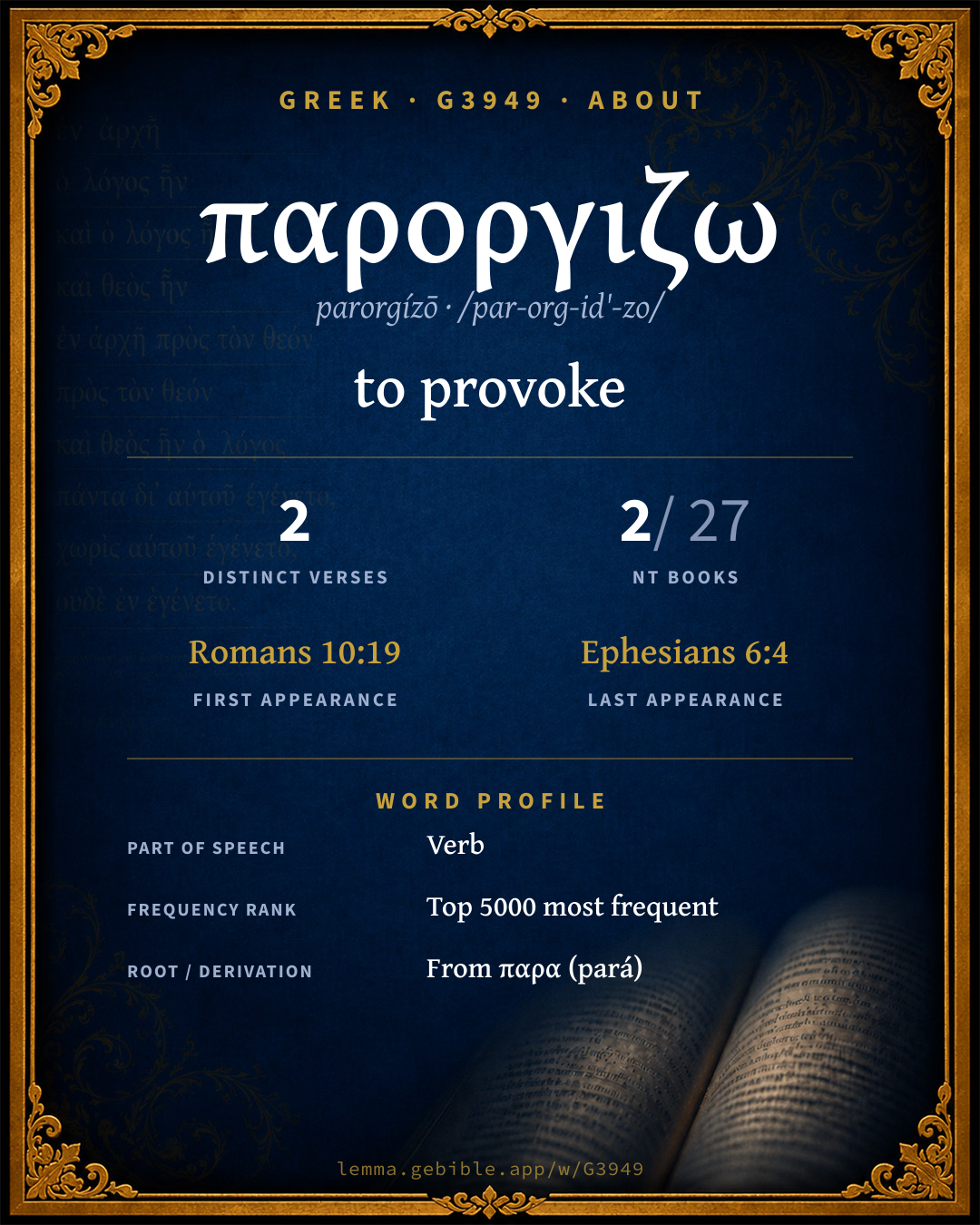
παροργίζω
to provoke
Full lexicon entry — Thayer's Greek Lexicon
From Thayer's Greek Lexicon
Where this word appears
See every Future-tense verb in the Greek New Testament →
Grammar key — what these labels mean
Part of speech
- Verb
- An action or state-of-being word.
Tense
- Future
- Action expected in future time.
- Present
- Ongoing or general action in present time (imperfective aspect).
Voice
- Active
- The subject performs the action.
Mood
- Indicative
- States a fact or asks a factual question (the mood of reality).
- Imperative
- Expresses a command or request.
Person
- 1st person
- The speaker (“I / we”).
- 2nd person
- The one addressed (“you”).
Number
- Singular
- One.
- Plural
- More than one.
Grammatical forms
- Verb, Future, Active, Indicative, 1st person, Singular 1 time (50%)
- Verb, Present, Active, Imperative, 2nd person, Plural 1 time (50%)
Parsed forms decoded from the imported morphology (Robinson–Tischendorf, public domain), counted across 2 parsed occurrences — not distinct verses.
Every verse where G3949 appears — 2 distinct verses across 2 books. Click any verse to open its interlinear word-by-word view. Verse text shown in the World English Bible for context — . Each verse’s Greek form is shown with its reference; the English is not keyword-highlighted, since the data carries no word-level English alignment. Use “Compare translations” on any verse to read it across multiple English versions. This concordance covers the Greek New Testament; Septuagint (Greek Old Testament) occurrences of this word are not indexed here.
Romans 1 verse
Ephesians 1 verse
About this entry
At a glance — auto-summarized from this page’s data, not written by a person. Every figure links to its source below. This summary describes the numbers; it doesn’t interpret them.
παροργιζω (parorgízō) is a Greek verb most often rendered “to provoke.” With only 2 verses it sits in the long tail of Greek New Testament vocabulary. Romans dominates its distribution — 1 of 2 verses. It first appears in Romans 10:19. Sharing its root, it stands alongside παρα, παραβαινω and παραβαλλω. The sections below give every sense, occurrence, and version rendering.
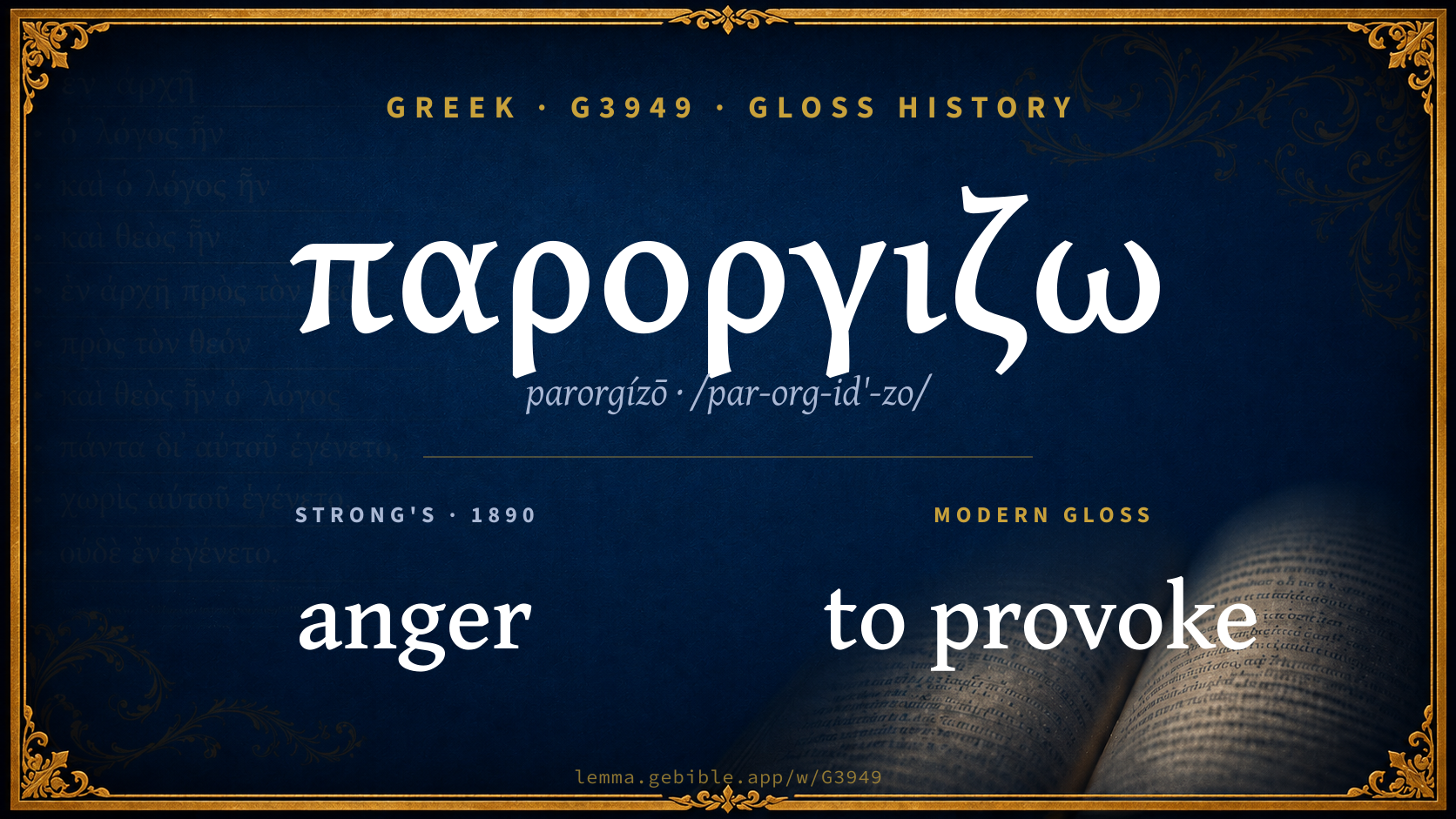
Gloss history
Strong's 1890 vs modern scholarship
About this word
Strong's G3949 catalogs a Greek word from the Greek New Testament.
These counts are not copied from any lexicon or concordance. They are computed here, from the morphology-tagged Greek New Testament. What Lemma adds →
- 2
- distinct verses
- The word appears in 2 distinct verses.
- 2 / 27
- NT books
- The word appears in 2 of 27 New Testament books.
- #2,678
- by frequency
- Top 5000 most frequent Greek words (rank 2,678 of 5,347 Greek words by occurrence).
View all 2 occurrences in the concordance →
By traditional corpus
Conventional, traditional groupings — biblical authorship is debated, so this is a traditional corpus grouping, not an authorship claim. Some books belong to more than one corpus (Luke is in both the Gospels and the Lukan corpus, and so on), so these shares overlap and need not total 100%. Each figure is a share of the word’s 2 distinct verses.
- Pauline corpus 2 verses · 100%
How translations render this word
Counts come from each version’s own published word-to-Strong’s tagging or interlinear alignment — an approximate guide to how each version renders this word, not a word-level alignment the data otherwise carries. Because each total is that version’s own tagged count, the per-version totals vary from one another and need not match the appearance or distinct-verse counts above. These counts may also differ from a printed concordance because Lemma counts each distinctly tagged rendering and does not collapse phrase taggings into a single head-word total. This is a fixed set of word-tagged versions (KJV, ASV, BSB, ULT) and does not change with the reading translation you choose elsewhere. Each version’s license is shown beside its name below (and on Sources).
- King James Version: I will anger 1×, Provoke 1×, Wrath 1×
- American Standard Version: Provoke 1×, Will i anger 1×, Wrath 1×
- Berean Standard Bible: I will make you angry 1×, Provoke 1×
- unfoldingWord Literal Text: Anger 2×
King James Version Public Domain
Renders G3949 across 3 tagged occurrences — most commonly:
American Standard Version Public Domain
Renders G3949 across 3 tagged occurrences — most commonly:
Berean Standard Bible Public Domain
Renders G3949 across 2 tagged occurrences — most commonly:
unfoldingWord Literal Text CC BY-SA 4.0
Renders G3949 across 5 tagged occurrences — most commonly:
Plus 3 renderings that appear only once — usually multi-word phrases or single function words the recovered tagging swept in, not distinct renderings.
Senses in Thayer's
The 1 sense Thayer's distinguishes for this word, in lexicon order (not ranked by frequency or importance). The full entry — with sub-senses — is in the Lexicon Entry tab.
- to rouse to wrath, to provoke, exasperate, anger
Word origin
Derived from παρα (pará) (G3844) — from.
Forms in the corpus
The 2 distinct written forms G3949 takes in the Greek New Testament, most frequent first — each parse links to that tense’s occurrences in the concordance.
| Form | Parsing | Example | Uses |
|---|---|---|---|
| παροργίζετε parorgízete | Verb, Present, Active, Imperative, 2nd person, Plural | Ephesians 6:4 | 1 |
| παροργιῶ parorgiō̂ | Verb, Future, Active, Indicative, 1st person, Singular | Romans 10:19 | 1 |
Same root — word family
Other Thayer's entries built from the same root as G3949, grouped by Strong’s listed origin. These share a root / origin per the lexicon — not necessarily a shared meaning. Each links to that word’s own entry.
Derives from
Shares the same root
- παραβαινω parabaínō G3845 to neglect
- παραβαλλω parabállō G3846 to place beside
- παραβιαζομαι parabiázomai G3849 to compel
- παραβουλευομαι parabouleúomai G3851 to consult wrongly
- παραγγελλω parangéllō G3853 to announce
- παραγινομαι paragínomai G3854 to appear
- παραγω parágō G3855 to pass by
- παραδειγματιζω paradeigmatízō G3856 to make example
- παραδεχομαι paradéchomai G3858 to receive
- παραδιατριβη paradiatribḗ G3859 empty business
- παραδιδωμι paradídōmi G3860 to deliver
- παραδοξος parádoxos G3861 strange
- παραζηλοω parazēlóō G3863 to provoke
- παραθαλασσιος parathalássios G3864 by the sea
- παραθεωρεω paratheōréō G3865 to compare
- παραινεω parainéō G3867 to exhort
- παραιτεομαι paraitéomai G3868 to beg pardon
- παρακαθιζω parakathízō G3869 to sit beside
- παρακαλεω parakaléō G3870 to call beside
- παρακαλυπτω parakalýptō G3871 to cover up
- παρακαταθηκη parakatathḗkē G3872 deposit
- παρακειμαι parákeimai G3873 to lie beside
- παρακολουθεω parakolouthéō G3877 to follow after
- παρακουω parakoúō G3878 to disobey
+51 more words share this root (not shown).
Derived from this word
Proper names from this root
People and places named from this root — a name, not an additional meaning of the word.
Compare all same-root words → Showing 4 of 79 — not the complete family. 1 of the same-root words is a proper name (a person or place). They share a root, not necessarily a meaning.
Septuagint usage
The same Greek word παροργιζω appears 45 times in the Greek Old Testament (Septuagint), across 44 verses in 15 books.
- 45
- LXX occurrences
- Tagged occurrences of this Greek word in the Septuagint.
- 44
- verses
- Distinct Septuagint verses containing this word.
- 15 / 39
- OT books
- The word appears in 15 of the 39 Old Testament books.
Sample Septuagint occurrences
- Deuteronomy 4:25 παραὀργίζω
- Judges 2:12 παραὀργίζω
- 1 Kings 15:30 παραὀργίζω
- 2 Kings 17:11 παραὀργίζω
- 2 Chronicles 28:25 παραὀργίζω
- Ezra 5:12 παραὀργίζω
- Job 12:6 παραὀργίζω
- Psalms 77:40 παραὀργίζω
- Isaiah 1:4 παραὀργίζω
- Jeremiah 7:18 παραὀργίζω
- Ezekiel 16:26 παραὀργίζω
- Daniel 11:36 παραὀργίζω
Septuagint occurrences (same lexeme)
Every verse where the same Strong’s number (G3949) appears in the Greek Septuagint. Verse text shown in the World English Bible for context; the Greek form is the matched word — the English is not keyword-highlighted.
- Deuteronomy 4:25 παραὀργίζω When you shall father children, and children's children, and you shall have been long in the land, and shall corrupt yourselves, and make an engraved image in the form of anything, and shall do that which is evil in the sight of Yahweh your God, to provoke him to anger;
- Deuteronomy 31:29 παραὀργίζω For I know that after my death you will utterly corrupt yourselves, and turn aside from the way which I have commanded you; and evil will happen to you in the latter days; because you will do that which is evil in the sight of Yahweh, to provoke him to anger through the work of your hands.
- Deuteronomy 32:21 παραὀργίζω They have moved me to jealousy with that which is not God; They have provoked me to anger with their vanities: I will move them to jealousy with those who are not a people; I will provoke them to anger with a foolish nation.
- Judges 2:12 παραὀργίζω and they forsook Yahweh, the God of their fathers, who brought them out of the land of Egypt, and followed other gods, of the gods of the peoples who were round about them, and bowed themselves down to them: and they provoked Yahweh to anger.
- 1 Kings 15:30 παραὀργίζω for the sins of Jeroboam which he sinned, and with which he made Israel to sin, because of his provocation with which he provoked Yahweh, the God of Israel, to anger.
- 1 Kings 16:2 παραὀργίζω Because I exalted you out of the dust, and made you prince over my people Israel, and you have walked in the way of Jeroboam, and have made my people Israel to sin, to provoke me to anger with their sins;
- 1 Kings 16:7 παραὀργίζω Moreover by the prophet Jehu the son of Hanani came the word of Yahweh against Baasha, and against his house, both because of all the evil that he did in the sight of Yahweh, to provoke him to anger with the work of his hands, in being like the house of Jeroboam, and because he struck him.
- 1 Kings 16:13 παραὀργίζω for all the sins of Baasha, and the sins of Elah his son, which they sinned, and with which they made Israel to sin, to provoke Yahweh, the God of Israel, to anger with their vanities.
- 1 Kings 16:26 παραὀργίζω For he walked in all the way of Jeroboam the son of Nebat, and in his sins with which he made Israel to sin, to provoke Yahweh, the God of Israel, to anger with their vanities.
- 1 Kings 16:33 παραὀργίζω Ahab made the Asherah; and Ahab did yet more to provoke Yahweh, the God of Israel, to anger than all the kings of Israel who were before him.
- 1 Kings 20:20 παραὀργίζω They killed everyone his man; and the Syrians fled, and Israel pursued them: and Ben Hadad the king of Syria escaped on a horse with horsemen.
- 1 Kings 20:22 παραὀργίζω The prophet came near to the king of Israel, and said to him, Go, strengthen yourself, and mark, and see what you do; for at the return of the year the king of Syria will come up against you.
- 1 Kings 22:54 παραὀργίζω
- 2 Kings 17:11 παραὀργίζω and there they burnt incense in all the high places, as did the nations whom Yahweh carried away before them; and they worked wicked things to provoke Yahweh to anger;
- 2 Kings 17:17 παραὀργίζω They caused their sons and their daughters to pass through the fire, and used divination and enchantments, and sold themselves to do that which was evil in the sight of Yahweh, to provoke him to anger.
- 2 Kings 21:6 παραὀργίζω He made his son to pass through the fire, and practiced sorcery, and used enchantments, and dealt with those who had familiar spirits, and with wizards: he worked much evil in the sight of Yahweh, to provoke him to anger.
- 2 Kings 21:15 παραὀργίζω because they have done that which is evil in my sight, and have provoked me to anger, since the day their fathers came forth out of Egypt, even to this day.
- 2 Kings 22:17 παραὀργίζω Because they have forsaken me, and have burned incense to other gods, that they might provoke me to anger with all the work of their hands, therefore my wrath shall be kindled against this place, and it shall not be quenched.
- 2 Kings 23:19 παραὀργίζω All the houses also of the high places that were in the cities of Samaria, which the kings of Israel had made to provoke [Yahweh] to anger, Josiah took away, and did to them according to all the acts that he had done in Bethel.
- 2 Kings 23:26 παραὀργίζω Notwithstanding, Yahweh didn't turn from the fierceness of his great wrath, with which his anger was kindled against Judah, because of all the provocation with which Manasseh had provoked him.
- 2 Chronicles 28:25 παραὀργίζω In every city of Judah he made high places to burn incense to other gods, and provoked to anger Yahweh, the God of his fathers.
- 2 Chronicles 33:6 παραὀργίζω He also made his children to pass through the fire in the valley of the son of Hinnom; and he practiced sorcery, and used enchantments, and practiced sorcery, and dealt with those who had familiar spirits, and with wizards: he worked much evil in the sight of Yahweh, to provoke him to anger.
- 2 Chronicles 34:25 παραὀργίζω Because they have forsaken me, and have burned incense to other gods, that they might provoke me to anger with all the works of their hands; therefore is my wrath poured out on this place, and it shall not be quenched.
- 2 Chronicles 35:19 παραὀργίζω In the eighteenth year of the reign of Josiah was this Passover kept.
- Ezra 5:12 παραὀργίζω But after that our fathers had provoked the God of heaven to wrath, he gave them into the hand of Nebuchadnezzar king of Babylon, the Chaldean, who destroyed this house, and carried the people away into Babylon.
- Job 12:6 παραὀργίζω The tents of robbers prosper, Those who provoke God are secure; Who carry their God in their hands.
- Psalms 77:40 παραὀργίζω
- Psalms 77:58 παραὀργίζω
- Psalms 105:16 παραὀργίζω He called for a famine on the land. He destroyed the food supplies.
- Psalms 105:32 παραὀργίζω He gave them hail for rain, With lightning in their land.
- Isaiah 1:4 παραὀργίζω Ah sinful nation, A people loaded with iniquity, A seed of evil-doers, Children who deal corruptly! They have forsaken Yahweh. They have despised the Holy One of Israel. They are estranged and backward.
- Jeremiah 7:18 παραὀργίζω The children gather wood, and the fathers kindle the fire, and the women knead the dough, to make cakes to the queen of the sky, and to pour out drink-offerings to other gods, that they may provoke me to anger.
- Jeremiah 7:19 παραὀργίζω Do they provoke me to anger? says Yahweh; [do they] not [provoke] themselves, to the confusion of their own faces?
- Jeremiah 8:19 παραὀργίζω Behold, the voice of the cry of the daughter of my people from a land that is very far off: isn't Yahweh in Zion? Isn't her King in her? Why have they provoked me to anger with their engraved images, and with foreign vanities?
- Jeremiah 11:17 παραὀργίζω For Yahweh of Hosts, who planted you, has pronounced evil against you, because of the evil of the house of Israel and of the house of Judah, which they have worked for themselves in provoking me to anger by offering incense to Baal.
- Jeremiah 25:6 παραὀργίζω and don't go after other gods to serve them or worship them, and don't provoke me to anger with the work of your hands; and I will do you no harm.
- Ezekiel 16:26 παραὀργίζω You have also committed sexual immorality with the Egyptians, your neighbors, great of flesh; and have multiplied your prostitution, to provoke me to anger.
- Ezekiel 16:54 παραὀργίζω that you may bear your own shame, and may be ashamed because of all that you have done, in that you are a comfort to them.
- Ezekiel 20:27 παραὀργίζω Therefore, son of man, speak to the house of Israel, and tell them, Thus says the Lord Yahweh: In this moreover have your fathers blasphemed me, in that they have committed a trespass against me.
- Ezekiel 32:9 παραὀργίζω I will also vex the hearts of many peoples, when I shall bring your destruction among the nations, into the countries which you have not known.
- Daniel 11:36 παραὀργίζω The king shall do according to his will; and he shall exalt himself, and magnify himself above every god, and shall speak marvelous things against the God of gods; and he shall prosper until the indignation be accomplished; for that which is determined shall be done.
- Hosea 12:15 παραὀργίζω
- Micah 2:7 παραὀργίζω Shall it be said, O house of Jacob: "Is the Spirit of Yahweh angry? Are these his doings? Don't my words do good to him who walks blamelessly?"
- Zechariah 8:14 παραὀργίζω For thus says Yahweh of hosts: "As I thought to do evil to you, when your fathers provoked me to wrath," says Yahweh of Hosts, "and I didn't repent;
These are occurrences of the same Greek lexeme (G3949) in the Septuagint — not a translation of any one Hebrew word. The store carries no word-level Hebrew↔Greek alignment, so no Hebrew original is asserted here. Counts come from the recovered LXX Strong's tagging — high-frequency vocabulary is well covered, while rare or late forms may be untagged — so they reflect tagged occurrences and may slightly undercount.