
Ephesians 6:4

Greek (Tischendorf 8th ed.) Ephesians 6:4 appears in the Greek New Testament. The text above is from the Tischendorf 8th edition. Each word links to its Strong’s number and a concise gloss. Click any word for its full Thayer’s Greek Lexicon entry.
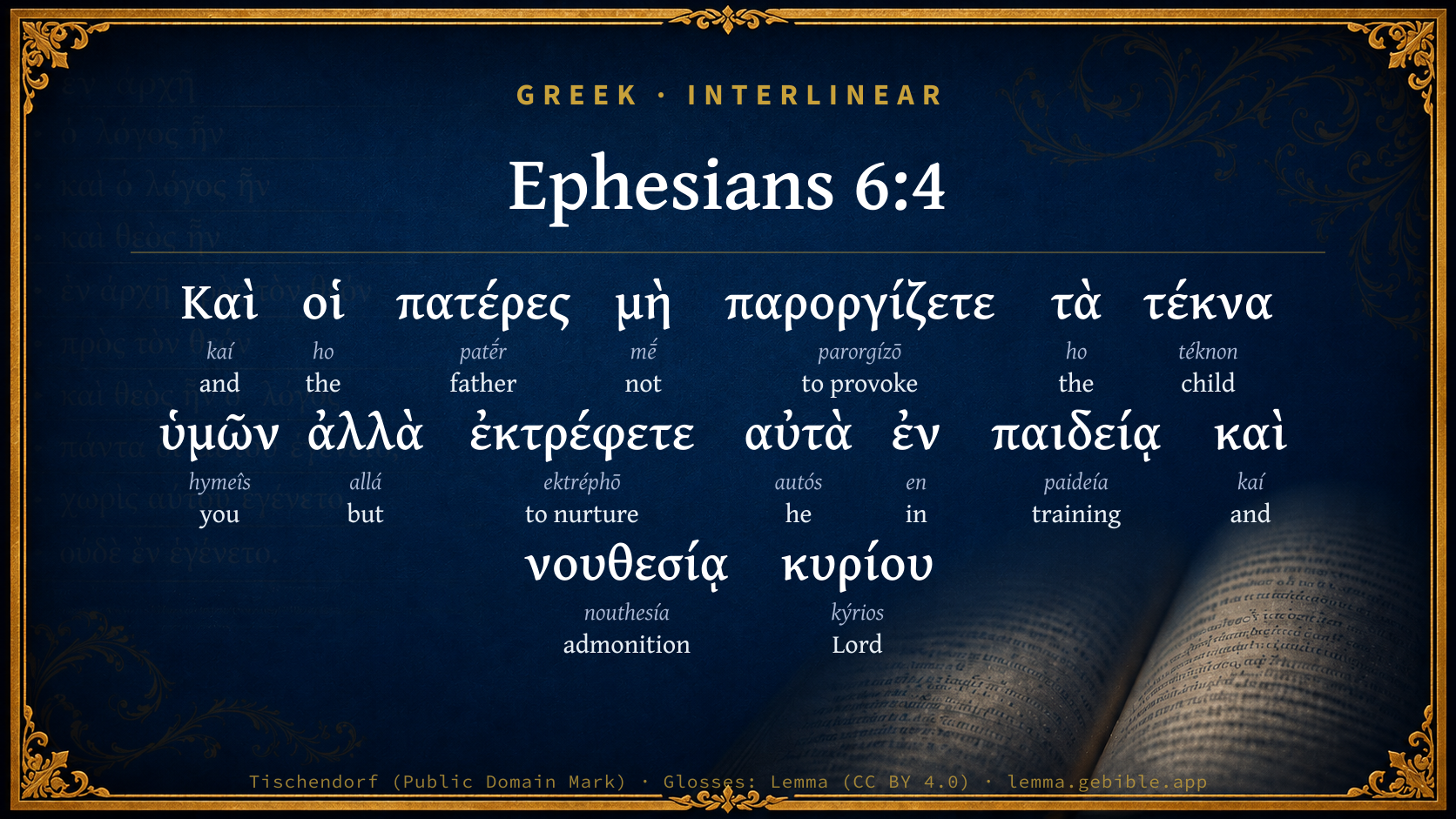
Download image
Cite this verse

Ephesians 6:4 (World English Bible). Public Domain. Lemma interlinear Bible study tool, https://lemma.gebible.app/v/ephesians/6/4.

Show BibTeX & RIS
BibTeX
RIS
English Translation
You fathers, don't provoke your children to wrath, but nurture them in the discipline and instruction of the Lord.
World English Bible · Public Domain
Highlights
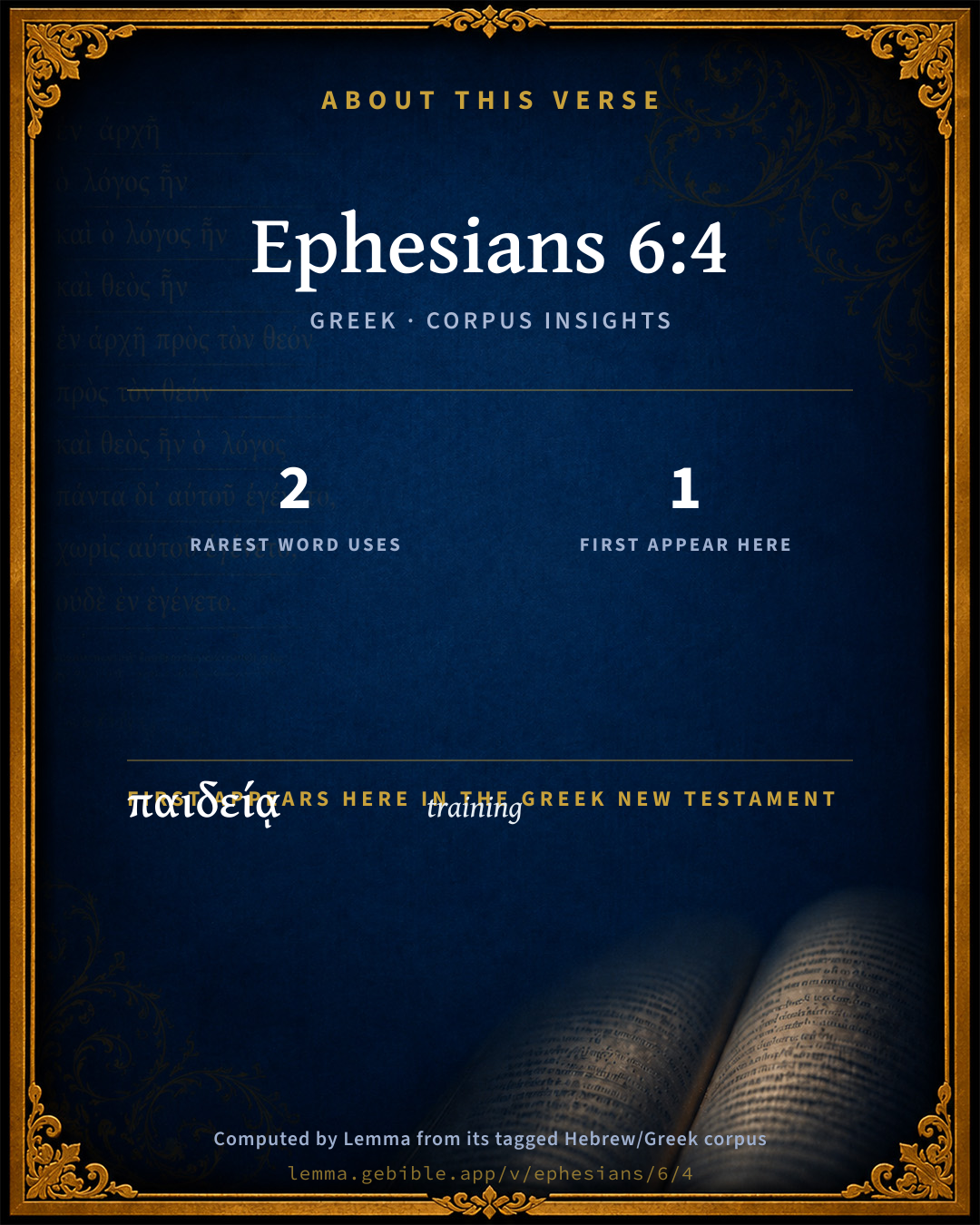
  • 1 first appearance in the Greek New Testament
Full analysis ↓
Download a study sheet

One document with this verse’s original text, its word-by-word gloss line, the meaning frame, cross-references with their text, attributed commentary, and full source and license credits — printable, and it pastes into notes with its structure intact.

This verse Autodidact and up

Study sheet (.html) Plain text (.txt)

A passage Seminary Student

Up to 50 verses in one chapter. A passage sheet keeps up to 6 commentary sources and 12 cross-references per verse, in the order this page ranks them, and says so on the sheet whenever that leaves anything out. Ask for a single verse and you get the Autodidact verse sheet above.

Everything on this page stays free to read, with no account — the sheet is a download of what is already on screen, not access to it.

Want to remove ads? Support Godless Engineer
Compare translations 3

The same verse in 3 English versions, stacked beneath the original-language interlinear above. Click any original word for its lexicon entry.

Each is an independent rendering of the whole verse — the interlinear is not word-aligned to these translations.

Highlighted words mark where these versions differ — a whole-verse word diff, not a word-by-word alignment.

  • World English Bible Public Domain
    You fathers, don't provoke your children to wrath, but nurture them in the discipline and instruction of the Lord.
  • King James Version Public Domain
    And, ye fathers, provoke not your children to wrath: but bring them up in the nurture and admonition of the Lord.
  • unfoldingWord Literal Text CC BY-SA 4.0
    And fathers, do not provoke your children to anger. Instead, raise them in the discipline and instruction of the Lord.

unfoldingWord Literal Text — © unfoldingWord, licensed CC BY-SA 4.0. Word-aligned USFM3 via Door43 (git.door43.org/unfoldingWord/en_ult).

Versions to compare (up to 4)

3 of 4 selected

Show all 19 translations

Every available English version of this verse, each an independent rendering of the whole verse.

  • World English Bible Public Domain
    You fathers, don't provoke your children to wrath, but nurture them in the discipline and instruction of the Lord.
  • Berean Standard Bible Public Domain
    Fathers, do not provoke your children to wrath; instead, bring them up in the discipline and instruction of the Lord.
  • Majority Standard Bible Public Domain
    Fathers, do not provoke your children to wrath; instead, bring them up in the discipline and instruction of the Lord.
  • King James Version Public Domain
    And, ye fathers, provoke not your children to wrath: but bring them up in the nurture and admonition of the Lord.
  • American Standard Version (1901) Public Domain
    And, ye fathers, provoke not your children to wrath: but nurture them in the chastening and admonition of the Lord.
  • Revised Version (1885) Public Domain
    And, ye fathers, provoke not your children to wrath: but nurture them in the chastening and admonition of the Lord.
  • Geneva Bible (1599) Public Domain
    And ye, fathers, prouoke not your children to wrath: but bring them vp in instruction and information of the Lord.
  • Douay-Rheims (1899) Public Domain
    And you, fathers, provoke not your children to anger; but bring them up in the discipline and correction of the Lord.
  • Young's Literal Translation Public Domain
    And the fathers! provoke not your children, but nourish them in the instruction and admonition of the Lord.
  • Literal Standard Version CC BY-SA 4.0
    And the fathers: do not provoke your children, but nourish them in the instruction and admonition of the LORD.
  • Unlocked Literal Bible CC BY-SA 4.0
    Fathers, do not provoke your children to anger. Instead, raise them in the discipline and instruction of the Lord.
  • unfoldingWord Literal Text CC BY-SA 4.0
    And fathers, do not provoke your children to anger. Instead, raise them in the discipline and instruction of the Lord.
  • Darby Bible Public Domain
    And [ye] fathers, do not provoke your children to anger, but bring them up in [the] discipline and admonition of [the] Lord.
  • World Messianic Bible Public Domain
    You fathers, don’t provoke your children to wrath, but nurture them in the discipline and instruction of the Lord.
  • Webster's Bible Public Domain
    And, ye fathers, provoke not your children to wrath: but bring them up in the nurture and admonition of the Lord.
  • Free Bible Version CC BY-SA 4.0
    Fathers, don't make your children mad, but look after them by disciplining them and instructing them about God.
  • Bible in Basic English Public Domain
    And, you fathers, do not make your children angry: but give them training in the teaching and fear of the Lord.
  • Text-Critical English NT CC BY 4.0
    Fathers, do not provoke your children to anger, but bring them up in the training and admonition of the Lord.
  • Tyndale New Testament (1534) Public Domain
    And ye fathers move not youre children to wrath: but bringe the vp with the norter and informacion of the Lorde.

Literal Standard Version (2020), Covenant Press — licensed CC BY-SA 4.0. Text via the HelloAO Bible API (eBible.org). Unlocked Literal Bible (unfoldingWord) — licensed CC BY-SA 4.0. Text via the HelloAO Bible API (eBible.org). unfoldingWord Literal Text — © unfoldingWord, licensed CC BY-SA 4.0. Word-aligned USFM3 via Door43 (git.door43.org/unfoldingWord/en_ult). Free Bible Version, Dr. Jonathan Gallagher — licensed CC BY-SA 4.0. Text via the HelloAO Bible API (eBible.org).

Word by word

More ways to search: Search by grammar → Find every occurrence → Compare this word →

Practice this passage: Drill this verse → Learn its vocabulary →

παροργίζετε
parorgízō
G3949
“to provoke”
Verb, Present, Active, Imperative, 2nd person, Plural
Part of Speech
Verb
Tense
Present
Voice
Active
Mood
Imperative
Person
2nd person
Number
Plural
Full Thayer's Definition

Origin: from G3844 and G3710

TDNT: 11:22,7

1. to rouse to wrath, to provoke, exasperate, anger
  1. Καὶ kaí G2532 “and” Conjunction
  2. οἱ ho G3588 “the” Article, Nominative, Plural, Masculine
  3. πατέρες patḗr G3962 “father” Noun, Nominative, Plural, Masculine
  4. μὴ mḗ G3361 “not” Particle, Negative
  5. τὰ ho G3588 “the” Article, Accusative, Plural, Neuter
  6. τέκνα téknon G5043 “child” Noun, Accusative, Plural, Neuter
  7. ὑμῶν hymeîs G5210 “you” Personal pronoun, 2nd person, Genitive, Plural
  8. ἀλλὰ allá G235 “but” Conjunction
  9. ἐκτρέφετε ektréphō G1625 “to nurture” Verb, Present, Active, Imperative, 2nd person, Plural
  10. αὐτὰ autós G846 “he” Personal pronoun, Accusative, Plural, Neuter
  11. ἐν en G1722 “in” Preposition
  12. παιδείᾳ paideía G3809 “training” Noun, Dative, Singular, Feminine
  13. καὶ kaí G2532 “and” Conjunction
  14. νουθεσίᾳ nouthesía G3559 “admonition” Noun, Dative, Singular, Feminine
  15. κυρίου kýrios G2962 “Lord” Noun, Genitive, Singular, Masculine

About this verse

These counts appear in no published source. They are computed here, from the morphology-tagged text and Lemma’s own curated glosses. What Lemma adds →

16
words
14
distinct lemmas
Pauline Epistles
section

Notable vocabulary

The rarest word here is παροργίζετε to provoke G3949 — appearing just 2 times in the whole Greek New Testament.

First appearance in Scripture

This word makes its first canonical appearance in the Greek New Testament here:

  • παιδείᾳ training G3809

Shared distinctive vocabulary

παροργίζετε to provoke G3949 occurs in 2 verses of the Greek New Testament. Also found in:
Repetition

Words recur within this verse:

Cross-references

30

Topical passages linked to Ephesians 6:4 in the Treasury of Scripture Knowledge — connected by theme and wording, ordered by reader-vote popularity; previews shown in the World English Bible.

  • Colossians 3:21 Fathers, don't provoke your children, so that they won't be discouraged.
  • Proverbs 22:6 Train up a child in the way he should go, And when he is old he will not depart from it.
  • Proverbs 29:15 The rod of correction gives wisdom, But a child left to himself causes shame to his mother.
  • Proverbs 19:18 Discipline your son, for there is hope; Don't be a willing party to his death.
  • Deuteronomy 6:7 and you shall teach them diligently to your children, and shall talk of them when you sit in your house, and when you walk by the way, and when you lie down, and when you rise up.
  • Proverbs 29:17 Correct your son, and he will give you peace; Yes, he will bring delight to your soul.
  • 2 Timothy 3:15 From infancy, you have known the sacred writings which are able to make you wise for salvation through faith, which is in Christ Jesus.
  • Proverbs 23:13–14 Don't withhold correction from a child. If you punish him with the rod, he will not die.
  • Proverbs 4:1–4 Listen, sons, to a father's instruction. Pay attention and know understanding;
  • Genesis 18:19 For I have known him, to the end that he may command his children and his household after him, that they may keep the way of Yahweh, to do righteousness and justice; to the end that Yahweh may bring on Abraham that which he has spoken of him."
  • Deuteronomy 4:9 Only take heed to yourself, and keep your soul diligently, lest you forget the things which your eyes saw, and lest they depart from your heart all the days of your life; but make them known to your children and your children's children;
  • Deuteronomy 11:19–21 You shall teach them your children, talking of them, when you sit in your house, and when you walk by the way, and when you lie down, and when you rise up.
  • Proverbs 22:15 Folly is bound up in the heart of a child: The rod of discipline drives it far from him.
  • 2 Timothy 1:5 having been reminded of the unfeigned faith that is in you; which lived first in your grandmother Lois, and your mother Eunice, and, I am persuaded, in you also.
  • Hebrews 12:7–10 It is for discipline that you endure. God deals with you as with children, for what son is there whom his father doesn't discipline?
  • Psalms 71:17–18 God, you have taught me from my youth. Until now, I have declared your wondrous works.
  • Psalms 78:4–7 We will not hide them from their children, Telling to the generation to come the praises of Yahweh, His strength, and his wondrous works that he has done.
  • Deuteronomy 6:20–24 When your son asks you in time to come, saying, What mean the testimonies, and the statutes, and the ordinances, which Yahweh our God has commanded you?
  • Joshua 24:15 If it seem evil to you to serve Yahweh, choose you this day whom you will serve; whether the gods which your fathers served that were beyond the River, or the gods of the Amorites, in whose land you dwell: but as for me and my house, we will serve Yahweh.
  • 1 Chronicles 28:9–10 You, Solomon my son, know the God of your father, and serve him with a perfect heart and with a willing mind; for Yahweh searches all hearts, and understands all the imaginations of the thoughts: if you seek him, he will be found of you; but if you forsake him, he will cast you off forever.
  • 1 Chronicles 28:20 David said to Solomon his son, Be strong and of good courage, and do it: don't be afraid, nor be dismayed; for Yahweh God, even my God, is with you; he will not fail you, nor forsake you, until all the work for the service of the house of Yahweh is finished.
  • Isaiah 38:19 The living, the living, he shall praise you, as I do this day: The father to the children shall make known your truth.
  • 1 Samuel 20:30–34 Then Saul's anger was kindled against Jonathan, and he said to him, You son of a perverse rebellious woman, don't I know that you have chosen the son of Jesse to your own shame, and to the shame of your mother's nakedness?
  • Exodus 13:14–15 It shall be, when your son asks you in time to come, saying, 'What is this?' that you shall tell him, 'By strength of hand Yahweh brought us out from Egypt, from the house of bondage;
  • Joshua 4:6–7 that this may be a sign among you, that when your children ask in time to come, saying, What do you mean by these stones?
  • Exodus 12:26–27 It will happen, when your children ask you, 'What do you mean by this service?'
  • Joshua 4:21–24 He spoke to the children of Israel, saying, When your children shall ask their fathers in time to come, saying, What mean these stones?
  • 1 Chronicles 22:10–13 he shall build a house for my name; and he shall be my son, and I will be his father; and I will establish the throne of his kingdom over Israel for ever.
  • 1 Chronicles 29:19 and give to Solomon my son a perfect heart, to keep your commandments, your testimonies, and your statutes, and to do all these things, and to build the palace, for which I have made provision.
  • Genesis 31:14–15 Rachel and Leah answered him, "Is there yet any portion or inheritance for us in our father's house?

Cross-references courtesy of OpenBible.info (CC BY 4.0).

Commentary

Notes on Ephesians 6:4 from classic Christian and Jewish commentators (each source and its license shown beneath its notes). The classic Christian expositions comment on the surrounding passage and are grouped to its opening verse, so a note may address several verses; the Jewish commentaries on the Tanakh (Rashi and others) are per-verse, so they appear only where the commentator wrote on this verse.

Lemma curates 59 commentaries, every one of them public domain or Creative Commons licensed, each selected and text-cleaned for this edition rather than reprinted as found. About our sources →

Tyndale Open Study Notes

Tyndale Open Resources

6:4 Fathers can often provoke their children to anger by being harsh or unjust (see Col 3:21). Parents should give their children the discipline and instruction that comes from the Lord (or the discipline and instruction about the Lord) so that they will learn a way of living that is good and pleases God. Such discipline is not to be excessive, but loving and gentle, so that children are not turned from the Lord but are drawn to him (cp. Heb 12:5-11).

Tyndale Open Study Notes — © Tyndale Open Resources, licensed CC BY-SA 4.0. Text via the HelloAO Bible API.

Bengel's Gnomon

Johann Albrecht Bengel

Eph 6:4. Καὶ οἱ πατέρες, and ye that are fathers) And is also prefixed at Eph 6:9, and ye masters. It is not put before husbands, ch. Eph 5:25. Parents and masters more readily abuse their power than husbands. He spoke of parents, Eph 6:1; he now addresses fathers in particular, for they are more readily carried away by passion. The same difference in the words, and the same admonition, occur, Col 3:20-21.—μὴ παροργίζετε, do not provoke) lest love be extinguished.—ἐκτρέφετε, but bring them up in the nurture) kindly.—ἐν παιδείᾳ καὶ νουθεσίᾳ, in the nurture [instruction] and admonition) The one of these counteracts (obviates) ignorance; the other, forgetfulness and levity. Both include the word, and all other training. So among the lawyers, νουθέτημα, and admonition, is mentioned, even such as is given by stripes. Job 5:17, מוסר, admonition; 1Sa 3:13, Eli οὐκ ἐνουθέτει, did not admonish his sons.

Bengel's Gnomon of the New Testament — English translation (T&T Clark, Edinburgh, 1860) — public domain. Text from a community e-Sword module.

Meyer's Critical & Exegetical Commentary

Heinrich August Wilhelm Meyer

Eph_6:4. The duty of fathers, negative and positive.

καὶ οἱ πατέρες] and ye fathers, so that καί quickly subjoins. Comp. Eph_6:9. Paul does not address the mothers, not because he is thinking of the training of grown-up children (so quite arbitrarily Olshausen), nor on account of an Oriental depreciation of the mothers (Rückert), in opposition to which vieweven apart from passages like Pro_14:1; Pro_31:10 ff.the whole teaching of the apostle concerning the relation of husband and wife in marriage (Eph_5:25 ff.) is decisive; but because the husband, as the head of the wife, has, even in the bringing up of children the rule, and the wives join in prosecuting the work of training ὑποτασσόμεναι τοῖς ἰδίοις ἀνδράσιν (Eph_5:22 ff.).

μὴ παροργίζετε] by injustice, harshness, hastiness of temper, undue severity, and the like, whereby the children are irritated against the fathers; at Col_3:21 there is subjoined as motive ἵνα μὴ ἀθυμῶσιν.

ἐκτρέφετε] not as at Eph_5:29, but of the bringing up, and that on its moral side. Pro_23:24; 1Ma_6:15; 1Ma_6:55; Plato, Gorg. p. 471 C; Polyb. vi. 6. 2. See Wyttenbach, ad Plut. de educ. p. 66; Lennep. ad Phalar, p. 350b.

ἐν παιδείᾳ καὶ νουθεσίᾳ κυρίου] ἐν denotes the regulative element, in which the training is to take place. Comp. Polyb. i. 65. 7: τῶν ἐν παιδείαις κ. νόμοις κ. πολιτικοῖς ἔθεσιν ἐκτεθραμμένων. Hence: in the Lords training and correction. παιδεία is the general term, the training of children as a whole, and νουθεσία is the special one, the reproof aiming at amendment, whether this admonition take place by means of words (νουθετικοὶ λόγοι, Xen. Mem. i. 2. 21) or of actual punishments (οἱ μὲν ῥάβδοι νουθετοῦσι κ.τ.λ., Plut. Quaest. Rom. p. 283). See Gellius, vi. 4; Kypke, Obss. ad 1 Thess. v. 14. With regard to the form, in place of which the better Greek has νουθέτησις, see Lobeck, ad Phryn. p. 512. κυρίου means neither to the Lord (Luther), nor according to the doctrine of Christ (Erasmus, Beza, Vatablus, Menochius, Estius, Zachariae, Koppe, Morus, Rosenmüller, Bisping, and others, including Holzhausen, who, however, takes κυρ. of God), nor worthily of the Lord (Matthies), or the like; but it is the genitive subjecti, so that the Lord Himself is conceived as exercising the training and reproof, in so far, namely, as Christ by His Spirit impels and governs the fathers therein. Comp. Soph. Electr. 335: ἅπαντα γάρ σοι ταʼ μὰ νουθετήματα κείνης διδακτὰ, κοὐδὲν ἐκ σαυτῆς λέγεις. Rückert is unable to come to a decision, and doubts whether Paul himself had a distinct idea before his mind.

Meyer — Critical and Exegetical Commentary on the New Testament — English translation by Peter Christie, edited by Frederick Crombie (T&T Clark, 1880) — public domain. Text from a community e-Sword module.

Expositor's Greek Testament

ed. W. Robertson Nicoll

Eph 6:4 . καὶ οἱ πατέρες , μὴ παροργίζετε τὰ τέκνα ὑμῶν : and, ye fathers, provoke not your children to wrath . The καί continues the statement of this second of the relative or domestic duties, presenting now the other side. The duty is one not only of children to parents, but also of parents to children. The parental duty is set forth in terms of the father’s obligation without particular mention of the mother’s, not because children of maturer age are in view (Olsh.), but simply because the father is the ruler in the house, as the husband is the head of the wife; the mother’s rule and responsibility being subordinate to his and represented by his. The parental duty is given first negatively , as avoidance of all calculated to irritate or exasperate the children injustice, severity and the like, so as to make them indisposed to filial obedience and honour. παροργίζειν , a strong verb, found again in Rom 10:19 , with which cf. μὴ ἐρεθίζετε in Col 3:21 . ἀλλʼ ἐκτρέφετε αὐτὰ ἐν παιδείᾳ καὶ νουθεσίᾳ Κυρίου : but nurture them in the discipline and admonition of the Lord . For ἀλλʼ TTrWHRV prefer ἀλλά as before. We have now the statement of parental duty on the positive side. ἐκτρέφειν has here obviously the sense of bringing up ( cf. Pro 23:24 ), not that of nourishing as in Eph 5:29 above. ἐν is not instrumental here but local , denoting the ethical sphere or element in which the παιδεία and the νουθεσία take place. παιδεία in classical Greek means education , the whole instruction and training of youth, including the training of the body . In the NT as also in the OT and the Apocrypha παιδεία and its verb παιδεύειν mean education per molestias (Aug., Enarr. , in Psa 119:66 ), discipline , instruction by correction or chastening (Luk 23:16 ; Heb 12:5 ; Heb 12:7-8 ; Rev 3:9 ; cf. Lev 26:18 ; Psa 6:1 ; Isa 53:5 ; Sir 4:17 ; Sir 22:6 ; 2Ma 6:12 ). Of the general Greek sense there is but one instance in the case of the verb in the NT (Act 7:22 ); and as regards the noun the passage in 2Ti 3:16 suits the idea of disciplinary instruction. There is no reason, therefore, for departing from the usual biblical sense of the word here, or for giving it the wide sense of all that makes the education of children. The term νουθεσία , not entirely strange to classical Greek ( e.g. , Aristoph., Ranae , 1009), but current rather in later Greek (Philo, Joseph., etc.) in place of the earlier form νουθέτησις ( νουθετία also appearing to occur occasionally), means admonition , training by word , and in actual use, mostly, though not necessarily, by word of reproof, remonstrance or blame ( cf. Trench, NT Syn. , pp. 104 108). The Vulg. translates very well, “in disciplina et correptione”. The distinction, therefore, between the two terms is not that between the general and the special (Mey.), but rather that between training by act and discipline and training by word (Ell.). The Κυρίου is taken by some as the gen. obj. , = “about Christ” (so the Greek commentators generally); by others as = “according to the doctrine of Christ” (Erasm., Est., etc.), or as = “worthy of the Lord” (Matthies). But it is best understood either as the possess. gen. or as the gen. of origin , = “the Lord’s discipline and admonition,” i.e., Christian training, the training that is of Christ, proceeding from Him and prescribed by Him.

The Expositor's Greek Testament, edited by W. Robertson Nicoll (1897–1910) — public domain. Text from a community e-Sword module.

Hodge's Commentary on Romans, Ephesians & First Corinthians

Charles Hodge

Eph_6:4

The duty of parents, who are here represented by the father, is stated in a negative and positive form. And ye fathers, provoke not your children to wrath. This is what they are not to do. They are not to excite the bad passions of their children by severity, injustice, partiality, or unreasonable exercise of authority. A parent had better sow tares in a field from which he expects to derive food for himself and family, than by his own ill conduct nurture evil in the heart of his child. The positive part of parental duty is expressed in the comprehensive direction, ἀλλ ̓ ἐκτρέφετε αὐτὰ ἐν παιδείᾳ καὶ νουθεσίᾳ κυρίου, i.e. educate them, bring them up, developing all their powers by (ἐν instrumental) the instruction and admonition of the Lord. Παιδείᾳ is a comprehensive word; it means the training or education of a child, including the whole process of instruction and discipline. Νουθεσία, from νουθετέω (νοῦς and τίθημι) to put in mind, is included under the more general term, and is correctly rendered admonition. It is the act of reminding one of his faults or duties. Children are not to be allowed to grow up without care or control. They are to be instructed, disciplined, and admonished, so that they be brought to knowledge, self-control, and obedience. This whole process of education is to be religious, and not only religious, but Christian. It is the nurture and admonition of the Lord, which is the appointed and the only effectual means of attaining the end of education. Where this means is neglected or any other substituted in its place, the result must be disastrous failure. The moral and religious element of our nature is just as essential and as universal as the intellectual. Religion therefore is as necessary to the development of the mind as knowledge. And as Christianity is the only true religion, and God in Christ the one true God, the only possible means of profitable education is the nurture and admonition of the Lord. That is, the whole process of instruction and discipline must be that which he prescribes, and which he administers, so that his authority should be brought into constant and immediate contact with the mind, heart and conscience of the child. It will not do for the parent to present himself as the ultimate end, the source of knowledge and possessor of authority to determine truth and duty. This would be to give his child a mere human development. Nor will it do for him to urge and communicate everything on the abstract ground of reason; for that would be to merge his child in nature. It is only by making God, God in Christ, the teacher and ruler, on whose authority everything is to be believed and in obedience to whose will everything is to be done, that the ends of education can possibly be attained. It is infinite folly in men to assume to be wiser than God, or to attempt to accomplish an end by other means than those which he has appointed.

Charles Hodge — Commentary on Romans (1835), First Corinthians (1857), and Ephesians (1856) — public domain. Text from a community e-Sword module.

Geneva Bible (1599)

Geneva Bible translators

Such information and precepts, as being taken out of God’s book are holy and acceptable to him.

It is the duty of fathers to use their fatherly authority moderately, and to God’s glory.

Geneva Bible (1599) marginal notes — public domain. Text via Bolls.life.

Jamieson, Fausset & Brown

Robert Jamieson, A. R. Fausset & David Brown

fathers--including mothers; the fathers are specified as being the fountains of domestic authority. Fathers are more prone to passion in relation to their children than mothers, whose fault is rather over-indulgence.

provoke not--irritate not, by vexatious commands, unreasonable blame, and uncertain temper [ALFORD]. Col 3:21, "lest they be discouraged."

nurture--Greek, "discipline," namely, training by chastening in act where needed (Job 5:17; Heb 12:7).

admonition--training by words (Deu 6:7; "catechise," Pro 22:6, Margin), whether of encouragement, or remonstrance, or reproof, according as is required [TRENCH]. Contrast Sa1 3:13, Margin.

of the Lord--such as the Lord approves, and by His Spirit dictates.

Jamieson, Fausset & Brown — Commentary Critical and Explanatory on the Whole Bible (1871) — public domain (CC PDM 1.0). Text via the HelloAO Bible API.

Adam Clarke's Commentary

Verse 4. Fathers, provoke not your children to wrath] Avoid all severity; this will hurt your own souls, and do them no good; on the contrary, if punished with severity or cruelty, they will be only hardened and made desperate in their sins. Cruel parents generally have bad children. He who corrects his children according to God and reason will feel every blow on his own heart more sensibly than his child feels it on his body. Parents are called to correct; not to punish, their children. Those who punish them do it from a principle of revenge; those who correct them do it from a principle of affectionate concern.

Bring them up, c.] Εκτρεφετε αυτα εν παιδειᾳ και νουθεσια Κυριου· literally, Nourish them in the discipline and instruction of the Lord. The mind is to be nourished with wholesome discipline and instruction, as the body is with proper food. παιδεια, discipline, may refer to all that knowledge which is proper for children, including elementary principles and rules for behaviour, c. νουθεσια, instruction, may imply whatever is necessary to form the mind to touch, regulate, and purify the passions and necessarily includes the whole of religion. Both these should be administered in the Lord-according to his will and word, and in reference to his eternal glory. All the important lessons and doctrines being derived from his revelation, therefore they are called the discipline and instruction of the Lord.

Adam Clarke's Commentary on the Bible (1810–1826) — public domain. Text from a community e-Sword/MySword module.

John Calvin's Commentaries

4. And, ye fathers. Parents, on the other hand, are exhorted not to irritate their children by unreasonable severity. This would excite hatred, and would lead them to throw off the yoke altogether. Accordingly, in writing to the Colossians, he adds, “lest they be discouraged.” (Colossians 3:21.) Kind and liberal treatment has rather a tendency to cherish reverence for their parents, and to increase the cheerfulness and activity of their obedience, while a harsh and unkind manner rouses them to obstinacy, and destroys the natural affections. But Paul goes on to say, “let them be fondly cherished;” for the Greek word, (ἐκτρέφετε,) which is translated bring up, unquestionably conveys the idea of gentleness and forbearance. To guard them, however, against the opposite and frequent evil of excessive indulgence, he again draws the rein which he had slackened, and adds, in the instruction and reproof of the Lord. It is not the will of God that parents, in the exercise of kindness, shall spare and corrupt their children. Let their conduct towards their children be at once mild and considerate, so as to guide them in the fear of the Lord, and correct them also when they go astray. That age is so apt to become wanton, that it requires frequent admonition and restraint.

John Calvin's Commentaries (1540-1563) — public domain. Text from the Calvin Translation Society English edition (1840s-50s) via the Christian Classics Ethereal Library (ccel.org). Calvin's coverage is partial (roughly two-thirds of the Bible); uncommented books and verses are honest gaps, never fabricated. The 19th-century editor's footnotes and remarks are omitted so the notes are faithfully Calvin's own voice.

Ellicott's Commentary for English Readers

(4) Provoke not your children to wrath.—The word is the same as in Eph_4:26. It denotes the exasperation produced by arbitrary and unsympathetic rule.

Nurture and admonition of the Lord.—In this phrase we have the two elements of education. “Nurture” is a word signifying generally “the treatment due to a child,” but by usage appropriated to practical training, or teaching by discipline; while “admonition” is the “putting children in mind” by word of instruction. It may be noted that in accordance with the characteristic sternness of ancient education, both words have a tinge of severity in them. The “nurture” of this passage is the same as the “chastening” of the famous passage in Heb_12:4-11. (Compare the cognate verb in Luk_23:16; 1Co_11:32; 2Co_6:9; 1Ti_1:20; Rev_3:19.) The “admonition” is used in Tit_3:10 for rebuke, and, inasmuch as it implies warning, is distinguished from teaching in Col_3:16. In this, as in other cases, Christianity gradually softened this stern authority of the father—so strikingly exemplified in the old Roman law—by the idea suggested in the addition of the phrase “of the Lord.” The children belong not to the parent only, but to Christ, taken into His arms in baptism, and sealed as His little ones. Hence the “reverence,” which Juvenal enforced in theory as due to children’s natural purity, become realised in Christian practice, and gradually transformed all Christian education to greater gentleness, forbearance, and love.

A Bible Commentary for English Readers, edited by Charles John Ellicott (1878–1897) — public domain. Text from a community e-Sword module.

The Cambridge Bible for Schools and Colleges

gen. ed. J. J. S. Perowne

4. fathers] We may equally well render, parents. Moses’ parents are called (Heb_11:23, Gr.) his fathers. The expression is found in the classics, Greek and Latin.—The father is the head of authority in the home, but the oneness of husband and wife, to speak of that only, secures the high authority of the mother also. This is assumed in the Fifth Commandment.

provoke not … to wrath] The same word occurs Col_3:21, and the cognate noun above, Eph_4:26, where see note. In Col. the suggestive words follow, “lest they be discouraged.” The precept and the reason are both full of holy wisdom.—Here, as in the section on Marriage, observe how the two parties are reminded each exclusively of his own duties.

At the present time, undoubtedly, parental authority is at a low ebb in English Christendom. Its revival will depend, under God, on the active recognition of the whole teaching of such a Scripture as this, full of the warrant of parental government, and of the wisdom of parental sympathy.

bring them up] The Gr. conveys the idea of development (here in the sphere of character and principle) by care and pains. The same word has occurred Eph_4:29, with reference to bodily development.

nurture] Better, discipline. “Chastening” (R.V.) seems to us too narrow a word, at least in its ordinary sense of punitive discipline. It is true that in the leading N.T. passage of the kind (Heb_12:5-10; and cp. Rev_3:19) the word (or its kindred verb) obviously conveys that idea. And the verb is used of the terrible “chastisement” of the Roman scourge (Luk_23:16; Luk_23:22). But a wider meaning is, by usage, quite lawful, and it is certainly in point here. All the wholesome restraints of a wise early education are in view; all training in the direction of a life modest, unselfish, and controlled. Such will be the discipline of the true Christian home, and of its partial extension, the true Christian school.

admonition] The Gr. noun recurs 1Co_10:11; Tit_3:10. For the kindred Gr. verb, see Act_20:31; Rom_15:14; 1Co_4:14; Col_1:28; Col_3:16; 1Th_5:12; 1Th_5:14; 2Th_3:15. It will be seen that the noun relates to the warning side of instruction, a side too often neglected.

of the Lord] On His revealed principles, learnt of Him, and for His sake. He is everywhere in the Christian home.

The Cambridge Bible for Schools and Colleges (gen. ed. J. J. S. Perowne; Cambridge University Press, 1878–1918) — public domain. Text from a community e-Sword module.

John Gill's Exposition

And ye fathers, provoke not your children to wrath,.... Neither by words; by unjust and, unreasonable commands; by contumelious and reproachful language; by frequent and public chidings, and by indiscreet and passionate expressions: nor by deeds; preferring one to another; by denying them the necessaries of life; by not allowing them proper recreation; by severe and cruel blows, and inhuman usage; by not giving them suitable education; by an improper disposal of them in marriage; and by profusely spending their estates, and leaving nothing to them: not but that parents may, and ought to correct and rebuke their children; nor are they accountable to them for their conduct; yet they should take care not to provoke them to wrath, because this alienates their minds from them, and renders their instructions and corrections useless, and puts them upon sinful practices; wrath lets in Satan, and leads to sin against God; and indeed it is difficult in the best of men to be angry and not sin; see Col 3:21. Fathers are particularly mentioned, they being the heads of families, and are apt to be too severe, as mothers too indulgent.

But bring them up in the nurture and admonition of the Lord; instructing them in the knowledge of divine things, setting them good examples, taking care to prevent their falling into bad company, praying with them, and for them, bringing them into the house of God, under the means of grace, to attend public worship; all which, under a divine blessing, may be very useful to them; the example of Abraham is worthy of imitation, Gen 18:19, and the advice of the wise man deserves attention, Pro 22:6.

John Gill's Exposition of the Whole Bible (1746–1763) — public domain (CC PDM 1.0). Text via the HelloAO Bible API.

Trapp's Complete Commentary

John Trapp

4 And, ye fathers, provoke not your children to wrath: but bring them up in the nurture and admonition of the Lord.

Ver. 4. Provoke not, &c.] God forbids bitterness and austerity in husbands, Col 3:19; masters, Col 4:1; parents here, and Col 3:21. Superiors must so carry themselves as to be at once loved and feared.

But bring them up in the nurture, &c.] Or, nourish them and nurture them. The latter is as needful as the former. They that nourish their children only, what do they more than the unreasonable creatures? The blessing upon posterity is entailed to piety in the second commandment. If I may see grace in my wife and children, said reverend Claviger, Satis habeo, satisque mihi, meae uxori, filiis et filiabus prospexi, I shall account them sufficiently cared for. (Selneccer.) Let parents labour to mend that by education that they have marred by propagation; for else they are Peremptores potius quam parentes, parricides rather than parents, and shall dearly answer for their poor children, which like Moses in the bed of flags, are ready to perish if they have not help. Nurture is a great help to nature; and some sons hononr not their fathers, because, as Eli, they honoured their sons, that is, they corrected not, but cockered them, 1Sa 2:29; 1Ki 1:5-6.

John Trapp, A Commentary or Exposition upon All the Books of the Old and New Testament (1647–1656) — public domain. Text from a community e-Sword module.

Albert Barnes' Notes on the Bible

And ye fathers - A command addressed particularly to “fathers,” because they are at the head of the family, and its government is especially committed to them. The object of the apostle here is, to show parents that their commands should be such that they can be easily obeyed, or such as are entirely reasonable and proper. If children are required to “obey,” it is but reasonable that the commands of the parent should be such that they can be obeyed, or such that the child shall not be discouraged in his attempt to obey. This statement is in accordance with what he had said Eph 5:22-25 of the relation of husband and wife. It was the duty of the wife to obey - but it was the corresponding duty of the husband to manifest such a character that it would be pleasant to yield obedience - so to love her, that his known wish would be law to her. In like manner it is the duty of children to obey a parent; but it is the duty of a parent to exhibit such a character, and to maintain such a government, that it would be proper for the child to obey; to command nothing that is unreasonable or improper, but to train up his children in the ways of virtue and pure religion.

Provoke not your children to wrath - That is, by unreasonable commands; by needless severity; by the manifestation of anger. So govern them, and so punish them - if punishment is necessary - that they shall not lose their confidence in you, but shall love you. The apostle here has hit on the very danger to which parents are most exposed in the government of their children. It is that of souring their temper; of making them feel that the parent is under the influence of anger, and that it is right for them to be so too. This is done:

(1) When the commands of a parent are unreasonable and severe. The spirit of a child then becomes irritated, and he is “discouraged;” Col 3:21.

(2) When a parent is evidently “excited” when he punishes a child. The child then feels:

(a)That if his “father” is angry, it is not wrong for him to be angry; and,

(b)The very fact of anger in a parent kindles anger in his bosom - just as it does when two men are contending.

If he submits in the case, it is only because the parent is the “strongest,” not because he is “right,” and the child cherishes “anger,” while he yields to power. There is no principle of parental government more important than that a father should command his own temper when he inflicts punishment. He should punish a child not because he is “angry,” but because it is “right;” not because it has become a matter of “personal contest,” but because God requires that he should do it, and the welfare of the child demands it. The moment when a child seem that a parent punishes him under the influence of anger, that moment the child will be likely to be angry too - and his anger will be as proper as that of the parent. And yet, how often is punishment inflicted in this manner! And how often does the child feel that the parent punished him simply because he was the “strongest,” not because it was “right;” and how often is the mind of a child left with a strong conviction that wrong has been done him by the punishment which he has received, rather than with repentance for the wrong that he has himself done.

But bring them up - Place them under such discipline and instruction that they shall become acquainted with the Lord.

In the nurture - ἐν παιδεία en paideia. The word used here means “training of a child;” hence education, instruction, discipline. Here it means that they are to train up their children in such a manner as the Lord approves; that is, they are to educate them for virtue and religion.

And admonition - The word used here - νουθεσία nouthesia means literally, “a putting in mind,” then warning, admonition, instruction. The sense here is, that they were to put them in mind of the Lord - of his existence, perfections, law, and claims on their hearts and lives. This command is positive, and is in accordance with all the requirements of the Bible on the subject. No one can doubt that the Bible enjoins on parents the duty of endeavoring to train up their children in the ways of religion, and of making it the grand purpose of this life to prepare them for heaven. It has been often objected that children should be left on religious subjects to form their own opinions when they are able to judge for themselves. Infidels and irreligious people always oppose or neglect the duty here enjoined; and the plea commonly is, that to teach religion to children is to make them prejudiced; to destroy their independence of mind; and to prevent their judging as impartially on so important a subject as they ought to. In reply to this, and in defense of the requirements of the Bible on the subject, we may remark:

(1) That to suffer a child to grow up without any instruction in religion, is about the same as to suffer a garden to lie without any culture. Such a garden would soon be overrun with weeds, and briars, and thorns - but not sooner, or more certainly, than the mind of a child would.

(2) People do instruct their children in a great many things, and why should they not in religion? They teach them how to behave in company; the art of farming; the way to make or use tools; how to make money; how to avoid the arts of the cunning seducer. But why should it not be said that all this tends to destroy their independence, and to make them prejudiced? Why not leave their minds open and free, and suffer them to form their own judgments about farming and the mechanic arts when their minds are matured?

(3) People do inculcate their own sentiments in religion. An infidel is not usually “very” anxious to conceal his views from his children. People teach by example; by incidental remarks; by the “neglect” of that which they regard as of no value. A man who does not pray, is teaching his children not to pray; he who neglects the public worship of God, is teaching his children to neglect it; he who does not read the Bible, is teaching his children not to read it. Such is the constitution of things, that it is impossible for a parent not to inculcate his own religious views on his children. Since this is so, all that the Bible requires is, that his instructions should be right.

(4) To inculcate the truths of religion is not to make the mind narrow, prejudiced, and indisposed to perceive the truth. Religion makes the mind candid, conscientious, open to conviction, ready to follow the truth. Superstition, bigotry, infidelity, and “all” error and falsehood, make the mind narrow and prejudiced.

(5) If a man does not teach his children truth, others will teach them “error.” The young sceptic that the child meets in the street; the artful infidel; the hater of God; the unprincipled stranger; “will” teach the child. But is it not better for a parent to teach his child the “truth” than for a stranger to teach him error?

(6) Religion is the most important of all subjects, and “therefore” it is of most importance that children on that subject should he taught truth. Of whom can God so properly require this as of a parent? If it be asked “in what way” a parent is to bring up his children in the nurture and admonition of the Lord, I answer:

By directly inculcating the doctrines and duties of religion - just as he does anything else that he regards as of value. By placing them in the Sunday school, where he may have a guarantee that they will be taught the truth. By “conducting” them - not merely “sending” them - to the sanctuary, that they may be taught in the house of God. By example - all teaching being valueless without that. By prayer for the divine aid in his efforts, and for the salvation of their souls. These duties are plain, simple, easy to be performed, and are such as a man “knows” he ought to perform. If neglected, and the soul of the child be lost, a parent has a most fearful account to render to God.

Albert Barnes' Notes on the Bible (1834–1885) — public domain. Text from a community e-Sword/MySword module.

Matthew Poole's English Annotations

Provoke not your children to wrath; viz. by unreasonable severity, moroseness, unrighteous commands, &c.

But bring them up in the nurture; or correction, as the word signifies, Heb 12:6-8.

And admonition; this denotes the end of the former; instruction in their duty must be, as well as correction to drive them to it.

Of the Lord; the Lord Jesus Christ; and so it is either that admonition which is commanded by him, or whereby they are brought to be acquainted with him.

Matthew Poole's English Annotations on the Holy Bible (1683–1685) — public domain. Text from a community e-Sword/MySword module.

Whedon's Commentary on the Bible

Daniel D. Whedon

4. Fathers—Specially addressed as head and representative, with whom despotism, instead of over indulgence, is the more probable fault.

Provoke not… wrath—Avoid exciting angry passions and making such excitements habitual. The fierce countenance and angry tone children will soon learn to imitate, and become themselves readily fierce and angry. On the contrary, a calm, serene firmness ever maintained is a lesson that moulds them to calmness and serenity of character. Children under reasonable, rather than passionate, control, soon learn that there is reason in the control. Happy is the family where serene rule in the parents diffuses serene conduct through the whole.

Bring them up—Embracing the whole process, bodily and mental, of bringing from infancy to majority.

Nurture—Rather, discipline; the entire training by gentle or severe means to right character. It no doubt implies severity and chastisement in its place. Among the Greeks ακολασια, literally, unchastisedness, was a word to signify profligacy. Those spurious philanthropists who would forbid all chastisement of children, ought, in consistency, to prohibit all punishment of adult transgressors, and so abolish all criminal law, and give up society to the mercies of lawless men.

Daniel D. Whedon (gen. ed.), Commentary on the Old and New Testaments (1874–1909) — public domain. Text from a community e-Sword module.

The Pulpit Commentary

And, ye fathers, provoke not your children to wrath. "Fathers" is inclusive of mothers, to whom the practical administration of the household and training of the children so much belong. The first counsel on the subject is negative, and probably has respect to a common pagan habit, against which Christians needed to be put on their guard. Irritation of children was common, through loss of temper and violence in reproving them, through capricious and unsteady treatment and unreasonable commands; but more especially (what is still so common) by the parents being violently angry when the children, inconsiderately, perhaps, disturbed or annoyed them, rather than when they deliberately did wrong. All this the apostle deprecates. But bring them up in the training and admonition of the Lord. The words paideia and nouqesia are not easily defined in this connection; the former is thought to denote the discipline of training, with its appropriate rewards and punishments; the latter, instruction. Both are to be "of the Lord," such as he inspires and approves. Instilling sound principles of life, training to good habits, cautioning and protecting against moral dangers, encouraging prayer, Bible-reading, church-going, sabbath-keeping; taking pains to let them have good associates, and especially dealing with them prayerfully and earnestly, in order that they may accept Christ as their Savior and follow him, are among the matters included in this counsel.

Duties of parents.

They are here summarily expressed, first in a negative and then in a positive form.

I THERE MUST BE INSTRUCTION. "Train up a child in the way he should go." Parents must not suffer them to grow up without instruction, as Rousseau suggested, because not to teach religion is to teach impiety and infidelity; not to teach truth is to teach error.

1. In what principles?

(1) In the principles of the Divine Word, which are able to make the youngest "wise unto salvation". (2Ti_3:15) "Desire the sincere milk of the Word, that ye may grow thereby". (1Pe_2:2) This is counsel for babes.

(2) Teach them they are sinners.

(3) Lead them to Christ as the Savior, and pray that the Lord may place his hands of power and blessing upon the little ones, as he did when on earth.

(4) Train them in habits of piety, church-going, and religious action.

2. In what manner?

(1) Early, like Timothy;

(2) gradually; (Deu_6:6-9)

(3) patiently; (Deu_6:20-23)

(4) lovingly;

(5) by example your own example, and Scripture examples;

(6) prayerfully.

II THERE MUST BE DISCIPLINE.

1. Children soon manifest a corrupt and selfish nature, for folly is bound up in their hearts; therefore they need correction. (Heb_12:9)

2. Parents must isolate them by their personal authority from evil or evil companions or temptations to evil.

1. Parents must use discipline with due discretion; they must not "provoke their children to wrath, lest they be discouraged

1. by unreasonable commands;

2. by undue severity;

3. by exhibitions of anger.

III ENCOURAGEMENTS OR MOTIVES TO THE FAITHFUL DISCHARGE OF PARENTAL DUTY.

1. The promise: "Train up a child in the way he should go, and when he is old he will not depart from it". (Pro_22:3)

2. We shall have the interests of eternity secured early in life.

3. We shall thus restrain them from many follies and sinful habits which would otherwise be the burden and curse of their after life.

4. We shall be promoting our own happiness and comfort in old age.

5. We shall be shaping the destinies of future generations. T.C.

The Pulpit Commentary (1880–1919), ed. H.D.M. Spence-Jones & Joseph S. Exell — public domain. Text from a community e-Sword module.

John Wesley's Explanatory Notes

And, ye fathers - Mothers are included; but fathers are named, as being more apt to be stern and severe. Provoke not your children to wrath - Do not needlessly fret or exasperate them. But bring them up - With all tenderness and mildness. In the instruction and discipline of the Lord - Both in Christian knowledge and practice.

John Wesley, Explanatory Notes Upon the Whole Bible (1754–1765) — public domain. Text via the GEBible commentary corpus.

Burkitt's Expository Notes on the New Testament

William Burkitt

Here the duty of both parents to their children is laid down.

Where note, 1. The apostle’s dehortation, or negative precept, Provoke not your children to wrath, that is, Be not too severe towards them, abuse not your parental power over them, provoke them not, nor embitter their spirits against you; by denying them what is convenient for them, by inveighing with bitter words against them, by unjust, unseasonable, or immoderate correction of them. To provoke or stir up any to sin, especially young ones, and particularly our children, renders us guilty before the Lord of all that sin which they have committed through our provocation: Fathers, provoke not your children to wrath.

Note, 2. St. Paul’s positive injunction given unto parents, Bring them up in the nurture and admonition of the Lord.

Where, 1. He directs to their education, Bring them up.

2. To join nurture and admonition with their education, Bring them up in the nurture and admonition of the Lord; that is, give them good instruction, withhold not early correction, set before them good example, begin with them betimes, and suffer not the devil, the world, and the flesh, to bespeak them for their service before you engage them for God’s; and remember, that there is a tie of nature, a tie of interest, and a tie of religion, which parents are under thus to do: Provoke not your children to wrath; but bring them up in the nurture, & c.

William Burkitt's Expository Notes on the New Testament (1700–1703) — public domain. Text from a community e-Sword module.

Godbey's Commentary on the New Testament

William B. Godbey

4. “And, fathers, provoke not your children to wrath.” You know the poor little things have inherited evil tempers from you. If you can not kill a rattlesnake, just let him alone. If you arouse him, he will probably kill somebody. The hereditary evil in your children is the snake nature, imbibed from the devil in the fall through the serpent. You can not kill it. Adam the Second alone can kill Adam the First. Hence, do your utmost to avoid arousing the evil tempers in your children, till you can get them all sanctified out by the cleansing blood. “But bring them up in the discipline and instruction of the Lord;” i.e., so correctly in the fear and love of God as to keep them out of sin, and enforce obedience. Solomon says, “If you beat a boy with a rod, you shall save his soul,” and warns us not to “spare the rod and spoil the child.” Meanwhile, you sedulously control him in harmony with the law of God. Your home is to be the school of Christ, in which you faithfully teach the inmates the Holy Scriptures and the way of the Lord.

William B. Godbey, Commentary on the New Testament (1896–1900) — public domain. Text from a community e-Sword module.

The People's New Testament

B. W. Johnson

4. And ye fathers. Parents have duties as well as children. Two are named. Provoke not, etc. Passionate and unreasonable rebukes, intemperate language, or cruel usage, would provoke resentment on the part of children. In the nurture and admonition of the Lord. The Revision reads: “Nurture them in the chastening and admonition of the Lord.” Training and restraining as well as admonition are implied. The Lord holds all parties responsible for a Christian training of their children.

B. W. Johnson's The People's New Testament with Notes (1889–1891) — public domain. Electronic text from the Christian Classics Ethereal Library (CCEL) ThML edition.

unfoldingWord translationNotes

Door43 World Missions Community

do not provoke your children to anger

"do not make your children angry" or "do not cause your children to be angry"

raise them in the discipline and instruction of the Lord

The abstract nouns "discipline" and "instruction" can be expressed as verbs. AT: "teach them to become adults by making sure that they know and do what the Lord wants them to do" (See: Abstract Nouns)

translationWords

ancestor

anger

discipline

lord

unfoldingWord translationNotes — © Distant Shores Media and the Door43 World Missions Community, licensed CC BY-SA 4.0. Source: git.door43.org/Door43/en_tn.

Cambridge Greek Testament for Schools and Colleges

4. Κιὰ οἱ πατέρες, μὴ παροργίζετε τὰ τέκνα ὑμῶν. In Col 3:21 μὴ ἐρεθίζετε. The danger to be avoided seems that of ‘nagging,’ irritating by the arbitrary exertion of authority for its own sake.

ἀλλὰ ἐκτρέφετε. The positive requirement is careful attention to a whole process of development. The care for the education of their children has been a distinctive mark of Israel all through their history from Gen 18:19 onwards.

ἐν παιδείᾳ καὶ νουθεσίᾳ Κυρίου. ἐν instrumental. The Lord is the real educator. Cf. Psa 18:34; Pro 3:11; Isa 50:5. The father in training and admonishing is to regard himself as His instrument; cf. 1Th 5:12; 2Co 5:20. παιδεία in 2Ti 3:16 certainly covers the whole ground of education and not merely the punitive side. νουθεσίᾳ, ‘admonition,’ relates to particulars and suggests repression. Teaching and admonishing are combined in Col 1:28; Col 3:16.

Cambridge Greek Testament for Schools and Colleges (Cambridge University Press, 1896; 21 vols, various authors incl. Carr, Maclear, Plummer, Farrar, Lumby, Moule, M. R. James, Simcox) — public domain. Text from a community e-Sword module.

Alford’s Greek Testament

Henry Alford

4.] And ye, fathers (the mothers being included, as ὑποτασσόμεναι τοῖς ἰδίοις ἀνδράσιν—they being the fountains of domestic rule: not for any other less worthy reason, to which the whole view of the sexes by the Apostle is opposed), irritate not (οἷον, says Chrys., οἱ πολλοὶ ποιοῦσιν, ἀποκληρονόμους ἐργαζόμενοι, καὶ ἀποκηρύκτους ποιοῦντες, καὶ φορτικῶς ἐπικείμενοι, οὐχ ὡς ἐλευθέροις ἀλλʼ ὡς ἀνδραπόδοις. But the Apostle seems rather to allude to provoking by vexatious commands, and unreasonable blame, and uncertain temper, in ordinary intercourse: cf. Col 3:21) your children, but bring them up (see on ch. 5:29, where it was used of physical fostering up: and cf. Plato, Rep. p. 538 c, περὶ δικαίων κ. καλῶν, ἐν οἷς ἐκτεθράμμεθα ὡς ὑπὸ γονεῦσι) in (as the sphere and element: see Plato above) the discipline and admonition (‘παιδεία hic significare videtur institutionem per pœnas: νουθεσία autem est ea institutio quæ fit verbis.’ Grot. Such indeed is the general sense of παιδεία in the LXX and N. T., the word having gained a deeper meaning than mere ‘eruditio,’ by the revealed doctrine of the depravity of our nature: see Trench, Syn. § 32. Ellic. remarks, that this sense seems not to have been unknown to earlier writers, e.g. Xen. Mem. i. 3. 5, διαίτῃ τήν τε ψυχὴν ἐπαίδευσε κ. τὸ σῶμα …, he disciplined &c., but not Polyb. ii. 9. 6, where it is ἀβλαβῶς ἐπαιδεύθησαν πρὸς τὸ μέλλον.

νουθεσία (a late form for νουθέτησις, see Phryn. Lob. p. 512) is as Cicero, ‘quasi lenior objurgatio:’ ‘the training by word—by the word of encouragement, when no more is wanted;—of remonstrance, reproof, or blame where these are required.’ Trench, ubi supra) of the Lord (i.e. Christ: either objective,—‘concerning the Lord:’—so Thdrt. and very many of the ancients, and Erasm., Beza (not Est.), &c.; or subjective—‘such as the Lord approves and dictates by His Spirit,’—so De W., Harl., Olsh., Mey., Stier. Conyb. renders ‘such training and correction as befits the servants of Christ,’ which surely the words can hardly contain).

Henry Alford, The Greek Testament (1849–1861) — public domain. Text from a community e-Sword module.

International Critical Commentary

4. καὶ οἱ πατέρες. καὶ marks that the obligation was not all on the side of the children. So καὶ οἱ Κύριοι, ver. 9. πατέρες, “patres potissimum alloquitur, nam hos facilius aufert iracundia,” Bengel. μὴ παροργίζετε, Col 3:21, μὴ ἐρεθίζετε, “Do not irritate.”

ἐν παιδείᾳ καὶ νουθεσίᾳ Κυρίου. παιδεία occurs only in one other place in St. Paul, viz. 2Ti 3:16, πᾶσα γραφή … ὠφέλιμος … πρὸς παιδείαν τὴν ἐν δικαιοσύνῃ. The verb παιδεύω also, although used of chastening in 1Co 11:32; 2Co 6:9, is employed in a wider sense in 2Ti 2:25; Tit 2:12. There is no sufficient reason, then, for supposing that the two substantives here are distinguished, as Grotius thinks: “παιδεία hic significare videtur institutionem per poenas: νουθεσία autem est ea institutio quae fit verbis,” followed by Ellicott and Alford. Rather, παιδεία is, as in classical writers, the more general, νουθεσία more specific, of instruction and admonition. νουθεσία is a later form for νουθέτησις. Κυρίου is not “concerning the Lord,” as Theodoret, etc.,—a meaning which the genitive after such a word as νουθ. can hardly have, but the subjective genitive; the Lord is regarded as the guiding principle of the education.

International Critical Commentary — older volumes (1896–1929), various authors — public domain. Text from a community e-Sword module.

Vincent's Word Studies in the New Testament

Marvin R. Vincent

Nurture and admonition [παιδεια και νουθεσια] . Pav deia from paiv a child. In classical usage, that which is applied to train and educate a Child. So Plato : "Education [παιδεια] is the constraining and directing of youth toward that right reason which the law affirms, and which the experience of the best of our elders has agreed to be truly right" (" Laws, "659). In scriptural usage another meaning has come into it and its kindred verb paideuein, which recognizes the necessity of correction or chastisement to thorough discipline. So Lev 26:18; Psa 6:1; Isa 53:5; Heb 12:5 - 8. In Act 7:22 paideuw occurs in the original classical sense :" Moses was instructed [επαιδευθη] in all the wisdom, "etc. The term here covers all the agencies which contribute to moral and spiritual training. Discipline is better than Rev., chastening. Nouqesia admonition occurs only here, 1Co 10:11, and Tit 3:10. The kindred verb nouqetew to warn or admonish, is found only in Paul 's letters, with the single exception of Act 20:31 (see note). Its distinctive feature is training by word of mouth, as is shown by its classical usage in connection with words meaning to exhort or teach. Xenophon uses the phrase nouqetikoi logoi admonitory words. Yet it may include monition by deed. Thus Plato, speaking of public instruction in music, says that the spectators were kept quiet by the admonition of the wand (rJabdou nouqethsiv," Laws, "700). He also uses the phrase plhgaiv nouqetein to admonish with blows. It includes rebuke, but not necessarily. Trench happily illustrates the etymological sense (nouv the mind, tiqhmi to put) :" Whatever is needed to cause the monition to be laid to heart. " Admonition is a mode of discipline, so that the two words nurture and admonition stand related as general and special.

Of the Lord. Such discipline as is prescribed by the Lord and is administered in His name.

Marvin R. Vincent, Word Studies in the New Testament (1887–1900) — public domain. Text from a community e-Sword/MySword module.

Lesson kit

Teaching starters — assembled from the data on this page, not authored interpretation. Every prompt links to the verse data it draws on. Edit before teaching.

Ephesians, in the Pauline Epistles, opens this verse with 16 words (14 distinct Greek lemmas). Its most distinctive word is parorgízō (“to provoke”). A historical commentator’s framing appears above. Read the whole chapter for the surrounding context.

Discussion questions

  1. How does “to provoke” (parorgízō) shape what this verse is saying?
  2. The word “training” first appears here in Scripture. What is being introduced at this debut?
  3. Romans 10:19 shares the word «to provoke» with this verse. How do the two illuminate each other?
  4. “and” occurs 2× in this one verse. What is the effect of the repetition?
  5. These translations render this verse differently. What is at stake in choosing one wording over another?
  6. Reading how Tyndale Open Study Notes and Bengel's Gnomon read this verse, where do the two commentators agree and where do they part?

Things to notice

  • 1 word makes its first canonical appearance in Scripture here.
  • These translations choose different wording for 13 words in this verse.
  • “and” occurs 2× in this single verse.
  • 14 distinct Greek lemmas span 16 words in this verse.

Reading settings

Reading text

Shown beneath each verse's original-language words.

Old Testament
Old Testament edition

Read the OT as the Masoretic Hebrew (MT) or the Greek Septuagint (LXX).

English shown for the Greek Septuagint (in the Hebrew ↔ Greek comparison).

Comparing translations? Open the Compare panel on any verse page to stack up to four side by side.