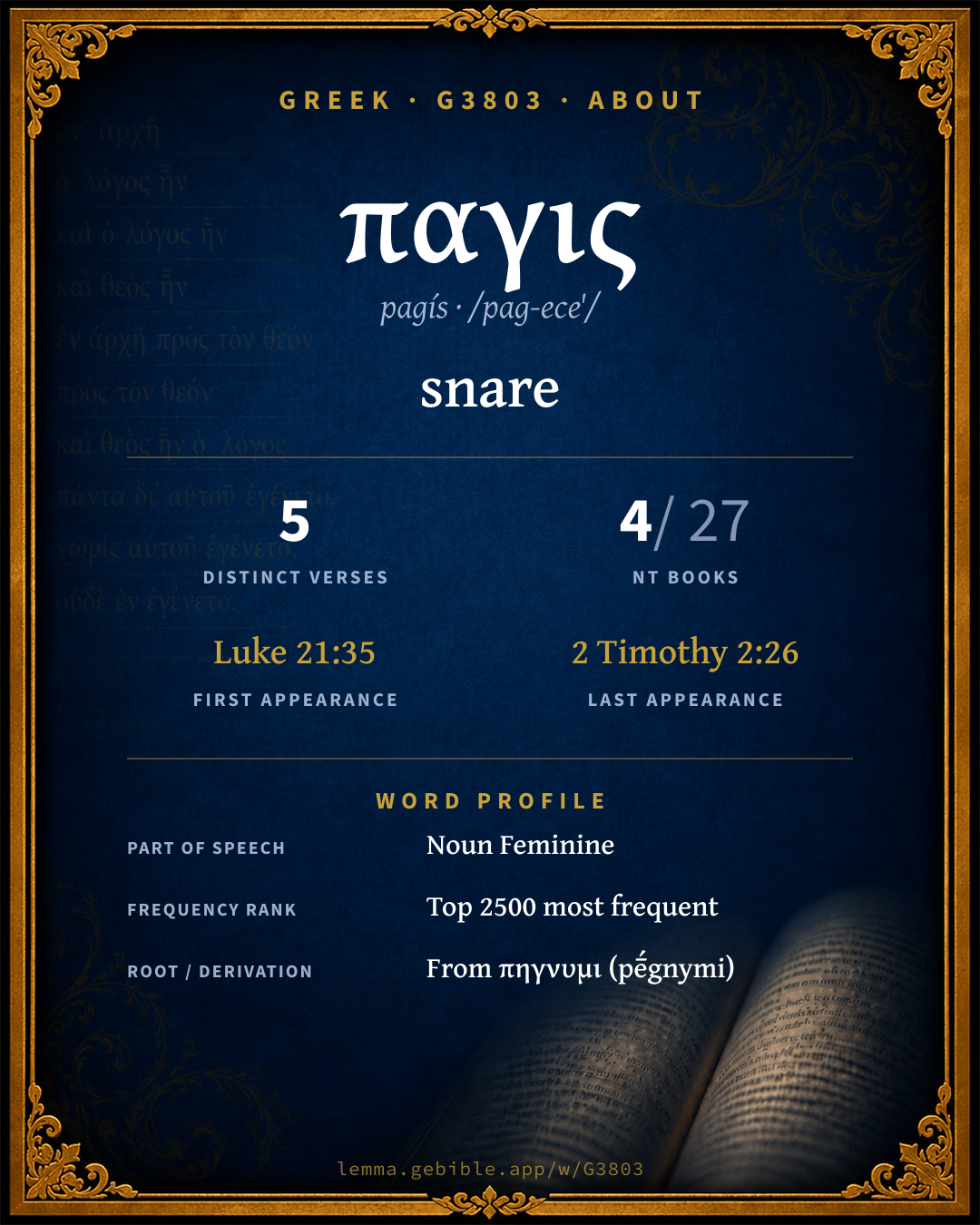
παγίς
snare
Full lexicon entry — Thayer's Greek Lexicon
From Thayer's Greek Lexicon
Where this word appears
See every Accusative-case word in the Greek New Testament →
Grammar key — what these labels mean
Part of speech
- Noun
- A naming word — a person, place, thing, or idea.
Case
- Accusative
- The case of the direct object and of extent.
- Genitive
- The case of source, possession, or “of” — answers “whose / from what.”
- Nominative
- The case of the subject (and the predicate nominative).
Gender
- Feminine
- Grammatically feminine.
Number
- Singular
- One.
Grammatical forms
- Noun, Accusative, Singular, Feminine 3 times (60%)
- Noun, Genitive, Singular, Feminine 1 time (20%)
- Noun, Nominative, Singular, Feminine 1 time (20%)
Parsed forms decoded from the imported morphology (Robinson–Tischendorf, public domain), counted across 5 parsed occurrences — not distinct verses.
Every verse where G3803 appears — 5 distinct verses across 4 books. Click any verse to open its interlinear word-by-word view. Verse text shown in the World English Bible for context — . Each verse’s Greek form is shown with its reference; the English is not keyword-highlighted, since the data carries no word-level English alignment. Use “Compare translations” on any verse to read it across multiple English versions. This concordance covers the Greek New Testament; Septuagint (Greek Old Testament) occurrences of this word are not indexed here.
Luke 1 verse
Romans 1 verse
1 Timothy 2 verses
- 1 Timothy 3:7 παγίδα n acc sg fem Moreover he must have good testimony from those who are outside, to avoid falling into reproach and the snare of the devil.
- 1 Timothy 6:9 παγίδα n acc sg fem But those who are determined to be rich fall into a temptation and a snare and many foolish and harmful lusts, such as drown men in ruin and destruction.
2 Timothy 1 verse
About this entry
At a glance — auto-summarized from this page’s data, not written by a person. Every figure links to its source below. This summary describes the numbers; it doesn’t interpret them.
The Greek noun παγις centers on the idea of “snare.” The Greek New Testament uses it only 5 verses. 1 Timothy dominates its distribution — 2 of 5 verses. Debuting at Luke 21:35, it then recurs through the corpus. Sharing its root, it stands alongside πηγνυμι, παχυνω and πηγανον. Dig into 5-verse concordance and the renderings breakdown below.
Gloss history
Strong's 1890 vs modern scholarship

About this word
Strong's G3803 catalogs a Greek word from the Greek New Testament.
These counts are not copied from any lexicon or concordance. They are computed here, from the morphology-tagged Greek New Testament. What Lemma adds →
- 5
- distinct verses
- The word appears in 5 distinct verses.
- 4 / 27
- NT books
- The word appears in 4 of 27 New Testament books.
- #1,648
- by frequency
- Top 2500 most frequent Greek words (rank 1,648 of 5,347 Greek words by occurrence).
View all 5 occurrences in the concordance →
By section of the New Testament
By traditional corpus
Conventional, traditional groupings — biblical authorship is debated, so this is a traditional corpus grouping, not an authorship claim. Some books belong to more than one corpus (Luke is in both the Gospels and the Lukan corpus, and so on), so these shares overlap and need not total 100%. Each figure is a share of the word’s 5 distinct verses.
- Pauline corpus 4 verses · 80%
- Gospels 1 verse · 20%
- Lukan (Luke–Acts) 1 verse · 20%
How translations render this word
Counts come from each version’s own published word-to-Strong’s tagging or interlinear alignment — an approximate guide to how each version renders this word, not a word-level alignment the data otherwise carries. Because each total is that version’s own tagged count, the per-version totals vary from one another and need not match the appearance or distinct-verse counts above. These counts may also differ from a printed concordance because Lemma counts each distinctly tagged rendering and does not collapse phrase taggings into a single head-word total. This is a fixed set of word-tagged versions (KJV, ASV, BSB, ULT) and does not change with the reading translation you choose elsewhere. Each version’s license is shown beside its name below (and on Sources).
- King James Version: Snare 4×
- American Standard Version: Snare 3×
- Berean Standard Bible: Snare 4×
- unfoldingWord Literal Text: Trap 4×, Areopagus 2×
King James Version Public Domain
Renders G3803 across 4 tagged occurrences — most commonly:
Not rendered by a distinct English word in 1 further occurrence.
American Standard Version Public Domain
Renders G3803 across 4 tagged occurrences — most commonly:
Plus 1 rendering that appears only once — usually multi-word phrases or single function words the recovered tagging swept in, not distinct renderings.
Berean Standard Bible Public Domain
Renders G3803 across 5 tagged occurrences — most commonly:
Plus 1 rendering that appears only once — usually multi-word phrases or single function words the recovered tagging swept in, not distinct renderings.
unfoldingWord Literal Text CC BY-SA 4.0
Renders G3803 across 7 tagged occurrences — most commonly:
Plus 1 rendering that appears only once — usually multi-word phrases or single function words the recovered tagging swept in, not distinct renderings.
Senses in Thayer's
The 1 sense Thayer's distinguishes for this word, in lexicon order (not ranked by frequency or importance). The full entry — with sub-senses — is in the Lexicon Entry tab.
- snare, trap, noose
Word origin
Derived from πηγνυμι (pḗgnymi) (G4078) — to fasten.
From G4078 ; a trap (as fastened by a noose or notch); figuratively a trick or stratagem ( temptation ): - snare
— Strong’s Exhaustive Concordance (1890), public domain.
Forms in the corpus
The 3 distinct written forms G3803 takes in the Greek New Testament, most frequent first — each parse links to that case’s occurrences in the concordance.
| Form | Parsing | Example | Uses |
|---|---|---|---|
| παγίδα pagída | Noun, Accusative, Singular, Feminine | Romans 11:9 | 3 |
| παγίδος pagídos | Noun, Genitive, Singular, Feminine | 2 Timothy 2:26 | 1 |
| παγίς pagís | Noun, Nominative, Singular, Feminine | Luke 21:35 | 1 |
Same root — word family
Other Thayer's entries built from the same root as G3803, grouped by Strong’s listed origin. These share a root / origin per the lexicon — not necessarily a shared meaning. Each links to that word’s own entry.
Derives from
Shares the same root
- παχυνω pachýnō G3975 to make fat
- πηγανον pḗganon G4076 rue
- πηγη pēgḗ G4077 fountain
- πικρος pikrós G4089 bitter
Derived from this word
Proper names from this root
People and places named from this root — a name, not an additional meaning of the word.
Compare all same-root words → Showing 4 of 8 — not the complete family. 1 of the same-root words is a proper name (a person or place). They share a root, not necessarily a meaning.
Septuagint usage
The same Greek word παγις appears 51 times in the Greek Old Testament (Septuagint), across 48 verses in 10 books.
- 51
- LXX occurrences
- Tagged occurrences of this Greek word in the Septuagint.
- 48
- verses
- Distinct Septuagint verses containing this word.
- 10 / 39
- OT books
- The word appears in 10 of the 39 Old Testament books.
Sample Septuagint occurrences
- Joshua 23:13 παγίς
- Job 18:8 παγίς
- Psalms 9:16 παγίς
- Proverbs 6:2 παγίς
- Ecclesiastes 9:12 παγίς
- Isaiah 8:14 παγίς
- Jeremiah 5:26 παγίς
- Ezekiel 29:4 παγίς
- Hosea 5:1 παγίς
- Amos 3:5 παγίς
Septuagint occurrences (same lexeme)
Every verse where the same Strong’s number (G3803) appears in the Greek Septuagint. Verse text shown in the World English Bible for context; the Greek form is the matched word — the English is not keyword-highlighted.
- Joshua 23:13 παγίς know for a certainty that Yahweh your God will no more drive these nations from out of your sight; but they shall be a snare and a trap to you, and a scourge in your sides, and thorns in your eyes, until you perish from off this good land which Yahweh your God has given you.
- Job 18:8 παγίς For he is cast into a net by his own feet, And he wanders into its mesh.
- Job 18:9 παγίς A snare shall take him by the heel; A trap shall lay hold on him.
- Job 22:10 παγίς Therefore snares are round about you. Sudden fear troubles you,
- Psalms 9:16 παγίς Yahweh has made himself known. He has executed judgment. The wicked is snared by the work of his own hands. Meditation. Selah.
- Psalms 9:31 παγίς
- Psalms 10:6 παγίς He says in his heart, "I shall not be shaken; For generations I shall have no trouble."
- Psalms 17:6 παγίς I have called on you, for you will answer me, God: Turn your ear to me. Hear my speech.
- Psalms 24:15 παγίς
- Psalms 30:5 παγίς For his anger is but for a moment; His favor is for a lifetime. Weeping may stay for the night, But joy comes in the morning.
- Psalms 34:7 παγίς The angel of Yahweh encamps round about those who fear him, And delivers them.
- Psalms 34:8 παγίς Oh taste and see that Yahweh is good. Blessed is the man who takes refuge in him.
- Psalms 56:7 παγίς Shall they escape by iniquity? In anger cast down the peoples, God.
- Psalms 63:6 παγίς When I remember you on my bed, And think about you in the night watches.
- Psalms 65:11 παγίς You crown the year with your bounty. Your carts overflow with abundance.
- Psalms 68:23 παγίς That you may crush them, dipping your foot in blood, That the tongues of your dogs may have their portion from your enemies."
- Psalms 90:3 παγίς You turn man to destruction, saying, "Return, you children of men."
- Psalms 118:110 παγίς
- Psalms 123:7 παγίς
- Psalms 139:6 παγίς This knowledge is beyond me. It's lofty. I can't attain it.
- Psalms 140:9 παγίς As for the head of those who surround me, Let the mischief of their own lips cover them.
- Psalms 141:4 παγίς Don't incline my heart to any evil thing, To practice deeds of wickedness with men who work iniquity. Don't let me eat of their delicacies.
- Proverbs 6:2 παγίς You are trapped by the words of your mouth. You are ensnared with the words of your mouth.
- Proverbs 6:5 παγίς Free yourself, like a gazelle from the hand of the hunter, Like a bird from the snare of the fowler.
- Proverbs 7:23 παγίς Until an arrow strikes through his liver, As a bird hurries to the snare, And doesn't know that it will cost his life.
- Proverbs 11:9 παγίς With his mouth the godless man destroys his neighbor, But the righteous will be delivered through knowledge.
- Proverbs 12:13 παγίς An evil man is trapped by sinfulness of lips, But the righteous shall come out of trouble.
- Proverbs 13:14 παγίς The teaching of the wise is a spring of life, To turn from the snares of death.
- Proverbs 14:27 παγίς The fear of Yahweh is a fountain of life, Turning people from the snares of death.
- Proverbs 18:7 παγίς A fool's mouth is his destruction, And his lips are a snare to his soul.
- Proverbs 20:16 παγίς Take the garment of one who puts up collateral for a stranger; And hold him in pledge for a wayward woman.
- Proverbs 21:6 παγίς Getting treasures by a lying tongue Is a fleeting vapor for those who seek death.
- Proverbs 22:5 παγίς Thorns and snares are in the path of the wicked: Whoever guards his soul stays from them.
- Proverbs 29:6 παγίς An evil man is snared by his sin, But the righteous can sing and be glad.
- Ecclesiastes 9:12 παγίς For man also doesn't know his time. As the fish that are taken in an evil net, and as the birds that are caught in the snare, even so are the sons of men snared in an evil time, when it falls suddenly on them.
- Isaiah 8:14 παγίς He shall be for a sanctuary; but for a stone of stumbling and for a rock of offense to both the houses of Israel, for a gin and for a snare to the inhabitants of Jerusalem.
- Isaiah 24:17 παγίς Fear, and the pit, and the snare, are on you, O inhabitant of the earth.
- Isaiah 24:18 παγίς It shall happen, that he who flees from the noise of the fear shall fall into the pit; and he who comes up out of the midst of the pit shall be taken in the snare: for the windows on high are opened, and the foundations of the earth tremble.
- Isaiah 42:22 παγίς But this is a people robbed and plundered; they are all of them snared in holes, and they are hid in prison-houses: they are for a prey, and none delivers; for a spoil, and none says, Restore.
- Jeremiah 5:26 παγίς For among my people are found wicked men: they watch, as fowlers lie in wait; they set a trap, they catch men.
- Jeremiah 5:27 παγίς As a cage is full of birds, so are their houses full of deceit: therefore they are become great, and grew rich.
- Jeremiah 18:22 παγίς Let a cry be heard from their houses, when you shall bring a troop suddenly on them; for they have dug a pit to take me, and hid snares for my feet.
- Jeremiah 31:43 παγίς
- Jeremiah 31:44 παγίς
- Ezekiel 29:4 παγίς I will put hooks in your jaws, and I will cause the fish of your rivers to stick to your scales; and I will bring you up out of the midst of your rivers, with all the fish of your rivers which stick to your scales.
- Hosea 5:1 παγίς "Listen to this, you priests! Listen, house of Israel, And give ear, house of the king! For the judgment is against you; For you have been a snare at Mizpah, And a net spread on Tabor.
- Hosea 9:8 παγίς A prophet watches over Ephraim with my God. A fowler's snare is on all of his paths, And hostility in the house of his God.
- Amos 3:5 παγίς Can a bird fall in a trap on the earth, Where no snare is set for him? Does a snare spring up from the ground, When there is nothing to catch?
These are occurrences of the same Greek lexeme (G3803) in the Septuagint — not a translation of any one Hebrew word. The store carries no word-level Hebrew↔Greek alignment, so no Hebrew original is asserted here. Counts come from the recovered LXX Strong's tagging — high-frequency vocabulary is well covered, while rare or late forms may be untagged — so they reflect tagged occurrences and may slightly undercount.