2 Timothy 2:26

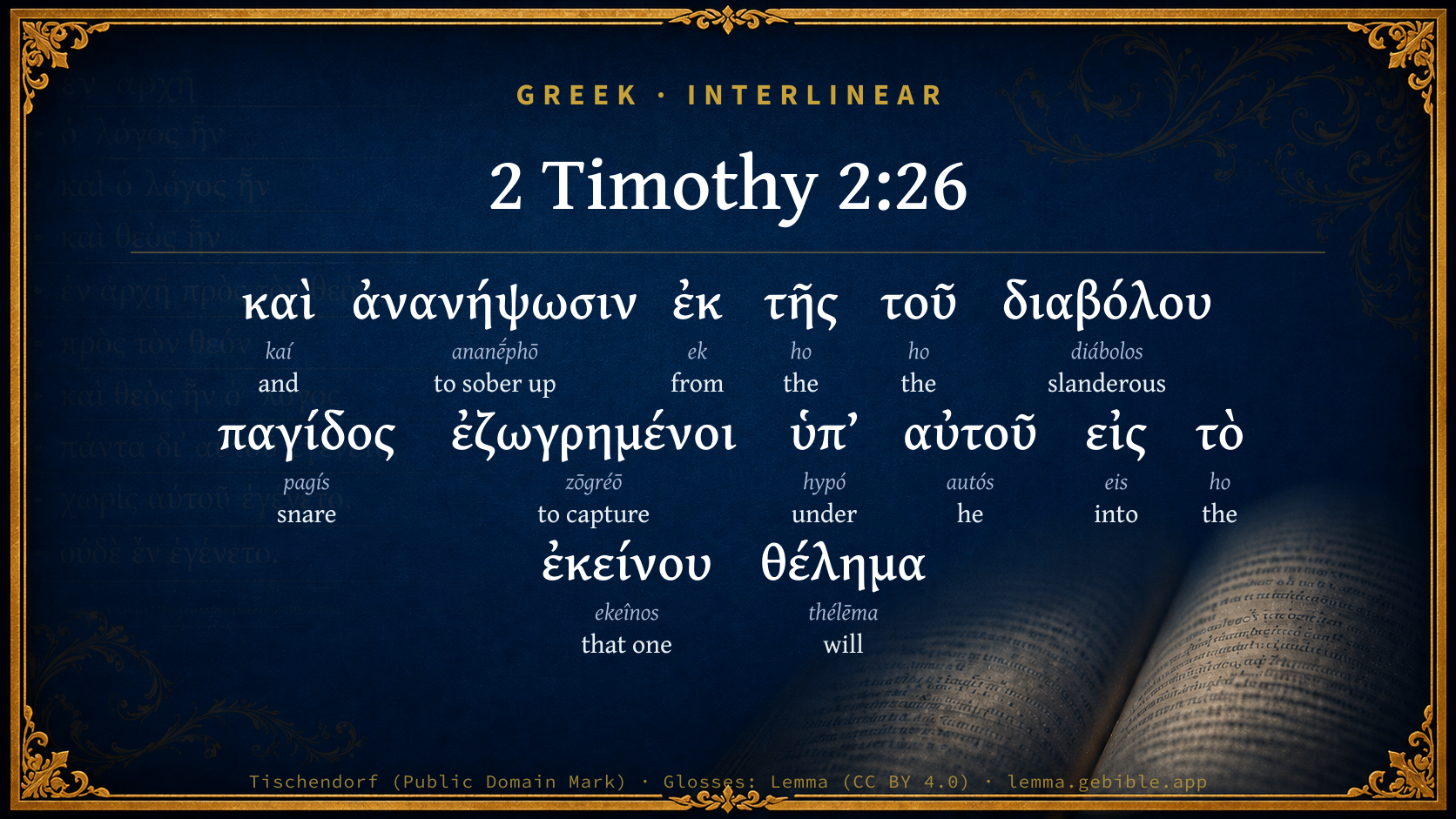
Greek (Tischendorf 8th ed.) 2 Timothy 2:26 appears in the Greek New Testament. The text above is from the Tischendorf 8th edition. Each word links to its Strong’s number and a concise gloss. Click any word for its full Thayer’s Greek Lexicon entry.
Download image
Cite this verse

2 Timothy 2:26 (World English Bible). Public Domain. Lemma interlinear Bible study tool, https://lemma.gebible.app/v/2-timothy/2/26.

Show BibTeX & RIS
BibTeX
RIS
English Translation
and they may recover themselves out of the devil's snare, having been taken captive by him to his will.
World English Bible · Public Domain
Highlights
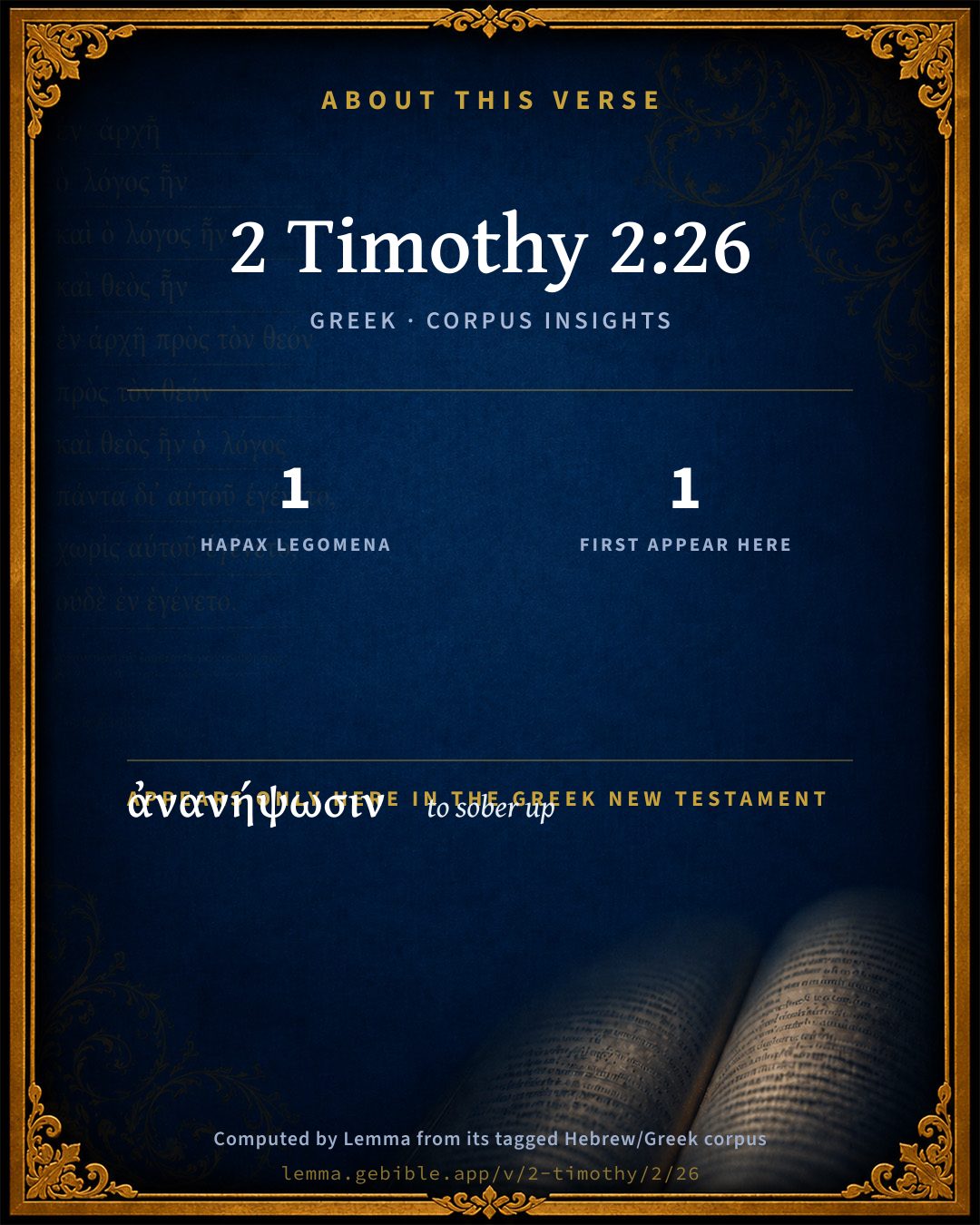
  • 1 hapax legomenon — only here in the Greek New Testament
  • 1 first appearance in the Greek New Testament
Full analysis ↓
Download a study sheet

One document with this verse’s original text, its word-by-word gloss line, the meaning frame, cross-references with their text, attributed commentary, and full source and license credits — printable, and it pastes into notes with its structure intact.

This verse Autodidact and up

Study sheet (.html) Plain text (.txt)

A passage Seminary Student

Up to 50 verses in one chapter. A passage sheet keeps up to 6 commentary sources and 12 cross-references per verse, in the order this page ranks them, and says so on the sheet whenever that leaves anything out. Ask for a single verse and you get the Autodidact verse sheet above.

Everything on this page stays free to read, with no account — the sheet is a download of what is already on screen, not access to it.

Want to remove ads? Support Godless Engineer
Compare translations 3

The same verse in 3 English versions, stacked beneath the original-language interlinear above. Click any original word for its lexicon entry.

Each is an independent rendering of the whole verse — the interlinear is not word-aligned to these translations.

Highlighted words mark where these versions differ — a whole-verse word diff, not a word-by-word alignment.

  • World English Bible Public Domain
    and they may recover themselves out of the devil's snare, having been taken captive by him to his will.
  • King James Version Public Domain
    And that they may recover themselves out of the snare of the devil, who are taken captive by him at his will.
  • unfoldingWord Literal Text CC BY-SA 4.0
    and they may become sober again from the trap of the devil, having been captured by him for the will of that one.

unfoldingWord Literal Text — © unfoldingWord, licensed CC BY-SA 4.0. Word-aligned USFM3 via Door43 (git.door43.org/unfoldingWord/en_ult).

Versions to compare (up to 4)

3 of 4 selected

Show all 19 translations

Every available English version of this verse, each an independent rendering of the whole verse.

  • World English Bible Public Domain
    and they may recover themselves out of the devil's snare, having been taken captive by him to his will.
  • Berean Standard Bible Public Domain
    Then they will come to their senses and escape the snare of the devil, who has taken them captive to his will.
  • Majority Standard Bible Public Domain
    Then they will come to their senses and escape the snare of the devil, who has taken them captive to his will.
  • King James Version Public Domain
    And that they may recover themselves out of the snare of the devil, who are taken captive by him at his will.
  • American Standard Version (1901) Public Domain
    and they may recover themselves out of the snare of the devil, having been taken captive by him unto his will.
  • Revised Version (1885) Public Domain
    and they may recover themselves out of the snare of the devil, having been taken captive by the Lord’s servant unto the will of God.
  • Geneva Bible (1599) Public Domain
    And come to amendment out of that snare of the deuil, of whom they are taken prisoners, to doe his will.
  • Douay-Rheims (1899) Public Domain
    And they may recover themselves from the snares of the devil, by whom they are held captive at his will.
  • Young's Literal Translation Public Domain
    and they may awake out of the devil's snare, having been caught by him at his will.
  • Literal Standard Version CC BY-SA 4.0
    and they may awake out of the Devil’s snare, having been caught by him at his will.
  • Unlocked Literal Bible CC BY-SA 4.0
    They may become sober again and leave the devil's trap, after they have been captured by him for his will.
  • unfoldingWord Literal Text CC BY-SA 4.0
    and they may become sober again from the trap of the devil, having been captured by him for the will of that one.
  • Darby Bible Public Domain
    and that they may awake up out of the snare of the devil, [who are] taken by him, for *his* will.
  • World Messianic Bible Public Domain
    and they may recover themselves out of the devil’s snare, having been taken captive by him to do his will.
  • Webster's Bible Public Domain
    And that they may recover themselves out of the snare of the devil, who are taken captive by him at his will.
  • Free Bible Version CC BY-SA 4.0
    In this way they may come to their senses and escape the devil's trap. For he has captured them and made them do whatever he wants.
  • Bible in Basic English Public Domain
    And so they may get themselves free from the net of the Evil One, being made the prisoners of the Lord's servant, for the purpose of God.
  • Text-Critical English NT CC BY 4.0
    Then they will come to their senses and escape from the snare of the devil, who has taken them captive to do his will.
  • Tyndale New Testament (1534) Public Domain
    that they maye come to the selves agayne out of the snare of the devyll which are now taken of him at his will.

Literal Standard Version (2020), Covenant Press — licensed CC BY-SA 4.0. Text via the HelloAO Bible API (eBible.org). Unlocked Literal Bible (unfoldingWord) — licensed CC BY-SA 4.0. Text via the HelloAO Bible API (eBible.org). unfoldingWord Literal Text — © unfoldingWord, licensed CC BY-SA 4.0. Word-aligned USFM3 via Door43 (git.door43.org/unfoldingWord/en_ult). Free Bible Version, Dr. Jonathan Gallagher — licensed CC BY-SA 4.0. Text via the HelloAO Bible API (eBible.org).

Word by word

More ways to search: Search by grammar → Find every occurrence → Compare this word →

Practice this passage: Drill this verse → Learn its vocabulary →

ἀνανήψωσιν
ananḗphō
G366
“to sober up”
Verb, Aorist, Active, Subjunctive, 3rd person, Plural
Part of Speech
Verb
Tense
Aorist
Voice
Active
Mood
Subjunctive
Person
3rd person
Number
Plural
Full Thayer's Definition

Origin: from G303 and G3525

TDNT: None

1. to return to soberness
  1. καὶ kaí G2532 “and” Conjunction
  2. ἐκ ek G1537 “from” Preposition
  3. τῆς ho G3588 “the” Article, Genitive, Singular, Feminine
  4. τοῦ ho G3588 “the” Article, Genitive, Singular, Masculine
  5. διαβόλου diábolos G1228 “slanderous” Adjective, Genitive, Singular, Masculine
  6. παγίδος pagís G3803 “snare” Noun, Genitive, Singular, Feminine
  7. ἐζωγρημένοι zōgréō G2221 “to capture” Verb, Perfect, Passive, Participle, Nominative, Plural, Masculine
  8. ὑπ’ hypó G5259 “under” Preposition
  9. αὐτοῦ autós G846 “he” Personal pronoun, Genitive, Singular, Masculine
  10. εἰς eis G1519 “into” Preposition
  11. τὸ ho G3588 “the” Article, Accusative, Singular, Neuter
  12. ἐκείνου ekeînos G1565 “that one” Demonstrative pronoun, Genitive, Singular, Masculine
  13. θέλημα thélēma G2307 “will” Noun, Accusative, Singular, Neuter

About this verse

These counts appear in no published source. They are computed here, from the morphology-tagged text and Lemma’s own curated glosses. What Lemma adds →

14
words
12
distinct lemmas
Pauline Epistles
section

Notable vocabulary

1 hapax legomenon — a word that appears only here in the entire Greek New Testament:

  • ἀνανήψωσιν to sober up G366

First appearance in Scripture

This word makes its first canonical appearance in the Greek New Testament here:

  • ἀνανήψωσιν to sober up G366

Shared distinctive vocabulary

ἐζωγρημένοι to capture G2221 occurs in 2 verses of the Greek New Testament. Also found in:

Repetition

A word recurs within this verse:

Cross-references

27

Topical passages linked to 2 Timothy 2:26 in the Treasury of Scripture Knowledge — connected by theme and wording, ordered by reader-vote popularity; previews shown in the World English Bible.

  • 1 Timothy 3:7 Moreover he must have good testimony from those who are outside, to avoid falling into reproach and the snare of the devil.
  • Isaiah 49:25–26 But thus says Yahweh, Even the captives of the mighty shall be taken away, and the prey of the terrible shall be delivered; for I will contend with him who contends with you, and I will save your children.
  • Psalms 124:7 Our soul has escaped like a bird out of the fowler's snare. The snare is broken, and we have escaped.
  • Isaiah 42:6–7 I, Yahweh, have called you in righteousness, and will hold your hand, and will keep you, and give you for a covenant of the people, for a light of the Gentiles;
  • Isaiah 8:15 Many shall stumble thereon, and fall, and be broken, and be snared, and be taken.
  • Ephesians 5:14 Therefore he says, "Awake, you who sleep, and arise from the dead, and Christ will shine on you."
  • Colossians 1:13 who delivered us out of the power of darkness, and translated us into the Kingdom of the Son of his love;
  • Revelation 20:2–3 He seized the dragon, the old serpent, which is the devil and Satan, who deceives the whole inhabited earth, and bound him for a thousand years,
  • Job 1:12 Yahweh said to Satan, "Behold, all that he has is in your power. Only on himself don't put forth your hand." So Satan went forth from the presence of Yahweh.
  • 2 Peter 2:18–20 For, uttering great swelling words of emptiness, they entice in the lusts of the flesh, by licentiousness, those who are indeed escaping from those who live in error;
  • Revelation 12:9 The great dragon was thrown down, the old serpent, he who is called the devil and Satan, the deceiver of the whole world. He was thrown down to the earth, and his angels were thrown down with him.
  • Job 2:6 Yahweh said to Satan, "Behold, he is in your hand. Only spare his life."
  • Isaiah 28:13 Therefore shall the word of Yahweh be to them precept on precept, precept on precept; line on line, line on line; here a little, there a little; that they may go, and fall backward, and be broken, and snared, and taken.
  • Isaiah 53:12 Therefore will I divide him a portion with the great, and he shall divide the spoil with the strong; because he poured out his soul to death, and was numbered with the transgressors: yet he bore the sin of many, and made intercession for the transgressors.
  • Matthew 12:28–29 But if I by the Spirit of God cast out demons, then the Kingdom of God has come upon you.
  • Luke 11:21 "When the strong man, fully armed, guards his own dwelling, his goods are safe.
  • Luke 15:17 But when he came to himself he said, 'How many hired servants of my father's have bread enough to spare, and I'm dying with hunger!
  • John 13:2 After supper, the devil having already put into the heart of Judas Iscariot, Simon's son, to betray him,
  • John 13:27 After the piece of bread, then Satan entered into him. Then Jesus said to him, "What you do, do quickly."
  • Acts 5:3 But Peter said, "Ananias, why has Satan filled your heart to lie to the Holy Spirit, and to keep back part of the price of the land?
  • Acts 26:18 to open their eyes, that they may turn from darkness to light and from the power of Satan to God, that they may receive remission of sins and an inheritance among those who are sanctified by faith in me.'
  • 1 Corinthians 15:34 Wake up righteously, and don't sin, for some have no knowledge of God. I say this to your shame.
  • 1 Timothy 1:20 of whom is Hymenaeus and Alexander; whom I delivered to Satan, that they might be taught not to blaspheme.
  • 1 Timothy 6:9–10 But those who are determined to be rich fall into a temptation and a snare and many foolish and harmful lusts, such as drown men in ruin and destruction.
  • Luke 22:31–32 The Lord said, "Simon, Simon, behold, Satan asked to have you, that he might sift you as wheat,
  • 2 Corinthians 2:11 that no advantage may be gained over us by Satan; for we are not ignorant of his schemes.
  • 2 Thessalonians 2:9–12 even he whose coming is according to the working of Satan with all power and signs and lying wonders,

Cross-references courtesy of OpenBible.info (CC BY 4.0).

Commentary

Notes on 2 Timothy 2:26 from classic Christian and Jewish commentators (each source and its license shown beneath its notes). The classic Christian expositions comment on the surrounding passage and are grouped to its opening verse, so a note may address several verses; the Jewish commentaries on the Tanakh (Rashi and others) are per-verse, so they appear only where the commentator wrote on this verse.

Lemma curates 59 commentaries, every one of them public domain or Creative Commons licensed, each selected and text-cleaned for this edition rather than reprinted as found. About our sources →

The Biblical Illustrator

Joseph S. Exell

2Ti_2:26

And that they may recover themselves out of the snare of the devil, who are taken captive by him at his will--And that they may return to sobriety from the benumbing intoxication of false philosophy and bad habits, here represented as a snare of the devil, in which, though held captive, they were not yet killed--out of the snare of the devil, being made living captives of by him.

So far, there is no difficulty, but the last clause, according to the will of Him, leaves the reader in doubt as to its meaning, since two pronouns are used which generally, if not universally, refer to two different subjects. De Wette, Huther, and Davidson disregard the difference of the pronouns, and make them both refer to the devil. But the contrast of the two pronouns is remarkable, and the sense of the passage very obscure, the will of the devil being an otiose addition, unless it he translated, as by Davidson, to do his will. If ἐκείνου refers to the more remote antecedent, then Gods will is suggested as the gracious accompaniment and occasion of this gift of repentance, or as the exposition of the state of new life, into which such penitents may be brought. The passage will read as follows:--Whether haply God would grant them repentance, and also whether haply they may return to society, into harmony with His will, out of the snare of the devil, seeing they have been made living captives by him. (H. R. Reynolds, D. D.)

Satans temptations are like snares

The devil is a fowler, beholds the world like a great and spacious forest full of all kinds of beasts and birds, and setteth snares and gins in every corner to catch them.

1. In a snare there is subtlety, so in Satans temptations.

(1) He never propounds a temptation in his own name. No, should he do so, his plot would be discerned prevented. How cunningly crept he into the serpent and seduced the woman? He conveyed himself into such things as we are least suspicious of. Who would have thought that any snare had been in the words of the apostle, Master pity thyself? Yet doth not Christ reply, Get thee behind Me, Satan?

(2) He can lay a snare in the very Scriptures. Though they be milk for babes, strong meat for grown men, he can poison all. Let Christ answer him by Scripture, straight he replies, tempting him by a place of Scripture. Cast thyself down; for it is written, God shall give His angels charge over Thee that thou dash not Thy foot against a stone.

(3) He can convey a temptation in the frame of a mans spirit. He conceives that some are apt to pride, malice, coveteousness, melancholy, mirth, silence, liberalness of speech, and according to our natural inclination he sets his gins for us. Thus he provides a wanton object in the time of idleness, a beautiful woman washing herself, and so the good king is caught in his net. What way the tree leans he thrusts it, and where the fence is weakest he seeks to enter. So subtley will he here lay a snare that we will hardly be brought to believe it is a temptation of Satan, but think rather it proceeds solely from our natural disposition.

2. In a snare there is cruelty; so here. He is called Abaddon, Apollion, a murderer, a destroyer.

3. In a snare is strength, and is it not to be found in Satans temptations?

4. You shall find in Satans temptations, as in snares, pleasures and suddenness. Were it not thus they were not snares properly. Was not the tree, in the eye of Eve, good for meat, pleasant, and to be desired to get knowledge (Gen_3:6)? Were not the daughters of men fair (Gen_6:2)? And in these was not a bait to catch the beholders? Have not fowlers a lure and call, as if they were birds themselves, to allure and deceive? Will they not scatter corn and all to seduce and bring within danger the little-suspicious birds? Do they not creep on their hands and knees, stand in close and secret places, and when the fowl is within reach how suddenly is the net pulled! Per adventure, when she is singing, playing, suspecting nothing, she is wound in. When Satan assaults, how eagerly, busily, and suddenly will he follow the prey? He sets a mans affections on fire, kindles such a heat within him that for the present the object of temptation seems wonderful fair, delightful, honourable; though when he is ensnared he perceives no such thing, but the direct contrary. (J. Barlow, D. D.)

The deluded captives

These words are the concluding portion of a solemn address to Timothy, in reference to the instruction of the ungodly, and is the end pointed out as resulting from that instruction--And that they may recover themselves out of the snare of the devil. They present to the thoughtful mind a sad picture, bringing before us on the one hand the devil, in the character of fowler; and on the other hand his victims, as deluded, taken alive, under a hard bondage.

I. The characters spoken of.

II. The means by which they are held in bondage.

III. The means by which they may be recovered from that bondage.

I. They are spoken of as those who are ensnared by Satan, and taken captive by him at his will.

1. We must notice who is the captor. It is the devil, the murderer and liar, the destroyer of souls; represented here under the character of a snarer or fowler. It is very important to notice Satan in his character, because it manifests his subtlety. The fowler must be subtle in hiding his net, or otherwise he would miss his prey. It is plain from Scripture that sin was introduced through Satans subtlety.

2. In the next place, see the awful force of the language. The expression, taken captive, is rendered in the margin taken alive; it is an idea derived from fowling, in which the prey is taken alive in snares: so the devil takes mens souls alive by his subtlety: nay, more, unless they be recovered out of his snares, they must be alive for ever under his sway: lost, yet alive; hopeless, yet alive; tormented, yet alive; ever desiring to die, but never able. The other expression, at his will, may bear a double interpretation. It may mean that they have been ensnared by Satans arts unto his will; i.e., they were so influenced by him that they complied with his will. It is most important to notice this, because it at once brings out the humiliating truth, that the ungodly comply with Satans will: The man who lives in drunkenness, who is a sensualist; or to pass on to sins which are thought little of in the world, the man who is untruthful, a backbiter, a slanderer or deceitful, is complying with Satans will. The man who is a neglecter of salvation, who never prays, who is putting off the thought of eternity to a convenient season, is complying with Satans will. Again, the expression at his will, may have reference to the devils will concerning his victims--viz., their destruction. Hence those who are taken alive by Satan at his will are taken alive by him for their destruction, he is leading them on, step by step, with the one end and the one object of dragging them alive into that pit of darkness and agony prepared for himself and his angels. Our look upon this other picture--while Satan wills your destruction, God wills your salvation. He would have all men to be saved, and to come to the knowledge of the truth.

3. In the next place, notice the bondage itself. It is worse than Egyptian bondage. A sinner, taken captive by Satan, has his immortal soul in captivity, bound in fetters which none can break but the Lord of glory. But we may see the fearfulness of this bondage by looking at it in a threefold point of view.

(1) The master whom the captive serves. Dread thought! it is not Jesus, the sinners great Deliverer, but it is the devil, the sinners great destroyer. Ah! and what a master! one who hates him; one who watches closely to prevent his victims escape, binding around him every day tighter and tighter the cords of his destruction. Look again--

(2) At the state of the captive. It is one of misery and wretchedness. The way of transgressors is hard. It is utterly impossible to experience true peace and happiness while walking in the pathway of the devil. Christs yoke in opposition to Satans; the one is perfect liberty while the other is the most galling bondage. Look again--

(3) At the end of this bondage. Now, Satan does not make his bondage felt, for fear of alarming the victim, and leading him to seek deliverance from it: but in eternity, when all hope of deliverance is past, he will make his bondage felt in all its overwhelming force.

II. The means by which Satan keeps sinners captive. He does so by his snares. We must look at some of those principle snares by which he deludes and holds captive the unwary.

1. The first snare of Satan which I shall mention is, his making sin pleasant, and hiding its awful consequences. He makes the sinner believe the command not to sin, to be a restriction of his liberty, and, therefore, one which he has no right to listen to. It is the present, and the present only, which the devil seeks to force on the captives mind; the present and its gain; but the awfully mysterious future he puts out of sight, veiling from the sinners mind his dread connection with it.

2. A second snare of Satans is, his insinuating doubts into the mind as to the truth of Gods Word.

3. A third snare of Satans is, his presenting God to the soul as one made up of all mercy.

4. A fourth snare of Satans is, by persuading the soul that the work of repentance is an easy work: that it need not be thought of till laid on a bed of sickness or a bed of death: and he will suggest to the sinners mind examples from Gods Word to bear out this delusion.

5. Another snare of Satan, by which he takes souls captive, is by making himself an object of ridicule. This is one of the depths of Satan: he knows that the Bible puts him forward as an object of dread; he takes care, therefore, to put himself forward as an object of ridicule, so as to blind the ungodly, and keep them captive at his will. Mark the consequence: all the warnings of Scripture concerning him, all the representations of him as an adversary, a murderer, fall on the ear of his captives as unmeaning titles, they cannot comprehend why he is to be dreaded. And why is this? Just because they are ignorant of the real reason why they cannot comprehend it--viz., Satan has deceived them, deceived them as to his character, deceived them as to his object, deceived them as to their danger, deceived them as to their end, and, will deceive them to that very hour when, as lost and wretched, they shall open their eyes, to learn then, but, alas I too late, that though the devil appeared to them an angel of light, yet he was indeed a deceiver, a liar, and a murderer.

6. Another snare by which Satan takes souls captive at his will is, by making them rest in outward forms instead of true conversion.

III. The means by which souls may be recovered from his bondage. And that they may recover themselves out of the snare of the devil. The word which is rendered recover is in the margin, awake. It properly means to become sober again, as from intoxication; to awake from a deep sleep; and then to come to ones self, or to a right mind. The idea is, that while men are under the bondage of the devil, they are like men intoxicated, or in a deep slumber, unconscious of their danger. How are they to be roused to a sense of their danger? The answer is given in the previous verse, we are to set before them the truth, the simple truth of Christ, If peradventure God will give them repentance to the acknowledging of it. Acknowledging, implying not merely confession of the truth, but a vital reception of it as it is in Jesus. It is the truth of Christ borne home to the heart by the Holy Ghost, which is the means of conversion. As long as Satan can spread over us the veil of darkness, so long are we his captives, but no sooner does the light of Christs truth break in on the soul, than the darkness is dispersed, Satan is vanquished, and the sinner delivered out of darkness into light, and from the power of sin and Satan unto God. But mark you, it is God alone who can effect this transformation; it is God alone who can bear home the word to the heart, and make it a converting word. (A. W. Snape, M. A.)

The snare of the devil

Forbidden fruit is sweet. It is sweetened by the devil. One forbidden tree in Eden seemed better than a thousand trees allowed. That terrible magician has power to concentrate our gaze upon one object--power to withdraw our eyes from the pure and wholesome fruits of many trees, and rivet them upon that one forbidden thing. He so intensifies our thought upon that one desire that it outgrows all desires, and perhaps life itself for the time seems stale and flat unless that one desire be gratified. That is one of the supernatural powers of the serpent to charm his victims. This dreadful delusion, this deadly fascination, fills common objects with dazzling beauty. The coloured lights of hell are reflected upon earthly things and make them appear heavenly. Thus the gaming-table is made to assume attractions which make money and land and houses insignificant trifles in comparison. Thus a glass of liquor grows in beauty and power that will out-dazzle the love of family, or the joys of home, or even the hopes of heaven. (R. S. Barrett.)

Snared through over-confidence

Naturalists tell us that amongst birds and butterflies, the swiftest, strongest fliers approach man much nearer than those with weaker wings, feeling confident that they can dart away from any threatened danger, and this misplaced confidence brings them into the net of the collector. (W. L. Watkinson.)

Caution necessary

In mountain ranges there is often a loose detritus especially dangerous to mountaineers; these loose or crumbling stones being called the devils stones, for, owing to their treacherous character, if you step on one incautiously you may be precipitated into the depths. There are many such stones in the path of life. False maxims with sophistical colourings; license stealing the name of liberty; harmful speculations, luring as grand chances; methods of trade outlined square, yet full of betrayal; sandy doctrines simulating the rock; friendships which are flowery graves; occupations, recreations which promise rest and serve only to slip us into mire; these are the things of peril: life is full of them; and he only walks surely who walks discreetly. (W. L. Watkinson.)

.

The Biblical Illustrator, edited by Joseph S. Exell (c. 1880s–1900s) — public domain. Text from a community e-Sword module.

Bengel's Gnomon

Johann Albrecht Bengel

2Ti 2:26. Καὶ) and so.—ἀνανήψωσιν) This depends on if at any time: if they may awake, and shake off sleep.—ἐκ τῆς—παγίδος, from the snare) There are here two evils, captivity and sleep; and there are two good things, awaking and deliverance. An abbreviated expression.—ἐζωγρημένοι) Luk 5:10; taken captive willingly.—ὑπʼ αὐτοῦ, by him[11]) by the servant of the Lord. Where God goes before, 2Ti 2:25, the work of His servant (2Ti 2:24) is successful. God rouses: His servant draws them out of the snare.—εἰς τὸ) Construed with, if at any time they may awake. Ἐκ marks the terminus from which they set out, εἰς that to which they are to go. The former terminus is, oppose themselves, 2Ti 2:25, and the snare of the devil, 2Ti 2:26: the latter is the acknowledgment of the truth and the will of God.—ἐκείνου, of Him[12]) God.—θέλημα, will) which is entirely free, and gives freedom; 1Pe 4:2. The opposite is, from the snare. Paul himself was awakened to conversion, so that he might “know the will of God;” Act 22:14.

[11] Not, by the devil, as in the Engl. Vers. They are taken so as to be saved alive, as ἐζωγρημένοι literally means. So our Lord uses the same word, and of the same thing, to Peter, Luk 5:10.—ED.

[12] Ἐκείνου being evidently distinct from αὐτοῦ; the latter referring to the servant of God, the former to God. Not as Engl. Vers., both referring to the devil.—ED.

Bengel's Gnomon of the New Testament — English translation (T&T Clark, Edinburgh, 1860) — public domain. Text from a community e-Sword module.

Expositor's Greek Testament

ed. W. Robertson Nicoll

2Ti 2:26 . ἀνανήψωσιν is to be connected with εἰς τὸ ἐκείνου θέλημα . Compare ἐκνήψατε δικαίως , 1Co 15:34 . ἐκείνου then refers to ὁ θεός , and θέλημα will have its usual force as the Will of God (see 1Pe 4:2 ): That they who had been taken captive by the devil may recover themselves ( respiscant , Vulg.) out of his snare, so as to serve the will of God . This is Beza’s explanation and that of von Soden (nearly), who compares αἰχμαλωτίζοντες , 2Co 10:5 . It has the advantage of giving a natural reference to αὐτοῦ and ἐκείνου respectively, which are employed accurately in 2Ti 3:9 . The paradoxical use of ζωγρέω in Luk 5:10 must not be taken as determining the use of the word elsewhere. Of the other explanations, that of the A.V. and Vulg., which supposes an inelegant but not impossible reference of both αὐτοῦ and ἐκείνου to τοῦ διαβόλου , is preferable to the R.V., following Wetstein and Bengel, which refers αὐτοῦ back to δοῦλον Κυρίου , and dissociates ἐζωγρημένοι from παγίδος , with which it is naturally connected. The reference of αὐτοῦ and ἐκείνου to the same subject, as given in the A.V., is paralleled by Wis 1:16 , συνθήκην ἔθεντο πρὸς αὐτόν , ὅτι ἄξιοί εἰσιν τῆς ἐκείνου μερίδος εἶναι .

The Expositor's Greek Testament, edited by W. Robertson Nicoll (1897–1910) — public domain. Text from a community e-Sword module.

Jamieson, Fausset & Brown

Robert Jamieson, A. R. Fausset & David Brown

recover themselves--Greek, "awake to soberness," namely from the spiritual intoxication whereby they have fallen into the snare of the devil.

the snare-- (Eph 6:11, "the wiles of the devil": Ti1 3:7; Ti1 6:9).

taken captive by him at his will--so as to follow the will of "THAT" (the Greek emphatically marks Satan thus) foe. However, different Greek pronouns stand for "him" and "his"; and the Greek for "taken captive" means not "captured for destruction," but "for being saved alive," as in Luk 5:10, "Thou shalt catch men to save them unto life"; also there is no article before the Greek participle, which the English Version "who are taken captive," would require. Therefore, translate, "That they may awake . . . taken as saved (and willing) captives by him (the servant of the Lord, Ti2 2:24), so as to follow the will of HIM (the Lord, Ti2 2:24, or "God," Ti2 2:25)." There are here two evils, the "snare" and sleep, from which they are delivered: and two goods to which they are translated, awaking and deliverance. Instead of Satan's thrall comes the free and willing captivity of obedience to Christ (Co2 10:5). It is God who goes before, giving repentance (Ti2 2:25); then the work of His servant following is sure to be crowned with success, leading the convert henceforth to "live to the will of God" (Act 22:14; Pe1 4:2).

Next: 2 Timothy Chapter 3

Jamieson, Fausset & Brown — Commentary Critical and Explanatory on the Whole Bible (1871) — public domain (CC PDM 1.0). Text via the HelloAO Bible API.

Adam Clarke's Commentary

Verse 26. And that they may recover themselves] The construction of this verse is extremely difficult, though the sense given by our translation is plain enough. I shall set down the original, and the principal English translations: -

Και ανανηψωσιν εκ της του διαβολου παγιδος, εζωγρημενοι ὑπ' αυτου εις εκεινου θελημα.

And thei rise agein fro snaaris of the debyl, of whome thei ben holde captyffis at his wille. - WICLIF. First translation into English, 1378.

And to turne agayne from the snare of devell, which are holden in prison of him at his will. - COVERDALE. First printed English Bible, 1535

That they may come to themselves agayne out of the snare of the devyll, which are now taken of him at hys will. - EDWARD VIth's Bible, by Becke, 1549.

And they may recover their senses to perform his will, after being rescued alive by the servant of the Lord out of the snare of the devil. - WAKEFIELD; who refers αυτου, him, to the servant of the Lord, 2Tim 2:24.

And being caught alive by him out of the snare of the devil, they may awake to do his will. - MACKNIGHT; who remarks that αυτου, the relative, means the servant of the Lord; and εκεινου, the demonstrative, refers to God, mentioned 2Tim 2:15.

I leave these different translations with the reader.

I HAVE referred, in the preceding notes, to inscriptions which appear on the buildings and coins of the Asiatics; such inscriptions are, in general, very curious, and carry with them a considerable show of piety to God, in the acknowledgment of his providence and mercy. I shall quote one merely as a curiosity, without supposing it to be immediately applicable to the illustration of the text.

There is extant a gold circular coin of the Great Mogul Shah Jehan, struck at Delhi, A. H. 1062, A. D. 1651, five inches and a half in diameter; on each side of this coin is a square, the angles of which touch the periphery; within this square, and in the segments, there are the following inscriptions: -

1. Within the square, on one side,

The bright star of religion, Mohammed (a second Sahib Kiran) Shah Jehan, the victorious emperor.

2. In the segment on the upper side of the square,

The impression upon this coin of 200 mohurs, was struck through the favour of God.

3. On the lateral segment to the left,

By the second Sahib Kiran, Shah Jehan, the defender of the faith.

4. On the bottom segment,

May the golden countenance from the sculpture of this coin enlighten the world.

5. On the lateral segment to the right,

As long as the splendid face of the moon is illuminated by the rays of the sun!

1. On the reverse, within the square,

There is no god but God; and Mohammed is the prophet of God. Struck in the capital of Shah Jehanabad, A.H. 1062.

2. On the top of the square,

Religion was illuminated by the truth of Abu Beker.

3. On the left hand compartment,

The faith was strengthened by the justice of Omar.

4. On the bottom compartment,

Piety was refreshed by the modesty and mildness of Othman.

5. On the right hand compartment,

The world was enlightened by the learning of Aly.

On these inscriptions it may be just necessary to observe that Abu Beker, Omar, Othman, and Aly, were the four khalifs who succeeded Mohammed. Abu Beker was the father of Ayesha, one of Mohammed's wives. Othman was son-in-law of Mohammed, having married his two daughters, Rakiah, and Omal-Calthoom. And Aly, son of Abi Taleb, Mohammed's uncle, was also one of the sons-in-law of Mohammed, having married Fatima, the daughter of his favourite wife, Ayesha. The Ottoman empire was not so called from Othman, the third khalif, but from Ottoman, the successful chief, who conquered a small part of the Grecian empire in Asia, and thus laid the foundation for the Turkish.

Grotius and others have supposed that the apostle alludes to the custom of putting an inscription on the foundation stone of a city or other building, giving an account of the time in which it was founded, built, c. Sometimes engraved stones were placed over the principal gates of cities and fortresses, particularly in the east, specifying the date of erection, repairs, c., and containing some religious sentiment or verse from the Koran. But I do not think it likely that the apostle refers to any thing of this kind. There appears to be an allusion here to the rebellion of Korah and his company against the authority of Moses, Nu 16:5, where, it is said: The Lord will show who are his: here the words of the Septuagint are nearly the same that the apostle uses in this verse, εγνω ὁ Θεος τους οντας αὑτου· God knoweth or approveth of them that are his. And the words in Nu 16:26, Depart from the tents of these wicked men, are similar to those of the apostle, Let every one that nameth the name of the Lord depart from iniquity. We may therefore take it for granted that those false teachers, the chief of whom were Hymeneus and Philetus, had risen up against the authority of St. Paul and he, in effect, informs Timothy here that God will deal with them as he did with Korah, Dathan, and Abiram, and their company. And as the true Israelites were to separate themselves from the tents of those wicked men, so he and the believers at Ephesus were to hold no sort of communion with those workers of iniquity. This subject he farther illustrates by a contract between two parties, each of which sets his seal to the instrument, the seal bearing the motto peculiar to the party. This I conceive to be the meaning but the common mode of interpretation will, it is probable, be most commonly followed.

Adam Clarke's Commentary on the Bible (1810–1826) — public domain. Text from a community e-Sword/MySword module.

John Calvin's Commentaries

26 And deliverance from the snare of the devil Illumination is followed by deliverance from the bondage of the devil; for unbelievers are so intoxicated by Satan, that, being asleep, they do not perceive their distresses. On the other hand, when the Lord shines upon us by the light of his truth, he wakens us out of that deadly sleep, breaks asunder the snares by which we were bound, and, having removed all obstacles, trains us to obedience to him.

By whom they are held captive A truly shocking condition, when the devil has so great power over us, that he drags us, as captive slaves, here and there at his pleasure. Yet such is the condition of all those whom the pride of their heart draws away from subjection to God. And this tyrannical dominion of Satan we see plainly, every day, in the reprobate; for they would not rush with such fury and with brutal violence into every kind of base and disgraceful crimes, if they were not drawn by the unseen power of Satan. That is what we saw at Ephesians 2:2, that, Satan exerts his energy in unbelievers.

Such examples admonish us to keep ourselves carefully under the yoke of Christ, and to yield ourselves to be governed by his Holy Spirit. And yet a captivity of this nature does not excuse wicked men, so that they do not sin, because it is by the instigation of Satan that they sin; for, although their being carried along so resistlessly to that which is evil proceeds from the dominion of Satan, yet they do nothing by constraint, but are inclined with their whole heart to that to which Satan drives them. The result is, that their captivity is voluntary.

John Calvin's Commentaries (1540-1563) — public domain. Text from the Calvin Translation Society English edition (1840s-50s) via the Christian Classics Ethereal Library (ccel.org). Calvin's coverage is partial (roughly two-thirds of the Bible); uncommented books and verses are honest gaps, never fabricated. The 19th-century editor's footnotes and remarks are omitted so the notes are faithfully Calvin's own voice.

Ellicott's Commentary for English Readers

(26) That they may recover themselves.—The literal meaning of the Greek word rendered “that they may recover themselves” is. that they may awake from drunkenness. The English version, however, gives the meaning with great exactness. Those taken in the snare of the devil are represented as not only captives in the snare of the devil, but as also helplessly wrapped in slumber.

The deadly peril of all “captives of sin” is here well painted. These unhappy ones, before they can free themselves from the toils of the evil one, must awake from the deep slumber in which they are wrapped: in other words, must first be conscious of their awful danger.

Who are taken captive by him at his will.—These words have been variously interpreted by commentators. The meaning that, on the whole, seems most satisfactory, represents the captive to sin waking up from his deathly slumber and escaping the toils of the evil one, for the purpose of carrying out for the future the will of God. The rendering of the whole verse would be as follows: “And that they may recover themselves out of the snare of the devil—being held captive by him—to do His (God’s) will.”

It must be remembered that the first pronoun in this sentence, “being held captive by him,” referred here to the devil, and the second pronoun in the sentence, “to do His will,” referred here to God, are represented in the Greek by two distinct words: the first by αὐτοῦ, the second by ἐκείνου.

A Bible Commentary for English Readers, edited by Charles John Ellicott (1878–1897) — public domain. Text from a community e-Sword module.

The Cambridge Bible for Schools and Colleges

gen. ed. J. J. S. Perowne

26. and that they may recover themselves] Omit ‘that,’ the verb depending on ‘if perchance.’ The verb ‘recover themselves’ is literally ‘return to soberness.’ Constructed with the preposition ‘out of’ it has the pregnant force very frequent in Greek ‘become sober and escape out of.’ Cf. Winer, Gr. § 66, 2, p. 547. The simple verb occurs ch. 2Ti_4:5 ‘be sober’; another compound in 1Co_15:34 ‘awake out of’ drunkenness ‘righteously.’ This compound is only here in N.T.

the snare of the devil] Has occurred 1Ti_3:7, where, as here, it is the snare laid by the devil, a state of proud self-will morally and intellectually, the very opposite to a state of obedience to God’s will.

who are taken captive by him at his will] The A.V. rendering is a mere enlargement of the idea of ‘snare,’ requires the aorist part. and refers the two different pronouns to the devil. But (1) St Paul’s use of the perfect passive participle, held captive, is very strongly in favour of a reference to the final state of ‘recovery,’ not to the previous state of ‘entanglement.’ The final clause in 2Ti_2:21, where this participle ends the sentence, expresses the final state of ‘the vessel unto honour.’ The final clause in 2Ti_3:5 where the false teachers are described, has the same participle to shew their permanent rejection of vital godliness. The final clause in 2Ti_3:17, where the man of God is described, is ended in the same weighty form, ‘for every good work in a state of perfect preparedness.’ Hence the force of the perfect participle (as distinguished from the aorist) required here is ‘that they may recover themselves out of the snare of the devil, continuing in the state of willing captivity into which they have been brought,’ ‘held willing captives.’

(2) St Paul’s use of the first pronoun here, rendered ‘by him,’ is strongly in favour of a reference to the ‘servant of the Lord.’ A certain person or thing is in his mind as his chief subject; and he refers to him or it after an interval, short or long, merely with this pronoun. Cf. 1Ti_4:16, ‘continue in them’—the words of the faith and of the good doctrine; Tit_3:1, ‘Put them in mind’—the aged men and women, the younger men and servants of ch. 2; 2Ti_2:17, ‘their word will eat’—‘those who strive about words,’ 2Ti_2:14.

(3) St Paul’s use of the preposition ‘unto’ for ‘into a state of,’ ‘into conformity with’ is strongly in favour of the last clause being intended to express the resulting state and condition; cf. ‘unto honour,’ ‘unto every good work,’ 2Ti_2:21; ‘unto full knowledge,’ 2Ti_2:25.

Render, therefore, held willing captives henceforth by their deliverer (the servant of the Lord) to do the will of God. So substantially the R.V. The participle is from a verb to ‘capture alive.’ Cf. Luk_5:10 the only other N.T. passage where the word occurs, and see Farrar’s note, ‘The word seems to imply the contrast between the fish that lay there glittering in dead heaps, and men who should be captured not for death (Jas_1:14) but for life.’ Both places refer to the evangelising work of the ministry.

The Cambridge Bible for Schools and Colleges (gen. ed. J. J. S. Perowne; Cambridge University Press, 1878–1918) — public domain. Text from a community e-Sword module.

John Gill's Exposition

And that they may recover themselves,.... Or "awake", and come to themselves, and appear to be sober, and in their right mind: the metaphor is taken from drunken men, who are overcharged, and are not in their senses, and being stupified fall asleep; and like these are persons intoxicated with errors and heresies, who when their minds are enlightened, and they are convinced of their evil tenets, repent of them, come to themselves, and acknowledge the truth, and so escape

out of the snare of the devil; for as carnal lusts and pleasures are the snares and nets, in which Satan, who may be compared to a fowler, catches some; so errors and heresies are those with which he ensnares others: "who are taken captive", or "alive",

by him at his will; such are taken in his nets and snares, as creatures are taken alive, by fowlers, and huntsmen; and they are held fast, and become his captives, and his slaves, and do his will, being led by him to whatsoever he pleases; he works powerfully in them, and they readily comply with him, and obey his lusts. Though some understand this, not of the will of the devil, but of the will of God; and that the sense is, that such persons are held captive by Satan, as long as it is the pleasure of God, and no longer; when the prey is taken from the mighty, and the lawful captive is delivered; and so it is an encouragement to the ministers of the word to go on in instructing, hoping this may be the case. Others connect this phrase, "to his will" or "according to his will", as they differently render it, with the word, "recover": and then the meaning is, that such, repenting of their errors, might escape out of the snare of Satan, in which they were taken alive; that so they might do the will of God, by professing and holding fast his truths; or that their repentance, recovery, and escape out of Satan's snare and captivity, are according to the will of God, and his sovereign good pleasure.

Next: 2 Timothy Chapter 3

John Gill's Exposition of the Whole Bible (1746–1763) — public domain (CC PDM 1.0). Text via the HelloAO Bible API.

Trapp's Complete Commentary

John Trapp

26 And that they may recover themselves out of the snare of the devil, who are taken captive by him at his will.

Ver. 26. Recover themselves] ανανηψωσι. Put away their spiritual drunkenness, 1Sa 1:14, and go forth and shake themselves, as Samson, out of sin’s lethargy. "Out of the snare of the devil," i.e. heretical doctrines or sensual pleasures; both which do intoxicate men’s brains and make them dead drunk.

Taken alive] But to be destroyed, 2Pe 2:12, without repentance unto life, Act 11:18. Εζωγρημενοι, taken alive, and in hunting.

John Trapp, A Commentary or Exposition upon All the Books of the Old and New Testament (1647–1656) — public domain. Text from a community e-Sword module.

Albert Barnes' Notes on the Bible

And that they may recover themselves - Margin, “awake.” The word which is rendered “recover” in the text, and “awake” in the margin - ἀνανήψωσιν ananēpsōsin - occurs nowhere else in the New Testament. It properly means, to become sober again, as from inebriation; to awake from a deep sleep, and then, to come to a right mind, as one does who is aroused from a state of inebriety, or from sleep. The representation in this part of the verse implies that, while under the influence of error, they were like a man intoxicated, or like one in deep slumber. From this state they were to be roused as one is from sleep, or as a man is recovered from the stupor and dullness of intoxication.

Out of the snare of the devil - The snare which the devil has spread for them, and in which they have become entangled. There is a little confusion of metaphor here, since, in the first part of the verse, they are represented as asleep, or intoxicated; and, here, as taken in a snare. Yet the general idea is clear. In one part of the verse, the influence of error is represented as producing sleep, or stupor; in the other, as being taken in a snare, or net; and, in both, the idea is, that an effort was to be made that they might be rescued from this perilous condition.

Who are taken captive by him at his will - Margin, “alive.” The Greek word means, properly, to take alive; and then, to take captive, to win over Luk 5:10; and then, to ensnare, or seduce. Here it means that they had been ensnared by the arts of Satan “unto (εἰς eis) his will;” that is, they were so influenced by him, that they complied with his will. Another interpretation of this passage should be mentioned here, by which it is proposed to avoid the incongruousness of the metaphor of “awaking” one from a “snare.” It is adopted by Doddridge, and is suggested also by Burder, as quoted by Rosenmuller, “A. u. n. Morgenland.” According to this, the reference is to an artifice of fowlers, to scatter seeds impregnated with some intoxicating drugs, intended to lay birds asleep, that they may draw the snare over them more securely. There can be no doubt that such arts were practiced, and it is possible that Paul may have alluded to it. Whatever is the allusion, the general idea is clear. It is an affecting representation of those who have fallen into error. They are in a deep slumber. They are as if under the fatal influence of some stupefying potion. They are like birds taken alive in this state, and at the mercy of the fowler. They will remain in this condition, unless they shall be roused by the mercy of God; and it is the business of the ministers of religion to carry to them that gospel call, which God is accustomed to bless in showing them their danger. That message should be continually sounded in the ears of the sinner, with the prayer and the hope that God will make it the means of arousing him to seek his salvation.

Albert Barnes' Notes on the Bible (1834–1885) — public domain. Text from a community e-Sword/MySword module.

Haydock's Catholic Bible Commentary

By whom they are held captives [11] at his will: for sinners wilfully put themselves under the slavery of the devil, and wilfully remain in it. The Greek signifies, that they are taken alive in the devil’s nets. (Witham)

===============================

[BIBLIOGRAPHY]

Captivi tenentur, Greek: ezogremenoi.

====================

George Leo Haydock (1774–1849), Haydock's Catholic Family Bible and Commentary, 1859 edition — public domain. Excludes Psalms (Douay-Rheims chapter numbering differs from Protestant) and Deuterocanonical books (Catholic canon only).

Matthew Poole's English Annotations

And that they may recover themselves; the Greek word ανανηψωσιν properly signifieth to awake out of a drunken sleep. A state of sin is a kind of drunkenness, in which men have lost the use of their reason.

Out of the snare of the devil; by the snare of the devil he means his temptations, which like snares are set covertly to catch souls.

Who are taken captive by him; Ηεβρεω word signfies persons taken captive in war; in such a miserable captivity are sinners.

At his will; εζωγρημενοι, which we translate at his will, may as well be translated to his will; and so the will of God may be meant, and the whole referred to the first sentence thus, may recover themselves out of the snare of the devil to the will of God; and that is the sense some make of it: but it seems more proper to refer it to the participle, taken captive, for that is next it; and so it signifieth the miserable state of sinners, who are captives at the devil’s command and will, that if he saith to them, Go, they go; if he saith, Come, they come; if he saith, Do this, they do it.

Matthew Poole's English Annotations on the Holy Bible (1683–1685) — public domain. Text from a community e-Sword/MySword module.

Whedon's Commentary on the Bible

Daniel D. Whedon

26. That—Supplied by the translators, is superfluous.

May recover themselves—Literally, may awake in soberness; a metaphor taken from persons who have been asleep in drunkenness. By a slight but not ungraceful mixture of metaphor the drunkenness is a snare of the devil. They awake sober from the devil’s snare.

Taken captive—Carrying out the image of a snare.

By him—The devil. At—Captured by him into (into obedience to) his own will.

From the fact that him and his in this last clause are different pronouns, (αυτου and εκεινου) Ellicott, Alford, and others refer the last his to God; captured by the devil into God’s will! The only reason for this preposterous perversion is, that such a use of different pronouns, though confessedly referable to the same person, requires that the last pronoun should be emphatic. Yet that requirement is amply satisfied (as Huther truly notes) by the rendering: Captured by the devil at his own will.

Daniel D. Whedon (gen. ed.), Commentary on the Old and New Testaments (1874–1909) — public domain. Text from a community e-Sword module.

The Pulpit Commentary

They for that they, A.V; having been taken captive by the Lords servant unto the will of God for who are taken captive by him at his will, A.V Having been taken captive, etc. This is undoubtedly a difficult passage. We will first take the individual words, and then turn to the general meaning. Recover themselves (ajnanhywsin); only found here in the New Testament, and never in the LXX In classical Greek, where it is, however, uncommon, it means literally "to recover from drunkenness," hence, "to come to one"s self," "to come to a right mind" (see Steph., "Thes."). Snare (pagiv); asw 1Ti_3:7 1Ti_6:9. Compare the use of pagideu. (Mat_22:15) Having been taken captive (ejzwgrhmenoi); only found in the New Testament in, Luk_5:10 besides this place, but common in the LXX and in classical Greek, in the sense of "to take alive," of prisoners of war, who, if not ransomed, always became slaves of the conqueror. Here, therefore, the meaning is "having been captured and enslaved." By him (margin) (uJp aujtou); i.e. of course the devil, who had just been named as having ensnared them. Unto the will of him (margin), (ejkeinou qelhma). The difficulty of the passage lies in the word ejkeinou, which at first sight seems to indicate a different antecedent from the antecedent of aujtou. This grammatical difficulty has led to the strange rendering of the R.V, and to the wholly unjustifiable intrusion into the text of the words, "the Lord"s servant" and of "God," producing altogether a sentence of unparalleled awkwardness and grotesqueness, and utter improbability. But there is no real difficulty in referring ejkeinou to the same person as aujtou (meaning in both cases the devil), as in the passage from Plato"s "Cratylus," cited by Huther, after De Wette, the cause of the use of ejkeinou being that St. Paul was at the moment emphasizing the fact of these captives being deprived of their own will, and made subservient to the will of another. The passage may be paraphrased: "If peradventure God may give them repentance unto the knowledge of the truth, so as to recover themselves out of the snare of the devil, after they had been led captive by him, so as to be no longer their own masters, but obliged to do his will.

The implied contrast is ouj tonou qelhma, just as in the passage from the "Cratylus," p. 430 (vol. 4. p. 306, Bekker"s edit.), ejkeinou is contrasted with gunaikov. The full passage is Deixai aujtw a mech ejkeinou eijkona a) dech gunaikov. Another example of the transition from aujtov to ejkeinov is inan, Joh_1:7, Joh_1:8, Outov hlqen eijv marturi) ina marturhsh peri tou fwtontev pisteuswsi di aujtou oujk h+n ejkeinov to fwv, k.t.l., where there is a contrast between John as the witness and Christ as the true Light (compare, toonov Joh_4:25, where ejkei has the force of "not you, but he"). For the general turn of phrase, comp.zontev 2Co_10:5, "Bringing into captivity every thought to the obedience of Christ," where aijcmalwti) (see 2Ti_3:6) corresponds to ejzwgrhmenoi and eijv thn uJpakohn tou Cristou to eijv tonou qelhma. It should be noted further that the sentence is certainly rather a peculiar one, from the use of such uncommon words as ajnanhfw and zwgrew, and the mixture of metaphors. But the sense of the A.V is fully borne out. The interpretation preferred by Bishop Ellicott is "they may recover themselves from the snare of the devil unto his will (viz. God"s), having (previously) been led captive by him (viz. the devil)."

The Pulpit Commentary (1880–1919), ed. H.D.M. Spence-Jones & Joseph S. Exell — public domain. Text from a community e-Sword module.

John Wesley's Explanatory Notes

Who - At present are not only captives, but asleep; utterly insensible of their captivity.

John Wesley, Explanatory Notes Upon the Whole Bible (1754–1765) — public domain. Text via the GEBible commentary corpus.

The People's New Testament

B. W. Johnson

26. And that they may recover. They are in “the snare of the devil,” taken captive at will. The only hope is that in the providence of God they “may recover” themselves (the idea is, to “return to soberness.” See margin of Revision), repent, and acknowledge the truth. Men are commanded to Repent, Matt. 3:2; Acts 2:38, etc., but here God is alluded to as “peradventure” giving repentance. The meaning is made clear by comparing with Acts 11:18: “Then hath God also the Gentiles granted repentance unto life.” The meaning there is that God has granted to the Gentiles the privilege of repentance, even as unto the Jews. So Paul's idea here is that God, peradventure, may grant these, though sinning so grievously, opportunities for repentance, instead of delivering them over to hardness of heart.

B. W. Johnson's The People's New Testament with Notes (1889–1891) — public domain. Electronic text from the Christian Classics Ethereal Library (CCEL) ThML edition.

Cambridge Greek Testament for Schools and Colleges

26. καὶ ἀνανήψωσιν ἐκ τῆς τοῦ διαβόλου παγίδος, and may return to soberness out of the snare of the devil. ἀνανήφειν is not found again in the Greek Bible, but we have ἐκνήφειν at 1Co 15:34. The παγὶς τοῦ διαβόλου here is certainly the snare laid by the devil for the feet of the unwary; the thought of man’s great spiritual adversary as a dangerous personal opponent is frequently before St Paul’s mind (see Eph 4:27; Eph 6:11). Compare the note on 1Ti 3:6.

ἐζωγρημένοι ὑπʼ αὐτοῦ εἰς τὸ ἐκείνου θέλημα. There is a difficulty here as to the reference of the pronouns αὐτοῦ and ἐκείνου. Do they refer to different subjects, and if so, how are they severally to be interpreted? Commentators have given very different answers. (i.) First it may be observed that the rendering of the A.V. which refers both words to ὁ διάβολος “taken captive by him at his will,” is not absolutely inconsistent with the change of pronoun from αὐτός to ἐκεῖνος. We have, e.g., in Wis 1:16 συνθήκην ἔθεντο πρὸς αὐτόν, ὅτι ἄξιοι εἰσιν τῆς ἐκείνου μερίδος εἷναι, where the two pronouns seem to refer to the same subject; and other similar examples have been cited. But, nevertheless, such a usage of pronouns is undoubtedly harsh; and further to render εἰς as if it were identical with κατά, calls for justification. We therefore decline to adopt the rendering of the A.V. unless no other will suit the context. (ii.) The Revisers refer αὐτοῦ to the δοῦλος κυρίου of 2Ti 2:24 and ἐκείνου to θεός of 2Ti 2:25, translating “having been taken captive by the Lord’s servant unto the will of God.” But it is surely unnatural and far-fetched to refer αὐτοῦ to an antecedent so far back as 2Ti 2:24, clause after clause having intervened, and the main thought having changed. (iii.) We prefer to adopt the interpretation suggested in the margin of the R.V. αὐτοῦ relates to the devil, as the position of the words indicates; ἐκείνου relates to God, and the whole sentence runs may return to soberness from the snare of the devil (having been caught by him) unto, i.e. to do, the will of God. Thus ἐζωγρημένοι ὑπʼ αὐτοῦ merely affords the explanation, logically necessary for the sense, as to how these unwary ones got into the devil’s snare, viz. they were taken captive by him; and εἰς τὸ ἐκείνου θέλημα expresses the purpose which they, when rescued, shall strive to fulfil. ἐκ τῆς τοῦ διαβόλου παγίδος is in strict correspondence with εἰς τὸ ἐκείνου θέλημα.

ζωγρεῖν only occurs elsewhere in N.T. at Luk 5:10 where it means ‘to catch alive,’ as it does here. In medical writers it is often used as equivalent to ‘to restore to life.’

Cambridge Greek Testament for Schools and Colleges (Cambridge University Press, 1896; 21 vols, various authors incl. Carr, Maclear, Plummer, Farrar, Lumby, Moule, M. R. James, Simcox) — public domain. Text from a community e-Sword module.

International Critical Commentary

26. ἀνανήψωσιν] cf. 4:5 νῆφε, and 1Co 15:34 ἐκνήψατε δικαίως—there, too, out of ignorance (ἀγνωσίαν γὰρ θεοῦ ἔχουσιν) and profitless discussion about the Resurrection.

ἐκ τῆς] … παγίδος 1Ti 3:6 note, Psa 124:7 ἡ ψυχὴ ἡμῶν ὡς στρουθίον ἐρρύσθη ἐκ τῆς παγίδος τῶν θηρεύοντων: Pro 5:22 παρανομίαι ἄνδρα ἀγρεύουσι.

ἐζωγρημένοι] cf. Luk 5:10 ἀνθρώπους ἔσῃ ζωγρῶν, a saying of the Lord’s which may be in the writer’s mind. In the LXX the emphasis is nearly always on taking or on saving alive; cf. Jos 2:13, Jos 6:25, Jos 9:20.

ὑπʼ αὐτοῦ . . . εἰς τὸ ἐκείνου θέλημα] Four alternative translations are possible.

(i) “Having been captured by the devil to do his will”; cf. Ign. Eph. 17, μὴ αἰχμαλωτίσῃ ὐμᾶς ἐκ τοῦ προκειμένου ζῆν [ὁ ἄρχων τοῦ αἰῶνος τούτου](so “a quo captivi tenentur ad ipsius voluntatem,” Vulg., A.V., most Patristic Comm., Holtzmann, Dibelius); ἐκείνου being substituted for αὐτοῦ to suggest a contrast with God whose will they ought to be doing,—“that false master’s will,”—cf. Test. XII. Patr., Napht. 3, ἐν καθαρότητι καρδίας συνήσετε τὸ θέλημα τοῦ Θεοῦ κρατεῖν καὶ ἀπορῥίπτειν τὸ θέλημα τοῦ Βελίαρ: cf. Wisd 1:16, 2:25. But this adds no new thought and does not give its full force to ἐζωγρημένοι.

(ii) After having been captured by the devil, they may return to do God’s will. “The true master’s will,” so Bernard, Wohlenberg; but the same objections hold good to this.

(iii) “Having been captured by God to do His will” (Thphl. εἰς τὸ ποιῆσαι τὸ θέλημα αὐτοῦ, cf. Heb 13:21), but it is doubtful whether God would be said ζωγρεῖν ἀνθρώπους.

(iv) Having been saved alive, captured into life, by the servant of the Lord to do the Lord’s will, and not the devil’s (Bengel, Wetstein, R.V. marg.).

This seems best, as (i) it gives its full force to ἐζωγρημένοι: cf. the Inscr. from Apamea, “my greetings to the beloved of God and the newly-caught” (Authority and Archœlogy, p. 384); cf. 2Co 10:5 for a similar metaphor.

(ii) It makes εἰς ἐκείνου θέλημα parallel to εἰς ἐπίγνωσιν ἀληθείας.

(iii) It ends on a note of hopefulness and encouragement to Timothy; cf. Chrys. de Sacerdotio, ii. 119, γενναίας οὖν δεῖ ψυχῆς ἵνα μὴ περικακῇ, ἵνα μὴ ἀπογινώσκῃ τὴν τῶν πεπλανημένων σωτηρίαν, ἵνα συνεχῶς ἐκεῖνο καὶ λογίζηται καὶ λέγῃ Μήποτε δῷ αὐτοῖς ὁ θεὸς ἐπίγνωσιν ἀληθείας καὶ ἀπαλλαγῶσι τῆς τοῦ διαβόλου παγίδος.

Blass, Grammar of New Testament Greek, English translation, 1898.

Apost. K.O. Apostolische Kirchen-Ordnung, in Texte und Untersuchungen, ii. 5.

J. Th. St. The Journal of Theological Studies, London, 1910-

H.D.B. Dictionary of the Bible, ed. J. Hastings, 1898-1904.

W.-H The New Testament in Greek, with Introduction and Appendix, by Westcott and Hort, Cambridge, 1881.

A.V. Authorized Version of the English Bible.

R.V. Revised Version of the English Bible.

International Critical Commentary — older volumes (1896–1929), various authors — public domain. Text from a community e-Sword module.

Vincent's Word Studies in the New Testament

Marvin R. Vincent

May recover themselves [ανανηψωσιν] . Lit. may return to soberness. N. T. o. See on be sober, 1Th 5:6. A similar connection of thought between coming to the knowledge of God and awaking out of a drunken stupor, occurs 1Co 14:34.

Out of the snare of the devil [εκ της του διαβολου παγιδος] . Comp. Psa 124:7. The phrase snare of the devil, only here and 1Ti 3:7 (note). The metaphor is mixed; return to soberness out of the snare of the devil.

Who are taken captive [εζωγρημενοι] . Or, having been held captive. Only here and Luk 5:10 (note on thou shalt catch!.

By him [υπ αυτου] . The devil.

At his will [εις τοεκεινου θελημα] . Better, unto his will : that is, to do his (God 's) will.

The whole will then read : "And that they may return to soberness out of the snare of the devil (having been held captive by him) to do God 's will."

Marvin R. Vincent, Word Studies in the New Testament (1887–1900) — public domain. Text from a community e-Sword/MySword module.

Lesson kit

Teaching starters — assembled from the data on this page, not authored interpretation. Every prompt links to the verse data it draws on. Edit before teaching.

2 Timothy, in the Pauline Epistles, opens this verse with 14 words (12 distinct Greek lemmas). Its most distinctive word is ananḗphō (“to sober up”). A historical commentator’s framing appears above. Read the whole chapter for the surrounding context.

Discussion questions

  1. The word ananḗphō carries the sense “to sober up.” How does it shape the verse?
  2. This verse holds 1 word here found nowhere else in the Greek New Testament. What might the rare word draw attention to?
  3. The word “to sober up” first appears here in Scripture. What is being introduced at this debut?
  4. Luke 5:10 shares the word «to capture» with this verse. How do the two illuminate each other?
  5. “the” occurs 3× in this one verse. What is the effect of the repetition?
  6. The translations on this page render this verse differently — a whole-verse word diff, not a word-by-word alignment. What might account for the different wordings?
  7. Reading how The Biblical Illustrator and Bengel's Gnomon read this verse, where do the two commentators agree and where do they part?

Things to notice

  • 1 word in this verse appears nowhere else in the Greek New Testament.
  • 1 word makes its first canonical appearance in Scripture here.
  • These translations choose different wording for 17 words in this verse.
  • “the” occurs 3× in this single verse.
  • 12 distinct Greek lemmas span 14 words in this verse.

Reading settings

Reading text

Shown beneath each verse's original-language words.

Old Testament
Old Testament edition

Read the OT as the Masoretic Hebrew (MT) or the Greek Septuagint (LXX).

English shown for the Greek Septuagint (in the Hebrew ↔ Greek comparison).

Comparing translations? Open the Compare panel on any verse page to stack up to four side by side.