
Psalms 63:6

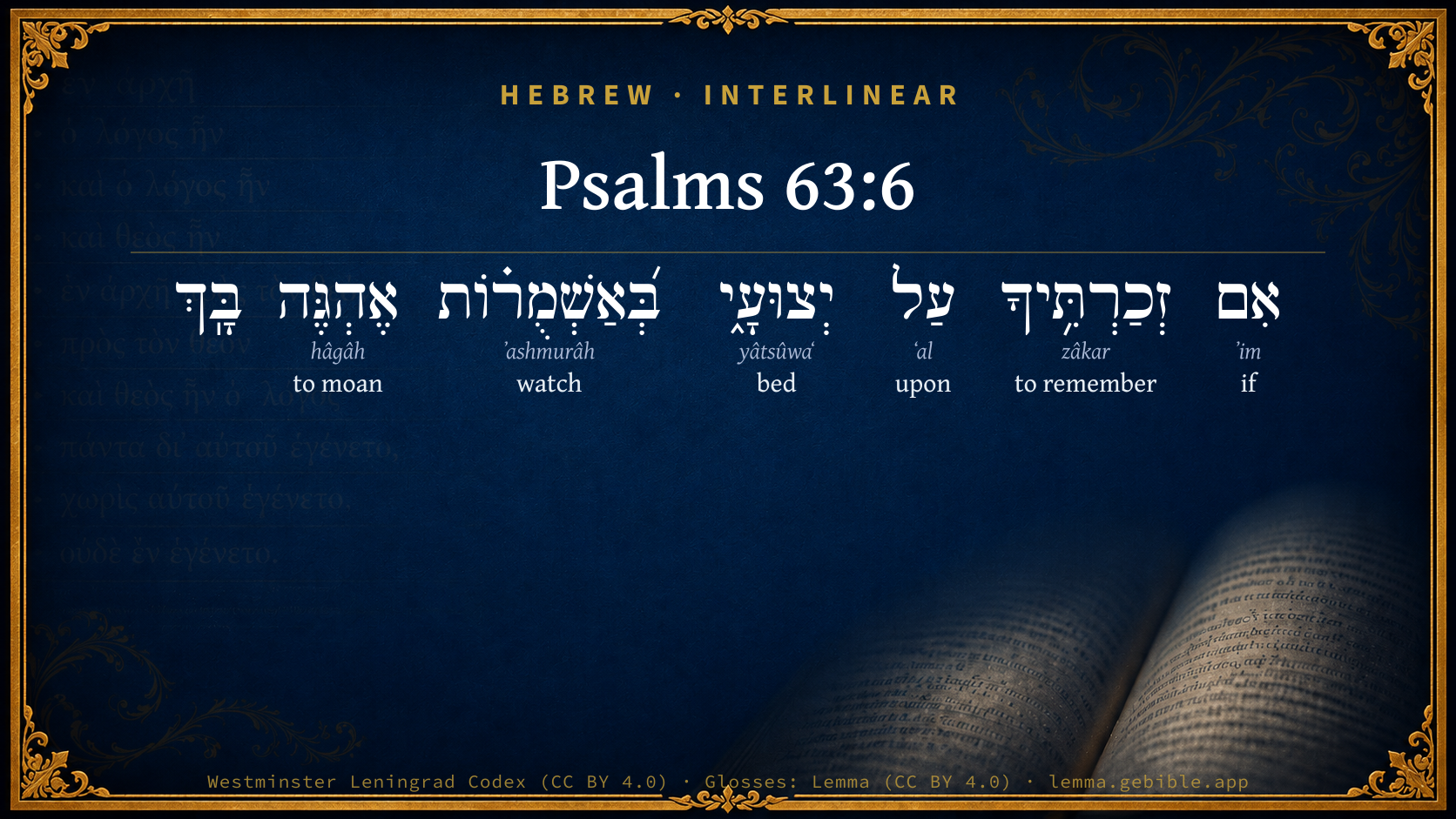
Hebrew (Westminster Leningrad Codex) Psalms 63:6 appears in the Hebrew Old Testament. The text above is from the Westminster Leningrad Codex. Each word links to its Strong’s number, a concise gloss, and parsing drawn from the Open Scriptures Hebrew Bible morphology. Click any word for its full Brown-Driver-Briggs (BDB) entry.
Download image
Cite this verse

Psalms 63:6 (World English Bible). Public Domain. Lemma interlinear Bible study tool, https://lemma.gebible.app/v/psalms/63/6.

Show BibTeX & RIS
BibTeX
RIS
English Translation
When I remember you on my bed, And think about you in the night watches.
World English Bible · Public Domain
Download a study sheet

One document with this verse’s original text, its word-by-word gloss line, the meaning frame, cross-references with their text, attributed commentary, and full source and license credits — printable, and it pastes into notes with its structure intact.

This verse Autodidact and up

Study sheet (.html) Plain text (.txt)

A passage Seminary Student

Up to 50 verses in one chapter. A passage sheet keeps up to 6 commentary sources and 12 cross-references per verse, in the order this page ranks them, and says so on the sheet whenever that leaves anything out. Ask for a single verse and you get the Autodidact verse sheet above.

Everything on this page stays free to read, with no account — the sheet is a download of what is already on screen, not access to it.

Want to remove ads? Support Godless Engineer
Compare translations 3

The same verse in 3 English versions, stacked beneath the original-language interlinear above. Click any original word for its lexicon entry.

Each is an independent rendering of the whole verse — the interlinear is not word-aligned to these translations.

Highlighted words mark where these versions differ — a whole-verse word diff, not a word-by-word alignment.

  • World English Bible Public Domain
    When I remember you on my bed, And think about you in the night watches.
  • King James Version Public Domain
    When I remember thee upon my bed, and meditate on thee in the night watches.
  • unfoldingWord Literal Text CC BY-SA 4.0
    When I remember you on my bed, I meditate on you in the night watches.

unfoldingWord Literal Text — © unfoldingWord, licensed CC BY-SA 4.0. Word-aligned USFM3 via Door43 (git.door43.org/unfoldingWord/en_ult).

Versions to compare (up to 4)

3 of 4 selected

Show all 18 translations

Every available English version of this verse, each an independent rendering of the whole verse.

  • World English Bible Public Domain
    When I remember you on my bed, And think about you in the night watches.
  • Berean Standard Bible Public Domain
    When I remember You on my bed, I think of You through the watches of the night.
  • Majority Standard Bible Public Domain
    When I remember You on my bed, I think of You through the watches of the night.
  • King James Version Public Domain
    When I remember thee upon my bed, and meditate on thee in the night watches.
  • American Standard Version (1901) Public Domain
    When I remember thee upon my bed, `And' meditate on thee in the night-watches.
  • Revised Version (1885) Public Domain
    When I remember thee upon my bed, and meditate on thee in the night watches.
  • Geneva Bible (1599) Public Domain
    When I remember thee on my bedde, and when I thinke vpon thee in the night watches.
  • Douay-Rheims (1899) Public Domain
    Let my soul be filled as with marrow and fatness: and my mouth shall praise thee with joyful lips.
  • Young's Literal Translation Public Domain
    If I have remembered Thee on my couch, In the watches -- I meditate on Thee.
  • Literal Standard Version CC BY-SA 4.0
    If I have remembered You on my bed, || I meditate on You in the watches.
  • Unlocked Literal Bible CC BY-SA 4.0
    when I think about you on my bed and meditate on you in the night hours.
  • unfoldingWord Literal Text CC BY-SA 4.0
    When I remember you on my bed, I meditate on you in the night watches.
  • Darby Bible Public Domain
    When I remember thee upon my bed, I meditate on thee in the night-watches:
  • World Messianic Bible Public Domain
    when I remember you on my bed, and think about you in the night watches.
  • Webster's Bible Public Domain
    \\63:5\\My soul shall be satisfied as with marrow and fatness; and my mouth shall praise thee with joyful lips:
  • Free Bible Version CC BY-SA 4.0
    I think of you all night long as I lie on my bed meditating about you.
  • Bible in Basic English Public Domain
    When the memory of you comes to me on my bed, and when I give thought to you in the night-time.
  • JPS Tanakh (1917) Public Domain
    (63-7) When I remember Thee upon my couch, and meditate on Thee in the night-watches.

Literal Standard Version (2020), Covenant Press — licensed CC BY-SA 4.0. Text via the HelloAO Bible API (eBible.org). Unlocked Literal Bible (unfoldingWord) — licensed CC BY-SA 4.0. Text via the HelloAO Bible API (eBible.org). unfoldingWord Literal Text — © unfoldingWord, licensed CC BY-SA 4.0. Word-aligned USFM3 via Door43 (git.door43.org/unfoldingWord/en_ult). Free Bible Version, Dr. Jonathan Gallagher — licensed CC BY-SA 4.0. Text via the HelloAO Bible API (eBible.org).

Word by word

More ways to search: Search by grammar → Find every occurrence → Compare this word →

Practice this passage: Drill this verse → Learn its vocabulary →

About this verse

These counts appear in no published source. They are computed here, from the morphology-tagged text and Lemma’s own curated glosses. What Lemma adds →

7
words
6
distinct lemmas
Wisdom
section

Notable vocabulary

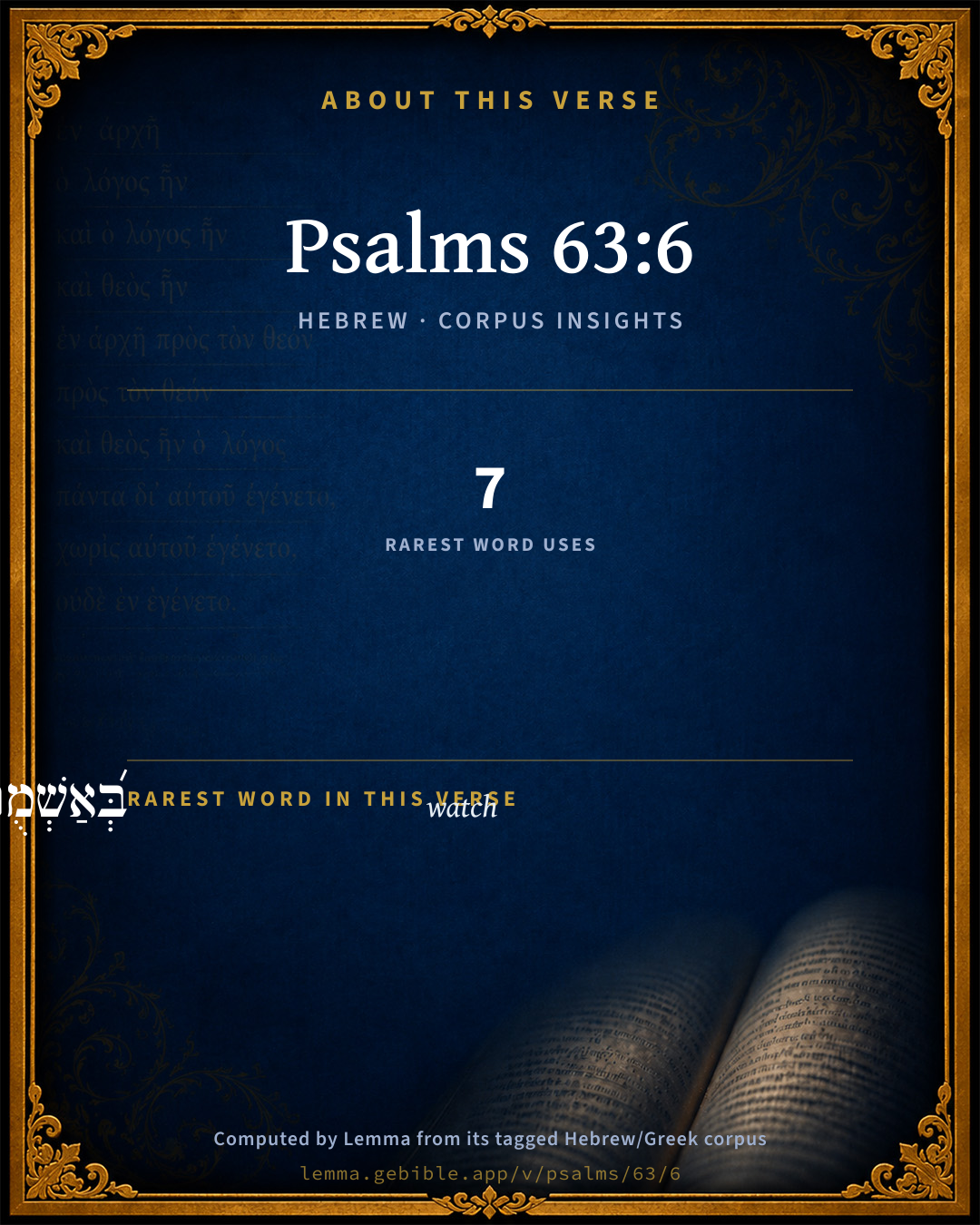
The rarest word here is בְּ֝אַשְׁמֻר֗וֹת watch H821 — appearing just 7 times in the whole Hebrew Bible.

Shared distinctive vocabulary

בְּ֝אַשְׁמֻר֗וֹת watch H821 occurs in 7 verses of the Hebrew Bible. Also found in:

Grammatical profile

  • 2 verbs
  • 2 nouns
  • 2 prepositions
  • 1 conjunction

Verb forms

  • זְכַרְתִּ֥יךָ Qal · Perfect
  • אֶהְגֶּה Qal · Imperfect

Hebrew & Septuagint length

In English translation the verse runs 15 words from the Hebrew and 18 from the Septuagint (LXX English) — closely comparable.

A rough comparison of the two English renderings, which tokenize alike — not a word-level alignment.

Word counts can differ between the Hebrew and the Greek without any difference in meaning — e.g. the Hebrew direct-object marker אֵת has no separate Greek word, and Greek often adds the article ὁ.

Cross-references

9

Topical passages linked to Psalms 63:6 in the Treasury of Scripture Knowledge — connected by theme and wording, ordered by reader-vote popularity; previews shown in the World English Bible.

  • Psalms 42:8 Yahweh will command his loving kindness in the daytime. In the night his song shall be with me: A prayer to the God of my life.
  • Psalms 119:147–148 I rise before dawn and cry for help. I put my hope in your words.
  • Psalms 149:5 Let the saints rejoice in honor. Let them sing for joy on their beds.
  • Psalms 119:55 I have remembered your name, Yahweh, in the night, And I obey your law.
  • Psalms 77:4–6 You hold my eyelids open. I am so troubled that I can't speak.
  • Psalms 139:17–18 How precious to me are your thoughts, God! How vast is the sum of them!
  • Lamentations 2:19 Arise, cry out in the night, at the beginning of the watches; Pour out your heart like water before the face of the Lord: Lift up your hands toward him for the life of your young children, that faint for hunger at the head of every street.
  • Song of Solomon 5:2 I was asleep, but my heart was awake. It is the voice of my beloved who knocks: Open to me, my sister, my love, my dove, my undefiled; For my head is filled with dew, My hair with the dampness of the night.
  • Song of Solomon 3:1–2 By night on my bed, I sought him whom my soul loves. I sought him, but I didn't find him.

Cross-references courtesy of OpenBible.info (CC BY 4.0).

Hebrew and Greek witnesses Masoretic Hebrew ↔ Greek Septuagint

The same verse in the two great witnesses to the Old Testament, shown verse-for-verse.

You’re reading Greek Psalm 62 (Hebrew Psalm 63). The Septuagint counts the superscription, so verse numbers can differ from the Hebrew — chapter-level alignment, not verse-by-verse. Numbering follows Rahlfs.

These are two independent witnesses, not word-aligned to each other, and the Septuagint is shown in lemma (dictionary) form.

Hebrew Psalms 63:6 Masoretic · Westminster Leningrad Codex

אִם זְכַרְתִּ֥יךָ עַל יְצוּעָ֑י בְּ֝אַשְׁמֻר֗וֹת אֶהְגֶּה בָּֽךְ

When I remember you on my bed, And think about you in the night watches.

World English Bible · Public Domain

Greek LXX Greek Psalm 62:6 Septuagint · lemma form

ὡσεί στέαρ καί πιότης ἐνπίμπλημι ὁ ψυχή ἐγώ καί χεῖλος ἀγαλλίασις αἰνέω ὁ στόμα ἐγώ

Forasmuch as I have remembered you on my bed: in the early seasons I have meditated on you.

LXX2012 (modern English Septuagint) · Public Domain

Hebrew: Westminster Leningrad Codex (CC BY 4.0). Greek: Septuagint (public domain); English from LXX2012 (modern English Septuagint) (Public Domain). How the Septuagint differs from the Hebrew →

Commentary

Notes on Psalms 63:6 from classic Christian and Jewish commentators (each source and its license shown beneath its notes). The classic Christian expositions comment on the surrounding passage and are grouped to its opening verse, so a note may address several verses; the Jewish commentaries on the Tanakh (Rashi and others) are per-verse, so they appear only where the commentator wrote on this verse.

Lemma curates 59 commentaries, every one of them public domain or Creative Commons licensed, each selected and text-cleaned for this edition rather than reprinted as found. About our sources →

Trapp's Complete Commentary

John Trapp

Psa 63:6 When I remember thee upon my bed, [and] meditate on thee in the [night] watches.

Ver. 6. When I remember thee upon my bed] Heb. beds, in the plural; because he took up his lodging in many places, having heaven sometimes for his canopy; and well content to break his sleep for God’s service.

In the night watches] The ancients divided the night into certain watches, Mar 13:35.

John Trapp, A Commentary or Exposition upon All the Books of the Old and New Testament (1647–1656) — public domain. Text from a community e-Sword module.

The Biblical Illustrator

Joseph S. Exell

Psa_63:6

Have I not remembered Thee in my bed, and thought upon Thee when I was waking?

The saint devout by night

Night piety is--

1. Commanded (Deu_6:7; Jos_1:8; Lam_2:19).

2. Exemplified (Psa_119:55; Psa_119:147-148; Luk_6:12).

3. Profitable (Psa_16:7; Psa_77:6; Psa_1:2).

I. The object of night piety.

1. Jehovah.

2. Our God.

3. One who is awake at every hour of the night. At any of the watches, there is access by Christ into the secret of His presence.

4. One who makes the night a season of visiting some of His chosen with the kindness of His love (Psa_17:3; Psa_42:8).

II. The exercises of night piety mentioned in the text.

1. Remembering the Lord upon our bed is first mentioned; remembering what He is, what He hath done, what He hath promised, what He hath commanded, what He hath given, and what way He hath led us through life by His providence.

2. The other exercise mentioned in our text is, meditating on the Lord in the night watches. This also includes several particulars; as thinking on Him, believing in Him, hoping in Him, praying to Him, and glorifying Him with praise.

III. The profit of night piety. They minister--

1. To the satisfying of the soul.

2. To the filling of the mouth with praise.

3. To the sanctifying of the lips to express the praises of the Lord with joy and gladness.

4. To the preventing of the intrusions of evil thoughts upon us, which often disturb and spoil the exercises of our night piety. (A. Shanks.)

Remembrance of and meditation on God

I. Remembrance of God.

1. The thing itself. There are three sorts and several kinds of Gods dispensations to us, in reference whereunto especially we are to remember Him.

(1) As to His work of creation, His making and framing of us. Not to remember the Lord which is our Maker and Creator, is very gross and incongruous. This deserves our remembrance especially, it is very useful to us for several purposes. As first, to strengthen our faith; He that made us He will also preserve us. To commit our souls to Him as to a faithful Creator. He that created us will raise us again. And as to strengthen our faith, so likewise to quicken our obedience, and to teach us to give up our souls and bodies, as a living sacrifice to Him, it is very pertinent to remember God thus, namely, in reference to this His first work of creation.

(2) In reference to His work of sanctification, as our Redeemer; His now making us, and framing us again, remember Him so; and that both as to the work of grace itself in us, as also in reference to all good means, for the strengthening of it.

(3) In reference to His work of providence. God has many thoughts of us (Jer_29:11; Psa_136:23; Gen_8:1; Gen_19:20; Gen_30:22; Mal_3:16). Now, forasmuch as God does thus carefully remember us, there is all the reason that may be why we should also remember Him. To help and strengthen our memories in this particular, let us be careful of these directions. First, get into ourselves strong apprehensions of God, and of that goodness and excellency which is in Him. Apprehension is a great help to memory; that which is deeply fastened and settled, and rooted in us, it will not so easily be forgotten of us; it is so with things, and it is so with persons, they are all there easily remembered where they are well apprehended. Secondly, let us labour to have good affections toward Him. If we love God we shall not forget Him, but we shall often have thoughts of Him; He will come into our minds, even in some absence and remoteness from Him, wherein we do not, perhaps, enjoy Him in His ordinances as formerly we have done. Thirdly, let us view His tokens and pledges, and remembrances of Himself, which He has left with us, as the Word and Sacraments, and the like. These are remembrances of Him, and accordingly we should apply ourselves to them under this notion; we should make use of them to such a purpose as this is.

2. The circumstance of place, for the performing of it. On my bed. The bed may be looked upon as a place for the remembrance of God in it according to a threefold notion. Either first of all, as a place of choice; in the bed to choose rather than anywhere else, where I am left to my liberty. Or, secondly, as a place of necessity; in the bed at least, where I cannot anywhere else, as having restraints upon me. Or thirdly, as a place of indifferency; in the bed as well as anywhere else besides, as it happens, and falls out unto me. And here again there are two things further considerable. First, a Christians privilege. And secondly, a Christians duty upon this privilege. The privilege of a Christian is this, that he may remember God in his bed where he can nowhere else. A Christians duty is this, that he ought to remember God on his bed, where he hath nowhere else to remember Him; he is not to neglect such an opportunity as this is. Here is a third now which we may add to the rest, not only a Christians privilege, and a Christians duty, but likewise his practice in the example of the prophet David; he did it for his particular, and hereby shows us what is likewise the nature and disposition of many others besides in this respect, even to remember God in their beds; where they are restrained from the more public enjoyment, yet to think of Him even in those restraints (Psa_42:4).

II. Meditation on God.

1. The thing itself. Meditation is beyond remembrance, for that may be only transitory and flitting, this is fixed and settled, and does signify a further fastening and continuing of our thoughts upon that which they are pitched upon.

(1) The attributes of God; His goodness, and wisdom, and power, meditate on them; they are such as are very worthy of our choicest thoughts, and we cannot think too much of them, so far forth as they are revealed unto us.

(2) His works which flow from His attributes, do much call for our meditation.

(3) Also the Word of God (1Ti_4:15). It is meditation which makes us to profit and thrive by that which we hear, which without this is very much lost. As it is not the meat while in the stomach, but digested and thoroughly concocted, and altered and changed, and so dispersed into the several parts of the body, which causes nourishment and increase; even so is it also here in spirituals.

2. The amplification of it from the circumstance of time, in the night watches. This was the time which David took for this performance. As for the place, on his bed; so for the time and season, in the night. He brake his sleep to think upon God (Psa_77:4). But why then, of all other times? Why does David choose to meditate on God in the night? Or why should any other do so in imitation of him? Surely there is very good ground and reason for it, as will appear to us in sundry regards, which we may take notice of.

(1) As freest from distraction, and the cumbrances and troubles of the world.

(2) As it is most subject to temptation and assault from Satan. We have never more need to betake and apply ourselves to God, than then, when we are in greatest danger of the devil, who is our spiritual enemy. Now, this we are at such a time as this is. He is a spirit of darkness, and so watches for a time of darkness, especially for the laying of his snares, and making his onsets upon us, as robbers they wait for the night; so then does this spiritual robber of souls. Then he may here work upon the fancy as he hath opportunity for it.

(3) As the time when conscience most works, and God Himself does usually draw near and apply Himself to us (Psa_16:7; Psa_17:3; Job_35:10). These things laid together, do make very much for such a performance as this is; and not only for meditation, but prayer, as the Hebrew word Hagah will bear it. We have herein the example not only here of David in the text, but also of some others in Scripture. Thus our Lord spent whole nights in prayer (Luk_6:12). Anna served God with fastings and prayer night and day. Paul had his labours, and lastings, and watchings (2Co_6:5; 2Co_11:27). And so for others. We know how in the primitive times they had their vigils and meetings in the night, which though at first had a good ground for them, in regard of the persecution by heathens; yet afterwards upon as good ground for their abuse were taken away. But, however, the moral and analogy holds good, and is in force still, which is this, To watch unto prayer, and not to omit such seasons as the night for ejaculation and lifting up our hearts to God in it, as David professes here of himself. (T. Horton, D. D.)

Influential meditation

I. It is directed to the most influential subject--Meditation on God--

1. Serves to rouse the intellectual faculties to their highest effort.

2. Serves to prostrate the soul in humility.

3. Serves to spiritualize all the sympathies of our nature.

4. Serves to assimilate the character to the Perfect One.

II. It is employed in a most influential season. In the night watches. Night is pre-eminently the season for solemn thought.

1. It gives the mind an inward direction. As all outside of him is thus entombed in silence and sable, his soul becomes solemnly conscious of itself and its responsibility.

2. It gives the mind a solemnity of mood. Night is the emblem and minister of seriousness. A thought which heaves the whole nature with solemn emotions in the night, has often but little influence over us in the day. (Homilist.)

Meditating upon religion

The life of God in the soul of man, the Christian life, is marked, amongst other things, by religion gradually gaining possession of the thoughts. It has been said that if we thought about religion as it deserves, we should never think about anything else. Nor can we, with strictness, deny this. For religious concerns do so outweigh all others in their importance and value. The wonder is not that men think so much but so little of it. The cast and turn of our infirm and fleshly nature lean all on the side of our thinking not enough of spiritual things.

I. Our nature is affected chiefly by what we see; the unseen has, therefore, but little power.

II. And we regard the things of religion not as near to us, but as distant. Like children we are affected only by what is present and near. But though this delusion be so general it has no foundation in reason. We do not so act in regard to our worldly affairs.

III. The spirituality of religion also hinders our thinking of it. All religion which is effectual must be spiritual. But our nature cares not for that which is purely spiritual. Therefore we need to pray for the help of the Spirit of God. (Archdeacon Paley.)

The Biblical Illustrator, edited by Joseph S. Exell (c. 1880s–1900s) — public domain. Text from a community e-Sword module.

J. A. Alexander on Psalms

Joseph Addison Alexander

7. (Psa 63:6). When I remember thee upon my bed, in the watches I will meditate upon thee. The first word in Hebrew is the one commonly translated if; but the condition indicated by it is sometimes specifically that of time. There seems to be reference in this Verse to the old division of the night, for municipal and military purposes, into three watches, the first (Lam 2:19), the middle (Jdg 7:19), and the morning watch (Exo 14:24, 1Sa 11:11). I will meditate of thee, or more literally in thee, implying an entire absorption of his powers and affections in the object. See above, on Psa 1:2.

Joseph Addison Alexander, The Psalms Translated and Explained (1850) — public domain. Text from a community e-Sword module.

Tyndale Open Study Notes

Tyndale Open Resources

63:6-8 The psalmist reflects and meditates on God’s presence through the night. In the absence of light, God is the light. The quietness of the night and the longing for dawn provide time to focus on the true significance of life with the Lord.

63:6 Meditating on God requires focused awareness, concentration, thought, and reflection (see 1:2).

Tyndale Open Study Notes — © Tyndale Open Resources, licensed CC BY-SA 4.0. Text via the HelloAO Bible API.

Jamieson, Fausset & Brown

Robert Jamieson, A. R. Fausset & David Brown

night--as well as day. Past favors assure him of future, and hence he presses earnestly near to God, whose power sustains him (Psa 17:8; Psa 60:5).

Jamieson, Fausset & Brown — Commentary Critical and Explanatory on the Whole Bible (1871) — public domain (CC PDM 1.0). Text via the HelloAO Bible API.

Adam Clarke's Commentary

Verse 6. When I remember thee upon my bed] I will lie down in thy fear and love; that I may sleep soundly under thy protection, and awake with a sense of thy presence and approbation; and when I awake in the night watches, or be awakened by them, I will spend the waking moments in meditation upon thee.

Adam Clarke's Commentary on the Bible (1810–1826) — public domain. Text from a community e-Sword/MySword module.

John Calvin's Commentaries

6 I shall surely remember thee, etc. It may be read also, when, or, as often as I remember thee, I will pray in the night watches. But as the Hebrew particle here used is occasionally taken for an adverb of affirmation, as well as of time, I have adhered to the commonly received translation, In this case, his remembering God is to be understood as the same thing with his meditating upon him; and the one clause contains just a repetition of the sentiment expressed in the other. If the particle be taken in the different sense formerly mentioned, the words intimate, that as often as the name of God recurred to his mind, he would dwell upon it with pleasure, and speak of his goodness. He particularly mentions the night watches, as, when retired from the sight of our fellow-creatures, we not only revert to what may have given us anxiety, but feel our thoughts drawn out more freely to different subjects. We have next the reason assigned for the engagement or declaration he has just made, which is, that he owed to God his preservation. The experience of the divine goodness should dispose us to prayer as well as praise. “I will come into thy house,” says the Psalmist in another place, “in the multitude of thy mercy,” (Psalm 5:7.) The second part of the seventh verse is expressive of the lively hope with which he was animated. He was resolved to rejoice and triumph under the shadow of God’s wings, as feeling the same peace and satisfaction in reliance upon his protection as he could have done had no danger existed.

John Calvin's Commentaries (1540-1563) — public domain. Text from the Calvin Translation Society English edition (1840s-50s) via the Christian Classics Ethereal Library (ccel.org). Calvin's coverage is partial (roughly two-thirds of the Bible); uncommented books and verses are honest gaps, never fabricated. The 19th-century editor's footnotes and remarks are omitted so the notes are faithfully Calvin's own voice.

Ellicott's Commentary for English Readers

(6) Remember.—Better, remembered.

Bed.—Literally, beds.

Night watches.—According to the Jewish reckoning, the night was divided into three watches: the “beginning,” or head (rôsh); the “middle” (tikhôn, Jdg_7:19); and the “morning” (boker, Exo_14:24).

A Bible Commentary for English Readers, edited by Charles John Ellicott (1878–1897) — public domain. Text from a community e-Sword module.

The Cambridge Bible for Schools and Colleges

gen. ed. J. J. S. Perowne

6. The A.V. connects this verse with Psa_63:5, but the absence of and in the second clause makes it preferable to connect it with Psa_63:7, thus:

When I remember thee upon my bed,

I meditate on thee in the night watches:

For thou hast been my help,

And in the shadow of thy wings will I shout for joy.

When once he calls God to mind as he lies down to rest, he is so engrossed with the thought of His love that he meditates on it all night long—per singulas vigilias (Jer.). The night was divided into three watches by the Israelites (Lam_2:19; Jdg_7:19; 1Sa_11:11); the division into four watches referred to in the N.T. was of Roman origin.

6, 7. Thankful recollection of past mercies.

The Cambridge Bible for Schools and Colleges (gen. ed. J. J. S. Perowne; Cambridge University Press, 1878–1918) — public domain. Text from a community e-Sword module.

John Gill's Exposition

When I remember thee upon my bed,.... Or "beds" (q); seeing he lay in many, as Kimchi observes, being obliged to flee from place to place. The sense is, that when he was on his bed in the night season, when alone, and free from worldly cares and fatigues, and called to mind the love of God to him, the past experience of his kindness, his promises to hits, and the fulfilment of them: that he should then be delightfully entertained, abundantly satisfied, slid his mouth be filled with songs of praise;

and meditate on thee in the night watches; which the Jewish writers on the text say were three, as they were with the Jews, but with the Romans four; See Gill on Mat 14:25; and the night, in the times of Homer (r), was divided into three parts: the night season is a very proper one for meditation on the perfections, providences, promises, word and works of God; and which is very delightful and profitable, when attended with the presence, Spirit, and grace of God. The Targum is,

"in the watches I will meditate on thy word.''

(q) "stratis meis", Pagninus, Montanus, Piscator, Cocceius; so Junius & Tremellius, Ainsworth. (r) Iliad. 10. v. 252, 253.

John Gill's Exposition of the Whole Bible (1746–1763) — public domain (CC PDM 1.0). Text via the HelloAO Bible API.

Albert Barnes' Notes on the Bible

When I remember thee upon my bed - See the notes at Psa 42:8. That is, when I lie down at night; when I compose myself to sleep. Nothing can be more proper than that our last thoughts, as we sink into quiet slumber, should be of God; of his being, his character, his mercy, his loving-kindness; of the dealings of his providence, and the manifestations of his grace toward us, during the day; and nothing is better suited to compose the mind to rest, and to induce quiet and gentle slumber, than the calmness of soul which arises from the idea of an Infinite God, and from confidence in him. Often when restless on our beds - when nothing else will lull the body to rest, the thought of God - the contemplation of his greatness, his mercy, and his love - the sweet sense of an assurance of his favor will soothe us, and cause us to sink into gentle repose. So it may be - so it will be - when we are about to sleep the long sleep of death, for then the most appropriate thoughts - the thoughts that will best prepare us for that long sleep - will be thoughts of God.

And meditate on thee in the night-watches - See the notes at Psa 1:2. The word watches here refers to the ancient divisions of the night for municipal or military purposes - periods of the night assigned to different persons to keep watch around a camp or city. The most common division of the night was into three parts, though the arrangement varied at different times. See Mat 14:25; Luk 12:38.

Albert Barnes' Notes on the Bible (1834–1885) — public domain. Text from a community e-Sword/MySword module.

The Treasury of David

Charles H. Spurgeon

Ver. 6. When I remember thee upon my bed. Lying awake, the good man betook himself to meditation, and then began to sing. He had a feast in the night, and a song in the night. He turned his bedchamber into an oratory, he consecrated his pillow, his praise anticipated the place of which it is written, "There is no night there." Perhaps the wilderness helped to keep him awake, and if so, all the ages are debtors to it for this delightful hymn. If day's cares tempt us to forget God, it is well that night's quiet should lead us to remember him. We see best in the dark if we there see God best.

And meditate on thee in the night watches. Keeping up sacred worship in my heart as the priests and Levites celebrated it in the sanctuary. Perhaps David had formerly united with those "who by night stand in the house of the Lord, "and now as he could not be with them in person, he remembers the hours as they pass, and unites with the choristers in spirit, blessing Jehovah as they did. It may be, moreover, that the king heard the voices of the sentries as they relieved guard, and each time he returned with renewed solemnity to his meditations upon his God. Night is congenial, in its silence and darkness, to a soul which would forget the world, and rise into a higher sphere. Absorption in the most hallowed of all themes makes watches, which else would be weary, glide away all too rapidly; it causes the lonely and hard couch to yield the most delightful repose --repose more restful than even sleep itself. We read of beds of ivory, but beds of piety are better far. Some revel in the night, but they are not a tithe so happy as those who meditate in God.

Ver. 6. When I remember thee upon my bed, (and) meditate on thee in the night watches. Thus the English version connects this verse with Ps 63:5. But the division of the strophes renders the following translation preferable, which, moreover, obviates the need of supplying "and:" Whenever I remember thee upon my bed, I meditate on thee in the night watches. The remembrance of thee on my bed so engrosses me, that I cannot draw my mind off the thought, so as to fall into the obliviousness of sleep; I often meditate on thee through the whole night watches. So Ps 119:55, 148 1:2. The Hebrew is beds; probably alluding to the fact that in his unsettled life in exile, he seldom slept for many nights in the same bed, but through fear of adversaries slept in different places. There were three night watches: the first (La 2:19); the middle (Jud 7:19); the third, or morning watch (Ex 19:24 1Sa 2:11). In the New Testament, the Roman usage of four prevails. A. R. Faussett.

Ver. 6. Remember--and meditate. The meditation of anything hath more sweetness in it than bare remembrance. The memory is the chest to lay up a truth, but meditation is the palate to feed upon it. The memory is like the ark in which the manna was laid up; meditation is like Israel's eating of the manna. When David began to meditate upon God, it was sweet to him as marrow. There is as much difference between a truth remembered and a truth meditated, as between a cordial in the glass and a cordial drunk down. John Wells (1668), in "Sabbath Holiness."

Ver. 6. Upon my bed. The bed may be looked upon as a place for the remembrance of God in it, according to a threefold notion.

I. As a place of choice. In the bed, of choice,

rather than anywhere else, where I am left to my

liberty. David when he had a mind to remember God, he

would make choice of his bed for it, as most suitable

and agreeable to it. In case of excessive weariness

contracted to the body from some occasion (this is

often put accidentally in Scripture), "To commune with

our hearts upon our bed, "etc., the occasion of it

here; it may fall out that the bed may be the fittest

place for such a duty as this. Ps 4:4.

II. As it is a place of necessity. In my bed at least,

when I cannot anywhere else, as having restraints upon

me. David, when (as now it was with him) he was

detained from the public ordinances, whether by

sickness, or any other impediment which he could not

withstand, yet he would not now wholly forget God; he

would remember him even in his bed. This is another

notion in which we may take it.

III. As a place of indifference; that is, there as well

as anywhere besides. I will not only remember thee

when I am up, when I shall make it my business to

remember thee, but even in my bed too. I will take an

occasion and opportunity to remember thee there. By

commending myself to thee, when I lie down to rest, and

acknowledging and owning of thee when I first awake. Thomas Horton.

Ver. 6. There were night watches kept in the tabernacle, for praising God (Ps 134:1), which it is probable David, when he had liberty, joined with the Levites in: but now he could not keep place with them, he kept time with them, and wished himself among them. Matthew Henry.

Ver. 6.

I. Important duties too much neglected: "Remembering

God, ""Meditating on Him."

II. Favourable seasons within reach of all: "Upon my bed; "

"In the night watches." J. S. B.

Psalms 63:7*

Charles H. Spurgeon's The Treasury of David (1869–1885) — public domain. Psalms only. Text from a community e-Sword/MySword module.

Whedon's Commentary on the Bible

Daniel D. Whedon

6. Meditate… in the… watches—Through all “the night watches”—the whole night. The language of this verse does not accord with a condition of alarm, agitation, and precipitate flight, such as David experienced the first night of his escape from Absalom; nor do these calm night meditations answer to the deep disturbance and casting about of his soul then. (See introductory note.) But they perfectly suit the serene safety which ensued after the peaceful departure of Saul. 1Sa_24:22.

Night watches— Of these the Hebrews reckoned three: the first, or “beginning of the watches,” ending at midnight, Lam_2:19; the “middle watch,” ending at the “cock crowing” or about three o’clock, Jdg_7:19; and the “morning watch,” ending at sunrise, Exo_14:24. In the time of Christ the Jews had adopted the Roman method of reckoning four watches of three hours each, beginning at six o’clock in the evening. Mar_13:35

Daniel D. Whedon (gen. ed.), Commentary on the Old and New Testaments (1874–1909) — public domain. Text from a community e-Sword module.

The Pulpit Commentary

When I remember thee upon my bed, and meditate on thee in the night watches. David had doubtless done this during the long and anxious night which followed his first day in the wilderness of Judea. (2Sa_16:14)

The Pulpit Commentary (1880–1919), ed. H.D.M. Spence-Jones & Joseph S. Exell — public domain. Text from a community e-Sword module.

Rashi

Rabbi Shlomo Yitzchaki (Rashi)

when my mouth praises with expressions of song Heb. ושפתי, languages of songs, as (Gen. 11: 1): “And all the earth was of one language (שפה),” which is translated: לישן חד.

Rashi on the Tanakh — English translations: “The Judaica Press complete Tanach with Rashi, translated by A. J. Rosenberg” (CC BY 4.0); “Pentateuch with Rashi's commentary by M. Rosenbaum and A.M. Silbermann, 1929-1934” (public domain); “The Metsudah Tanach series, Lakewood, N.J” (CC BY 4.0); and “The Book of Joshua, Metsudah Publications, 1997” (CC BY 4.0). Text via Sefaria.

Lesson kit

Teaching starters — assembled from the data on this page, not authored interpretation. Every prompt links to the verse data it draws on. Edit before teaching.

Psalms, in the Wisdom, opens this verse with 7 words (6 distinct Hebrew lemmas). Its most distinctive word is ʼashmurâh (“watch”). A historical commentator’s framing appears above. Read the whole chapter for the surrounding context.

Discussion questions

  1. How does “watch” (ʼashmurâh) shape what this verse is saying?
  2. How does Exodus 14:24, which shares the word «watch», read alongside this verse?
  3. These translations render this verse differently. What is at stake in choosing one wording over another?
  4. «זְכַרְתִּ֥יךָ» is a Qal Perfect verb. How does that grammatical form shape the action described?
  5. Compare how Trapp's Complete Commentary and The Biblical Illustrator read this verse. Where do they agree or differ?

Things to notice

Reading settings

Reading text

Shown beneath each verse's original-language words.

Old Testament
Old Testament edition

Read the OT as the Masoretic Hebrew (MT) or the Greek Septuagint (LXX).

English shown for the Greek Septuagint (in the Hebrew ↔ Greek comparison).

Comparing translations? Open the Compare panel on any verse page to stack up to four side by side.