
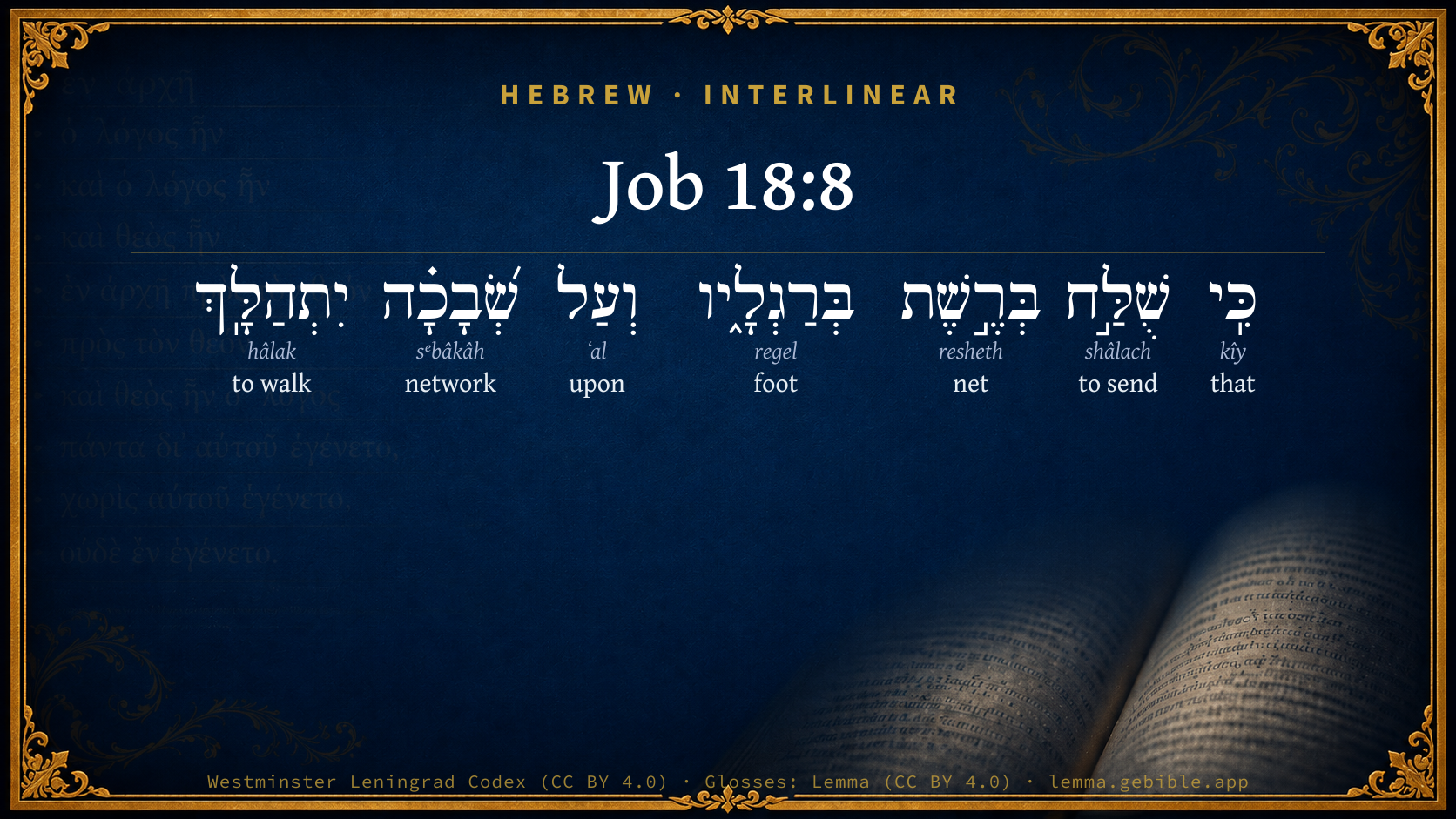
Job 18:8

Hebrew (Westminster Leningrad Codex) Job 18:8 appears in the Hebrew Old Testament. The text above is from the Westminster Leningrad Codex. Each word links to its Strong’s number, a concise gloss, and parsing drawn from the Open Scriptures Hebrew Bible morphology. Click any word for its full Brown-Driver-Briggs (BDB) entry.
Download image
Cite this verse

Job 18:8 (World English Bible). Public Domain. Lemma interlinear Bible study tool, https://lemma.gebible.app/v/job/18/8.

Show BibTeX & RIS
BibTeX
RIS
English Translation
For he is cast into a net by his own feet, And he wanders into its mesh.
World English Bible · Public Domain
Download a study sheet

One document with this verse’s original text, its word-by-word gloss line, the meaning frame, cross-references with their text, attributed commentary, and full source and license credits — printable, and it pastes into notes with its structure intact.

This verse Autodidact and up

Study sheet (.html) Plain text (.txt)

A passage Seminary Student

Up to 50 verses in one chapter. A passage sheet keeps up to 6 commentary sources and 12 cross-references per verse, in the order this page ranks them, and says so on the sheet whenever that leaves anything out. Ask for a single verse and you get the Autodidact verse sheet above.

Everything on this page stays free to read, with no account — the sheet is a download of what is already on screen, not access to it.

Want to remove ads? Support Godless Engineer
Compare translations 3

The same verse in 3 English versions, stacked beneath the original-language interlinear above. Click any original word for its lexicon entry.

Each is an independent rendering of the whole verse — the interlinear is not word-aligned to these translations.

Highlighted words mark where these versions differ — a whole-verse word diff, not a word-by-word alignment.

  • World English Bible Public Domain
    For he is cast into a net by his own feet, And he wanders into its mesh.
  • King James Version Public Domain
    For he is cast into a net by his own feet, and he walketh upon a snare.
  • unfoldingWord Literal Text CC BY-SA 4.0
    For he will be cast into a net by his feet, and he will wander into a pitfall.

unfoldingWord Literal Text — © unfoldingWord, licensed CC BY-SA 4.0. Word-aligned USFM3 via Door43 (git.door43.org/unfoldingWord/en_ult).

Versions to compare (up to 4)

3 of 4 selected

Show all 18 translations

Every available English version of this verse, each an independent rendering of the whole verse.

  • World English Bible Public Domain
    For he is cast into a net by his own feet, And he wanders into its mesh.
  • Berean Standard Bible Public Domain
    For his own feet lead him into a net, and he wanders into its mesh.
  • Majority Standard Bible Public Domain
    For his own feet lead him into a net, and he wanders into its mesh.
  • King James Version Public Domain
    For he is cast into a net by his own feet, and he walketh upon a snare.
  • American Standard Version (1901) Public Domain
    For he is cast into a net by his own feet, And he walketh upon the toils.
  • Revised Version (1885) Public Domain
    For he is cast into a net by his own feet, and he walketh upon the toils.
  • Geneva Bible (1599) Public Domain
    For hee is taken in the net by his feete, and he walketh vpon the snares.
  • Douay-Rheims (1899) Public Domain
    For he hath thrust his feet into a net, and walketh in its meshes.
  • Young's Literal Translation Public Domain
    For he is sent into a net by his own feet, And on a snare he doth walk habitually.
  • Literal Standard Version CC BY-SA 4.0
    For he is sent into a net by his own feet, || And he habitually walks on a snare.
  • Unlocked Literal Bible CC BY-SA 4.0
    For he will be thrown into a net by his own feet; he will walk into a pitfall.
  • unfoldingWord Literal Text CC BY-SA 4.0
    For he will be cast into a net by his feet, and he will wander into a pitfall.
  • Darby Bible Public Domain
    For he is sent into the net by his own feet, and he walketh on the meshes;
  • World Messianic Bible Public Domain
    For he is cast into a net by his own feet, and he wanders into its mesh.
  • Webster's Bible Public Domain
    For he is cast into a net by his own feet, and he walketh upon a snare.
  • Free Bible Version CC BY-SA 4.0
    Their own feet trip them up and they are caught in a net; as they walk along they fall into a pit.
  • Bible in Basic English Public Domain
    His feet take him into the net, and he goes walking into the cords.
  • JPS Tanakh (1917) Public Domain
    For he is cast into a net by his own feet, and he walketh upon the toils.

Literal Standard Version (2020), Covenant Press — licensed CC BY-SA 4.0. Text via the HelloAO Bible API (eBible.org). Unlocked Literal Bible (unfoldingWord) — licensed CC BY-SA 4.0. Text via the HelloAO Bible API (eBible.org). unfoldingWord Literal Text — © unfoldingWord, licensed CC BY-SA 4.0. Word-aligned USFM3 via Door43 (git.door43.org/unfoldingWord/en_ult). Free Bible Version, Dr. Jonathan Gallagher — licensed CC BY-SA 4.0. Text via the HelloAO Bible API (eBible.org).

Word by word

More ways to search: Search by grammar → Find every occurrence → Compare this word →

Practice this passage: Drill this verse → Learn its vocabulary →

About this verse

These counts appear in no published source. They are computed here, from the morphology-tagged text and Lemma’s own curated glosses. What Lemma adds →

7
words
7
distinct lemmas
Wisdom
section

Notable vocabulary

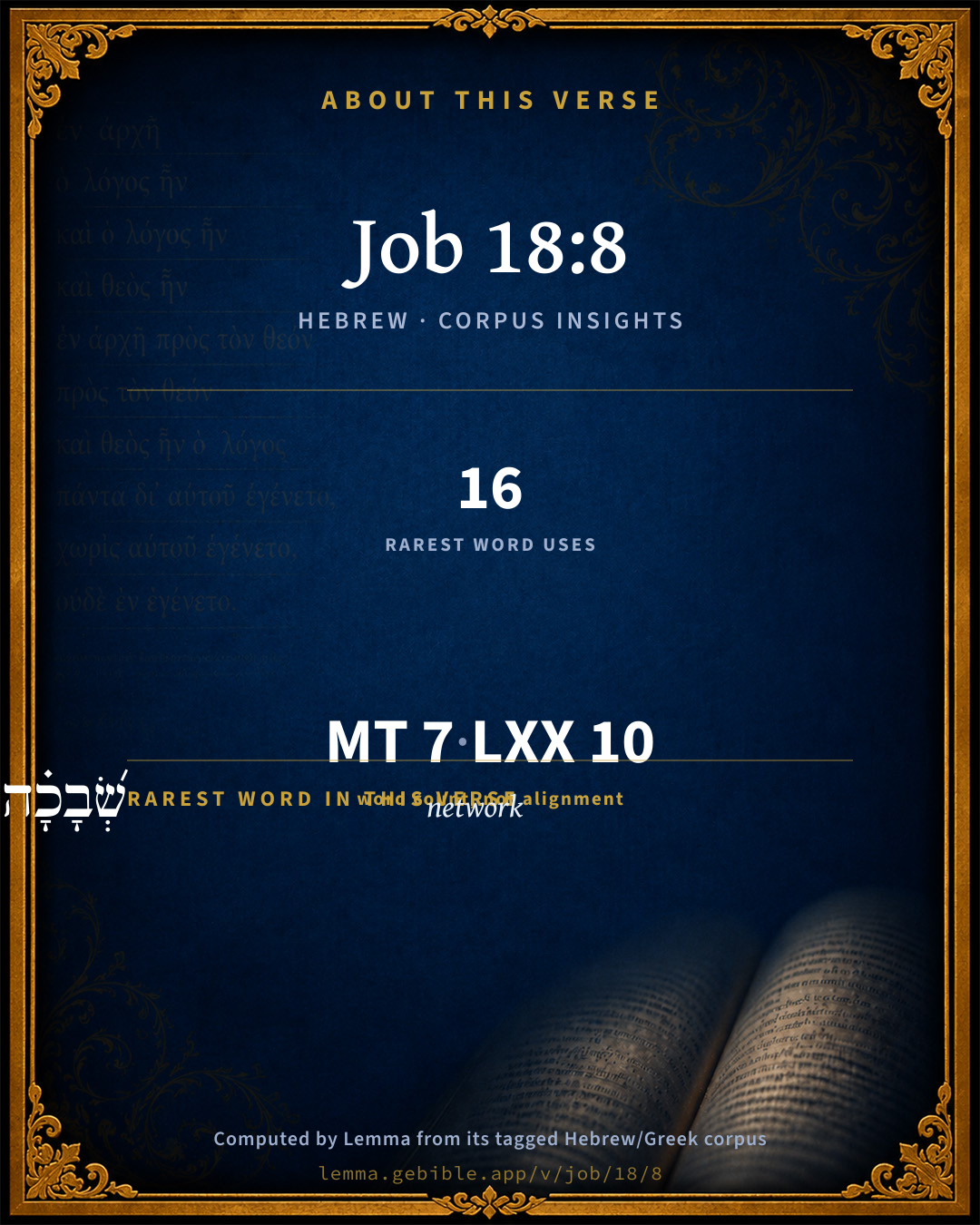
The rarest word here is שְׂ֝בָכָ֗ה network H7639 — appearing just 16 times in the whole Hebrew Bible.

Shared distinctive vocabulary

שְׂ֝בָכָ֗ה network H7639 occurs in 12 verses of the Hebrew Bible. Also found in:

Grammatical profile

  • 2 verbs
  • 3 nouns
  • 1 preposition
  • 1 conjunction

Verb forms

  • שֻׁלַּ֣ח Pual · Perfect
  • יִתְהַלָּֽךְ Hithpael · Imperfect

Hebrew & Septuagint length

In English translation the verse runs 17 words from the Hebrew and 17 from the Septuagint (LXX English) — the same length.

A rough comparison of the two English renderings, which tokenize alike — not a word-level alignment.

Word counts can differ between the Hebrew and the Greek without any difference in meaning — e.g. the Hebrew direct-object marker אֵת has no separate Greek word, and Greek often adds the article ὁ.

In the original languages it is 7 Hebrew tokens and 10 Greek tokens — but the two are counted differently (Hebrew bundles its prefixes and suffixes into one token; the Greek is in lemma form), so that isn’t a like-for-like length.

Cross-references

13

Topical passages linked to Job 18:8 in the Treasury of Scripture Knowledge — connected by theme and wording, ordered by reader-vote popularity; previews shown in the World English Bible.

  • Psalms 9:15 The nations have sunk down in the pit that they made; In the net which they hid, their own foot is taken.
  • Job 22:10 Therefore snares are round about you. Sudden fear troubles you,
  • Psalms 35:8 Let destruction come on him unawares. Let his net that he has hidden catch himself. Let him fall into that destruction.
  • Esther 3:9 If it please the king, let it be written that they be destroyed: and I will pay ten thousand talents of silver into the hands of those who have the charge of the [king's] business, to bring it into the king's treasuries.
  • Esther 6:13 Haman recounted to Zeresh his wife and all his friends everything that had happened to him. Then his wise men and Zeresh his wife said to him, If Mordecai, before whom you have begun to fall, be of the seed of the Jews, you shall not prevail against him, but shall surely fall before him.
  • Esther 7:5 Then spoke the king Ahasuerus and said to Esther the queen, Who is he, and where is he, that dared presume in his heart to do so?
  • Esther 7:10 So they hanged Haman on the gallows that he had prepared for Mordecai. Then was the king's wrath pacified.
  • Proverbs 5:22 The evil deeds of the wicked ensnare him. The cords of his sin hold him firmly.
  • Proverbs 29:6 An evil man is snared by his sin, But the righteous can sing and be glad.
  • Ezekiel 32:3 Thus says the Lord Yahweh: I will spread out my net on you with a company of many peoples; and they shall bring you up in my net.
  • 1 Timothy 3:7 Moreover he must have good testimony from those who are outside, to avoid falling into reproach and the snare of the devil.
  • 1 Timothy 6:9 But those who are determined to be rich fall into a temptation and a snare and many foolish and harmful lusts, such as drown men in ruin and destruction.
  • 2 Timothy 2:26 and they may recover themselves out of the devil's snare, having been taken captive by him to his will.

Cross-references courtesy of OpenBible.info (CC BY 4.0).

Hebrew and Greek witnesses Masoretic Hebrew ↔ Greek Septuagint

The same verse in the two great witnesses to the Old Testament, shown verse-for-verse.

These are two independent witnesses, not word-aligned to each other, and the Septuagint is shown in lemma (dictionary) form.

Hebrew Job 18:8 Masoretic · Westminster Leningrad Codex

כִּֽי שֻׁלַּ֣ח בְּרֶ֣שֶׁת בְּרַגְלָ֑יו וְעַל שְׂ֝בָכָ֗ה יִתְהַלָּֽךְ

For he is cast into a net by his own feet, And he wanders into its mesh.

World English Bible · Public Domain

Greek LXX Job 18:8 Septuagint · lemma form

ἐνβάλλω δέ ὁ πούς αὐτός ἐν παγίς ἐν δίκτυον ἑλίσσω

His foot also has been caught in a snare, and let it be entangled in a net.

LXX2012 (modern English Septuagint) · Public Domain

Hebrew: Westminster Leningrad Codex (CC BY 4.0). Greek: Septuagint (public domain); English from LXX2012 (modern English Septuagint) (Public Domain). How the Septuagint differs from the Hebrew →

Commentary

Notes on Job 18:8 from classic Christian and Jewish commentators (each source and its license shown beneath its notes). The classic Christian expositions comment on the surrounding passage and are grouped to its opening verse, so a note may address several verses; the Jewish commentaries on the Tanakh (Rashi and others) are per-verse, so they appear only where the commentator wrote on this verse.

Lemma curates 59 commentaries, every one of them public domain or Creative Commons licensed, each selected and text-cleaned for this edition rather than reprinted as found. About our sources →

The Cambridge Bible for Schools and Colleges

gen. ed. J. J. S. Perowne

8–11. All things hasten on his ruin; the moral order of the world is such that wherever he moves or touches upon it it becomes a snare to seize him. “Snares” do not mean temptations, they are hidden instruments of destruction that seize and hold the hunted creature. His “counsel,” and his own feet (Job_18:8), his evil nature and its outcome, his evil conduct, carry him into these snares—laid for wickedness in the constitution of things.

The Cambridge Bible for Schools and Colleges (gen. ed. J. J. S. Perowne; Cambridge University Press, 1878–1918) — public domain. Text from a community e-Sword module.

Trapp's Complete Commentary

John Trapp

Job 18:8 For he is cast into a net by his own feet, and he walketh upon a snare.

Ver. 8. For he is cast into a net by his own feet] Wicked men are even ambitious for destruction; judgments need not go to find them out; they run to meet their bane. Divine justice and their own indiscretion undo them. He hath sent his feet into the net, so the Vulgate rendereth it. He is sent into a net by his own feet, so Mr Broughton. "His own iniquities shall take the wicked himself, and he shall be holden with the cords of his sins," Pro 5:22; these shall cast him into inextricable straits.

And he walketh upon a snare] Upon a platted gin, saith Broughton; whereupon the more he strives to get, the more he entangleth himself. Sic laqueas fera dum iactat astringit. Sic aves viscum dum trepidantes excutiunt, plumis omnibus illinunt (Sen. de Ira, lib. iii. cap. 6): So the beast, while he tosseth the snares wherein he is taken, straiteneth them. So the birds, while they think to shake off the birdlime, besmear all their feathers with it.

John Trapp, A Commentary or Exposition upon All the Books of the Old and New Testament (1647–1656) — public domain. Text from a community e-Sword module.

Joseph Benson's Commentary

Job 18:8. He is cast into a net by his own feet — By his own choice, design, and actions. And he walketh upon a snare — Or, as the words may be rendered, runneth to and fro on the toils, and therefore must needs be entangled and destroyed. “The metaphor” says Heath, “is taken from a beast, which the hunters have driven into the toils. He runs hither and thither, striving to find a way out, but the net entangles him more and more, till at length it fastens upon him.”

Joseph Benson's Commentary on the Old and New Testaments (1811–1818) — public domain. Text from a community e-Sword module.

Keil & Delitzsch

C. F. Keil & F. Delitzsch

8 For he is driven into the net by his own feet,

And he walketh over a snare.

9 The trap holdeth his heel fast,

The noose bindeth him.

10 His snare lieth hidden in the earth,

His nets upon the path;

11 Terrors affright him on every side,

And scare him at every step.

The Pual שׁלּח signifies not merely to be betrayed into, but driven into, like the Piel, Job 30:12, to drive away, and as it is to be translated in the similar passage in the song of Deborah, Jdg 5:15 : "And as Issachar, Barak was driven (i.e., with desire for fighting) behind him down into the valley (the place of meeting under Mount Tabor);" בּרגליו, which there signifies, according to Jdg 4:10; Jdg 8:5, "upon his feet = close behind him," is here intended of the intermediate cause: by his own feet he is hurried into the net, i.e., against his will, and yet with his own feet he runs into destruction. The same thing is said in Job 18:8; the way on which he complacently wanders up and down (which the Hithp. signifies here) is שׂבכה, lattice-work, here a snare (Arab. schabacah, a net, from שׂבך, schabaca, to intertwine, weave), and consequently will suddenly break in and bring him to ruin. This fact of delivering himself over to destruction is established in apocopated futt. (Job 18:9) used as praes., and without the voluntative signification in accordance with the poetic licence: a trap catches a heel (poetic brevity for: the trap catches his heel), a noose seizes upon him, עליו (but with the accompanying notion of overpowering him, which the translation "bind" is intended to express). Such is the meaning of צמּים here, which is not plur., but sing., from צמם (Arab. ḍmm), to tie, and it unites in itself the meanings of snare-layer (Job 5:5) and of snare; the form (as אבּיר, אדּיר) corresponds more to the former, but does not, however, exclude the latter, as תּנּין and לפּיד (λαμπάς) show.

The continuation in Job 18:10 of the figure of the fowler affirms that that issue of his life (Job 18:9) has been preparing long beforehand; the prosperity of the evil-doer from the beginning tends towards ruin. Instead of חבלו we have the pointing חבלו, as it would be in Arab. in a similar sense hhabluhu (from hhabl, a cord, a net). The nearer destruction is now to him, the stronger is the hold which his foreboding has over him, since, as Job 18:11 adds, terrible thoughts (בּלּהות) and terrible apparitions fill him with dismay, and haunt him, following upon his feet. לרגליו, close behind him, as Gen 30:30; Sa1 25:42; Isa 41:2; Hab 3:5. The best authorized pointing of the verb is והפיצהוּ, with Segol (Ges. 104, 2, c), Chateph-Segol, and Kibbutz. Except in Hab 3:14, where the prophet includes himself with his people, הפיץ, diffundere, dissipare (vid., Job 37:11; Job 40:11), never has a person as its obj. elsewhere. It would also probably not be used, but for the idea that the spectres of terror pursue him at every step, and are now here, now there, and his person is as it were multiplied.

Keil & Delitzsch — Biblical Commentary on the Old Testament (1861–1891) — public domain (CC PDM 1.0). Text via the HelloAO Bible API. (Old Testament only.)

Tyndale Open Study Notes

Tyndale Open Resources

18:8-10 A series of hunting devices illustrates the biblical principle of retribution (see study note on 34:11).

Tyndale Open Study Notes — © Tyndale Open Resources, licensed CC BY-SA 4.0. Text via the HelloAO Bible API.

Geneva Bible (1599)

Geneva Bible translators

Meaning, that the wicked are in continual danger.

Geneva Bible (1599) marginal notes — public domain. Text via Bolls.life.

Jamieson, Fausset & Brown

Robert Jamieson, A. R. Fausset & David Brown

he walketh upon--rather, "he lets himself go into the net" [UMBREIT]. If the English Version be retained, then understand "snare" to be the pitfall, covered over with branches and earth, which when walked upon give way (Psa 9:15; Job 35:8).

Jamieson, Fausset & Brown — Commentary Critical and Explanatory on the Whole Bible (1871) — public domain (CC PDM 1.0). Text via the HelloAO Bible API.

Adam Clarke's Commentary

Verse 8. For he is cast into a net] His own conduct will infallibly bring him to ruin. He shall be like a wild beast taken in a net; the more he flounces in order to extricate himself, the more he shall be entangled.

He walketh upon a snare.] He is continually walking on the meshes of a net, by which he must soon be entangled and overthrown.

Adam Clarke's Commentary on the Bible (1810–1826) — public domain. Text from a community e-Sword/MySword module.

Ellicott's Commentary for English Readers

(8) He is cast into a net.—Job had compared himself to one hunted by the Almighty (Job_10:16), and Bildad here describes the evil man as snared in a net, but it is one for which he has no one to thank but himself. It is his own pit he falls into; the insinuation being that Job is likewise responsible for his calamities, which are the punishment of his sin. It is to be observed that in this and the following verses the speaker heaps together every word he can find descriptive of the art of snaring.

A Bible Commentary for English Readers, edited by Charles John Ellicott (1878–1897) — public domain. Text from a community e-Sword module.

John Gill's Exposition

The gin shall take him by the heel,.... And hold him fast, so that he shall not be able to get away, especially out of such as are set by God himself; for God has his nets, and snares, and gins for wicked men, and such plenty of them, that he even is said to rain them on them; yea, he himself is a gin and a snare unto them, and out of his hands there is no escaping, wherefore it is a terrible thing to fall into them, see Eze 12:13;

and the robber shall prevail against him; either robbers literally taken, such as the Sabeans and Chaldeans, to whom Bildad may have reference, who prevailed against Job, and plundered him of his substance; and such as these, as the word signifies, are "thirsty ones" (p), who thirst after the wealth and riches of men, and after their blood for the sake thereof, bloodthirsty ones; Mr. Broughton renders it, "the savage", barbarous, wild, and uncivilized, that lived in desert places, and were like wild beasts, let their hair grow long, to make them look more terrible and formidable, which some take to be the signification of the word, and render it "horrid" (q) or terrible; see Gill on Job 5:5; or else the devil may be meant, who is like a roaring lion, terrible and frightful, and who, as he was a murderer from the beginning, so a thief and robber, that comes to kill and destroy, and whom God suffers to prevail over the children of disobedience, and in whom he works powerfully, being the strong man armed, that has possession of them and their goods, and keeps them in peace; and who has his snares, which he lays suited to the tempers and dispositions of men, and in which they are taken alive, as beasts of prey, and are detained by him at his pleasure, Ti2 2:26.

(p) "sitibundos", Montanus; "sitibundus", Tigurine version. (q) "Horridus", Junius & Tremellius, Cocceius, Schmidt.

John Gill's Exposition of the Whole Bible (1746–1763) — public domain (CC PDM 1.0). Text via the HelloAO Bible API.

Albert Barnes' Notes on the Bible

For he is cast into a net by his own feet - He is caught in his own tricks, as if he had spread a net or dug a pitfall for another, and had fallen into it himself. The meaning is, that he would bring ruin upon himself while he was plotting the rain of others; see Psa 9:16, “The wicked is snared by the work of his own hands;” compare the note at Job 5:13. The phrase “by his own feet” here means, that he walks there himself. He is not led or driven by others, but he goes himself into the net. Wild animals are sometimes driven, but he walks along of his own accord into the net, and has no one to blame but himself.

And he walketh upon a snare - Or a pitfall. This was formerly the mode of taking wild beasts. It was done by excavating a place in the earth, and covering it over with turf, leaves, etc. supported in a slender manner; so that the lion, or elephant or tiger that should tread on it, would fall through. These methods of taking wild beasts have been practiced from the earliest times, and are practiced everywhere.

Albert Barnes' Notes on the Bible (1834–1885) — public domain. Text from a community e-Sword/MySword module.

Haydock's Catholic Bible Commentary

Meshes, (maculis) or holes of the net. (Menochius) --- The more he strives to get out, the more he gets entangled. (Calmet)

George Leo Haydock (1774–1849), Haydock's Catholic Family Bible and Commentary, 1859 edition — public domain. Excludes Psalms (Douay-Rheims chapter numbering differs from Protestant) and Deuterocanonical books (Catholic canon only).

Matthew Poole's English Annotations

By his own feet; by his own choice, and design, and actions.

He walketh upon a snare; and therefore must needs be entangled and destroyed.

Matthew Poole's English Annotations on the Holy Bible (1683–1685) — public domain. Text from a community e-Sword/MySword module.

Whedon's Commentary on the Bible

Daniel D. Whedon

8. Walketh upon a snare — His terra firma is but earth-covered “latticework” (שׂבכה) over a pitfall concealing an unfathomable abyss.

Daniel D. Whedon (gen. ed.), Commentary on the Old and New Testaments (1874–1909) — public domain. Text from a community e-Sword module.

The Pulpit Commentary

For he is cast into a net by his own feet. He walks of his own accord into a snare, not necessarily into one that he has himself set for others, as in Psa_7:15 Psa_9:15 Psa_35:8 Psa_57:6; and Pro_26:27; but either into one of his own setting, or into one laid for him by others (see ver. 10). And he walketh upon a snare. A mere repetition of the idea expressed in the preceding hemistich.

Vers. 8-10. The sinner entrapped by his own feet.

According to Bildad"s representation, the wicked man needs no huntsman to run him to earth. His own fatuous course will lead him to ruin. his own foolish feet walk into the snare.

I THE READY SNARE. "The snare is laid for him in the ground.

1. Its author. It is laid for him. He does not make and set it; he does not know where it is. If he knew, of course he would avoid it. He does not even think of its existence. Were he to do so, he would be on his guard. Another has laid the snare. Man has a great enemy, watching to pounce on him a robber of souls, who sets traps and gins for the unwary. Let us be on our guard. Like the Pilgrim, we are on the enchanter"s ground; this earth has become our foe"s territory.

2. Its character. A snare is a hidden device. The net is set among the bushes, the wires are hidden by the grass. Men are deluded into ruin. Deceitful appearances lure them to destruction.

3. Its condition. The snare is already laid. If we are not ready to meet our foe, he is ready for us. No one can accuse Satan of dilatoriness. He is beforehand with his schemes. He was prepared to entrap the first man. The snare was ready almost as soon as Eden was planted.

4. Its position. "In the way.

(1) The bad man"s way. This is its most usual place. The snares are most numerous on the broad road.

(2) The common way. The snares are also to be found on the narrow way that leads to life. The Christian is not out of danger. Bunyan"s enchanted ground lay right in the road to the Celestial City. We do not escape the dangers of temptation by becoming Christians.

II THE UNWARY FEET. The wicked man walks straight into the snare. Here is the difference between this man and the good man. There are snares about the path of the man of God; but a Divine light reveals them, and a Divine hand draws him back from his great peril. It is otherwise with the godless man. Note the reasons why his feet go straight for the snare.

1. Darkness. His light is put out (ver. 5). If he started with a lantern, the foul atmosphere through which he has travelled has extinguished it. Now that he needs it in the place of peril, it is but a useless impediment.

2. Desertion of God. We are too blind to see all the snares that are set for our feet, but we may have the help of an unerring Guide. The sinner rejects the heavenly Guide. In proud independence he prefers to go alone.

3. Proneness to coil. The sinner sees a fascination in the region of the snare. Perhaps it is set in a bed of flowers, or in an orchard of fruit. It may be that some pleasant shady dell conceals it, or possibly it is hidden by a mossy couch that invites repose. At all events, it is most deceptive and powerful where sin most abounds.

4. Destiny. A sort of fatality dogs the footsteps of the sinner. Start how he may, he is sure to direct his feet at last straight for the snare. He is like one mesmerized. He can but walk into the net. The hideous explanation of his fascination for ruin is that he is no longer his own master. He has made himself the slave of Satan. Yet even he may find safety in the mighty deliverance of the Christ who came to destroy the works of the devil. W.F.A.

The Pulpit Commentary (1880–1919), ed. H.D.M. Spence-Jones & Joseph S. Exell — public domain. Text from a community e-Sword module.

John Wesley's Explanatory Notes

Feet - By his own designs and actions.

John Wesley, Explanatory Notes Upon the Whole Bible (1754–1765) — public domain. Text via the GEBible commentary corpus.

Rashi

Rabbi Shlomo Yitzchaki (Rashi)

For his end will be that... he shall be sent into a net His feet will be sent to step on a net and be caught.

and he shall walk on the toils Heb. שבכה. Every שבכה is made like a net, and that is the coif that is on the head of women.

Rashi on the Tanakh — English translations: “The Judaica Press complete Tanach with Rashi, translated by A. J. Rosenberg” (CC BY 4.0); “Pentateuch with Rashi's commentary by M. Rosenbaum and A.M. Silbermann, 1929-1934” (public domain); “The Metsudah Tanach series, Lakewood, N.J” (CC BY 4.0); and “The Book of Joshua, Metsudah Publications, 1997” (CC BY 4.0). Text via Sefaria.

Lesson kit

Teaching starters — assembled from the data on this page, not authored interpretation. Every prompt links to the verse data it draws on. Edit before teaching.

Job, in the Wisdom, opens this verse with 7 words (7 distinct Hebrew lemmas). Its most distinctive word is sᵉbâkâh (“network”). A historical commentator’s framing appears above. Read the whole chapter for the surrounding context.

Discussion questions

  1. The word sᵉbâkâh carries the sense “network.” How does it shape the verse?
  2. 1 Kings 7:17 shares the word «network» with this verse. How do the two illuminate each other?
  3. These translations render this verse differently; the difference is in the English rendering, not the original. What questions does that raise?
  4. The verb «שֻׁלַּ֣ח» is Pual Perfect. How does its form color the action?
  5. Reading how The Cambridge Bible for Schools and Colleges and Trapp's Complete Commentary read this verse, where do the two commentators agree and where do they part?

Things to notice

Reading settings

Reading text

Shown beneath each verse's original-language words.

Old Testament
Old Testament edition

Read the OT as the Masoretic Hebrew (MT) or the Greek Septuagint (LXX).

English shown for the Greek Septuagint (in the Hebrew ↔ Greek comparison).

Comparing translations? Open the Compare panel on any verse page to stack up to four side by side.