
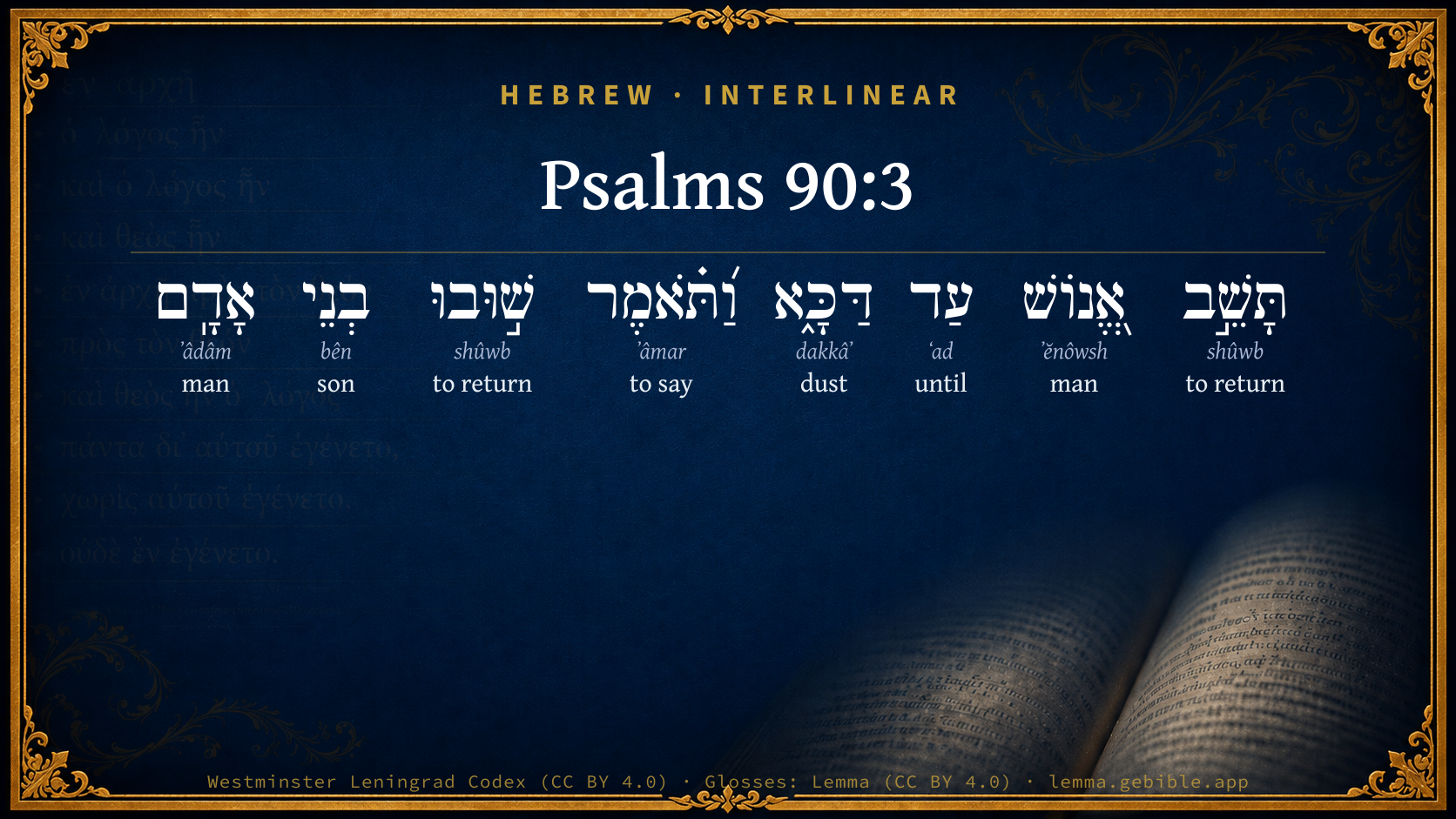
Psalms 90:3

Hebrew (Westminster Leningrad Codex) Psalms 90:3 appears in the Hebrew Old Testament. The text above is from the Westminster Leningrad Codex. Each word links to its Strong’s number, a concise gloss, and parsing drawn from the Open Scriptures Hebrew Bible morphology. Click any word for its full Brown-Driver-Briggs (BDB) entry.
Download image
Cite this verse

Psalms 90:3 (World English Bible). Public Domain. Lemma interlinear Bible study tool, https://lemma.gebible.app/v/psalms/90/3.

Show BibTeX & RIS
BibTeX
RIS
English Translation
You turn man to destruction, saying, "Return, you children of men."
World English Bible · Public Domain
Download a study sheet

One document with this verse’s original text, its word-by-word gloss line, the meaning frame, cross-references with their text, attributed commentary, and full source and license credits — printable, and it pastes into notes with its structure intact.

This verse Autodidact and up

Study sheet (.html) Plain text (.txt)

A passage Seminary Student

Up to 50 verses in one chapter. A passage sheet keeps up to 6 commentary sources and 12 cross-references per verse, in the order this page ranks them, and says so on the sheet whenever that leaves anything out. Ask for a single verse and you get the Autodidact verse sheet above.

Everything on this page stays free to read, with no account — the sheet is a download of what is already on screen, not access to it.

Want to remove ads? Support Godless Engineer
Compare translations 3

The same verse in 3 English versions, stacked beneath the original-language interlinear above. Click any original word for its lexicon entry.

Each is an independent rendering of the whole verse — the interlinear is not word-aligned to these translations.

Highlighted words mark where these versions differ — a whole-verse word diff, not a word-by-word alignment.

  • World English Bible Public Domain
    You turn man to destruction, saying, "Return, you children of men."
  • King James Version Public Domain
    Thou turnest man to destruction; and sayest, Return, ye children of men.
  • unfoldingWord Literal Text CC BY-SA 4.0
    You cause man to return to dust, and you say, “Return, sons of man.”

unfoldingWord Literal Text — © unfoldingWord, licensed CC BY-SA 4.0. Word-aligned USFM3 via Door43 (git.door43.org/unfoldingWord/en_ult).

Versions to compare (up to 4)

3 of 4 selected

Show all 18 translations

Every available English version of this verse, each an independent rendering of the whole verse.

  • World English Bible Public Domain
    You turn man to destruction, saying, "Return, you children of men."
  • Berean Standard Bible Public Domain
    You return man to dust, saying, “Return, O sons of mortals.”
  • Majority Standard Bible Public Domain
    You return man to dust, saying, “Return, O sons of mortals.”
  • King James Version Public Domain
    Thou turnest man to destruction; and sayest, Return, ye children of men.
  • American Standard Version (1901) Public Domain
    Thou turnest man to destruction, And sayest, Return, ye children of men.
  • Revised Version (1885) Public Domain
    Thou turnest man to destruction; and sayest, Return, ye children of men.
  • Geneva Bible (1599) Public Domain
    Thou turnest man to destruction: againe thou sayest, Returne, ye sonnes of Adam.
  • Douay-Rheims (1899) Public Domain
    Turn not man away to be brought low: and thou hast said: Be converted, O ye sons of men.
  • Young's Literal Translation Public Domain
    Thou turnest man unto a bruised thing, And sayest, Turn back, ye sons of men.
  • Literal Standard Version CC BY-SA 4.0
    You turn man to a bruised thing, || And say, Return, you sons of men.
  • Unlocked Literal Bible CC BY-SA 4.0
    You return man to dust, and you say, “Return, you descendants of mankind.”
  • unfoldingWord Literal Text CC BY-SA 4.0
    You cause man to return to dust, and you say, “Return, sons of man.”
  • Darby Bible Public Domain
    Thou makest [mortal] man to return to dust, and sayest, Return, children of men.
  • World Messianic Bible Public Domain
    You turn man to destruction, saying, “Return, you children of men.”
  • Webster's Bible Public Domain
    Thou turnest man to destruction; and sayest, Return, ye children of men.
  • Free Bible Version CC BY-SA 4.0
    You turn people back into dust, saying, “Return to dust, human beings.”
  • Bible in Basic English Public Domain
    You send man back to his dust; and say, Go back, you children of men.
  • JPS Tanakh (1917) Public Domain
    Thou turnest man to contrition; and sayest: 'Return, ye children of men.'

Literal Standard Version (2020), Covenant Press — licensed CC BY-SA 4.0. Text via the HelloAO Bible API (eBible.org). Unlocked Literal Bible (unfoldingWord) — licensed CC BY-SA 4.0. Text via the HelloAO Bible API (eBible.org). unfoldingWord Literal Text — © unfoldingWord, licensed CC BY-SA 4.0. Word-aligned USFM3 via Door43 (git.door43.org/unfoldingWord/en_ult). Free Bible Version, Dr. Jonathan Gallagher — licensed CC BY-SA 4.0. Text via the HelloAO Bible API (eBible.org).

Word by word

More ways to search: Search by grammar → Find every occurrence → Compare this word →

Practice this passage: Drill this verse → Learn its vocabulary →

About this verse

These counts appear in no published source. They are computed here, from the morphology-tagged text and Lemma’s own curated glosses. What Lemma adds →

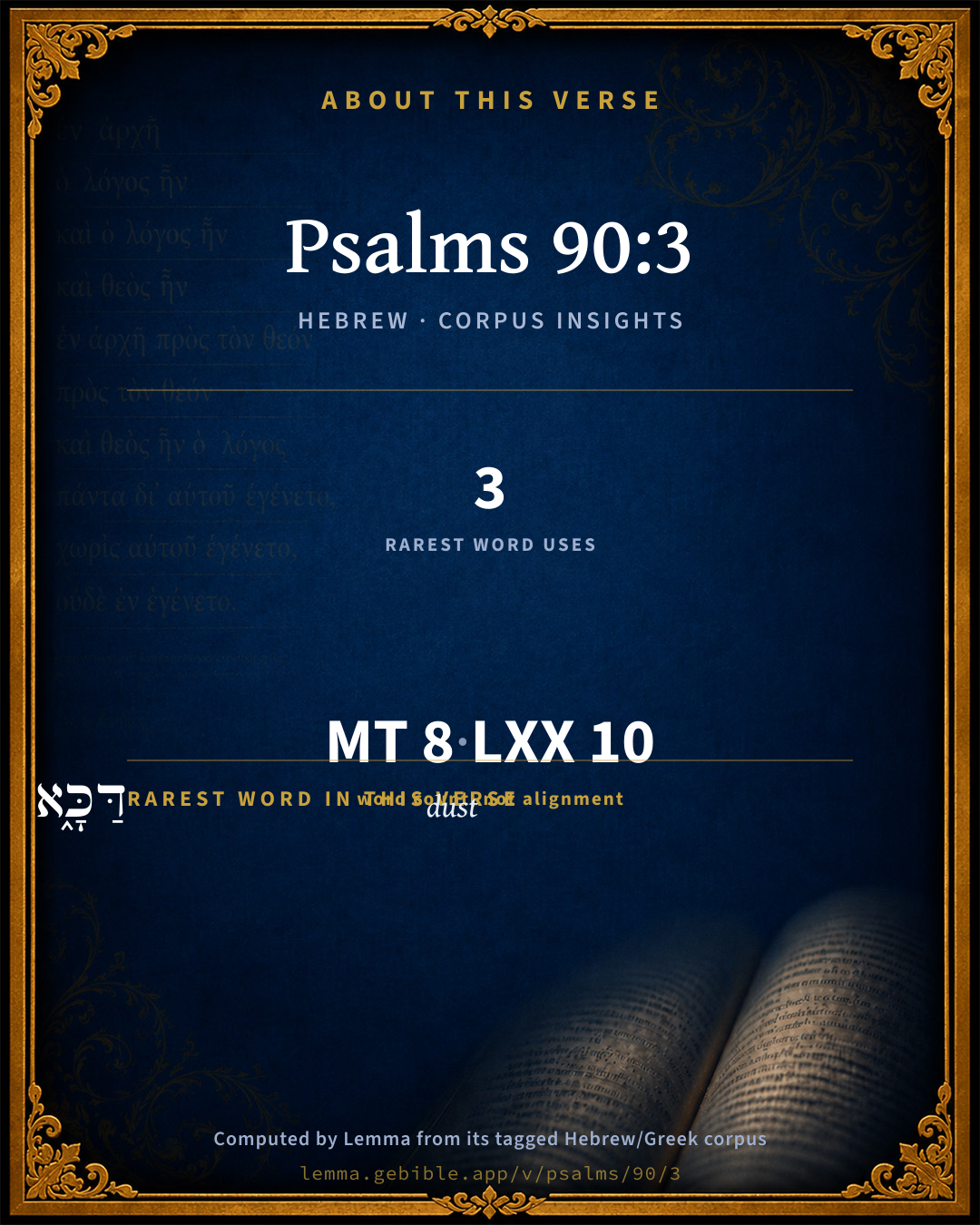
8
words
7
distinct lemmas
Wisdom
section

Notable vocabulary

The rarest word here is דַּכָּ֑א dust H1793 — appearing just 3 times in the whole Hebrew Bible.

Shared distinctive vocabulary

דַּכָּ֑א dust H1793 occurs in 3 verses of the Hebrew Bible. Also found in:

Grammatical profile

  • 3 verbs
  • 4 nouns
  • 1 preposition

Verb forms

  • תָּשֵׁ֣ב Hiphil · Imperfect
  • וַ֝תֹּ֗אמֶר Qal · Sequential Imperfect
  • שׁ֣וּבוּ Qal · Imperative

Repetition

A word recurs within this verse — often emphatic in Hebrew:

  • תָּשֵׁ֣ב to return H7725 ×2

Hebrew & Septuagint length

In English translation the verse runs 11 words from the Hebrew and 16 from the Septuagint (LXX English) — closely comparable.

A rough comparison of the two English renderings, which tokenize alike — not a word-level alignment.

Word counts can differ between the Hebrew and the Greek without any difference in meaning — e.g. the Hebrew direct-object marker אֵת has no separate Greek word, and Greek often adds the article ὁ.

In the original languages it is 8 Hebrew tokens and 10 Greek tokens — but the two are counted differently (Hebrew bundles its prefixes and suffixes into one token; the Greek is in lemma form), so that isn’t a like-for-like length.

Cross-references

8

Topical passages linked to Psalms 90:3 in the Treasury of Scripture Knowledge — connected by theme and wording, ordered by reader-vote popularity; previews shown in the World English Bible.

  • Genesis 3:19 By the sweat of your face will you eat bread until you return to the ground, for out of it you were taken. For you are dust, and to dust you shall return."
  • Ecclesiastes 12:7 And the dust returns to the earth as it was, And the spirit returns to God who gave it.
  • Job 34:14–15 If he set his heart on himself, If he gathered to himself his spirit and his breath;
  • Psalms 104:29 You hide your face: they are troubled; You take away their breath: they die, and return to the dust.
  • Psalms 146:4 His spirit departs, and he returns to the earth. In that very day, his thoughts perish.
  • Genesis 6:6–7 Yahweh was sorry that he had made man on the earth, and it grieved him in his heart.
  • Numbers 14:35 I, Yahweh, have spoken, surely this will I do to all this evil congregation, who are gathered together against me: in this wilderness they shall be consumed, and there they shall die.
  • Job 12:10 In whose hand is the life of every living thing, The breath of all mankind?

Cross-references courtesy of OpenBible.info (CC BY 4.0).

Hebrew and Greek witnesses Masoretic Hebrew ↔ Greek Septuagint

The same verse in the two great witnesses to the Old Testament, shown verse-for-verse.

You’re reading Greek Psalm 89 (Hebrew Psalm 90). The Septuagint counts the superscription, so verse numbers can differ from the Hebrew — chapter-level alignment, not verse-by-verse. Numbering follows Rahlfs.

These are two independent witnesses, not word-aligned to each other, and the Septuagint is shown in lemma (dictionary) form.

Hebrew Psalms 90:3 Masoretic · Westminster Leningrad Codex

תָּשֵׁ֣ב אֱ֭נוֹשׁ עַד דַּכָּ֑א וַ֝תֹּ֗אמֶר שׁ֣וּבוּ בְנֵי אָדָֽם

You turn man to destruction, saying, "Return, you children of men."

World English Bible · Public Domain

Greek LXX Greek Psalm 89:3 Septuagint · lemma form

μή ἀποστρέφω ἄνθρωπος εἰς ταπείνωσις καί εἶπον ἐπιστρέφω υἱός ἄνθρωπος

Turn not man back to his low place, whereas you said, Return, you⌃ sons of men?

LXX2012 (modern English Septuagint) · Public Domain

On this verse, Ellicott's Commentary for English Readers discusses the Septuagint’s reading. Read the note in Commentary ↓

Hebrew: Westminster Leningrad Codex (CC BY 4.0). Greek: Septuagint (public domain); English from LXX2012 (modern English Septuagint) (Public Domain). How the Septuagint differs from the Hebrew →

Commentary

Notes on Psalms 90:3 from classic Christian and Jewish commentators (each source and its license shown beneath its notes). The classic Christian expositions comment on the surrounding passage and are grouped to its opening verse, so a note may address several verses; the Jewish commentaries on the Tanakh (Rashi and others) are per-verse, so they appear only where the commentator wrote on this verse.

Lemma curates 59 commentaries, every one of them public domain or Creative Commons licensed, each selected and text-cleaned for this edition rather than reprinted as found. About our sources →

Trapp's Complete Commentary

John Trapp

Psa 90:3 Thou turnest man to destruction; and sayest, Return, ye children of men.

Ver. 3. Thou turnest man to destruction] Ad minutissimum quiddam, so Beza rendereth it, to a very small business, to dust and powder. Others, ad contritionem vel contusionem, by turning loose upon him various diseases and distresses; thou turnest him out of the world, Ecc 1:13. And generally, thou sayest of all and singular sons of men,

Return, ye] Your bodies to the earth, according to the decree, Gen 3:17-19, your souls to God, that gave them, Ecc 12:7. And here the course of man’s life is compared, saith one, to a race in a tilt or tourney, where we soon run to the end of the race, as it were, and then return back again. Intelligit Moses vitam humanam similem esse gyro, saith another. Man’s life is compared to a ring or round; we walk a short round; and then God gathers us in to himself. One, being asked what life was? made an answer answerless, for he presently turned his back and went his way. We fetch here but a turn, and God saith, "Return, ye children of men." This some make to be an irony; as if God should say, Live again, if ye can. Some apply it to the resurrection, others to mortification and vivification.

John Trapp, A Commentary or Exposition upon All the Books of the Old and New Testament (1647–1656) — public domain. Text from a community e-Sword module.

The Biblical Illustrator

Joseph S. Exell

Psa_90:3

Thou turnest man to destruction; and sayest, Return, ye children of men.

Mans thoughts of man

I wish to point out our duty to the world of humanity; to the communities to which we belong; to the generation in which we live; to the great family of mankind, of which God has made us members.

1. What have been, what are mens thoughts respecting the race of man? We know not for how many thousands of years our race may have lived on this little planet, rolling and spinning like an angry midge amid the immensities of space; but, over a space of forty centuries at least, in the pages of many literatures, in the accents of many tongues, we find the opinions of men respecting man. They have been uttered, as freely as to-day, by the bards and prophets of races long since vanished, in language long since dead. Man has ever been a mystery to himself. Who are you? indignantly asked an irascible person, who had been delayed in his hurried progress by running against a modern philosopher in the streets. Ah, replied the philosopher, if you could tell me that--if you could tell me what I am--I would give you all I possess in the world. To-day, however, we do not want to enter into any transcendent mysteries; we only want to learn what men have thought of man in his moral, his spiritual, his religious aspect. And here, strange to say, we are confronted at once with a perfect chaos of conflicting judgments. According to some, man is a being so small, so intolerably contemptible, so radically unjust, mean, and selfish, that he is not worth working for; he is not only a shadow less than shade, a nothing less than nothing; not only fading as a leaf and crushed before the moth; not only like the grass of the field, which to-day is, and to-morrow is cast into the oven; but also, as far as moral dignity is concerned, he is the mere insect of an hour; a creature essentially allied to the animal; a being who combines the instincts of the tiger and the ape; a blot on Gods fair creation; a jar in the sweet untroubled silence; a discord amid the infinite harmony; a flutter in the eternal calm. It is remarkable how cynics and sceptics in all ages have coincided in this view. Think of Diogenes, searching in daylight with a lantern to find a man in the streets of Athens; think of Phocion, whenever a passage in his speech was applauded, turning round and asking, Have I said anything wrong, then? think of Pyrrho the atheist, describing men as a herd of swine, rioting on board a rudderless vessel in a storm; think of La Rochefoucauld reducing mans virtues into mere selfish vices in thin disguise; think of Voltaire describing the multitude as a compound of bears and monkeys; think of Schopenhauer, condemning this as the worst of all possible worlds, and arguing that man is a radical mistake; think of the more serious voice which says, However we brazen it out, we men are a little breed. But then turn to the other side, the grand and exalted opinions which man has entertained of man. Think of Shakespeares, What a piece of work is a man! How noble in reason! how infinite in faculty! in form and moving, how express and admirable! in action, how like an angel! in apprehension, how like a god! Think of Henry Smiths, When we turn our eyes upon the soul it will soon tell us its own royal pedigree and noble extraction by those sacred hieroglyphics which it bears upon itself. Or take Novalis, Man is the true Shekinah, the glory-cloud of God. We touch heaven when we lay our hands on that high form.

2. Which, then, are we to follow of these diverse judgments? By which are we to be guided in our own dealings with our fellow-men? I answer with all my heart, take the nobler and better view of mankind. Adopt it, not as a voluntary illusion, but as a sacred fact, as a living faith. Good and evil without end may be said of man; and both be amply borne out by history and by experience. That is due to the fact that man is a composite being; that he partakes of two natures--the animal and the spiritual; that he is swayed by two impulses--the evil and the good; that he has in him two beings--the Adam and the Christ; that the Angel has him by the hand, and the serpent by the heart; that our little lives are kept in equipoise by balance of two opposite desires--the struggle of the impulse that enjoys, and the more noble impulse that aspires. Hence we may say of man, in the same breath, How poor, how rich, how abject, how august, how wonderful, how complicated is man. Glory and scandal of the universal, says Pascal, the judge of angels, a worm of earth; if he exalts himself I smite him down, if he humbles himself I lift him up. But is there no practical reconciliation of these antitheses? Yes, there is: not in the world, not in nature, not in philosophy; but there is in religion, there is in Christ..

3. I would urge you, then, not to give up faith in God or in man, or in Gods doctrines for man, nor sweetness, nor charity, nor invincible hopefulness. To lose faith in man is to lose faith in God who made him; to lose faith in mans nature is to lose faith in your own. Depend upon it, that the man who begins by saying, Mankind is a rascal, will soon add the words, The world lives by its scoundrelism, and so will I. It makes all the difference in the world whether you judge man from Thersites or from Achilles, from a Nero or from a Marcus Aurelius, from a Marat or from St. Louis; from living men like one or two whom one could name, or from the depraved, wife-beating sots and brutal burglars who are the festering curse of the lowest dregs of the population; from living women like some whom one could name, or from those unmotherly mothers and unwomanly women who nigh turn the motherhood to shame and womanliness to loathing. Oh, judge mankind from its highest and its best!

(1) Let us try to believe that there is a good side in every man. Man, it has been said, is like a piece of Labrador opal. It has no lustre as you turn it in your hand till you come to a particular angle, and then it shows deep and beautiful colours. We sometimes read with amazement how some one, who seemed to be past all remedy in abandoned vileness, suddenly, touched by the glory of heroism, will rise to a great act of self-sacrifice. Look at the battle of Waterloo; look at the trenches of Sebastopol; look at the charge at Balaclava; look at the burning of the Goliath; look at the wreck of the Birkenhead; to see how the commonest and coarsest of men can recognize the invincible claim and sovereignty of duty, even at the cost of life. Mans nature may often look like the dull chill blank of the Alpine mountain side, darkened only by the shadows of its black and stubborn pines, but let the dawn blush in the vernal sky, and the south wind breathe, and the sun fire to the high tops of those mountain pines, and the snow will melt and vanish under their soft and golden touches, till at last it rushes down in avalanche, and then where yesterday was snow, to-day shall be green grass and purple flower.

(2) And as another way to help us in retaining our faith in human nature, let us sometimes turn away from the thought of bad men altogether, to that galaxy of heaven, wherein shine the clustered constellations of saintly lives. The saints in the long ages have not been few. To these have been due the progress, to these the ennoblement, to these the preservation of the world. Among all the bad passions, among all the disordered lives of men--amid all their meanness, and littleness, and emptiness, and egotism--it is as water in the desert to come in life and more often among the records of the dead on these natures pure as crystal, active as fire, unselfish as the ministering spirits, strong, generous, and enduring as the hearts of martyrs. Look on these; think of these; do not think of the heartless and aimless crowds that vegetate without living, but read the lives and actions of these fine children of the light.

(3) But above all, as the best of all rules, think constantly of Christ; and fix your eyes on Him. Of what account after all are the saints compared to Christ? They are, said Luther, no more than sparkling dewdrops of the nightdew upon the head of the bridegroom scattered among His hair. The only measure of a perfect man is the measure of the stature of the fulness of Christ.

4. And oh, lastly, the most sure way to justify our faith and hope in human nature is to justify it in ourselves. If you would raise others, live yourself as on a mountain; live yourself as on a promontory. Say with the good emperor of old, Whatever happens I must be good; even as though the emerald and the purple should say, Whatever happens I must be emerald, and keep my colour. That is how men widen the skirts of light, and make the struggle with darkness narrower. To do this is a worthy object; it is the only worthy object of our lives. (Dean Farrar.)

The Biblical Illustrator, edited by Joseph S. Exell (c. 1880s–1900s) — public domain. Text from a community e-Sword module.

Joseph Benson's Commentary

Psa 90:3. Thou turnest man to destruction — But as for man, his case is far otherwise; his time is short; and though he was made by thee happy and immortal, yet for his sin thou didst make him mortal and miserable. And sayest — Or, didst say, that is, pronounce that sad sentence, Return, ye children of men, namely, to the dust, out of which ye were taken.

Joseph Benson's Commentary on the Old and New Testaments (1811–1818) — public domain. Text from a community e-Sword module.

J. A. Alexander on Psalms

Joseph Addison Alexander

3. (Psa 90:3) Thou turnest man even to dust, and sayest, Return, sons of Man (or Adam)! The evident allusion to Gen 3:19, which is also found in Job 10:9; Job 34:15, and reappears in Psa 104:29 (compare Psa 103:14), may serve to determine the meaning of the word translated dust in the first clause, but which is properly an adjective signifying crushed, broken to pieces, ground to powder, and is figuratively applied, in Psa 34:18), to brokenness of heart. Compare Isa 57:15. The Hebrew preposition is stronger than our to, and means as far as, even to. The full sense of the whole phrase is, even to the state of one completely crushed or ground to powder, even to a pulverised condition. The shortness and fragility of human life is thus brought into the strongest contrast with the eternity of God.

Joseph Addison Alexander, The Psalms Translated and Explained (1850) — public domain. Text from a community e-Sword module.

Tyndale Open Study Notes

Tyndale Open Resources

90:3-6 Unlike God, humans are mortal and transitory.

Tyndale Open Study Notes — © Tyndale Open Resources, licensed CC BY-SA 4.0. Text via the HelloAO Bible API.

Geneva Bible (1599)

Geneva Bible translators

Moses by lamenting the frailty and shortness of man’s life moveth God to pity.

Geneva Bible (1599) marginal notes — public domain. Text via Bolls.life.

Adam Clarke's Commentary

Verse 3. Thou turnest man to destruction] Literally, Thou shalt turn dying man, אנוש enosh, to the small dust, דכא dacca but thou wilt say, Return, ye children of Adam. This appears to be a clear and strong promise of the resurrection of the human body, after it has long slept, mingled with the dust of the earth.

Adam Clarke's Commentary on the Bible (1810–1826) — public domain. Text from a community e-Sword/MySword module.

John Calvin's Commentaries

3 Thou shalt turn man to destruction. Moses, in the first place, mentions how frail and transitory is the life of man, and bewails its miseries. This he does, not for the purpose of quarrelling with God, but as an argument to induce him the more readily to exercise his mercy, even as he is elsewhere said to pardon mortal men, when he considers of what they are made, and remembers that they are but dust and grass, (Psalm 103:14.) he compares the course of our life to a ring or circle, because God, placing us upon the earth, turns us about within a narrow circuit, and when we have reached the last point, draws us back to himself in a moment. Others give a different interpretation, namely, that God leads men forth to death, and afterwards restores them at the resurrection. But this subtilty is far-fetched, and does not harmonise with the context. We have here laid down a simple definition of our life, that it is, as it were, a short revolution in which we quickly complete our circle, the last point of which is the termination of our earthly course. This account of human life sets in a clearer light the gracious manner in which God deals with his servants, in adopting them to be his peculiar people, that he may at length gather them together into his everlasting inheritance. Nor is it in vain that it is added, by way of contrast, (verse 4,) that a thousand years in God’s sight are as yesterday Although we are convinced from experience that men, when they have completed their circle, are forthwith taken out of the world, yet the knowledge of this frailty fails in making a deep impression upon our hearts, because we do not lift our eyes above the world. Whence proceeds the great stupidity of men, who, bound fast to the present state of existence, proceed in the affairs of life as if they were to live two thousand years, but because they do not elevate their conceptions above visible objects? Each man, when he compares himself with others, flatters himself that he will live to a great age. In short, men are so dull as to think that thirty years, or even a smaller number, are, as it were, an eternity; nor are they impressed with the brevity of their life so long as this world keeps possession of their thoughts. This is the reason why Moses awakens us by elevating our minds to the eternity of God, without the consideration of which we perceive not how speedily our life vanishes away. The imagination that we shall have a long life, resembles a profound sleep in which we are all benumbed, until meditation upon the heavenly life swallow up this foolish fancy respecting the length of our continuance upon earth.

As men are thus blinded, Moses sets before their view God as their judge. O Lord! as if he had said, if men would duly reflect upon that eternity from which thou beholdest these inconstant circlings of the world, they would not make so great account of the present life. But as, instead of seriously considering what is true duration, they rather wilfully turn away their eyes from heaven, this explains why they are so stupid, and look upon one day as if it were a hundred years. Moses’ apostrophe to God is emphatic, implying that his patience being exhausted at seeing us so thoughtless, he addresses himself to God; and that it was labor to no purpose for him to speak to the deaf, who would not be taught that they were mortal, no, not even by the proofs of this, which experience was constantly presenting before them. This text is quoted by the Apostle Peter in a sense somewhat different, (2 Peter 3:8,) while at the same time he does not pervert it, for he aptly and judiciously applies the testimony of Moses in illustration of the subject of which he is there treating. The design of Moses is to elevate the minds of men to heaven by withdrawing them from their own gross conceptions. And what is the object of Peter? As many, because Christ does not hasten his coming according to their desire, cast off the hope of the resurrection through the weariness of long delay, he corrects this preposterous impatience by a very suitable remedy. He perceives men’s faith in the Divine promises fainting and failing, from their thinking that Christ delays his coming too long. Whence does this proceed, but because they grovel upon the earth? Peter therefore appropriately applies these words of Moses to cure this vice. As the indulgence in pleasures to which unbelievers yield themselves is to be traced to this, that having their hearts too much set upon the world, they do not taste the pleasures of a celestial eternity; so impatience proceeds from the same source. Hence we learn the true use of this doctrine. To what is it owing that we have so great anxiety about our life, that nothing suffices us, and that we are continually molesting ourselves, but because we foolishly imagine that we shall nestle in this world for ever? Again, to what are we to ascribe that extreme fretfulness and impatience, which make our hearts fail in waiting for the coming of Christ, but to their grovelling upon the earth? Let us learn then not to judge according to the understanding of the flesh, but to depend upon the judgment of God; and let us elevate our minds by faith, even to his heavenly throne, from which he declares that this earthly life is nothing. Nor does Moses simply contrast a thousand years with one day, but he contrasts them with yesterday, which is already gone; for whatever is still before our eyes has a hold upon our minds, but we are less affected with the recollection of what is past. In regard to the word watch, the ancients, as is well known, were accustomed to divide the night into four watches, consisting of three hours each. To express still more forcibly how inconsiderable that which appears to us a long period is in God’s eyes, this similitude is added, That a thousand years in his sight differ nothing from three hours of the night, in which men scarcely know whether they are awake or asleep.

John Calvin's Commentaries (1540-1563) — public domain. Text from the Calvin Translation Society English edition (1840s-50s) via the Christian Classics Ethereal Library (ccel.org). Calvin's coverage is partial (roughly two-thirds of the Bible); uncommented books and verses are honest gaps, never fabricated. The 19th-century editor's footnotes and remarks are omitted so the notes are faithfully Calvin's own voice.

Ellicott's Commentary for English Readers

(3) Thou turnest . . .—Probably we must render, Thou turnest man to dust; and sayest, Turn, sons of Adam—i.e., one generation dies and another succeeds (see Psa_104:29-30), the continuance of the race being regarded as distinctly due to Divine power as the Creation, to which there is probably allusion.

The LXX. suggest as the true reading, “Turn not man to dust, but say rather,” &c.

A Bible Commentary for English Readers, edited by Charles John Ellicott (1878–1897) — public domain. Text from a community e-Sword module.

The Cambridge Bible for Schools and Colleges

gen. ed. J. J. S. Perowne

3. The thought here is not merely that man’s life is infinitely brief in contrast to the eternity of God, but that it is absolutely at His disposal. The Psalmist plainly refers to Gen_3:19, though he chooses different words to emphasise his point: Thou makest mortal man return to atoms. Enôsh denotes man in his frailty (Psa_103:15): dakkâ, lit. pulverisation, implies the dissolution of the body into its constituent elements.

and sayest, Return &c.] Two interpretations deserve consideration: (1) ‘Return to the dust whence ye were taken,’ cp. Psa_146:4; Job_10:9; Job_34:15. (2) ‘Return into being,’ a call to new generations to appear on the stage of history (Isa_41:4). Cp. P.B.V. “Again thou sayest, Come again, ye children of men.” In favour of (2) it is urged that and sayest implies fresh action on the part of God: and that the antithesis of the rise of new generations as the old pass away is more forcible than the synonymous parallelism of (1): but (2) involves a somewhat strained interpretation of Return, and the evident allusion to Gen_3:19 is in favour of (1). The interpretations Return to Me (cp. Ecc_12:7), and Return to life in the resurrection, are untenable.

The Cambridge Bible for Schools and Colleges (gen. ed. J. J. S. Perowne; Cambridge University Press, 1878–1918) — public domain. Text from a community e-Sword module.

John Gill's Exposition

Thou turnest man to destruction,.... Or to death, as the Targum, which is the destruction of man; not an annihilation of body or soul, but a dissolution of the union between them; the words may be rendered, "thou turnest man until he is broken" (b); and crumbled into dust; thou turnest him about in the world, and through a course of afflictions and diseases, and at last by old age, and however by death, returns him to his original, from whence he came, the dust of the earth, which he becomes again, Gen 3:19 the grave may be meant by destruction:

and sayest, return, ye children of men, or "Adam"; from whom they all sprung, and in whom they all sinned, and so became subject to death; to these he says, when by diseases he threatens them with a dissolution, return by repentance, and live; and sometimes, when they are brought to the brink of the grave, he returns them from sickness to health, delivers them from the pit, and enlightens them with the light of the living, as he did Hezekiah: or this may refer to the resurrection of the dead, which will be by Christ, and by his voice calling the dead to return to life, to rise and come to judgment; though some understand this as descriptive of death, when by the divine order and command man returns to his original dust; thus the frailty of man is opposed to the eternity of God. Gussetius understands all this of God's bringing men to repentance, contrition, and conversion; and takes the sense to be,

"thou turnest till he becomes contrite, and sayest, be ye converted, ye sons of Adam;''

which he thinks (c) best agrees with the mind of the Apostle Peter, who quotes the following passage, Pe2 3:8. Some, as Arama observes, connect this with the following verse; though men live 1000 years, yet they are but as yesterday in the sight of God.

(b) "convertes hominem usque ad contritionem", Montanus; "donec conteratur", Musculus, Tigurine verion; "donee sit contritus", Vatablus; "ut sit contritus", Junius & Tremellius. (c) Ebr. Comment. p. 158.

John Gill's Exposition of the Whole Bible (1746–1763) — public domain (CC PDM 1.0). Text via the HelloAO Bible API.

Albert Barnes' Notes on the Bible

Thou turnest man to destruction - In contradistinction from his own unchangeableness and eternity. Man passes away; God continues ever the same. The word rendered “destruction” - דכא dakkâ' - means properly anything beaten or broken small or very fine, and hence, “dust.” The idea here is, that God causes man to return to dust; that is, the elements which compose the body return to their original condition, or seem to mingle with the earth. Gen 3:19 : “dust thou art, and unto dust shalt thou return.” The word “man” here, of course, refers to man in general - all people. It is the great law of our being. Individual man, classes of people, generations of people, races of people, pass away; but God remains the same. The Septuagint and the Latin Vulgate render this, “Thou turnest man to “humiliation;” which, though not the sense of the original, is a true idea, for there is nothing more humiliating than that a human body, once so beautiful, should turn back to dust; nothing more humbling than the grave.

And sayest, Return, ye children of men - Return to your dust; go back to the earth from which you came. Return, all of you without exception; - kings, princes, nobles, warriors, conquerors; mighty people, captains, and counselors; ye learned and great, ye honored and flattered, ye beautiful and happy, ye youthful and vigorous, and ye aged and venerable; whatever is your rank, whatever are your possessions, whatever are your honors, whatever you have to make you lovely, to charm, to please, to be admired; or whatever there is to make you loathsome and detestable; ye vicious, ye profane, low, grovelling, sensual, debased; go all of you alike to “dust!’ Oh, how affecting the thought that this is the lot of man; how much should it do to abase the pride of the race; how much should it do to make any man sober and humble, that he himself is soon to turn back to dust - unhonored, undistinguished, and undistinguishable dust!

Albert Barnes' Notes on the Bible (1834–1885) — public domain. Text from a community e-Sword/MySword module.

Matthew Poole's English Annotations

But as for man, his case is far otherwise, his time is short; and though he was made by thee a happy creature, and should have been immortal, yet upon and for his sin thou didst make him mortal and miserable.

Sayest, or, didst say, i.e. pronounce that sad sentence here following,

Return, O men, to the dust, out of which you were taken, Gen 3:19; Psa 146:4; Ecc 12:7.

Matthew Poole's English Annotations on the Holy Bible (1683–1685) — public domain. Text from a community e-Sword/MySword module.

The Treasury of David

Charles H. Spurgeon

Ver. 3. Thou turnest man to destruction, or "to dust." Man's body is resolved into its elements, and is as though it had been crushed and ground to powder.

And sayest, Return, ye children of men, i.e., return even to the dust out of which ye were taken. The frailty of man is thus forcibly set forth; God creates him out of the dust, and back to dust he goes at the word of his Creator. God resolves and man dissolves. A word created and a word destroys. Observe how the action of God is recognised; man is not said to die because of the decree of faith, or the action of inevitable law, but the Lord is made the agent of all, his hand turns and his voice speaks; without these we should not die, no power on earth or hell could kill us.

"An angel's arm cannot save me from the grave,

Myriads of angels cannot confine me there."

Ver. 3. Thou turnest man to destruction, etc. The prophet conceives of God as of a potter, that having of dust tempered a mass, and framed it into a vessel, and dried it, doth presently, within a minute or an hour after, dash it again in pieces, and beat it to dust, in passion as it were speaking unto it, "Get thee to dust again." The word here translated "destruction", signifies a beating, or grinding, or pounding of a thing to powder. And the prophet seems to allude to the third of Genesis, where God speaks of Adam, "Dust thou art, and to dust thou shalt return", as if he should say, O Lord, thou that hast made and framed man of the dust of the earth, thou beatest him to dust again; and as thou madest him by thy word alone, so with thy word thou suddenly turnest, and beatest him against to dust; as a man that makes a thing, and presently mars it again...He doth it with a word, against which is no resistance, when that word is once come out of his mouth; it is not all the diet, physic, and help, and prayers in the world that can save the life. And this he can do suddenly, in the twinkling of an eye. And therefore we should, as we love our lives, fear him, and take heed how we offend and displease him that can with a word turn the strongest man into dust. —William Bradshaw.

Ver. 3. Thou turnest man to destruction, etc. The first word for "man", signifies a man full of misery, full of sickness and infirmities, a miserable man, vwna. And the other word here used in the end of the verse, signifies a man made of clay, or of the very slime of the earth. From hence we learn what is the nature of all men, of all the sons of Adam, viz., a piece of living clay, a little piece of red earth. And besides that man is subject to breaking and crushing, every way a miserable man; so is he of a brittle mould, a piece of red clay, that hath in it for a time a living soul, which must return to God that gave it; and the body, this piece of earth, return to the earth from whence it came: and if we had no Scripture at all to prove this, daily experience before our eyes makes it clear how all men, even the wisest, the strongest, the greatest and the mightiest monarchs and princes in the world, be but miserable men, made of red earth, and quickly turn again to dust. —Samuel Smith, in "Moses his Prayer", 1656.

Ver. 3. Thou turnest man to destruction. Augustine says, We walk amid perils. If we were glass vases we might fear less dangers. What is there more fragile than a vase of glass? And vet it is preserved, and lasts for centuries: we therefore are more frail and infirm. —Le Blanc.

Ver. 3. Return ye. One being asked what life was? made an answer answerless, for he presently turned his back and went his way. —John Trapp.

Ver. 3.

1. The cause of death—"thou turnest."

2. The nature of death—"return."

3. The necessities of death—reconciliation with God, and preparation to return.

Psalms 90:4*

Charles H. Spurgeon's The Treasury of David (1869–1885) — public domain. Psalms only. Text from a community e-Sword/MySword module.

Whedon's Commentary on the Bible

Daniel D. Whedon

3. Thou turnest man to destruction— “Man,” a generic term here for the human race, with the fundamental idea of mortal—mortal man.

Destruction—Crushing, and by metonomy that which is crushed, that is, dust.

Return—That is, return to dust, as Gen_3:19.

Ye children of men— אדםshould be taken as a proper name, and the passage read, Return to dust, ye sons of Adam.

Daniel D. Whedon (gen. ed.), Commentary on the Old and New Testaments (1874–1909) — public domain. Text from a community e-Sword module.

The Pulpit Commentary

Thou turnest man to destruction; or, "to dust". (comp. Gen_3:19) And sayest, Return, ye children of men; i.e. "return once more, and replenish the earth." There may be an allusion to the destruction of mankind by the Deluge, and the repeopling of the earth by the descendants of Noah, as Dr. Kay supposes; or the meaning may be that God is continually bringing one generation of men to an end. and then setting up another, having the same control over human life that he has over inanimate nature (ver. 2).

The Pulpit Commentary (1880–1919), ed. H.D.M. Spence-Jones & Joseph S. Exell — public domain. Text from a community e-Sword module.

John Wesley's Explanatory Notes

Turnedst - But as for man, his case is far otherwise, though he was made by thee happy. and immortal, yet for his sin thou didst make him mortal and miserable. Saidst - Didst pronounce that sad sentence, return, O men, to the dust out of which ye were taken, Gen. iii, 19.

John Wesley, Explanatory Notes Upon the Whole Bible (1754–1765) — public domain. Text via the GEBible commentary corpus.

unfoldingWord translationNotes

Door43 World Missions Community

You return man to dust

This implies that just as God created the first man, Adam, from the soil, God will cause people's bodies to turn back into soil after they die. AT: "You return people to dust when they die" (See: Assumed Knowledge and Implicit Information)

return man

Here "man" means people in general. (See: When Masculine Words Include Women)

Return, you descendants

The words "to dust" or "to soil" are understood. AT: "Return to dust, you descendants" or "Return to soil, you descendants" (See: Ellipsis)

you descendants of mankind

This is a way of referring to humans in general. AT: "you humans" or "you people" (See: Idiom)

For a thousand years in your sight are as yesterday when it is past, and as a watch in the night

The writer means that a long period of time seems like a short period of time to God. AT: "You consider a thousand years the same as one day in the past, or as a few short hours in the night" or "Even a thousand years is not a long time to you" (See: Simile)

a thousand years

"1,000 years" (See: Numbers)

in your sight

Here sight represents judgment or evaluation. AT: "to you" (See: Metaphor)

translationWords

descend

year

watch (biblical time)

unfoldingWord translationNotes — © Distant Shores Media and the Door43 World Missions Community, licensed CC BY-SA 4.0. Source: git.door43.org/Door43/en_tn.

Rashi

Rabbi Shlomo Yitzchaki (Rashi)

You bring man to the crushing point You bring agonies upon man until You reduce him to a weakened state, near death, and You tell him with these agonies, “Return, O sons of men from your evil ways.”

Rashi on the Tanakh — English translations: “The Judaica Press complete Tanach with Rashi, translated by A. J. Rosenberg” (CC BY 4.0); “Pentateuch with Rashi's commentary by M. Rosenbaum and A.M. Silbermann, 1929-1934” (public domain); “The Metsudah Tanach series, Lakewood, N.J” (CC BY 4.0); and “The Book of Joshua, Metsudah Publications, 1997” (CC BY 4.0). Text via Sefaria.

Lesson kit

Teaching starters — assembled from the data on this page, not authored interpretation. Every prompt links to the verse data it draws on. Edit before teaching.

Psalms, in the Wisdom, opens this verse with 8 words (7 distinct Hebrew lemmas). Its most distinctive word is dakkâʼ (“dust”). A historical commentator’s framing appears above. Read the whole chapter for the surrounding context.

Discussion questions

  1. What does “dust” (dakkâʼ) contribute to the verse as a whole?
  2. Psalms 34:18 shares the word «dust» with this verse. How do the two illuminate each other?
  3. “to return” occurs 2× in this one verse. What is the effect of the repetition?
  4. The translations on this page render this verse differently — a whole-verse word diff, not a word-by-word alignment. What might account for the different wordings?
  5. The verb «תָּשֵׁ֣ב» is Hiphil Imperfect. How does its form color the action?
  6. Reading how Trapp's Complete Commentary and The Biblical Illustrator read this verse, where do the two commentators agree and where do they part?

Things to notice

Reading settings

Reading text

Shown beneath each verse's original-language words.

Old Testament
Old Testament edition

Read the OT as the Masoretic Hebrew (MT) or the Greek Septuagint (LXX).

English shown for the Greek Septuagint (in the Hebrew ↔ Greek comparison).

Comparing translations? Open the Compare panel on any verse page to stack up to four side by side.