
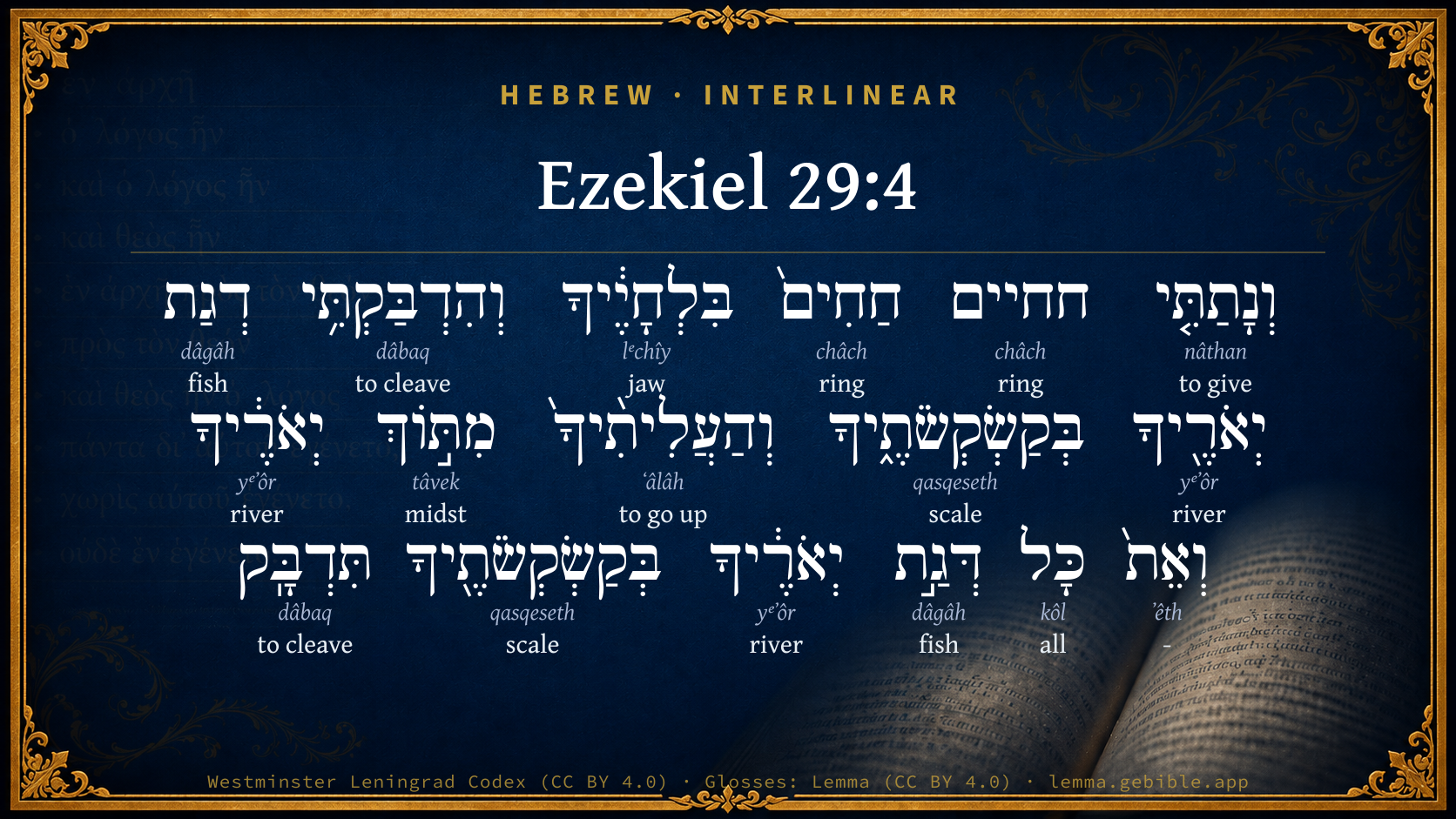
Ezekiel 29:4

Hebrew (Westminster Leningrad Codex) Ezekiel 29:4 appears in the Hebrew Old Testament. The text above is from the Westminster Leningrad Codex. Each word links to its Strong’s number, a concise gloss, and parsing drawn from the Open Scriptures Hebrew Bible morphology. Click any word for its full Brown-Driver-Briggs (BDB) entry.
Download image
Cite this verse

Ezekiel 29:4 (World English Bible). Public Domain. Lemma interlinear Bible study tool, https://lemma.gebible.app/v/ezekiel/29/4.

Show BibTeX & RIS
BibTeX
RIS
English Translation
I will put hooks in your jaws, and I will cause the fish of your rivers to stick to your scales; and I will bring you up out of the midst of your rivers, with all the fish of your rivers which stick to your scales.
World English Bible · Public Domain
Download a study sheet

One document with this verse’s original text, its word-by-word gloss line, the meaning frame, cross-references with their text, attributed commentary, and full source and license credits — printable, and it pastes into notes with its structure intact.

This verse Autodidact and up

Study sheet (.html) Plain text (.txt)

A passage Seminary Student

Up to 50 verses in one chapter. A passage sheet keeps up to 6 commentary sources and 12 cross-references per verse, in the order this page ranks them, and says so on the sheet whenever that leaves anything out. Ask for a single verse and you get the Autodidact verse sheet above.

Everything on this page stays free to read, with no account — the sheet is a download of what is already on screen, not access to it.

Want to remove ads? Support Godless Engineer
Compare translations 3

The same verse in 3 English versions, stacked beneath the original-language interlinear above. Click any original word for its lexicon entry.

Each is an independent rendering of the whole verse — the interlinear is not word-aligned to these translations.

Highlighted words mark where these versions differ — a whole-verse word diff, not a word-by-word alignment.

  • World English Bible Public Domain
    I will put hooks in your jaws, and I will cause the fish of your rivers to stick to your scales; and I will bring you up out of the midst of your rivers, with all the fish of your rivers which stick to your scales.
  • King James Version Public Domain
    But I will put hooks in thy jaws, and I will cause the fish of thy rivers to stick unto thy scales, and I will bring thee up out of the midst of thy rivers, and all the fish of thy rivers shall stick unto thy scales.
  • unfoldingWord Literal Text CC BY-SA 4.0
    For I will place hooks in your jaw, and the fish of your Nile will cling to your scales; I will lift you up from the middle of your river along with all the fish of the river that cling to your scales.

unfoldingWord Literal Text — © unfoldingWord, licensed CC BY-SA 4.0. Word-aligned USFM3 via Door43 (git.door43.org/unfoldingWord/en_ult).

Versions to compare (up to 4)

3 of 4 selected

Show all 18 translations

Every available English version of this verse, each an independent rendering of the whole verse.

  • World English Bible Public Domain
    I will put hooks in your jaws, and I will cause the fish of your rivers to stick to your scales; and I will bring you up out of the midst of your rivers, with all the fish of your rivers which stick to your scales.
  • Berean Standard Bible Public Domain
    But I will put hooks in your jaws and cause the fish of your streams to cling to your scales. I will haul you up out of your rivers, and all the fish of your streams will cling to your scales.
  • Majority Standard Bible Public Domain
    But I will put hooks in your jaws and cause the fish of your streams to cling to your scales. I will haul you up out of your rivers, and all the fish of your streams will cling to your scales.
  • King James Version Public Domain
    But I will put hooks in thy jaws, and I will cause the fish of thy rivers to stick unto thy scales, and I will bring thee up out of the midst of thy rivers, and all the fish of thy rivers shall stick unto thy scales.
  • American Standard Version (1901) Public Domain
    And I will put hooks in thy jaws, and I will cause the fish of thy rivers to stick unto thy scales; and I will bring thee up out of the midst of thy rivers, with all the fish of thy rivers which stick unto thy scales.
  • Revised Version (1885) Public Domain
    And I will put hooks in thy jaws, and I will cause the fish of thy rivers to stick unto thy scales; and I will bring thee up out of the midst of thy rivers, with all the fish of thy rivers which stick unto thy scales.
  • Geneva Bible (1599) Public Domain
    But I will put hookes in thy chawes, and I will cause the fish of thy riuers to sticke vnto thy scales, and I will drawe thee out of the middes of thy riuers, and all the fishe of thy riuers shall sticke vnto thy scales.
  • Douay-Rheims (1899) Public Domain
    But I will put a bridle in thy jaws: and I will cause the fish of thy rivers to stick to thy scales: and I will draw thee out of the midst of thy rivers, and all thy fish shall stick to thy scales.
  • Young's Literal Translation Public Domain
    And I have put hooks in thy jaws, And I have caused the fish of thy floods to cleave to thy scales, And I have caused thee to come up from the midst of thy floods, And every fish of thy floods to thy scales doth cleave.
  • Literal Standard Version CC BY-SA 4.0
    And I have put hooks in your jaws, || And I have caused the fish of your floods to cleave to your scales, || And I have caused you to come up from the midst of your floods, || And every fish of your floods cleaves to your scales.
  • Unlocked Literal Bible CC BY-SA 4.0
    For I will place hooks in your jaw, and the fish of your Nile will cling to your scales; I will lift you up from the middle of your river along with all the fish of the river that cling to your scales.
  • unfoldingWord Literal Text CC BY-SA 4.0
    For I will place hooks in your jaw, and the fish of your Nile will cling to your scales; I will lift you up from the middle of your river along with all the fish of the river that cling to your scales.
  • Darby Bible Public Domain
    And I will put hooks in thy jaws, and I will cause the fish of thy rivers to stick unto thy scales, and I will bring thee up out of the midst of thy rivers, and all the fish of thy rivers shall stick unto thy scales;
  • World Messianic Bible Public Domain
    I will put hooks in your jaws, and I will make the fish of your rivers stick to your scales. I will bring you up out of the middle of your rivers, with all the fish of your rivers which stick to your scales.
  • Webster's Bible Public Domain
    But I will put hooks in thy jaws, and I will cause the fish of thy rivers to stick to thy scales, and I will bring thee out of the midst of thy rivers, and all the fish of thy rivers shall stick to thy scales.
  • Free Bible Version CC BY-SA 4.0
    I'm going to put hooks in your jaws and make the fish in your river stick to your scales. I will pull you up out of your river, and all the fish will stick to your scales.
  • Bible in Basic English Public Domain
    And I will put hooks in your mouth, and the fish of your streams will be hanging from your skin; and I will make you come up out of your streams, with all the fish of your streams hanging from your skin.
  • JPS Tanakh (1917) Public Domain
    And I will put hooks in thy jaws, and I will cause the fish of thy rivers to stick unto thy scales; and I will bring thee up out of the midst of thy rivers, and all the fish of thy rivers shall stick unto thy scales.

Literal Standard Version (2020), Covenant Press — licensed CC BY-SA 4.0. Text via the HelloAO Bible API (eBible.org). Unlocked Literal Bible (unfoldingWord) — licensed CC BY-SA 4.0. Text via the HelloAO Bible API (eBible.org). unfoldingWord Literal Text — © unfoldingWord, licensed CC BY-SA 4.0. Word-aligned USFM3 via Door43 (git.door43.org/unfoldingWord/en_ult). Free Bible Version, Dr. Jonathan Gallagher — licensed CC BY-SA 4.0. Text via the HelloAO Bible API (eBible.org).

Word by word

More ways to search: Search by grammar → Find every occurrence → Compare this word →

Practice this passage: Drill this verse → Learn its vocabulary →

חחיים
châch
H2397
“rings”
Noun, Common, Masculine, Plural, Absolute
Part of Speech
Noun
Type
Common
Gender
Masculine
Number
Plural
State
Absolute
Full BDB Definition

Origin: from the same as H2336

TWOT: 620b

hook, ring, fetter, brooch - hook, ring (in nose of captive) - hook, ring (as jewellery) - nose ring - bracelet
  1. וְנָתַתִּ֤י nâthan H5414 “and · to give” Conjunction + Verb, Qal, Sequential Perfect, 1st Person, Common, Singular
  2. חַחִים֙ châch H2397 “rings” Noun, Common, Masculine, Plural, Absolute
  3. בִּלְחָיֶ֔יךָ lᵉchîy H3895 “in/at · jaws · your” Preposition + Noun, Common, Both, Dual, Construct + Suffix, Personal, 2nd Person, Masculine, Singular
  4. וְהִדְבַּקְתִּ֥י dâbaq H1692 “and · to cleave” Conjunction + Verb, Hiphil, Sequential Perfect, 1st Person, Common, Singular
  5. דְגַת dâgâh H1710 “fish of” Noun, Common, Feminine, Singular, Construct
  6. יְאֹרֶ֖יךָ yᵉʼôr H2975 “rivers · your” Noun, Common, Masculine, Plural, Construct + Suffix, Personal, 2nd Person, Masculine, Singular
  7. בְּקַשְׂקְשֹׂתֶ֑יךָ qasqeseth H7193 “in/at · scales · your” Preposition + Noun, Common, Feminine, Plural, Construct + Suffix, Personal, 2nd Person, Masculine, Singular
  8. וְהַעֲלִיתִ֨יךָ֙ ʻâlâh H5927 “and · to go up · you” Conjunction + Verb, Hiphil, Sequential Perfect, 1st Person, Common, Singular + Suffix, Personal, 2nd Person, Masculine, Singular
  9. מִתּ֣וֹךְ tâvek H8432 “from · midst of” Preposition + Noun, Common, Masculine, Singular, Construct
  10. יְאֹרֶ֔יךָ yᵉʼôr H2975 “rivers · your” Noun, Common, Masculine, Plural, Construct + Suffix, Personal, 2nd Person, Masculine, Singular
  11. וְאֵת֙ ʼêth H853 “and · -” Conjunction + Particle, Direct Object
  12. כָּל kôl H3605 “all of” Noun, Common, Masculine, Singular, Construct
  13. דְּגַ֣ת dâgâh H1710 “fish of” Noun, Common, Feminine, Singular, Construct
  14. יְאֹרֶ֔יךָ yᵉʼôr H2975 “rivers · your” Noun, Common, Masculine, Plural, Construct + Suffix, Personal, 2nd Person, Masculine, Singular
  15. בְּקַשְׂקְשֹׂתֶ֖יךָ qasqeseth H7193 “in/at · scales · your” Preposition + Noun, Common, Feminine, Plural, Construct + Suffix, Personal, 2nd Person, Masculine, Singular
  16. תִּדְבָּֽק dâbaq H1692 “to cleave” Verb, Qal, Imperfect, 3rd Person, Feminine, Singular

About this verse

These counts appear in no published source. They are computed here, from the morphology-tagged text and Lemma’s own curated glosses. What Lemma adds →

17
words
11
distinct lemmas
Prophets
section

Notable vocabulary

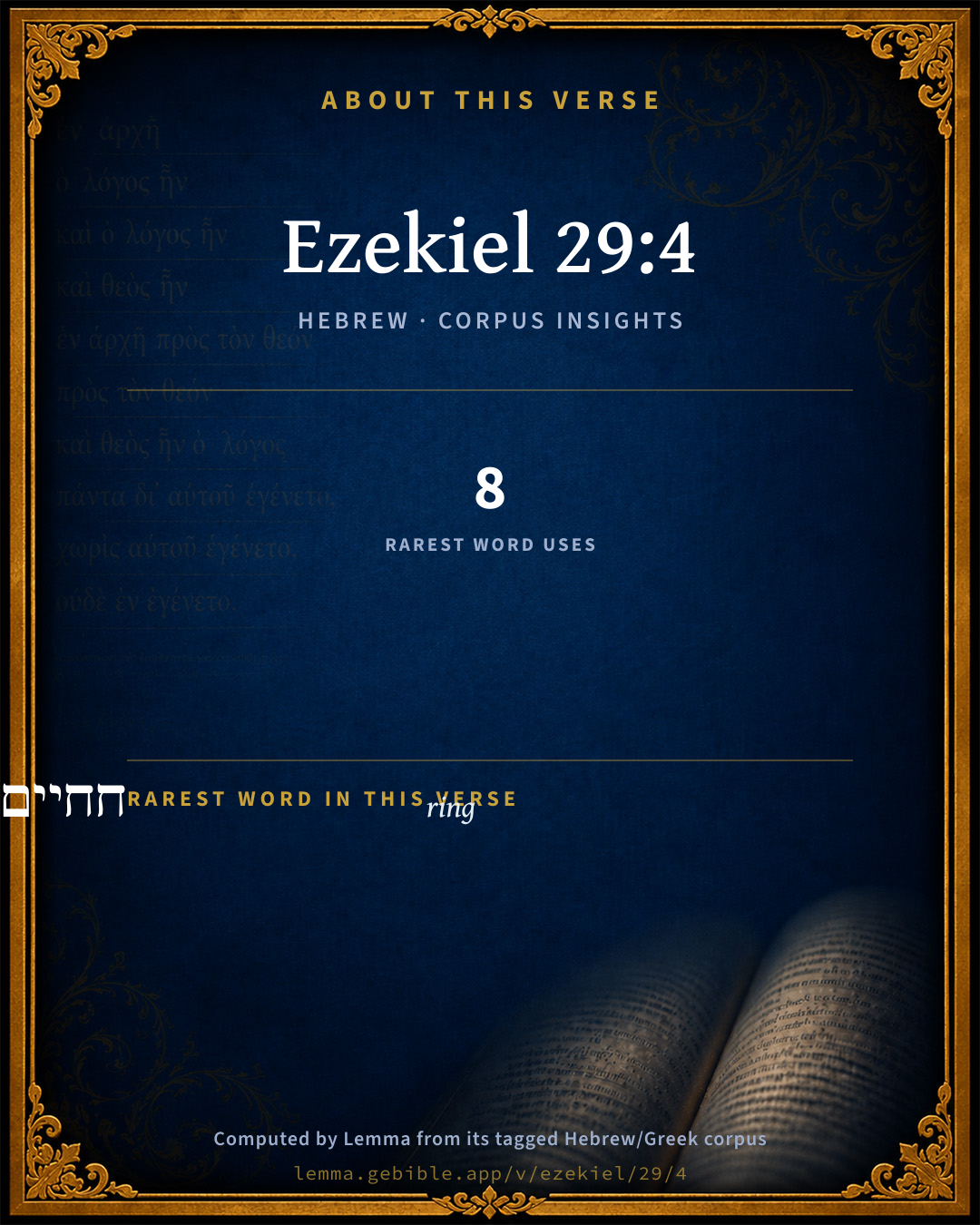
The rarest word here is חחיים ring H2397 — appearing just 8 times in the whole Hebrew Bible.

Shared distinctive vocabulary

חחיים ring H2397 occurs in 7 verses of the Hebrew Bible. Also found in:

Grammatical profile

  • 4 verbs
  • 12 nouns
  • 1 particle

Verb forms

  • וְנָתַתִּ֤י Qal · Sequential Perfect
  • וְהִדְבַּקְתִּ֥י Hiphil · Sequential Perfect
  • וְהַעֲלִיתִ֨יךָ֙ Hiphil · Sequential Perfect
  • תִּדְבָּֽק Qal · Imperfect

Repetition

Words recur within this verse — often emphatic in Hebrew:

  • יְאֹרֶ֖יךָ river H2975 ×3
  • חחיים ring H2397 ×2
  • וְהִדְבַּקְתִּ֥י to cleave H1692 ×2
  • דְגַת fish H1710 ×2
  • בְּקַשְׂקְשֹׂתֶ֑יךָ scale H7193 ×2

Hebrew & Septuagint length

In English translation the verse runs 46 words from the Hebrew and 35 from the Septuagint (LXX English) — closely comparable.

A rough comparison of the two English renderings, which tokenize alike — not a word-level alignment.

Word counts can differ between the Hebrew and the Greek without any difference in meaning — e.g. the Hebrew direct-object marker אֵת has no separate Greek word, and Greek often adds the article ὁ.

Cross-references

6

Topical passages linked to Ezekiel 29:4 in the Treasury of Scripture Knowledge — connected by theme and wording, ordered by reader-vote popularity; previews shown in the World English Bible.

  • 2 Kings 19:28 Because of your raging against me, and because your arrogance is come up into my ears, therefore will I put my hook in your nose, and my bridle in your lips, and I will turn you back by the way by which you came.
  • Ezekiel 38:4 and I will turn you about, and put hooks into your jaws, and I will bring you forth, and all your army, horses and horsemen, all of them clothed in full armor, a great company with buckler and shield, all of them handling swords;
  • Job 41:1–2 "Can you draw out Leviathan with a fishhook? Or press down his tongue with a cord?
  • Isaiah 37:29 Because of your raging against me, and because your arrogance is come up into my ears, therefore will I put my hook in your nose, and my bridle in your lips, and I will turn you back by the way by which you came.
  • Amos 4:2 The Lord Yahweh has sworn by his holiness that behold, "The days shall come on you that they will take you away with hooks, And the last of you with fish hooks.
  • Habakkuk 1:14–15 and make men like the fish of the sea, like the creeping things, that have no ruler over them?

Cross-references courtesy of OpenBible.info (CC BY 4.0).

Hebrew and Greek witnesses Masoretic Hebrew ↔ Greek Septuagint

The same verse in the two great witnesses to the Old Testament, shown verse-for-verse.

These are two independent witnesses, not word-aligned to each other, and the Septuagint is shown in lemma (dictionary) form.

Hebrew Ezekiel 29:4 Masoretic · Westminster Leningrad Codex

וְנָתַתִּ֤י חחיים חַחִים֙ בִּלְחָיֶ֔יךָ וְהִדְבַּקְתִּ֥י דְגַת יְאֹרֶ֖יךָ בְּקַשְׂקְשֹׂתֶ֑יךָ וְהַעֲלִיתִ֨יךָ֙ מִתּ֣וֹךְ יְאֹרֶ֔יךָ וְאֵת֙ כָּל דְּגַ֣ת יְאֹרֶ֔יךָ בְּקַשְׂקְשֹׂתֶ֖יךָ תִּדְבָּֽק

I will put hooks in your jaws, and I will cause the fish of your rivers to stick to your scales; and I will bring you up out of the midst of your rivers, with all the fish of your rivers which stick to your scales.

World English Bible · Public Domain

Greek LXX Ezekiel 29:4 Septuagint · lemma form

καί ἐγώ δίδωμι παγίς εἰς ὁ σιαγών σύ καί προςκολλάω ὁ ἰχθύς ὁ ποταμός σύ πρός ὁ πτέρυξ σύ καί ἀναἄγω σύ ἐκ μέσος ὁ ποταμός σύ καί πᾶς ὁ ἰχθύς ὁ ποταμός σύ

And I will put hooks in your jaws, and I will cause the fish of your river to stick to your sides, and I will bring you up out of the midst of your river:

LXX2012 (modern English Septuagint) · Public Domain

Hebrew: Westminster Leningrad Codex (CC BY 4.0). Greek: Septuagint (public domain); English from LXX2012 (modern English Septuagint) (Public Domain). How the Septuagint differs from the Hebrew →

Targum (Aramaic paraphrase)

1

The Targum is the ancient Jewish Aramaic paraphrase of the Hebrew Scriptures — an interpretive translation, not the Hebrew text itself. Onkelos (literal) and Pseudo-Jonathan (expansive) render the Torah, and Jonathan the Prophets. Coverage is partial: where no permissively-licensed English translation exists for a verse, only the Aramaic is shown. This is verse-level text, not a word-by-word alignment to the Hebrew.

  1. Targum Jonathan Prophets (Joshua–Malachi)
    וְאֶתֵּן שִׁירִין בְּלִיסָתָךְ וְאֶקְטוֹל שִׁלְטוֹנֵי תוּקְפָךְ עִם גִבָּרָךְ וַאֲבַטְלִינָךְ מִמַלְכוּתָךְ וְיַת כָּל שִׁלְטוֹנֵי תוּקְפָךְ עִם גִבָּרָךְ יִתְקַטְלוּן:

    (no public-domain English translation for this verse)

    Targum Jonathan — Aramaic: “Mikraot Gedolot” (public domain). English: “Sefaria Community Translation” (CC0 1.0 (public-domain dedication)); “London "Chaldee Paraphrase," 1871” (public domain). Text via Sefaria.

Commentary

Notes on Ezekiel 29:4 from classic Christian and Jewish commentators (each source and its license shown beneath its notes). The classic Christian expositions comment on the surrounding passage and are grouped to its opening verse, so a note may address several verses; the Jewish commentaries on the Tanakh (Rashi and others) are per-verse, so they appear only where the commentator wrote on this verse.

Lemma curates 59 commentaries, every one of them public domain or Creative Commons licensed, each selected and text-cleaned for this edition rather than reprinted as found. About our sources →

Trapp's Complete Commentary

John Trapp

Eze 29:4 But I will put hooks in thy jaws, and I will cause the fish of thy rivers to stick unto thy scales, and I will bring thee up out of the midst of thy rivers, and all the fish of thy rivers shall stick unto thy scales.

Ver. 4. But I will put hooks in thy jaws.] Speaking to Tyre, a sea town, sea metaphors were made use of. Now he fetcheth them from waters and fishes, that he may frame himself to his hearers. A good precedent for preachers.

To stick unto thy scales.] Thy subjects shall all follow thee into the field, that there you may all fall together. Had they kept themselves in Egypt, they might have been far safer; for that country could hardly be come at by an enemy. But they went forth to meet their bane, as if they had been ambitions of destruction. God had a holy hand in it.

John Trapp, A Commentary or Exposition upon All the Books of the Old and New Testament (1647–1656) — public domain. Text from a community e-Sword module.

Joseph Benson's Commentary

Eze 29:4-5. But I will put hooks in thy jaws — The king of Egypt being spoken of as a great fish, or a crocodile, God here, in pursuance of the same metaphor, tells him that he will put hooks in his jaws, or stop his vain-glorious designs and boastings, by raising up enemies that should gain the mastery over him, as the fisherman has the fish in his power, when he has struck the hook into its jaws. This hook to the king of Egypt was Amasis, one of his officers, who set up himself as king, by the favour of the people, and dethroned his master. I will cause the fish of thy rivers to stick unto thy scales — I will cause even thy own people to press thee hard, and to be a torment to thee. And I will bring thee up out of thy rivers — By this is metaphorically expressed his being induced to undertake a foreign expedition. The expression alludes to the nature of a crocodile, which is not confined to the water, but uses to come upon the land, where he is frequently taken. And I will leave thee thrown into the wilderness, and all the fish of thy rivers — Thy army shall be discomfited, and fall in the deserts of Lybia and Cyrene; for there seems to be here an allusion to the heavy loss which Apries and the Egyptian army sustained in his expedition against the Cyrenians, toward whom they must have marched over the desert. Herod. 2. § 161. Apries himself did not fall in battle, but was taken prisoner by Amasis, and strangled by the Egyptians. Herod. 2. § 169. See note on Jer 44:30. Thou shalt fall upon the open fields — A king is said to be defeated, or victorious, when his armies are so. Thou shalt not be brought together, nor gathered — The bones, or carcasses, of thy army shall not be collected in order to their burial, nor gathered to the dead in the sepulchres allotted for them. I have given thee for meat to the beasts of the field, &c. — See Rev 19:17-18. Some think the expression here is metaphorical, and signifies that the power of depriving him of his kingdom, power, liberty, riches, and at last life itself, should be given to cruel and rapacious men.

Joseph Benson's Commentary on the Old and New Testaments (1811–1818) — public domain. Text from a community e-Sword module.

Tyndale Open Study Notes

Tyndale Open Resources

29:4-5 The picture of the mighty crocodile anticipates the arrival of the Lord as a great hunter. As with Tyre, a watery fortress would once again prove vulnerable to assault. The outwardly fearsome king of Egypt would be captured like any ordinary crocodile and brought out into the wilderness, the place of judgment, along with his allies, the fish. There he would die, and his body would be left dishonorably exposed for the wild animals and birds to eat.

Tyndale Open Study Notes — © Tyndale Open Resources, licensed CC BY-SA 4.0. Text via the HelloAO Bible API.

Geneva Bible (1599)

Geneva Bible translators

I will send enemies against thee, which shall pluck thee, and thy people which trust in thee, out of thy sure places.

Geneva Bible (1599) marginal notes — public domain. Text via Bolls.life.

Jamieson, Fausset & Brown

Robert Jamieson, A. R. Fausset & David Brown

hooks in thy jaws-- (Isa 37:29; compare Job 41:1-2). Amasis was the "hook." In the Assyrian sculptures prisoners are represented with a hook in the underlip, and a cord from it held by the king.

cause . . . fish . . . stick unto . . . scales--Pharaoh, presuming on his power as if he were God (Eze 29:3, "I have made it"), wished to stand in the stead of God as defender of the covenant-people, his motive being, not love to them, but rivalry with Babylon. He raised the siege of Jerusalem, but it was only for a time (compare Eze 29:6; Jer 37:5, Jer 37:7-10); ruin overtook not only them, but himself. As the fish that clung to the horny scales of the crocodile, the lord of the Nile, when he was caught, shared his fate, so the adherents of Pharaoh, lord of Egypt, when he was overthrown by Amasis, should share his fate.

Jamieson, Fausset & Brown — Commentary Critical and Explanatory on the Whole Bible (1871) — public domain (CC PDM 1.0). Text via the HelloAO Bible API.

Adam Clarke's Commentary

Verse 4. I will put hooks in thy jaws] Amasis, one of this king's generals, being proclaimed king by an insurrection of the people, dethroned Apries, and seized upon the kingdom; and Apries was obliged to flee to Upper Egypt for safety.

I will cause the fish - to stick unto thy scales] Most fish are sorely troubled with a species of insect which bury their heads in their flesh, under their scales, and suck out the vital juices. The allusion seems to be to this. Pharaoh was the crocodile; the fish, the common people; and the sticking to his scales, the insurrection by which he was wasted and despoiled of his kingdom.

Adam Clarke's Commentary on the Bible (1810–1826) — public domain. Text from a community e-Sword/MySword module.

Ellicott's Commentary for English Readers

(4) Hooks in thy jaws.—An allusion to the ancient way of taking and destroying the crocodile, otherwise invulnerable to their arms.

Fish of thy rivers shall stick unto thy scales.—As the crocodile, the lord of the Nile, represents the royal power of Egypt, so the fish represent the people dependent upon him. Pharaoh is not to fall alone, but shall drag his people with him into a common ruin.

A Bible Commentary for English Readers, edited by Charles John Ellicott (1878–1897) — public domain. Text from a community e-Sword module.

The Cambridge Bible for Schools and Colleges

gen. ed. J. J. S. Perowne

4. with hooks. This is suggested by the monster inhabiting the waters. Possibly the crocodile was occasionally caught with hooks, as Herodotus affirms (cf. ch. Eze_32:3), although Job_41:1 seems to doubt the practicability of it. On “hooks,” ch. Eze_38:4; Isa_37:29.

fish of thy rivers] A figure for the population of the country of rivers; hardly merely for the army of Pharaoh.

The Cambridge Bible for Schools and Colleges (gen. ed. J. J. S. Perowne; Cambridge University Press, 1878–1918) — public domain. Text from a community e-Sword module.

John Gill's Exposition

But I will put hooks in thy jaws,.... The allusion is to fishhooks, which are taken by fishes with the bait into their mouths, and stick in their jaws, by which they are drawn out of the river, and taken. The king of Egypt being before compared to a fish, these hooks design some powerful princes and armies, which should be the ruin of Pharaoh; one of them, according to Junius and Grotius, was Amasis, at the head of the Cyreneans and Greeks; and another was Nebuchadnezzar king of Babylon; see Job 41:1,

and I will cause the fish of thy rivers to stick unto thy scales; the people of his kingdom, especially his soldiers, generals, princes, and great men, to cleave to him, follow him, and go out with him in his expedition against Amasis. The Targum is,

"I will kill the princes of thy strength with thy mighty ones:''

and I will bring thee up out of the midst of thy rivers: alluding to the crocodile, to which he is compared, which sometimes comes out of the river, and goes on dry land. The king of Egypt was brought out of his kingdom by the following means: Amasis, with the Cyreneans and Greeks, having seized upon Lybia, and drove the king of it from thence, he applied to Pharaoh for help, who gathered a large army of Egyptians, and led them out into the fields of Cyrene, where they were defeated by Amasis, and almost all perished, and the king saved himself by flight; upon which the Egyptians mutinied and rebelled against him, and Amasis became their king:

and all the fish of thy rivers shall stick unto thy scales; the common people of Egypt; for the above numerous army consisted only of Egyptians, whom he gathered from all parts, drained his rivers of them, and almost exhausted his country hereby; he had indeed in an army, after this battle with Amasis, thirty thousand auxiliaries, Carians and Ionians; but these were not the fish of his rivers. The Targum is,

"I will make thy kingdom to cease from thee, and all the princes of thy strength with thy mighty ones shall be killed;''

with which the history agrees. The allusion to the crocodile is here very just and pertinent, which is a fish full of scales. Monsieur Thevenot (a), who saw many of them, says, that

"the body of this fish is large, and all of a size; the back is covered with high scales, like the heads of nails in a court gate, of a greenish colour, and so hard that they are proof against a halberd; and it has a long tail covered with scales like the body;''

and another traveller says (b) they have scales on their back musket proof, and therefore must be wounded in the belly; but another traveller (c) says, this is a vulgar report that a musket shot will not pierce the skins of the crocodiles, for upon trial it is found false; yet all writers, ancient and modern, allow it to have very firm scales on its back, which render it capable of bearing the heaviest strokes, and to be in a measure impenetrable and invincible; so Herodotus (d) says, it has a skin full of scales, on the back infrangible; or, as Pliny (e) expresses it, invincible against all blows and strokes it may be stricken with; and so says Aristotle (f), with which Aelian (g) agrees, who says that the crocodile has by nature a back and tail impenetrable; for it is covered with scales, as if it was armed as one might say, not unlike to hard shells.

(a) Travels, par. 1. B. 2. c. 72. p. 245. (b) Mandelsloe in Harris's Voyages, &c. vol. 1. p. 759. (c) Tavernier in ib. p. 835. (d) Euterpe, sive l. 2. c. 63. (e) Nat. Hist. l. 8. c. 25. (f) Hist. Animal: l. 2. c. 10. (g) De Animal. l. 10. c. 24.

John Gill's Exposition of the Whole Bible (1746–1763) — public domain (CC PDM 1.0). Text via the HelloAO Bible API.

Albert Barnes' Notes on the Bible

Hooks in thy jaws - Compare Job 41:2. The crocodile is thus rendered an easy prey.

Fish of thy rivers - i. e., the allies of Egypt shall be involved in her ruin.

Albert Barnes' Notes on the Bible (1834–1885) — public domain. Text from a community e-Sword/MySword module.

Haydock's Catholic Bible Commentary

Bridle. The Tentyrians jump upon the crocodile’s back, give it a club to bite at, which they seize with both hands, and bring it to the shore. (Pliny, [Natural History?] viii. 25.) --- Others throw a hook baited with swine’s flesh, and holding the rope on the shore, make a little pig squeak, with draws the attention of the crocodile; and, as it comes for its prey, it swallows the hook, and its eyes being filled with dust is easily slain. (Herodotus ii. 70.) --- Apries sent an army against Cyrene, which being defeated as it was thought by the king’s fault, many of the Egyptians revolted. He sent Amasis, entered Egypt, drove Apries into Higher Egypt, slew many of the inhabitants, and Jews, &c., and left Amasis to govern the wretched remains of the kingdom. (Usher, the year of the world 3430.) The Scripture, however, seems to say that Pharao was slain; (Jeremias xliii., &c.; Calmet) which Ctesias assures us was done by Amasis, though Herodotus (ii. 169.) says he was killed by the people, and buried with his fathers. This latter circumstance is not very probable: but the historian followed the account of the priests, who would mention what was most honourable for the nation. He seems to have been left unburied, ver. 5. Scales. The people depended on the king and share his fate. (Calmet)

George Leo Haydock (1774–1849), Haydock's Catholic Family Bible and Commentary, 1859 edition — public domain. Excludes Psalms (Douay-Rheims chapter numbering differs from Protestant) and Deuterocanonical books (Catholic canon only).

Matthew Poole's English Annotations

Thou art secure against all, but God will draw thee out of thy river to thy ruin.

Hooks; the allegory is continued; fish are drawn out with hooks and lines, and God hath hooks for this proud dragon, first Areasis, and next the Babylonian king. The expedition of Areasis at the head of the Cyreneans and Grecians, and the event of it, is exactly represented in this hieroglyphic in the text. Amasis with those forces mastered Libya, the king thereof applies for help to this Pharaoh, he gathers all the power of Egypt out of Egypt with him into Cyrene, where he was defeated, lost all but a few that fled with him, and on this occasion the Egyptians rebelled against him: now this short history opens the parable. The first hook you see in the jaws of this dragon, this drew him out of his river, i.e. his kingdom.

The fish; these are the people of Egypt, the subjects of this kingdom.

To stick unto thy scales; to adhere to their king in this war.

I will bring thee up out of the midst of thy rivers; both the king and his subjects, which made up his army, go out of the rivers, leave Egypt, and march into Cyrene (which was part of that kingdom now called Bares) with their king, as if they had been little fishes on the back of a mighty one. Thus far the emblem; the rest follows.

Matthew Poole's English Annotations on the Holy Bible (1683–1685) — public domain. Text from a community e-Sword/MySword module.

Whedon's Commentary on the Bible

Daniel D. Whedon

4. I will put hooks in thy jaws — So the crocodile was sometimes caught (Herodotus, 2:70). The fish which stick to his scales represent the Egyptian population and dependencies — such as Gaza and Jerusalem and other towns which had foolishly trusted to the Pharaoh for help against the Assyrians.

Daniel D. Whedon (gen. ed.), Commentary on the Old and New Testaments (1874–1909) — public domain. Text from a community e-Sword module.

The Pulpit Commentary

Vers. 4, 5. I will put hooks in thy jaws. So Herodotus (2. 70) describes the way in which the Egyptians caught the crocodile by baiting a large hook with swines flesh. Jomard ("Description de l Egypt,"1:27) gives a similar account. (comp. also Job_41:1, Job_41:2, though there the capture seems represented as an almost impossible achievement; probably the process had become more familiar since the date of that book) The fish that stick to the scales of the crocodile are, of course, in the interpretation of the parable, either the Egyptian army itself or the nations that had thrown themselves into alliance with Egypt, and the destruction of the two together in the wilderness points to some great overthrow of the Egyptian army and its auxiliaries, probably to that of the expedition against Cyrene (Herod., 2:161) which led to the revolt of Amasis, and which would take the wilderness west of the Nile on its line of march. The beasts of the field and the fowls of the heaven (we note the recurrence of the old Homeric phrase, as in "Iliad," 1:4, 5) should devour the carcasses of the slain, the corpses of the fallen and prostrate nation.

The Pulpit Commentary (1880–1919), ed. H.D.M. Spence-Jones & Joseph S. Exell — public domain. Text from a community e-Sword module.

John Wesley's Explanatory Notes

Put hooks - The Allegory is continued. The fish - The people of Egypt. To stick - To adhere to their king.

John Wesley, Explanatory Notes Upon the Whole Bible (1754–1765) — public domain. Text via the GEBible commentary corpus.

unfoldingWord translationNotes

Door43 World Missions Community

General Information:

Yahweh continues giving Ezekiel his message to Pharaoh, speaking of him as though he were a monster in the water and the people of Egypt were fish. (See: Symbolic Language)

hooks

sharp and bent pieces of metal or wood that people use to catch fish and other animals in the water

scales

hard pieces of skin that are on fish, crocodiles, and other animals

you will not be gathered nor lifted up

This can be stated in active form. The implication is that they would die in the wilderness. AT: "no one will gather you or pick you up" or "no one will gather your bodies and bury you" (See: Active or Passive and Assumed Knowledge and Implicit Information)

translationWords

Nile River

desert

face

life

heaven

unfoldingWord translationNotes — © Distant Shores Media and the Door43 World Missions Community, licensed CC BY-SA 4.0. Source: git.door43.org/Door43/en_tn.

Rashi

Rabbi Shlomo Yitzchaki (Rashi)

hooks [Heb. חַתִים,] type of iron rings, ens in Old French.

the fish of your rivers to fasten onto your scales [Heb. בְּקַשְּׂקְשּׂתֶיךָ,] en tes e(s)chardes in Old French, to your scales. That is to say, I shall inspire all your mighty men to go forth with you to war so that they will all fall.

Rashi on the Tanakh — English translations: “The Judaica Press complete Tanach with Rashi, translated by A. J. Rosenberg” (CC BY 4.0); “Pentateuch with Rashi's commentary by M. Rosenbaum and A.M. Silbermann, 1929-1934” (public domain); “The Metsudah Tanach series, Lakewood, N.J” (CC BY 4.0); and “The Book of Joshua, Metsudah Publications, 1997” (CC BY 4.0). Text via Sefaria.

Lesson kit

Teaching starters — assembled from the data on this page, not authored interpretation. Every prompt links to the verse data it draws on. Edit before teaching.

Ezekiel, in the Prophets, opens this verse with 17 words (11 distinct Hebrew lemmas). Its most distinctive word is châch (“ring”). A historical commentator’s framing appears above. Read the whole chapter for the surrounding context.

Discussion questions

  1. What does “ring” (châch) contribute to the verse as a whole?
  2. Exodus 35:22 shares the word «ring» with this verse. How do the two illuminate each other?
  3. “river” occurs 3× in this one verse. What is the effect of the repetition?
  4. The translations on this page render this verse differently — a whole-verse word diff, not a word-by-word alignment. What might account for the different wordings?
  5. The verb «וְנָתַתִּ֤י» is Qal Sequential Perfect. How does its form color the action?
  6. Reading how Trapp's Complete Commentary and Joseph Benson's Commentary read this verse, where do the two commentators agree and where do they part?

Things to notice

Reading settings

Reading text

Shown beneath each verse's original-language words.

Old Testament
Old Testament edition

Read the OT as the Masoretic Hebrew (MT) or the Greek Septuagint (LXX).

English shown for the Greek Septuagint (in the Hebrew ↔ Greek comparison).

Comparing translations? Open the Compare panel on any verse page to stack up to four side by side.