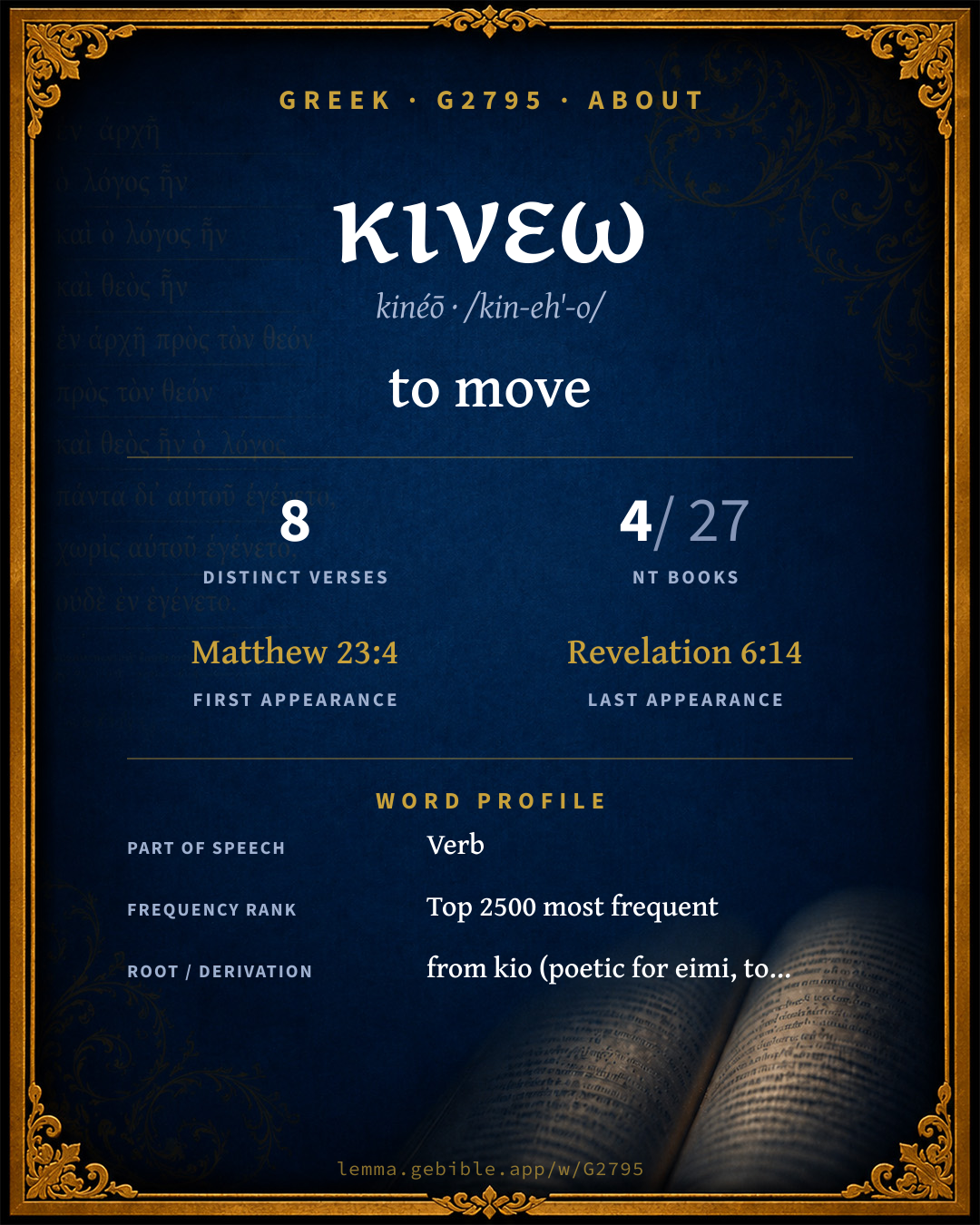
κινέω
to move
‘to move’ is one of 2 main senses fuller range ↓
Full lexicon entry — Thayer's Greek Lexicon
From Thayer's Greek Lexicon
Where this word appears
See every Present-tense verb in the Greek New Testament →
Grammar key — what these labels mean
Part of speech
- Verb
- An action or state-of-being word.
Tense
- Present
- Ongoing or general action in present time (imperfective aspect).
- Aorist
- Action viewed as a simple whole, without regard to duration — often past (perfective aspect).
- Future
- Action expected in future time.
Voice
- Active
- The subject performs the action.
- Passive
- The subject receives the action.
Mood
- Participle
- A verbal adjective (“writing,” “having written”).
- Infinitive
- A verbal noun (“to write”), unmarked for person or number.
- Indicative
- States a fact or asks a factual question (the mood of reality).
Case
- Nominative
- The case of the subject (and the predicate nominative).
- Accusative
- The case of the direct object and of extent.
Person
- 3rd person
- The one spoken about (“he / she / it / they”).
- 1st person
- The speaker (“I / we”).
Gender
- Masculine
- Grammatically masculine.
Number
- Plural
- More than one.
- Singular
- One.
1 verse where G2795 appears in the Aorist tense in the Book of Acts. Filtered view — show all forms. Click any verse to open its interlinear word-by-word view. Verse text shown in the World English Bible for context — . Each verse’s Greek form is shown with its reference; the English is not keyword-highlighted, since the data carries no word-level English alignment. Use “Compare translations” on any verse to read it across multiple English versions. This concordance covers the Greek New Testament; Septuagint (Greek Old Testament) occurrences of this word are not indexed here.
Acts
About this entry
At a glance — auto-summarized from this page’s data, not written by a person. Every figure links to its source below. This summary describes the numbers; it doesn’t interpret them.
“to move” is the headline sense of the Greek verb κινεω (kinéō). Scripture first uses it in Matthew 23:4. It appears 8 verses across 4 books of the Greek New Testament, among its uncommon vocabulary. More than a third of its appearances fall in Acts. Catalogued under 2 senses, its meaning is not single-sense. See the sense tree, 8-verse concordance, and the renderings breakdown below.
Gloss history
Strong's 1890 vs modern scholarship

About this word
Strong's G2795 catalogs a Greek word from the Greek New Testament.
These counts are not copied from any lexicon or concordance. They are computed here, from the morphology-tagged Greek New Testament. What Lemma adds →
- 8
- distinct verses
- The word appears in 8 distinct verses.
- 4 / 27
- NT books
- The word appears in 4 of 27 New Testament books.
- #1,240
- by frequency
- Top 2500 most frequent Greek words (rank 1,240 of 5,347 Greek words by occurrence).
View all 8 occurrences in the concordance →
Most concentrated in
- Acts 3 verses 38%
- Matthew 2 verses 25%
- Revelation 2 verses 25%
By section of the New Testament
By traditional corpus
Conventional, traditional groupings — biblical authorship is debated, so this is a traditional corpus grouping, not an authorship claim. Some books belong to more than one corpus (Luke is in both the Gospels and the Lukan corpus, and so on), so these shares overlap and need not total 100%. Each figure is a share of the word’s 8 distinct verses.
- Gospels 3 verses · 38%
- Lukan (Luke–Acts) 3 verses · 38%
- Johannine 2 verses · 25%
- Revelation 2 verses · 25%
How translations render this word
Counts come from each version’s own published word-to-Strong’s tagging or interlinear alignment — an approximate guide to how each version renders this word, not a word-level alignment the data otherwise carries. Because each total is that version’s own tagged count, the per-version totals vary from one another and need not match the appearance or distinct-verse counts above. These counts may also differ from a printed concordance because Lemma counts each distinctly tagged rendering and does not collapse phrase taggings into a single head-word total. This is a fixed set of word-tagged versions (KJV, ASV, BSB, ULT) and does not change with the reading translation you choose elsewhere. Each version’s license is shown beside its name below (and on Sources).
- King James Version: Move 2×, Wagging 2×
- American Standard Version: Move 2×, Wagging 2×
- Berean Standard Bible: Move 2×, Shaking 2×
- unfoldingWord Literal Text: Wagging 2×
King James Version Public Domain
Renders G2795 across 8 tagged occurrences — most commonly:
Plus 4 renderings that appear only once — usually multi-word phrases or single function words the recovered tagging swept in, not distinct renderings.
American Standard Version Public Domain
Renders G2795 across 8 tagged occurrences — most commonly:
Plus 4 renderings that appear only once — usually multi-word phrases or single function words the recovered tagging swept in, not distinct renderings.
Berean Standard Bible Public Domain
Renders G2795 across 8 tagged occurrences — most commonly:
Plus 4 renderings that appear only once — usually multi-word phrases or single function words the recovered tagging swept in, not distinct renderings.
unfoldingWord Literal Text CC BY-SA 4.0
Renders G2795 across 8 tagged occurrences — most commonly:
Plus 6 renderings that appear only once — usually multi-word phrases or single function words the recovered tagging swept in, not distinct renderings.
Senses in Thayer's
The 2 senses Thayer's distinguishes for this word, in lexicon order (not ranked by frequency or importance). The full entry — with sub-senses — is in the Lexicon Entry tab.
- to cause to go, i.e. to move, set in motion
- metaph.
Word origin
Origin: from kio (poetic for eimi, to go)
From κίω kiō (poetic for [ εἶμι eimi to go ]); to stir (transitively) literally or figuratively : - (re-) move (-r) way.
— Strong’s Exhaustive Concordance (1890), public domain.
Forms in the corpus
The 7 distinct written forms G2795 takes in the Greek New Testament, most frequent first — each parse links to that tense’s occurrences in the concordance.
| Form | Parsing | Example | Uses |
|---|---|---|---|
| κινοῦντες kinoûntes | Verb, Present, Active, Participle, Nominative, Plural, Masculine | Matthew 27:39 | 2 |
| κινήσω kinḗsō | Verb, Future, Active, Indicative, 1st person, Singular | Revelation 2:5 | 1 |
| κινούμεθα kinoúmetha | Verb, Present, Passive, Indicative, 1st person, Plural | Acts 17:28 | 1 |
| κινοῦντα kinoûnta | Verb, Present, Active, Participle, Accusative, Singular, Masculine | Acts 24:5 | 1 |
| κινῆσαι kinē̂sai | Verb, Aorist, Active, Infinitive | Matthew 23:4 | 1 |
| ἐκινήθη ekinḗthē | Verb, Aorist, Passive, Indicative, 3rd person, Singular | Acts 21:30 | 1 |
| ἐκινήθησαν ekinḗthēsan | Verb, Aorist, Passive, Indicative, 3rd person, Plural | Revelation 6:14 | 1 |
Same root — word family
Other Thayer's entries built from the same root as G2795, grouped by Strong’s listed origin. These share a root / origin per the lexicon — not necessarily a shared meaning. Each links to that word’s own entry.
Derived from this word
Compare all same-root words → They share a root, not necessarily a meaning.
Septuagint usage
The same Greek word κινεω appears 41 times in the Greek Old Testament (Septuagint), across 40 verses in 17 books.
- 41
- LXX occurrences
- Tagged occurrences of this Greek word in the Septuagint.
- 40
- verses
- Distinct Septuagint verses containing this word.
- 17 / 39
- OT books
- The word appears in 17 of the 39 Old Testament books.
Sample Septuagint occurrences
- Genesis 7:14 κινέω
- Leviticus 11:44 κινέω
- Numbers 14:44 κινέω
- Judges 9:9 κινέω
- 1 Samuel 1:13 κινέω
- 2 Samuel 15:20 κινέω
- 2 Kings 19:21 κινέω
- 2 Chronicles 35:15 κινέω
- Job 13:25 κινέω
- Psalms 21:8 κινέω
- Proverbs 17:13 κινέω
- Song of Solomon 2:17 κινέω
Septuagint occurrences (same lexeme)
Every verse where the same Strong’s number (G2795) appears in the Greek Septuagint. Verse text shown in the World English Bible for context; the Greek form is the matched word — the English is not keyword-highlighted.
- Genesis 7:14 κινέω they, and every animal after its kind, all the cattle after their kind, every creeping thing that creeps on the earth after its kind, and every bird after its kind, every bird of every sort.
- Genesis 7:21 κινέω All flesh died that moved on the earth, including birds, cattle, animals, every creeping thing that creeps on the earth, and every man.
- Genesis 8:17 κινέω Bring forth with you every living thing that is with you of all flesh, including birds, cattle, and every creeping thing that creeps on the earth; that they may breed abundantly in the earth, and be fruitful, and multiply on the earth."
- Genesis 8:19 κινέω Every animal, every creeping thing, and every bird, whatever moves on the earth, after their families, went forth out of the ark.
- Genesis 9:2 κινέω The fear of you and the dread of you will be on every animal of the earth, and on every bird of the sky. Everything that the ground teems with, and all the fish of the sea are delivered into your hand.
- Genesis 11:2 κινέω It happened, as they traveled east, that they found a plain in the land of Shinar; and they lived there.
- Genesis 20:1 κινέω Abraham traveled from there toward the land of the South, and lived between Kadesh and Shur. He lived as a foriegner in Gerar.
- Leviticus 11:44 κινέω For I am Yahweh your God. Sanctify yourselves therefore, and be holy; for I am holy: neither shall you defile yourselves with any kind of creeping thing that moves on the earth.
- Leviticus 11:46 κινέω "'This is the law of the animal, and of the bird, and of every living creature that moves in the waters, and of every creature that creeps on the earth,
- Numbers 14:44 κινέω But they presumed to go up to the top of the mountain: nevertheless the ark of the covenant of Yahweh, and Moses, didn't depart out of the camp.
- Judges 9:9 κινέω But the olive tree said to them, Should I leave my fatness, with which by me they honor God and man, and go to wave back and forth over the trees?
- Judges 9:11 κινέω But the fig tree said to them, Should I leave my sweetness, and my good fruit, and go to wave back and forth over the trees?
- Judges 9:13 κινέω The vine said to them, Should I leave my new wine, which cheers God and man, and go to wave back and forth over the trees?
- Judges 20:37 κινέω The liers-in-wait hurried, and rushed on Gibeah; and the liers-in-wait drew themselves along, and struck all the city with the edge of the sword.
- 1 Samuel 1:13 κινέω Now Hannah, she spoke in her heart; only her lips moved, but her voice was not heard: therefore Eli thought she had been drunken.
- 2 Samuel 15:20 κινέω Whereas you came but yesterday, should I this day make you go up and down with us, seeing I go where I may? return you, and take back your brothers; mercy and truth be with you.
- 2 Kings 19:21 κινέω This is the word that Yahweh has spoken concerning him: The virgin daughter of Zion has despised you and ridiculed you; the daughter of Jerusalem has shaken her head at you.
- 2 Kings 23:18 κινέω He said, Let him be; let no man move his bones. So they let his bones alone, with the bones of the prophet who came out of Samaria.
- 2 Chronicles 35:15 κινέω The singers the sons of Asaph were in their place, according to the commandment of David, and Asaph, and Heman, and Jeduthun the king's seer; and the porters were at every gate: they didn't need to depart from their service; for their brothers the Levites prepared for them.
- Job 13:25 κινέω Will you harass a driven leaf? Will you pursue the dry stubble?
- Job 16:4 κινέω I also could speak as you do. If your soul were in my soul's place, I could join words together against you, And shake my head at you.
- Psalms 21:8 κινέω Your hand will find out all of your enemies. Your right hand will find out those who hate you.
- Proverbs 17:13 κινέω Whoever rewards evil for good, Evil shall not depart from his house.
- Song of Solomon 2:17 κινέω Until the day is cool, and the shadows flee away, Turn, my beloved, And be like a roe or a young hart on the mountains of Bether.
- Song of Solomon 4:6 κινέω Until the day is cool, and the shadows flee away, I will go to the mountain of myrrh, To the hill of frankincense.
- Isaiah 22:25 κινέω In that day, says Yahweh of hosts, shall the nail that was fastened in a sure place give way; and it shall be hewn down, and fall; and the burden that was on it shall be cut off; for Yahweh has spoken it.
- Isaiah 33:20 κινέω Look on Zion, the city of our solemnities: your eyes shall see Jerusalem a quiet habitation, a tent that shall not be removed, the stakes of it shall never be plucked up, neither shall any of the cords of it be broken.
- Isaiah 37:22 κινέω this is the word which Yahweh has spoken concerning him: The virgin daughter of Zion has despised you and ridiculed you; the daughter of Jerusalem has shaken her head at you.
- Isaiah 41:7 κινέω So the carpenter encourages the goldsmith, [and] he who smoothes with the hammer him who strikes the anvil, saying of the soldering, It is good; and he fastens it with nails, that is should not be moved.
- Isaiah 46:7 κινέω They bear it on the shoulder, they carry it, and set it in its place, and it stands, from its place it shall not move: yes, one may cry to it, yet it can not answer, nor save him out of his trouble.
- Jeremiah 10:4 κινέω They deck it with silver and with gold; they fasten it with nails and with hammers, that it not move.
- Jeremiah 14:10 κινέω Thus says Yahweh to this people, Even so have they loved to wander; they have not refrained their feet: therefore Yahweh does not accept them; now will he remember their iniquity, and visit their sins.
- Jeremiah 18:16 κινέω to make their land an astonishment, and a perpetual hissing; everyone who passes thereby shall be astonished, and shake his head.
- Jeremiah 31:17 κινέω There is hope for your latter end, says Yahweh; and [your] children shall come again to their own border.
- Lamentations 2:15 κινέω All that pass by clap their hands at you; They hiss and wag their head at the daughter of Jerusalem, [saying], Is this the city that men called The perfection of beauty, The joy of the whole earth?
- Daniel 2:3 κινέω The king said to them, I have dreamed a dream, and my spirit is troubled to know the dream.
- Daniel 3:79 κινέω
- Daniel 4:12 κινέω The leaves of it were beautiful, and the fruit of it much, and in it was food for all: the animals of the field had shadow under it, and the birds of the sky lived in the branches of it, and all flesh was fed from it.
- Daniel 11:38 κινέω But in his place shall he honor the god of fortresses; and a god whom his fathers didn't know shall he honor with gold, and silver, and with precious stones, and pleasant things.
- Zephaniah 2:15 κινέω This is the joyous city that lived carelessly, that said in her heart, "I am, and there is none besides me." How she has become a desolation, a place for animals to lie down in! Everyone who passes by her will hiss, and shake their fists.
These are occurrences of the same Greek lexeme (G2795) in the Septuagint — not a translation of any one Hebrew word. The store carries no word-level Hebrew↔Greek alignment, so no Hebrew original is asserted here. Counts come from the recovered LXX Strong's tagging — high-frequency vocabulary is well covered, while rare or late forms may be untagged — so they reflect tagged occurrences and may slightly undercount.