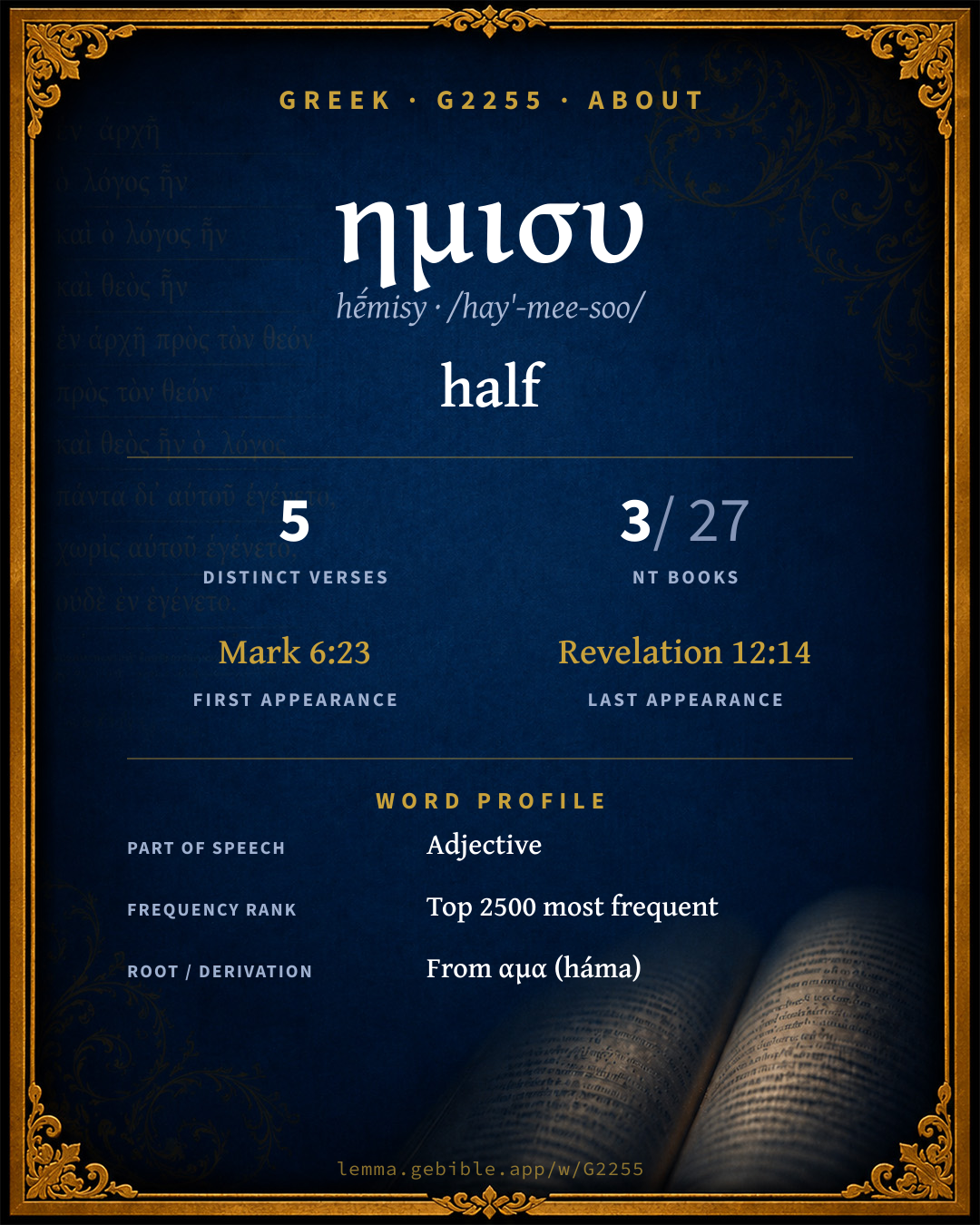
ἥμισυ
half
Full lexicon entry — Thayer's Greek Lexicon
From Thayer's Greek Lexicon
Where this word appears
See every Accusative-case word in the Greek New Testament →
Grammar key — what these labels mean
Part of speech
- Adjective
- A word that describes or qualifies a noun.
Case
- Accusative
- The case of the direct object and of extent.
- Genitive
- The case of source, possession, or “of” — answers “whose / from what.”
Gender
- Neuter
- Grammatically neuter.
Number
- Singular
- One.
- Plural
- More than one.
Grammatical forms
- Adjective, Accusative, Singular, Neuter 3 times (60%)
- Adjective, Accusative, Plural, Neuter 1 time (20%)
- Adjective, Genitive, Singular, Neuter 1 time (20%)
Parsed forms decoded from the imported morphology (Robinson–Tischendorf, public domain), counted across 5 parsed occurrences — not distinct verses.
Every verse where G2255 appears — 5 distinct verses across 3 books. Click any verse to open its interlinear word-by-word view. Verse text shown in the World English Bible for context — . Each verse’s Greek form is shown with its reference; the English is not keyword-highlighted, since the data carries no word-level English alignment. Use “Compare translations” on any verse to read it across multiple English versions. This concordance covers the Greek New Testament; Septuagint (Greek Old Testament) occurrences of this word are not indexed here.
Mark 1 verse
Luke 1 verse
Revelation 3 verses
- Revelation 11:9 ἥμισυ adj acc sg neut From among the peoples, tribes, languages, and nations people will look at their dead bodies for three and a half days, and will not allow their dead bodies to be laid in a tomb.
- Revelation 11:11 ἥμισυ adj acc sg neut After the three and a half days, the breath of life from God entered into them, and they stood on their feet. Great fear fell on those who saw them.
- Revelation 12:14 ἥμισυ adj acc sg neut Two wings of the great eagle were given to the woman, that she might fly into the wilderness to her place, so that she might be nourished for a time, and times, and half a time, from the face of the serpent.
About this entry
At a glance — auto-summarized from this page’s data, not written by a person. Every figure links to its source below. This summary describes the numbers; it doesn’t interpret them.
“half” is the headline sense of the Greek adjective ημισυ (hḗmisy). With only 5 verses it sits in the long tail of Greek New Testament vocabulary. More than half of its appearances fall in Revelation. First canonically at Mark 6:23, it enters the text early. It shares a root with αμα, αμαω and αμμος. See the sense tree, 5-verse concordance, and the renderings breakdown below.
Gloss history
Strong's 1890 vs modern scholarship
About this word
Strong's G2255 catalogs a Greek word from the Greek New Testament.
These counts are not copied from any lexicon or concordance. They are computed here, from the morphology-tagged Greek New Testament. What Lemma adds →
- 5
- distinct verses
- The word appears in 5 distinct verses.
- 3 / 27
- NT books
- The word appears in 3 of 27 New Testament books.
- #1,648
- by frequency
- Top 2500 most frequent Greek words (rank 1,648 of 5,347 Greek words by occurrence).
View all 5 occurrences in the concordance →
Most concentrated in
- Revelation 3 verses 60%
- Mark 1 verse 20%
- Luke 1 verse 20%
By section of the New Testament
By traditional corpus
Conventional, traditional groupings — biblical authorship is debated, so this is a traditional corpus grouping, not an authorship claim. Some books belong to more than one corpus (Luke is in both the Gospels and the Lukan corpus, and so on), so these shares overlap and need not total 100%. Each figure is a share of the word’s 5 distinct verses.
- Johannine 3 verses · 60%
- Revelation 3 verses · 60%
- Gospels 2 verses · 40%
- Lukan (Luke–Acts) 1 verse · 20%
How translations render this word
Counts come from each version’s own published word-to-Strong’s tagging or interlinear alignment — an approximate guide to how each version renders this word, not a word-level alignment the data otherwise carries. Because each total is that version’s own tagged count, the per-version totals vary from one another and need not match the appearance or distinct-verse counts above. These counts may also differ from a printed concordance because Lemma counts each distinctly tagged rendering and does not collapse phrase taggings into a single head-word total. This is a fixed set of word-tagged versions (KJV, ASV, BSB, ULT) and does not change with the reading translation you choose elsewhere. Each version’s license is shown beside its name below (and on Sources).
- King James Version: Half 5×
- American Standard Version: Half 5×
- Berean Standard Bible: Half 5×
- unfoldingWord Literal Text: Half 5×
King James Version Public Domain
Renders G2255 across 5 tagged occurrences — most commonly:
American Standard Version Public Domain
Renders G2255 across 5 tagged occurrences — most commonly:
Berean Standard Bible Public Domain
Renders G2255 across 5 tagged occurrences — most commonly:
unfoldingWord Literal Text CC BY-SA 4.0
Renders G2255 across 5 tagged occurrences — most commonly:
Senses in Thayer's
The 1 sense Thayer's distinguishes for this word, in lexicon order (not ranked by frequency or importance). The full entry — with sub-senses — is in the Lexicon Entry tab.
- half
Word origin
Derived from αμα (háma) (G260) — together.
Neuter of a derivative from an inseparable prefix akin to G260 (through the idea of partition involved in connection ) and meaning semi- ; (as noun) half : - half.
— Strong’s Exhaustive Concordance (1890), public domain.
Forms in the corpus
The 3 distinct written forms G2255 takes in the Greek New Testament, most frequent first — each parse links to that case’s occurrences in the concordance.
| Form | Parsing | Example | Uses |
|---|---|---|---|
| ἥμισυ hḗmisy | Adjective, Accusative, Singular, Neuter | Revelation 11:9 | 3 |
| ἡμίσειά hēmíseiá | Adjective, Accusative, Plural, Neuter | Luke 19:8 | 1 |
| ἡμίσους hēmísous | Adjective, Genitive, Singular, Neuter | Mark 6:23 | 1 |
Same root — word family
Other Thayer's entries built from the same root as G2255, grouped by Strong’s listed origin. These share a root / origin per the lexicon — not necessarily a shared meaning. Each links to that word’s own entry.
Derives from
Shares the same root
- αμαω amáō G270 to reap
- αμμος ámmos G285 sand
- ιμας himás G2438 leather strap
- ομου homoû G3674 together
Derived from this word
Compare all same-root words → Showing 4 of 8 — not the complete family. They share a root, not necessarily a meaning.
Septuagint usage
The same Greek word ημισυ appears 125 times in the Greek Old Testament (Septuagint), across 108 verses in 18 books.
- 125
- LXX occurrences
- Tagged occurrences of this Greek word in the Septuagint.
- 108
- verses
- Distinct Septuagint verses containing this word.
- 18 / 39
- OT books
- The word appears in 18 of the 39 Old Testament books.
Sample Septuagint occurrences
- Exodus 24:6 ἥμισυς
- Leviticus 6:13 ἥμισυς
- Numbers 12:12 ἥμισυς
- Deuteronomy 3:12 ἥμισυς
- Joshua 1:12 ἥμισυς
- Judges 16:3 ἥμισυς
- 2 Samuel 10:4 ἥμισυς
- 1 Kings 3:25 ἥμισυς
- 1 Chronicles 2:54 ἥμισυς
- 2 Chronicles 9:6 ἥμισυς
- Ezra 13:9 ἥμισυς
- Esther 5:1 ἥμισυς
Septuagint occurrences (same lexeme)
Every verse where the same Strong’s number (G2255) appears in the Greek Septuagint — showing the first 50 of 108. Verse text shown in the World English Bible for context; the Greek form is the matched word — the English is not keyword-highlighted.
- Exodus 24:6 ἥμισυς Moses took half of the blood and put it in basins, and half of the blood he sprinkled on the altar.
- Exodus 25:10 ἥμισυς "They shall make an ark of acacia wood. Its length shall be two and a half cubits, its breadth a cubit and a half, and a cubit and a half its height.
- Exodus 25:17 ἥμισυς You shall make a mercy seat of pure gold. Two and a half cubits shall be its length, and a cubit and a half its breadth.
- Exodus 25:23 ἥμισυς "You shall make a table of acacia wood. Two cubits shall be its length, and a cubit its breadth, and one and a half cubits its height.
- Exodus 26:12 ἥμισυς The overhanging part that remains of the curtains of the tent, the half curtain that remains, shall hang over the back of the tent.
- Exodus 26:16 ἥμισυς Ten cubits shall be the length of a board, and one and a half cubits the breadth of each board.
- Exodus 27:5 ἥμισυς You shall put it under the ledge around the altar beneath, that the net may reach halfway up the altar.
- Exodus 30:13 ἥμισυς They shall give this, everyone who passes over to those who are numbered, half a shekel after the shekel of the sanctuary; (the shekel is twenty gerahs;) half a shekel for an offering to Yahweh.
- Exodus 30:15 ἥμισυς The rich shall not give more, and the poor shall not give less, than the half shekel, when they give the offering of Yahweh, to make atonement for your souls.
- Exodus 30:23 ἥμισυς "Also take fine spices: of liquid myrrh, five hundred shekels; and of fragrant cinnamon half as much, even two hundred and fifty; and of fragrant cane, two hundred and fifty;
- Exodus 38:24 ἥμισυς All the gold that was used for the work in all the work of the sanctuary, even the gold of the offering, was twenty-nine talents, and seven hundred thirty shekels, after the shekel of the sanctuary.
- Exodus 39:3 ἥμισυς They beat the gold into thin plates, and cut it into wires, to work it in the blue, in the purple, in the scarlet, and in the fine linen, the work of the skillful workman.
- Leviticus 6:13 ἥμισυς Fire shall be kept burning on the altar continually; it shall not go out.
- Numbers 12:12 ἥμισυς Let her not, I pray, be as one dead, of whom the flesh is half consumed when he comes out of his mother's womb.
- Numbers 15:9 ἥμισυς then shall he offer with the bull a meal-offering of three tenth parts [of an ephah] of fine flour mixed with half a hin of oil:
- Numbers 15:10 ἥμισυς and you shall offer for the drink-offering half a hin of wine, for an offering made by fire, of a sweet savor to Yahweh.
- Numbers 28:14 ἥμισυς Their drink-offerings shall be half a hin of wine for a bull, and the third part of a hin for the ram, and the fourth part of a hin for a lamb: this is the burnt offering of every month throughout the months of the year.
- Numbers 31:29 ἥμισυς take it of their half, and give it to Eleazar the priest, for Yahweh's heave-offering.
- Numbers 31:30 ἥμισυς Of the children of Israel's half, you shall take one drawn out of every fifty, of the persons, of the oxen, of the donkeys, and of the flocks, [even] of all the cattle, and give them to the Levites, who keep the charge of the tent of Yahweh.
- Numbers 32:33 ἥμισυς Moses gave to them, even to the children of Gad, and to the children of Reuben, and to the half-tribe of Manasseh the son of Joseph, the kingdom of Sihon king of the Amorites, and the kingdom of Og king of Bashan, the land, according to the cities of it with [their] borders, even the cities of the land round about.
- Numbers 34:13 ἥμισυς Moses commanded the children of Israel, saying, This is the land which you shall inherit by lot, which Yahweh has commanded to give to the nine tribes, and to the half-tribe;
- Numbers 34:14 ἥμισυς for the tribe of the children of Reuben according to their fathers' houses, and the tribe of the children of Gad according to their fathers' houses, have received, and the half-tribe of Manasseh have received, their inheritance:
- Numbers 34:15 ἥμισυς the two tribes and the half-tribe have received their inheritance beyond the Jordan at Jericho eastward, toward the sunrise.
- Deuteronomy 3:12 ἥμισυς This land we took in possession at that time: from Aroer, which is by the valley of the Arnon, and half the hill-country of Gilead, and the cities of it, gave I to the Reubenites and to the Gadites:
- Deuteronomy 3:13 ἥμισυς and the rest of Gilead, and all Bashan, the kingdom of Og, gave I to the half-tribe of Manasseh; all the region of Argob, even all Bashan. (The same is called the land of Rephaim.
- Deuteronomy 29:7 ἥμισυς When you came to this place, Sihon the king of Heshbon, and Og the king of Bashan, came out against us to battle, and we struck them:
- Joshua 1:12 ἥμισυς To the Reubenites, and to the Gadites, and to the half-tribe of Manasseh, spoke Joshua, saying,
- Joshua 4:12 ἥμισυς The children of Reuben, and the children of Gad, and the half-tribe of Manasseh, passed over armed before the children of Israel, as Moses spoke to them:
- Joshua 9:2 ἥμισυς that they gathered themselves together, to fight with Joshua and with Israel, with one accord.
- Joshua 12:2 ἥμισυς Sihon king of the Amorites, who lived in Heshbon, and ruled from Aroer, which is on the edge of the valley of the Arnon, and [the city that is in] the middle of the valley, and half Gilead, even to the river Jabbok, the border of the children of Ammon;
- Joshua 12:5 ἥμισυς and ruled in Mount Hermon, and in Salecah, and in all Bashan, to the border of the Geshurites and the Maacathites, and half Gilead, the border of Sihon king of Heshbon.
- Joshua 12:6 ἥμισυς Moses the servant of Yahweh and the children of Israel struck them: and Moses the servant of Yahweh gave it for a possession to the Reubenites, and the Gadites, and the half-tribe of Manasseh.
- Joshua 13:7 ἥμισυς Now therefore divide this land for an inheritance to the nine tribes, and the half-tribe of Manasseh.
- Joshua 13:8 ἥμισυς With him the Reubenites and the Gadites received their inheritance, which Moses gave them, beyond the Jordan eastward, even as Moses the servant of Yahweh gave them:
- Joshua 13:25 ἥμισυς Their border was Jazer, and all the cities of Gilead, and half the land of the children of Ammon, to Aroer that is before Rabbah;
- Joshua 13:29 ἥμισυς Moses gave [inheritance] to the half-tribe of Manasseh: and it was for the half-tribe of the children of Manasseh according to their families.
- Joshua 13:31 ἥμισυς and half Gilead, and Ashtaroth, and Edrei, the cities of the kingdom of Og in Bashan, were for the children of Machir the son of Manasseh, even for the half of the children of Machir according to their families.
- Joshua 14:2 ἥμισυς by the lot of their inheritance, as Yahweh commanded by Moses, for the nine tribes, and for the half-tribe.
- Joshua 18:7 ἥμισυς For the Levites have no portion among you; for the priesthood of Yahweh is their inheritance: and Gad and Reuben and the half-tribe of Manasseh have received their inheritance beyond the Jordan eastward, which Moses the servant of Yahweh gave them.
- Joshua 21:5 ἥμισυς The rest of the children of Kohath had by lot out of the families of the tribe of Ephraim, and out of the tribe of Dan, and out of the half-tribe of Manasseh, ten cities.
- Joshua 21:6 ἥμισυς The children of Gershon had by lot out of the families of the tribe of Issachar, and out of the tribe of Asher, and out of the tribe of Naphtali, and out of the half-tribe of Manasseh in Bashan, thirteen cities.
- Joshua 21:25 ἥμισυς Out of the half-tribe of Manasseh, Taanach with its suburbs, and Gath-rimmon with its suburbs; two cities.
- Joshua 21:27 ἥμισυς To the children of Gershon, of the families of the Levites, out of the half-tribe of Manasseh [they gave] Golan in Bashan with its suburbs, the city of refuge for the manslayer, and Be-eshterah with its suburbs; two cities.
- Joshua 22:1 ἥμισυς Then Joshua called the Reubenites, and the Gadites, and the half-tribe of Manasseh,
- Joshua 22:7 ἥμισυς Now to the one half-tribe of Manasseh Moses had given [inheritance] in Bashan; but to the other half gave Joshua among their brothers beyond the Jordan westward; moreover when Joshua sent them away to their tents, he blessed them,
- Joshua 22:9 ἥμισυς The children of Reuben and the children of Gad and the half-tribe of Manasseh returned, and departed from the children of Israel out of Shiloh, which is in the land of Canaan, to go to the land of Gilead, to the land of their possession, which they owned, according to the commandment of Yahweh by Moses.
- Joshua 22:10 ἥμισυς When they came to the region about the Jordan, that is in the land of Canaan, the children of Reuben and the children of Gad and the half-tribe of Manasseh built there an altar by the Jordan, a great altar to look on.
- Joshua 22:11 ἥμισυς The children of Israel heard say, Behold, the children of Reuben and the children of Gad and the half-tribe of Manasseh have built an altar in the forefront of the land of Canaan, in the region about the Jordan, on the side that pertains to the children of Israel.
- Joshua 22:13 ἥμισυς The children of Israel sent to the children of Reuben, and to the children of Gad, and to the half-tribe of Manasseh, into the land of Gilead, Phinehas the son of Eleazar the priest,
- Joshua 22:15 ἥμισυς They came to the children of Reuben, and to the children of Gad, and to the half-tribe of Manasseh, to the land of Gilead, and they spoke with them, saying,
These are occurrences of the same Greek lexeme (G2255) in the Septuagint — not a translation of any one Hebrew word. The store carries no word-level Hebrew↔Greek alignment, so no Hebrew original is asserted here. Counts come from the recovered LXX Strong's tagging — high-frequency vocabulary is well covered, while rare or late forms may be untagged — so they reflect tagged occurrences and may slightly undercount.