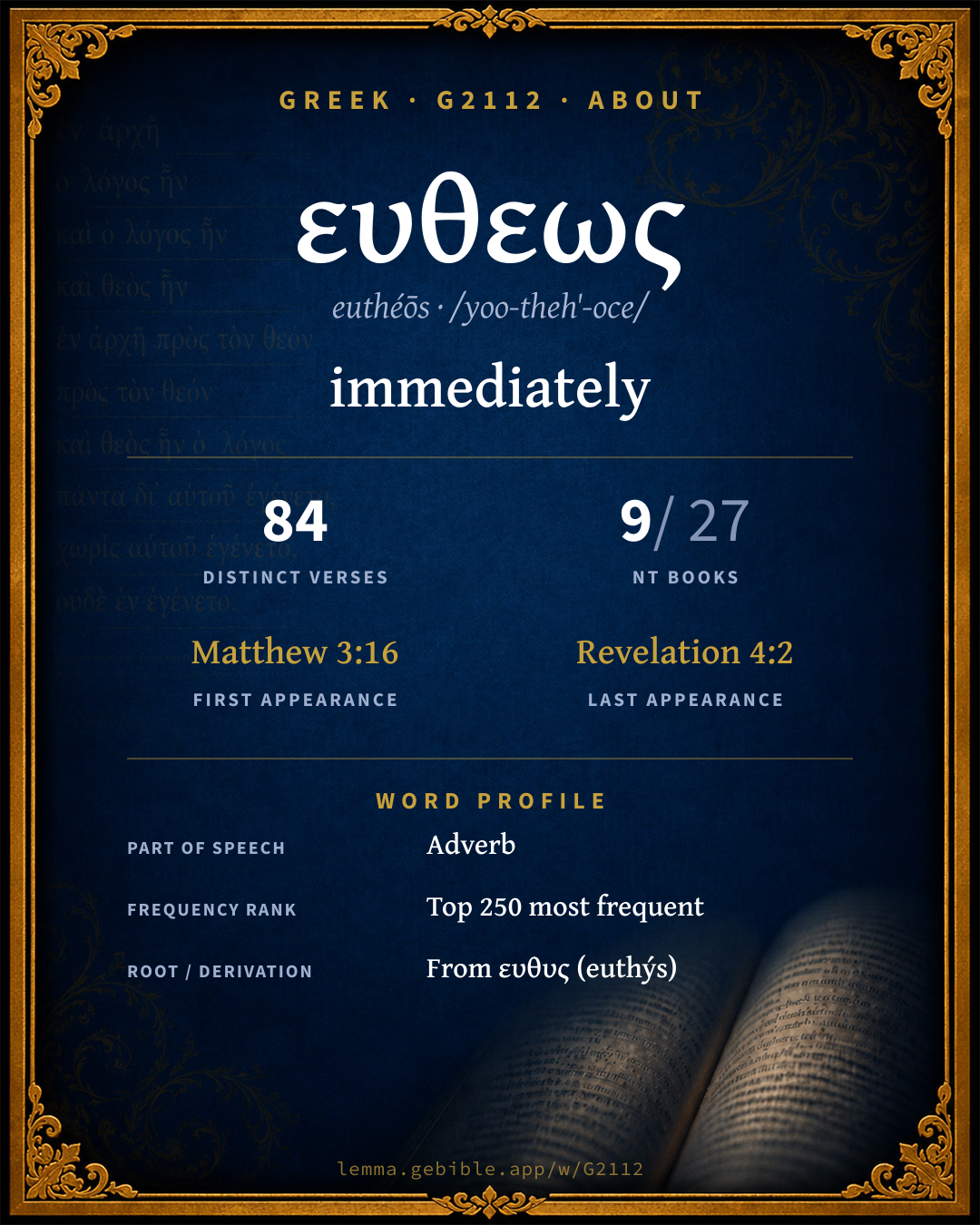
εὐθέως
immediately
Full lexicon entry — Thayer's Greek Lexicon
From Thayer's Greek Lexicon
Where this word appears
Grammar key — what these labels mean
Part of speech
- Adverb
- A word that modifies a verb, adjective, or other adverb.
Every verse where G2112 appears — 84 distinct verses across 9 books. Click any verse to open its interlinear word-by-word view. Verse text shown in the World English Bible for context — . Each verse’s Greek form is shown with its reference; the English is not keyword-highlighted, since the data carries no word-level English alignment. Use “Compare translations” on any verse to read it across multiple English versions. This concordance covers the Greek New Testament; Septuagint (Greek Old Testament) occurrences of this word are not indexed here.
Matthew 17 verses
- Matthew 3:16 εὐθὺς adv Jesus, when he was baptized, went up directly from the water: and behold, the heavens were opened to him. He saw the Spirit of God descending as a dove, and coming on him.
- Matthew 4:20 εὐθέως adv They immediately left their nets and followed him.
- Matthew 4:22 εὐθέως adv They immediately left the boat and their father, and followed him.
- Matthew 8:3 εὐθέως adv Jesus stretched out his hand, and touched him, saying, "I want to. Be made clean." Immediately his leprosy was cleansed.
- Matthew 13:5 εὐθέως adv Others fell on rocky ground, where they didn't have much soil, and immediately they sprang up, because they had no depth of earth.
- Matthew 13:20 εὐθὺς adv What was sown on the rocky places, this is he who hears the word, and immediately with joy receives it;
- Matthew 13:21 εὐθὺς adv yet he has no root in himself, but endures for a while. When oppression or persecution arises because of the word, immediately he stumbles.
- Matthew 14:27 εὐθὺς adv But immediately Jesus spoke to them, saying "Cheer up! I AM! Don't be afraid."
- Matthew 14:31 εὐθέως adv Immediately Jesus stretched out his hand, took hold of him, and said to him, "You of little faith, why did you doubt?"
- Matthew 20:34 εὐθέως adv Jesus, being moved with compassion, touched their eyes; and immediately their eyes received their sight, and they followed him.
- Matthew 21:2 εὐθὺς adv saying to them, "Go into the village that is opposite you, and immediately you will find a donkey tied, and a colt with her. Untie them, and bring them to me.
- Matthew 21:3 εὐθὺς adv If anyone says anything to you, you shall say, 'The Lord needs them,' and immediately he will send them."
- Matthew 24:29 Εὐθέως adv But immediately after the oppression of those days, the sun will be darkened, the moon will not give its light, the stars will fall from the sky, and the powers of the heavens will be shaken;
- Matthew 25:15 εὐθέως adv To one he gave five talents, to another two, to another one; to each according to his own ability. Then he went on his journey.
- Matthew 26:49 εὐθέως adv Immediately he came to Jesus, and said, "Hail, Rabbi!" and kissed him.
- Matthew 26:74 εὐθέως adv Then he began to curse and to swear, "I don't know the man!" Immediately the rooster crowed.
- Matthew 27:48 εὐθέως adv Immediately one of them ran, and took a sponge, and filled it with vinegar, and put it on a reed, and gave him a drink.
Mark 41 verses
- Mark 1:10 εὐθὺς adv Immediately coming up from the water, he saw the heavens parting, and the Spirit descending on him like a dove.
- Mark 1:12 εὐθὺς adv Immediately the Spirit drove him out into the wilderness.
- Mark 1:18 εὐθὺς adv Immediately they left their nets, and followed him.
- Mark 1:20 εὐθὺς adv Immediately he called them, and they left their father, Zebedee, in the boat with the hired servants, and went after him.
- Mark 1:21 εὐθὺς adv They went into Capernaum, and immediately on the Sabbath day he entered into the synagogue and taught.
- Mark 1:23 εὐθὺς adv Immediately there was in their synagogue a man with an unclean spirit, and he cried out,
- Mark 1:28 εὐθὺς adv The report of him went out immediately everywhere into all the region of Galilee and its surrounding area.
- Mark 1:29 εὐθὺς adv Immediately, when they had come out of the synagogue, they came into the house of Simon and Andrew, with James and John.
- Mark 1:30 εὐθὺς adv Now Simon's wife's mother lay sick with a fever, and immediately they told him about her.
- Mark 1:42 εὐθὺς adv When he had said this, immediately the leprosy departed from him, and he was made clean.
- Mark 1:43 εὐθὺς adv He strictly warned him, and immediately sent him out,
- Mark 2:8 εὐθὺς adv Immediately Jesus, perceiving in his spirit that they so reasoned within themselves, said to them, "Why do you reason these things in your hearts?
- Mark 2:12 εὐθὺς adv He arose, and immediately took up the mat, and went out in front of them all; so that they were all amazed, and glorified God, saying, "We never saw anything like this!"
- Mark 3:6 εὐθὺς adv The Pharisees went out, and immediately conspired with the Herodians against him, how they might destroy him.
- Mark 4:5 εὐθὺς adv Others fell on the rocky ground, where it had little soil, and immediately it sprang up, because it had no depth of soil.
- Mark 4:15 εὐθὺς adv These are the ones by the road, where the word is sown; and when they have heard, immediately Satan comes, and takes away the word which has been sown in them.
- Mark 4:16 εὐθὺς adv These in like manner are those who are sown on the rocky places, who, when they have heard the word, immediately receive it with joy.
- Mark 4:17 εὐθὺς adv They have no root in themselves, but are short-lived. When oppression or persecution arises because of the word, immediately they stumble.
- Mark 4:29 εὐθὺς adv But when the fruit is ripe, immediately he puts forth the sickle, because the harvest has come."
- Mark 5:2 εὐθὺς adv When he had come out of the boat, immediately there met him out of the tombs a man with an unclean spirit,
- Mark 5:29 εὐθὺς adv Immediately the flow of her blood was dried up, and she felt in her body that she was healed of her affliction.
- Mark 5:30 εὐθὺς adv Immediately Jesus, perceiving in himself that the power had gone out from him, turned around in the crowd, and asked, "Who touched my clothes?"
- Mark 5:42 εὐθὺς εὐθὺς adv adv Immediately the girl rose up, and walked, for she was twelve years old. They were amazed with great amazement.
- Mark 6:25 εὐθὺς adv She came in immediately with haste to the king, and asked, "I want you to give me right now the head of John the Baptizer on a platter."
- Mark 6:27 εὐθὺς adv Immediately the king sent out a soldier of his guard, and commanded to bring John's head, and he went and beheaded him in the prison,
- Mark 6:45 εὐθὺς adv Immediately he made his disciples get into the boat, and to go ahead to the other side, to Bethsaida, while he himself sent the multitude away.
- Mark 6:50 εὐθὺς adv for they all saw him, and were troubled. But he immediately spoke with them, and said to them, "Cheer up! It is I! Don't be afraid."
- Mark 6:54 εὐθὺς adv When they had come out of the boat, immediately the people recognized him,
- Mark 7:25 εὐθὺς adv For a woman, whose little daughter had an unclean spirit, having heard of him, came and fell down at his feet.
- Mark 7:35 εὐθὺς adv Immediately his ears were opened, and the impediment of his tongue was released, and he spoke clearly.
- Mark 8:10 εὐθὺς adv Immediately he entered into the boat with his disciples, and came into the region of Dalmanutha.
- Mark 9:15 εὐθὺς adv Immediately all the multitude, when they saw him, were greatly amazed, and running to him greeted him.
- Mark 9:20 εὐθὺς adv They brought him to him, and when he saw him, immediately the spirit convulsed him, and he fell on the ground, wallowing and foaming at the mouth.
- Mark 9:24 εὐθὺς adv Immediately the father of the child cried out with tears, "I believe. Help my unbelief!"
- Mark 10:52 εὐθὺς adv Jesus said to him, "Go your way. Your faith has made you well." Immediately he received his sight, and followed Jesus in the way.
- Mark 11:2 εὐθὺς adv and said to them, "Go your way into the village that is opposite you. Immediately as you enter into it, you will find a young donkey tied, on which no one has sat. Untie him, and bring him.
- Mark 11:3 εὐθὺς adv If anyone asks you, 'Why are you doing this?' say, 'The Lord needs him;' and immediately he will send him back here."
- Mark 14:43 εὐθὺς adv Immediately, while he was still speaking, Judas, one of the twelve, came--and with him a multitude with swords and clubs, from the chief priests, the scribes, and the elders.
- Mark 14:45 εὐθὺς adv When he had come, immediately he came to him, and said, "Rabbi! Rabbi!" and kissed him.
- Mark 14:72 εὐθὺς adv The rooster crowed the second time. Peter remembered the word, how that Jesus said to him, "Before the rooster crows twice, you will deny me three times." When he thought about that, he wept.
- Mark 15:1 εὐθὺς adv Immediately in the morning the chief priests, with the elders and scribes, and the whole council, held a consultation, and bound Jesus, and carried him away, and delivered him up to Pilate.
Luke 7 verses
- Luke 5:13 εὐθέως adv He stretched out his hand, and touched him, saying, "I want to. Be made clean." Immediately the leprosy left him.
- Luke 6:49 εὐθὺς adv But he who hears, and doesn't do, is like a man who built a house on the earth without a foundation, against which the stream broke, and immediately it fell, and the ruin of that house was great."
- Luke 12:36 εὐθέως adv Be like men watching for their lord, when he returns from the marriage feast; that, when he comes and knocks, they may immediately open to him.
- Luke 12:54 εὐθέως adv He said to the multitudes also, "When you see a cloud rising from the west, immediately you say, 'A shower is coming,' and so it happens.
- Luke 14:5 εὐθέως adv He answered them, "Which of you, if your son or an ox fell into a well, wouldn't immediately pull him out on a Sabbath day?"
- Luke 17:7 εὐθέως adv But who is there among you, having a servant plowing or keeping sheep, that will say, when he comes in from the field, 'Come immediately and sit down at the table,'
- Luke 21:9 εὐθέως adv When you hear of wars and disturbances, don't be terrified, for these things must happen first, but the end won't come immediately."
John 5 verses
- John 6:21 εὐθέως adv They were willing therefore to receive him into the boat. Immediately the boat was at the land where they were going.
- John 13:30 εὐθύς adv Therefore, having received that morsel, he went out immediately. It was night.
- John 13:32 εὐθὺς adv If God has been glorified in him, God will also glorify him in himself, and he will glorify him immediately.
- John 18:27 εὐθέως adv Peter therefore denied it again, and immediately the rooster crowed.
- John 19:34 εὐθὺς adv However one of the soldiers pierced his side with a spear, and immediately blood and water came out.
Acts 10 verses
- Acts 9:18 εὐθέως adv Immediately something like scales fell from his eyes, and he received his sight. He arose and was baptized.
- Acts 9:20 εὐθέως adv Immediately in the synagogues he proclaimed the Christ, that he is the Son of God.
- Acts 9:34 εὐθέως adv Peter said to him, "Aeneas, Jesus Christ heals you. Get up and make your bed!" Immediately he arose.
- Acts 10:16 εὐθὺς adv This was done three times, and immediately the vessel was received up into heaven.
- Acts 12:10 εὐθέως adv When they were past the first and the second guard, they came to the iron gate that leads into the city, which opened to them by itself. They went out, and went down one street, and immediately the angel departed from him.
- Acts 16:10 εὐθέως adv When he had seen the vision, immediately we sought to go out to Macedonia, concluding that the Lord had called us to preach the Gospel to them.
- Acts 17:10 εὐθέως adv The brothers immediately sent Paul and Silas away by night to Beroea. When they arrived, they went into the Jewish synagogue.
- Acts 17:14 εὐθέως adv Then the brothers immediately sent out Paul to go as far as to the sea, and Silas and Timothy still stayed there.
- Acts 21:30 εὐθέως adv All the city was moved, and the people ran together. They seized Paul and dragged him out of the temple. Immediately the doors were shut.
- Acts 22:29 εὐθέως adv Immediately those who were about to examine him departed from him, and the commanding officer also was afraid when he realized that he was a Roman, because he had bound him.
Galatians 1 verse
James 1 verse
3 John 1 verse
Revelation 1 verse
About this entry
At a glance — auto-summarized from this page’s data, not written by a person. Every figure links to its source below. This summary describes the numbers; it doesn’t interpret them.
ευθεως — transliterated euthéōs — is a Greek verb carrying the sense “immediately.” Where the King James Version keeps “straightway,” modern versions use “immediately” — see the renderings breakdown. With 84 verses in 9 books, it is a moderately common word in the Greek New Testament. Its uses concentrate in Mark (49% of all occurrences). Debuting at Matthew 3:16, it then recurs through the corpus. See the sense tree, 84-verse concordance, and the renderings breakdown below.
Gloss history
Strong's 1890 vs modern scholarship

About this word
Strong's G2112 catalogs a Greek word from the Greek New Testament.
These counts are not copied from any lexicon or concordance. They are computed here, from the morphology-tagged Greek New Testament. What Lemma adds →
- 84
- distinct verses
- The word appears in 84 distinct verses.
- 9 / 27
- NT books
- The word appears in 9 of 27 New Testament books.
- #200
- by frequency
- Top 250 most frequent Greek words (rank 200 of 5,347 Greek words by occurrence).
View all 84 occurrences in the concordance →
By section of the New Testament
By traditional corpus
Conventional, traditional groupings — biblical authorship is debated, so this is a traditional corpus grouping, not an authorship claim. Some books belong to more than one corpus (Luke is in both the Gospels and the Lukan corpus, and so on), so these shares overlap and need not total 100%. Each figure is a share of the word’s 84 distinct verses.
- Gospels 70 verses · 83%
- Lukan (Luke–Acts) 17 verses · 20%
- Johannine 7 verses · 8%
- General (Catholic) Epistles 2 verses · 2%
- Pauline corpus 1 verse · 1%
- Revelation 1 verse · 1%
How translations render this word
Counts come from each version’s own published word-to-Strong’s tagging or interlinear alignment — an approximate guide to how each version renders this word, not a word-level alignment the data otherwise carries. Because each total is that version’s own tagged count, the per-version totals vary from one another and need not match the appearance or distinct-verse counts above. These counts may also differ from a printed concordance because Lemma counts each distinctly tagged rendering and does not collapse phrase taggings into a single head-word total. This is a fixed set of word-tagged versions (KJV, ASV, BSB, ULT) and does not change with the reading translation you choose elsewhere. Each version’s license is shown beside its name below (and on Sources).
- King James Version: Immediately 33×, Straightway 30×, Forthwith 7×
- American Standard Version: Straightway 59×, Immediately 5×
- Berean Standard Bible: Immediately 26×, Once 20×, Soon as 5×
- unfoldingWord Literal Text: Immediately 84×
King James Version Public Domain
Renders G2112 across 78 tagged occurrences — most commonly:
Plus 6 renderings that appear only once — usually multi-word phrases or single function words the recovered tagging swept in, not distinct renderings. Not rendered by a distinct English word in 2 further occurrences.
American Standard Version Public Domain
Renders G2112 across 75 tagged occurrences — most commonly:
Plus 11 renderings that appear only once — usually multi-word phrases or single function words the recovered tagging swept in, not distinct renderings.
Berean Standard Bible Public Domain
Renders G2112 across 73 tagged occurrences — most commonly:
Plus 8 renderings that appear only once — usually multi-word phrases or single function words the recovered tagging swept in, not distinct renderings. Not rendered by a distinct English word in 10 further occurrences.
unfoldingWord Literal Text CC BY-SA 4.0
Renders G2112 across 86 tagged occurrences — most commonly:
Plus 2 renderings that appear only once — usually multi-word phrases or single function words the recovered tagging swept in, not distinct renderings.
Senses in Thayer's
The 1 sense Thayer's distinguishes for this word, in lexicon order (not ranked by frequency or importance). The full entry — with sub-senses — is in the Lexicon Entry tab.
- straightway, immediately, forthwith
Word origin
Derived from ευθυς (euthýs) (G2117) — straight.
Adverb from G2117 ; directly that is at once or soon : - anon as soon as forthwith immediately shortly straightway.
— Strong’s Exhaustive Concordance (1890), public domain.
Forms in the corpus
The 4 distinct written forms G2112 takes in the Greek New Testament, most frequent first — each parse links to that case’s occurrences in the concordance.
| Form | Parsing | Example | Uses |
|---|---|---|---|
| εὐθὺς euthỳs | Adverb | Matthew 3:16 | 52 |
| εὐθέως euthéōs | Adverb | Matthew 4:20 | 31 |
| Εὐθέως Euthéōs | Adverb | Matthew 24:29 | 1 |
| εὐθύς euthýs | Adverb | John 13:30 | 1 |
Same root — word family
Other Thayer's entries built from the same root as G2112, grouped by Strong’s listed origin. These share a root / origin per the lexicon — not necessarily a shared meaning. Each links to that word’s own entry.
Derives from
Shares the same root
- ευθυδρομεω euthydroméō G2113 to run straight
- ευθυνω euthýnō G2116 to make straight
- ευθυτης euthýtēs G2118 righteousness
Compare all same-root words → Showing 4 of 5 — not the complete family. They share a root, not necessarily a meaning.
Septuagint usage
The same Greek word ευθεως appears 2 times in the Greek Old Testament (Septuagint), across 2 verses in 2 books.
- 2
- LXX occurrences
- Tagged occurrences of this Greek word in the Septuagint.
- 2
- verses
- Distinct Septuagint verses containing this word.
- 2 / 39
- OT books
- The word appears in 2 of the 39 Old Testament books.
Sample Septuagint occurrences
- Joshua 6:11 εὐθέως
- Job 5:3 εὐθέως
Septuagint occurrences (same lexeme)
Every verse where the same Strong’s number (G2112) appears in the Greek Septuagint. Verse text shown in the World English Bible for context; the Greek form is the matched word — the English is not keyword-highlighted.
- Joshua 6:11 εὐθέως So he caused the ark of Yahweh to compass the city, going about it once: and they came into the camp, and lodged in the camp.
- Job 5:3 εὐθέως I have seen the foolish taking root, But suddenly I cursed his habitation.
These are occurrences of the same Greek lexeme (G2112) in the Septuagint — not a translation of any one Hebrew word. The store carries no word-level Hebrew↔Greek alignment, so no Hebrew original is asserted here. Counts come from the recovered LXX Strong's tagging — high-frequency vocabulary is well covered, while rare or late forms may be untagged — so they reflect tagged occurrences and may slightly undercount.