Acts 9:18

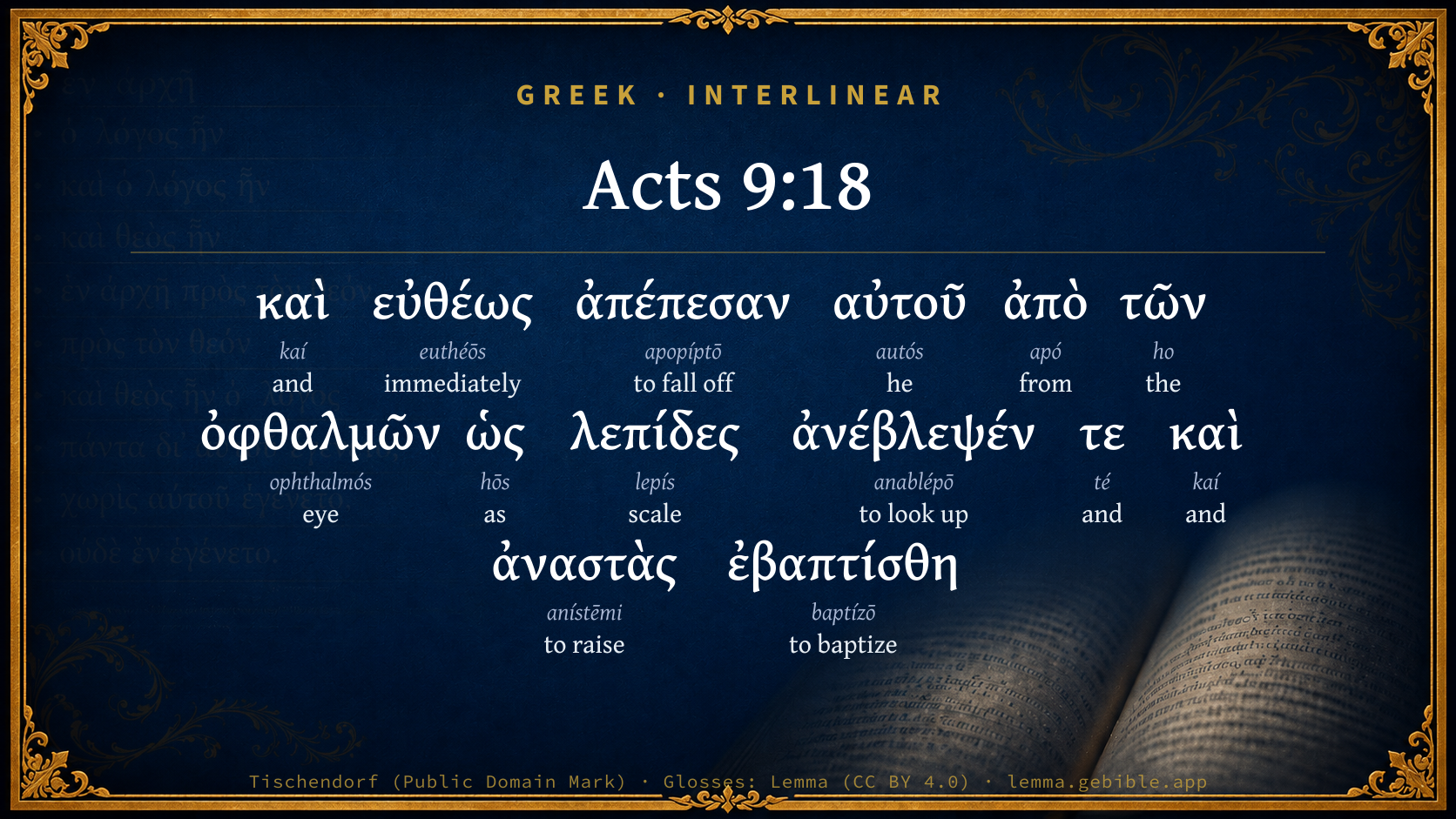
Greek (Tischendorf 8th ed.) Acts 9:18 appears in the Greek New Testament. The text above is from the Tischendorf 8th edition. Each word links to its Strong’s number and a concise gloss. Click any word for its full Thayer’s Greek Lexicon entry.
Download image
Cite this verse

Acts 9:18 (World English Bible). Public Domain. Lemma interlinear Bible study tool, https://lemma.gebible.app/v/acts/9/18.

Show BibTeX & RIS
BibTeX
RIS
English Translation
Immediately something like scales fell from his eyes, and he received his sight. He arose and was baptized.
World English Bible · Public Domain
Highlights
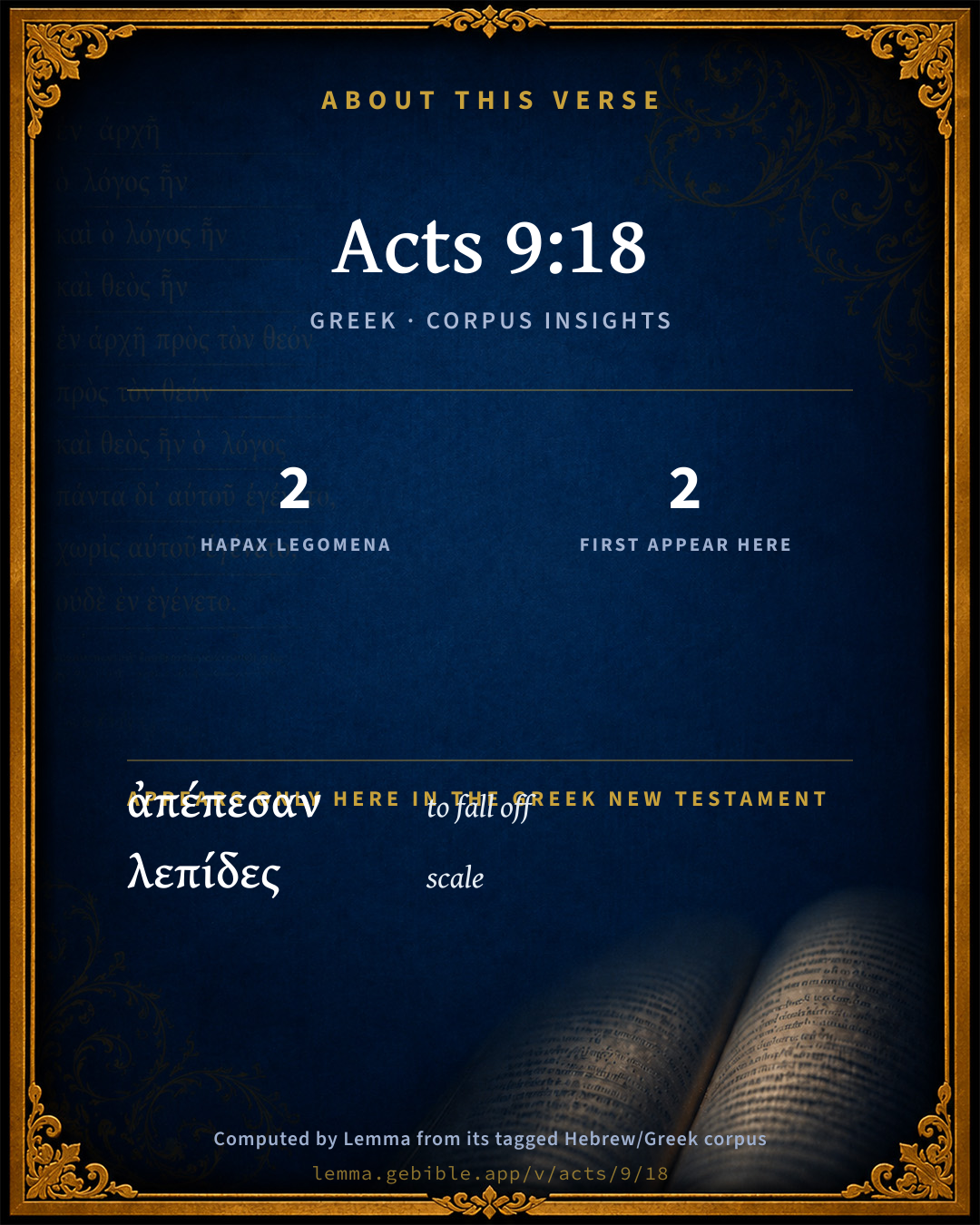
  • 2 hapax legomena — only here in the Greek New Testament
  • 2 first appearances in the Greek New Testament
Full analysis ↓
Download a study sheet

One document with this verse’s original text, its word-by-word gloss line, the meaning frame, cross-references with their text, attributed commentary, and full source and license credits — printable, and it pastes into notes with its structure intact.

This verse Autodidact and up

Study sheet (.html) Plain text (.txt)

A passage Seminary Student

Up to 50 verses in one chapter. A passage sheet keeps up to 6 commentary sources and 12 cross-references per verse, in the order this page ranks them, and says so on the sheet whenever that leaves anything out. Ask for a single verse and you get the Autodidact verse sheet above.

Everything on this page stays free to read, with no account — the sheet is a download of what is already on screen, not access to it.

Want to remove ads? Support Godless Engineer
Compare translations 3

The same verse in 3 English versions, stacked beneath the original-language interlinear above. Click any original word for its lexicon entry.

Each is an independent rendering of the whole verse — the interlinear is not word-aligned to these translations.

Highlighted words mark where these versions differ — a whole-verse word diff, not a word-by-word alignment.

  • World English Bible Public Domain
    Immediately something like scales fell from his eyes, and he received his sight. He arose and was baptized.
  • King James Version Public Domain
    And immediately there fell from his eyes as it had been scales: and he received sight forthwith, and arose, and was baptized.
  • unfoldingWord Literal Text CC BY-SA 4.0
    And immediately like scales fell from his eyes, and he saw again, and rising up, he was baptized;

unfoldingWord Literal Text — © unfoldingWord, licensed CC BY-SA 4.0. Word-aligned USFM3 via Door43 (git.door43.org/unfoldingWord/en_ult).

Versions to compare (up to 4)

3 of 4 selected

Show all 19 translations

Every available English version of this verse, each an independent rendering of the whole verse.

  • World English Bible Public Domain
    Immediately something like scales fell from his eyes, and he received his sight. He arose and was baptized.
  • Berean Standard Bible Public Domain
    At that instant, something like scales fell from Saul’s eyes, and his sight was restored. He got up and was baptized,
  • Majority Standard Bible Public Domain
    At that instant, something like scales fell from Saul’s eyes, and his sight was restored. He got up and was baptized,
  • King James Version Public Domain
    And immediately there fell from his eyes as it had been scales: and he received sight forthwith, and arose, and was baptized.
  • American Standard Version (1901) Public Domain
    And straightway there fell from his eyes as it were scales, and he received his sight; and he arose and was baptized;
  • Revised Version (1885) Public Domain
    And straightway there fell from his eyes as it were scales, and he received his sight; and he arose and was baptized;
  • Geneva Bible (1599) Public Domain
    And immediately there fell from his eyes as it had bene scales, and suddenly he receiued sight, and arose, and was baptized,
  • Douay-Rheims (1899) Public Domain
    And immediately there fell from his eyes as it were scales, and he received his sight; and rising up, he was baptized.
  • Young's Literal Translation Public Domain
    And immediately there fell from his eyes as it were scales, he saw again also presently, and having risen, was baptized,
  • Literal Standard Version CC BY-SA 4.0
    And immediately there fell from his eyes as it were scales, he also saw again instantly, and having risen, was immersed,
  • Unlocked Literal Bible CC BY-SA 4.0
    Immediately something like scales fell from Saul's eyes, and he received his sight; he arose and was baptized;
  • unfoldingWord Literal Text CC BY-SA 4.0
    And immediately like scales fell from his eyes, and he saw again, and rising up, he was baptized;
  • Darby Bible Public Domain
    And straightway there fell from his eyes as it were scales, and he saw, and rising up was baptised;
  • World Messianic Bible Public Domain
    Immediately something like scales fell from his eyes, and he received his sight. He arose and was immersed.
  • Webster's Bible Public Domain
    And immediately there fell from his eyes as it had been scales: and he received sight forthwith, and arose, and was baptized.
  • Free Bible Version CC BY-SA 4.0
    Immediately, something like scales fell from his eyes, and his sight was restored. He got up and was baptized.
  • Bible in Basic English Public Domain
    And straight away it seemed as if a veil was taken from his eyes, and he was able to see; and he got up, and had baptism;
  • Text-Critical English NT CC BY 4.0
    Immediately something like scales fell from Saul's eyes, and he received his sight. Then he rose and was baptized,
  • Tyndale New Testament (1534) Public Domain
    And immediatly ther fell from his eyes as it had bene scales and he receaved syght and arose and was baptised

Literal Standard Version (2020), Covenant Press — licensed CC BY-SA 4.0. Text via the HelloAO Bible API (eBible.org). Unlocked Literal Bible (unfoldingWord) — licensed CC BY-SA 4.0. Text via the HelloAO Bible API (eBible.org). unfoldingWord Literal Text — © unfoldingWord, licensed CC BY-SA 4.0. Word-aligned USFM3 via Door43 (git.door43.org/unfoldingWord/en_ult). Free Bible Version, Dr. Jonathan Gallagher — licensed CC BY-SA 4.0. Text via the HelloAO Bible API (eBible.org).

Word by word

More ways to search: Search by grammar → Find every occurrence → Compare this word →

Practice this passage: Drill this verse → Learn its vocabulary →

ἀπέπεσαν
apopíptō
G634
“to fall off”
Verb, Aorist, Active, Indicative, 3rd person, Plural
Part of Speech
Verb
Tense
Aorist
Voice
Active
Mood
Indicative
Person
3rd person
Number
Plural
Full Thayer's Definition

Origin: from G575 and G4098

TDNT: None

1. to fall off, slip down from
  1. καὶ kaí G2532 “and” Conjunction
  2. εὐθέως euthéōs G2112 “immediately” Adverb
  3. αὐτοῦ autós G846 “he” Personal pronoun, Genitive, Singular, Masculine
  4. ἀπὸ apó G575 “from” Preposition
  5. τῶν ho G3588 “the” Article, Genitive, Plural, Masculine
  6. ὀφθαλμῶν ophthalmós G3788 “eye” Noun, Genitive, Plural, Masculine
  7. ὡς hōs G5613 “as” Adverb
  8. λεπίδες lepís G3013 “scale” Noun, Nominative, Plural, Feminine
  9. ἀνέβλεψέν anablépō G308 “to look up” Verb, Aorist, Active, Indicative, 3rd person, Singular
  10. τε té G5037 “and” Particle
  11. καὶ kaí G2532 “and” Conjunction
  12. ἀναστὰς anístēmi G450 “to raise” Verb, Aorist, Active, Participle, Nominative, Singular, Masculine
  13. ἐβαπτίσθη baptízō G907 “to baptize” Verb, Aorist, Passive, Indicative, 3rd person, Singular

About this verse

These counts appear in no published source. They are computed here, from the morphology-tagged text and Lemma’s own curated glosses. What Lemma adds →

14
words
13
distinct lemmas
Acts
section

Notable vocabulary

2 hapax legomena — words that appear only here in the entire Greek New Testament:

  • ἀπέπεσαν to fall off G634
  • λεπίδες scale G3013

First appearance in Scripture

These words make their first canonical appearance in the Greek New Testament here:

  • ἀπέπεσαν to fall off G634
  • λεπίδες scale G3013

Shared distinctive vocabulary

ἀνέβλεψέν to look up G308 occurs in 23 verses of the Greek New Testament. Also found in:

Repetition

A word recurs within this verse:

Cross-references

7

Topical passages linked to Acts 9:18 in the Treasury of Scripture Knowledge — connected by theme and wording, ordered by reader-vote popularity; previews shown in the World English Bible.

  • 2 Corinthians 3:14 But their minds were hardened, for until this very day at the reading of the old covenant the same veil remains, because in Christ it passes away.
  • Acts 22:16 Now why do you wait? Arise, be baptized, and wash away your sins, calling on the name of the Lord.'
  • Acts 2:38 Peter said to them, "Repent, and be baptized, everyone of you, in the name of Jesus Christ for the forgiveness of sins, and you will receive the gift of the Holy Spirit.
  • Acts 13:12–13 Then the proconsul, when he saw what was done, believed, being astonished at the teaching of the Lord.
  • Acts 13:37–38 But he whom God raised up saw no decay.
  • 2 Corinthians 4:6 seeing it is God who said, "Light will shine out of darkness," who has shone in our hearts, to give the light of the knowledge of the glory of God in the face of Jesus Christ.
  • Acts 2:41 Then those who gladly received his word were baptized. There were added that day about three thousand souls.

Cross-references courtesy of OpenBible.info (CC BY 4.0).

Where the printed editions differ

1 variant

Places in this verse where the major printed Greek editions disagree on the wording in a way that affects the translation — a comparison of editions, not a manuscript-by-manuscript collation. The editions are the modern critical texts (Nestlé-Aland 28/27, SBL, Westcott-Hort, Tregelles, Tyndale House) and the traditional texts behind the KJV (the Textus Receptus and the Byzantine/Majority text). It is not a claim about which reading is original.

  1. Extra text
    παραχρῆμα

    “immediately”

    In TR Not in NA28NA27TynSBLWHTregByz

    παραχρῆμα (parachrēma) 'immediately' is only in traditional manuscripts (TR)

Textual data: Translators Amalgamated Greek New Testament (STEPBible TAGNT) · CC BY 4.0.

Commentary

Notes on Acts 9:18 from classic Christian and Jewish commentators (each source and its license shown beneath its notes). The classic Christian expositions comment on the surrounding passage and are grouped to its opening verse, so a note may address several verses; the Jewish commentaries on the Tanakh (Rashi and others) are per-verse, so they appear only where the commentator wrote on this verse.

Lemma curates 59 commentaries, every one of them public domain or Creative Commons licensed, each selected and text-cleaned for this edition rather than reprinted as found. About our sources →

Bengel's Gnomon

Johann Albrecht Bengel

Act 9:18. Εὐθέως, immediately) A miracle.—ἀπέπεσον, there fell from) Saul, after having beheld Christ, does not see by reason of the splendour: upon Ananias, whom He sent, coming, he recovers his sight.—ὡσεὶ λεπίδες, as it were scales) The humour in the eyes having been dried up.—ἐβαπτίσθη, he was baptized) by Ananias; but instructed by the Lord.

Bengel's Gnomon of the New Testament — English translation (T&T Clark, Edinburgh, 1860) — public domain. Text from a community e-Sword module.

Expositor's Greek Testament

ed. W. Robertson Nicoll

Act 9:18 . καὶ εὐθέως : as the immediate result of the laying on of hands the recovery of sight is given, but the baptism follows for the reception of the Holy Ghost, cf. Act 22:13 ff. ἀπέπεσον … ὡσεὶ λ .: the words cannot be taken as merely figurative with Weiss or Zöckler, or with Blass as merely indicating the speediness of the cure some scaly substance had formed over the eyes, probably as the result of the dazzling brightness which had struck upon them, cf. Tob 3:17 ; Tob 11:13 ; Tob 2:10 ( cf. Act 6:8 ), λευκώματα = white films (see H. and R., sub v ., λεύκωμα ). St. Chrysostom’s comment is also to be noted: καὶ ἵνα μὴ νομίσῃ φαντασίαν τις εἶναι τὴν πήρωσιν , δια τοῦτο αἱ λεπίδες . Here, as elsewhere, we may see traces of St. Luke’s accuracy as a physician. Both ἀποπίπτειν and λεπίς are used only by St. Luke in N.T. ( λεπίς , although found six times in LXX, does not occur in the sense before us), and both words are found conjoined in medical writers, the former for the falling off of scales from the cuticle and particles from the diseased parts of the body or bones, etc., and λεπίς as the regular medical term for the particles or scaly substances thrown off from the body (see instances in Hobart, p. 39, and Felten, in loco ), and cf. also Zahn, Einleitung in das N. T. , ii., p. 436 (1899). ἂναστὰς , see above on Act 8:26 ; the word may here be taken literally (although not necessarily so), as of Saul rising from a sitting or reclining position (so Weiss). ἐβαπτίσθη : no doubt by Ananias there was no reception into the Church without this. λαβὼν τροφὴν , see on Act 9:9 . ἐνίσχυσεν : here used intransitively ( 1Ma 7:25 , 3Ma 2:32 ), if we adopt reading of T.R. which is retained by Weiss. We have the verb, in the N.T. peculiar to St. Luke, used in the transitive sense ( cf. Luk 22:43-44 , W. H., App. , 67, and Plummer, in loco ), and in this sense its use outside the LXX is confined to Hippocrates and St. Luke, Hobart, p. 80 ( cf. 2Sa 22:40 , Sir 1:4 ); but cf. Psalms of Solomon , Act 16:12 . The reading here to which Wendt apparently inclines is ἐνισχύθη (see critical notes), as this would be in accordance with the transitive use of the verb in Luk 22:43 , and other instances.

The Expositor's Greek Testament, edited by W. Robertson Nicoll (1897–1910) — public domain. Text from a community e-Sword module.

Jamieson, Fausset & Brown

Robert Jamieson, A. R. Fausset & David Brown

there fell from his eyes as it were scales--"This shows that the blindness as well as the cure was supernatural. Substances like scales would not form naturally in so short a time" [WEBSTER and WILKINSON]. And the medical precision of Luke's language here is to be noted.

was baptized--as directed by Ananias (Act 22:16).

Jamieson, Fausset & Brown — Commentary Critical and Explanatory on the Whole Bible (1871) — public domain (CC PDM 1.0). Text via the HelloAO Bible API.

Adam Clarke's Commentary

Verse 18. There fell from his eyes as it had been scales] This was real: he had been so dazzled with the brightness of the light that we may suppose the globe of the eye, and particularly the cornea, had suffered considerable injury. The structure of the cornea was doubtless much disturbed, and the whole of that humour would be rendered opaque, and incapable of permitting the rays of light to pass through the different humours to the retina, where all the images of things transmitted through the lenses, or humours, are distinctly painted. In the miraculous cure the membrane was restored to its primitive state, and the opaque matter separated from the cornea, in the form of thin laminae or scales. This being done, the light would have as free a passage as formerly, and the result would be distinct vision.

And arose, and was baptized.] That he was baptized by Ananias there is every reason to believe; as he appears to have been the chief Christian at Damascus. As baptism implied, in an adult, the public profession of that faith into which he was baptized, this baptism of Saul proved, at once, his own sincerity, and the deep and thorough conviction he had of the truth of Christianity.

Adam Clarke's Commentary on the Bible (1810–1826) — public domain. Text from a community e-Sword/MySword module.

John Calvin's Commentaries

18. There fell from his eyes as it had been scales. The blindness of Paul, as we have said before did not proceed from fear alone or from amazedness; but by this means was he admonished of his former blindness, that he might quite abandon that boldness and vain confidence wherewith he was puffed up. He boasted that he was taught at the feet of Gamaliel, (Acts 22:3;) and undoubtedly he thought very well of his great wittiness, which was notwithstanding mere blindness. Therefore he is deprived of the sight of his body three days, that he may begin to see with his mind; for those must become fools, whosoever they be, which seem to themselves wise, that they may attain to true wisdom. For seeing that Christ is the Sun of righteousness, in seeing without him we see not; it is he also which openeth the eyes of the mind. Both things were showed to Paul, and to us are they showed in his person; for he hath his eyes covered with scales, that, condemning all his knowledge of ignorance, he may learn that he hath need of new light, which he hath hitherto wanted; and he is taught that he must let [seek] the true light from none other save only from Christ, and that it is given by no other means save only through his goodness. Furthermore, whereas being pined with three days hunger, he maketh no haste to receive meat until he be baptized, thereby appeareth the earnest desire he had to learn, because he refreshed not his body with meat until his soul had received strength.

John Calvin's Commentaries (1540-1563) — public domain. Text from the Calvin Translation Society English edition (1840s-50s) via the Christian Classics Ethereal Library (ccel.org). Calvin's coverage is partial (roughly two-thirds of the Bible); uncommented books and verses are honest gaps, never fabricated. The 19th-century editor's footnotes and remarks are omitted so the notes are faithfully Calvin's own voice.

Ellicott's Commentary for English Readers

(18) There fell from his eyes as it had been scales.—The description suggests the thought that the blindness was caused by an incrustation, caused by acute inflammation, covering the pupil of the eye, or closing up the eye-lids, analogous to the “whiteness,” that peeled (or scaled) off from the eyes of Tobit (Tob_11:13). Like phenomena are mentioned by Hippocrates, and the care with which St. Luke records the fact in this instance, may be noted, with Act_3:7; Act_28:8, as one of the examples of the technical precision of his calling as a physician.

Arose, and was baptised.—It is clear that both Saul and Ananias looked on this as the indispensable condition for admission into the visible society of the kingdom of God. No visions and revelations of the Lord, no intensity of personal conversion, exempted him from it. For him, too, that was the “washing of regeneration” (Tit_3:5), the moment of the new birth, of being buried with Christ (Rom_6:3-4). It may be inferred almost as a matter of certainty that it was at the hands of Ananias that he received baptism. The baptism would probably be administered in one or other of the rivers which the history of Naaman had made famous, and so the waters of “Abana and Pharpar, rivers of Damascus” (2Ki_5:12), were now sanctified no less than those of Jordan for the “mystical washing away of sin.”

A Bible Commentary for English Readers, edited by Charles John Ellicott (1878–1897) — public domain. Text from a community e-Sword module.

The Cambridge Bible for Schools and Colleges

gen. ed. J. J. S. Perowne

18. And immediately there fell from his eyes as it had been scales] The word rendered “scales” is used as a technical term for a disease of the eye by Hippocrates, and the verb derived from it is found (Tob_11:13) used of the cure of a disease of similar character. “And the whiteness pilled away from the corners of his eyes.” This “whiteness” is rendered in the margin (Tob_2:10) “white films,” and was clearly something like the “scales” which caused Saul’s blindness, and a process for the cure thereof is called (Act_3:17) “to scale away the whiteness of Tobit’s eyes.” St Paul (Act_22:11) ascribes his blindness to the glory of the heavenly light, and it may have been some secretion, caused by the intensity of that vision, which formed over them, and at his cure fell away. Some have thought that his constant employment of an amanuensis, and the mention of the large characters in which he wrote in his Epistle to the Galatians (Act_6:11) “Ye see in what large letters I have written to you,” are indications that the Apostle suffered permanently in his eyesight from the heavenly vision.

and he received [recovered, and so in 17] sight forthwith] The oldest MSS. omit the last word.

and arose, and was baptized] In the fuller account (Act_22:16) we learn that the exhortation to be baptized was part of the message with which Ananias was charged, and so was divinely commissioned to receive Saul thus into the Christian Church.

The Cambridge Bible for Schools and Colleges (gen. ed. J. J. S. Perowne; Cambridge University Press, 1878–1918) — public domain. Text from a community e-Sword module.

John Gill's Exposition

And immediately there fell from his eyes, as it had been scales,.... Which were little thin skins or films, like the scales of fishes, which were formed from the defluxions that fell from his brain, through the excessive light that shone around him, and the surprise he was thrown into by it: these, as soon as Ananias put his hands upon him, dropped off; which were an emblem and representation of the scales of ignorance, of himself, of sin, of righteousness, of the law, of the Gospel, and of Jesus as the Messiah; and of unbelief in him, and of pride, malice, and envy, and of superstition and bigotry, and of error and false doctrine, which, upon his being enlightened by the Spirit of God, fell from him:

and he received sight forthwith; his corporeal sight, which was an emblem of that spiritual sight he had also received: the word "forthwith", or "immediately", is not in the Vulgate Latin, Syriac, and Arabic versions, but seems necessary; and indeed, if it was not expressed, it would be understood; for as soon as the scales fell from his eyes, he must receive his sight: the Ethiopic version places it after the word "baptized", in the next clause:

and arose, and was baptized; that is, after Ananias had appointed it to him, as his duty, had pressed him to it, and called upon him to submit to it without delay, Act 22:16 And this shows that baptism was performed by immersion; for had it been done in any other way, either by pouring or sprinkling a little water, Saul might have kept his seat, and water might have been brought to him, and so the ordinance might have been performed; but he arose and went, either to a bath that might be in Judas's house, fit for such a purpose; for the Jews had their baths to bathe their whole bodies in on certain occasions; or he went to some certain place of water without doors, convenient for the administration of baptism, where it was administered by Ananias unto him. And this also may suggest to us, that only enlightened persons are the proper objects of this ordinance; such as have the scales of darkness, ignorance, and unbelief removed from them, and have a spiritual sight and sense of divine things: hence the ancients used to call baptism by the name of "illumination", and baptized persons "enlightened" ones.

John Gill's Exposition of the Whole Bible (1746–1763) — public domain (CC PDM 1.0). Text via the HelloAO Bible API.

Trapp's Complete Commentary

John Trapp

18 And immediately there fell from his eyes as it had been scales: and he received sight forthwith, and arose, and was baptized.

Ver. 18. There fell from his eyes] God also at the same time tore the covering, rent the veil that was spread over the eyes of his understanding, Isa 24:7. See "The Blind Eye Opened" in a discourse on Eph 5:8, by my entire friend Mr Dugard.

John Trapp, A Commentary or Exposition upon All the Books of the Old and New Testament (1647–1656) — public domain. Text from a community e-Sword module.

Albert Barnes' Notes on the Bible

As it had been scales - ὡσεὶ λεπίδες hōsei lepides. The word ὡσεὶ hōsei, “as it had been,” is designed to qualify the following word. It is not said that scales literally fell from his eyes, but that an effect followed as if scales had been suddenly taken off. Evidently, the expression is deigned to mean no more than this. The effect was such as would take place if some dark, imperious substance had been placed before the eyes, and had been suddenly removed. The cure was as sudden, the restoration to sight was as immediate, as if such an interposing substance had been suddenly removed. This is all that the expression fairly implies, and this is all that the nature of the case demands. As the blindness had been caused by the natural effect of the light, probably on the optic nerve (Act 9:8-9, note), it is manifest that no literal removing of scales would restore the vision. We are therefore to lay aside the idea of literal scales falling to the earth. No such thing is affirmed, and no such thing would have met the case. The word translated “scales” is used nowhere else in the New Testament. It means properly “the small crust or layer which composes a part of the covering of a fish, and also any thin layer or leaf exfoliated or separated, as scales of iron, bone, or a piece of bark, etc.” (Webster). An effect similar to this is described in Tobit 11:8, 13. It is evident that there was a miracle in the healing of Saul. The “blindness” was the natural effect of the light. The “cure” was by miraculous power. This is evident:

(1) Because there were no means used that would naturally restore the sight. It may be remarked here that “gutta serena” has been regarded by physicians as one of the most incurable of diseases. Few cases are restored, and few remedies are efficacious (See the Edinburgh Encyclopedia’s “Surgery” on Amaurosis.)

(2) Ananias was sent for this very purpose to heal him, Act 9:17.

(3) The immediate effect shows that this was miraculous. Had it been a slow recovery, it might have been doubtful; but here it was instantaneous, and it was thus put beyond a question that it was a miracle.

And was baptized - In this he followed the example of all the early converts to Christianity. They were baptized immediately. See Act 2:41; Act 8:12, Act 8:36-39.

Albert Barnes' Notes on the Bible (1834–1885) — public domain. Text from a community e-Sword/MySword module.

Matthew Poole's English Annotations

Scales, as scales of fish: it was no ordinary blindness, nor from any ordinary cause, and could not have been cured by common means.

Matthew Poole's English Annotations on the Holy Bible (1683–1685) — public domain. Text from a community e-Sword/MySword module.

Whedon's Commentary on the Bible

Daniel D. Whedon

18. There fell—Ananias had put his hand upon him, verse (12,) Saul received the Holy Ghost, (Act_9:17,) and what followed? The regenerated and Spirit-filled Saul burst away the bondage produced upon his external sense. Very probably during the three days the humours had dried upon his eyeballs, and as the abounding of his spirit quickened the whole man, the scale-like particles fell from his eyes, thus forming a striking emblem of his renewed spiritual eye-sight.

Arose, and was baptized—Apparently without leaving the room. The interpolation by Lechler of a journey to the banks of some branch of the Barada river is licentious mis-interpretation. There is in the text (whatever there may be in his commentary) no intermediate event or action between the arose and the was baptized. The baptism in this case was preceded by faith, justification, regeneration by the Holy Spirit, and even the special bestowment of the Holy Ghost. It follows the regenerating affusion of the Spirit as the physical picture of a spiritual operation—the water-outpouring imaging the Spirit-outpouring.

Daniel D. Whedon (gen. ed.), Commentary on the Old and New Testaments (1874–1909) — public domain. Text from a community e-Sword module.

The Pulpit Commentary

Straightway for immediately, A.V.; as it were for as it had been, A.V.; received his sight for received sight forthwith, A.V. and T.R.; he arose for arose, A.V. As it were scales (lepidev); scales, or flakes; any thin substance which peals off; a frequent term in Greek medical writers. And was baptized. It is a curious difference between St. Paul and the other apostles that, if they were baptized at all, which is doubtful, they must have been baptized by Christ himself; whereas St. Paul received his baptism at the hands of Ananias. This is one mark of his being "born out of due time." And yet he was not behind the very chiefest apostles.

The Pulpit Commentary (1880–1919), ed. H.D.M. Spence-Jones & Joseph S. Exell — public domain. Text from a community e-Sword module.

McGarvey & Pendleton's Commentaries

J. W. McGarvey

See notes on verse 17

J. W. McGarvey (with Philip Y. Pendleton), Commentaries on the New Testament (The Fourfold Gospel, 1914; Acts; and the epistles) — public domain. Text from a community e-Sword/MySword module.

The People's New Testament

B. W. Johnson

18. He arose, and was baptized. The account is more fully given by Paul himself (Acts 22:13–16). Ananias said, “Receive thy sight, and in the same hour I looked upon him.” Then, after stating why the Lord had called him, he added: “Why tarriest thou? Arise, and be baptized, and wash away thy sins, calling on the name of the Lord.” Note (1) that “tarrying” for weeks or months before baptism was then unknown; (2) that there would be no necessity of “arising,” if water was applied in baptism, but there would be if he had to go to a place suitable for immersion; (3) that the term wash (Greek, “bathe”) implies more than a sprinkling or pouring; (4) that neither Ananias nor Paul (22:16) understood that his sins were remitted before baptism. Compare Acts 2:38 and 22:16.

B. W. Johnson's The People's New Testament with Notes (1889–1891) — public domain. Electronic text from the Christian Classics Ethereal Library (CCEL) ThML edition.

Cambridge Greek Testament for Schools and Colleges

18. ὡς for ὡσεὶ with אAB.

παραχρῆμα omitted with אABCHP. Not represented in Vulg.

18. ὡς λεπίδες, as it had been scales. The word λεπίς is used by Hippocrates as a technical term for a disease of the eye, and λεπίζω is found (Tob 3:17; Tob 11:13) used to describe the peeling-process by which such a disease was cured. καὶ ἐλεπίσθη ἀπὸ τῶν κάνθων τῶν ὀφθαλμῶν αὐτοῦ τὰ λευκώματα, ‘and the whiteness pilled away from the corners of his eyes’ (A.V.). λευκώματα is rendered in the margin (Tob 2:10) ‘white films’; they were clearly something like the ‘scales’ which caused Saul’s blindness, and a process for the cure thereof is called (Act 3:17) λεπίσαι τὰ λευκώματα, ‘to scale away the whiteness of Tobit’s eyes.’ St Paul (Act 22:11) ascribes his blindness to the glory of the heavenly light, and it may have been some secretion, caused by the intensity of that vision, which formed over them, and at his cure fell away. Some have thought that his constant employment of an amanuensis, and the mention of the large characters in which he wrote in his Epistle to the Galatians (Act 6:11) ‘ye see in what large letters I have written to you,’ are indications that the Apostle suffered permanently in his eyesight from the heavenly vision.

On the recovery of St Paul’s sight, Chrysostom remarks καὶ ἵνα μὴ νομίσῃ φαντασίαν τις εἶναι τὴν πήρωσιν, διὰ τοῦτο αἱ λεπίδες.

καὶ ἀνέβλεψεν, and he recovered his sight. Render thus also in the previous verse.

καὶ ἀναστὰς ἐβαπτίσθη, and he arose and was baptized. In the fuller account (Act 22:16) we learn that the exhortation to be baptized was part of the message with which Ananias was charged, and so he was divinely commissioned to receive Saul thus into the Christian Church.

Cambridge Greek Testament for Schools and Colleges (Cambridge University Press, 1896; 21 vols, various authors incl. Carr, Maclear, Plummer, Farrar, Lumby, Moule, M. R. James, Simcox) — public domain. Text from a community e-Sword module.

Alford’s Greek Testament

Henry Alford

18. ὡσεὶ λεπίδες] The recovery of sight is plainly related as miraculous, the consequence of the divinely appointed laying on of the hands of Ananias. And this scaly substance which fell from his eyes was thrown off in the process of the instantaneous healing.

ἐβαπτίσθη] It has been well remarked (Olsh.) that great honour was here placed upon the sacrament of baptism, inasmuch as not even Saul, who had seen the Lord in special revelation and was an elect vessel, was permitted to dispense with this, the Lord’s appointed way of admission into His Church.

Henry Alford, The Greek Testament (1849–1861) — public domain. Text from a community e-Sword module.

Vincent's Word Studies in the New Testament

Marvin R. Vincent

There fell - scales [απεπεσον - λεπιδες] . Both words occur only here in the New Testament. In Paul 's own account of his conversion in ch. 26. he does not mention his blindness : in ch. 22. he mentions both the blindness and the recovery of sight, but not the particular circumstances which Luke records. The mention of the scales, or incrustations, such as are incidental to ophthalmia, is characteristic of the physician, and ajpopiptein, to fall off, was used technically by medical writers of the falling of scales from the skin, and of particles from diseased parts of the body. "We may suppose that Luke had often heard Paul relate how he felt at that moment" (Hackett).

Marvin R. Vincent, Word Studies in the New Testament (1887–1900) — public domain. Text from a community e-Sword/MySword module.

Lesson kit

Teaching starters — assembled from the data on this page, not authored interpretation. Every prompt links to the verse data it draws on. Edit before teaching.

Acts, in the Acts, opens this verse with 14 words (13 distinct Greek lemmas). Its most distinctive word is apopíptō (“to fall off”). A historical commentator’s framing appears above. Read the whole chapter for the surrounding context.

Discussion questions

  1. The word apopíptō carries the sense “to fall off.” How does it shape the verse?
  2. 2 words here appear nowhere else in the Greek New Testament. Why might the author reach for such rare wording?
  3. 2 words make their first appearance in Scripture here. What does this debut establish?
  4. How does Matthew 11:5, which shares the word «to look up», read alongside this verse?
  5. What does the repetition of “and” (2× in this one verse) do in this verse?
  6. These translations render this verse differently; the difference is in the English rendering, not the original. What questions does that raise?
  7. Compare how Bengel's Gnomon and Expositor's Greek Testament read this verse. Where do they agree or differ?

Things to notice

  • 2 words in this verse appear nowhere else in the Greek New Testament.
  • 2 words make their first canonical appearance in Scripture here.
  • These translations choose different wording for 13 words in this verse.
  • “and” occurs 2× in this single verse.
  • 13 distinct Greek lemmas span 14 words in this verse.

Reading settings

Reading text

Shown beneath each verse's original-language words.

Old Testament
Old Testament edition

Read the OT as the Masoretic Hebrew (MT) or the Greek Septuagint (LXX).

English shown for the Greek Septuagint (in the Hebrew ↔ Greek comparison).

Comparing translations? Open the Compare panel on any verse page to stack up to four side by side.