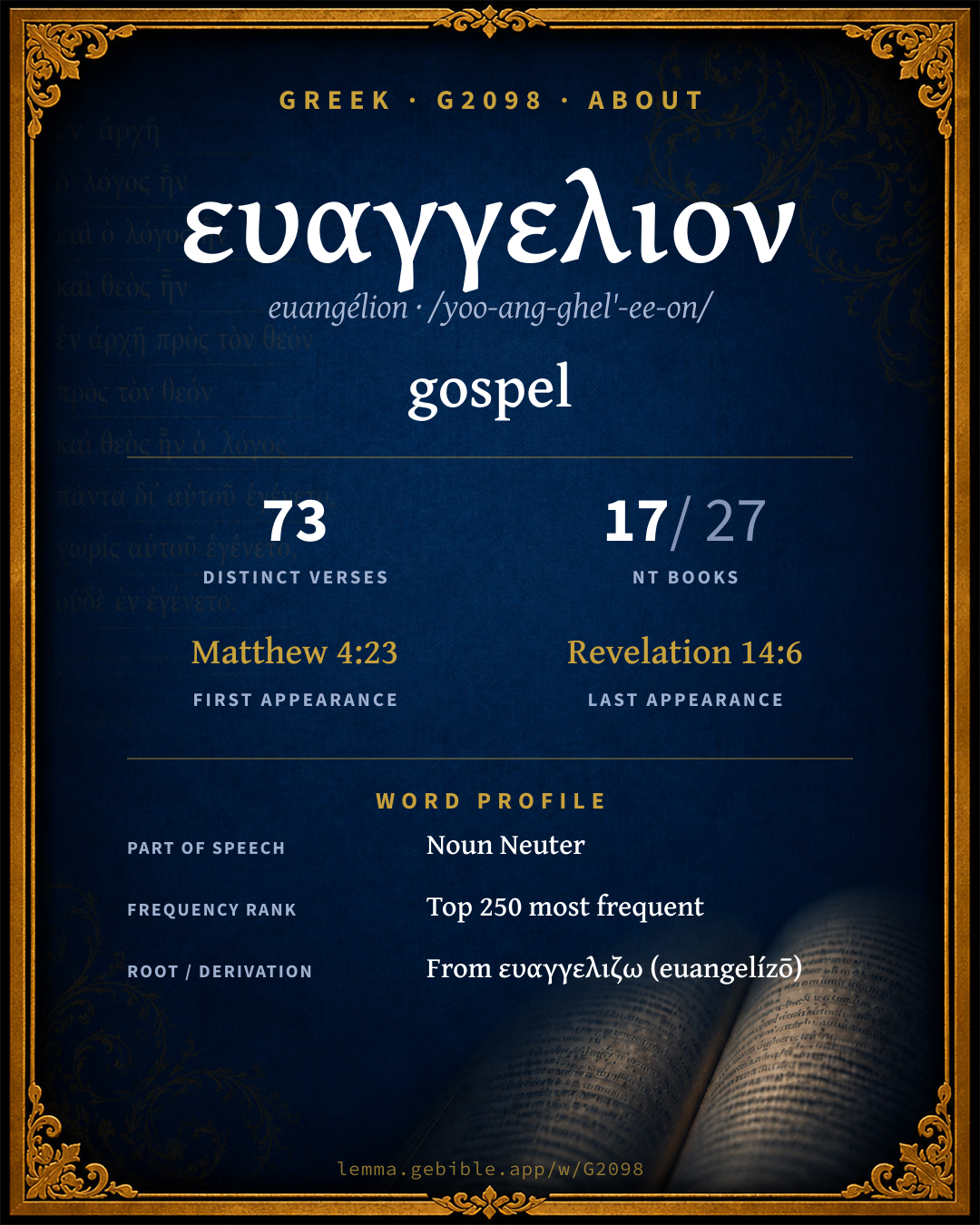
εὐαγγέλιον
gospel
‘gospel’ is one of 2 main senses fuller range ↓
Full lexicon entry — Thayer's Greek Lexicon
From Thayer's Greek Lexicon
Where this word appears
See every Accusative-case word in the Greek New Testament →
Grammar key — what these labels mean
Part of speech
- Noun
- A naming word — a person, place, thing, or idea.
Case
- Accusative
- The case of the direct object and of extent.
- Genitive
- The case of source, possession, or “of” — answers “whose / from what.”
- Dative
- The case of the indirect object, means, or location — “to / for / with / in.”
- Nominative
- The case of the subject (and the predicate nominative).
Gender
- Neuter
- Grammatically neuter.
Number
- Singular
- One.
Grammatical forms
- Noun, Accusative, Singular, Neuter 35 times (46%)
- Noun, Genitive, Singular, Neuter 23 times (30%)
- Noun, Dative, Singular, Neuter 12 times (16%)
- Noun, Nominative, Singular, Neuter 6 times (8%)
Parsed forms decoded from the imported morphology (Robinson–Tischendorf, public domain), counted across 76 parsed occurrences — not distinct verses.
Every verse where G2098 appears — 73 distinct verses across 17 books. Click any verse to open its interlinear word-by-word view. Verse text shown in the World English Bible for context — . Each verse’s Greek form is shown with its reference; the English is not keyword-highlighted, since the data carries no word-level English alignment. Use “Compare translations” on any verse to read it across multiple English versions. This concordance covers the Greek New Testament; Septuagint (Greek Old Testament) occurrences of this word are not indexed here.
Matthew 4 verses
- Matthew 4:23 εὐαγγέλιον n acc sg neut Jesus went about in all Galilee, teaching in their synagogues, preaching the Gospel of the Kingdom, and healing every disease and every sickness among the people.
- Matthew 9:35 εὐαγγέλιον n acc sg neut Jesus went about all the cities and the villages, teaching in their synagogues, and preaching the Gospel of the Kingdom, and healing every disease and every sickness among the people.
- Matthew 24:14 εὐαγγέλιον n nom sg neut This Gospel of the Kingdom will be preached in the whole world for a testimony to all the nations, and then the end will come.
- Matthew 26:13 εὐαγγέλιον n nom sg neut Most assuredly I tell you, wherever this Gospel is preached in the whole world, what this woman has done will also be spoken of as a memorial of her."
Mark 8 verses
- Mark 1:1 εὐαγγελίου n gen sg neut The beginning of the Gospel of Jesus Christ, the Son of God.
- Mark 1:14 εὐαγγέλιον n acc sg neut Now after John was taken into custody, Jesus came into Galilee, preaching the Gospel of the Kingdom of God,
- Mark 1:15 εὐαγγελίῳ n dat sg neut and saying, "The time is fulfilled, and the Kingdom of God is at hand! Repent, and believe in the Gospel."
- Mark 8:35 εὐαγγελίου n gen sg neut For whoever wants to save his life will lose it; and whoever will lose his life for my sake and the Gospel's will save it.
- Mark 10:29 εὐαγγελίου n gen sg neut Jesus said, "Most assuredly I tell you, there is no one who has left house, or brothers, or sisters, or father, or mother, or wife, or children, or land, for my sake, and for the Gospel's sake,
- Mark 13:10 εὐαγγέλιον n nom sg neut The Gospel must first be preached to all the nations.
- Mark 14:9 εὐαγγέλιον n nom sg neut Most assuredly I tell you, wherever this Gospel may be preached throughout the whole world, that which this woman has done will also be spoken of for a memorial of her."
- Mark 16:15 εὐαγγέλιον n acc sg neut He said to them, "Go into all the world, and preach the Gospel to the whole creation.
Acts 2 verses
- Acts 15:7 εὐαγγελίου n gen sg neut When there had been much discussion, Peter rose up and said to them, "Brothers, you know that a good while ago God made choice among you, that by my mouth the Gentiles should hear the word of the Gospel, and believe.
- Acts 20:24 εὐαγγέλιον n acc sg neut But these things don't count; nor do I hold my life dear to myself, so that I may finish my race with joy, and the ministry which I received from the Lord Jesus, to fully testify to the Gospel of the grace of God.
Romans 9 verses
- Romans 1:1 εὐαγγέλιον n acc sg neut Paul, a servant of Jesus Christ, called to be an apostle, set apart for the Gospel of God,
- Romans 1:9 εὐαγγελίῳ n dat sg neut For God is my witness, whom I serve in my spirit in the Gospel of his Son, how unceasingly I make mention of you always in my prayers,
- Romans 1:16 εὐαγγέλιον n acc sg neut For I am not ashamed of the Gospel of Christ, for it is the power of God for salvation for everyone who believes; for the Jew first, and also for the Greek.
- Romans 2:16 εὐαγγέλιόν n acc sg neut in the day when God will judge the secrets of men, according to my Gospel, by Jesus Christ.
- Romans 10:16 εὐαγγελίῳ n dat sg neut But they didn't all listen to the glad news. For Isaiah says, "Lord, who has believed our report?"
- Romans 11:28 εὐαγγέλιον n acc sg neut Concerning the Gospel, they are enemies for your sake. But concerning the election, they are beloved for the fathers' sake.
- Romans 15:16 εὐαγγέλιον n acc sg neut that I should be a servant of Christ Jesus to the Gentiles, ministering as a priest the Gospel of God, that the offering up of the Gentiles might be made acceptable, sanctified by the Holy Spirit.
- Romans 15:19 εὐαγγέλιον n acc sg neut in the power of signs and wonders, in the power of God's Spirit; so that from Jerusalem, and around as far as to Illyricum, I have fully preached the Gospel of Christ;
- Romans 16:25 εὐαγγέλιόν n acc sg neut
1 Corinthians 6 verses
- 1 Corinthians 4:15 εὐαγγελίου n gen sg neut For though you have ten thousand tutors in Christ, yet not many fathers. For in Christ Jesus, I became your father through the Gospel.
- 1 Corinthians 9:12 εὐαγγελίῳ n dat sg neut If others partake of this right over you, don't we yet more? Nevertheless we did not use this right, but we bear all things, that we may cause no hindrance to the Gospel of Christ.
- 1 Corinthians 9:14 εὐαγγέλιον εὐαγγελίου n acc sg neut n gen sg neut Even so the Lord ordained that those who proclaim the Gospel should live from the Gospel.
- 1 Corinthians 9:18 εὐαγγέλιον εὐαγγελίῳ n acc sg neut n dat sg neut What then is my reward? That, when I preach the Gospel, I may present the Gospel of Christ without charge, so as not to abuse my authority in the Gospel.
- 1 Corinthians 9:23 εὐαγγέλιον n acc sg neut Now I do this for the Gospel's sake, that I may be a joint partaker of it.
- 1 Corinthians 15:1 εὐαγγέλιον n acc sg neut Now I declare to you, brothers, the Gospel which I preached to you, which also you received, in which you also stand,
2 Corinthians 8 verses
- 2 Corinthians 2:12 εὐαγγέλιον n acc sg neut Now when I came to Troas for the Gospel of Christ, and when a door was opened to me in the Lord,
- 2 Corinthians 4:3 εὐαγγέλιον n nom sg neut Even if our Gospel is veiled, it is veiled in those who perish;
- 2 Corinthians 4:4 εὐαγγελίου n gen sg neut in whom the god of this world has blinded the minds of the unbelieving, that the light of the Gospel of the glory of Christ, who is the image of God, should not dawn on them.
- 2 Corinthians 8:18 εὐαγγελίῳ n dat sg neut We have sent together with him the brother whose praise in the Gospel is known through all the assemblies.
- 2 Corinthians 9:13 εὐαγγέλιον n acc sg neut seeing that through the proof given by this service, they glorify God for the obedience of your confession to the Gospel of Christ, and for the liberality of your contribution to them and to all;
- 2 Corinthians 10:14 εὐαγγελίῳ n dat sg neut For we don't stretch ourselves too much, as though we didn't reach to you. For we came even as far as to you with the Gospel of Christ,
- 2 Corinthians 11:4 εὐαγγέλιον n acc sg neut For if he who comes preaches another Jesus, whom we did not preach, or if you receive a different spirit, which you did not receive, or a different gospel, which you did not accept, you put up with that well enough.
- 2 Corinthians 11:7 εὐαγγέλιον n acc sg neut Or did I commit a sin in humbling myself that you might be exalted, because I preached to you God's Gospel free of charge?
Galatians 7 verses
- Galatians 1:6 εὐαγγέλιον n acc sg neut I marvel that you are so quickly deserting him who called you in the grace of Christ to a different gospel;
- Galatians 1:7 εὐαγγέλιον n acc sg neut and there isn't another gospel. Only there are some who trouble you, and want to pervert the Gospel of Christ.
- Galatians 1:11 εὐαγγέλιον n acc sg neut But I make known to you, brothers, concerning the Gospel which was preached by me, that it is not according to man.
- Galatians 2:2 εὐαγγέλιον n acc sg neut I went up by revelation, and I laid before them the Gospel which I preach among the Gentiles, but privately before those who were respected, for fear that I might be running, or had run, in vain.
- Galatians 2:5 εὐαγγελίου n gen sg neut to whom we gave no place in the way of subjection, not for an hour, that the truth of the Gospel might continue with you.
- Galatians 2:7 εὐαγγέλιον n acc sg neut but to the contrary, when they saw that I had been entrusted with the Gospel for the uncircumcision, even as Peter with the Gospel for the circumcision
- Galatians 2:14 εὐαγγελίου n gen sg neut But when I saw that they didn't walk uprightly according to the truth of the Gospel, I said to Peter before them all, "If you, being a Jew, live as the Gentiles do, and not as the Jews do, why do you compel the Gentiles to live as the Jews do?
Ephesians 4 verses
- Ephesians 1:13 εὐαγγέλιον n acc sg neut in whom you also, having heard the word of the truth, the Gospel of your salvation,--in whom, having also believed, you were sealed with the Holy Spirit of promise,
- Ephesians 3:6 εὐαγγελίου n gen sg neut that the Gentiles are fellow heirs, and fellow members of the body, and fellow partakers of his promise in Christ Jesus through the Gospel,
- Ephesians 6:15 εὐαγγελίου n gen sg neut and having fitted your feet with the preparation of the Gospel of peace;
- Ephesians 6:19 εὐαγγελίου n gen sg neut on my behalf, that utterance may be given to me in opening my mouth, to make known with boldness the mystery of the Gospel,
Philippians 8 verses
- Philippians 1:5 εὐαγγέλιον n acc sg neut for your partnership in furtherance of the Gospel from the first day until now;
- Philippians 1:7 εὐαγγελίου n gen sg neut It is even right for me to think this way on behalf of all of you, because I have you in my heart, because, both in my bonds and in the defense and confirmation of the Gospel, you all are partakers with me of grace.
- Philippians 1:12 εὐαγγελίου n gen sg neut Now I desire to have you know, brothers, that the things which happened to me have turned out rather to the progress of the Gospel;
- Philippians 1:16 εὐαγγελίου n gen sg neut The former insincerly preach Christ from selfish ambition, thinking that they add affliction to my chains;
- Philippians 1:27 εὐαγγελίου εὐαγγελίου n gen sg neut n gen sg neut Only let your manner of life be worthy of the Gospel of Christ, that, whether I come and see you or am absent, I may hear of your state, that you stand firm in one spirit, with one soul striving for the faith of the Gospel;
- Philippians 2:22 εὐαγγέλιον n acc sg neut But you know the proof of him, that, as a child serves a father, so he served with me in furtherance of the Gospel.
- Philippians 4:3 εὐαγγελίῳ n dat sg neut Yes, I beg you also, true yoke-fellow, help these women, for they labored with me in the Gospel, with Clement also, and the rest of my fellow workers, whose names are in the book of life.
- Philippians 4:15 εὐαγγελίου n gen sg neut You yourselves also know, you Philippians, that in the beginning of the Gospel, when I departed from Macedonia, no assembly shared with me in the matter of giving and receiving but you only.
Colossians 2 verses
- Colossians 1:5 εὐαγγελίου n gen sg neut because of the hope which is laid up for you in the heavens, of which you heard before in the word of the truth of the Gospel,
- Colossians 1:23 εὐαγγελίου n gen sg neut if it is so that you continue in the faith, grounded and steadfast, and not moved away from the hope of the Gospel which you heard, which is being proclaimed in all creation under heaven; of which I, Paul, was made a servant.
1 Thessalonians 6 verses
- 1 Thessalonians 1:5 εὐαγγέλιον n nom sg neut and that our Gospel came to you not in word only, but also in power, and in the Holy Spirit, and with much assurance. You know what kind of men we showed ourselves to be among you for your sake.
- 1 Thessalonians 2:2 εὐαγγέλιον n acc sg neut but having suffered before and been shamefully treated, as you know, at Philippi, we grew bold in our God to tell you the Gospel of God in much conflict.
- 1 Thessalonians 2:4 εὐαγγέλιον n acc sg neut But even as we have been approved by God to be entrusted with the Gospel, so we speak; not as pleasing men, but God, who tests our hearts.
- 1 Thessalonians 2:8 εὐαγγέλιον n acc sg neut Even so, affectionately longing for you, we were well pleased to impart to you, not the Gospel of God only, but also our own souls, because you had become very dear to us.
- 1 Thessalonians 2:9 εὐαγγέλιον n acc sg neut For you remember, brothers, our labor and travail; for working night and day, that we might not burden any of you, we preached to you the Gospel of God.
- 1 Thessalonians 3:2 εὐαγγελίῳ n dat sg neut and sent Timothy, our brother and God's servant in the Gospel of Christ, to establish you, and to comfort you concerning your faith;
2 Thessalonians 2 verses
1 Timothy 1 verse
2 Timothy 3 verses
- 2 Timothy 1:8 εὐαγγελίῳ n dat sg neut Therefore don't be ashamed of the testimony of our Lord, nor of me his prisoner; but endure hardship for the Gospel according to the power of God,
- 2 Timothy 1:10 εὐαγγελίου n gen sg neut but has now been revealed by the appearing of our Savior, Christ Jesus, who abolished death, and brought life and immortality to light through the Gospel.
- 2 Timothy 2:8 εὐαγγέλιόν n acc sg neut Remember Jesus Christ, risen from the dead, of the seed of David, according to my Gospel,
Philemon 1 verse
1 Peter 1 verse
Revelation 1 verse
About this entry
At a glance — auto-summarized from this page’s data, not written by a person. Every figure links to its source below. This summary describes the numbers; it doesn’t interpret them.
ευαγγελιον — transliterated euangélion — is a Greek noun carrying the sense “gospel.” Its earliest occurrence is Matthew 4:23. It appears 73 verses across 17 books of the Greek New Testament, among its moderately common vocabulary. Thayer's distinguishes 2 senses for it. It shares a root with ευαγγελιζω and ευαγγελιστης. Each statement above links to its evidence; the full detail follows below.
Gloss history
Strong's 1890 vs modern scholarship
About this word
Strong's G2098 catalogs a Greek word from the Greek New Testament.
These counts are not copied from any lexicon or concordance. They are computed here, from the morphology-tagged Greek New Testament. What Lemma adds →
- 73
- distinct verses
- The word appears in 73 distinct verses.
- 17 / 27
- NT books
- The word appears in 17 of 27 New Testament books.
- #225
- by frequency
- Top 250 most frequent Greek words (rank 225 of 5,347 Greek words by occurrence).
View all 73 occurrences in the concordance →
Most concentrated in
- Romans 9 verses 12%
- Mark 8 verses 11%
- 2 Corinthians 8 verses 11%
By section of the New Testament
By traditional corpus
Conventional, traditional groupings — biblical authorship is debated, so this is a traditional corpus grouping, not an authorship claim. Some books belong to more than one corpus (Luke is in both the Gospels and the Lukan corpus, and so on), so these shares overlap and need not total 100%. Each figure is a share of the word’s 73 distinct verses.
- Pauline corpus 57 verses · 78%
- Gospels 12 verses · 16%
- Lukan (Luke–Acts) 2 verses · 3%
- Johannine 1 verse · 1%
- General (Catholic) Epistles 1 verse · 1%
- Revelation 1 verse · 1%
How translations render this word
Counts come from each version’s own published word-to-Strong’s tagging or interlinear alignment — an approximate guide to how each version renders this word, not a word-level alignment the data otherwise carries. Because each total is that version’s own tagged count, the per-version totals vary from one another and need not match the appearance or distinct-verse counts above. These counts may also differ from a printed concordance because Lemma counts each distinctly tagged rendering and does not collapse phrase taggings into a single head-word total. This is a fixed set of word-tagged versions (KJV, ASV, BSB, ULT) and does not change with the reading translation you choose elsewhere. Each version’s license is shown beside its name below (and on Sources).
- King James Version: Gospel 73×, Gospel's 3×
- American Standard Version: Gospel 70×, Furtherance of the gospel 2×
- Berean Standard Bible: Gospel 72×, Good news 2×
- unfoldingWord Literal Text: Gospel 76×, A 2×
King James Version Public Domain
Renders G2098 across 77 tagged occurrences — most commonly:
Plus 1 rendering that appears only once — usually multi-word phrases or single function words the recovered tagging swept in, not distinct renderings.
American Standard Version Public Domain
Renders G2098 across 74 tagged occurrences — most commonly:
Plus 2 renderings that appear only once — usually multi-word phrases or single function words the recovered tagging swept in, not distinct renderings.
Berean Standard Bible Public Domain
Renders G2098 across 74 tagged occurrences — most commonly:
Not rendered by a distinct English word in 2 further occurrences.
unfoldingWord Literal Text CC BY-SA 4.0
Renders G2098 across 79 tagged occurrences — most commonly:
Plus 1 rendering that appears only once — usually multi-word phrases or single function words the recovered tagging swept in, not distinct renderings.
Senses in Thayer's
The 2 senses Thayer's distinguishes for this word, in lexicon order (not ranked by frequency or importance). The full entry — with sub-senses — is in the Lexicon Entry tab.
- a reward for good tidings
- good tidings
Word origin
Derived from ευαγγελιζω (euangelízō) (G2097) — to evangelize.
From the same as G2097 ; a good message that is the gospel : - gospel.
— Strong’s Exhaustive Concordance (1890), public domain.
Forms in the corpus
The 4 distinct written forms G2098 takes in the Greek New Testament, most frequent first — each parse links to that case’s occurrences in the concordance.
| Form | Parsing | Example | Uses |
|---|---|---|---|
| εὐαγγέλιον euangélion | Noun, Accusative, Singular, Neuter | Matthew 4:23 | 38 |
| εὐαγγελίου euangelíou | Noun, Genitive, Singular, Neuter | Mark 1:1 | 23 |
| εὐαγγελίῳ euangelíō | Noun, Dative, Singular, Neuter | Mark 1:15 | 12 |
| εὐαγγέλιόν euangélión | Noun, Accusative, Singular, Neuter | Romans 2:16 | 3 |
Same root — word family
Other Thayer's entries built from the same root as G2098, grouped by Strong’s listed origin. These share a root / origin per the lexicon — not necessarily a shared meaning. Each links to that word’s own entry.
Derives from
Shares the same root
Compare all same-root words → They share a root, not necessarily a meaning.
Septuagint usage
The same Greek word ευαγγελιον appears 1 time in the Greek Old Testament (Septuagint), across 1 verse in 1 book.
- 1
- LXX occurrences
- Tagged occurrences of this Greek word in the Septuagint.
- 1
- verse
- Distinct Septuagint verses containing this word.
- 1 / 39
- OT books
- The word appears in 1 of the 39 Old Testament books.
Sample Septuagint occurrences
- 2 Samuel 4:10 εὐαγγέλιον
Septuagint occurrences (same lexeme)
Every verse where the same Strong’s number (G2098) appears in the Greek Septuagint. Verse text shown in the World English Bible for context; the Greek form is the matched word — the English is not keyword-highlighted.
These are occurrences of the same Greek lexeme (G2098) in the Septuagint — not a translation of any one Hebrew word. The store carries no word-level Hebrew↔Greek alignment, so no Hebrew original is asserted here. Counts come from the recovered LXX Strong's tagging — high-frequency vocabulary is well covered, while rare or late forms may be untagged — so they reflect tagged occurrences and may slightly undercount.