
2 Corinthians 10:14

Greek (Tischendorf 8th ed.) 2 Corinthians 10:14 appears in the Greek New Testament. The text above is from the Tischendorf 8th edition. Each word links to its Strong’s number and a concise gloss. Click any word for its full Thayer’s Greek Lexicon entry.
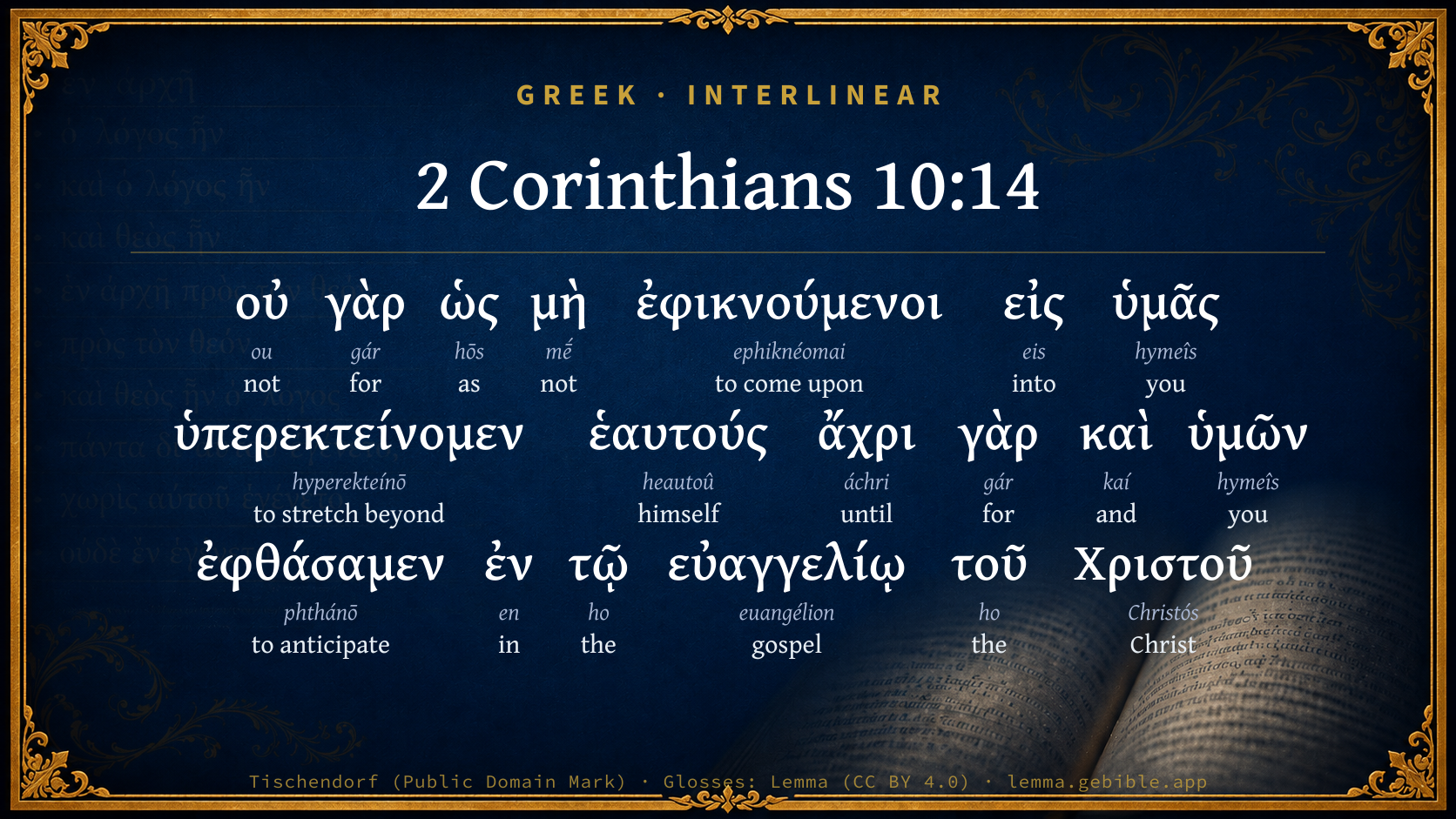
Download image
Cite this verse

2 Corinthians 10:14 (World English Bible). Public Domain. Lemma interlinear Bible study tool, https://lemma.gebible.app/v/2-corinthians/10/14.

Show BibTeX & RIS
BibTeX
RIS
English Translation
For we don't stretch ourselves too much, as though we didn't reach to you. For we came even as far as to you with the Gospel of Christ,
World English Bible · Public Domain
Highlights
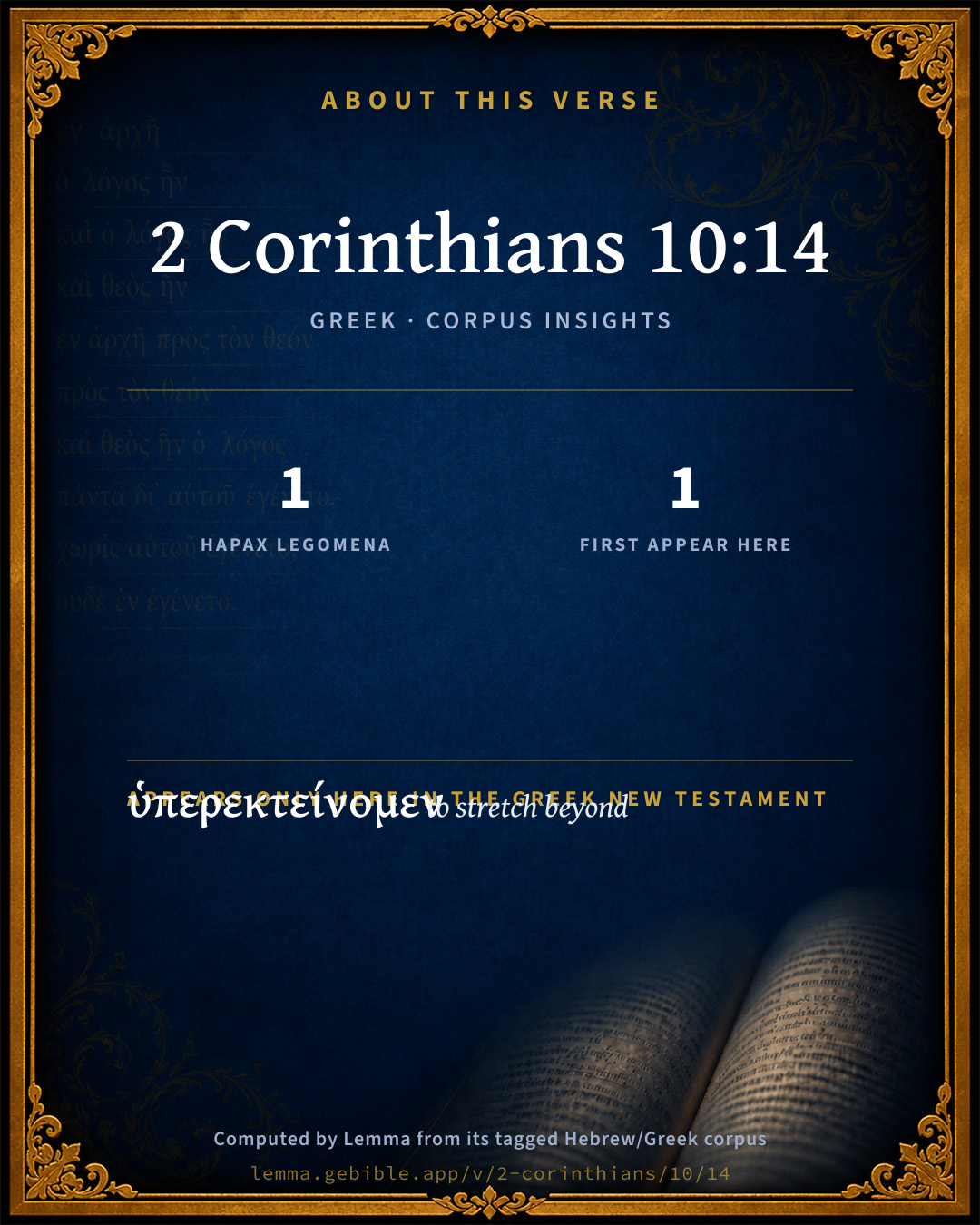
  • 1 hapax legomenon — only here in the Greek New Testament
  • 1 first appearance in the Greek New Testament
Full analysis ↓
Download a study sheet

One document with this verse’s original text, its word-by-word gloss line, the meaning frame, cross-references with their text, attributed commentary, and full source and license credits — printable, and it pastes into notes with its structure intact.

This verse Autodidact and up

Study sheet (.html) Plain text (.txt)

A passage Seminary Student

Up to 50 verses in one chapter. A passage sheet keeps up to 6 commentary sources and 12 cross-references per verse, in the order this page ranks them, and says so on the sheet whenever that leaves anything out. Ask for a single verse and you get the Autodidact verse sheet above.

Everything on this page stays free to read, with no account — the sheet is a download of what is already on screen, not access to it.

Want to remove ads? Support Godless Engineer
Compare translations 3

The same verse in 3 English versions, stacked beneath the original-language interlinear above. Click any original word for its lexicon entry.

Each is an independent rendering of the whole verse — the interlinear is not word-aligned to these translations.

Highlighted words mark where these versions differ — a whole-verse word diff, not a word-by-word alignment.

  • World English Bible Public Domain
    For we don't stretch ourselves too much, as though we didn't reach to you. For we came even as far as to you with the Gospel of Christ,
  • King James Version Public Domain
    For we stretch not ourselves beyond our measure, as though we reached not unto you: for we are come as far as to you also in preaching the gospel of Christ:
  • unfoldingWord Literal Text CC BY-SA 4.0
    For we are not overextending ourselves, as though we did not reach to you, for we came even as far as you with the gospel of Christ,

unfoldingWord Literal Text — © unfoldingWord, licensed CC BY-SA 4.0. Word-aligned USFM3 via Door43 (git.door43.org/unfoldingWord/en_ult).

Versions to compare (up to 4)

3 of 4 selected

Show all 19 translations

Every available English version of this verse, each an independent rendering of the whole verse.

  • World English Bible Public Domain
    For we don't stretch ourselves too much, as though we didn't reach to you. For we came even as far as to you with the Gospel of Christ,
  • Berean Standard Bible Public Domain
    We are not overstepping our bounds, as if we had not come to you. Indeed, we were the first to reach you with the gospel of Christ.
  • Majority Standard Bible Public Domain
    We are not overstepping our bounds, as if we had not come to you. Indeed, we were the first to reach you with the gospel of Christ.
  • King James Version Public Domain
    For we stretch not ourselves beyond our measure, as though we reached not unto you: for we are come as far as to you also in preaching the gospel of Christ:
  • American Standard Version (1901) Public Domain
    For we stretch not ourselves overmuch, as though we reached not unto you: for we came even as far as unto you in the gospel of Christ:
  • Revised Version (1885) Public Domain
    For we stretch not ourselves overmuch, as though we reached not unto you: for we came even as far as unto you in the gospel of Christ:
  • Geneva Bible (1599) Public Domain
    For we stretche not our selues beyonde our measure, as though wee had not attained vnto you: for euen to you also haue we come in preaching the Gospel of Christ,
  • Douay-Rheims (1899) Public Domain
    For we stretch not ourselves beyond our measure, as if we reached not unto you. For we are come as far as to you in the gospel of Christ.
  • Young's Literal Translation Public Domain
    for not as not reaching to you do we stretch ourselves overmuch, for even unto you did we come in the good news of the Christ,
  • Literal Standard Version CC BY-SA 4.0
    for we do not stretch ourselves too much, as not reaching to you, for even to you we came in the good news of the Christ,
  • Unlocked Literal Bible CC BY-SA 4.0
    For we did not overextend ourselves when we reached you. We were the first to reach as far as you with the gospel of Christ.
  • unfoldingWord Literal Text CC BY-SA 4.0
    For we are not overextending ourselves, as though we did not reach to you, for we came even as far as you with the gospel of Christ,
  • Darby Bible Public Domain
    For we do not, as not reaching to you, overstretch ourselves, (for we have come to you also in the glad tidings of the Christ;)
  • World Messianic Bible Public Domain
    For we don’t stretch ourselves too much, as though we didn’t reach to you. For we came even as far as to you with the Good News of Messiah,
  • Webster's Bible Public Domain
    For we stretch not ourselves beyond our measure, as though we reached not to you; for we are come as far as to you also in preaching the gospel of Christ:
  • Free Bible Version CC BY-SA 4.0
    We are not over-extending our authority in saying this, as if we didn't get as far as you, for we did get to you and share with you the good news of Christ.
  • Bible in Basic English Public Domain
    For we have no need to make ourselves seem more than we are, as if our authority did not come as far as to you: for we came even as far as you with the good news of Christ:
  • Text-Critical English NT CC BY 4.0
    For we are not overextending ourselves, as though we did not reach you; we were the first to come all the way to you with the gospel of Christ.
  • Tyndale New Testament (1534) Public Domain
    For we stretche uot out oure selves beyode measure as though we had not reached vnto you. For even vnto you have we come with the gospell of Christ

Literal Standard Version (2020), Covenant Press — licensed CC BY-SA 4.0. Text via the HelloAO Bible API (eBible.org). Unlocked Literal Bible (unfoldingWord) — licensed CC BY-SA 4.0. Text via the HelloAO Bible API (eBible.org). unfoldingWord Literal Text — © unfoldingWord, licensed CC BY-SA 4.0. Word-aligned USFM3 via Door43 (git.door43.org/unfoldingWord/en_ult). Free Bible Version, Dr. Jonathan Gallagher — licensed CC BY-SA 4.0. Text via the HelloAO Bible API (eBible.org).

Word by word

More ways to search: Search by grammar → Find every occurrence → Compare this word →

Practice this passage: Drill this verse → Learn its vocabulary →

ὑπερεκτείνομεν
hyperekteínō
G5239
“to stretch beyond”
Verb, Present, Active, Indicative, 1st person, Plural
Part of Speech
Verb
Tense
Present
Voice
Active
Mood
Indicative
Person
1st person
Number
Plural
Full Thayer's Definition

Origin: from G5228 and G1614

TDNT: 09:45,2

1. to extend beyond the prescribed bounds, stretch out beyond measure, stretch out overmuch
  1. οὐ ou G3756 “not” Particle, Negative
  2. γὰρ gár G1063 “for” Conjunction
  3. ὡς hōs G5613 “as” Adverb
  4. μὴ mḗ G3361 “not” Particle, Negative
  5. ἐφικνούμενοι ephiknéomai G2185 “to come upon” Verb, Present, Middle or Passive deponent, Participle, Nominative, Plural, Masculine
  6. εἰς eis G1519 “into” Preposition
  7. ὑμᾶς hymeîs G5210 “you” Personal pronoun, 2nd person, Accusative, Plural
  8. ἑαυτούς heautoû G1438 “himself” Reflexive pronoun, 1st person, Accusative, Plural, Masculine
  9. ἄχρι áchri G891 “until” Adverb
  10. γὰρ gár G1063 “for” Conjunction
  11. καὶ kaí G2532 “and” Conjunction
  12. ὑμῶν hymeîs G5210 “you” Personal pronoun, 2nd person, Genitive, Plural
  13. ἐφθάσαμεν phthánō G5348 “to anticipate” Verb, Aorist, Active, Indicative, 1st person, Plural
  14. ἐν en G1722 “in” Preposition
  15. τῷ ho G3588 “the” Article, Dative, Singular, Neuter
  16. εὐαγγελίῳ euangélion G2098 “gospel” Noun, Dative, Singular, Neuter
  17. τοῦ ho G3588 “the” Article, Genitive, Singular, Masculine
  18. Χριστοῦ Christós G5547 “Christ” Noun, Genitive, Singular, Masculine

About this verse

These counts appear in no published source. They are computed here, from the morphology-tagged text and Lemma’s own curated glosses. What Lemma adds →

19
words
16
distinct lemmas
Pauline Epistles
section

Notable vocabulary

1 hapax legomenon — a word that appears only here in the entire Greek New Testament:

  • ὑπερεκτείνομεν to stretch beyond G5239

First appearance in Scripture

This word makes its first canonical appearance in the Greek New Testament here:

  • ὑπερεκτείνομεν to stretch beyond G5239

Shared distinctive vocabulary

ἐφικνούμενοι to come upon G2185 occurs in 2 verses of the Greek New Testament. Also found in:
Repetition

Words recur within this verse:

Cross-references

17

Topical passages linked to 2 Corinthians 10:14 in the Treasury of Scripture Knowledge — connected by theme and wording, ordered by reader-vote popularity; previews shown in the World English Bible.

  • Romans 1:16 For I am not ashamed of the Gospel of Christ, for it is the power of God for salvation for everyone who believes; for the Jew first, and also for the Greek.
  • 1 Corinthians 4:15 For though you have ten thousand tutors in Christ, yet not many fathers. For in Christ Jesus, I became your father through the Gospel.
  • 1 Timothy 1:11 according to the Gospel of the glory of the blessed God, which was committed to my trust.
  • Mark 1:1 The beginning of the Gospel of Jesus Christ, the Son of God.
  • Acts 20:24 But these things don't count; nor do I hold my life dear to myself, so that I may finish my race with joy, and the ministry which I received from the Lord Jesus, to fully testify to the Gospel of the grace of God.
  • Romans 2:16 in the day when God will judge the secrets of men, according to my Gospel, by Jesus Christ.
  • Romans 15:18–19 For I will not dare to speak of any things except those which Christ worked through me, for the obedience of the Gentiles, by word and deed,
  • 1 Corinthians 2:10 But to us, God revealed them through the Spirit. For the Spirit searches all things, yes, the deep things of God.
  • 1 Corinthians 3:5–6 Who then is Apollos, and who is Paul, but servants through whom you believed; and each as the Lord gave to him?
  • 1 Corinthians 9:1–2 Am I not free? Am I not an apostle? Haven't I seen Jesus Christ, our Lord? Aren't you my work in the Lord?
  • 2 Corinthians 2:12 Now when I came to Troas for the Gospel of Christ, and when a door was opened to me in the Lord,
  • 2 Corinthians 3:1–3 Are we beginning again to commend ourselves? Or do we need, as do some, letters of commendation to you or from you?
  • 2 Corinthians 4:4 in whom the god of this world has blinded the minds of the unbelieving, that the light of the Gospel of the glory of Christ, who is the image of God, should not dawn on them.
  • Galatians 1:6–8 I marvel that you are so quickly deserting him who called you in the grace of Christ to a different gospel;
  • Colossians 1:5 because of the hope which is laid up for you in the heavens, of which you heard before in the word of the truth of the Gospel,
  • Romans 16:25
  • 1 Corinthians 3:10 According to the grace of God which was given to me, as a wise master builder I laid a foundation, and another builds on it. But let each man be careful how he builds on it.

Cross-references courtesy of OpenBible.info (CC BY 4.0).

Commentary

Notes on 2 Corinthians 10:14 from classic Christian and Jewish commentators (each source and its license shown beneath its notes). The classic Christian expositions comment on the surrounding passage and are grouped to its opening verse, so a note may address several verses; the Jewish commentaries on the Tanakh (Rashi and others) are per-verse, so they appear only where the commentator wrote on this verse.

Lemma curates 59 commentaries, every one of them public domain or Creative Commons licensed, each selected and text-cleaned for this edition rather than reprinted as found. About our sources →

Joseph Benson's Commentary

2Co 10:14-16. We stretch not, &c. — In preaching at Corinth, we do not, like the false teacher, go out of our line, as not reaching to you; but we are come even as far as you — By a gradual, regular process, having taken the intermediate places in our way. The apostles themselves, (unless they received particular direction to that purpose, see Act 16:6-7,) “were not at liberty to preach in some countries, and pass by others. St. Paul, therefore, following this rule, preached in all the countries of the Lesser Asia, beginning at Jerusalem. From Asia he passed into Macedonia, where he preached in many of the chief cities. Then he preached in Greece, and particularly at Athens; and at last came to Corinth, in a regular course of preaching the gospel, where it had not been preached before.” Not — Like those whom I have had so much reason to complain of; boasting of things without, or beyond, our proper measure — Not intruding into churches planted by other men’s labours — Where we have no natural and proper call. “The apostle justly considered the false teacher’s coming, and establishing himself in the Corinthian church, as one of its ordinary pastors, and his assuming the direction of that church, in opposition to him, as an unlawful intrusion; because that church having been planted by St. Paul, the edification and direction of it belonged only to him, and the bishops and deacons ordained by him. Besides, this intruder, by pretending to more knowledge than the apostle, and by assuming an authority superior to his, endeavoured to draw the Corinthians from following his doctrines and precepts.” — Macknight. But having hope, when your faith is increased — And I can leave you to the care of your ordinary teachers; to be by you enlarged according to our rule — That is, with respect to our line of preaching; abundantly. To preach the gospel in the regions beyond you — The apostle hoped that the believers at Corinth would soon be so well instructed in the doctrines of the gospel, and so confirmed in the faith, as to render it proper for him to leave them to the care of others; and to go and preach the gospel in the countries beyond them, where the gospel had not been preached, namely, in the regions of Italy and Spain, whither we know he intended to go. For in Laconia, Arcadia, and the other countries of Peloponnesus, which composed the Roman province of Achaia, he had already preached the gospel, as is plain from the inscription of both his letters to the Corinthians. And not to boast in another man’s line — Or province, marked out, as it were, by a line; of things made ready to our hand — As some, who are very solicitous about their own case, affect to do, and then pride themselves in sowing the ground which others had cleared. As the apostle here contrasts his own behaviour with that of the false teacher, we may infer, from what he says, that that teacher took to himself great praise for having instructed the Corinthians more perfectly than, he said, Paul had done, and for having regulated the affairs of the church, which he pretended had been left in disorder by the apostle.

Joseph Benson's Commentary on the Old and New Testaments (1811–1818) — public domain. Text from a community e-Sword module.

Bengel's Gnomon

Johann Albrecht Bengel

2Co 10:14. Οὐ γὰρ ὑπερεκτείνομεν) for we stretch not ourselves beyond our measure.—ἄχρι γὰρ, for as far as) Paul proves from the effect, that the Corinthians were included in the rule marked out to him by God.—ἐν τῷ εὐαγγελίῳ, in the office of (preaching) the Gospel) comp. 2Co 2:12, [ἐλθὼν—εἰς τὸ εὐαγγέλιον Χριστοῦ, when I came to (preach) Christ’s Gospel.]

Bengel's Gnomon of the New Testament — English translation (T&T Clark, Edinburgh, 1860) — public domain. Text from a community e-Sword module.

Meyer's Critical & Exegetical Commentary

Heinrich August Wilhelm Meyer

2Co_10:14. A parenthetical (see on 2Co_10:15) confirmation of ἐφικέσθαι ἄχρι καὶ ὑμῶν: for not, as though we were such as do not reach to you, do we overstretch ourselves, i.e., dropping the figure: for we do not usurp for ourselves any extension of our working at variance with its destined limit, as would be the case, if you lay beyond the measured-off province which is divinely assigned to us. Paul abides by his figure: for if he were not destined to extend his official working even to Corinth, and yet wished to do so, he would resemble a man who stretches himself beyond the boundary-line drawn for him, in order to reach to a point that lies beyond the limits which he is forbidden to overpas.

ὡς μὴ ἐφικν. εἰς ὑμᾶς] ἐφικν. is to be taken in no other sense than the previous ἐφικέσθαι. The present, however, denotes: as though we were persons, in whose case the reaching to you does not occur, i.e. whose position within their measured local district implies that you are not capable of being reached by them, because, forsooth, you lie beyond the limits of this district. Luther, Beza, and many others, overlooking this continuation of the figure, and taking ἐφικνούμενοι, in spite of the present (and in spite of the present ὑπερεκτείνομεν), historically, have explained it: ut si non pervenissemus, from which error there has sprung the participle of the second aorist, supported by very weak evidence, and yet preferred by Billroth. Regarding μή, Winer, p. 442 [E. T. 595], very correctly remarks: a mere conception; in point of fact, the state of the case is otherwise; compare, on the other hand, 1Co_9:26.

ἄχρι γὰρ καὶ ὑμῶν κ.τ.λ.] This is now the historical position of the case, in confirmation of what was just figuratively expressed by οὐ γὰρ … ἑαυτούς. How fraught with shame must the sum of recollections, which this simple historical fact embraced, have been for the misled portion of the church! ἐφθάσαμεν is simply: we have arrived at (Rom_9:31; Php_3:16; Mat_12:28; 1Th_2:16), not: we have arrived before (sooner than the opponents, Osiander, comp. Ewald). This important point Paul must have denoted by some such expression as ἐφθάσ. ἐκείνους (comp. 1Th_4:15).

ἐν τῷ εὐαγγ. τ. Χ.] The gospel of Christ is conceived as the official element in which the ἐφθάσαμεν took place: in the matter of the gospel, i.e. in functione evangelica (Bengel). Comp. Rom_1:9; 2Co_8:18; Php_4:3; 1Th_3:2.

Meyer — Critical and Exegetical Commentary on the New Testament — English translation by Peter Christie, edited by Frederick Crombie (T&T Clark, 1880) — public domain. Text from a community e-Sword module.

Expositor's Greek Testament

ed. W. Robertson Nicoll

2Co 10:14 . οὐ γὰρ ὡς μὴ κ . τ . λ .: for we stretch not ourselves overmuch, as though we reached not unto you ( ὡς μή indicating that the case is only a hypothetical one; cf. 1Co 4:18 ); for we came ( φθάνω being used as in modern Greek; see reff.) as far as unto you in the Gospel of Christ . Corinth was the westernmost point that he had reached. This verse, it will be observed, is parenthetical, and is introduced to make it clear that Corinth was part of his appointed sphere; cf. 1Co 3:5 ; 1Co 4:15 ; 1Co 9:1 .

The Expositor's Greek Testament, edited by W. Robertson Nicoll (1897–1910) — public domain. Text from a community e-Sword module.

Cambridge Greek Testament for Schools and Colleges

14. οὐ γὰρ ὡς μή (אDFGKLM, dfg Vulg.) rather than ὡς γὰρ μή (B 114, 116) or οὐ γὰρ μὴ ὡς (P).

14. οὐ γὰρ ὡς μή. See critical note. The punctuation is doubtful, both as regards the whole verse, which may be a parenthesis (WH.), and as regards the arrangement of its parts, which may have either a comma or an interrogation at ἑαυτούς, and either a comma or a colon at τοῦ χριστοῦ. Reading οὐ γὰρ ὡς μὴ ἐφικνούμενοι, it is best to treat the verse as not parenthetical, and to connect 2Co 10:15 with 2Co 10:14; also to make no part of 2Co 10:14 a question: For we are not, as if we did not reach unto you, overstretching ourselves; for as far as even you we were the first to come in the gospel of the Christ. Or we may fill in the opening words thus; For we are not overstretching ourselves, as we should be doing if we did not reach unto you. See Winer, p. 595. If S, Paul’s province did not include Corinth, then he would be over-extending himself by transgressing limits: but manifestly it does include Corinth. Possibly ἐφθάσαμεν means no more than ‘came’ (R.V.). It is one of many words which in late Greek lost their sharpness of meaning, and perhaps here there is no thought of anticipating others, of being the first to come: comp. Rom 9:31; Php 3:16; 1Th 2:16; Luk 11:20. In 1Th 4:15, where it is not followed by a preposition, the idea of anticipating survives. Here no doubt the main point is that he came as far as Corinth with the Gospel; but it adds to the point to say that he was the first to preach in those regions, ἐν τοῖς κλίμασι τῆς Ἀχαίας (2Co 11:10). Comp. what Horace says of his being the first to introduce iambics into Italy. Libera per vacuum posui vestigia princes, Non aliena meo pressi pede (Epp. I. xix. 21). And with ὑπερεκτείνομεν comp. Sunt quibus in satira videor nimis acer et ultra Legem tendere opus (Sat. II. i. 1).

If we read ὡς γὰρ μὴ ἐφικνούμενοι, the first half of the sentence becomes a question expecting a negative answer, as the strong verb ὑπερεκτείνομεν shews; For are we overstretching ourselves as if we did not reach unto you? For other doubtful interrogatives see on 2Co 10:7.

Cambridge Greek Testament for Schools and Colleges (Cambridge University Press, 1896; 21 vols, various authors incl. Carr, Maclear, Plummer, Farrar, Lumby, Moule, M. R. James, Simcox) — public domain. Text from a community e-Sword module.

Jamieson, Fausset & Brown

Robert Jamieson, A. R. Fausset & David Brown

"We are not stretching ourselves beyond our measure, as (we should be) if we did not reach unto you: (but we do), for as far as even to you have we come in preaching the Gospel."

Jamieson, Fausset & Brown — Commentary Critical and Explanatory on the Whole Bible (1871) — public domain (CC PDM 1.0). Text via the HelloAO Bible API.

Adam Clarke's Commentary

Verse 14. For we stretch not ourselves beyond] We have not proceeded straight from Macedonia through Thessaly, and across the Adriatic Gulf into Italy, which would have led us beyond you westward; but knowing the mind of our God we left this direct path, and came southward through Greece, down into Achaia, and there we planted the Gospel. The false apostle has therefore got into our province, and entered into our labours, and there boasts as if the conversion of the heathen Achaians had been his own work. As there is an allusion here to the stadium, and to the Olympic games in general, we may consider the apostle as laying to the charge of the disturber at Corinth that he had got his name surreptitiously inserted on the military list; that he was not striving lawfully; had no right to the stadium, and none to the crown. See the observations at the end of 1Co 9; "1Co 9:27" and the note on ver. 13 of this chapter; "2Co 10:13"

Adam Clarke's Commentary on the Bible (1810–1826) — public domain. Text from a community e-Sword/MySword module.

John Calvin's Commentaries

14. For we do not overstretch. He alludes to persons who either forcibly stretch out their arms, or raise themselves up on their feet, when wishing to catch hold of what is not at their hand, for of this nature is a greedy thirst for glory, nay more, it is often more disgusting. For ambitious persons do not merely stretch out their arms and lift up their feet, but are even carried headlong with the view of obtaining some pretext for glorying. He tacitly intimates that his rivals were of this stamp. He afterwards declares on what ground he had come to the Corinthians — because he had founded their church by his ministry. Hence he says, in the gospel of Christ; for he had not come to them empty, but had been the first to bring the gospel to them. The preposition in is taken by some in another way; for they render it, by the gospel, and this meaning does not suit ill. At the same time, Paul seems to set off to advantage his coming to the Corinthians, on the ground of his having been furnished with so precious a gift.

John Calvin's Commentaries (1540-1563) — public domain. Text from the Calvin Translation Society English edition (1840s-50s) via the Christian Classics Ethereal Library (ccel.org). Calvin's coverage is partial (roughly two-thirds of the Bible); uncommented books and verses are honest gaps, never fabricated. The 19th-century editor's footnotes and remarks are omitted so the notes are faithfully Calvin's own voice.

Ellicott's Commentary for English Readers

(14) For we stretch not ourselves . . . as though we reached not unto you.—Some of the better MSS. omit the negative, and then the sentence must be taken as a question: “Are we over-reaching” (i.e., transgressing boundaries), “as though you were not within the limit assigned to us?”

For we are come as far as to you also.—The word for “come” (not the usual verb) is one which almost always in the New Testament, as in classical Greek, carries with it the sense of anticipation, “getting before others.” (See Note on Mat_12:28.) And this is obviously St. Paul’s meaning. “We were the first to come,” he says, “as working within our limits; the very fact that we did so come being a proof of it.” They (his rivals) came afterwards, and were intruders. On Corinth, as the then limit of his work, see Note on the preceding verse.

A Bible Commentary for English Readers, edited by Charles John Ellicott (1878–1897) — public domain. Text from a community e-Sword module.

The Cambridge Bible for Schools and Colleges

gen. ed. J. J. S. Perowne

14. For we stretch not] The meaning is, For we are not straining ourselves beyond our due limits in claiming you as our charge, for it is an undeniable fact that we came (the tense is the simple past in the original and the word has the sense of anticipating others in coming) as far as you in our work of preaching the Gospel. Corinth was the farthest point the Apostle had yet reached.

The Cambridge Bible for Schools and Colleges (gen. ed. J. J. S. Perowne; Cambridge University Press, 1878–1918) — public domain. Text from a community e-Sword module.

John Gill's Exposition

To preach the Gospel in the regions beyond you,.... Here the apostle clearly expresses what he hoped for, and explains what he meant by being enlarged according to rule; namely, that he should be at liberty to preach the Gospel elsewhere; and hoped he should be directed by the providence of God, to carry it into the more remote and distant parts of the world, where as yet Christ had not been named:

and not to boast in another man's line: or enter into another man's province, glory in other men's labours, as did the false apostles: and boast

of things made ready to our hand; that is, of places cultivated and improved, by the preaching of the Gospel, so as to bring forth fruit to the honour and glory of God; where many souls were already converted, and churches were planted and put into good order, and were in a flourishing condition; see Rom 15:18.

John Gill's Exposition of the Whole Bible (1746–1763) — public domain (CC PDM 1.0). Text via the HelloAO Bible API.

Trapp's Complete Commentary

John Trapp

14 For we stretch not ourselves beyond our measure, as though we reached not unto you: for we are come as far as to you also in preaching the gospel of Christ:

Ver. 14. For we stretch not, &c.] υπερεκτεινομεν, we tenter not ourselves beyond our scantling.

John Trapp, A Commentary or Exposition upon All the Books of the Old and New Testament (1647–1656) — public domain. Text from a community e-Sword module.

Albert Barnes' Notes on the Bible

For we stretch not ourselves beyond our measure - In coming to preach to you we have not gone beyond the proper limits assigned us. We have not endeavored to enlarge the proper boundaries, to stretch the line which limited us, but have kept honestly within the proper limits.

As though we reached not unto you - That is, as if our boundaries did not extend so far as to comprehend you. We have not overstepped the proper limits, as if Greece was not within the proper sphere of action.

For we are come as far as to you ... - In the regular work of preaching the gospel we have come to you. We have gone from place to place preaching the gospel where we had opportunity; we have omitted no important places, until in the regular discharge of our duties in preaching we have reached you and have preached the gospel to you. We have not omitted other places in order to come to you and enter into the proper field of labor of others, but in the regular work of making the gospel known as far as possible to all people we have come to Corinth. Far as it is, therefore, from the place where we started, we have approached it in a regular manner, and have not gone out of our proper province in doing it.

Albert Barnes' Notes on the Bible (1834–1885) — public domain. Text from a community e-Sword/MySword module.

Matthew Poole's English Annotations

For in our boasting of you as our converts, amongst whom I have preached the gospel, and God hath made my preaching successful;

we stretch not ourselves beyond our measure, and arrogate that to ourselves which belongeth not to us: for the thing is true, and ye know that in our

preaching the gospel we have come as far as unto you, and that God hath given our labours success amongst you.

Matthew Poole's English Annotations on the Holy Bible (1683–1685) — public domain. Text from a community e-Sword/MySword module.

Whedon's Commentary on the Bible

Daniel D. Whedon

14. Stretch—Rather, overstretch. We do not overstretch in coming to Corinth, as though we, in our proper field, reached not unto you. It is no overstrain for us to claim Corinth as within the boundary line of our apostolic mission.

Are come—Literally, we have anticipated, been beforehand. The meaning: We were beforehand, (before the Christines,) even as far as to you.

Daniel D. Whedon (gen. ed.), Commentary on the Old and New Testaments (1874–1909) — public domain. Text from a community e-Sword module.

The Pulpit Commentary

As though we reached not unto you. In including you within the reach of our measuring line, we are guilty neither of presumption nor of intrusion. Your Church is a part of our legitimate province and range of. (Act_18:1, Act_18:4) We are come as far as to you; rather, we anticipated others in coming to you; " we were the first to come as far as unto you." To St. Paul belonged the undisputed glory of having first introduced the gospel into the regions of Macedonia and Achaia.

Vers. 14-18.

The true sphere of human usefulness and the source of human glory.

we stretch not ourselves beyond our measure, as though we reached not unto you: for we are come as far as to you also in preaching the gospel of Christ: not boasting of things without our measure, that is, of other men"s labours; but having hope, when your faith is increased, that we shall be enlarged by you according to our rule abundantly. To preach the gospel in the regions beyond you, and not to boast in another man"s line of things made ready to our hand. But he that glorieth, let him glory in the Lord. For not he that commendeth himself is approved, but whom the Lord commendeth." Here are two subjects for meditation.

I THE TRUE SPHERE OF HUMAN USEFULNESS.

1. It is a sphere in which we are placed by Divine appointment. Paul teaches that his sphere of labour in Corinth was according to the Divine will. "We stretch not ourselves beyond our measure overmuch, as though we reached not unto you." As if he had said, "I am not come to Corinth merely by my own inclinations, or as a matter of impulse or caprice, or as an intruder. I am come here by the will of God. I am licensed by him to this sphere.

2. The consciousness that we are in this sphere is a just reason for exultation. "Not boasting of things without our measure." As if Paul had said, "My boasting, or my exultation, is not that I have entered into the sphere of other men"s labours, but that I am in the sphere to which I have been divinely commissioned." The opponents of Paul, in Corinth, boasted of the influence they had gained in the Church which he himself had founded by his self-sacrificing labours, and whose members owed, either directly or indirectly, their conversion to him; whereas his rejoicing was that he was doing the work of God in the sphere to which he had been sent.

3. It is a sphere which widens with our usefulness. Although Paul felt that Corinth was the sphere to which he had been sent, he knew that the field would be widened according to his spiritual success. "Having hope, when your faith is increased that as your faith groweth, that we shall be enlarged magnified by you according to our rule province abundantly." The increase of their faith would lead to an enlargement of his sphere of labour. The true method of extending the sphere of labour to which we have been sent is by the multiplication of our converts. Each soul which a minister bring to Christ enlarges the field of his usefulness, enables him to break up new ground still further on.

II THE TRUE SOURCE OF HUMAN EXULTATION. In what did Paul exult or "boast"?

1. Not in crediting himself with the labours of other men. He did not "boast in another man"s line province of things made ready to our hand." How common it is for men to credit themselves with the labours of others! We find this in every department of labour. In literature there are plagiarists, in scientific discoveries and artistic inventions there are unjust claimants, and even in religion one minister is often found to claim the good that others have accomplished. Paul was above this. The genius of Christianity condemns this mean and miserable dishonesty.

2. Not in self-commendation. "For not he that commendeth himself is approved" That conscience approves of our conduct, though at all times a source of pleasure, is not a true source of exultation; for conscience is not infallible. Conscience sometimes deceives. What, then, was his true source Of exultation? "He that glorieth, let him glory in the Lord." "God forbid that I should glory, save in the cross."

The Pulpit Commentary (1880–1919), ed. H.D.M. Spence-Jones & Joseph S. Exell — public domain. Text from a community e-Sword module.

John Wesley's Explanatory Notes

We are come even to you - By a gradual, regular process, having taken the intermediate places in our way, in preaching the gospel of Christ.

John Wesley, Explanatory Notes Upon the Whole Bible (1754–1765) — public domain. Text via the GEBible commentary corpus.

McGarvey & Pendleton's Commentaries

J. W. McGarvey

For we stretch not ourselves overmuch, as though we reached not unto you: for we came even as far as unto you in the gospel of Christ:

J. W. McGarvey (with Philip Y. Pendleton), Commentaries on the New Testament (The Fourfold Gospel, 1914; Acts; and the epistles) — public domain. Text from a community e-Sword/MySword module.

The People's New Testament

B. W. Johnson

14. For we stretch not ourselves beyond our measure. This verse renders clearer the thought in those preceding. The Judaizers said that Paul had exceeded his commission in coming to Corinth, that he had no authority there. He asserts that not he, but they had gone beyond the measure. Others were apostles to the circumcision; he and Barnabas to the uncircumcision. When he came to Europe he was sent by the Spirit (Acts 16:9).

B. W. Johnson's The People's New Testament with Notes (1889–1891) — public domain. Electronic text from the Christian Classics Ethereal Library (CCEL) ThML edition.

Alford’s Greek Testament

Henry Alford

14.] Further explanation of ἐφικ. ἄχρι κ. ὑμ. For we are not stretching ourselves beyond (our bounds), as (we should be doing) if we did not reach to you (not, as if we had not reached to you, as Luth., Beza: the pres. betokens the allotment of the field of apostolic work as his own, ‘ut si non perveniamus.’ The μή shews that the case is only a supposed one: so also 1Co 4:18, but compare 1Co 9:26, ὡς οὐκ ἀέρα δέρων, where the case is the real one; see Winer, edn. 6, § 55.1 [a]): for even as far as [unto] you did we advance (the proper meaning of φθάνω must hardly be pressed here: the Apostle would not introduce a distinct thought by a word of secondary importance in the sentence) in the gospel (the element in which our advance was made: ‘the gospel’ = ‘the promulgation of the gospel’).

Henry Alford, The Greek Testament (1849–1861) — public domain. Text from a community e-Sword module.

International Critical Commentary

14. We again have several doubtful points to consider; text, arrangement, and punctuation are all uncertain. At the outset all these must be regarded as tentative.

οὐ γὰρ ὡς μή. Adopting this reading, we will treat the verse as not a mere parenthesis to explain v.13, and will connect v.15 with v. 14; moreover, we will regard no part of v. 14 as interrogative. ‘For we are not overstretching ourselves, as (we should be doing) if we did not reach unto you, for as far as even you we were the first to come in the Gospel (8:18; Rom 1:9) of the Christ, not glorying beyond our measure, etc.’ Or, without supplying anything, we may take the first part of v. 14 thus; ‘For we are not, as if we did not reach unto you, overstretching ourselves.’ If the reading ὡς γὰρ μή is adopted, then the first part must be a question; ‘For are we overstretching ourselves, as if we did not reach unto you’? ‘Are we exceeding our commission in claiming authority in Corinth’? Facts speak for themselves; he founded the Church there.

It is not certain that φθάνω here, as in 1Th 4:15, retains its class. signification of ‘come first,’ ‘precede,’ ‘anticipate.’ In later Greek it commonly means simply ‘come’ (1Th 2:16; Rom 9:31; Php 3:16); so in papyri and perhaps here (RV). Nevertheless, the fact that he not only came as far as Corinth with the Glad-tidings, but was the first to do so, has point.

Unless v. 14 is treated as a parenthetical explanation of v. 13 (WH.), we need only a comma at the end of it.

οὐ γὰρ ὡς μή (א D F G K L M, Latt.) rather than ὡς γὰρ μή (B and two cursives).

International Critical Commentary — older volumes (1896–1929), various authors — public domain. Text from a community e-Sword module.

Vincent's Word Studies in the New Testament

Marvin R. Vincent

We stretch not ourselves beyond our measure [μη υπερεκτεινομεν εαυτους] . The verb only here in the New Testament. The A. V. is needlessly verbose. Rev., better, stretch not ourselves overmuch.

As though we reached not unto you. Lit., as not reaching. Paul would say : It is not as if God had not appointed our apostolic labor to reach to you. If He had not thus appointed, then our desire to labor among you would have been an overstretching of ourselves. Therefore, in boasting of our labor in Corinth, we do not boast beyond our measure.

We are come [εφθασαμεν] . Rev., we came. The verb originally means to come before, anticipate, as 1Th 4:15 (A. V., prevent; Rev., precede); but it gradually loses the idea of priority, and means simply come to, arrive at. So Mt 12:28; Phi 3:16. It may possibly be used here with a hint of the earlier meaning, were the first to come. See Rev., margin.

Marvin R. Vincent, Word Studies in the New Testament (1887–1900) — public domain. Text from a community e-Sword/MySword module.

Lesson kit

Teaching starters — assembled from the data on this page, not authored interpretation. Every prompt links to the verse data it draws on. Edit before teaching.

2 Corinthians, in the Pauline Epistles, opens this verse with 19 words (16 distinct Greek lemmas). Its most distinctive word is hyperekteínō (“to stretch beyond”). A historical commentator’s framing appears above. Read the whole chapter for the surrounding context.

Discussion questions

  1. What does “to stretch beyond” (hyperekteínō) contribute to the verse as a whole?
  2. This verse holds 1 word here found nowhere else in the Greek New Testament. What might the rare word draw attention to?
  3. The word “to stretch beyond” first appears here in Scripture. What is being introduced at this debut?
  4. 2 Corinthians 10:13 shares the word «to come upon» with this verse. How do the two illuminate each other?
  5. “for” occurs 2× in this one verse. What is the effect of the repetition?
  6. These translations render this verse differently. What is at stake in choosing one wording over another?
  7. Reading how Joseph Benson's Commentary and Bengel's Gnomon read this verse, where do the two commentators agree and where do they part?

Things to notice

  • 1 word in this verse appears nowhere else in the Greek New Testament.
  • 1 word makes its first canonical appearance in Scripture here.
  • These translations choose different wording for 16 words in this verse.
  • “for” occurs 2× in this single verse.
  • 16 distinct Greek lemmas span 19 words in this verse.

Reading settings

Reading text

Shown beneath each verse's original-language words.

Old Testament
Old Testament edition

Read the OT as the Masoretic Hebrew (MT) or the Greek Septuagint (LXX).

English shown for the Greek Septuagint (in the Hebrew ↔ Greek comparison).

Comparing translations? Open the Compare panel on any verse page to stack up to four side by side.