Isaiah 63:6

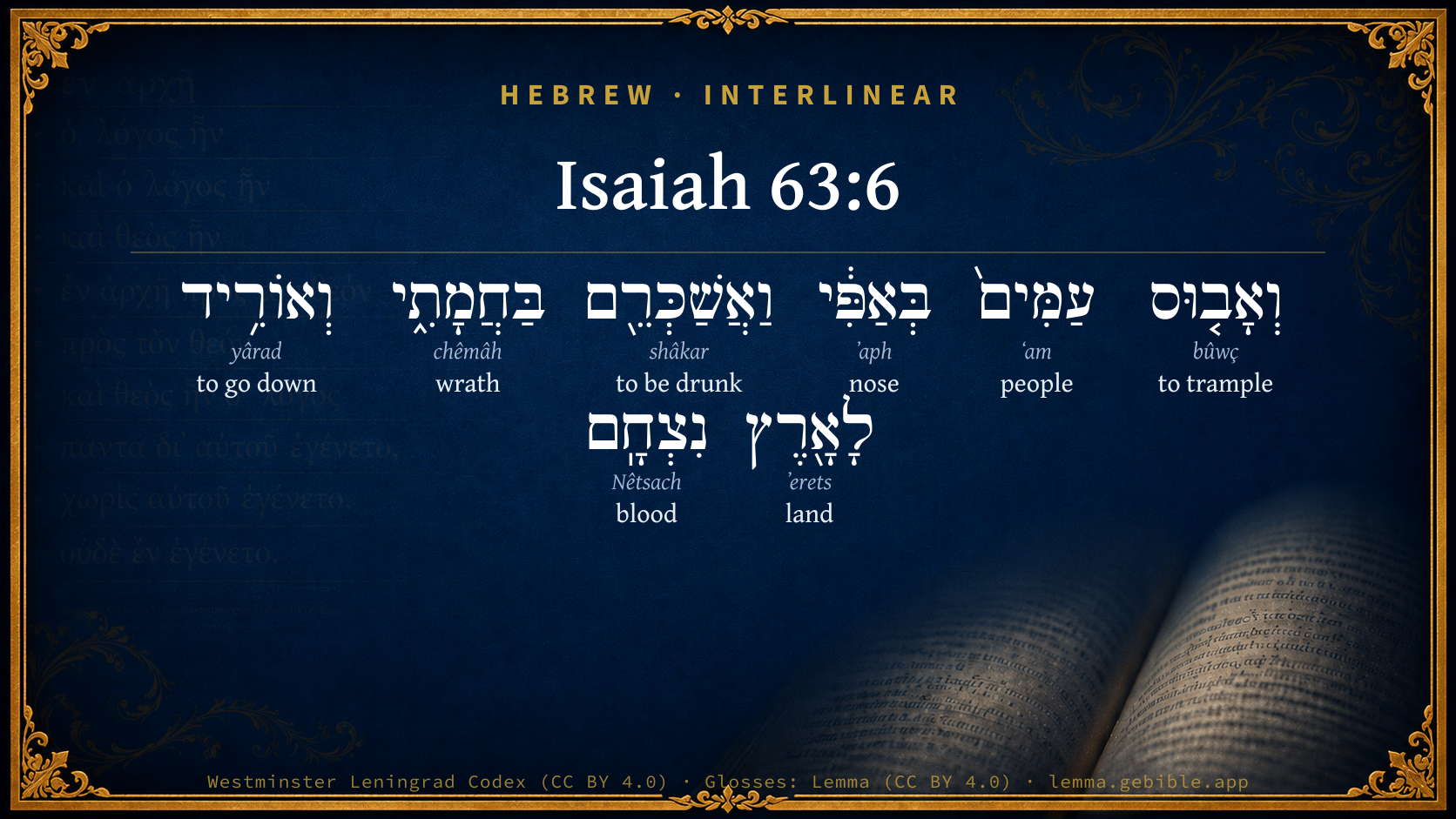
Hebrew (Westminster Leningrad Codex) Isaiah 63:6 appears in the Hebrew Old Testament. The text above is from the Westminster Leningrad Codex. Each word links to its Strong’s number, a concise gloss, and parsing drawn from the Open Scriptures Hebrew Bible morphology. Click any word for its full Brown-Driver-Briggs (BDB) entry.
Download image
Cite this verse

Isaiah 63:6 (World English Bible). Public Domain. Lemma interlinear Bible study tool, https://lemma.gebible.app/v/isaiah/63/6.

Show BibTeX & RIS
BibTeX
RIS
English Translation
I trod down the peoples in my anger, and made them drunk in my wrath, and I poured out their lifeblood on the earth.
World English Bible · Public Domain
Download a study sheet

One document with this verse’s original text, its word-by-word gloss line, the meaning frame, cross-references with their text, attributed commentary, and full source and license credits — printable, and it pastes into notes with its structure intact.

This verse Autodidact and up

Study sheet (.html) Plain text (.txt)

A passage Seminary Student

Up to 50 verses in one chapter. A passage sheet keeps up to 6 commentary sources and 12 cross-references per verse, in the order this page ranks them, and says so on the sheet whenever that leaves anything out. Ask for a single verse and you get the Autodidact verse sheet above.

Everything on this page stays free to read, with no account — the sheet is a download of what is already on screen, not access to it.

Want to remove ads? Support Godless Engineer
Compare translations 3

The same verse in 3 English versions, stacked beneath the original-language interlinear above. Click any original word for its lexicon entry.

Each is an independent rendering of the whole verse — the interlinear is not word-aligned to these translations.

Highlighted words mark where these versions differ — a whole-verse word diff, not a word-by-word alignment.

  • World English Bible Public Domain
    I trod down the peoples in my anger, and made them drunk in my wrath, and I poured out their lifeblood on the earth.
  • King James Version Public Domain
    And I will tread down the people in mine anger, and make them drunk in my fury, and I will bring down their strength to the earth.
  • unfoldingWord Literal Text CC BY-SA 4.0
    And I trampled peoples in my nose, and I made them drunk in my heat, and I brought down their blood to the earth.” q1

unfoldingWord Literal Text — © unfoldingWord, licensed CC BY-SA 4.0. Word-aligned USFM3 via Door43 (git.door43.org/unfoldingWord/en_ult).

Versions to compare (up to 4)

3 of 4 selected

Show all 18 translations

Every available English version of this verse, each an independent rendering of the whole verse.

  • World English Bible Public Domain
    I trod down the peoples in my anger, and made them drunk in my wrath, and I poured out their lifeblood on the earth.
  • Berean Standard Bible Public Domain
    I trampled the nations in My anger; in My wrath I made them drunk and poured out their blood on the ground.”
  • Majority Standard Bible Public Domain
    I trampled the nations in My anger; in My wrath I made them drunk and poured out their blood on the ground.”
  • King James Version Public Domain
    And I will tread down the people in mine anger, and make them drunk in my fury, and I will bring down their strength to the earth.
  • American Standard Version (1901) Public Domain
    And I trod down the peoples in mine anger, and made them drunk in my wrath, and I poured out their lifeblood on the earth.
  • Revised Version (1885) Public Domain
    And I trod down the peoples in mine anger, and made them drunk in my fury, and I poured out their lifeblood on the earth.
  • Geneva Bible (1599) Public Domain
    Therefore I wil tread downe the people in my wrath, and make them drunken in mine indignation, and wil bring downe their strength to the earth.
  • Douay-Rheims (1899) Public Domain
    And I have trodden down the people in my wrath, and have made them drunk in my indignation, and have brought down their strength to the earth.
  • Young's Literal Translation Public Domain
    And I tread down peoples in mine anger, And I make them drunk in my fury, And I bring down to earth their strength.
  • Literal Standard Version CC BY-SA 4.0
    And I tread down peoples in My anger, || And I make them drunk in My fury, || And I bring down their strength to earth.”
  • Unlocked Literal Bible CC BY-SA 4.0
    I trampled down the peoples in my anger and made them drunk in my wrath, and I poured out their blood on the earth.
  • unfoldingWord Literal Text CC BY-SA 4.0
    And I trampled peoples in my nose, and I made them drunk in my heat, and I brought down their blood to the earth.” q1
  • Darby Bible Public Domain
    And I have trodden down the peoples in mine anger, and made them drunk in my fury; and their blood have I brought down to the earth.
  • World Messianic Bible Public Domain
    I trod down the peoples in my anger and made them drunk in my wrath. I poured their lifeblood out on the earth.”
  • Webster's Bible Public Domain
    And I will tread down the people in my anger, and make them drunk in my fury, and I will bring down their strength to the earth.
  • Free Bible Version CC BY-SA 4.0
    I trampled down the nations in my anger; in my fury I made them drunk, and spilled their blood upon the ground.
  • Bible in Basic English Public Domain
    And in my passion the peoples were crushed under my feet, and broken in my wrath, and I put down their strength to the earth.
  • JPS Tanakh (1917) Public Domain
    And I trod down the peoples in Mine anger, and made them drunk with My fury, and I poured out their lifeblood on the earth.'

Literal Standard Version (2020), Covenant Press — licensed CC BY-SA 4.0. Text via the HelloAO Bible API (eBible.org). Unlocked Literal Bible (unfoldingWord) — licensed CC BY-SA 4.0. Text via the HelloAO Bible API (eBible.org). unfoldingWord Literal Text — © unfoldingWord, licensed CC BY-SA 4.0. Word-aligned USFM3 via Door43 (git.door43.org/unfoldingWord/en_ult). Free Bible Version, Dr. Jonathan Gallagher — licensed CC BY-SA 4.0. Text via the HelloAO Bible API (eBible.org).

Word by word

More ways to search: Search by grammar → Find every occurrence → Compare this word →

Practice this passage: Drill this verse → Learn its vocabulary →

נִצְחָֽם
Nêtsach
H5332
“blood · their”
Noun, Common, Masculine, Singular, Construct + Suffix, Personal, 3rd Person, Masculine, Plural
Part of Speech
Noun
Type
Common
Gender
Masculine
Number
Singular
State
Construct
Full BDB Definition

Origin: probably identical with H5331 , through the idea of brilliancy of colour

TWOT: 1403a

juice - juice of grapes - blood, gore (figuratively)
  1. וְאָב֤וּס bûwç H947 “and · to trample” Conjunction + Verb, Qal, Imperfect, 1st Person, Common, Singular
  2. עַמִּים֙ ʻam H5971 “peoples” Noun, Common, Masculine, Plural, Absolute
  3. בְּאַפִּ֔י ʼaph H639 “in/at · nose · my” Preposition + Noun, Common, Masculine, Singular, Construct + Suffix, Personal, 1st Person, Common, Singular
  4. וַאֲשַׁכְּרֵ֖ם shâkar H7937 “and · to be drunk · them” Conjunction + Verb, Piel, Imperfect, 1st Person, Common, Singular + Suffix, Personal, 3rd Person, Masculine, Plural
  5. בַּחֲמָתִ֑י chêmâh H2534 “in/at · wrath · my” Preposition + Noun, Common, Feminine, Singular, Construct + Suffix, Personal, 1st Person, Common, Singular
  6. וְאוֹרִ֥יד yârad H3381 “and · to go down” Conjunction + Verb, Hiphil, Imperfect, 1st Person, Common, Singular
  7. לָאָ֖רֶץ ʼerets H776 “to/for the · land” Preposition, Determined + Noun, Common, Both, Singular, Absolute

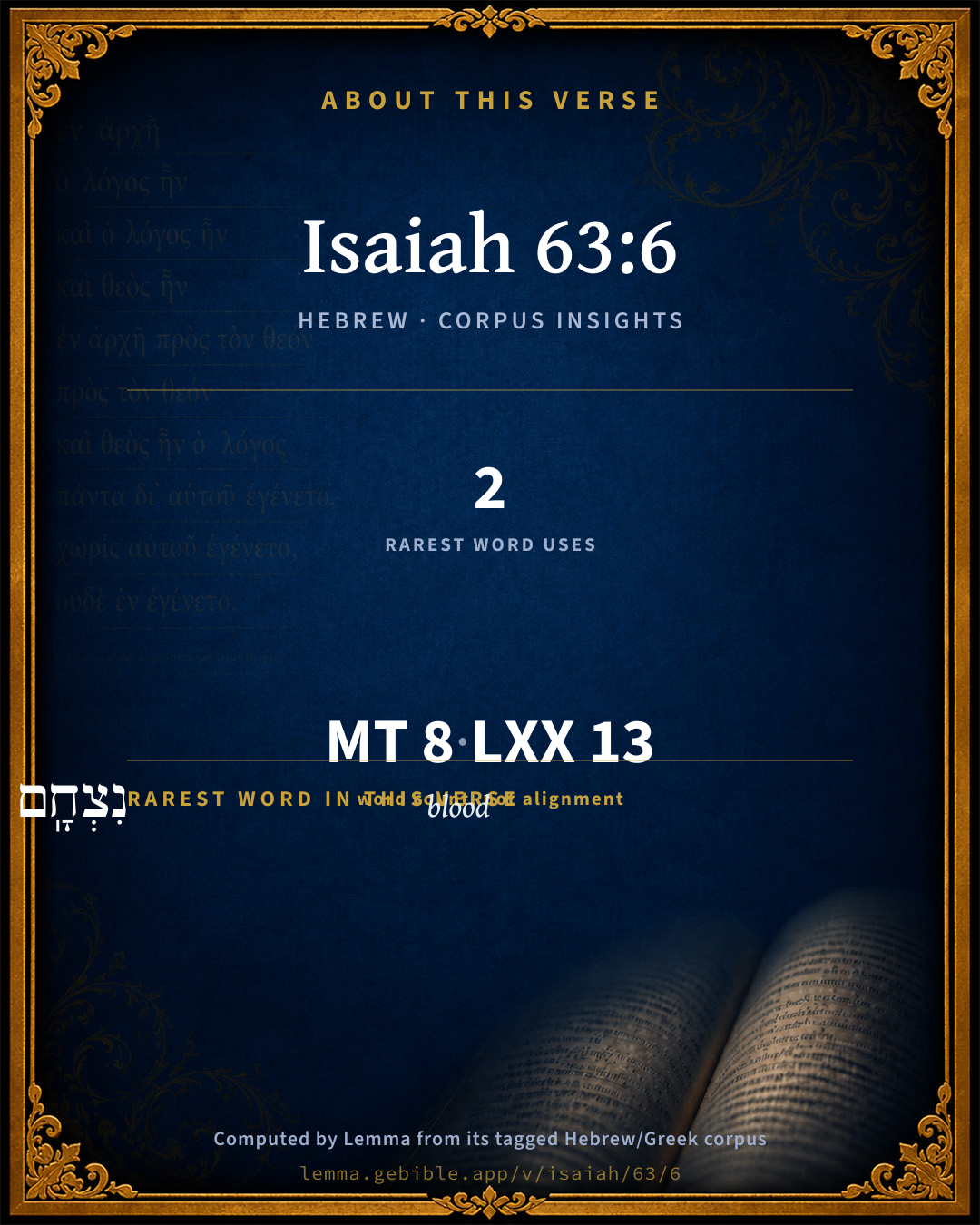
About this verse

These counts appear in no published source. They are computed here, from the morphology-tagged text and Lemma’s own curated glosses. What Lemma adds →

8
words
8
distinct lemmas
Prophets
section

Notable vocabulary

The rarest word here is נִצְחָֽם blood H5332 — appearing just 2 times in the whole Hebrew Bible.

Shared distinctive vocabulary

נִצְחָֽם blood H5332 occurs in 2 verses of the Hebrew Bible. Also found in:

Grammatical profile

  • 3 verbs
  • 5 nouns

Verb forms

  • וְאָב֤וּס Qal · Imperfect
  • וַאֲשַׁכְּרֵ֖ם Piel · Imperfect
  • וְאוֹרִ֥יד Hiphil · Imperfect

Hebrew & Septuagint length

In English translation the verse runs 24 words from the Hebrew and 15 from the Septuagint (LXX English) — the Septuagint runs noticeably shorter here. See the side-by-side →

A rough comparison of the two English renderings, which tokenize alike — not a word-level alignment.

Word counts can differ between the Hebrew and the Greek without any difference in meaning — e.g. the Hebrew direct-object marker אֵת has no separate Greek word, and Greek often adds the article ὁ.

In the original languages it is 8 Hebrew tokens and 13 Greek tokens — but the two are counted differently (Hebrew bundles its prefixes and suffixes into one token; the Greek is in lemma form), so that isn’t a like-for-like length.

Cross-references

17

Topical passages linked to Isaiah 63:6 in the Treasury of Scripture Knowledge — connected by theme and wording, ordered by reader-vote popularity; previews shown in the World English Bible.

  • Isaiah 49:26 I will feed those who oppress you with their own flesh; and they shall be drunken with their own blood, as with sweet wine: and all flesh shall know that I, Yahweh, am your Savior, and your Redeemer, the Mighty One of Jacob.
  • Revelation 14:10 he also will drink of the wine of the wrath of God, which is prepared unmixed in the cup of his anger. He will be tormented with fire and sulfur in the presence of the holy angels, and in the presence of the Lamb.
  • Revelation 16:19 The great city was divided into three parts, and the cities of the nations fell. Babylon the great was remembered in the sight of God, to give to her the cup of the wine of the fierceness of his wrath.
  • Job 21:20 Let his own eyes see his destruction. Let him drink of the wrath of the Almighty.
  • Psalms 60:3 You have shown your people hard things. You have made us drink the wine that makes us stagger.
  • Psalms 75:8 For in the hand of Yahweh there is a cup, Full of foaming wine mixed with spices. He pours it out. Indeed the wicked of the earth drink and drink it to its very dregs.
  • Isaiah 25:10–12 For in this mountain will the hand of Yahweh rest; and Moab shall be trodden down in his place, even as straw is trodden down in the water of the dung-hill.
  • Isaiah 26:5–6 For he has brought down those who dwell on high, the lofty city: he lays it low, he lays it low even to the ground; he brings it even to the dust.
  • Isaiah 29:9 Stay you and wonder; take your pleasure and be blind: they are drunken, but not with wine; they stagger, but not with strong drink.
  • Isaiah 51:21–23 Therefore hear now this, you afflicted, and drunken, but now with wine:
  • Isaiah 63:2–3 Why are you red in your clothing, and your garments like him who treads in the wine vat?
  • Jeremiah 25:16–17 They shall drink, and reel back and forth, and be mad, because of the sword that I will send among them.
  • Jeremiah 25:26–27 and all the kings of the north, far and near, one with another; and all the kingdoms of the world, which are on the surface of the earth: and the king of Sheshach shall drink after them.
  • Lamentations 3:15 He has filled me with bitterness, he has sated me with wormwood.
  • Revelation 16:6 For they poured out the blood of the saints and the prophets, and you have given them blood to drink. They deserve this."
  • Revelation 18:3–6 For all the nations have drunk of the wine of the wrath of her sexual immorality, the kings of the earth committed sexual immorality with her, and the merchants of the earth grew rich from the abundance of her luxury."
  • Revelation 18:21 A mighty angel took up a stone like a great millstone and cast it into the sea, saying, "Thus with violence will Babylon, the great city, be thrown down, and will be found no more at all.

Cross-references courtesy of OpenBible.info (CC BY 4.0).

Hebrew and Greek witnesses Masoretic Hebrew ↔ Greek Septuagint

The same verse in the two great witnesses to the Old Testament, shown verse-for-verse.

Here the Septuagint runs noticeably shorter than the Hebrew — LXX2012 (modern English Septuagint) 15 words vs World English Bible 24. A rough length comparison of the two English translations, not a word-level alignment — read both below.

These are two independent witnesses, not word-aligned to each other, and the Septuagint is shown in lemma (dictionary) form.

Hebrew Isaiah 63:6 Masoretic · Westminster Leningrad Codex

וְאָב֤וּס עַמִּים֙ בְּאַפִּ֔י וַאֲשַׁכְּרֵ֖ם בַּחֲמָתִ֑י וְאוֹרִ֥יד לָאָ֖רֶץ נִצְחָֽם

I trod down the peoples in my anger, and made them drunk in my wrath, and I poured out their lifeblood on the earth.

World English Bible · Public Domain

Greek LXX Isaiah 63:6 Septuagint · lemma form

καί καταπατέω αὐτός ὁ ὀργή ἐγώ καί καταἄγω ὁ αἷμα αὐτός εἰς γῆ

And I trampled them in my anger, and brought down their blood to the earth.

LXX2012 (modern English Septuagint) · Public Domain

On this verse, Jamieson, Fausset & Brown discusses the Septuagint’s reading. Read the note in Commentary ↓

Hebrew: Westminster Leningrad Codex (CC BY 4.0). Greek: Septuagint (public domain); English from LXX2012 (modern English Septuagint) (Public Domain). How the Septuagint differs from the Hebrew →

Targum (Aramaic paraphrase)

1

The Targum is the ancient Jewish Aramaic paraphrase of the Hebrew Scriptures — an interpretive translation, not the Hebrew text itself. Onkelos (literal) and Pseudo-Jonathan (expansive) render the Torah, and Jonathan the Prophets. Coverage is partial: where no permissively-licensed English translation exists for a verse, only the Aramaic is shown. This is verse-level text, not a word-by-word alignment to the Hebrew.

  1. Targum Jonathan Prophets (Joshua–Malachi)
    וַאֲקַטֵל עַמְמַיָא בְּרוּגְזִי וַאֲדוֹשְׁשִׁינוֹן בְּחֵימְתִי וְאֶרְמֵי לַאֲרַע אַרְעִיתָא קְטִילֵי גִבָּרֵיהוֹן:

    And I will slay the nations in my anger, and I will tread them down in my fury, and I will cast the slain of their mighty ones into the lowest parts of the earth.

    Targum Jonathan — Aramaic: “Mikraot Gedolot” (public domain). English: “Sefaria Community Translation” (CC0 1.0 (public-domain dedication)); “London "Chaldee Paraphrase," 1871” (public domain). Text via Sefaria.

Commentary

Notes on Isaiah 63:6 from classic Christian and Jewish commentators (each source and its license shown beneath its notes). The classic Christian expositions comment on the surrounding passage and are grouped to its opening verse, so a note may address several verses; the Jewish commentaries on the Tanakh (Rashi and others) are per-verse, so they appear only where the commentator wrote on this verse.

Lemma curates 59 commentaries, every one of them public domain or Creative Commons licensed, each selected and text-cleaned for this edition rather than reprinted as found. About our sources →

Trapp's Complete Commentary

John Trapp

Isa 63:6 And I will tread down the people in mine anger, and make them drunk in my fury, and I will bring down their strength to the earth.

Ver. 6. Make them drunk in my fury.] I will give them large draughts of my displeasure. {as Psa 75:9} I will infatuate and utterly disable them to rebel and resist; yea, I will make them drunk with their own blood, as with new wine. {Isa 49:26 Rev 16:6} {See Trapp on "Rev 16:6"} The perverse Jews, at the last destruction of their city, became a famous instance, being buried, as it were, in a bog of blood.

And I will bring down their strength.] Or, Their blood, as it is rendered Isa 63:3, eo quod vita et virtus hominis in sanguine, {a} because life and strength is in the blood.

{a} Oecolam.

John Trapp, A Commentary or Exposition upon All the Books of the Old and New Testament (1647–1656) — public domain. Text from a community e-Sword module.

Tyndale Open Study Notes

Tyndale Open Resources

63:6 made them stagger: The wicked nations would be forced to drink from the intoxicating cup of God’s wrath (49:26; 51:17, 21).

Tyndale Open Study Notes — © Tyndale Open Resources, licensed CC BY-SA 4.0. Text via the HelloAO Bible API.

Geneva Bible (1599)

Geneva Bible translators

I will so astonish them and make them so giddy, that they shall not know which way to go.

Geneva Bible (1599) marginal notes — public domain. Text via Bolls.life.

Jamieson, Fausset & Brown

Robert Jamieson, A. R. Fausset & David Brown

Rather, preterites, "I trod down . . . made them drunk." The same image occurs Isa 51:17, Isa 51:21-23; Psa 75:8; Jer 25:26-27.

will bring down . . . strength to . . . earth--rather, "I spilled their life-blood (the same Hebrew words as in Isa 63:3) on the earth" [LOWTH and Septuagint].

Jamieson, Fausset & Brown — Commentary Critical and Explanatory on the Whole Bible (1871) — public domain (CC PDM 1.0). Text via the HelloAO Bible API.

Adam Clarke's Commentary

Verse 6. And make them drunk in my fury - "And I crushed them in mine indignation"] For ואשכרם vaashkerem, and I made them drunken, twenty-seven MSS., (three ancient,) twelve of De Rossi's, and the old edition of 1488, have ואשברם vaashabberem, and I crushed them: and so the Syriac and Chaldee. The Septuagint have omitted this whole line.

Adam Clarke's Commentary on the Bible (1810–1826) — public domain. Text from a community e-Sword/MySword module.

Ellicott's Commentary for English Readers

(6) I will tread down . . .—Better, I trod; and so throughout the verse.

Make them drunk, implies a change of imagery from that of the battle to that of the cup of wrath, as in Isa_51:17, Psa_75:8, Jer_25:15. The section which thus closes has often been applied (as, e.g., in the Prayer-Book Epistle for the Monday before Easter) to the passion of our Lord. In that agony and death it has been said He was alone, and none was with Him. He trod the winepress of the wrath of God. It is obvious, however, that this, though we may legitimately apply some of Isaiah’s phrases to it, is not an interpretation of this passage, which paints a victory, and not a passion. The true analogue in the New Testament is that of the victory of the triumphant Christ in Rev_19:11-13; but it may be conceded that, from one point of view, the agony and the cross were themselves a conflict with the powers of evil (Joh_12:31-32; Col_2:15), and that as He came out of that conflict as a conqueror, the words in which Isaiah paints the victor over Edom may, though in a much remoter analogy, be applicable to Him in that conflict also.

A Bible Commentary for English Readers, edited by Charles John Ellicott (1878–1897) — public domain. Text from a community e-Sword module.

The Cambridge Bible for Schools and Colleges

gen. ed. J. J. S. Perowne

6. Repetition of the thought of Isa_63:3.

And I will tread down the people] R.V. rightly, And I trod down the peoples, though the verb differs from either of those in Isa_63:3. Past tenses are to be restored throughout.

make (made) them drunk] Some MSS., as well as the first printed edition of the Hebrew Bible (Soncino, 1488) read “broke them in pieces.” The Targ. likewise supports this reading, which is more suitable to the context than that of the received text. The orthographic difference is minute (substitution of ב for כ).

and I will … strength] R.V. and I poured out their lifeblood,—as in Isa_63:3. The A.V. thinks of another noun, similar in form, but from a different root, meaning “glory” (cf. 1Sa_15:29).

The Cambridge Bible for Schools and Colleges (gen. ed. J. J. S. Perowne; Cambridge University Press, 1878–1918) — public domain. Text from a community e-Sword module.

John Gill's Exposition

And I will tread down the people in mine anger,.... See Gill on Isa 63:3,

and make them drunk in my fury; or with it (s) the wrath of God is signified by a cup, which he gives wicked men to drink, and which is an inebriating one to them, Psa 75:8, and here it signifies the cup of the wine of the fierceness of God's wrath, which shall be given to mystical Babylon, to antichrist and his followers, Rev 14:10,

and I will bring down their strength to the earth; their strong kingdoms, fortified cities, and mighty men, their wealth and riches, of which they boasted, and in which they trusted; see Isa 26:5. The eighteenth chapter of the Revelation is a commentary on these words.

(s) "excandescentia mea", Junius & Tremellius; "aestu meo", Cocceius; so Gataker.

John Gill's Exposition of the Whole Bible (1746–1763) — public domain (CC PDM 1.0). Text via the HelloAO Bible API.

Albert Barnes' Notes on the Bible

And I will tread them down - Or rather, ‘I did tread them down.’ The allusion here is to a warrior who tramples on his foes and treads them in the dust (see the notes at Isa 25:10).

And made them drunk - That is, I made them reel and fall under my fury like a drunken man. In describing the destruction of Idumea in Isa 34:5, Yahweh says that his sword was made drunk, or that it rushed intoxicated from heaven. See the notes on that verse. But here he says that the people, under the terrors of his wrath, lost their power of self-command, and fell to the earth like an intoxicated man. Kimchi says that the idea is, that Yahweh extended the cup of his wrath for them to drink until they became intoxicated and fell. An image of this kind is several times used in the Scriptures (see the notes at Isa 51:17; compare Psa 75:8). Lowth and Noyes render this, ‘I crushed them.’ The reason of this change is, that according to Kennicott, twenty-seven manuscripts (three of them ancient) instead of the present Hebrew reading ואשׁכרם va'ăshakerēm, ‘And I will make them drunk,’ read ואשׁברם va'ăshaberēm, ‘I will break or crush them.’ Such a change, it is true, might easily have been made from the similarity of the Hebrew letters, כ (k) and ב (b). But the authority for the change does not seem to me to be sufficient, nor is it necessary. The image of making them stagger and fall like a drunken man, is more poetic than the other, and is in entire accordance with the usual manner of writing by the sacred penman. The Chaldee renders it, ‘I cast to the lowest earth the slain of their strong ones.’

And I will bring down their strength - I subdued their strong places, and their mighty armies. Such is the sense giver, to the passage by our translators. But Lowth and Noyes render it, more correctly, ‘I spilled their life-blood upon the ground.’ The word which our translators have rendered ‘strength’ (נצח nētsach), is the same word which is used in Isa 63:3, and which is rendered there ‘blood’ (see the note at that verse). It is probably used in the same sense here, and means that Yahweh had brought their blood to the earth; that is, he had spilled it upon the ground. So the Septuagint renders it, ‘I shed their blood (κατήγαγον τὸ αίμα katēgagon to haima) upon the earth.’ This finishes the vision of the mighty conqueror returning from Edom. The following verse introduces a new subject. The sentiment in the passage is, that Yahweh by his own power, and by the might of his own arm, would subdue all his foes and redeem his people. Edom in its hostility to his people, the apt emblem of all his foes, would be completely humbled; and in its subjugation there would be the emblem and the pledge that all his enemies would be destroyed, and that his own church would be safe. See the notes at Isa. 34; Isa 35:1-10.

Albert Barnes' Notes on the Bible (1834–1885) — public domain. Text from a community e-Sword/MySword module.

Haydock's Catholic Bible Commentary

Drunk with the wine of my fury, Psalm lxxiv. 9., and Ezechiel xxiii. 31. (Haydock)

George Leo Haydock (1774–1849), Haydock's Catholic Family Bible and Commentary, 1859 edition — public domain. Excludes Psalms (Douay-Rheims chapter numbering differs from Protestant) and Deuterocanonical books (Catholic canon only).

Matthew Poole's English Annotations

Make them drunk: the Hebrew often expresseth calamities by a cup of wine, or strong drink, by which the distressed persons are made drunk, Psa 75:8; Isa 51:21,22; they go as it were to and fro, not knowing what to do with themselves; and in special drunk with their own blood, Isa 49:26; Rev 16:6.

I will bring down their strength to the earth; whatever it is wherein their strength lies, their strong ones, or their strong places, or deep counsels, &c., he will bring to the very dust, to nothing; like drunken men, they shall fall to the ground, not being able to stand; the most miserable condition that men can fall into, Psa 36:12.

Matthew Poole's English Annotations on the Holy Bible (1683–1685) — public domain. Text from a community e-Sword/MySword module.

The Pulpit Commentary

I will tread down... make drunk ... bring down; rather, I trode down... made drunk... brought down. See the comment on ver. 3. The destruction was to be utter, overwhelming, absolute one from which there could be no recovery. (comp. Rev_19:11-21, where the simile of the wine-press, and the "vesture dipped in blood," seem introduced with a special reference to this passage)

The Pulpit Commentary (1880–1919), ed. H.D.M. Spence-Jones & Joseph S. Exell — public domain. Text from a community e-Sword module.

John Wesley's Explanatory Notes

Drunk - They go as it were to and fro, not knowing what to do with themselves. Bring down - Whatever it is wherein their strength lies, he will bring to the very dust, to nothing.

John Wesley, Explanatory Notes Upon the Whole Bible (1754–1765) — public domain. Text via the GEBible commentary corpus.

J. A. Alexander on Isaiah

Joseph Addison Alexander

“And I tread the nations in, my anger, and I make them drunk in my wrath, and I bring down to the earth their juice.” The use of the word tread leads to the resumption of the figure of a wine-press, which is employed besides this passage in Lam 1:15; Joe 3:13; Rev 14:19-20). In order to connect the common reading with the context, we have only to assume a mixture of metaphors, such as we continually meet with in Isaiah, or a sudden change of figure, which is not only common but characteristic of this prophet.

Joseph Addison Alexander, The Prophecies of Isaiah (1846–1847; New York: Scribner, 1870–1878) — public domain. Text from a community e-Sword module.

Rashi

Rabbi Shlomo Yitzchaki (Rashi)

And I trod Heb. וְאָבוּס. An expression of wallowing in blood and treading with the feet. Comp. (Ezekiel 16:6) “wallowing (מִתְבּוֹסֶסֶת) in your blood.” Comp. also (Jer. 12:10): “They trod (בֹּסְסוּ) My field.”

their power Heb. נִצְחָם, the might of their victory.

Rashi on the Tanakh — English translations: “The Judaica Press complete Tanach with Rashi, translated by A. J. Rosenberg” (CC BY 4.0); “Pentateuch with Rashi's commentary by M. Rosenbaum and A.M. Silbermann, 1929-1934” (public domain); “The Metsudah Tanach series, Lakewood, N.J” (CC BY 4.0); and “The Book of Joshua, Metsudah Publications, 1997” (CC BY 4.0). Text via Sefaria.

Ibn Ezra

Rabbi Abraham ibn Ezra

Nations. Other nations beside Edom.

ואוריד לארץ נצחם And I will pour out their blood to the earth.

Ibn Ezra on the Tanakh — English translations: “Sefaria Community Translation” (CC0 1.0 (public-domain dedication)); “Yalkut, Sifsei Chachomim Chumash, Metsudah Publications, 2009” (CC BY 4.0); and “Commentary of Ibn Ezra on Isaiah - trans. by M. Friedlander, 1873” (public domain). Text via Sefaria.

Lesson kit

Teaching starters — assembled from the data on this page, not authored interpretation. Every prompt links to the verse data it draws on. Edit before teaching.

Isaiah, in the Prophets, opens this verse with 8 words (8 distinct Hebrew lemmas). Its most distinctive word is Nêtsach (“blood”). The Greek Septuagint runs shorter here. A historical commentator’s framing appears above. Read the whole chapter for the surrounding context.

Discussion questions

  1. How does “blood” (Nêtsach) shape what this verse is saying?
  2. Isaiah 63:3 shares the word «blood» with this verse. How do the two illuminate each other?
  3. Compared with the Hebrew, the Septuagint runs shorter here. What questions does that raise?
  4. The translations on this page render this verse differently — a whole-verse word diff, not a word-by-word alignment. What might account for the different wordings?
  5. The verb «וְאָב֤וּס» is Qal Imperfect. How does its form color the action?
  6. Reading how Trapp's Complete Commentary and Tyndale Open Study Notes read this verse, where do the two commentators agree and where do they part?

Things to notice

Reading settings

Reading text

Shown beneath each verse's original-language words.

Old Testament
Old Testament edition

Read the OT as the Masoretic Hebrew (MT) or the Greek Septuagint (LXX).

English shown for the Greek Septuagint (in the Hebrew ↔ Greek comparison).

Comparing translations? Open the Compare panel on any verse page to stack up to four side by side.