
1 Peter 5:2

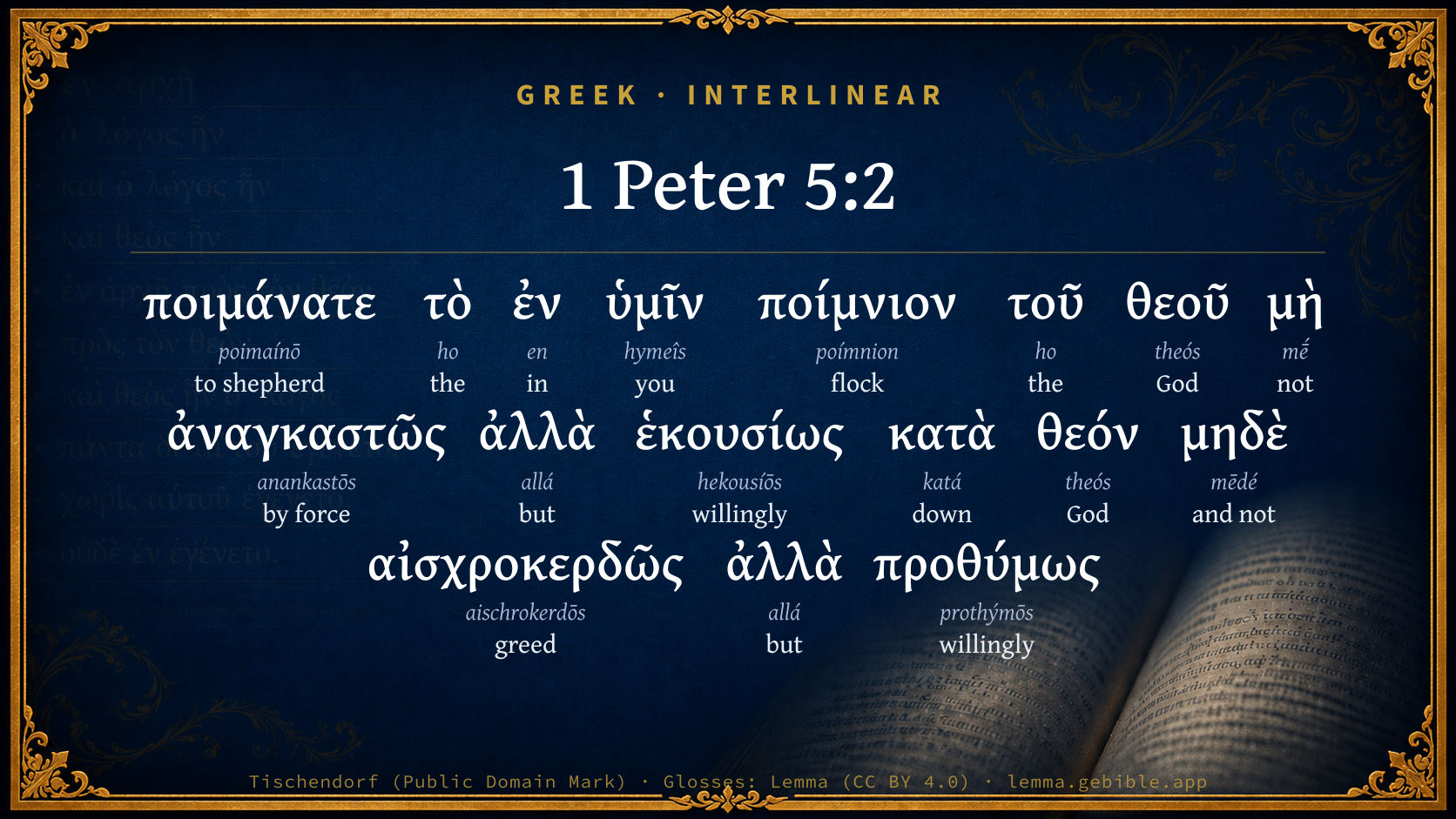
Greek (Tischendorf 8th ed.) 1 Peter 5:2 appears in the Greek New Testament. The text above is from the Tischendorf 8th edition. Each word links to its Strong’s number and a concise gloss. Click any word for its full Thayer’s Greek Lexicon entry.
Download image
Cite this verse

1 Peter 5:2 (World English Bible). Public Domain. Lemma interlinear Bible study tool, https://lemma.gebible.app/v/1-peter/5/2.

Show BibTeX & RIS
BibTeX
RIS
English Translation
Shepherd the flock of God which is among you, exercising the oversight, not under compulsion, but voluntarily, not for dishonest gain, but willingly;
World English Bible · Public Domain
Highlights
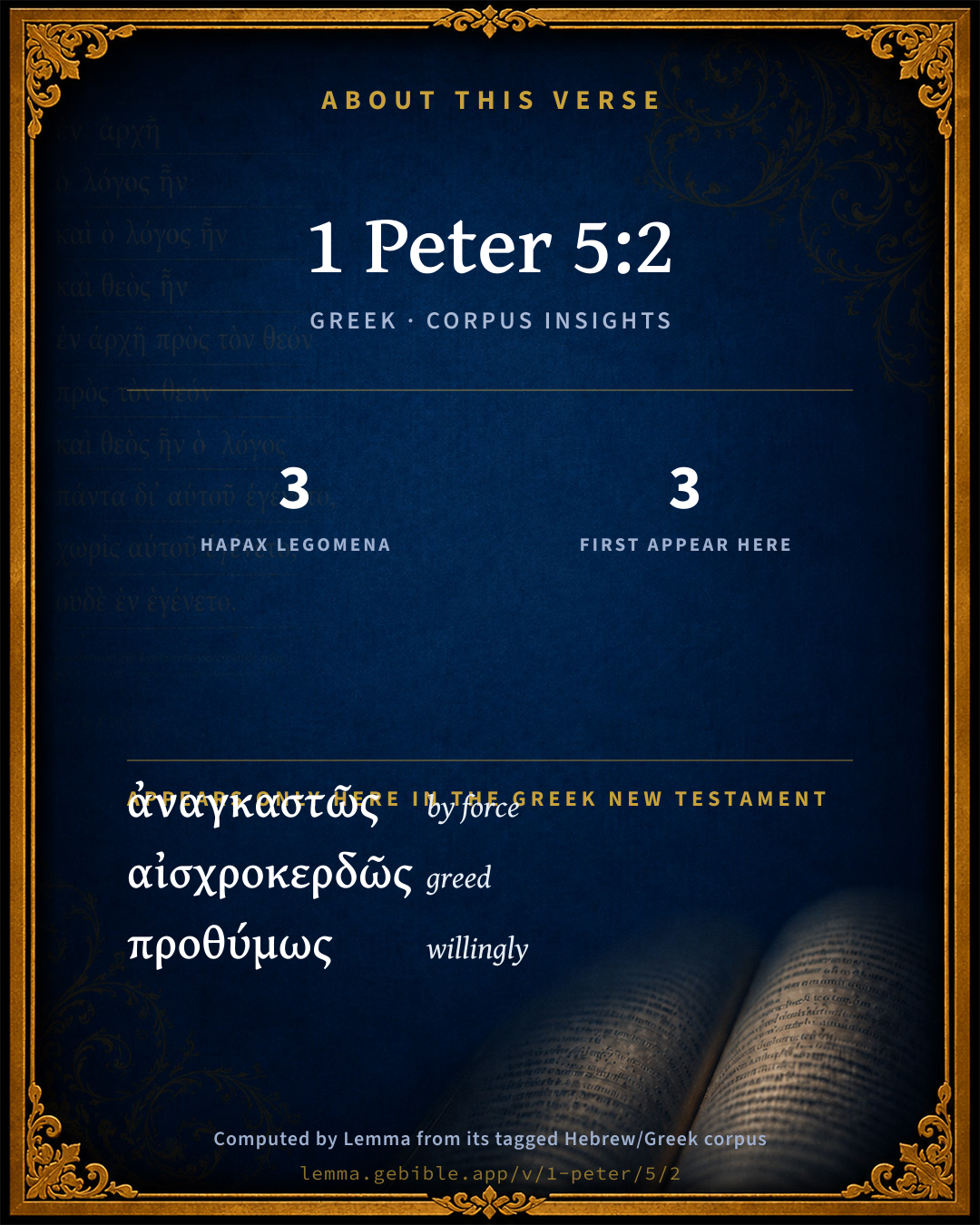
  • 3 hapax legomena — only here in the Greek New Testament
  • 3 first appearances in the Greek New Testament
Full analysis ↓
Download a study sheet

One document with this verse’s original text, its word-by-word gloss line, the meaning frame, cross-references with their text, attributed commentary, and full source and license credits — printable, and it pastes into notes with its structure intact.

This verse Autodidact and up

Study sheet (.html) Plain text (.txt)

A passage Seminary Student

Up to 50 verses in one chapter. A passage sheet keeps up to 6 commentary sources and 12 cross-references per verse, in the order this page ranks them, and says so on the sheet whenever that leaves anything out. Ask for a single verse and you get the Autodidact verse sheet above.

Everything on this page stays free to read, with no account — the sheet is a download of what is already on screen, not access to it.

Want to remove ads? Support Godless Engineer
Compare translations 3

The same verse in 3 English versions, stacked beneath the original-language interlinear above. Click any original word for its lexicon entry.

Each is an independent rendering of the whole verse — the interlinear is not word-aligned to these translations.

Highlighted words mark where these versions differ — a whole-verse word diff, not a word-by-word alignment.

  • World English Bible Public Domain
    Shepherd the flock of God which is among you, exercising the oversight, not under compulsion, but voluntarily, not for dishonest gain, but willingly;
  • King James Version Public Domain
    Feed the flock of God which is among you, taking the oversight thereof, not by constraint, but willingly; not for filthy lucre, but of a ready mind;
  • unfoldingWord Literal Text CC BY-SA 4.0
    Shepherd the flock of God among you, exercising oversight—not under compulsion, but willingly, according to God—and not greedily, but eagerly;

unfoldingWord Literal Text — © unfoldingWord, licensed CC BY-SA 4.0. Word-aligned USFM3 via Door43 (git.door43.org/unfoldingWord/en_ult).

Versions to compare (up to 4)

3 of 4 selected

Show all 19 translations

Every available English version of this verse, each an independent rendering of the whole verse.

  • World English Bible Public Domain
    Shepherd the flock of God which is among you, exercising the oversight, not under compulsion, but voluntarily, not for dishonest gain, but willingly;
  • Berean Standard Bible Public Domain
    Be shepherds of God’s flock that is among you, watching over them not out of compulsion, but because it is God’s will; not out of greed, but out of eagerness;
  • Majority Standard Bible Public Domain
    Be shepherds of God’s flock that is among you, watching over them not out of compulsion, but willingly; not out of greed, but out of eagerness;
  • King James Version Public Domain
    Feed the flock of God which is among you, taking the oversight thereof, not by constraint, but willingly; not for filthy lucre, but of a ready mind;
  • American Standard Version (1901) Public Domain
    Tend the flock of God which is among you, exercising the oversight, not of constraint, but willingly, according to `the will of' God; nor yet for filthy lucre, but of a ready mind;
  • Revised Version (1885) Public Domain
    Tend the flock of God which is among you, exercising the oversight, not of constraint, but willingly, according unto God; nor yet for filthy lucre, but of a ready mind;
  • Geneva Bible (1599) Public Domain
    Feede the flocke of God, which dependeth vpon you, caring for it not by constraint, but willingly: not for filthy lucre, but of a ready minde:
  • Douay-Rheims (1899) Public Domain
    Feed the flock of God which is among you, taking care of it, not by constraint, but willingly, according to God: not for filthy lucre's sake, but voluntarily:
  • Young's Literal Translation Public Domain
    feed the flock of God that `is' among you, overseeing not constrainedly, but willingly, neither for filthy lucre, but of a ready mind,
  • Literal Standard Version CC BY-SA 4.0
    feed the flock of God that [is] among you, overseeing not by compulsion, but willingly, neither for shameful gain, but eagerly,
  • Unlocked Literal Bible CC BY-SA 4.0
    Be shepherds of God's flock that is under your care, serving as overseers—not because you must, but because you are willing, as God would have you serve—not for shameful profit but eagerly.
  • unfoldingWord Literal Text CC BY-SA 4.0
    Shepherd the flock of God among you, exercising oversight—not under compulsion, but willingly, according to God—and not greedily, but eagerly;
  • Darby Bible Public Domain
    shepherd the flock of God which [is] among you, exercising oversight, not by necessity, but willingly; not for base gain, but readily;
  • World Messianic Bible Public Domain
    shepherd the flock of God which is among you, exercising the oversight, not under compulsion, but voluntarily; not for dishonest gain, but willingly;
  • Webster's Bible Public Domain
    Feed the flock of God which is among you, taking the oversight of it, not by constraint, but willingly; not for filthy lucre, but from a ready mind;
  • Free Bible Version CC BY-SA 4.0
    Look after God's flock you have been given to care for, watching over it not because you're forced to, but gladly, as God wants you to. Do this willingly, not looking to make a profit from it.
  • Bible in Basic English Public Domain
    Keep watch over the flock of God which is in your care, using your authority, not as forced to do so, but gladly; and not for unclean profit but with a ready mind;
  • Text-Critical English NT CC BY 4.0
    Shepherd the flock of God that is among you, exercising oversight, not under compulsion, but willingly; not for sordid gain, but eagerly.
  • Tyndale New Testament (1534) Public Domain
    se that ye fede Christes flocke which is amonge you takynge the oversyght of them

Literal Standard Version (2020), Covenant Press — licensed CC BY-SA 4.0. Text via the HelloAO Bible API (eBible.org). Unlocked Literal Bible (unfoldingWord) — licensed CC BY-SA 4.0. Text via the HelloAO Bible API (eBible.org). unfoldingWord Literal Text — © unfoldingWord, licensed CC BY-SA 4.0. Word-aligned USFM3 via Door43 (git.door43.org/unfoldingWord/en_ult). Free Bible Version, Dr. Jonathan Gallagher — licensed CC BY-SA 4.0. Text via the HelloAO Bible API (eBible.org).

Word by word

More ways to search: Search by grammar → Find every occurrence → Compare this word →

Practice this passage: Drill this verse → Learn its vocabulary →

About this verse

These counts appear in no published source. They are computed here, from the morphology-tagged text and Lemma’s own curated glosses. What Lemma adds →

17
words
14
distinct lemmas
General Epistles
section

Notable vocabulary

3 hapax legomena — words that appear only here in the entire Greek New Testament:

  • ἀναγκαστῶς by force G317
  • αἰσχροκερδῶς greed G147
  • προθύμως willingly G4290

First appearance in Scripture

These words make their first canonical appearance in the Greek New Testament here:

  • ἀναγκαστῶς by force G317
  • αἰσχροκερδῶς greed G147
  • προθύμως willingly G4290

Shared distinctive vocabulary

ἑκουσίως willingly G1596 occurs in 2 verses of the Greek New Testament. Also found in:
Repetition

Words recur within this verse:

Cross-references

37

Topical passages linked to 1 Peter 5:2 in the Treasury of Scripture Knowledge — connected by theme and wording, ordered by reader-vote popularity; previews shown in the World English Bible.

  • Titus 1:7 For the overseer must be blameless, as God's steward; not self-pleasing, not easily angered, not given to wine, not violent, not greedy for dishonest gain;
  • 1 Timothy 3:8 Deacons, in the same way, must be reverent, not double-tongued, not addicted to much wine, not greedy for money;
  • Acts 20:26–28 Therefore I testify to you this day that I am clean from the blood of all men,
  • Titus 3:1 Remind them to be in subjection to rulers and to authorities, to be obedient, to be ready for every good work,
  • 1 Timothy 3:3 not a drinker, not violent, not greedy for money, but gentle, not quarrelsome, not covetous;
  • Ezekiel 34:2–3 Son of man, prophesy against the shepherds of Israel, prophesy, and tell them, even to the shepherds, Thus says the Lord Yahweh: Woe to the shepherds of Israel who feed themselves! Shouldn't the shepherds feed the sheep?
  • 1 Corinthians 9:7 What soldier ever serves at his own expense? Who plants a vineyard, and doesn't eat of its fruit? Or who feeds a flock, and doesn't drink from the flock's milk?
  • Ezekiel 34:23 I will set up one shepherd over them, and he shall feed them, even my servant David; he shall feed them, and he shall be their shepherd.
  • Ezekiel 34:31 You my sheep, the sheep of my pasture, are men, and I am your God, says the Lord Yahweh.
  • Micah 3:11 Her leaders judge for bribes, And her priests teach for a price, And her prophets of it tell forturnes for money: Yet they lean on Yahweh, and say, Isn't Yahweh in the midst of us? No disaster will come on us.
  • Micah 5:4 He shall stand, and shall shepherd in the strength of Yahweh, In the majesty of the name of Yahweh his God: And they will live, for then he will be great to the ends of the earth.
  • Micah 7:14 Shepherd your people with your staff, The flock of your heritage, Who dwell by themselves in a forest, In the midst of fertile pasture land, let them feed; In Bashan and Gilead, as in the days of old.
  • Zechariah 11:17 Woe to the worthless shepherd who leaves the flock! The sword will be on his arm, and on his right eye. His arm will be completely withered, and his right eye will be totally blinded!"
  • Malachi 1:10 "Oh that there were one among you who would shut the doors, that you might not kindle fire on my altar in vain! I have no pleasure in you," says Yahweh of hosts, "neither will I accept an offering at your hand.
  • Luke 12:32 Don't be afraid, little flock, for it is your Father's good pleasure to give you the Kingdom.
  • John 21:15–17 So when they had eaten their breakfast, Jesus said to Simon Peter, "Simon, son of Jonah, do you love me more than these?" He said to him, "Yes, Lord; you know that I have affection for you." He said to him, "Feed my lambs."
  • 1 Corinthians 9:16–17 For if I preach the Gospel, I have nothing to boast about; for necessity is laid on me; but woe is to me, if I don't preach the Gospel.
  • 2 Corinthians 12:14–15 Behold, this is the third time I am ready to come to you, and I will not be a burden to you; for I seek not your possessions, but you. For the children ought not to save up for the parents, but the parents for the children.
  • Titus 1:11 whose mouths must be stopped; men who overthrow whole houses, teaching things which they ought not, for dishonest gain's sake.
  • Hebrews 12:15 looking carefully lest there be any man who falls short of the grace of God; lest any root of bitterness springing up trouble you, and thereby the many be defiled;
  • 2 Peter 2:3 In covetousness they will exploit you with deceptive words: whose sentence now from of old doesn't linger, and their destruction will not slumber.
  • Psalms 78:71–72 From following the ewes that have their young, He brought him to be the shepherd of Jacob, his people, And Israel, his inheritance.
  • Song of Solomon 1:8 If you don't know, most beautiful among women, Follow the tracks of the sheep. Graze your young goats beside the shepherds' tents.
  • Isaiah 6:8 I heard the Lord's voice, saying, "Whom shall I send, and who will go for us?" Then I said, "Here I am. Send me!"
  • Isaiah 40:11 He will feed his flock like a shepherd, he will gather the lambs in his arm, and carry them in his bosom, [and] will gently lead those who have their young.
  • Isaiah 56:11 Yes, the dogs are greedy, they can never have enough; and these are shepherds who can't understand: they have all turned to their own way, each one to his gain, from every quarter.
  • Isaiah 63:11 Then he remembered the days of old, Moses [and] his people, [saying], Where is he who brought them up out of the sea with the shepherds of his flock? where is he who put his holy Spirit in the midst of them?
  • Jeremiah 6:13 For from the least of them even to the greatest of them everyone is given to covetousness; and from the prophet even to the priest everyone deals falsely.
  • Jeremiah 13:17 But if you will not hear it, my soul shall weep in secret for [your] pride; and my eye shall weep sore, and run down with tears, because Yahweh's flock is taken captive.
  • Revelation 18:12–13 merchandise of gold, silver, precious stones, pearls, fine linen, purple, silk, scarlet, all expensive wood, every vessel of ivory, every vessel made of most precious wood, and of brass, and iron, and marble;
  • Jeremiah 8:10 Therefore will I give their wives to others, and their fields to those who shall possess them: for everyone from the least even to the greatest is given to covetousness; from the prophet even to the priest every one deals falsely.
  • Jeremiah 13:20 Lift up your eyes, and see those who come from the north: where is the flock that was given you, your beautiful flock?
  • Acts 20:33–34 I coveted no one's silver, or gold, or clothing.
  • Acts 21:13 Then Paul answered, "What are you doing, weeping and breaking my heart? For I am ready not only to be bound, but also to die at Jerusalem for the name of the Lord Jesus."
  • Romans 1:15 So, as much as is in me, I am eager to preach the Gospel to you also who are in Rome.
  • Titus 2:14 who gave himself for us, that he might redeem us from all iniquity, and purify for himself a people for his own possession, zealous for good works.
  • Philemon 1:14 But I was willing to do nothing without your consent, that your goodness would not be as of necessity, but of free will.

Cross-references courtesy of OpenBible.info (CC BY 4.0).

Where the printed editions differ

1 variant

Places in this verse where the major printed Greek editions disagree on the wording in a way that affects the translation — a comparison of editions, not a manuscript-by-manuscript collation. The editions are the modern critical texts (Nestlé-Aland 28/27, SBL, Westcott-Hort, Tregelles, Tyndale House) and the traditional texts behind the KJV (the Textus Receptus and the Byzantine/Majority text). It is not a claim about which reading is original.

  1. Extra text
    κατὰ θεόν,

    “according to God,”

    In NA28NA27TynSBLTreg Not in WHTRByz

    κατὰ θεόν, (kata theon) 'according to God,' is only in older manuscripts (NA28+NA27+Tyn+SBL+Treg)

Textual data: Translators Amalgamated Greek New Testament (STEPBible TAGNT) · CC BY 4.0.

Commentary

Notes on 1 Peter 5:2 from classic Christian and Jewish commentators (each source and its license shown beneath its notes). The classic Christian expositions comment on the surrounding passage and are grouped to its opening verse, so a note may address several verses; the Jewish commentaries on the Tanakh (Rashi and others) are per-verse, so they appear only where the commentator wrote on this verse.

Lemma curates 59 commentaries, every one of them public domain or Creative Commons licensed, each selected and text-cleaned for this edition rather than reprinted as found. About our sources →

Joseph Benson's Commentary

1Pe 5:2. Feed the flock of God — Both by doctrine and discipline; which is among you — Namely, the churches of Christ, which you are called to preside over; taking the oversight thereof — Greek, επισκοπουντες, discharging the episcopal office. By this it appears that those who are styled bishops, from their having the oversight of others, and also presbyters, or elders, are spoken of as the same persons. Not by constraint — Unwillingly, as if it were a burden; but willingly — “In the first age, when the profession of the gospel exposed men to persecution, and when the persecutions fell more especially on the bishops, it may easily be imagined that some who were appointed to that office would undertake it unwillingly; not only because they were not disposed to do the duties thereof diligently, but because they were not willing to suffer.” Not for filthy lucre — Which, if it be the motive of acting, is filthy beyond expression. The apostle means also, not for a maintenance; for the sake of which merely, or chiefly, no one should undertake the pastoral office. They that preach the gospel may live by the gospel, but no one ought to engage in such a work merely that he may live by it. “O consider this, ye that leave one flock and go to another, merely ‘because there is more gain, a larger salary!’ Is it not astonishing that men ‘can see no harm in this?’ That it is not only practised, but avowed, all over the nation?” — Wesley. But of a ready mind — With a sincere desire to glorify God, and to save the souls of men. In the Syriac version, the word προθυμως, here used, is translated toto corde, with the whole heart. Dr. Benson’s observation on this verse is, “How severely are they here condemned, who feed themselves and not the flock; who take the patrimony of the church, and commit the care of souls to others, to whom they allow a very small share of that plenty which they have for doing little.”

Joseph Benson's Commentary on the Old and New Testaments (1811–1818) — public domain. Text from a community e-Sword module.

Tyndale Open Study Notes

Tyndale Open Resources

5:2 Care for the flock (literally Shepherd the flock): Our word pastor comes from New Testament imagery of a shepherd pasturing his flock.

Tyndale Open Study Notes — © Tyndale Open Resources, licensed CC BY-SA 4.0. Text via the HelloAO Bible API.

Bengel's Gnomon

Johann Albrecht Bengel

1Pe 5:2. Ποιμάνατε, feed) by discipline and doctrine.—τὸ ἐν ὑμῖν) entrusted to you for your part.—μὴ ἀναγκαστῶς, not by constraint) Necessity is laid upon them, 1Co 9:16, but willingness prevents it from being felt. This is efficacious both in undertaking and in discharging the office. Those pastors are not undeserving of censure, who, if it were in their power, would prefer to be anything else.—[ἀλλʼ—ἀλλὰ, but—but) The motive and scope ought to be free from fault.—V. g.]—μηδὲ αἰσχροκερδῶς, nor for the sake of dishonourable gain) The receiving of pay is not forbidden, 1Co 9:14; but there ought to be the absence of all that is dishonourable, and the presence of a noble promptness.—προθύμως, willingly) So that the enjoyment consists in feeding the flock, and not in the pay.

Bengel's Gnomon of the New Testament — English translation (T&T Clark, Edinburgh, 1860) — public domain. Text from a community e-Sword module.

Meyer's Critical & Exegetical Commentary

Heinrich August Wilhelm Meyer

1Pe_5:2. ποιμάνατε τὸ ἐν ὑμῖν ποίμνιον τοῦ Θεοῦ] The work of directing the church is often in the N. and O. T. represented by the figure of pasturing (cf. Act_20:28; Joh_21:16; Jer_23:1-4; Eze_34:2 ff.), and the church by that of a flock (Luk_12:32). τοῦ Θεοῦ is added here very significantly. By it the flock is designated as belonging, not to the elders who tend it, but to God as His peculiar property. Luther takes a too narrow view of the idea of tending,he limits it to the preaching of the gospel. It applies rather to all and everything that is done by the elders, for the welfare of the individual as well as for that of the entire congregation. τὸ ἐν ὑμῖν must not be separated from ποίμνιον, as if it were equal to quantum in vobis est (cf. Rom_1:15), i. e. intendite omnes nervos (Calvin); it rather forms one idea with ποίμνιον. The greater number of commentators understand ἐν in a local sense, either: in vestris regionibus (Pott), or: with you, within your reach (Luther, in the commentary, Hensler, de Wette, Besser, Schott,[266] etc.). Since ἐν ὑμῖν, as a more precise local definition, stands somewhat significantly, and the churches only are the place where the elders are, and not vice versa (Hofmann), ἐν ὑμῖν must, according to the analogy of κεῖσθαι ἔν τινι, be interpreted: that which is committed to you (Luthers translation, Bengel, Steiger), or: that which is placed under your care (hand). ἐν ὑμῖν then serves to give point to the exhortation.

ἐπισκοποῦντες, cf. the critical notes. It must be observed that ἐπισκοπ. is here placed in conjunction with ποιμάνατε, as in chap. 1Pe_2:25 : ποιμήν and ἐπίσκοπος. This participle, with the adverbs belonging to it, states what should be the character of the ποιμαίνειν.[267] The verb (which, except here, occurs only in Heb_12:15), equivalent to: to give heed, denotes the labours of the elders in caring for the congregation, but with the implied meaning of oversight. The still closer definition follows in three adjuncts, each of which consists of a negative and a positive member. The thought is aptly given by Calvin: Dum Pastores ad officium hortari vult, tria potissimum vitia notat, quae plurimum obesse solent, pigritiam scilicet, lucri captandi cupiditatem et licentiam dominandi; primo vitio opponit alacritatem aut voluntarium studium, secundo liberalem affectum, tertio moderationem ac modestiam.

ἀναγκαστῶς (an expression foreign to Greek usage, and occurring only here, which Hofmann erroneously denies) and ἙΚΟΥΣΊΩς (this adverb occurs in the N. T., besides in this passage, only in Heb_10:26; the adjective in Phm_1:14) are opposed to each other, in such a way that the former characterizes the work as undertaken from outward motives only, the latter as from inward. The same antithesis occurs in Phm_1:14 : ΚΑΤᾺ ἈΝΆΓΚΗΝ … ΚΑΤᾺ ἙΚΟΎΣΙΟΝ (similarly the antithesis of ἌΚΩΝ and ἙΚΏΝ, 1Co_9:17); with ἙΚΟΥΣΊΩς, cf. Exo_36:2. The position, etc., must be regarded as the outwardly inciting or compelling motive. Bengel is incorrect: id valet et in suscipiendo et in gerendo munere; to the former there is in this case no allusion.

According to the Rec., ἑκουσίως is yet further strengthened by ΚΑΤᾺ ΘΕΌΝ (cf. chap. 1Pe_4:6; 2Co_7:9-10), equal to ΚΑΤᾺ ΤῸ ΘΈΛΗΜΑ ΤΟῦ ΘΕΟῦ.

ΑἸΣΧΡΟΚΕΡΔῶς (the adverb occurs here only, the adjective 1Ti_3:8; Tit_1:7; Tit_1:11 : ΑἸΣΧΡΟῦ ΚΈΡΔΟΥς ΧΆΡΙΝ); the apostle places the impure motive side by side with the unwillingness of ἈΝΑΓΚ. (Wiesinger).

ΠΡΟΘΎΜΩς (in the N. T. the adverb occurs here only; more frequently the adjective and substantive) as antithesis to ΑἸΣΧΡΟΚΕΡΔῶς: out of love to the thing itself; Luther: from the bottom of the heart.[268]

[266] Schotts opinion, that in ἐν ὑμῖν this antithesis to τοῦ Θεοῦ is expressed, that the church, belonging to heaven, is yet at present in the bodily and visible vicinity of the elders, and surrounded by them, must be rejected as purely arbitrary.Gerhards interpretation: qui vobiscum est, videlicet cum quo unum corpus, una ecclesia estis, brings out an idea which is in no way indicated by the apostle.

[267] It is doubtless correct that the adverbs do not simply define more nearly the term ἐπισκοποῦντες, in and for itself considered; but it is wrong to make them co-ordinate with this idea (as against Hofmann); closely joined with ἐπισκοποῦντες, they, with this participle, are connected with ποιμάνετε.

[268] Hofmann: With a joyous devotionwhich excludes all secondary considerationsto the work which has to be done.

Meyer — Critical and Exegetical Commentary on the New Testament — English translation by Peter Christie, edited by Frederick Crombie (T&T Clark, 1880) — public domain. Text from a community e-Sword module.

Expositor's Greek Testament

ed. W. Robertson Nicoll

1Pe 5:2 . The command laid upon St. Peter, shepherd my sheep (Joh 21:19 ) became the charge delivered to succeeding elders ( v. Act 20:28 ) and a familiar description of the Christian pastor ( e.g. , 1Co 9:7 ) who must copy the good Shepherd who obeyed where His predecessors fell short (Eze 34 ). τὸ ἐν ὑμῖν ποίνιον τοῦ θεοῦ . Christendom is God’s flock among you not yours but God’s. ἀναγκαστῶς . As a matter of constraint contrasted with ἑκουσίως , willingly not as pressed men but as volunteers. In times of persecution lukewarm elders might well regret their prominence; hence the need for the aphorism if any aspire to oversight he desireth a noble work (1Ti 3:1 ). So of gifts of money St. Paul requires that they be μὴ ἐξ ἀνάγκης (2Co 9:7 ). It is possible that St. Paul’s words, ἀνάγκη μοι ἐπικεῖται (1Co 9:16 ) had been wrested. αἰσχροκερδῶς . If the work be voluntarily undertaken, the worker has a reward according to St. Paul (1Co 9:16 f.). Base gainers are those who wish to make gain whence they ought not (Aristotle, Nic. Eth. , ver 1, 43). προθύμως . The adverb occurs in 2Ch 29:34 , LXX, where the Levites eagerly purified themselves; Heb. the Levites upright of heart to … The verb προθυμεῖν is used in Chron. to render נדב offer freewill offerings .

1Pe 5:3 . Application of the saying, the reputed rulers of the nations lord it ( κατακυριεύουσιν ) over them … not so among you; but whosoever would be great among you he shall be your servant … for the Son of Man came … to serve (Mar 10:42 f.). τῶν κλήρων , the lots, i.e. , the portions of the new Israel who fall to your care as Israel fell to that of Jehovah (Deu 9:29 , οὗτοι λαός σου καὶ κλῆρός σου ). The meaning is determined by the corresponding τοῦ ποιμνίου . and supported by the use of προσεκληρώθησαν were made an additional portion in Act 17:4 . So it is said of God’s servant that He κληρονομήσει πολλούς . (Isa 13:12 ). The Vulgate has dominantes in cleris , and Oecumenius following the usage of his time explains the phrase likewise as equivalent to τὸ ἱερὸν σύστημα , i.e. , the inferior clergy. τύποι γεινόμενοι , i.e. , as servants according to Mark l.c.; cf. 1Th 1:7 ; 1Ti 4:12 .

The Expositor's Greek Testament, edited by W. Robertson Nicoll (1897–1910) — public domain. Text from a community e-Sword module.

Geneva Bible (1599)

Geneva Bible translators

He saith not, Offer for the quick and dead, and sing patched shreds in a strange tongue, but (Feed.)

The second: Let the shepherd consider, that the flock is not his, but God’s.

The third: Let not the shepherds invade other men’s flocks, but let them feed that which God hath committed unto them.

Let the shepherds govern the Church with the word and example of godly and unblamable life, not by constraint but willingly, not for filthy lucre, but of a ready mind, not as Lords over God’s portion and heritage, but as his ministers.

The first rule: He that is a shepherd, let him feed the flock.

Geneva Bible (1599) marginal notes — public domain. Text via Bolls.life.

Jamieson, Fausset & Brown

Robert Jamieson, A. R. Fausset & David Brown

Feed--Greek, "Tend as a shepherd," by discipline and doctrine. Lead, feed, heed: by prayer, exhortation, government, and example. The dignity is marked by the term "elder"; the duties of the office, to tend or oversee, by "bishop." Peter has in mind Christ's injunction to him, "Feed (tend) My sheep . . . Feed (pasture) My lambs" (Joh 21:16). He invites the elders to share with him the same duty (compare Act 20:28). The flock is Christ's.

which is among you--While having a concern for all the Church, your special duty is to feed that portion of it "which is among you."

oversight--Greek, "bishopric," or duty of bishops, that is, overseer.

not by constraint--Necessity is laid upon them, but willingness prevents it being felt, both in undertaking and in fulfilling the duty [BENGEL]. "He is a true presbyter and minister of the counsel of God who doeth and teacheth the things of the Lord, being not accounted righteous merely because he is a presbyter, but because righteous, chosen into the presbytery" [CLEMENT OF ALEXANDRIA].

willingly--One oldest manuscript, Vulgate, Syriac, and Coptic, add, "as God would have it to be done" (Rom 8:27).

not for filthy lucre-- (Isa 56:11; Tit 1:7).

of a ready mind--promptly and heartily, without selfish motive of gain-seeking, as the Israelites gave their services willing-heartedly to the sanctuary.

Jamieson, Fausset & Brown — Commentary Critical and Explanatory on the Whole Bible (1871) — public domain (CC PDM 1.0). Text via the HelloAO Bible API.

Adam Clarke's Commentary

Verse 2. Feed the flock] Do not fleece the flock.

Taking the oversight] επισκοπουντες. Discharging the office of bishops or superintendents. This is another proof that bishop and presbyter were the same order in the apostolic times, though afterwards they were made distinct.

Not by constraint] The office was laborious and dangerous, especially in these times of persecution; it is no wonder then that even those who were best qualified for the office should strive to excuse themselves with a genuine Nolo episcopari, "I am unwilling to be a bishop."

Not for filthy lucre] Could the office of a bishop, in those early days, and in the time of persecution, be a lucrative office? Does not the Spirit of God lead the apostle to speak these things rather for posterity than for that time? 1Tim 3:3.

But of a ready mind] Doing all for Christ's sake, and through love to immortal souls.

Adam Clarke's Commentary on the Bible (1810–1826) — public domain. Text from a community e-Sword/MySword module.

John Calvin's Commentaries

2 Feed the flock of God We hence learn what the word presbyter imports, even that it includes the office of feeding. It is for a far different end that the Pope makes presbyters, even that they may daily slay Christ, there being no mention made of feeding in their ordination. Let us then remember to distinguish between the institution of Christ and the confusion of the Pope, it being as different as light is from darkness. Let us also bear in mind the definition given of the word; for the flock of Christ cannot be fed except with pure doctrine, which is alone our spiritual food.

Hence pastors are not mute hypocrites, nor those who spread their own figments, which, like deadly poison, destroy the souls of men.

The words, as much as it is in you, mean the same as though he had said, “Apply all your strength to this very thing, and whatever power God has conferred on you.” The old interpreter has given this rendering, “Which is among you;” and this may be the sense of the words: more correct, however, is the rendering of Erasmus, which I have followed, though I do not reject nor disapprove of the other.

The flock of God, or, of the Lord, or, of Christ: it matters little which you take, for the three readings are found in different copies.

Taking the oversight, or, discharging the office of a bishop. Erasmus renders the words, “Taking care of it,” (curam illius agentes;) but as the Greek word is ἐπισκοποῦντες I doubt not but that Peter meant to set forth the office and title of the episcopate. We may learn also from other parts of Scripture that these two names, bishop and presbyter, are synonymous. He then shews how they were rightly to perform the pastoral office, though the word ἐπισκοπεῖν generally means to preside or to oversee. What I have rendered “not constraintally,” is literally, “not necessarily;” for when we act according to what necessity prescribes, we proceed in our work slowly and frigidly, as it were by constraint.

John Calvin's Commentaries (1540-1563) — public domain. Text from the Calvin Translation Society English edition (1840s-50s) via the Christian Classics Ethereal Library (ccel.org). Calvin's coverage is partial (roughly two-thirds of the Bible); uncommented books and verses are honest gaps, never fabricated. The 19th-century editor's footnotes and remarks are omitted so the notes are faithfully Calvin's own voice.

Ellicott's Commentary for English Readers

(2) Feed the flock of God which is among you.—By the word “feed” here is meant, not merely the giving of pasture, but the whole government. It is the verb used in Joh_21:16, not that in the 15th and 17th verses. There can be hardly any doubt that St. Peter was thinking of that scene when he issued these directions. Our Lord had committed into his hands all His sheep and lambs, without restriction of age or country, to be fed and shepherded; and now the time was approaching when he would have to “put off this tabernacle” (2Pe_1:14), and he here takes order that “after his decease” the charge committed to him. may be fulfilled. He still shepherds the flock by proxy. Two other points must be mentioned, which bring this passage into connection with the charge given by St. Paul to the Ephesian elders (Act_20:28), which was very probably known to St. Peter. (1) St. Peter calls it “the flock of God.” Textual critics are much divided on the reading in Act_20:28, but, on the whole, the Received reading seems the best supported: “the Church of God which He hath purchased with His own blood.” At the same time, St. Peter is in remembrance how Christ had said, “Feed My sheep.” It may be fairly thought, therefore, when we see St. Peter’s own theology in 1Pe_1:25; 1Pe_2:3; 1Pe_3:15, that when he writes, “Feed the flock of God,” his thoughts turn to the Second Person of the Holy Trinity rather than to the First. (2) Hooker well points out, on Act_20:28, the unity of the flock. Though there were many elders in Ephesus, there was but one flock they fed between them. So now, all over Asia Minor, it was but one flock. St. Peter, to whom the flock throughout the whole world was committed, saw it as a whole, but the elders to whom he writes had only to look to that part of the one flock which was “among them.” The marginal rendering is against the order of the Greek words, and does not suit the context so well when the context is rightly understood.

Taking the oversight thereof.—It is exceedingly doubtful whether these words form part of the original text or not. If they do, the translation unduly limits the meaning, which would be better expressed by “maintaining (or, exercising) the oversight,” or “performing the duties of bishops,” for he is addressing men who were already ordained. By this time the word “bishop” had not become a fixed title of one special office, though the office itself was in existence.

Not by constraint, but willingly.—Why should this exhortation be given so prominently? It is hardly to be thought that St. Peter had in view the humility which led men to adopt such strange methods of avoiding the responsibility of the priesthood as we find resorted to by Chrysostom and Ambrose. Much more probably he is thinking of the actual danger to life and property of being “ringleaders of the sect” (Act_24:5), which would lead cowardly bishops to throw up their office. He is not treating of the motives which should lead a man to accept the position. He speaks to persons who already hold the office, and urges them not to leave the flock, like hirelings, when they see the persecution coming on. Several of the best authorities add,” but willingly, according to God.” It was God, that is, who put them in that station, and they must not need the compulsion of their laity, or of the rest of the episcopate, or of the Apostles, to keep them at their post.

Not for filthy lucre, but of a ready mind.—The opposite vice to that on which he has just passed sentence. Some, who had no fears, might be tempted to retain the office by the good salary which the Church gave, or might threaten to resign if their salaries were not raised in proportion to their risk. The “ready mind,” of which the Apostle speaks, means the love of the work itself, which should be the sole motive in seeking, or performing, the gospel ministry.

A Bible Commentary for English Readers, edited by Charles John Ellicott (1878–1897) — public domain. Text from a community e-Sword module.

The Cambridge Bible for Schools and Colleges

gen. ed. J. J. S. Perowne

2. feed the flock of God] The word for “feed,” here as elsewhere, implies the whole work of the shepherd—guiding, directing, protecting, as well as supplying food (comp. Luk_17:7; Joh_21:16; Act_20:28; 1Co_9:7). The shepherd’s work had been from a very early period a parable of that of rulers and of teachers. Kings were to Homer the “shepherds of the people” (ποίμενες λαῶν). David was taken from the sheepfold to feed Israel as the flock of Jehovah (Psa_78:70-71). The sin of the kings and rulers of Judah had been that they did not feed the flock, but scattered and destroyed it (Jer_23:1-4; Eze_34:2-31). In St Peter’s use of the word we note a reproduction of the words that had fallen on his ears with a three-fold, yet varied, iteration, “Feed my sheep” (Joh_21:16). The comprehensiveness of the word must not be lost sight of. It includes more than preaching or teaching, and takes in the varied duties of what we rightly call the pastoral office. In the words “the flock of God” men are tacitly reminded who is the Chief Shepherd whom they serve, and to whom they will have to render an account (comp. Act_20:28). It may be noted as a characteristic difference that in the Old Testament the shepherds of the people are always the civil rulers of the nation (e.g. Psa_78:71; Eze_34:2), while in the New that thought falls into the background, and the shepherd of the flock is its spiritual guide and teacher.

taking the oversight thereof] The first three words are the English equivalent of the Greek participle of the verb formed from Episcopos, the “bishop,” or “overseer” of the Church. In its being thus used to describe the office of the elders of the Church we have a close parallel to St Paul’s addressing the “elders” of the Church as being also “overseers” (Act_20:28). The two terms were in fact interchangeable, and what is now the higher office of the Bishop in relation to the Presbyters was discharged by the Apostle or his personal representative.

not by constraint, but willingly] The words that follow indicate the three great conditions of true pastoral work. (1) It must not be entered on reluctantly and as under pressure. In one sense indeed the truest and best work may be done by one who feels, as St Paul felt, that a “necessity is laid” upon him (1Co_9:16), but there the necessity was that of a motive essentially spiritual. What St Peter deprecates is the drawing back from the labour and responsibility of the care of souls. The Nolo episcopari, which has been so often the formula of the pride or the sloth that apes humility, would have been in his eyes the sign of cowardice and weakness. Here, as in other things, the true temper is that of cheerful and willing service. The history of the Church presents, it is true, not a few instances, among which Chrysostom and Ambrose are preeminent, of the pastoral and episcopal office being forced upon a reluctant acceptance, but in such cases the reluctance left no trace in the after life. The work once entered on was done “willingly,” not as a forced and constrained service. It may be noted that the memorable treatise of Chrysostom, On the Priesthood, is in its form an apologia for his unwillingness to enter on the priestly office on the ground of its infinite dangers and responsibilities. Some of the better MSS. add the words “according to God,” to “willingly,” the phrase having the same meaning (“according to the will of God,”) as in chap. 1Pe_4:6, 2Co_7:9-10.

not for filthy lucre] The adverb is not found elsewhere in the New Testament. The corresponding adjective meets us in 1Ti_3:3; 1Ti_3:8, Tit_1:7. The words are interesting as shewing that even in the troubled times in which St Peter wrote there was enough wealth in the Church to make the position of a Bishop-presbyter a lucrative one. There was the double stipend for those who were both pastors and preachers (1Ti_5:17). There was, for baser natures, the temptation of using spiritual influence for secular ends, “devouring widows’ houses,” as the Pharisees did in Judæa (Mat_23:14), “leading captive silly women,” as did the false teachers at Ephesus (2Ti_3:6) and Crete (Tit_1:11). It may be noted that the term which both the Apostles use of the man who enters on the work of the ministry of souls from such a motive, is one which Greek writers commonly use of one who seeks gain in base and sordid ways. In their eyes the calling of a presbyter might be made, so followed, as disreputable an occupation as that of the usurer, or the pander, or the slave-dealer. In contrast with this temper, eagerly catching at emoluments, the Apostle points to the cheerful readiness that seeks eagerly for work.

The Cambridge Bible for Schools and Colleges (gen. ed. J. J. S. Perowne; Cambridge University Press, 1878–1918) — public domain. Text from a community e-Sword module.

John Gill's Exposition

Feed the flock of God which is among you,.... Some read, "as much as in you is"; that is, to the utmost of your power, according to your abilities, referring to the manner of feeding the flock, doing it in the best way they are capable of; but the phrase is rather descriptive of the flock to be fed, which points it out, and distinguishes it from all others, and for which they should have a particular regard; it being the flock, as the Syriac version renders it, which "is delivered unto you"; which was committed to their care, and they were made overseers of, and stood in a special relation to; wherefore it was incumbent on them to regard them, so as they did not, and were not obliged to regard, any other distinct flock: by "the flock of God"; or, "of Christ", as some copies read, is meant, not the whole world, which Philo the Jew (r) calls the greatest and most perfect, , "flock of the true God"; but the church of God, over which they were elders or pastors, consisting of Christ's sheep and lambs, he ordered Peter to feed, as he now does his fellow elders; and because they are the flock of God, which he has chosen, distinguished, and separated from the rest of the world, and has made the care and charge of Christ; put them into his hands, whence they are called the sheep of his hand; which he has purchased with his blood, and effectually called by his grace, and returned them to himself, the Shepherd and Bishop of souls, who before were as sheep going astray, and folded them together in a Gospel church state; all this is a reason, and a strong one, why they should be fed; not with every wind of doctrine, which blows up the pride of human nature, and swells men with vain conceits of themselves; nor with the chaff of human doctrines; nor with trifling and speculative notions; but with knowledge and understanding of divine and evangelical truths, with the words of faith and sound doctrine, with the wholesome words of our Lord Jesus Christ; with the Gospel of the grace of God, which contains milk for babes, and meat for strong men; and with a crucified Christ himself, who is the bread of life, and whose flesh is meat indeed, and his blood drink indeed; by directing them to his person, blood, and righteousness, to live by faith on; by preaching the doctrines of peace and pardon by his blood, atonement and satisfaction by his sacrifice, and justification by his righteousness, and complete salvation by his obedience and death: in short, feeding includes the whole of the pastor's work, the ministry of the word, the administration of ordinances, and the rule and government of the church, in the several branches of it; for the same word signifies to rule as to feed; and which work is further expressed by

taking the oversight thereof; that is, of the flock; or "take the care of it", as the Syriac version renders it, and adds, "spiritually"; in a spiritual manner; which is an interpretation of the phrase: an acting the part of a bishop or overseer of it, as the word signifies; looking diligently to it, inspecting into the various cases of the members of the church; using diligence to know the state of the flock, and performing all the offices of a careful shepherd; as feeding the flock; and not themselves; strengthening the diseased; healing the sick; binding up that which was broken; bringing again that which was driven away, and seeking that which was lost; watching over them that they go not astray; and restoring of them in the spirit of meekness, when they are gone out of the way; and overlooking both their practices and their principles; admonishing, reproving them for sin, as the case requires; and preserving them, as much as in them lies, from wolves, and beasts of prey; from false teachers, and from all errors and heresies: all which is to be done,

not by constraint; or with force, in a rigorous and severe manner; for this may be understood actively of pastors not forcing their flock, over driving them, or ruling them with force and cruelty, complained of in Eze 34:4 or passively, of their being forced to feed the flock, and superintend it; as such may be said to be, who enter into the ministry, and continue in it, because obliged to it for want of a livelihood, and not knowing how to get one any other way; or through the pressing instances of relations, acquaintance, and friends; this ought not to be a matter of necessity, but of choice; they should be induced to it by no other necessity than what Christ has laid upon them, by calling them to the work, and furnishing them for it with the gifts of his Spirit; and should engage and continue in it by no other constraint than that of his love; wherefore it follows,

but willingly. The Vulgate Latin version adds, "according to God", and so some copies; according to the will of God, and agreeably to his word; and the Ethiopic version renders it, "with equity for God"; with all uprightness and integrity, for the sake of the honour and glory of God; this should be done with all a man's heart and soul, and should spring from pure love to Christ; for no man is fit to feed Christ's lambs and sheep but those who sincerely love him; see Joh 21:15, and from a cordial and affectionate concern for the good of souls; and from, an hearty desire unto, and delight in, the work itself; otherwise all he does will be as a task and burden; he will do it grudgingly, and with negligence, and will murmur under it, at least secretly. The Arabic version renders it, "watching, not forced watches, but willing ones". This contrast of phrases seems to be Jewish, or Rabbinical (s); it is a tradition of the Rabbans;

"blood which is defiled, and they sprinkle it ignorantly, it is accepted; presumptuously, not accepted; of what things are these said? of a private person; but of a congregation, whether ignorantly or presumptuously, it is accepted; and of a stranger, whether ignorantly or presumptuously, , "whether by constraint or willingly", it is not accepted:''

it follows here,

not for filthy lucre; not from a covetous disposition, which is a filthy one; and for the sake of gaining money, and amassing wealth and riches, as the false prophets in Isaiah's time, who were never satisfied; and the false teachers in the apostle's time, who, through covetousness, made merchandise of men, and supposed that gain was godliness; whereas there is no such thing as serving God and mammon; and as the work of the ministry should not be entered upon, and continued in, with any such sordid view; so neither for the sake of gaining glory and applause, a presidency, and chief place in the churches, and a name among the ministers of the Gospel, and credit and esteem among men:

but of a ready mind; or, "from the whole heart", as the Syriac version renders it; and in a cheerful view of reproaches and persecutions, of the loss of credit and reputation, of worldly substance, and of life itself; and with a sincere concern for the glory of God, and the good of immortal souls; being ready to do everything with cheerfulness, that may contribute to either of these. The Ethiopic version renders it, "in the fulness of your heart with joy".

(r) De Agricultura, p. 195. (s) T. Bab. Menachot, fol. 25. 1. Vid. T. Bab. Avoda Zara, fol. 54. 1. & Maimon. Hilch. Issure Mizbeach, c. 4. sect. 5, 6.

John Gill's Exposition of the Whole Bible (1746–1763) — public domain (CC PDM 1.0). Text via the HelloAO Bible API.

Trapp's Complete Commentary

John Trapp

2 Feed the flock of God which is among you, taking the oversight thereof, not by constraint, but willingly; not for filthy lucre, but of a ready mind;

Ver. 2. Feed the flock] Being both learned and loving. The Greek word for a shepherd (ποιμην, as if οιμην, from οις, sheep and μαω) signifieth one that earnestly desireth after his sheep.

Feed the flock] That is, rule them, say the pope’s janizaries. True it is the word signifieth sometimes to govern; usually to feed; but they catch at government, led go feeding.

Not by constraint, but willingly] It is with the pastors of Germany for the most part, saith Melancthon, as with him in Plautus, that said, Ego non servio libenter: herus meus me, non habet, libenter tamen utitur me ut lippis oculis. I serve of no good will, my master also hath as little good will to use my service; and yet he makes such use of me as he doth of some eyes, which we must have or none.

Not for filthy lucre] As your church choppers and money changers, that take up the ministry only as a trade to pick a living out of it. We preach the gospel among us, saith a Popish writer, tantum ut nos pascat et vestiat, merely for food and raiment. Christ’s faithful undershepherds, though as men they have natural necessities and relations, and as labourers in the word and doctrine they have need of "communicating with others by way of giving and receiving" of this world’s good, yet they have higher aims, which of ready mind they duly prosecute, &c. There is a worm called clerus, that destroyeth honeycombs; so doth the Popish clergy the Lord’s inheritance. But Clerus Angliae was wont to be stupor mundi, the world’s wonder for height of holiness and depth of learning.

John Trapp, A Commentary or Exposition upon All the Books of the Old and New Testament (1647–1656) — public domain. Text from a community e-Sword module.

Albert Barnes' Notes on the Bible

Feed the flock of God - Discharge the duties of a shepherd toward the flock. On the word “feed,” see the notes at Joh 21:15. It is a word which Peter would be likely to remember, from the solemn manner in which the injunction to perform the duty was laid on him by the Saviour. The direction means to take such an oversight of the church as a shepherd is accustomed to take of his flock. See the notes at John 10:1-16.

Which is among you - Margin, as much as in you is. The translation in the text is the more correct. It means the churches which were among them, or over which they were called to preside.

Taking the oversight thereof - ἐπισκοποῦντες episkopountes. The fair translation of this word is, “discharging the episcopal office”; and the word implies all that is always implied by the word “bishop” in the New Testament. This idea should have been expressed in the translation. The meaning is not merely to take the oversight - for that might be done in a subordinate sense by anyone in office; but it is to take such an oversight as is implied in the episcopate, or by the word “bishop.” The words “episcopate,” “episcopal,” and “episcopacy,” are merely the Greek word used here and its correlatives transferred to our language. The sense is that of overseeing; taking the oversight of; looking after, as of a flock; and the word has originally no reference to what is now spoken of as especially the episcopal office. It is a word strictly applicable to any minister of religion, or officer of a church. In the passage before us this duty was to be performed by those who, in 1Pe 5:1, are called presbyters, or elders; and this is one of the numerous passages in the New Testament which prove that all that is properly implied in the performance of the episcopal functions pertained to those who were called presbyters, or elders. If so, there was no higher grade of ministers to which the special duties of the episcopate were to be entrusted; that is, there was no class of officers corresponding to those who are now called “bishops.” Compare the notes at Act 20:28.

Not by constraint, but willingly - Not as if you felt that a heavy yoke was imposed on you, or a burden from which you would gladly be discharged. Go cheerfully to your duty as a work which you love, and act like a freeman in it, and not as a slave. Arduous as are the labors of the ministry, yet there is no work on earth in which a man can and should labor more cheerfully.

Not for filthy lucre - Shameful or dishonorable gain. See the notes at 1Ti 3:3.

But of a ready mind - Cheerfully, promptly. We are to labor in this work, not under the influence of the desire of gain, but from the promptings of love. There is all the difference conceivable between one who does a thing because he is paid for it, and one who does it from love - between, for example, the manner in which one attends on us when we are sick who loves us, and one who is merely hired to do it. Such a difference is there in the spirit with which one who is actuated by mercenary motives, and one whose heart is in the work, will engage in the ministry.

Albert Barnes' Notes on the Bible (1834–1885) — public domain. Text from a community e-Sword/MySword module.

Haydock's Catholic Bible Commentary

Feed the flock. This shews he speaks of bishops and priests, and not of elders in years only.

George Leo Haydock (1774–1849), Haydock's Catholic Family Bible and Commentary, 1859 edition — public domain. Excludes Psalms (Douay-Rheims chapter numbering differs from Protestant) and Deuterocanonical books (Catholic canon only).

Matthew Poole's English Annotations

Feed; teach and rule, Mat 2:6; Joh 21:15-17; Act 20:28.

The flock of God; the church.

Which is among you; which is with you, or committed to your charge; intimating that the flock not being their own, they were to give an account of it to him that had set them over it.

Taking the oversight thereof; or, being bishops, or acting as bishops over it, i.e. superintending, inspecting, and watching over it with all care, Act 20:28,29.

Not by constraint; not merely because ye must: what men do out of compulsion, they do more slightly and perfunctorily, as those that would not do it if they could help it: see the like expression, 2Co 9:7.

But willingly; cheerfully and freely, as Exo 36:2; Psa 54:6; compare 1Co 9:17.

Not for filthy lucre; not out of covetousness, or a design of making a gain of the work; it being a shameful thing for a shepherd to feed the sheep out of love to the fleece: see Tit 1:7; 1Ti 3:3,8.

But of a ready mind; out of a good affection to the welfare of the flock, in opposition to the private gain before mentioned. He doth not do his work freely, and of a ready mind, who is either driven to it by necessity, or drawn by covetousness.

Matthew Poole's English Annotations on the Holy Bible (1683–1685) — public domain. Text from a community e-Sword/MySword module.

Whedon's Commentary on the Bible

Daniel D. Whedon

2. Feed the flock—Rather, Tend the flock. The flock is the Church, and belongs to God; the work of the elders is to tend it as shepherds, guiding, teaching, watching, feeding. It can hardly be that there was not present in St. Peter’s mind the memorable scene on the shore of the Sea of Galilee, (Joh_21:15-17,) in which Jesus used to him nearly the same words: “Tend my sheep.” All that it meant as addressed to him, it means here as addressed to the elders.

Taking… thereof—Overseeing, superintending, doing the work of bishops. The time had not then come when, as in a more complete organization of the Church, the designation of Bishop was specially given to the president of the presbyters. How this oversight should be exercised, is specified in three particulars, negatively and positively: (1) As to the spirit, not by constraint, as if under compulsion or necessity, and against the will, as might naturally be the case in view of the weightier burdens or the greater exposure to the malice of persecutors; but willingly, freely, and with the fulness of consecrated souls. (2) The motive.

Not for filthy lucre—Base gain. It is, indeed, the Lord’s ordinance that “they which preach the gospel should live of the gospel,” (1Co_9:14,) but base is the minister who makes the money gained his motive.

Ready mind—With alacrity and zeal, from love of the Church and of souls.

Daniel D. Whedon (gen. ed.), Commentary on the Old and New Testaments (1874–1909) — public domain. Text from a community e-Sword module.

The Pulpit Commentary

Feed the flock of God which is among you; rather, tend, as a shepherd tends his flock. The verb poimanate is aorist, as if St. Peter wished to concentrate into one point of view all the labors of the ministerial life. He is echoing the word so solemnly addressed to himself by the risen Lord, "Feed my sheep poimaine tabata mou." The word covers all the various duties of the pastoral office: "Pasce mente, pasce ore, pasce operc, pasce animi oratione, verbi exhortatione, exempli exhibitione" (St. Bernard, quoted by Alford). St. Peter lays stress upon the solemn fact that the flock belongs to God, not to the shepherds. (comp. Act_20:28) Some understand the words rendered "which is among you to ejn uJmin as meaning "quantum in vobis est," as far as lies in your power." Others as that which is committed to you," or "that which is placed under your care." But the simple local meaning seems the best. Taking the oversight thereof. This word ejpiskopountev is not found in the Sinaitic and Vatican Manuscripts. Alford thinks that "it has, perhaps, been removed for ecclesiastical reasons, for fear presbuteroi should be supposed to be, as they really were, ejpiskopoi It is in the Alexandrine and most other ancient manuscripts and versions, and there seems to be no sufficient reason for omitting it. It shows that when this Epistle was written, the words presbuterov and ejpiskopov, presbyter and bishop, were still synonymous (comp. Act_20:17 and 28 in the Greek; also Tit_1:5 and 7). Not by constraint, but willingly. The word ajnagkastwv, by constraint, occurs only here. St. Paul says, (1Co_9:16) "Necessity is laid upon me;" but that was an inward necessity, the constraining love of Christ. Bede, quoted by Alford, says, "Coacte pascit gregem, qui propter rerum temporalium penurium non habens unde vivat, idcirco praedicat evangelium ut de evangelio vivere possit." Some good manuscripts add, after "willingly," the words katan, "according to God," i.e. according to his will. (comp. Rom_8:27) Not for filthy lucre. The adverb aijscrokerdwv occurs only here (for the thought, 1Ti_3:8; Tit_1:7) It would seem that, even in the apostolic age, there were sometimes such opportunities of gain (see Tit_1:11; 2Ti_3:6) as to be a temptation to enter the ministry for the sake of money. St. Peter uses a strong word in condemnation of such a motive. But of a ready mind. This adverb proqumwv occurs nowhere else in the New Testament; it has a stronger meaning than the preceding word eJkousiwv, willingly; it implies zeal and enthusiasm.

HOMILIES BY J.R. THOMSON Vers. 2-4.

The true pastorate.

The office of the Christian pastor the bishop, the presbyter, the deacon was something new in the history of mankind. The functions of the Christian pastor differ widely and radically from those of the heathen priest or philosopher; and they differ decidedly from those of the Jewish prophet or priest. The bonds uniting pastor and people together are more sacred, more tender, and more morally powerful than the official bonds which owe their efficacy merely to superior power or superior wisdom. It is only the religion of Christ which can furnish the basis for the pastoral relation, even among those who accept the great doctrines of man"s spiritual nature and the Divine redemption.

I THE NATURE OF THE PASTORAL LIFE AND MINISTRY.

1. The personal spring of this ministry is the pure devotion of heart and energies to the welfare of those for whom Christ died.

2. The intellectual character of the pastorate is expressed in the vocation described by St. Peter as "feeding the flock." The reference in this language is evidently to teaching, to wise and constant instruction in Divine and spiritual truth.

3. The moral work to be fulfilled is ruling in righteousness. It is not enough for the Christian minister to teach; he is called to guide in the way of virtue and piety, to exercise supervision over the character and the conduct of the members of the flock.

II THE TEMPTATIONS AND PERILS OF THE PASTORAL LIFE AND MINISTRY. St. Peter deals very faithfully with his fellow-laborers; he reminds them that they are but men, and are subject to human infirmities, which must be guarded against by watchfulness and prayer.

1. It is possible for one to assume or to retain the pastoral office without a cheerful and cordial delight in it; as e.g. is the case with those who engage in the service of the Church, not by Divine summons, but through the influence of friends or through the force of circumstances. Such ministers lose the greater part of their power for good, because their heart is not in their work.

2. Mercenary service cannot be profitable to men or acceptable to God. He who for the sake of gain insincerely professes to seek men"s spiritual welfare is beneath human contempt.

3. A domineering spirit is contrary to the very nature and purpose of the pastoral relation. That proud and ambitious natures have made the Church the means of rising to high station and to vast power is plainly taught by the history of Christendom. But upon the work of such men the blessing of the chief Shepherd cannot rest; for he was "meek and lowly in heart.

III THE RECOMPENSE OF THE PASTORAL LIFE AND MINISTRY.

1. It is not present, but future.

2. It is not from man, but from God.

3. It is not perishable, but immortal.

For the faithful and the lowly servant of Christ there is reserved the amaranthine crown. J.R.T.

Vers. 2-5.

True office-bearers in the Church (No. 2).

Tend the flock of God which is among you," etc. The apostle"s practical exhortation to leaders in the Church about well-doing opens up a view of

I THEIR DUTY. "Tend a completer word than "feed." The word flock" suggests what tending is needful; e.g. feeding, leading, controlling, protecting, exercising the oversight." Keen and constant care. Of what sort of care he speaks, the word Peter coins to describe Christ, "chief Shepherd," eloquently tells.

1. Receive instructions from him.

2. Imitate him.

II THEIR MOTIVE.

1. This motive is dealt with negatively.

(1) Not constrainedly a warning against perfunctoriness.

(2) Not covetously. "Lucre" becomes filthy if it is a motive for spiritual work.

(3) Not ambitiously. Not "lording it.

2. This motive is dealt with positively.

(1) Voluntariness. "Ready mind.

(2) Sympathy. Making yourselves ensamples.

III THEIR HOPE. "The crown the symbol of dignity. Of glory;" not tinseled or tarnished, but unalloyed. "That fadeth not away." Amaranthine; imperishable. We are advancing to such a coronation if we are true workers for Christ.

IV THEIR SPIRIT.

1. Mutual subjection. "Be subject," etc.

2. Perfect humility. "Gird yourselves with humility;" persistent and constant lowliness of temper.

V THEIR HELP. "God giveth grace." Grace, the favor of God, the gentlest yet mightiest inspiration of souls. U.R.T.

The Pulpit Commentary (1880–1919), ed. H.D.M. Spence-Jones & Joseph S. Exell — public domain. Text from a community e-Sword module.

John Wesley's Explanatory Notes

Feed the flock - Both by doctrine and discipline. Not by constraint - Unwillingly, as a burden. Not for filthy gain - Which, if it be the motive of acting, is filthy beyond expression. O consider this, ye that leave one flock and go to another, merely because there is more gain, a large salary! Is it not astonishing that men can see no harm in this? that it is not only practiced, but avowed, all over the nation?

John Wesley, Explanatory Notes Upon the Whole Bible (1754–1765) — public domain. Text via the GEBible commentary corpus.

Burkitt's Expository Notes on the New Testament

William Burkitt

Observe here, 1. The title given to the church, it is the flock of God; denominations are given in scripture to persons and things, proper to the state of things and persons: thus here the church is called a flock, and sometimes a little flock, in opposition to the herds and huge droves of the men of the world; yet the flock consists not of a few absolutely, but comparatively only; a flock contains a multitude.

Again, as the church is called a flock for their number, so for their order; a flock is under inspection and government continually, Christ Jesus is the great overseer of this flock; and farther, it is a flock in respect of the unity and love that is amongst them; though the church be scattered over the world, yet there is an holy combination and sweet communion of the members amongst themselves.

Observe, 2. The duty exhorted to, and that is double, to feed the flock, and to be an example unto the flock.

1. Feed the flock, taking the oversight of it; feed it with wholesome doctrine, guide and govern it by strict discipline, overlooking it continually, and watch over it with unwearied diligence; and that you may do so, be perpetually resident, feed the flock that is among you. How can the flock be duly watched over, when the shepherd lives several miles from the fold, and is following his pleasure when he should be feeding his sheep? Feed the flock among you.

Observe, 3. The manner directed to, how, and after which, the shepherds should feed and watch over the flocks.

1. Not by constraint, but willingly; that is, not as a burden, but a pleasure, with a free and ready mind; what men do out of compulsion from base fear, they do with no satisfaction either to God or man.

2. Not for filthy lucre: to feed the flock purely for the sake of the fleece, and to take a living only to get a living, is an horrid impiety; to be driven into the ministerial office by necessity is bad, but to be drawn by covetousness is much worse.

3. Not as being lords over God’s heritage.

Where note, The title given to the church, they are God’s heritage, his people, not our own, his lot and portion, he having a special and peculiar right unto them, and property in them: therefore they are not to be lorded over, not to be treated with insolence and imperiousness, ruling them by the sword, and outward force, which has made many hypocrites, but not one convert.

Lastly, He requires that they be ensamples to the flock; that is, in their daily conversation. Now how can they be examples to them, if they live not amongst them? They must be examples of such meekness and humility; of such patience and charity, of such mortification and self-denial, as become persons of their holy character and profession; and be patterns of those virtues amongst their people in conversation which they recommend to them from the pulpit.

This duty of ministerial exemplariness in conversation is bound upon us by innumerable arguments taken from the command of Christ, from the glory of God, from the preciousness of the soul, from the dignity of our office, from the success of our ministry, which depends more upon our practice than upon our preaching; from our own interest, with respect to our present comfort and future happiness; from the influence it has upon our people, an encouraging and confirming influence.

William Burkitt's Expository Notes on the New Testament (1700–1703) — public domain. Text from a community e-Sword module.

The People's New Testament

B. W. Johnson

2. Feed the flock of God. “Tend” (Revision). The word means more than feed. See John 21:15–17. Which is among you. The churches wherever you are. Taking the oversight. Acting as bishops (Acts 20:28). Not of constraint. Attend to the duties cheerfully, willingly. Not for filthy lucre. Not for sordid love of gain, but with alacrity.

B. W. Johnson's The People's New Testament with Notes (1889–1891) — public domain. Electronic text from the Christian Classics Ethereal Library (CCEL) ThML edition.

Cambridge Greek Testament for Schools and Colleges

2. ποιμάνατε denotes the duty of feeding, protecting and ruling. St Peter is apparently handing on to the Elders the same charge which our Lord gave to him, Joh 21:16; cf. Act 20:28. In Eph 4:11 ποιμένες καὶ διδάσκαλοι probably refer to the local officers, i.e. presbyters.

τὸ ἐν ὑμῖν must be coupled with ποίμνιον and not, as Calvin renders it, “so far as lieth in you” (cf. Rom 12:18) = that portion of God’s flock which is among you, i.e. in your town or district, not (as Bengel and Luther) which depends upon you.

ἐπισκοποῦντες is read by the T.R. with AKLP etc., m. Vulg. Syrr. (add πνευματικῶς Syr. vg.) Memph. Arm. Aeth. R.V1.; but אB, two cursives, Hieron. etc. omit the word, so W.H., E.V. margin.

If the word is accepted it would support the identification of πρεσβύτεροι with ἐπίσκοποι in the N.T. In any ease St Peter uses ἐπίσκοπος of Christ as the ποιμήν, 1Pe 2:25.

ἀναγκαστῶς, under a sense of compulsion, resenting as a burden the duty imposed upon you, but voluntarily (ἑκουσίως). In another sense God’s workers are “under compulsion” to work faithfully because their stewardship is not due to their own choice only, but is imposed upon them by God, cf. 1Co 9:16-17. Here, however, the reference is to the spirit in which they perform their work, “not grudgingly or of necessity” (2Co 9:7).

Some MSS. אAP add κατὰ θεόν, which might mean “as God shepherds His flock,” but more probably “in accordance with God’s will as He would have you do.”

μηδὲ αἰσχροκερδῶς, not in the spirit of a hireling anxious only to make some sordid (not necessarily ill-gotten) gain. The phrase may imply that it was customary for Elders to receive some stipend, but possibly refers to their duties as treasurers of Church funds. In Tit 1:7 one of the qualifications for an ἐπίσκοπος is that he should not be αἰσχροκερδής, and so also of deacons, 1Ti 3:8; cf. also Tit 1:11 of false teachers who overturn whole households αἰσχροῦ κέρδους χάριν.

προθύμως, with the ready mind which is not content merely to do the minimum of prescribed duty, cf. 2Co 8:11-12.

Cambridge Greek Testament for Schools and Colleges (Cambridge University Press, 1896; 21 vols, various authors incl. Carr, Maclear, Plummer, Farrar, Lumby, Moule, M. R. James, Simcox) — public domain. Text from a community e-Sword module.

Alford’s Greek Testament

Henry Alford

2.] tend ([or keep] the aor. stronger than the pres. in the imperative: gathering together the whole ποιμαίνειν into one ποίμαναι as the act of the life) the flock (compare the injunction given to St. Peter himself in Joh 21:16, ποίμαινε τὰ πρόβατά μου. “Quam ergo ovium pascendarum curam a Christo sibi noverat commendatam, in ejus societatem presbyteros vocat,” Gerhard. The verb includes in one word the various offices of a shepherd; the leading, feeding, heeding: “pasce mente, pasce ore, pasce opere, pasce animi oratione, verbi exhortatione, exempli exhibitione,” Bernard, in Wiesinger. Our only, but not sufficient, word is, ‘tending’) of God (cf. Act 20:28. The similitude is among the commonest in Scripture: cf. Jer 3:15, 23:Jer 3:1-4; Eze 34:2 ff.; Joh 10:11 ff.) which is among you (τὸ ἐν ὑμῖν is taken by Erasm. and Calvin to mean “quantum in vobis est:” and no doubt this is possible; yet it sounds more Latin than Greek, which would rather perhaps be τὸ καθʼ ὑμᾶς, or τὸ ἐξ ὑμῶν, as Wies. observes. But the sense is the greatest objection: “Petrus noverat sibi a Christo non esse dictum, pasce quantum in te est, oves meas, sed absolute et simpliciter, pasce,” as Gerhard. And the ἐν ὑμῖν above seems decisive against this meaning. But even then we find various renderings: as “vobis pro vestra parte commissum,” Bengel, as εἶναι or κεῖσθαι ἔν τινι, and so Luther (die Heerde, so euch befohlen ist), Steiger, al.: Huther says, ἐν signifies here, as elsewhere also, inner communion, not merely local presence: “the flock which is under your charge.” Gerhard gives “qui vobiscum est, videlicet cum quo unum corpus, una ecclesia estis,” to which I do not see that Huther has any right to object, as he does. But the mere local meaning is by far the best. He orders them to feed the flock of God, not generally, nor œcumenically, but locally, as far as concerned that part of it found among them) [, overseeing (it) (the word ἐπισκοποῦντες, which tallies very much with St. Peter’s participial style, has perhaps been removed for ecclesiastical reasons, for fear πρεσβύτεροι should be supposed to be, as they really were, ἐπίσκοποι: “ipsum episcopatus nomen et officium exprimere voluit,” Calv.)] not constrainedly (‘coacte:’ as Bengel, “necessitas incumbit, 1Co 9:16, sed hujus sensum absorbet lubentia. Id valet et in suscipiendo et in gerendo munere. Non sine reprehensione sunt pastores qui, si res integra esset, mallent quidvis potius esse:” , “Coacte pascit gregem Dei, qui propter rerum temporalium penuriam non habens unde vivat, idcirco prædicat Evangelium ut de Evangelio vivere possit.” And then, as Calv., “Dum agimus ad necessitatis præscriptum, lente et frigide in opere progredimur”) but willingly (not exactly, as Bede, “supernæ mercedis intuitu,” but out of love to the great Shepherd, and to the flock. The addition in al., κατὰ θεόν, is curious, and not easily accounted for. It certainly does not, as Huther says, clear up the thought, but rather obscures it. The expression is seldom found; and never in the sense here required. Cf. Rom 8:27; 2Co 7:9 ff.), nor yet (μηδέ brings in a climax each time) with a view to base gain (“propter quæstum et terrena commoda,” as Bede. Cf. Isa 56:11; Jer 6:13, Jer 6:8:10; Eze 34:2, Eze 34:3, &c.; and Tit 1:7) but earnestly (as 2Co 12:14 (cf. προθυμία, 2Co 8:11, 2Co 9:2), prompted by a desire not of gain, but of good to the flock;—ready and enthusiastic, as (the illustration is Bede’s) the children of Israel, and even the workmen, gave their services eagerly and gratuitously to build the tabernacle of old):

Henry Alford, The Greek Testament (1849–1861) — public domain. Text from a community e-Sword module.

Vincent's Word Studies in the New Testament

Marvin R. Vincent

Feed [ποιμανατε] . Better, Rev., tend, since the verb denotes all that is included in the office of a shepherd - guiding, guarding, folding, no less than feeding, which latter is expressed by boskw. There is, doubtless, a reminiscence in the word of Christ 's charge to Peter (Joh 21:15 - 17). Both words are used there : "Feed [βοσκε] my lambs" (ver. 15); "tend [ποιμαινε] my sheep" (ver. 16); "feed [βοσκε] my sheep" (ver. 17). The A. V. obliterates the distinction by rendering all three feed. Bengel rightly remarks, "Feeding is part of tending." See on Mt 2:6.

Taking the oversight. The best texts omit. Rev. retains.

By constraint [αναγκαστως] . Only here in New Testament.

Willingly [εκουσιως] . Only here and Heb 10:26.

For filthy lucre [εισχροκερδως] . From aijscrov, disgraceful, and kerdov, gain. Only here in New Testament. The word filthy is intended to convey the idea which lies in aijscrov, base or dishonorable; becoming such if it is made the motive of the minister 's service. Compare 2Co 12:14.

Willingly [προθυμως] . Not strong enough. The word is compounded of pro, forward, and qumov, heart or spirit. Hence Rev., with a ready mind; a forward spirit; denoting not mere willingness, but zeal. Only here in New Testament. Compare the kindred adjective proqumov, ready (Rom 1:15; Mt 26:41; Mr 14:38), and the kindred noun proqumia, readiness (2Co 8:11, 12, 19; 2Co 9:2).

Marvin R. Vincent, Word Studies in the New Testament (1887–1900) — public domain. Text from a community e-Sword/MySword module.

Lesson kit

Teaching starters — assembled from the data on this page, not authored interpretation. Every prompt links to the verse data it draws on. Edit before teaching.

1 Peter, in the General Epistles, opens this verse with 17 words (14 distinct Greek lemmas). Its most distinctive word is anankastōs (“by force”). A historical commentator’s framing appears above. Read the whole chapter for the surrounding context.

Discussion questions

  1. The word anankastōs carries the sense “by force.” How does it shape the verse?
  2. This verse holds 3 words here found nowhere else in the Greek New Testament. What might the rare words draw attention to?
  3. 3 words here appear for the first time in Scripture. What is being introduced at this debut?
  4. Hebrews 10:26 shares the word «willingly» with this verse. How do the two illuminate each other?
  5. “God” occurs 2× in this one verse. What is the effect of the repetition?
  6. These translations render this verse differently; the difference is in the English rendering, not the original. What questions does that raise?
  7. Reading how Joseph Benson's Commentary and Tyndale Open Study Notes read this verse, where do the two commentators agree and where do they part?

Things to notice

  • 3 words in this verse appear nowhere else in the Greek New Testament.
  • 3 words make their first canonical appearance in Scripture here.
  • These translations choose different wording for 22 words in this verse.
  • “God” occurs 2× in this single verse.
  • 14 distinct Greek lemmas span 17 words in this verse.

Reading settings

Reading text

Shown beneath each verse's original-language words.

Old Testament
Old Testament edition

Read the OT as the Masoretic Hebrew (MT) or the Greek Septuagint (LXX).

English shown for the Greek Septuagint (in the Hebrew ↔ Greek comparison).

Comparing translations? Open the Compare panel on any verse page to stack up to four side by side.