1 Peter 4:9

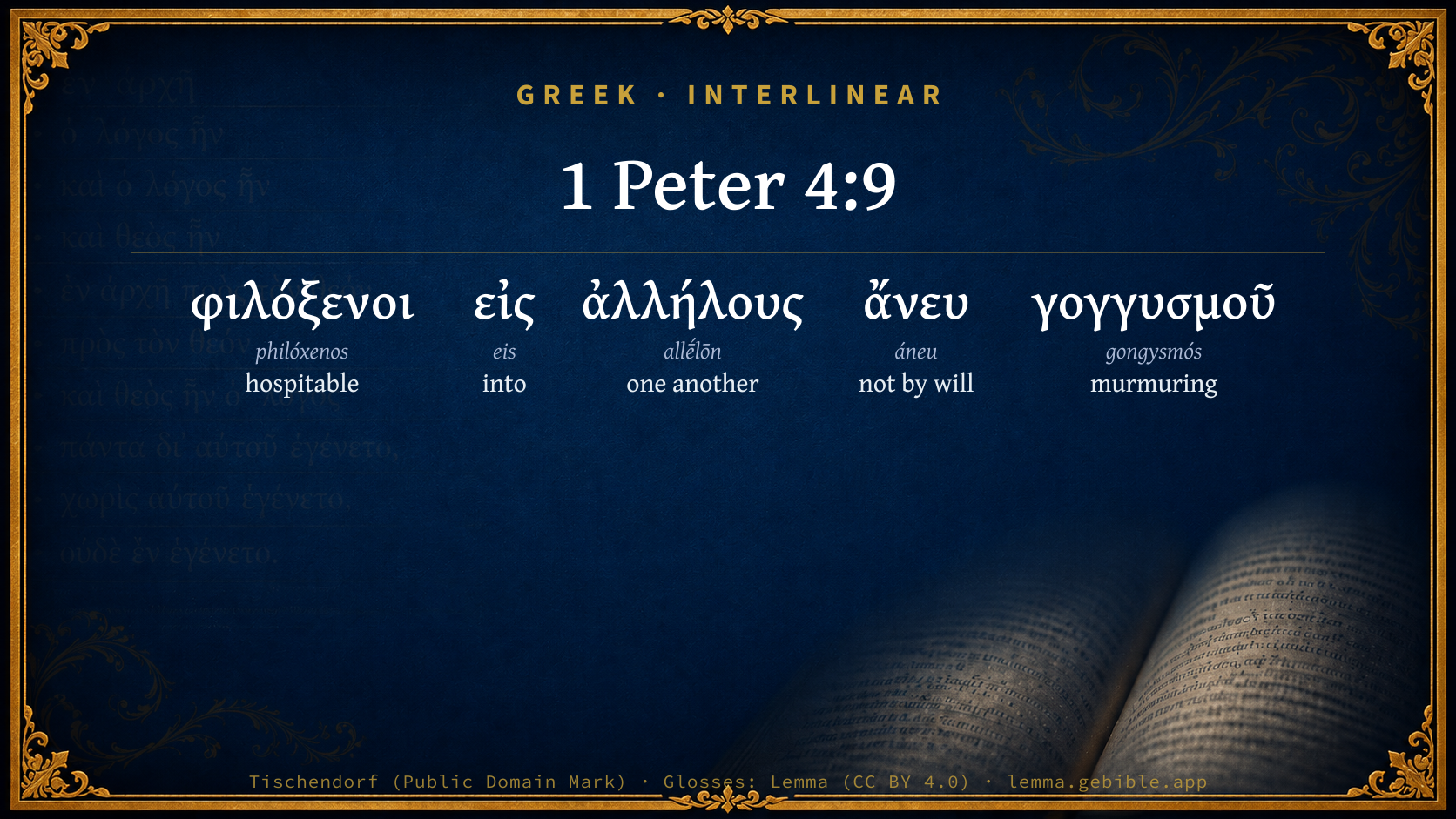
Greek (Tischendorf 8th ed.) 1 Peter 4:9 appears in the Greek New Testament. The text above is from the Tischendorf 8th edition. Each word links to its Strong’s number and a concise gloss. Click any word for its full Thayer’s Greek Lexicon entry.
Download image
Cite this verse

1 Peter 4:9 (World English Bible). Public Domain. Lemma interlinear Bible study tool, https://lemma.gebible.app/v/1-peter/4/9.

Show BibTeX & RIS
BibTeX
RIS
English Translation
Be hospitable one to another without grumbling.
World English Bible · Public Domain
Download a study sheet

One document with this verse’s original text, its word-by-word gloss line, the meaning frame, cross-references with their text, attributed commentary, and full source and license credits — printable, and it pastes into notes with its structure intact.

This verse Autodidact and up

Study sheet (.html) Plain text (.txt)

A passage Seminary Student

Up to 50 verses in one chapter. A passage sheet keeps up to 6 commentary sources and 12 cross-references per verse, in the order this page ranks them, and says so on the sheet whenever that leaves anything out. Ask for a single verse and you get the Autodidact verse sheet above.

Everything on this page stays free to read, with no account — the sheet is a download of what is already on screen, not access to it.

Want to remove ads? Support Godless Engineer
Compare translations 3

The same verse in 3 English versions, stacked beneath the original-language interlinear above. Click any original word for its lexicon entry.

Each is an independent rendering of the whole verse — the interlinear is not word-aligned to these translations.

Highlighted words mark where these versions differ — a whole-verse word diff, not a word-by-word alignment.

  • World English Bible Public Domain
    Be hospitable one to another without grumbling.
  • King James Version Public Domain
    Use hospitality one to another without grudging.
  • unfoldingWord Literal Text CC BY-SA 4.0
    hospitable ones to one another without complaining;

unfoldingWord Literal Text — © unfoldingWord, licensed CC BY-SA 4.0. Word-aligned USFM3 via Door43 (git.door43.org/unfoldingWord/en_ult).

Versions to compare (up to 4)

3 of 4 selected

Show all 19 translations

Every available English version of this verse, each an independent rendering of the whole verse.

  • World English Bible Public Domain
    Be hospitable one to another without grumbling.
  • Berean Standard Bible Public Domain
    Show hospitality to one another without complaining.
  • Majority Standard Bible Public Domain
    Show hospitality to one another without complaining.
  • King James Version Public Domain
    Use hospitality one to another without grudging.
  • American Standard Version (1901) Public Domain
    using hospitality one to another without murmuring:
  • Revised Version (1885) Public Domain
    using hospitality one to another without murmuring:
  • Geneva Bible (1599) Public Domain
    Be ye harberous one to another, without grudging.
  • Douay-Rheims (1899) Public Domain
    Using hospitality one towards another, without murmuring,
  • Young's Literal Translation Public Domain
    hospitable to one another, without murmuring;
  • Literal Standard Version CC BY-SA 4.0
    [be] hospitable to one another, without murmuring;
  • Unlocked Literal Bible CC BY-SA 4.0
    Be hospitable to one another without complaining.
  • unfoldingWord Literal Text CC BY-SA 4.0
    hospitable ones to one another without complaining;
  • Darby Bible Public Domain
    hospitable one to another, without murmuring;
  • World Messianic Bible Public Domain
    Be hospitable to one another without grumbling.
  • Webster's Bible Public Domain
    Use hospitality one to another without grudging.
  • Free Bible Version CC BY-SA 4.0
    Show hospitality to one another, and don't complain.
  • Bible in Basic English Public Domain
    Keep open house for all with a glad heart;
  • Text-Critical English NT CC BY 4.0
    Be hospitable to one another without grumbling.
  • Tyndale New Testament (1534) Public Domain
    Be ye herberous one to another and that with out grudginge.

Literal Standard Version (2020), Covenant Press — licensed CC BY-SA 4.0. Text via the HelloAO Bible API (eBible.org). Unlocked Literal Bible (unfoldingWord) — licensed CC BY-SA 4.0. Text via the HelloAO Bible API (eBible.org). unfoldingWord Literal Text — © unfoldingWord, licensed CC BY-SA 4.0. Word-aligned USFM3 via Door43 (git.door43.org/unfoldingWord/en_ult). Free Bible Version, Dr. Jonathan Gallagher — licensed CC BY-SA 4.0. Text via the HelloAO Bible API (eBible.org).

Word by word

More ways to search: Search by grammar → Find every occurrence → Compare this word →

Practice this passage: Drill this verse → Learn its vocabulary →

About this verse

These counts appear in no published source. They are computed here, from the morphology-tagged text and Lemma’s own curated glosses. What Lemma adds →

5
words
5
distinct lemmas
General Epistles
section

Notable vocabulary

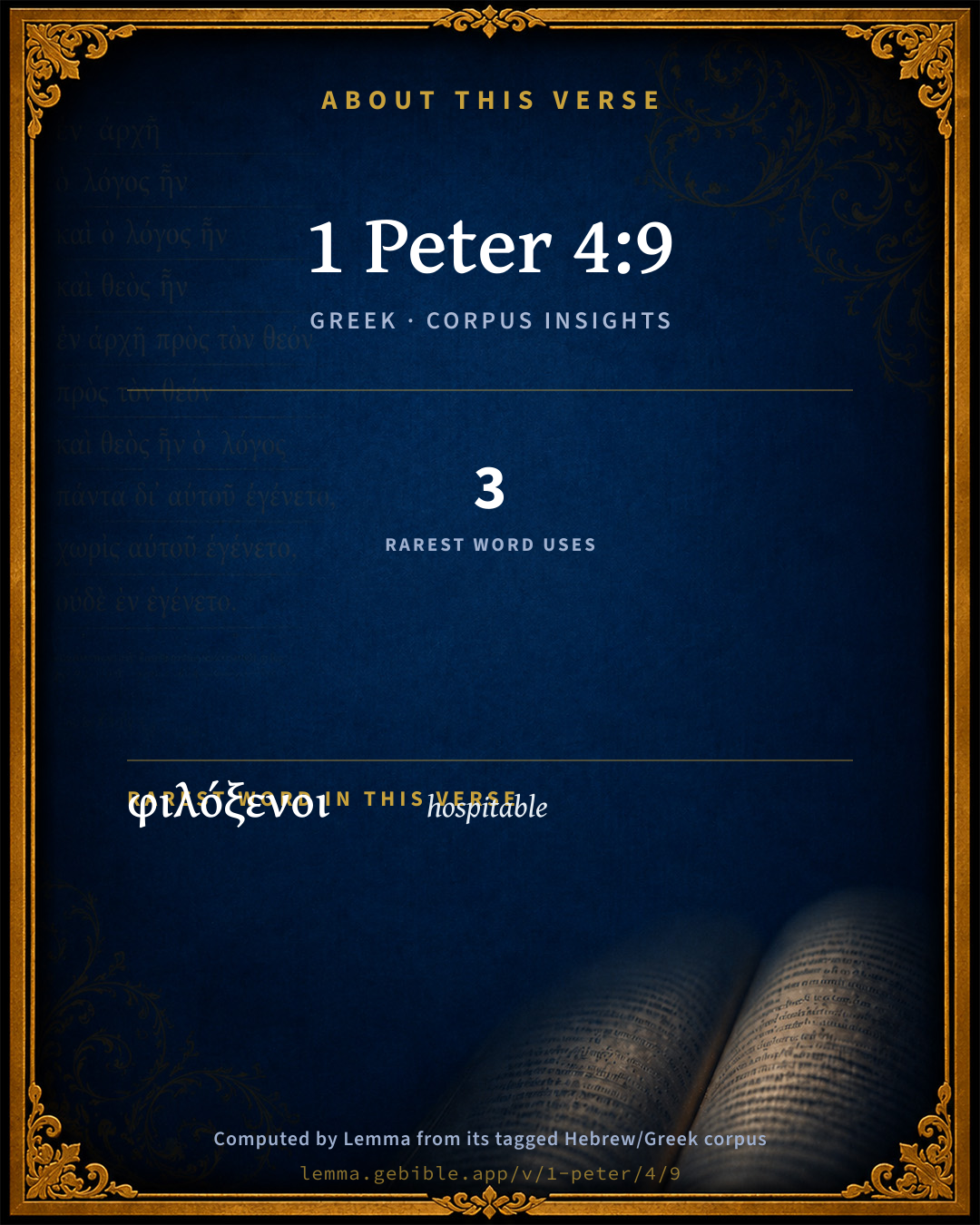
The rarest word here is φιλόξενοι hospitable G5382 — appearing just 3 times in the whole Greek New Testament.

Shared distinctive vocabulary

φιλόξενοι hospitable G5382 occurs in 3 verses of the Greek New Testament. Also found in:

Cross-references

10

Topical passages linked to 1 Peter 4:9 in the Treasury of Scripture Knowledge — connected by theme and wording, ordered by reader-vote popularity; previews shown in the World English Bible.

  • Hebrews 13:2 Don't forget to show hospitality to strangers, for in doing so, some have entertained angels without knowing it.
  • Romans 12:13 contributing to the needs of the saints; given to hospitality.
  • Philippians 2:14 Do all things without murmurings and disputes,
  • Hebrews 13:16 But don't forget to be doing good and sharing, for with such sacrifices God is well pleased.
  • 2 Corinthians 9:7 Let each man give according as he has determined in his heart; not grudgingly, or under compulsion; for God loves a cheerful giver.
  • 1 Timothy 3:2 The overseer therefore must be without reproach, the husband of one wife, temperate, sensible, modest, hospitable, good at teaching;
  • Titus 1:8 but given to hospitality, as a lover of good, sober-minded, fair, holy, self-controlled;
  • James 5:9 Don't grumble, brothers, against one another, so that you won't be judged. Behold, the judge stands at the door.
  • Philemon 1:14 But I was willing to do nothing without your consent, that your goodness would not be as of necessity, but of free will.
  • Romans 16:23 Gaius, my host and host of the whole assembly, greets you. Erastus, the treasurer of the city, greets you, as does Quartus, the brother.

Cross-references courtesy of OpenBible.info (CC BY 4.0).

Commentary

Notes on 1 Peter 4:9 from classic Christian and Jewish commentators (each source and its license shown beneath its notes). The classic Christian expositions comment on the surrounding passage and are grouped to its opening verse, so a note may address several verses; the Jewish commentaries on the Tanakh (Rashi and others) are per-verse, so they appear only where the commentator wrote on this verse.

Lemma curates 59 commentaries, every one of them public domain or Creative Commons licensed, each selected and text-cleaned for this edition rather than reprinted as found. About our sources →

Bengel's Gnomon

Johann Albrecht Bengel

1Pe 4:9. Εἰς ἀλλήλους, mutually) This relates to those who dwelt in different cities or districts.—γογγυσμῶν, murmurings) These are avoided by preserving an equality of duties, or by not nicely weighing their inequality.

Bengel's Gnomon of the New Testament — English translation (T&T Clark, Edinburgh, 1860) — public domain. Text from a community e-Sword module.

Meyer's Critical & Exegetical Commentary

Heinrich August Wilhelm Meyer

1Pe_4:9. In this and the following verses two manifestations of love are brought prominently forward, in which its ministering nature is revealed. First: φιλόξενοι εἰς ἀλλήλους] cf. Rom_12:13; Heb_13:2; 3Jn_1:5; 1Ti_3:2, etc. The chief emphasis lies on the words which serve more closely to define the statement: ἄνευ γογγυσμοῦ, without murmuring, i.e. murmuring at the trouble caused by the hospitality shown to brethren. The same thing is said in a more general way, Php_2:14 : πάντα ποιεῖτε χωρὶς γογγυσμῶν καὶ διαλογισμῶν; cf. 2Co_9:7 : μὴ ἐκ λύπης, ἢ ἐξ ἀνάγκης.

Meyer — Critical and Exegetical Commentary on the New Testament — English translation by Peter Christie, edited by Frederick Crombie (T&T Clark, 1880) — public domain. Text from a community e-Sword module.

Expositor's Greek Testament

ed. W. Robertson Nicoll

1Pe 4:9 . Hospitality is the practical proof of this love ; its practice was necessary to the cohesion of the scattered brotherhood as to the welfare of those whose duties called them to travel. The inns were little better than brothels and Christians were commonly poor. Chrysostom cites the examples of Abraham and Lot ( cf. Heb 13:2 ). The united advocacy of this virtue was successful so much so that the Didache has to provide against abuses such as Lucian depicts in the biography of Peregrinus “a Christian traveller shall not remain more than two or three days … if he wishes to settle … is unskilled and will not work he is a Χριστέμπορος , makes his Christian profession his merchandise.” ἀλλήλους , used despite ἑαυτούς above and below, perhaps because the recipients of hospitality belong necessarily to other Churches. ἄνευ γογγυσμοῦ , St. Peter guards against the imperfection of even Christian human nature. Sir 29:25-28 describes how a stranger who outstays his welcome is first set to menial tasks and then driven out.

The Expositor's Greek Testament, edited by W. Robertson Nicoll (1897–1910) — public domain. Text from a community e-Sword module.

Geneva Bible (1599)

Geneva Bible translators

Of all the duties of charity, he commendeth one, namely, which was at that time most necessary, to wit, hospitality, which he will have to be voluntary and most courteous and bountiful.

Geneva Bible (1599) marginal notes — public domain. Text via Bolls.life.

Jamieson, Fausset & Brown

Robert Jamieson, A. R. Fausset & David Brown

(Rom 12:13; Heb 13:2.) Not the spurious hospitality which passes current in the world, but the entertaining of those needing it, especially those exiled for the faith, as the representatives of Christ, and all hospitality to whomsoever exercised from genuine Christian love.

without grudging--Greek, "murmuring." "He that giveth, let him do it with simplicity," that is open-hearted sincerity; with cordiality. Not secretly speaking against the person whom we entertain, or upbraiding him with the favor we have conferred in him.

Jamieson, Fausset & Brown — Commentary Critical and Explanatory on the Whole Bible (1871) — public domain (CC PDM 1.0). Text via the HelloAO Bible API.

Adam Clarke's Commentary

Verse 9. Use hospitality] Be ever ready to divide your bread with the hungry, and to succour the stranger. See Clarke on Heb 13:2.

Without grudging.] ανευγαγγυσμων. Without grumblings. Do nothing merely because it is commanded, but do it from love to God and man; then it will be without grumbling.

Adam Clarke's Commentary on the Bible (1810–1826) — public domain. Text from a community e-Sword/MySword module.

John Calvin's Commentaries

9 Use hospitality, or, Be hospitable. After having generally exhorted them to love one another, he specially mentions one of the duties of love. At that time hospitality was commonly used, and it was deemed in a manner a sacred kind of humanity, as we have stated elsewhere. He then bids them mutually to exercise it, so that no one might require more from others than what he himself was prepared to render. He adds, without murmurings, for it is a rare example that one spends himself and his own on his neighbor without any disparaging reflection. Then the Apostle would have us to show kindness willingly and with a cheerful mind.

John Calvin's Commentaries (1540-1563) — public domain. Text from the Calvin Translation Society English edition (1840s-50s) via the Christian Classics Ethereal Library (ccel.org). Calvin's coverage is partial (roughly two-thirds of the Bible); uncommented books and verses are honest gaps, never fabricated. The 19th-century editor's footnotes and remarks are omitted so the notes are faithfully Calvin's own voice.

Ellicott's Commentary for English Readers

(9) Use hospitality.—It is a great pity that again (as in 1Pe_3:8, and elsewhere) the participial clauses are broken up in our version into separate injunctions. Here it is, properly, being hospitable. This is the first form of charity—receiving Christians who came from other towns (comp. 3Jn_1:5-6). See how such hospitality covers (to the surprise of the bestowers) a multitude of sins in Mat_25:35-38.

Without grudging.—That is, without murmuring. How frequently Christian hospitality is marred by grumbling at the expense and the trouble which it costs!

A Bible Commentary for English Readers, edited by Charles John Ellicott (1878–1897) — public domain. Text from a community e-Sword module.

The Cambridge Bible for Schools and Colleges

gen. ed. J. J. S. Perowne

9. Use hospitality one to another without grudging] Literally, Be hospitable. The stress laid on this virtue in the New Testament, as in 1Ti_3:2; Rom_12:13; Heb_13:2, brings before us some of the more striking features of the social life of the Christians of the first three centuries. The Christian traveller coming to a strange city was in a position of no little difficulty. The houses of heathen friends, if he had any, were likely to bring trials of one kind or another. He might be taunted and persecuted for his faith or tempted to “run to the same excess of riot with them.” Inns presented too often scenes of drunkenness and impurity, foul words and fouler acts. It was therefore an unspeakable gain for such an one to know that he could find shelter in a Christian home. The fact that he was a Christian, that he brought with him some “letter of commendation” (2Co_3:1) as a safeguard against imposture, was to be enough to secure a welcome. It lay in the nature of things that sometimes strangers might thus present themselves with inconvenient frequency or under inconvenient conditions, and therefore St Peter adds “be hospitable … without murmurings.” Men were not to look on it as a trouble or a nuisance, or think themselves hardly treated. They might be entertaining angels unawares (Heb_13:2). Here also God loved a cheerful giver (2Co_9:7).

The Cambridge Bible for Schools and Colleges (gen. ed. J. J. S. Perowne; Cambridge University Press, 1878–1918) — public domain. Text from a community e-Sword module.

John Gill's Exposition

Use hospitality,.... Or, "be lovers of strangers", as the phrase may be rendered, and as it is in the Syriac version; that is, such as are of a distant country, or come from afar, and are unknown by face, especially good men, that are obliged to remove from their native country for the sake of religion, or by one providence or another; and these are to be loved: and love is to be shown them, both negatively, by not vexing them, and making them uneasy in body or mind; by not oppressing them by violence and injustice, and making any exorbitant demands upon them; or by not perverting judgment with respect to them; and positively, by directing, counselling, and advising them, and if need be, by giving them food, and raiment, and lodging: and it is what men have been led to by the very light of nature, as in the instances of Jethro the Midianite towards Moses, and the inhabitants of Melita with Publius, the chief man of the island, towards the Apostle Paul and his company; and is what God enjoined the Israelites by divers laws, since they had been strangers in the land of Egypt; and various are the exhortations to it in the New Testament; and some, by the practice of it, have entertained angels unawares, as Abraham, and Lot; and even Christ himself, as the two disciples travelling to Emmaus; and is what is highly regarded and commended by Christ, and the contrary is resented by him; and therefore it ought to be used and practised frequently; saints should inure themselves to it, be given to it, pursue and follow hard after it; See Gill on Rom 12:13; see Gill on Heb 13:2. The apostle adds here, one to another; which clause is left out in the Syriac and Ethiopic versions; the reason of which may be, because the authors of these versions might think this not so consistent with the duty exhorted to, since the objects of it are strangers; but it should be observed, that so were these persons the apostle writes to; see Pe1 1:1, they were scattered about, and lived in different countries, and were strangers to one another, and therefore the clause is pertinent enough; and the sense is, that as they were in foreign countries, and at a distance one from another, whenever by any providence they were brought where each other were, that they would be hospitable to one another: and that

without grudging: food, raiment, and lodging, or what they want, whether direction or advice, thinking it no trouble to give them either; or without murmurings, as it may be rendered, as if they were burdensome, and they were too chargeable to them, and their stay too long; and without complaints of them, finding fault, and picking quarrels with them, and laying charges against them, in order to get rid of them. This is one branch of charity before recommended.

John Gill's Exposition of the Whole Bible (1746–1763) — public domain (CC PDM 1.0). Text via the HelloAO Bible API.

Trapp's Complete Commentary

John Trapp

9 Use hospitality one to another without grudging.

Ver. 9. Without grudgings] Without shucking and hucking. 2Co 8:12; {See Trapp on "2Co 8:12"}

John Trapp, A Commentary or Exposition upon All the Books of the Old and New Testament (1647–1656) — public domain. Text from a community e-Sword module.

Albert Barnes' Notes on the Bible

Use hospitality one to another - On the duty of hospitality, see the Rom 12:13 note; Heb 13:2 note.

Without grudging - Greek, “without murmurs;” that is, without complaining of the hardship of doing it; of the time, and expense, and trouble required in doing it. The idea of grudging, in the common sense of that word - that is, of doing it unwillingly, or regretting the expense, and considering it as ill-bestowed, or as not producing an equivalent of any kind - is not exactly the idea here. It is that we are to do it without murmuring or complaining. It greatly enhances the value of hospitality, that it be done on our part with entire cheerfulness. One of the duties involved in it is to make a guest happy; and this can be done in no other way than by showing him that he is welcome.

Albert Barnes' Notes on the Bible (1834–1885) — public domain. Text from a community e-Sword/MySword module.

Matthew Poole's English Annotations

Use hospitality; Christian hospitality in entertaining strangers, those especially that are brought to need your kindness by suffering for the gospel.

Without grudging; or murmuring, either at the expense you make, or the carriage of those ye entertain; q.d. Use hospitality willingly, freely, cheerfully, Rom 12:8; 2Co 9:7.

Matthew Poole's English Annotations on the Holy Bible (1683–1685) — public domain. Text from a community e-Sword/MySword module.

Whedon's Commentary on the Bible

Daniel D. Whedon

9. Hospitality—As would often be necessary toward those who might be driven from home, or otherwise suffering.

Without grudging—Not murmuring at the cost or trouble.

Daniel D. Whedon (gen. ed.), Commentary on the Old and New Testaments (1874–1909) — public domain. Text from a community e-Sword module.

The Pulpit Commentary

Use hospitality one to another; literally, being hospitable (Rom_12:13; 1Ti_3:2; Heb_13:2 3Jn_1:5) Hospitality must have been a necessary, and often a costly, duty in the early ages of the Church. There was no public provision for the poor. Christians traveling from place to place would find no suitable shelter except in the houses of Christians. They would be obliged to avoid the public houses of entertainment, where they would be exposed often to danger, always to temptation; only the private houses of Christians would be safe for them. Hence the use of the "letters of commendation," mentioned by St. Paul. (2Co_3:1) Those who brought such letters were to be received in Christian homes. The well-known "Teaching of the Twelve Apostles" speaks of this right of hospitality, and gives cautions against its abuse. Tim apostle is not speaking of ordinary social gatherings; they have their place and their utility in the Christian life, but they do not, as a rule, afford scope for the higher self-denials of Christian charity. (comp. Luk_14:12, Luk_14:13) Without grudging. Such hospitality would be always costly, often inconvenient, sometimes attended with danger, as in the case of the first British martyr; but it was to be without murmuring. Murmuring would take from the hospitality all its beauty; it should be offered as a gift of love, and Christian love can never murmur. (2Co_9:7)

Vers. 9-11.

Christian love as a service.

hospitality one to another," etc. Here the apostle describes Christian love as a service. For as the word variously translated minister" and "deacon" denotes a servant, so the word "ministereth" here really conveys the simple thought of service a thought which veins the beautiful marble of these two verses. This service is

I UNIVERSAL IN ITS OBLIGATION. "As each hath received a gift." That includes all, for all are gifted by God with some endowment or other. The man who has received no gift from God would be one not only without possession or influence, but without life; he is as nothing, and he is nowhere to be found. We have seen all through the Epistle some of Peter"s memories of his Lord"s teaching. Is there not here a recollection of the parable of the talents? In its light every gifted man is "a steward" (ver. 10).

II MANIFOLD IN ITS METHOD. All serve, but all serve in different ways. The service of love is not a dreary monotone, but the richest music; it embraces the full diapason of duty. It is "the manifold grace of God.

Some of the notes are here. Using hospitality." This is specially applicable to those to whom the Epistle was first written, i.e. "strangers of the dispersion." It was, indeed, almost the earliest form of Christian charity. Peter finds it in Simon the tanner, Paul in Gains, etc. It is incumbent on men now in the midst of the yawning social distinctions, and of the ceaseless travel of today, Here is an echo of the teaching of the apostle"s Lord, "I was a stranger, and ye took me in." "Without murmuring;" i.e. without grumbling. Three watch-dogs keep the door of the inhospitable man: temper, suspicion, reproach. "If any man speaketh." Just as the hands put on the table viands for the body, the lips are to spread a banquet for the intellect and the heart. How? "As it were oracles of God." That must mean with reality, with purity, with tenderness. "If any man ministereth." This comprehends every form of service. It is a widening of the other two just mentioned. "As of the strength which God supplies." That implies that the service will be rendered

(1) humbly, no pride, for he is a channel only, not a fountain;

(2) freely, no stint, or grudging, when God is the Source.

III ONE IN PURPOSE. "That in all things God may be glorified." Hospitality, teaching, almsgiving, all are to be for the glory of God. "Through Jesus Christ." Had it not been for Jesus Christ, that kindness, activity, wisdom, liberality, would not have been. He awakened all. He is the Head from whom the life of love flows. "Whose is the glory and dominion, forever and ever. Amen." This is not a note of conclusion, but of strong emotion. Reason, gratitude, love, all utter their deep "amen" to the declaration that God through Christ has endless glory and dominion. U.R.T.

The Pulpit Commentary (1880–1919), ed. H.D.M. Spence-Jones & Joseph S. Exell — public domain. Text from a community e-Sword module.

John Wesley's Explanatory Notes

One to another - Ye that are of different towns or countries. Without murmuring - With all cheerfulness. Prov. x, 12.

John Wesley, Explanatory Notes Upon the Whole Bible (1754–1765) — public domain. Text via the GEBible commentary corpus.

Burkitt's Expository Notes on the New Testament

William Burkitt

As a principal act and eminent exercise of charity, the apostle advises to use hospitality to their poor brethern, without grudging or murmuring at the charge: hospitality is a necessary, a commendable, and a commanded, duty; St. Paul requires, that we be given to hospitality. Rom 12:13

Observe farther, the apostle doth not barely say, use hospitality, but use it one to another: it is a mutual duty; whence it appears, that though hospitality towards the poor be a commanded duty, yet hospitality among the rich is no sin, but a duty likewise, to give reciprocal entertainments; for though our Saviour says, Luk 14:12. When thou makest a dinner, or a supper, call not thy friends and rich neighbours; the prohibition is not absolute, he doth not forbid the inviting of the rich, but chargeth us not to forget the poor: we may treat both, if we have enough for both; but if not, what we have to spare must be for them that have nothing, not for them that have enough already, for we must prefer works of pious charity before acts of civil courtesy: Use hospitality one to another without grudging.

William Burkitt's Expository Notes on the New Testament (1700–1703) — public domain. Text from a community e-Sword module.

The People's New Testament

B. W. Johnson

9. Using hospitality. A duty very needful in that age of persecution when Christians were so often driven from home. See notes on Rom. 12:13; 1 Tim. 3:2.

B. W. Johnson's The People's New Testament with Notes (1889–1891) — public domain. Electronic text from the Christian Classics Ethereal Library (CCEL) ThML edition.

Cambridge Greek Testament for Schools and Colleges

9. φιλόξενοι. The duty of hospitality to strangers, commended by our Lord, Mat 25:35, is also enjoined in Rom 12:13 and Heb 13:2. In 1Ti 3:2 and Tit 1:8 it is demanded as one of the special qualifications for an ἐπίσκοπος. In the primitive Church Christian travellers would be exposed to certain annoyance and possible danger unless the Christians of the place received them into their houses, and without such aid the missions of itinerant preachers (ἀπόστολοι) would have been almost impossible (cf. Tit 3:13; 3Jn 1:6-8; 3Jn 1:10; Phm 1:22; Rom 16:1; 1Co 9:4-14). At the same time such hospitality must have been a somewhat serious tax upon Christians who were by no means well off, and from the regulations given in the Didache we gather that there was before long a real danger that unscrupulous strangers might impose upon the generosity of the Church.

So here St Peter urges his readers to exercise hospitality ungrudgingly, remembering that any gifts which they possess, whether in worldly goods or faculties for service, are only entrusted to them as stewards to use them for God. For the duty of giving cheerfully, cf. 2Co 9:7; Rom 12:8. In this latter passage, as here, charitable duties are coupled with those of preaching, teaching or ministering, as varied χαρίσματα given by God to the several members of the Body of Christ.

For γογγυσμός cf. Php 2:14.

Cambridge Greek Testament for Schools and Colleges (Cambridge University Press, 1896; 21 vols, various authors incl. Carr, Maclear, Plummer, Farrar, Lumby, Moule, M. R. James, Simcox) — public domain. Text from a community e-Sword module.

Alford’s Greek Testament

Henry Alford

9.] hospitable towards one another (see besides reff., Rom 12:13. “Loquitur non de pomposa hospitalitate Luk 14:12, … sed de Christiana illa et sancta hospitalitate, qua peregrinos egenos, maxime vero propter religionis veræ professionem exules Christiani ex sincera caritate promte in ædes suas recipiunt, eos amanter et benigne complectuntur, tanquam Christi membra et ecclesiæ concives fovent” &c. Gerhard) without murmuring (see ref. Phil. and note. The opposite to γογγυσμός in hospitality is simple open-heartedness, Rom 12:8: the consequence of it, “occulta maledicentia, odiosa exprobratio beneficiorum,” as Gerhard here):

Henry Alford, The Greek Testament (1849–1861) — public domain. Text from a community e-Sword module.

Vincent's Word Studies in the New Testament

Marvin R. Vincent

Using hospitality. Compare Rom 13:13.

Marvin R. Vincent, Word Studies in the New Testament (1887–1900) — public domain. Text from a community e-Sword/MySword module.

Lesson kit

Teaching starters — assembled from the data on this page, not authored interpretation. Every prompt links to the verse data it draws on. Edit before teaching.

1 Peter, in the General Epistles, opens this verse with 5 words (5 distinct Greek lemmas). Its most distinctive word is philóxenos (“hospitable”). A historical commentator’s framing appears above. Read the whole chapter for the surrounding context.

Discussion questions

  1. What does “hospitable” (philóxenos) contribute to the verse as a whole?
  2. 1 Timothy 3:2 shares the word «hospitable» with this verse. How do the two illuminate each other?
  3. These translations render this verse differently; the difference is in the English rendering, not the original. What questions does that raise?
  4. Reading how Bengel's Gnomon and Meyer's Critical & Exegetical Commentary read this verse, where do the two commentators agree and where do they part?

Things to notice

Reading settings

Reading text

Shown beneath each verse's original-language words.

Old Testament
Old Testament edition

Read the OT as the Masoretic Hebrew (MT) or the Greek Septuagint (LXX).

English shown for the Greek Septuagint (in the Hebrew ↔ Greek comparison).

Comparing translations? Open the Compare panel on any verse page to stack up to four side by side.