
2 Corinthians 8:12

Greek (Tischendorf 8th ed.) 2 Corinthians 8:12 appears in the Greek New Testament. The text above is from the Tischendorf 8th edition. Each word links to its Strong’s number and a concise gloss. Click any word for its full Thayer’s Greek Lexicon entry.
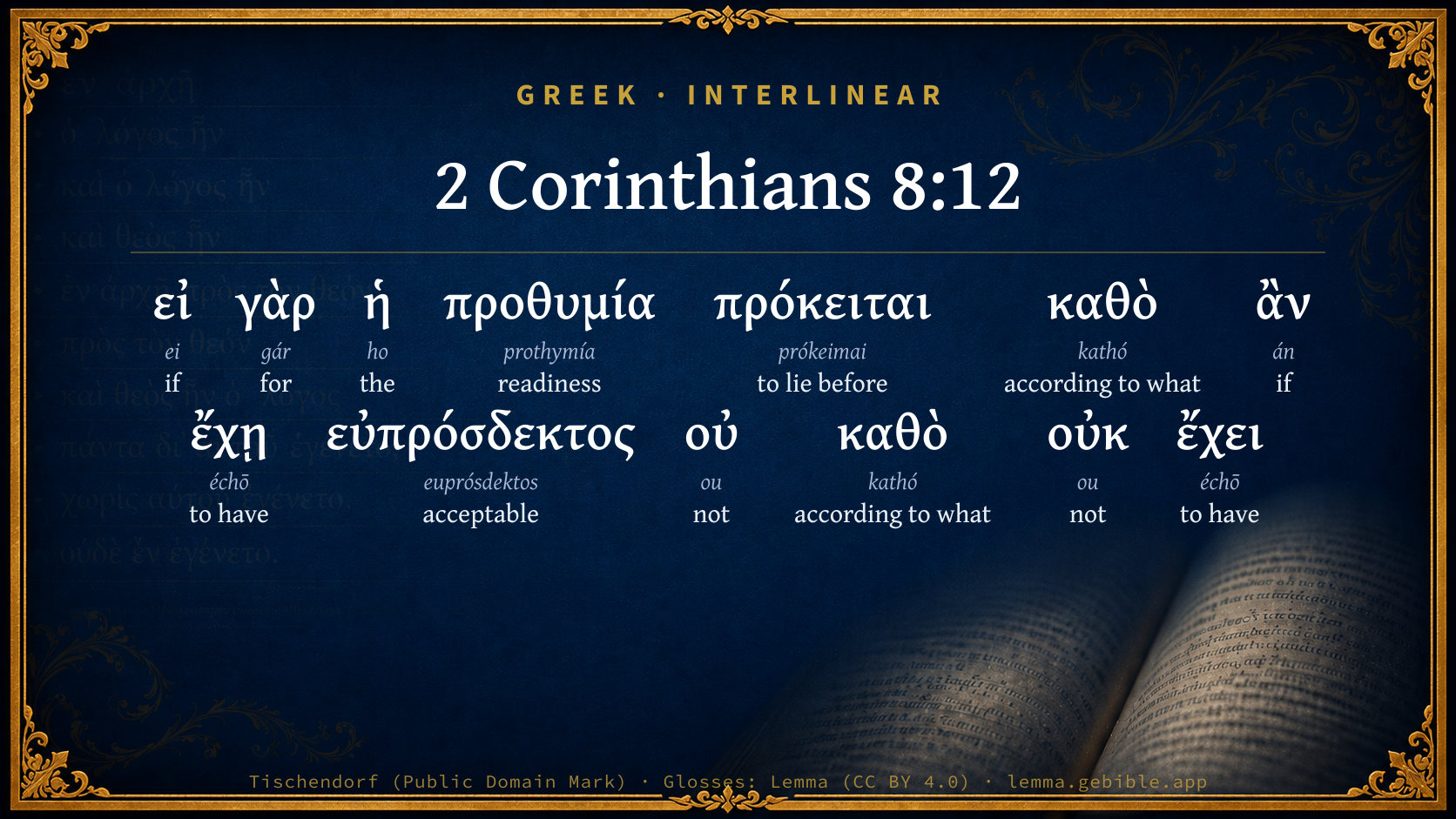
Download image
Cite this verse

2 Corinthians 8:12 (World English Bible). Public Domain. Lemma interlinear Bible study tool, https://lemma.gebible.app/v/2-corinthians/8/12.

Show BibTeX & RIS
BibTeX
RIS
English Translation
For if the readiness is there, it is acceptable according to what you have, not according to what you don't have.
World English Bible · Public Domain
Highlights
  • 1 first appearance in the Greek New Testament
Full analysis ↓
Download a study sheet

One document with this verse’s original text, its word-by-word gloss line, the meaning frame, cross-references with their text, attributed commentary, and full source and license credits — printable, and it pastes into notes with its structure intact.

This verse Autodidact and up

Study sheet (.html) Plain text (.txt)

A passage Seminary Student

Up to 50 verses in one chapter. A passage sheet keeps up to 6 commentary sources and 12 cross-references per verse, in the order this page ranks them, and says so on the sheet whenever that leaves anything out. Ask for a single verse and you get the Autodidact verse sheet above.

Everything on this page stays free to read, with no account — the sheet is a download of what is already on screen, not access to it.

Want to remove ads? Support Godless Engineer
Compare translations 3

The same verse in 3 English versions, stacked beneath the original-language interlinear above. Click any original word for its lexicon entry.

Each is an independent rendering of the whole verse — the interlinear is not word-aligned to these translations.

Highlighted words mark where these versions differ — a whole-verse word diff, not a word-by-word alignment.

  • World English Bible Public Domain
    For if the readiness is there, it is acceptable according to what you have, not according to what you don't have.
  • King James Version Public Domain
    For if there be first a willing mind, it is accepted according to that a man hath, and not according to that he hath not.
  • unfoldingWord Literal Text CC BY-SA 4.0
    For if the readiness is already there, fully acceptable according to whatever one might have, not according to what he does not have.

unfoldingWord Literal Text — © unfoldingWord, licensed CC BY-SA 4.0. Word-aligned USFM3 via Door43 (git.door43.org/unfoldingWord/en_ult).

Versions to compare (up to 4)

3 of 4 selected

Show all 19 translations

Every available English version of this verse, each an independent rendering of the whole verse.

  • World English Bible Public Domain
    For if the readiness is there, it is acceptable according to what you have, not according to what you don't have.
  • Berean Standard Bible Public Domain
    For if the eagerness is there, the gift is acceptable according to what one has, not according to what he does not have.
  • Majority Standard Bible Public Domain
    For if the eagerness is there, the gift is acceptable according to what one has, not according to what he does not have.
  • King James Version Public Domain
    For if there be first a willing mind, it is accepted according to that a man hath, and not according to that he hath not.
  • American Standard Version (1901) Public Domain
    For if the readiness is there, `it is' acceptable according as `a man' hath, not according as `he' hath not.
  • Revised Version (1885) Public Domain
    For if the readiness is there, it is acceptable according as a man hath, not according as he hath not.
  • Geneva Bible (1599) Public Domain
    For if there be first a willing minde, it is accepted according to that a man hath, and not according to that he hath not.
  • Douay-Rheims (1899) Public Domain
    For if the will be forward, it is accepted according to that which a man hath, not according to that which he hath not.
  • Young's Literal Translation Public Domain
    for if the willing mind is present, according to that which any one may have it is well-accepted, not according to that which he hath not;
  • Literal Standard Version CC BY-SA 4.0
    for if the willing mind is present, it is well-accepted according to that which anyone may have, not according to that which he does not have;
  • Unlocked Literal Bible CC BY-SA 4.0
    For if you are eager to do this deed, it is a good and acceptable thing. It must be based on what a person has, not on what he does not have.
  • unfoldingWord Literal Text CC BY-SA 4.0
    For if the readiness is already there, fully acceptable according to whatever one might have, not according to what he does not have.
  • Darby Bible Public Domain
    For if the readiness be there, [a man is] accepted according to what he may have, not according to what he has not.
  • World Messianic Bible Public Domain
    For if the readiness is there, it is acceptable according to what you have, not according to what you don’t have.
  • Webster's Bible Public Domain
    For if there is first a willing mind, it is accepted according to what a man hath, and not according to what he hath not.
  • Free Bible Version CC BY-SA 4.0
    If the willingness is there, it's fine to give what you have, not what you don't have!
  • Bible in Basic English Public Domain
    For if there is a ready mind, a man will have God's approval in the measure of what he has, and not of what he has not.
  • Text-Critical English NT CC BY 4.0
    For if the eager willingness is there, it is acceptable according to what one has, not according to what one does not have.
  • Tyndale New Testament (1534) Public Domain
    For if ther be fyrst a willynge mynde it is accepted accordynge to that a man hath and not accordinge to that he hath not.

Literal Standard Version (2020), Covenant Press — licensed CC BY-SA 4.0. Text via the HelloAO Bible API (eBible.org). Unlocked Literal Bible (unfoldingWord) — licensed CC BY-SA 4.0. Text via the HelloAO Bible API (eBible.org). unfoldingWord Literal Text — © unfoldingWord, licensed CC BY-SA 4.0. Word-aligned USFM3 via Door43 (git.door43.org/unfoldingWord/en_ult). Free Bible Version, Dr. Jonathan Gallagher — licensed CC BY-SA 4.0. Text via the HelloAO Bible API (eBible.org).

Word by word

More ways to search: Search by grammar → Find every occurrence → Compare this word →

Practice this passage: Drill this verse → Learn its vocabulary →

About this verse

These counts appear in no published source. They are computed here, from the morphology-tagged text and Lemma’s own curated glosses. What Lemma adds →

13
words
10
distinct lemmas
Pauline Epistles
section

Notable vocabulary

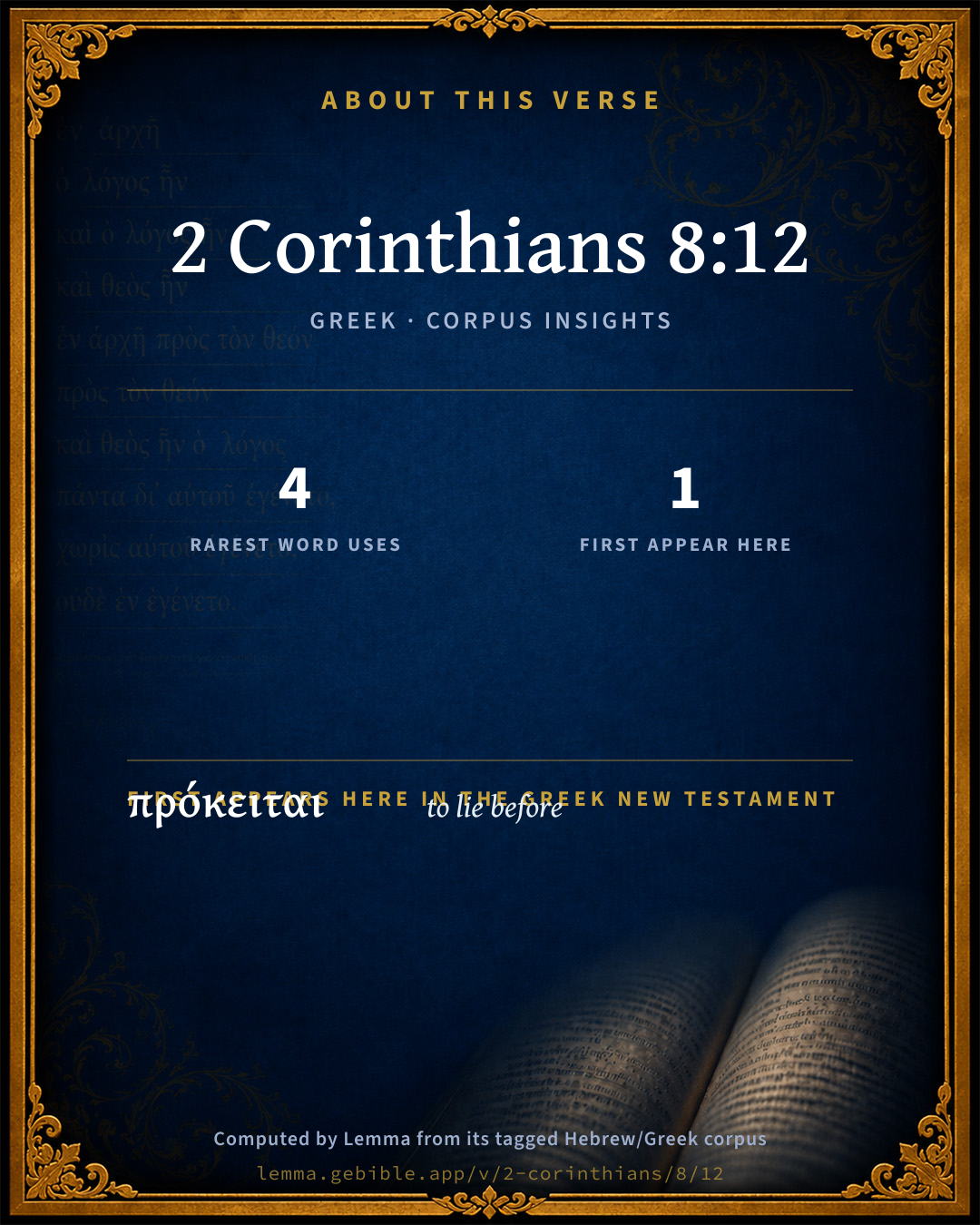
The rarest word here is καθὸ according to what G2526 — appearing just 4 times in the whole Greek New Testament.

First appearance in Scripture

This word makes its first canonical appearance in the Greek New Testament here:

  • πρόκειται to lie before G4295

Shared distinctive vocabulary

καθὸ according to what G2526 occurs in 3 verses of the Greek New Testament. Also found in:
Repetition

Words recur within this verse:

  • καθὸ according to what G2526 ×2
  • ἔχῃ to have G2192 ×2
  • οὐ not G3756 ×2

Cross-references

15

Topical passages linked to 2 Corinthians 8:12 in the Treasury of Scripture Knowledge — connected by theme and wording, ordered by reader-vote popularity; previews shown in the World English Bible.

  • Mark 12:42–44 A poor widow came, and she cast in two small brass coins, which equal a quadrans coin.
  • 2 Corinthians 9:7 Let each man give according as he has determined in his heart; not grudgingly, or under compulsion; for God loves a cheerful giver.
  • Exodus 35:29 The children of Israel brought a freewill offering to Yahweh; every man and woman, whose heart made them willing to bring for all the work, which Yahweh had commanded to be made by Moses.
  • Luke 21:1–4 He looked up, and saw the rich people who were putting their gifts into the treasury.
  • Exodus 35:21–22 They came, everyone whose heart stirred him up, and everyone whom his spirit made willing, and brought Yahweh's offering, for the work of the tent of meeting, and for all of its service, and for the holy garments.
  • Exodus 25:2 "Speak to the children of Israel, that they take an offering for me. From everyone whose heart makes him willing you shall take my offering.
  • Exodus 35:5 'Take from among you an offering to Yahweh. Whoever is of a willing heart, let him bring it, Yahweh's offering: gold, silver, brass,
  • 1 Peter 4:10 According as each has received a gift, be ministering it among yourselves, as good stewards of the grace of God in its various forms.
  • 1 Chronicles 29:3–18 In addition, because I have set my affection on the house of my God, seeing that I have a treasure of my own of gold and silver, I give it to the house of my God, over and above all that I have prepared for the holy house,
  • Mark 14:7–8 For you always have the poor with you, and whenever you want to, you can do them good; but you will not always have me.
  • Luke 12:47–48 That servant, who knew his lord's will, and didn't prepare, nor do what he wanted, will be beaten with many stripes,
  • Luke 16:10 He who is faithful in a very little is faithful also in much. He who is dishonest in a very little is also dishonest in much.
  • 2 Chronicles 6:8 But Yahweh said to David my father, Whereas it was in your heart to build a house for my name, you did well that it was in your heart:
  • Proverbs 19:22 That which makes a man to be desired is his kindness. A poor man is better than a liar.
  • Luke 7:44–46 Turning to the woman, he said to Simon, "Do you see this woman? I entered into your house, and you gave me no water for my feet, but she has wet my feet with her tears, and wiped them with the hair of her head.

Cross-references courtesy of OpenBible.info (CC BY 4.0).

Commentary

Notes on 2 Corinthians 8:12 from classic Christian and Jewish commentators (each source and its license shown beneath its notes). The classic Christian expositions comment on the surrounding passage and are grouped to its opening verse, so a note may address several verses; the Jewish commentaries on the Tanakh (Rashi and others) are per-verse, so they appear only where the commentator wrote on this verse.

Lemma curates 59 commentaries, every one of them public domain or Creative Commons licensed, each selected and text-cleaned for this edition rather than reprinted as found. About our sources →

The Biblical Illustrator

Joseph S. Exell

2Co_8:12

If there be first a willing mind, it is accepted according to that a man hath.

The Christian accepted according to his advantages

We are led to judge of our own merits by considering what we would do if we were in situations different from that in which we have been placed. Had we unbounded wealth, we say, how would we use it for the benefit and happiness of mankind! Had we our place among the mighty of this world, what a field should we have for doing good! Thus we lose ourselves in vain imaginations, in mere dreams of fancied usefulness. And why is this but because we forget the words of the apostle, God accepts a man according to that which he hath, not according to that which he hath not. Thus, then, it seems that it is a mistake for a man to dwell upon what he hath not; let him rather apply himself seriously to consider what he hath. And here every one will most surely find that he has enough. And some things there must be which every man hath; some of the duties of life must be in the power of every one; he is a son, or a parent, and then how much opportunity he has for forbearance, and succour, and self-denial: or he has friends, or he has enemies, and this enables him to exercise the Christian graces of forgiveness. But while he sees in it abundant matter of serious self-examination, it suggests also equally strong motives of consolation. God accepts according to what a man hath, not according to what he hath not. If it be asked, why we are thus accepted in the sight of God, we may be assured that it is not for the works sake. When we have done all, be it more or less, we can only say we are unprofitable servants. And yet there is One, for whose sake they are accepted, as the tests and fruits of faith. A willing mind, this is the sacrifice required on our part; and what does this expression imply? In the meaning of Scripture, more perhaps than we should at first suppose; it implies a sincere disposition to submit to God in all things, to be led by Him, without any reference to the degree in which such conduct may interfere with our own selfish inclinations and objects. The absence of a willing mind is seen in the case of those who say that they intend at some future time to repent. We have all our opportunities and means of serving God. We have seen that those opportunities may be greater or less. If they are greater, our responsibilities will also be greater. (H. W. Sulivan, M. A.)

Gods acceptance of His peoples will for the deed

I. Want of power to do more shall not mar the acceptance of what is done from a willing mind according to power. In that case God will accept of His peoples will for the deed.

1. In what particular eases God accepts His peoples will for the deed.

(1) Where there is a sincere will to serve Him in a piece of work requiring some external abilities which are wanting (Act_3:6).

(2) When doing the best we can through grace, our work after all is attended with many blemishes.

(3) Going as far as we have access in a work, but meeting with a providential stop (Heb_11:17). There is a great difference betwixt the stops men make and those which God makes; the former argues an unwilling mind, but the latter not so.

(4) Services that one really desires, and fain would perform for God, but have not opportunity (2Ch_6:8; Php_4:10).

(5) Services performed with a real desire of success for Gods honour and mens good; the Lord accepts the good will to the success denied, as if it had succeeded according to their wish (Isa_49:4; 2Co_2:15).

2. Why does God accept such will for the deed?

(1) The sincere will to a work is present, which God mainly regards.

(2) We have a merciful High Priest to present that will for acceptance, notwithstanding all the weaknesses, blemishes, providential hindrances, want of opportunity, and failure of success, that it may be attended with (Heb_4:15-16).

3. We have a merciful Father to deal with (Psa_103:13-14). (T. Boston, D. D.)

The Biblical Illustrator, edited by Joseph S. Exell (c. 1880s–1900s) — public domain. Text from a community e-Sword module.

Bengel's Gnomon

Johann Albrecht Bengel

2Co 8:12. Πρόκειται, if there be obvious [if there be first]) So πονηρία πρόκειται ὑμῖν, evil is before you, Exo 10:10.—εὐπρόσδεκτος, he is well-acccepted or very acceptable) to God, ch. 2Co 9:7, with his gift. [Not as Engl. V. “it is accepted;” 2Co 9:7 confirms this, “The Lord loveth a cheerful giver.”]—οὐ καθὸ οὐκ ἔχει, not according to what a man has not) For thus [were God’s favour regulated by the amount of the gift, not by the willingness of the giver] a more humble person would be less acceptable.

Bengel's Gnomon of the New Testament — English translation (T&T Clark, Edinburgh, 1860) — public domain. Text from a community e-Sword module.

Meyer's Critical & Exegetical Commentary

Heinrich August Wilhelm Meyer

2Co_8:12. Confirmation of the ἐκ τοῦ ἔχειν by a general proposition. There is nothing to be supplied except the simple ἐστί after εὐπρόσδεκτος, so that ἡ προθυμία remains the subject (Vulg., Erasmus, and others, including Rückert, Osiander, Ewald). It is quite superfluous mentally to supply the non-genuine τις after ἔχῃ, and to refer εὐπρόσδ. to it (Billroth), all the more that Paul is fond of personifying abstractions (ἡ προθυμία). The correct translation is: For, if the inclination exists (presents itself as existing), it is well-pleasing in proportion to that which it has, not in proportion to that which it has not, i.e. God measures His good pleasure according to that which the πρόθυμος (who is ready to contribute) possesses, not according to that which he does not possess.[277] If, for example, the poor man who is ready to give little, because he has not much, were less pleasing to God than the rich man, who is willing to give much, God would then determine His good pleasure according to what the ΠΡΌΘΥΜΟς does not possess. Such an unjust standard God does not apply to good will! οὐ γὰρ τὴν ποσότητα, ἀλλὰ τῆς γνώμης ὁρᾶ τὴν ποιότητα, Theodoret. On ΠΡΌΚΕΙΤΑΙ in the sense specified, see Kypke, II. p. 259, and from Philo, Loesner, p. 312. Comp. ΠΑΡΆΚΕΙΤΑΙ, Rom_7:18. The interpretation prius adest, namely, tanquam boni operis fundamentum (Erasmus, Beza, Estius, and others), is not supported by linguistic usage, and there is no hint in the context of a reference to time. Flatt imports unpleasing into the negative half of the sentence; and Hofmann goes still further, since he finds in πρόκειται the realization of the good will, and attaches to this (not to εὐπρόσδ.) the ΚΑΘῸ ἘᾺΝ ἜΧῌ, while he thereupon adds the supplementary words Οὐ ΚΑΘῸ ΟὐΚ ἜΧΕΙ so as to form the sentence: that is not the condition of the acceptableness of the good will, that it is present as realized according to the measure of what it has not. In this way we should have mentally to add εἰ πρόκειται after Οὐ; and Paul would not only have made use of a fragmentary mode of expression as unintelligibly as possible, but would withal have posited an inconceivable case, namely, that the good will is realized according to the measure of non-possession, which is tantamount to saying that the good will gives what it has not. And the assumption that πρόκειται denotes already the realization of the προθυμία by the act, is the more erroneous, that the one before whom the προθυμία is laid is here God, as is shown by εὐπρόσδεκτος. God, however, looks on the heart, and the frame of mind itself lies open before Him.

Note further the difference between the conditioned καθὸ ἐὰν ἔχῃ, in proportion to what he, under the respective circumstances of each case (ἐάν = ἄν), may have, and the unconditioned καθὸ οὐκ ἔχει. Comp. Hartung, Partikell. II. p. 293 f.; Klotz, ad Devar. p. 143.

[277] An evangelical commentary on this sentence is the story of the widows mite, Mar_12:42 ff.; Luk_21:2 ff.

Meyer — Critical and Exegetical Commentary on the New Testament — English translation by Peter Christie, edited by Frederick Crombie (T&T Clark, 1880) — public domain. Text from a community e-Sword module.

Expositor's Greek Testament

ed. W. Robertson Nicoll

2Co 8:12 . εἰ γὰρ ἡ προθυμία κ . τ . λ .: for if the readiness is there it is acceptable according as a man has, not according as he has not: cf. 2Co 9:7 , Mar 12:43 , and Tob 4:8 , “As thy substance is, give alms of it according to thine abundance; if thou have little, be not afraid to give alms according to that little”.

The Expositor's Greek Testament, edited by W. Robertson Nicoll (1897–1910) — public domain. Text from a community e-Sword module.

Geneva Bible (1599)

Geneva Bible translators

Against such as use to excuse themselves, because they are not rich, as though it were only proper to rich men to help the poor.

Geneva Bible (1599) marginal notes — public domain. Text via Bolls.life.

Jamieson, Fausset & Brown

Robert Jamieson, A. R. Fausset & David Brown

For--Following up the rule "out of that which ye have" (Co2 8:11), and no more.

a willing mind--rather, as Greek, "the readiness," namely, to will, referring to Co2 8:11.

accepted--Greek "favorably accepted."

according to that a man hath--The oldest manuscripts omit "a man." Translate, "According to whatsoever it have"; the willing mind, or "readiness" to will, is personified [ALFORD]. Or better, as BENGEL, "He is accepted according to whatsoever he have"; so Co2 9:7, The Lord loveth a cheerful giver." Compare as to David, Kg1 8:18. God accepts the will for the deed. He judges not according to what a man has the opportunity to do, but according to what he would do if he had the opportunity (compare Mar 14:8; and the widow's mite, Luk 21:3-4).

Jamieson, Fausset & Brown — Commentary Critical and Explanatory on the Whole Bible (1871) — public domain (CC PDM 1.0). Text via the HelloAO Bible API.

Adam Clarke's Commentary

Verse 12. According to that a man hath] According to his real property; not taking that which belongs to his own family, and is indispensably necessary for their support; and not taking that which belongs to others; viz. what he owes to any man.

Adam Clarke's Commentary on the Bible (1810–1826) — public domain. Text from a community e-Sword/MySword module.

Ellicott's Commentary for English Readers

(12) For if there be first a willing mind.—This grows “out of that which ye have” in the previous verse. He is expecting a sum large relatively, and not absolutely. The history of the widow’s mite, found in the Gospel of his friend St. Luke (Luk_21:1-4), was probably not unknown to him as belonging to “the words of the Lord Jesus” which he freely cites (Act_20:35). He has, at all events, imbibed the spirit of its teaching from other like words.

A Bible Commentary for English Readers, edited by Charles John Ellicott (1878–1897) — public domain. Text from a community e-Sword module.

The Cambridge Bible for Schools and Colleges

gen. ed. J. J. S. Perowne

12. For if there be first a willing mind] Literally, For if willingness (or readiness) is present. See Heb_6:18. The word translated willing mind here is rendered readiness in 2Co_8:11 and ready mind in 2Co_8:19.

The Cambridge Bible for Schools and Colleges (gen. ed. J. J. S. Perowne; Cambridge University Press, 1878–1918) — public domain. Text from a community e-Sword module.

John Gill's Exposition

For if there be first a willing mind,.... If what is done springs from a truly noble, generous spirit, a spirit of bountifulness and liberality; and is given cheerfully and freely, and according to a man's ability; the quantity matters not, whether it be more or less:

it is accepted; both of God and man:

according to that a man hath, and not according to that he hath not. The widow's mite was as acceptable, and more so, than all the rich men cast into the treasury; a cup of cold water given to a prophet, in the name of a prophet, is taken notice of by God, and shall have its reward. The present sent by the Philippians to the Apostle Paul, and which perhaps was not very large, was "an odour of a sweet smell, a sacrifice acceptable, well pleasing to God", Phi 4:18.

John Gill's Exposition of the Whole Bible (1746–1763) — public domain (CC PDM 1.0). Text via the HelloAO Bible API.

Trapp's Complete Commentary

John Trapp

12 For if there be first a willing mind, it is accepted according to that a man hath, and not according to that he hath not.

Ver. 12. It is accepted] Sic minimo capitur thuris honore Deus. Noah’s sacrifice could not be great, yet was greatly accepted. Jacob had his sons take a little of every good thing, and carry for a present to the lord of Egypt. Saul and his servant present Samuel with the fourth part of a shekel, to the value of about our five pence. Thankfulness (they had learned) was not measured by God and by good men by the weight, but by the will of the retributor. God calls for that which a man’s heart inclines him to do, be it more, be it less; so low doth his highness stoop to our meanness, preferring the willingness of the mind before the worthiness of the work. That poor widow’s mite was beyond the rich man’s magnificence, because it came out of a richer mind.

John Trapp, A Commentary or Exposition upon All the Books of the Old and New Testament (1647–1656) — public domain. Text from a community e-Sword module.

Albert Barnes' Notes on the Bible

For if there be first a willing mind - If there is a “readiness” (προθυμία prothumia), a disposition to give; if the heart is in it, then the offering will be acceptable to God, whether you be able to give much or little. A willing mind is the first consideration. No donation, however large, can be acceptable where that does not exist; none, however small, can be otherwise than acceptable where that is found. This had relation as used by Paul to the duty of almsgiving; but the principle is as applicable to everything in the way of duty. A willing mind is the first and main thing. it is that which God chiefly desires, and that without which everything else will be offensive, hypocritical, and vain; see the note, 2Co 9:7.

It is accepted - Doddridge, Rosenmuller, Macknight, and some others apply this to the person, and render it,” he is accepted;” but the more usual, and the more natural interpretation is to apply it to the gift - it is accepted. God will approve of it, and will receive it favorably.

According to that a man hath ... - He is not required to give what he has not. His obligation is proportioned to his ability. His offering is acceptable to God according to the largeness and willingness of his heart, and not according to the narrowness of his fortune - Locke. If the means are small, if the individual is poor, and if the gift shall be, therefore, small in amount, yet it may be proof of a larger heart and of more true love to God and his cause than when a much more ample benefaction is made by one in better circumstances. This sentiment the Saviour expressly stated and defended in the case of the poor widow; Mar 12:42-44; Luk 21:1-4. She who had cast in her two mites into the treasury had put in more than all which the rich people had contributed, for they had given of their abundance, but she had cast in all that she had, even all her living. The great and obviously just and equal principle here stated, was originally applied by Paul to the duty of giving alms. But it is equally true and just as applied to all the duties which we owe to God. He demands:

(1) A willing mind, a heart disposed to yield obedience. He claims that our service should be voluntary and sincere, and that we should make an unreserved consecration of what we have.

(2) Secondly, he demands only what we have power to render. He requires a service strictly according to our ability, and to be measured by that. He demands no more than our powers are suited to produce; no more than we are able to render. Our obligations in all cases are limited by our ability. This is obviously the rule of equity, and this is all that is anywhere demanded in the Bible, and this is everywhere demanded. Thus, our love to him is to be in proportion to our ability, and not to be graduated by the ability of angels or other beings. “And thou shalt love the Lord thy God with all thy heart, and with all thy soul, and with all thy mind, and with all thy strength;” Mar 12:30. Here the obligation is limited by the ability, and the love is to be commensurate with the ability. So of repentance, faith, and of obedience in any form. None but a tyrant ever demands more than can be rendered; and to demand more is the appropriate description of a tyrant, and cannot pertain to the ever-blessed God.

(3) Thirdly, if there is any service rendered to God, according to the ability, it is accepted of him. It may not be as much or as valuable as may be rendered by beings of higher powers; it may not be as much as we would desire to render, but it is all that God demands, and is acceptable to him. The poor widow was not able to give as much as the rich man; but her offering was equally acceptable, and might be more valuable, for it would be accompanied with her prayers. The service which we can render to God may not be equal to that which the angels render; but it may be equally appropriate to our condition and our powers, and may be equally acceptable to God. God may be as well pleased with the sighings of penitence as the praises of angels; with the offerings of a broken and a contrite heart as with the loud hallelujahs of unfallen beings in heaven.

Albert Barnes' Notes on the Bible (1834–1885) — public domain. Text from a community e-Sword/MySword module.

Haydock's Catholic Bible Commentary

He tells them that it is the will that chiefly makes their charity acceptable to God, who sees the heart. And that the design is not to make others live at their ease, in a richer condition than those who give, but to make a kind of equality, their brethren in Judea being now in great poverty and want. (Witham) --- God regards two things in our alms: first, the zeal and good-will with which we give our alms; secondly the greatness of our charities, that is, if they be proportionate to our means. If you have little, give a little, but with good-will; if you have much, give also much, but with equal benevolence and zeal. God measures the extent of our charity by the greatness of our zeal, not requiring of us what we have not, but what we have to spare, relieving others, without overcharging ourselves. (Bible de Vence) --- Yielding our superfluities, that the poor may not want necessaries. (Menochius)

George Leo Haydock (1774–1849), Haydock's Catholic Family Bible and Commentary, 1859 edition — public domain. Excludes Psalms (Douay-Rheims chapter numbering differs from Protestant) and Deuterocanonical books (Catholic canon only).

Matthew Poole's English Annotations

He had before directed them to give out of that which they had, that is, in a proportion to what God had blessed them with; for he tells them that it is the willing mind which God accepteth, not the quantity of the gift. God doth not require of people things not in their power, yet bare velleities, or pretended willings, are not accepted; there must be an acting according to our power to justify the sincerity of our willing mind, and men vainly pretend to will that towards the performance of which they never move. Though God requireth not of us things that are not within our power, yet he requireth of us the putting forth of our power in doing what he hath commanded us, so far as we are able; which indeed can alone justify the willingness of our mind to be more than a mere pretence. A present impotency, if contracted by our own fault, will not excuse us from the performance of those acts as to which it doth extend, to which some are bound by the just laws of God or men; but it is very unreasonable to think it should excuse as to those acts to which it doth not extend, and as to which it cannot be pleaded.

Matthew Poole's English Annotations on the Holy Bible (1683–1685) — public domain. Text from a community e-Sword/MySword module.

Whedon's Commentary on the Bible

Daniel D. Whedon

12. A willing mind—A readiness; and this readiness, by a sort of personification, is the subject of all the verbs. Literal rendering: If there be a readiness, it is accepted according to what it hath, not according to what it hath not. A man can be required to do only as he has power; unless he has flung his power away. And with the same proviso a man can be required to will only what he has power to will.

Daniel D. Whedon (gen. ed.), Commentary on the Old and New Testaments (1874–1909) — public domain. Text from a community e-Sword module.

The Pulpit Commentary

For if there be first a willing mind, etc. "For if the readiness is forth-coming, it is acceptable," etc. In other words, God considers not quantum, but ex quanto; not the magnitude of the gift, but the proportion which it bears to the means of the giver.

The rule of acceptance.

Justice is distinctive of all the demands and of all the proceedings of the providence of God. Often, as in the case before us, the righteousness of the principles of the Divine government is so apparent that no question can possibly be raised concerning it.

I THE GENERAL PRINCIPLE HERE PROPOUNDED. It is that the requirements of God correspond to the possessions of man.

1. What men have, they have received from the undeserved bounty of theirCreator. This holds good with regard to property and to talents and opportunities.

2. An account is expected from every man by him who is the Judge andsovereign Lord of all. We are to some extent and in some matters accountable to our fellow men, but foreverything to him in whom "we live, and move, and have our being.

3. The rule according to which the supreme Governor will judge mankindis one of absolute rectitude to that a man hath." The feeble man will not be expected to have done the work of the strong; the dull man the work of the genius; the peasant the work of the prince; nor the beggar to have given with the generosity of the millionaire. But each must answer for that which has been entrusted to himself. In all things the disposition, the spirit, the endeavour, will be taken into account; "if there be first the ready mind the forward zeal be at hand." Such is the universal condition of Divine acceptance and approval.

II THE SPECIAL APPLICATION OF THE PRINCIPLE HERE DEDUCED.

1. In the matter of gifts there is scope for moral culture and watchfulness.Unless liberality be shown upon definite principle, it will most likely not be shown at all. There is need of watching against selfishness and avarice.

2. It is well for every Christian to anticipate and apply beforehand theDivine principle to judge himself, that he may not be judged by God; to put to himself the question, "How much owest thou unto thy Lord?

3. Especially should the inspired rule of liberality be observed by those whoare prospering in the world. As means increase, let gifts be enlarged. The Judge cannot accept from the wealthy the gifts which were approved when offered by the poor. T.

Readiness accepted.

It is characteristic of St. Paul that, when dealing with specific questions of duty, he laid down principles of much wider application. Thus, while the immediate topic was a collection for the relief of poor saints, and he acknowledges the liberality of the Corinthians, the apostle takes occasion to explain the value of "readiness," i.e. a disposition stretching forward to serve God and the Church, and not needing to be dragged forward by importunity. This is acceptable to God, the supreme Lover and spontaneous Giver of every good and perfect gift. What he regards is not the amount of the gift laid on his altar, but the disposition which gives promptly and gladly according to the resources at its command. Now, this principle is of wide application. It will prove all kinds of service. God is pleased with those servants of his who have a ready mind. An apt but misleading phrase is sometimes heard the will for the deed." Too often it is used as an excuse for shirking duty or withholding gifts. Two things must be kept in mind

I GOD DOES NOT ACCEPT INTENTION OR GOOD WILL INSTEAD OF THE DEED WHEN IT IS WITHIN ONE"S POWER TO PERFORM. And God looks behind the excuses that a covetous or indolent heart puts forward, and knows the absolute fact regarding what each man has or has not, can or cannot do. In giving to the poor or for the propagation of the gospel, one may obtain praise of men by bestowing a large sum in answer to an urgent appeal; but he has no praise from God if his contribution has been reluctant, or if it does not bear a fair proportion to the resources at his disposal. Sometimes one cannot give as much as formerly or as much as his neighbours, and therefore prays to be excused from giving anything, expressing a hope that the will may be taken for the deed. But it will not be so taken. He is required to give according to what he has, not what he has not. And the willing offering is just as acceptable to God as a gift a thousand times as large from a man a thousand times as rich. So also in regard to personal service. How many who call Jesus "Lord," when any definite piece of Christian work is proposed to them, put it aside, alleging that they have no turn for it or no time for it! So they stand all the day idle. Because they cannot serve with great ability or in a conspicuous station, they do nothing, and simply wish well to the cause of God and of righteousness. But empty good wishes are cheap and little worth, and God will not in such cases take the will for the deed. He who employs two talents with a willing mind will be commended in exactly the same terms as his fellow servant who has had five. And let him who has only one beware of hiding it in the earth. Men are very apt to take gifts from Christ, but not the gift of his "yoke." They are also not unwilling to own their faults, but do not mend them merely raise a sort of foolish protest against their own weakness. In like manner they hear with muck satisfaction of the efforts made to purify and reform society, but personally they take no trouble about it; devote no time or pains to such endeavours. The hard work of philanthropy they complacently leave to others. Many act in the same way in regard to the expense incurred in a good cause. They are quite proud of the large sums raised in their church, and of the free handedness of their country. But they do not give. They blandly wave their best wishes over the gifts of others. But where there is power to do something for the good cause, God will not accept a wish for the deed. Where there is power to give, he will not accept a smile for a gift.

II WHERE GOOD WILL SHOWS ITSELF IN DEEDS OR GIFTS, GOD LOOKS NOT SO MUCH ON THE AMOUNT OF THE OFFERING AS ON THE HEART OF THE DOER OR GIVER. It is the prothumia, the readiness of disposition, which pleases him. He loves the earnest worker and the cheerful giver. He approves that doer of the Word who does not need to be coaxed and pressed to undertake some part of Christian service, and that giver who, instead of waiting to be solicited, seeks out the objects most worthy of help, and makes his offering with a simplicity and a spontaneousness which greatly enhance the gift. In fact, while God does not accept the will for the deed from those who are able to do, he always accepts the will in the deed, and is pleased with the evidence of a ready mind. King David was not permitted to build a temple to Jehovah; but it was well that it was in his heart to do so, (1Ki_8:18) and the preparations which he made for the work are recorded with honour. (1Ch 29) The women who prepared spices and ointments for the dead body of Jesus Christ were not allowed to carry out their purpose, for before they reached the sepulchre he had risen; but their readiness of mind was pleasing to the Lord, and they got something better to do than anoint a corpse. They were made the first preachers of his resurrection. (Luk_24:10) The men who had followed Jesus were more slow of heart. They brooded over the disappointment of their hopes about the Messiah"s kingdom, and the dark storm of odium which had broken on their Master and on his cause. So they had no thought of an early visit to the sepulchre. But the women thought less of the cause and more of the Master. And so with their ready mind they got the highest honour. Learn that the secret of happiness and usefulness lies in having the same ready mind, fastened, not so much on this piece of work or that, as on the Lord himself, for or to whom all Christian work is to be done. You may not get outlet for your readiness in the way that you planned or expected, but you will get outlet and employment for it; and God will accept it according to what it is, not according to its apparent success. Man looks on the outward appearance, but the Lord looks upon the heart. F.

Willing minds putting value on gifts.

a willing mind." The apostle has been calling to mind the resolve which the Corinthian Church had made a year previously. They had determined to join in the collection that was being made for the poor and suffering saints at Jerusalem. It seems that the disturbed state of the Church and the delay of St. Paul"s visit had led to the forgetfulness of this resolve, and little or nothing had been done in relation to it. The apostle now brings the matter again before them, reminds them that there was at one time the willing mind, and he seems delicately to suggest to them that it would be a beautiful way of testifying to the restored relations between himself and them, if they.would revive this collection, carry the matter through, and give him the joy of carrying their gifts to the poor Jerusalem saints, in whom he was so deeply interested. He was thus led to dwell upon the importance, before God, of the spirit in which gifts are made. They ought to carry our hearts to him, just as the old Mosaic sacrifices carried the hearts of the worshippers. Gifts have voices which God can hear, and he reads our hearts by the help of them. Two points are here suggested.

I MAN ESTIMATES GIFTS BY THEIR MONEY VALUE. A fair enough standard in view of the institutions that have to be sustained and the work which has to be done. The Church needs large gifts, and is compelled to ask for quantity. She needs the devotements of the rich, and is not wholly wrong in trying to raise ever higher the standard of Christian gifts for Christian uses. But the money estimate of gifts needs to be set under most careful limitations. It fails to take account of the relative circumstances of the givers. A pound is a pound, whoever may give it; but the rich man passes it over, and knows that it will not involve his going without any one thing that he wishes to have. The poor man hands it over, and knows it means wearing the threadbare coat a few months longer, or going without some personal gratification. In really worthy scales that poor man"s pound weighs heavy, for there is added to it that self-denial which is, in God"s sight, of great price. Man cannot discern or rightly appraise motives. The business principle too often wholly sways men in their Christian and Church relations, and men are accepted by the largeness of their contributions rather than by the largeness of the love with which they contribute.

II GOD ESTIMATES GIFTS BY THEIR WILL VALUE. "If there be first the willing mind, there is acceptance." God seeth not as man seeth.

Man looketh on the countenance; God looketh on the heart. Man appraises the value of the thing; God reads the state of the will and the purpose of the heart. Illustration may be taken from the large gift of Barnabas to the early Church. God accepted it because it was the expression of a willing mind. The gifts of Ananias and Sapphira were smaller; they were not, however, refused on this ground, but only because the will was wrong and the motive mixed and bad. The "amount" of a gift is quite as important in the sight of God as in the sight of man, because a great gift alone can express the willing mind of a man with great means. God judges proportions. He only desires to see Christian love triumphing over disabilities, and making the rich, who cling to fiches, splendidly generous, and the poor making the "poverty which had consumed them even to the very bottom" (ver. 2) yield noble and self-denying contributions. With God the question is How much did your heart give? It is a second thing, with him, to ask How much did your hand give? But he does expect the heart and the hand to honourably act together, the hand honestly expressing what the heart feels. R.T.

The Pulpit Commentary (1880–1919), ed. H.D.M. Spence-Jones & Joseph S. Exell — public domain. Text from a community e-Sword module.

John Wesley's Explanatory Notes

A man - Every believer. Is accepted - With God. According to what he hath - And the same rule holds universally. Whoever acknowledges himself to be a vile, guilty sinner, and, in consequence of this acknowledgment, flies for refuge to the wounds of a crucified saviour, and relies on his merits alone for salvation, may in every circumstance of life apply this indulgent declaration to himself.

John Wesley, Explanatory Notes Upon the Whole Bible (1754–1765) — public domain. Text via the GEBible commentary corpus.

Scofield Reference Notes

C. I. Scofield

willing

See 2Co 8:10-12, (See Scofield "2Co 8:1").

The Scofield Reference Bible (1917 edition), notes by C. I. Scofield — public domain. Text from a community e-Sword module.

McGarvey & Pendleton's Commentaries

J. W. McGarvey

For if the readiness is there, it is acceptable according as a man hath, not according as he hath not . [As you once had the willingness to give, let your will perfect itself in doing, and take up the collection according to your ability to give, for if a man is willing to give, God accepts the gift, not valuing it according to its magnitude, but according to the proportion which it bears to the means in the possession of the giver.]

J. W. McGarvey (with Philip Y. Pendleton), Commentaries on the New Testament (The Fourfold Gospel, 1914; Acts; and the epistles) — public domain. Text from a community e-Sword/MySword module.

The People's New Testament

B. W. Johnson

12. For if there is first a willing mind. The willing mind had been shown in the readiness “to will.” The willing mind is essential to the acceptance of the gift. If there be this pre-requisite, then God accepts the gift and measures it according to a man's means.

B. W. Johnson's The People's New Testament with Notes (1889–1891) — public domain. Electronic text from the Christian Classics Ethereal Library (CCEL) ThML edition.

Cambridge Greek Testament for Schools and Colleges

12. After ἔχῃ C2L, Copt. Syr.-Pesh. add τις to smooth the construction.

12. εἰ γὰρ ἡ προθυμία πρόκειται. For if the readiness is there, it is acceptable according to what it may have, not according to what it hath not. The strong compound εὐπρόσδεκτος means ‘very welcome.’ S. Paul uses it four times; here and 2Co 6:2; Rom 15:16; Rom 15:31; in Rom 15:16 of this very collection by Gentiles for the Palestinian Jews considered as an oblation (προσφορά): elsewhere only 1Pe 2:5, where see Hort’s note; not in the LXX. The τις inserted in some texts (see critical note), and adopted in the A.V., is not genuine, and need not be inserted, as in the R.V. The subject of ἔχῃ may be ἡ προθυμία personified. On the change from the indefinite ἐὰν ἕχῃ to the definite οὐκ ἔχει see Winer, p. 385. ‘If there be first’ (A.V.) misinterprets εἰ πρόκειται, which means ‘if it lies before us, if it ‘is there’ (R.V.).

Cambridge Greek Testament for Schools and Colleges (Cambridge University Press, 1896; 21 vols, various authors incl. Carr, Maclear, Plummer, Farrar, Lumby, Moule, M. R. James, Simcox) — public domain. Text from a community e-Sword module.

Alford’s Greek Testament

Henry Alford

12.] Explanation of ἐκ τοῦ ἔχειν,—that on it, προθυμία being presupposed, and not on absolute quantity, acceptability depends. For if a willing mind is present,—according to what it may happen to possess, it is acceptable, not according to what it possesseth not. The construction of the sentence is simple enough: προθυμία being the subject throughout, quasi-personified: readiness in God’s service is accepted, if its exertion be commensurate with its means,—and is not measured by an unreasonable requirement of what it has not.

Henry Alford, The Greek Testament (1849–1861) — public domain. Text from a community e-Sword module.

International Critical Commentary

12. εἰ γὰρ ἡ προθυμία πρόκειται. ‘For if the readiness is there (lit. ‘lies before us’), it is acceptable according as [a man] may have, and not according as [he] has not.’ The τις is not original, but perhaps it ought to be supplied (RV). Otherwise ἡ προθυμία personified is the nom. to ἔχη and ἔχει. Cf. Tobit 4:8, which is one of the offertory sentences in the English Liturgy. It is not likely that πρόκειται here means ‘precedes,’ ‘be first’ (AV), prius adsit (Beza). The amount that a man may have is indefinite, ἐὰν ἔχῃ: his not having is a definite fact (οὐκ ἔξει). In Rom 15:31 εὐπρόσδεκτος is again used in reference to the Palestine relief fund. See on 6:2, and Hort on 1Pe 2:5; also Index IV. *

ἐάν (B C D3 E K P) rather than ἄν (א D* F G L). א B C* D F G K P omit τις, which C2 L have after ἔχῃ and D F G after ἔχει.

International Critical Commentary — older volumes (1896–1929), various authors — public domain. Text from a community e-Sword module.

Vincent's Word Studies in the New Testament

Marvin R. Vincent

If there be first a willing mind [ει η προθυμια προκειται] . The error of the A. V. consists in regarding pro in prokeitai as indicating priority in time; be first; whereas it signifies position, before one; as "the hope, or the race, or the joy which is set before us." Heb 6:18; Heb 12:1, 2; or "the example which is set forth," Jude 1:7. Hence Rev., correctly, if the readiness is there.

Marvin R. Vincent, Word Studies in the New Testament (1887–1900) — public domain. Text from a community e-Sword/MySword module.

Lesson kit

Teaching starters — assembled from the data on this page, not authored interpretation. Every prompt links to the verse data it draws on. Edit before teaching.

2 Corinthians, in the Pauline Epistles, opens this verse with 13 words (10 distinct Greek lemmas). Its most distinctive word is kathó (“according to what”). A historical commentator’s framing appears above. Read the whole chapter for the surrounding context.

Discussion questions

  1. How does “according to what” (kathó) shape what this verse is saying?
  2. This is the first place “to lie before” appears in Scripture (first appears here). What does its debut here establish?
  3. How does Romans 8:26, which shares the word «according to what», read alongside this verse?
  4. What does the repetition of “according to what” (2× in this one verse) do in this verse?
  5. These translations render this verse differently; the difference is in the English rendering, not the original. What questions does that raise?
  6. Compare how The Biblical Illustrator and Bengel's Gnomon read this verse. Where do they agree or differ?

Things to notice

  • 1 word makes its first canonical appearance in Scripture here.
  • These translations choose different wording for 17 words in this verse.
  • “according to what” occurs 2× in this single verse.
  • 10 distinct Greek lemmas span 13 words in this verse.

Reading settings

Reading text

Shown beneath each verse's original-language words.

Old Testament
Old Testament edition

Read the OT as the Masoretic Hebrew (MT) or the Greek Septuagint (LXX).

English shown for the Greek Septuagint (in the Hebrew ↔ Greek comparison).

Comparing translations? Open the Compare panel on any verse page to stack up to four side by side.