
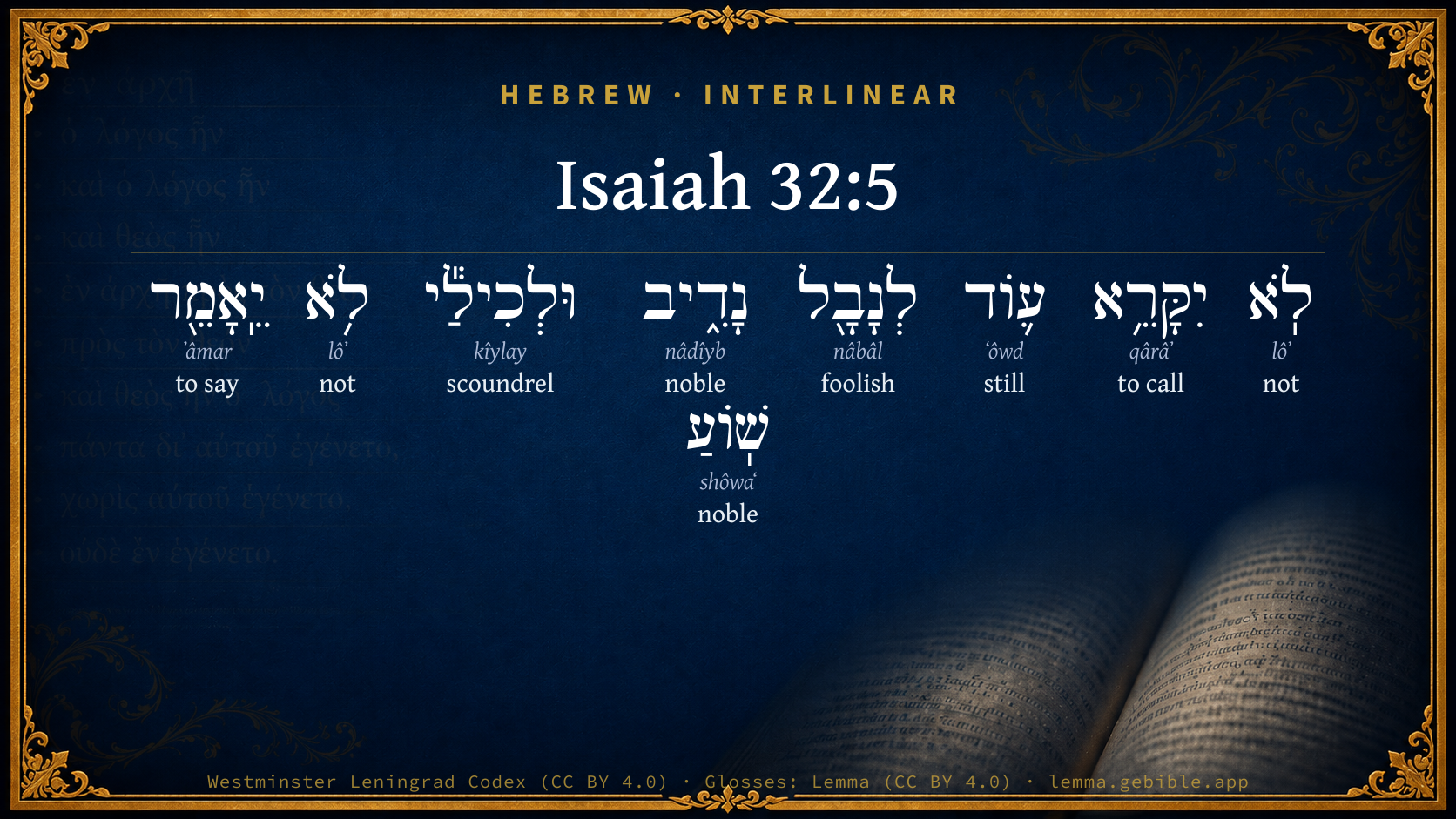
Isaiah 32:5

Hebrew (Westminster Leningrad Codex) Isaiah 32:5 appears in the Hebrew Old Testament. The text above is from the Westminster Leningrad Codex. Each word links to its Strong’s number, a concise gloss, and parsing drawn from the Open Scriptures Hebrew Bible morphology. Click any word for its full Brown-Driver-Briggs (BDB) entry.
Download image
Cite this verse

Isaiah 32:5 (World English Bible). Public Domain. Lemma interlinear Bible study tool, https://lemma.gebible.app/v/isaiah/32/5.

Show BibTeX & RIS
BibTeX
RIS
English Translation
The fool shall be no more called noble, nor the scoundrel be highly respected.
World English Bible · Public Domain
Highlights Full analysis ↓
Download a study sheet

One document with this verse’s original text, its word-by-word gloss line, the meaning frame, cross-references with their text, attributed commentary, and full source and license credits — printable, and it pastes into notes with its structure intact.

This verse Autodidact and up

Study sheet (.html) Plain text (.txt)

A passage Seminary Student

Up to 50 verses in one chapter. A passage sheet keeps up to 6 commentary sources and 12 cross-references per verse, in the order this page ranks them, and says so on the sheet whenever that leaves anything out. Ask for a single verse and you get the Autodidact verse sheet above.

Everything on this page stays free to read, with no account — the sheet is a download of what is already on screen, not access to it.

Want to remove ads? Support Godless Engineer
Compare translations 3

The same verse in 3 English versions, stacked beneath the original-language interlinear above. Click any original word for its lexicon entry.

Each is an independent rendering of the whole verse — the interlinear is not word-aligned to these translations.

Highlighted words mark where these versions differ — a whole-verse word diff, not a word-by-word alignment.

  • World English Bible Public Domain
    The fool shall be no more called noble, nor the scoundrel be highly respected.
  • King James Version Public Domain
    The vile person shall be no more called liberal, nor the churl said to be bountiful.
  • unfoldingWord Literal Text CC BY-SA 4.0
    It will no longer be called to the fool, “noble,” and it will not be said of the scoundrel, “honorable.”

unfoldingWord Literal Text — © unfoldingWord, licensed CC BY-SA 4.0. Word-aligned USFM3 via Door43 (git.door43.org/unfoldingWord/en_ult).

Versions to compare (up to 4)

3 of 4 selected

Show all 18 translations

Every available English version of this verse, each an independent rendering of the whole verse.

  • World English Bible Public Domain
    The fool shall be no more called noble, nor the scoundrel be highly respected.
  • Berean Standard Bible Public Domain
    No longer will a fool be called noble, nor a scoundrel be respected.
  • Majority Standard Bible Public Domain
    No longer will a fool be called noble, nor a scoundrel be respected.
  • King James Version Public Domain
    The vile person shall be no more called liberal, nor the churl said to be bountiful.
  • American Standard Version (1901) Public Domain
    The fool shall be no more called noble, nor the churl said to be bountiful.
  • Revised Version (1885) Public Domain
    The vile person shall be no more called liberal, nor the churl said to be bountiful.
  • Geneva Bible (1599) Public Domain
    A nigard shall no more be called liberall, nor the churle riche.
  • Douay-Rheims (1899) Public Domain
    The fool shall no more be called prince: neither shall the deceitful be called great:
  • Young's Literal Translation Public Domain
    A fool is no more called `noble,' And to a miser it is not said, `rich;'
  • Literal Standard Version CC BY-SA 4.0
    A fool is no more called “noble,” || And to a miser it is not said, “rich”;
  • Unlocked Literal Bible CC BY-SA 4.0
    The fool will no longer be called honorable, nor the deceiver called principled.
  • unfoldingWord Literal Text CC BY-SA 4.0
    It will no longer be called to the fool, “noble,” and it will not be said of the scoundrel, “honorable.”
  • Darby Bible Public Domain
    The vile man shall be no more called noble, nor the churl said to be bountiful:
  • World Messianic Bible Public Domain
    The fool will no longer be called noble, nor the scoundrel be highly respected.
  • Webster's Bible Public Domain
    The vile person shall be no more called liberal, nor the churl said to be bountiful.
  • Free Bible Version CC BY-SA 4.0
    No longer will fools be called respectable or crooks highly-regarded.
  • Bible in Basic English Public Domain
    The foolish man will no longer be named noble, and they will not say of the false man that he is a man of honour.
  • JPS Tanakh (1917) Public Domain
    The vile person shall be no more called liberal, nor the churl said to be noble.

Literal Standard Version (2020), Covenant Press — licensed CC BY-SA 4.0. Text via the HelloAO Bible API (eBible.org). Unlocked Literal Bible (unfoldingWord) — licensed CC BY-SA 4.0. Text via the HelloAO Bible API (eBible.org). unfoldingWord Literal Text — © unfoldingWord, licensed CC BY-SA 4.0. Word-aligned USFM3 via Door43 (git.door43.org/unfoldingWord/en_ult). Free Bible Version, Dr. Jonathan Gallagher — licensed CC BY-SA 4.0. Text via the HelloAO Bible API (eBible.org).

Word by word

More ways to search: Search by grammar → Find every occurrence → Compare this word →

Practice this passage: Drill this verse → Learn its vocabulary →

About this verse

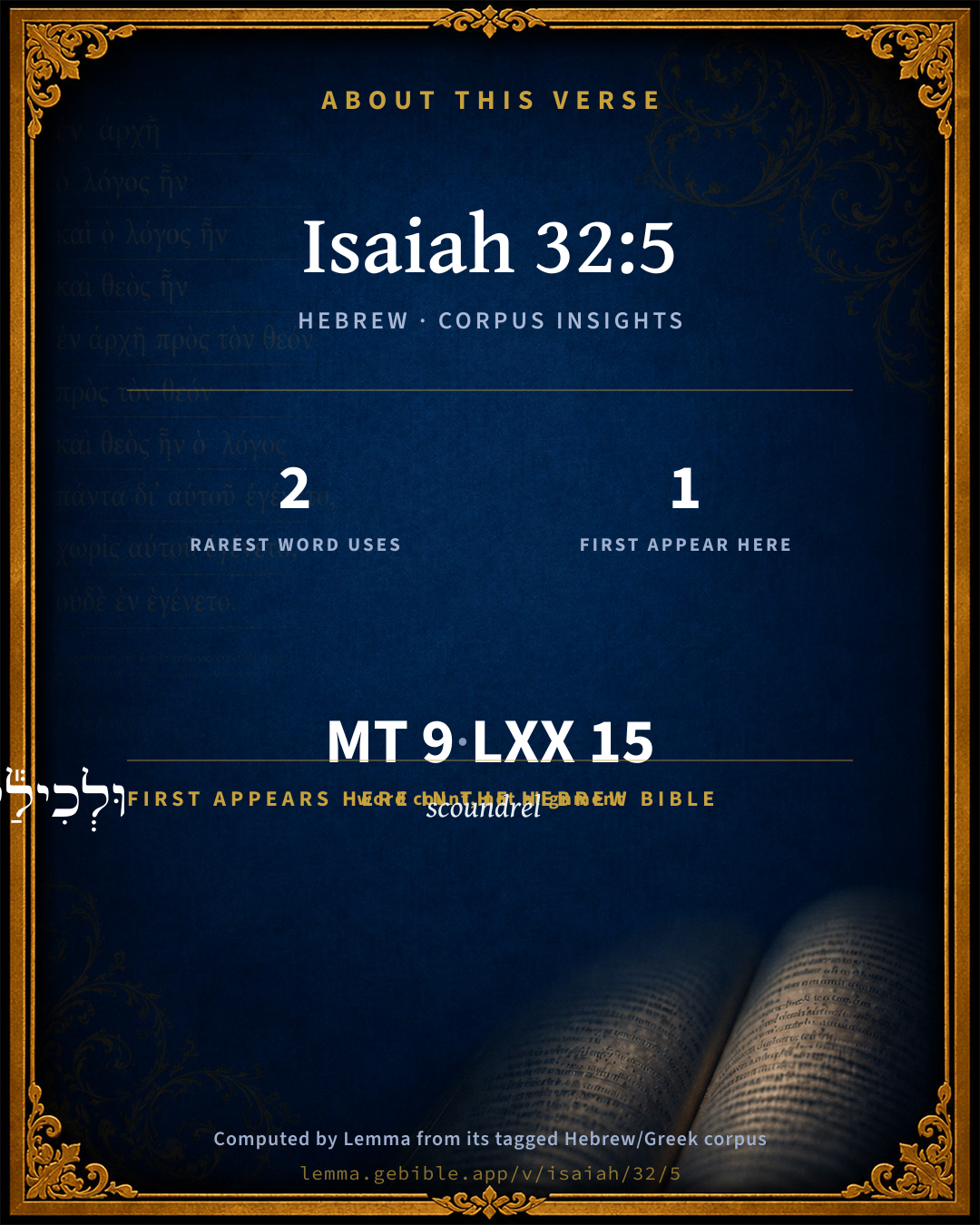
These counts appear in no published source. They are computed here, from the morphology-tagged text and Lemma’s own curated glosses. What Lemma adds →

9
words
8
distinct lemmas
Prophets
section

Notable vocabulary

The rarest word here is וּלְכִילַ֕י scoundrel H3596 — appearing just 2 times in the whole Hebrew Bible.

First appearance in Scripture

This word makes its first canonical appearance in the Hebrew Bible here:

  • וּלְכִילַ֕י scoundrel H3596

Shared distinctive vocabulary

וּלְכִילַ֕י scoundrel H3596 occurs in 2 verses of the Hebrew Bible. Also found in:

Grammatical profile

  • 2 verbs
  • 2 nouns
  • 2 adjectives
  • 1 adverb
  • 2 particles

Verb forms

  • יִקָּרֵ֥א Niphal · Imperfect
  • יֵֽאָמֵ֖ר Niphal · Imperfect

Repetition

A word recurs within this verse — often emphatic in Hebrew:

Hebrew & Septuagint length

In English translation the verse runs 14 words from the Hebrew and 23 from the Septuagint (LXX English) — the Septuagint runs noticeably longer here. See the side-by-side →

A rough comparison of the two English renderings, which tokenize alike — not a word-level alignment.

Word counts can differ between the Hebrew and the Greek without any difference in meaning — e.g. the Hebrew direct-object marker אֵת has no separate Greek word, and Greek often adds the article ὁ.

In the original languages it is 9 Hebrew tokens and 15 Greek tokens — but the two are counted differently (Hebrew bundles its prefixes and suffixes into one token; the Greek is in lemma form), so that isn’t a like-for-like length.

Cross-references

6

Topical passages linked to Isaiah 32:5 in the Treasury of Scripture Knowledge — connected by theme and wording, ordered by reader-vote popularity; previews shown in the World English Bible.

  • Isaiah 5:20 Woe to those who call evil good, and good evil; Who put darkness for light, And light for darkness; Who put bitter for sweet, And sweet for bitter!
  • Psalms 15:4 In whose eyes a vile man is despised, But who honors those who fear Yahweh; He who keeps an oath even when it hurts, and doesn't change;
  • Malachi 3:18 Then you shall return and discern between the righteous and the wicked, between him who serves God and him who doesn't serve him.
  • 1 Samuel 25:3–8 Now the name of the man was Nabal; and the name of his wife Abigail; and the woman was of good understanding, and of a beautiful face: but the man was churlish and evil in his doings; and he was of the house of Caleb.
  • 1 Samuel 25:25 Please don't let my lord regard this worthless fellow, even Nabal; for as his name is, so is he; Nabal is his name, and folly is with him: but I your handmaid didn't see the young men of my lord, whom you did send.
  • Proverbs 23:6–8 Don't eat the food of him who has a stingy eye, And don't crave his delicacies:

Cross-references courtesy of OpenBible.info (CC BY 4.0).

Hebrew and Greek witnesses Masoretic Hebrew ↔ Greek Septuagint

The same verse in the two great witnesses to the Old Testament, shown verse-for-verse.

Here the Septuagint runs noticeably longer than the Hebrew — LXX2012 (modern English Septuagint) 23 words vs World English Bible 14. A rough length comparison of the two English translations, not a word-level alignment — read both below.

These are two independent witnesses, not word-aligned to each other, and the Septuagint is shown in lemma (dictionary) form.

Hebrew Isaiah 32:5 Masoretic · Westminster Leningrad Codex

לֹֽא יִקָּרֵ֥א ע֛וֹד לְנָבָ֖ל נָדִ֑יב וּלְכִילַ֕י לֹ֥א יֵֽאָמֵ֖ר שֽׁוֹעַ

The fool shall be no more called noble, nor the scoundrel be highly respected.

World English Bible · Public Domain

Greek LXX Isaiah 32:5 Septuagint · lemma form

καί οὐκέτι μή εἶπον ὁ μωρός ἄρχω καί οὐκέτι μή εἶπον ὁ ὑπηρέτης σύ σιγάω

And they shall no more at all tell a fool to rule, and your servants shall no more at all say, Be silent.

LXX2012 (modern English Septuagint) · Public Domain

On this verse, Matthew Poole's English Annotations discusses the Septuagint’s reading. Read the note in Commentary ↓

Hebrew: Westminster Leningrad Codex (CC BY 4.0). Greek: Septuagint (public domain); English from LXX2012 (modern English Septuagint) (Public Domain). How the Septuagint differs from the Hebrew →

Targum (Aramaic paraphrase)

1

The Targum is the ancient Jewish Aramaic paraphrase of the Hebrew Scriptures — an interpretive translation, not the Hebrew text itself. Onkelos (literal) and Pseudo-Jonathan (expansive) render the Torah, and Jonathan the Prophets. Coverage is partial: where no permissively-licensed English translation exists for a verse, only the Aramaic is shown. This is verse-level text, not a word-by-word alignment to the Hebrew.

  1. Targum Jonathan Prophets (Joshua–Malachi)
    לָא יִתְאֲמַר עוֹד לְרַשִׁיעַיָא צַדִיקַיָא וְלִדְעַבָרוּ עַל מֵימְרֵהּ לָא יִתְאַמַר תַּקִיפִין:

    And the wicked man shall no more be called just, and he that transgresses against His WORD shall not be called mighty.

    Targum Jonathan — Aramaic: “Mikraot Gedolot” (public domain). English: “Sefaria Community Translation” (CC0 1.0 (public-domain dedication)); “London "Chaldee Paraphrase," 1871” (public domain). Text via Sefaria.

Commentary

Notes on Isaiah 32:5 from classic Christian and Jewish commentators (each source and its license shown beneath its notes). The classic Christian expositions comment on the surrounding passage and are grouped to its opening verse, so a note may address several verses; the Jewish commentaries on the Tanakh (Rashi and others) are per-verse, so they appear only where the commentator wrote on this verse.

Lemma curates 59 commentaries, every one of them public domain or Creative Commons licensed, each selected and text-cleaned for this edition rather than reprinted as found. About our sources →

Trapp's Complete Commentary

John Trapp

Isa 32:5 The vile person shall be no more called liberal, nor the churl said [to be] bountiful.

Ver. 5. The vile person shall be no more called liberal.] Benefici et magnifici domini. That sapless fellow Nabal shall no more be called Nadib, that is, bountiful benefactor, or gracious lord. Of Archbishop Bancroft was made this couplet:

“Here lies his Grace in cold clay clad,

Who died for want of what he had.”

In Ahaz’s time the worst of men got honours and offices. Hezekiah would look to that. Dignity shall henceforth wait upon desert, and flattery shall be utterly out of fashion and request at court. Our old English Bibles have it thus: A niggard shall not be called a gentle or gentleman.

Nor the churl said to be bountiful.] The holdfast, whose logic is all little enough to conclude for himself, shall not be called a Magnifico. The Vulgate Latin hath it, Neque fraudulentus appellabitur maior.

John Trapp, A Commentary or Exposition upon All the Books of the Old and New Testament (1647–1656) — public domain. Text from a community e-Sword module.

The Biblical Illustrator

Joseph S. Exell

Isa_32:5

The vile person shall be no more called liberal

Vile person

(Hebrews, nabal):--Compare 1Sa_25:1-44.

(A. B.Davidson, LL. D.)

The conventional abuse of moral terms

Liberal and bountiful were conventional names. The Hebrew word for liberal originally meant exactly that--open-hearted, generous, magnanimous. In the East it is the character which, above all, they call princely. So, like our words noble and nobility, it became a term of rank--lord or prince--and was often applied to men who were not at all great-hearted, but the very opposite: even to the vile person. Vile person is literally the faded, or the exhausted, whether mentally or morally--the last kind of character that would be princely. The other conventional term used by Isaiah refers to wealth, rather than rank. The Hebrew for bountiful literally means abundant--a man blessed with plenty--and is used in the Old Testament both for the rich and the fortunate. Its nearest English equivalent is, perhaps, the successful man. To this, Isaiah fitly opposes a name, wrongly rendered in our version churl, but corrected in the margin to crafty--the fraudulent, the knave. When moral discrimination comes, says Isaiah, men will not apply the term princely to worn-out characters, nor grant them the social respect implied by the term. They will not call the fraudulent the fortunate, nor canonise him as successful who has gotten his wealth by underhand means. The worthless character shall no more be called princely, nor the knave hailed as the successful. But mens characters shall stand out true in their actions, and by their fruits ye shall know them. In those magic days the heart shall come to the lips, and its effects be unmistakable. (Prof. G. A. Smith, D. D.)

The Biblical Illustrator, edited by Joseph S. Exell (c. 1880s–1900s) — public domain. Text from a community e-Sword module.

Joseph Benson's Commentary

Isa 32:5-6. The vile person — Base and worthless men; shall be no more called liberal — Shall no longer be reputed honourable, because of their high and honourable places, but wickedness shall be discovered wherever it is, and virtue manifested and rewarded. Nor the churl said to be bountiful — The sordid and covetous man; but under this one vice all vices are understood, as under the opposite virtue of bountifulness all virtues are comprehended. For the vile person will speak villany — Men shall no longer be miscalled; for every one will discover what he is by his words and actions. And will work iniquity — He will, from time to time, be devising wickedness, that he may execute it when he hath opportunity. To practise hypocrisy — To do bad things, though with a pretence of religion and justice. To utter error — To pass unjust sentences, directly contrary to the command of God. To cause the drink, &c. — Whereby they take away the bread and drink of the poor.

Joseph Benson's Commentary on the Old and New Testaments (1811–1818) — public domain. Text from a community e-Sword module.

Tyndale Open Study Notes

Tyndale Open Resources

32:5 Only foolish people value fools and scoundrels as heroes (see also 19:11, 13; 32:6-8).

Tyndale Open Study Notes — © Tyndale Open Resources, licensed CC BY-SA 4.0. Text via the HelloAO Bible API.

Geneva Bible (1599)

Geneva Bible translators

Vice shall no more be called virtue, nor virtue esteemed by power and riches.

Geneva Bible (1599) marginal notes — public domain. Text via Bolls.life.

Jamieson, Fausset & Brown

Robert Jamieson, A. R. Fausset & David Brown

vile--rather, "fool" [LOWTH]; that is, ungodly (Psa 14:1; Psa 74:18).

liberal--rather, "noble-minded."

churl--rather, "fraudulent" [GESENIUS].

bountiful--religiously. The atheistic churl, who envies the believer his hope "full of immortality," shall no longer be held as a patriot struggling for the emancipation of mankind from superstition [HORSLEY].

Jamieson, Fausset & Brown — Commentary Critical and Explanatory on the Whole Bible (1871) — public domain (CC PDM 1.0). Text via the HelloAO Bible API.

Adam Clarke's Commentary

Verse 5. The vile person shall no more be called liberal] The different epithets here employed require minute explanation.

The vile person - נבל nabal, the pampered, fattened, brainless fellow, who eats to live, and lives to eat; who will scarcely part with any thing, and that which he does give he gives with an evil eye and a grudging heart.

Liberal - נדיב nadib; the generous, openhearted, princely man, who writes on all his possessions, For myself and mankind, and lives only to get and to do good.

The churl - כילי kilai, the avaricious man; he who starves himself amidst his plenty, and will not take the necessaries of life for fear of lessening his stock.

Thus he differs from נבל nabal, who feeds himself to the full, and regards no one else; like the rich man in the Gospel. The avaricious man is called כילי kilai, from כי ki, for, לי li, myself; or contracted from כל col, all, and לי li, to myself: all is mine; all I have is my own; and all I can get is for myself: and yet this man enjoys nothing; he withholds

From back and belly too their proper fare:-

O cursed lust of gold, when for thy sake

The wretch throws up his interest in both worlds,

First starved in this, then damned in that to come!

Bountiful - שוע shoa, he who is abundantly rich; who rejoices in his plenty, and deals out to the distressed with a liberal hand.

Adam Clarke's Commentary on the Bible (1810–1826) — public domain. Text from a community e-Sword/MySword module.

Ellicott's Commentary for English Readers

(5) The vile person shall be no more called liberal.—Better, noble, the καλοκάγαθος of the Greeks, the ingenuus of the Latin. So for “bountiful,” read gentle. Here, again, we have a picture, the exact contrast of that which met us at the beginning of Isaiah’s work, when men “called good evil, and evil good” (chap 5:20).

A Bible Commentary for English Readers, edited by Charles John Ellicott (1878–1897) — public domain. Text from a community e-Sword module.

The Cambridge Bible for Schools and Colleges

gen. ed. J. J. S. Perowne

5. True and false nobility shall no longer be confounded because of artificial caste-distinctions.

The vile person] or, the fool; see the typical specimen, Nabal by name and by nature, in 1 Samuel 25.

liberal] Better: noble (in rank). The word denotes, first, one of generous, self-sacrificing disposition; and then one of noble degree; Num_21:18 and often.

The word rendered churl occurs only here (and Isa_32:7), and its meaning is uncertain. The view adopted by most commentators derives it from a root signifying guile or craftiness (hence Cheyne well renders knave). bountiful represents another rare word (only Job_34:19 [E.V. “rich”]), perhaps man of substance.

The Cambridge Bible for Schools and Colleges (gen. ed. J. J. S. Perowne; Cambridge University Press, 1878–1918) — public domain. Text from a community e-Sword module.

John Gill's Exposition

The vile person shall be no more called liberal,.... Or "Nabal" (a fool) "shall no more be called Nadib" (e) (a prince); or have this name put upon him, or be advanced to honour and dignity, or be flattered with such a title, so unbecoming him. The sense seems to be, that, in Gospel times, such who are fools as to the knowledge of spiritual things, that have no spiritual and experimental knowledge of the truths of the Gospel, but are quite ignorant of them, shall not be made princes, or spiritual rulers, and governors in the house of God;

nor the churl said to be bountiful; or called a lord, as Jarchi interprets the word; which, he says, is used of such an one, because all men look to him, and respect him (f); but now a covetous and tenacious man, that withholds more than is meet, that keeps, all he has to himself, without communicating to others, and scarcely allows himself the necessaries of life, being so sordidly avaricious, such an one shall not be a pastor, or ruler, in the church of God; such were the Scribes and Pharisees among the Jews in Christ's time, and therefore rejected, Mat 23:14 folly and covetousness are both bad things in a minister of the word, and greatly disqualify a man for that work and office: or else the sense of the whole is, that there should be such a discerning of men in Gospel times, and such faithfulness used towards them, that a wicked man should not be taken for a good man, nor in a flattering way be called one; but the precious and the vile should be distinguished, and called by their right names. The Targum is,

"the wicked man shall be no more called just, and they that transgress his word shall not be called mighty.''

(e) "Nabal non vocabitur Nadib", Gataker. (f) Kimchi makes it to be the same with a "prodigal person"; and so Ben Melech; but Elias, in his Tishbi, p. 93, 95. says there is a difference between them; he says, is one that squanders his money in eating and drinking, and the like, which is a bad custom; but is an honourable person, who gives his money to good purposes, and more than is meet, which is a good custom; and he is more praiseworthy than the liberal man.

John Gill's Exposition of the Whole Bible (1746–1763) — public domain (CC PDM 1.0). Text via the HelloAO Bible API.

Albert Barnes' Notes on the Bible

The vile person - Hebrew, ‘Fool.’ But the connection requires us to understand this as the opposite of liberal; and it means a person who is close, miserly, narrow-minded, covetous. This person is designated, very appropriately, as a fool.

Shall be no more called liberal - It is probable that under the reign of former princes, when all views of right and wrong had been perverted, people of unprincipled character had been the subjects of flattery, and names of virtue had been attributed to them by their friends and admirers. But it would not be so under the virtuous reign of the prince here celebrated. Things would be called by their right names, and flattery would not be allowed to attribute to people, qualities which they did not possess.

Nor the churl - The word ‘churl’ means properly a rude, surly, ill-bred man; then a miser, a niggard. The Hebrew word means properly a deceiver, a fraudulent man (Gesenius). The word avaricious, however, seems to suit the connection. Lowth renders it, ‘Niggard.’ Noyes, ‘Crafty.’

Bountiful - Flattery shall no more ascribe to a miserly man a character which does not belong to him.

Albert Barnes' Notes on the Bible (1834–1885) — public domain. Text from a community e-Sword/MySword module.

Haydock's Catholic Bible Commentary

Deceitful. Hebrew, "miser be called liberal," Luke xxii. 25. These good princes are contrasted with Achaz, who had oppressed his subjects.

George Leo Haydock (1774–1849), Haydock's Catholic Family Bible and Commentary, 1859 edition — public domain. Excludes Psalms (Douay-Rheims chapter numbering differs from Protestant) and Deuterocanonical books (Catholic canon only).

Matthew Poole's English Annotations

The vile person; base and worthless men. Heb. the fool; which in Scripture use commonly signifies a wicked man.

Shall be no more called liberal, or noble, or a prince, or lord, as this word is used, Psa 118:9; 146:3, and elsewhere. The sense of the place is, either,

1. Unworthy men shall not be advanced to places of honour and power, as the LXX. and some others understand it; for to be called is oft put in Scripture for to be, as hath been frequently observed. Or,

2. Vicious and worthless persons shall no longer be reputed honourable and virtuous because of their high and honourable places, as commonly they are under wicked princes by means of flatterers; but wickedness shall be discovered and punished wheresoever it is, and virtue shall be manifested and rewarded, and all things shall be managed with sincerity and simplicity; which was eminently fulfilled under the gospel; by the preaching whereof, and by Christ’s Spirit, hypocrites are detected, and men are enabled to discern between good and evil, both persons and things. The churl; the sordid and covetous man; which is a great vice in any man, but especially in magistrates; who therefore must be men hating covetousness, Exo 18:21. But under this one vice all vices are understood by a synecdoche, very frequent in Scripture and in other authors; as under the apposite virtue of bountifulness all virtues are comprehended.

Matthew Poole's English Annotations on the Holy Bible (1683–1685) — public domain. Text from a community e-Sword/MySword module.

Whedon's Commentary on the Bible

Daniel D. Whedon

5-8. Vile person — A fool in the scriptural sense, one who knows well enough, but knows unwisely, viciously.

Liberal — Noble.

Churl — One acting niggardly. Messianic times are of gradual growth. Radical moral changes are not wrought in an hour. Steadily the changes go on, until they end in universal righteousness and peace. The prophet here gives persons, qualities, and things their right names. The fool, or “vile person,” cannot, in that day, as now, pass for a noble man. The niggard or “churl” shall have no name for being generous, for making small gifts go for much giving.

The instruments also of the churl are devices for making himself richer at the cost of the poor. On the other hand, the noble man is the liberal man; kind to all, he supplies wants with generosity, and by such a name shall he stand.

Daniel D. Whedon (gen. ed.), Commentary on the Old and New Testaments (1874–1909) — public domain. Text from a community e-Sword module.

The Pulpit Commentary

The vile person shall be no more called liberal; rather, the foolish person as nabal is commonly translated (Deu_32:6 2Sa_3:33 2Sa_13:13 Psa_14:1 Psa_39:8 Psa_74:22, etc.) such a man as the "Nabal" of 1Sa 25. Men are apt to confound moral distinctions, and to call the "fools" who waste their substance in feasting and revelry "generous" or "liberal," and the niggards (churls) who hoard their riches "warm men," "wealthy men," "men well to do in the world" (Isa_5:20; and comp. Arist.," Eth. Nic.," 2:8, Thucyd., 3:82). This perversion of truth shall not obtain in Messiah"s kingdom. Bountiful; rather, wealthy. (comp. Job_34:19, where the same word is translated "rich

Vers. 5-8. A mark of good government, etc.

Three lines of thought are here laid down. We have

I A MARK OF GOOD GOVERNMENT. The displacement of the unworthy and the elevation of the good and wise. Under the reign of the righteous King (ver. 1) the "fool will no longer be called a nobleman," the man of mean character but lofty rank will be made to know his true place in the commonwealth; on the other hand, the man who has in him the qualities of nobility (ver. 8) shall have the opportunity of dealing graciously and bountifully. There is no surer sign of demoralization, no more certain indication of approaching ruin in any community, than the promotion of the unfit and the unworthy; and there is no healthier symptom than the advancement of the upright and the capable. Let nations, societies, Churches, look to it.

II A HINT AS TO SIN"S LARGE DIMENSIONS.

1. Its tenacity of purpose. "The vile person will continue to speak villany, and his heart to work iniquity" (ver. 6). You may put him in a position in which you might hope that the commonest self-respect would ensure propriety of conduct, but you will be mistaken; the corrupt tree will bear evil fruit on any soil.

2. Its guilefulness. "To practice hypocrisy;" professing justice and purity, it enacts all that is unfair and evil.

3. Its falsity. To utter error," etc. Sin, especially when found in high places, is most mischievous in that it scatters everywhere the fruitful seeds of error; it poisons the mind with misleading fancies, with shallow notions which may sound well but are essentially false and which conduct to wrong and ruin. Thus it leads men to act "against the Lord," for they pursue a path which he has forbidden, and they diffuse principles which are hostile to his reign.

4. Its heartlessness. (Ver. 6.) What though the issue of those evil actions be that men"s hearts are hungry and their souls athirst; what though they bring about impoverishment, destitution bodily or spiritual, or both together, let the cup be drained, let the game be played out!

5. Its unscrupulousness. Its "instruments are evil" (ver. 7).

6. Its effrontery. (Ver. 7.) They whom it is wronging may be the poor, and therefore the appropriate objects of compassion; they may be the innocent, those who are in the right, and therefore the proper objects of regard; nothing but downright falsehood may suffice to prevail against them (Ahab and Naboth). No matter; let the case be established, let sentence be executed!

III A COMMENDATION OF GENEROSITY. "The liberal deviseth liberal things," etc. (ver. 8).

1. A man of a noble nature will find opportunities for doing generous things. How well a man serves the Church or the world is not a question of circumstance half so much as a matter of character. Given a free, generous, open-hearted man, and you may confidently reckon on repeated and continuous acts of unselfish usefulness. "Jesus "went about doing good, for God was with him," and because God was in him; because, in him, as in a perennial fountain, dwelt Divine love, pity, self-sacrifice. We need care comparatively little about arranging opportunities of service, though that is not a matter of indifference; what is of supreme consequence is that those we teach and train should have planted within them the sacred seeds of holy, Christian generosity.

2. Generous measures will give a noble heart stability: by them "he shall stand.

(1) They will commend him to the affection and the support of the direct recipients of his goodness. (Job_29:11-13)

(2) They will result in general prosperity. (Pro_11:24 2Co_9:6)

(3) They will command the blessing of God. C. (Psa_41:1 Psa_112:9 Luk_6:35 Heb_13:16)

The Pulpit Commentary (1880–1919), ed. H.D.M. Spence-Jones & Joseph S. Exell — public domain. Text from a community e-Sword module.

John Wesley's Explanatory Notes

The vile - Base and worthless men. Liberal - Shall no longer be reputed honourable, because of their high and honourable places, but wickedness shall be discovered where ever it is, and virtue manifested and rewarded. The churl - The sordid and covetous man; but under this one vice, all vices are understood, as under the opposite virtue of bountifulness; all virtues are comprehended.

John Wesley, Explanatory Notes Upon the Whole Bible (1754–1765) — public domain. Text via the GEBible commentary corpus.

Keil & Delitzsch

C. F. Keil & F. Delitzsch

A third fruit of the blessing is the naming and treating of every one according to his true character. "The fool will no more be called a nobleman, nor the crafty a gentleman. For a fool speaks follies, and his heart does godless things, to practise tricks and to speak error against Jehovah, to leave the soul of hungry men empty, and to withhold the drink of thirsty ones. And the craft of a crafty man is evil, who devises stratagems to destroy suffering ones by lying words, even when the needy exhibits his right. But a noble man devises noble things, and to noble things he adheres." Nobility of birth and wealth will give place to nobility of character, so that the former will not exist or not be recognised without the latter. Nâdı̄bh is properly one who is noble in character, and then, dropping the ethical meaning, one who is noble by rank. The meaning of the word generosus follows the same course in the opposite direction. Shōă‛ is the man who is raised to eminence by the possession of property; the gentleman, as in Job 34:19. The prophet explains for himself in what sense he uses the words nâbhâl and kı̄lai. We see from his explanation that kı̄lai neither signifies the covetous, from kūl (Saad.), nor the spendthrift, from killâh (Hitzig). Jerome gives the correct rendering, viz., fraudulentus; and Rashi and Kimchi very properly regard it as a contraction of nekhı̄lai. It is an adjective form derived from כּיל = נכיל, like שׂיא = נשׂיא (Job 20:6). The form כּלי in Isa 32:1 is used interchangeably with this, merely for the sake of the resemblance in sound to כּליו (machinatoris machinae pravae). In Isa 32:6, commencing with ki (for), the fact that the nâbhâl (fool) and kı̄lai (crafty man) will lose their titles of honour, is explained on the simple ground that such men are utterly unworthy of them. Nâbhâl is a scoffer at religion, who thinks himself an enlightened man, and yet at the same time has the basest heart, and is a worthless egotist. The infinitives with Lamed show in what the immorality ('âven) consists, with which his heart is so actively employed. In Isa 32:6, ūbhedabbēr ("and if he speak") is equivalent to, "even in the event of a needy man saying what is right and well founded:" Vâv = et in the sense of etiam ((cf., Sa2 1:23; Psa 31:12; Hos 8:6; Ecc 5:6); according to Knobel, it is equivalent to et quidem, as in Ecc 8:2; Amo 3:11; Amo 4:10; whereas Ewald regards it as Vav conj. (283, d), "and by going to law with the needy," but את־אביון would be the construction in this case (vid., Kg2 25:6). According to Isa 32:8, not only does the noble man devise what is noble, but as such (הוּא) he adheres to it. We might also adopt this explanation, "It is not upon gold or upon chance that he rises;" but according to the Arabic equivalents, qūm signifies persistere here.

Keil & Delitzsch — Biblical Commentary on the Old Testament (1861–1891) — public domain (CC PDM 1.0). Text via the HelloAO Bible API. (Old Testament only.)

J. A. Alexander on Isaiah

Joseph Addison Alexander

When men’s eyes are thus opened, they will no longer confound the essential distinctions of moral character, because they will no longer be deceived by mere appearances. Things will then be called by their right names. “The fool (in the emphatic Scriptural sense, the wicked man) will no longer be called noble (men will no longer attach ideas of dignity and greatness to the name or person of presumptuous sinners), and the churl (or niggard) will no more be spoken of (or to) as liberal.” The last clause, like the other, contains a specific illustration of the general truth that men shall be estimated at their real value.

Joseph Addison Alexander, The Prophecies of Isaiah (1846–1847; New York: Scribner, 1870–1878) — public domain. Text from a community e-Sword module.

Rashi

Rabbi Shlomo Yitzchaki (Rashi)

deceitful (כִּילַי) a plotting deceiver, who plots evil.

noble (שׁוּעַ) an expression of a lord, to whom everyone turns (שׁוֹעִין).

Rashi on the Tanakh — English translations: “The Judaica Press complete Tanach with Rashi, translated by A. J. Rosenberg” (CC BY 4.0); “Pentateuch with Rashi's commentary by M. Rosenbaum and A.M. Silbermann, 1929-1934” (public domain); “The Metsudah Tanach series, Lakewood, N.J” (CC BY 4.0); and “The Book of Joshua, Metsudah Publications, 1997” (CC BY 4.0). Text via Sefaria.

Ibn Ezra

Rabbi Abraham ibn Ezra

נבל The vile person. Comp. נובלת fading (1:30).

כילי The opposite of שוע. שוע Bountiful. A noble person, whose hands are loose, ready to give, and not closed. Comp. ושוע and turning. Adopting a sort of homiletic explanation, כילי may be said to be composed of two words, כי לי for it belongs to me; for he says, שלי שלי what is mine shall remain mine (Aboth 5:13)

Ibn Ezra on the Tanakh — English translations: “Sefaria Community Translation” (CC0 1.0 (public-domain dedication)); “Yalkut, Sifsei Chachomim Chumash, Metsudah Publications, 2009” (CC BY 4.0); and “Commentary of Ibn Ezra on Isaiah - trans. by M. Friedlander, 1873” (public domain). Text via Sefaria.

Lesson kit

Teaching starters — assembled from the data on this page, not authored interpretation. Every prompt links to the verse data it draws on. Edit before teaching.

Isaiah, in the Prophets, opens this verse with 9 words (8 distinct Hebrew lemmas). Its most distinctive word is kîylay (“scoundrel”). The Greek Septuagint runs longer here. A historical commentator’s framing appears above. Read the whole chapter for the surrounding context.

Discussion questions

  1. How does “scoundrel” (kîylay) shape what this verse is saying?
  2. This is the first place “scoundrel” appears in Scripture (first appears here). What does its debut here establish?
  3. How does Isaiah 32:7, which shares the word «scoundrel», read alongside this verse?
  4. What does the repetition of “not” (2× in this one verse) do in this verse?
  5. The Septuagint runs longer here than the Hebrew. What might account for the difference?
  6. These translations render this verse differently; the difference is in the English rendering, not the original. What questions does that raise?
  7. «יִקָּרֵ֥א» is a Niphal Imperfect verb. How does that grammatical form shape the action described?
  8. Compare how Trapp's Complete Commentary and The Biblical Illustrator read this verse. Where do they agree or differ?

Things to notice

Reading settings

Reading text

Shown beneath each verse's original-language words.

Old Testament
Old Testament edition

Read the OT as the Masoretic Hebrew (MT) or the Greek Septuagint (LXX).

English shown for the Greek Septuagint (in the Hebrew ↔ Greek comparison).

Comparing translations? Open the Compare panel on any verse page to stack up to four side by side.