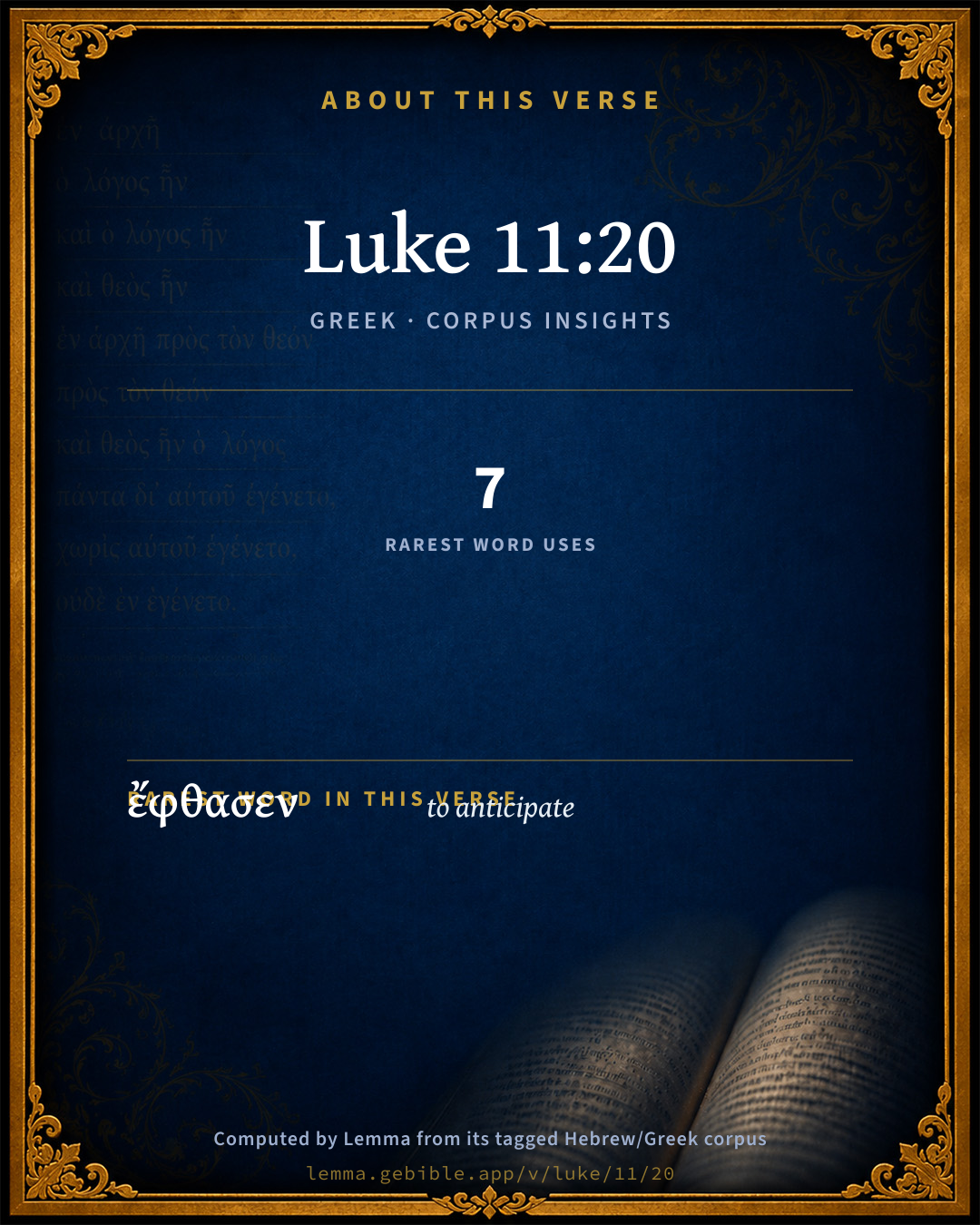
Luke 11:20

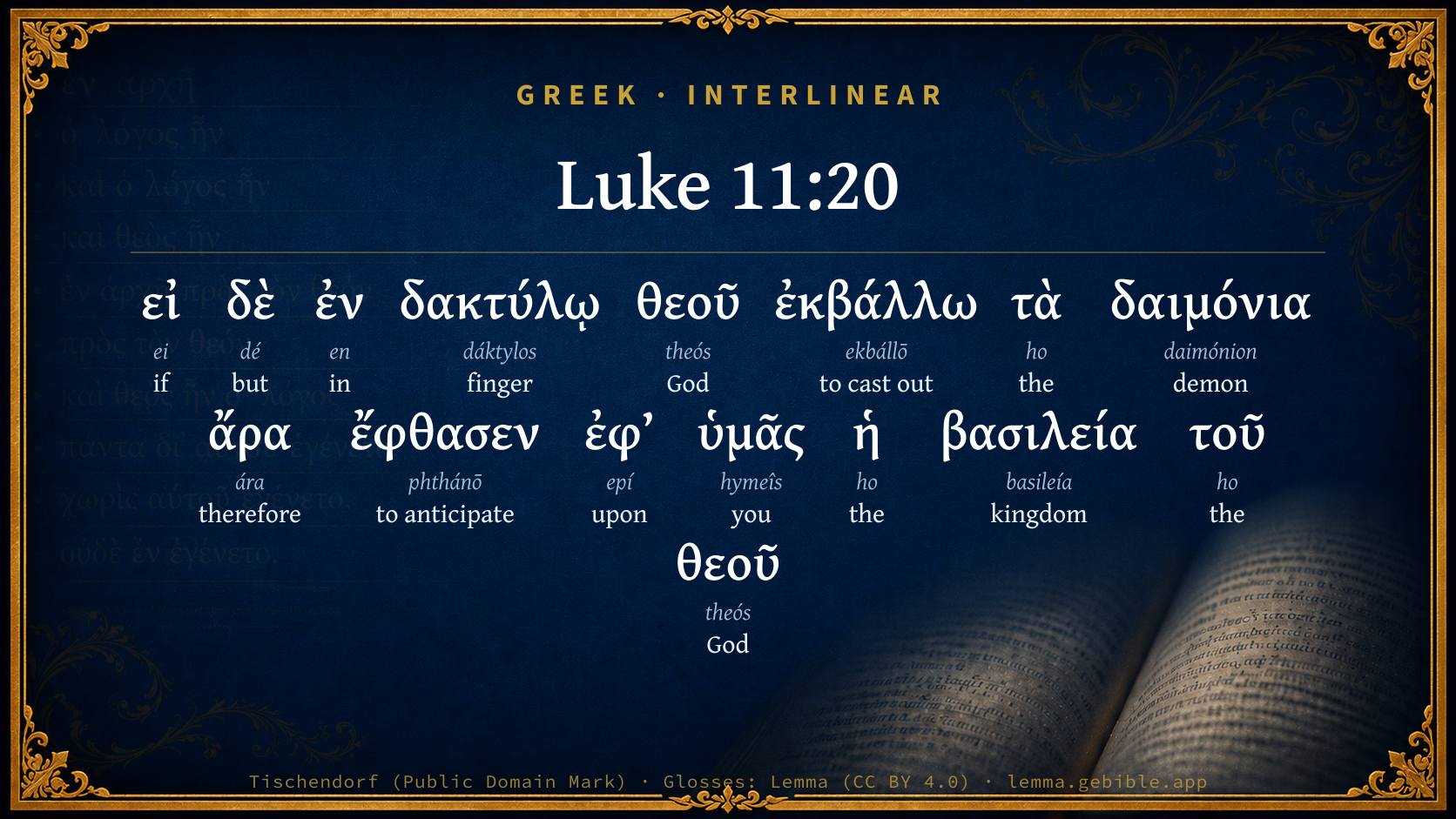
Greek (Tischendorf 8th ed.) Luke 11:20 appears in the Greek New Testament. The text above is from the Tischendorf 8th edition. Each word links to its Strong’s number and a concise gloss. Click any word for its full Thayer’s Greek Lexicon entry.
Download image
Cite this verse

Luke 11:20 (World English Bible). Public Domain. Lemma interlinear Bible study tool, https://lemma.gebible.app/v/luke/11/20.

Show BibTeX & RIS
BibTeX
RIS
English Translation
But if I by the finger of God cast out demons, then the Kingdom of God has come to you.
World English Bible · Public Domain
Download a study sheet

One document with this verse’s original text, its word-by-word gloss line, the meaning frame, cross-references with their text, attributed commentary, and full source and license credits — printable, and it pastes into notes with its structure intact.

This verse Autodidact and up

Study sheet (.html) Plain text (.txt)

A passage Seminary Student

Up to 50 verses in one chapter. A passage sheet keeps up to 6 commentary sources and 12 cross-references per verse, in the order this page ranks them, and says so on the sheet whenever that leaves anything out. Ask for a single verse and you get the Autodidact verse sheet above.

Everything on this page stays free to read, with no account — the sheet is a download of what is already on screen, not access to it.

Want to remove ads? Support Godless Engineer
Compare translations 3

The same verse in 3 English versions, stacked beneath the original-language interlinear above. Click any original word for its lexicon entry.

Each is an independent rendering of the whole verse — the interlinear is not word-aligned to these translations.

Highlighted words mark where these versions differ — a whole-verse word diff, not a word-by-word alignment.

  • World English Bible Public Domain
    But if I by the finger of God cast out demons, then the Kingdom of God has come to you.
  • King James Version Public Domain
    But if I with the finger of God cast out devils, no doubt the kingdom of God is come upon you.
  • unfoldingWord Literal Text CC BY-SA 4.0
    But if I cast out the demons by the finger of God, then the kingdom of God has come upon you.

unfoldingWord Literal Text — © unfoldingWord, licensed CC BY-SA 4.0. Word-aligned USFM3 via Door43 (git.door43.org/unfoldingWord/en_ult).

Versions to compare (up to 4)

3 of 4 selected

Show all 19 translations

Every available English version of this verse, each an independent rendering of the whole verse.

  • World English Bible Public Domain
    But if I by the finger of God cast out demons, then the Kingdom of God has come to you.
  • Berean Standard Bible Public Domain
    But if I drive out demons by the finger of God, then the kingdom of God has come upon you.
  • Majority Standard Bible Public Domain
    But if I drive out demons by the finger of God, then the kingdom of God has come upon you.
  • King James Version Public Domain
    But if I with the finger of God cast out devils, no doubt the kingdom of God is come upon you.
  • American Standard Version (1901) Public Domain
    But if I by the finger of God cast out demons, then is the kingdom of God come upon you.
  • Revised Version (1885) Public Domain
    But if I by the finger of God cast out devils, then is the kingdom of God come upon you.
  • Geneva Bible (1599) Public Domain
    But if I by ye finger of God cast out deuils, doutles the kingdome of God is come vnto you.
  • Douay-Rheims (1899) Public Domain
    But if I by the finger of God cast out devils; doubtless the kingdom of God is come upon you.
  • Young's Literal Translation Public Domain
    but if by the finger of God I cast forth the demons, then come unawares upon you did the reign of God.
  • Literal Standard Version CC BY-SA 4.0
    but if by the finger of God I cast forth the demons, then the Kingdom of God came unaware on you.
  • Unlocked Literal Bible CC BY-SA 4.0
    But if I drive out demons by the finger of God, then the kingdom of God has come to you.
  • unfoldingWord Literal Text CC BY-SA 4.0
    But if I cast out the demons by the finger of God, then the kingdom of God has come upon you.
  • Darby Bible Public Domain
    But if by the finger of God I cast out demons, then the kingdom of God is come upon you.
  • World Messianic Bible Public Domain
    But if I by God’s finger cast out demons, then God’s Kingdom has come to you.
  • Webster's Bible Public Domain
    But if I with the finger of God cast out demons, no doubt the kingdom of God is come upon you.
  • Free Bible Version CC BY-SA 4.0
    However, if I am driving out demons by the power of God, then this proves God's kingdom has arrived. It's right here among you!
  • Bible in Basic English Public Domain
    But if I, by the finger of God, send out evil spirits, then the kingdom of God has overtaken you.
  • Text-Critical English NT CC BY 4.0
    But if I cast out demons by the finger of God, then the kingdom of God has come upon you.
  • Tyndale New Testament (1534) Public Domain
    But if I with the finger of God cast out devyls noo doute the kyngdome of God is come vpon you.

Literal Standard Version (2020), Covenant Press — licensed CC BY-SA 4.0. Text via the HelloAO Bible API (eBible.org). Unlocked Literal Bible (unfoldingWord) — licensed CC BY-SA 4.0. Text via the HelloAO Bible API (eBible.org). unfoldingWord Literal Text — © unfoldingWord, licensed CC BY-SA 4.0. Word-aligned USFM3 via Door43 (git.door43.org/unfoldingWord/en_ult). Free Bible Version, Dr. Jonathan Gallagher — licensed CC BY-SA 4.0. Text via the HelloAO Bible API (eBible.org).

Word by word

More ways to search: Search by grammar → Find every occurrence → Compare this word →

Practice this passage: Drill this verse → Learn its vocabulary →

ἔφθασεν
phthánō
G5348
“to anticipate”
Verb, Aorist, Active, Indicative, 3rd person, Singular
Part of Speech
Verb
Tense
Aorist
Voice
Active
Mood
Indicative
Person
3rd person
Number
Singular
Full Thayer's Definition

Origin: apparently a primary verb

TDNT: 10:28,1

1. to come before, precede, anticipate 2. to come to, arrive at 3. to reach, attain to
  1. εἰ ei G1487 “if” Conditional
  2. δὲ dé G1161 “but” Conjunction
  3. ἐν en G1722 “in” Preposition
  4. δακτύλῳ dáktylos G1147 “finger” Noun, Dative, Singular, Masculine
  5. θεοῦ theós G2316 “God” Noun, Genitive, Singular, Masculine
  6. ἐκβάλλω ekbállō G1544 “to cast out” Verb, Present, Active, Indicative, 1st person, Singular
  7. τὰ ho G3588 “the” Article, Accusative, Plural, Neuter
  8. δαιμόνια daimónion G1140 “demon” Noun, Accusative, Plural, Neuter
  9. ἄρα ára G686 “therefore” Particle
  10. ἐφ’ epí G1909 “upon” Preposition
  11. ὑμᾶς hymeîs G5210 “you” Personal pronoun, 2nd person, Accusative, Plural
  12. ἡ ho G3588 “the” Article, Nominative, Singular, Feminine
  13. βασιλεία basileía G932 “kingdom” Noun, Nominative, Singular, Feminine
  14. τοῦ ho G3588 “the” Article, Genitive, Singular, Masculine
  15. θεοῦ theós G2316 “God” Noun, Genitive, Singular, Masculine

About this verse

These counts appear in no published source. They are computed here, from the morphology-tagged text and Lemma’s own curated glosses. What Lemma adds →

16
words
13
distinct lemmas
Gospels
section

Notable vocabulary

The rarest word here is ἔφθασεν to anticipate G5348 — appearing just 7 times in the whole Greek New Testament.

Shared distinctive vocabulary

ἔφθασεν to anticipate G5348 occurs in 7 verses of the Greek New Testament. Also found in:

Repetition

Words recur within this verse:

Cross-references

9

Topical passages linked to Luke 11:20 in the Treasury of Scripture Knowledge — connected by theme and wording, ordered by reader-vote popularity; previews shown in the World English Bible.

  • Exodus 8:19 Then the magicians said to Pharaoh, "This is the finger of God:" and Pharaoh's heart was hardened, and he didn't listen to them; as Yahweh had spoken.
  • Matthew 12:28 But if I by the Spirit of God cast out demons, then the Kingdom of God has come upon you.
  • Luke 10:9 Heal the sick who are therein, and tell them, 'The Kingdom of God has come near to you.'
  • Matthew 3:2 "Repent, for the Kingdom of Heaven is at hand!"
  • Daniel 2:44 In the days of those kings shall the God of heaven set up a kingdom which shall never be destroyed, nor shall the sovereignty of it be left to another people; but it shall break in pieces and consume all these kingdoms, and it shall stand forever.
  • Luke 10:11 'Even the dust from your city that clings to us, we wipe off against you. Nevertheless know this, that the Kingdom of God has come near to you.'
  • 2 Thessalonians 1:5 This is an obvious sign of the righteous judgment of God, to the end that you may be counted worthy of the Kingdom of God, for which you also suffer.
  • Acts 20:25 Now, behold, I know that you all, among whom I went about preaching the Kingdom of God, will see my face no more.
  • Acts 28:23–28 When they had appointed him a day, many people came to him at his lodging. He explained to them, testifying about the Kingdom of God, and persuading them concerning Jesus, both from the law of Moses and from the prophets, from morning until evening.

Cross-references courtesy of OpenBible.info (CC BY 4.0).

Commentary

Notes on Luke 11:20 from classic Christian and Jewish commentators (each source and its license shown beneath its notes). The classic Christian expositions comment on the surrounding passage and are grouped to its opening verse, so a note may address several verses; the Jewish commentaries on the Tanakh (Rashi and others) are per-verse, so they appear only where the commentator wrote on this verse.

Lemma curates 59 commentaries, every one of them public domain or Creative Commons licensed, each selected and text-cleaned for this edition rather than reprinted as found. About our sources →

Tyndale Open Study Notes

Tyndale Open Resources

11:20 the Kingdom of God has arrived among you: Jesus’ exorcisms were evidence that the Kingdom of God was present.

Tyndale Open Study Notes — © Tyndale Open Resources, licensed CC BY-SA 4.0. Text via the HelloAO Bible API.

Bengel's Gnomon

Johann Albrecht Bengel

Luk 11:20. Δακτύλῳ, with the finger) by a power manifestly divine, and without any difficulty. Comp. Exo 8:19.

Bengel's Gnomon of the New Testament — English translation (T&T Clark, Edinburgh, 1860) — public domain. Text from a community e-Sword module.

Expositor's Greek Testament

ed. W. Robertson Nicoll

Luk 11:20 . ἐν δακτύλῳ Θεοῦ : instead of Mt.’s ἐν πνεύματι Θεοῦ , which is doubtless the original expression, being more appropriate to the connection of thought. Lk.’s expression emphasises the immediateness of the Divine action through Jesus, in accordance with his habit of giving prominence to the miraculousness of Christ’s healing acts. But the question was not as to the fact, but as to the moral quality of the miracle. The phrase recalls Exo 8:9 . ἔφθασεν : φθάνω in classics means to anticipate, in later Greek to reach , the idea of priority being dropped out.

The Expositor's Greek Testament, edited by W. Robertson Nicoll (1897–1910) — public domain. Text from a community e-Sword module.

Godet's Commentaries

Frédéric Louis Godet

Vers. 20-26. After having by this new argumentum ad hominem refuted the supposition of His adversaries, Jesus gives the true explanation of His cures by contrasting the picture of one of those expulsions which He works (Luk 11:20-22) with that of a cure performed by the exorcists (Luk 11:23-26).

Vers. 20-22.—“But if I with the finger of God cast out devils, no doubt the kingdom of God is come upon you. 21. When a strong man armed keepeth his palace, his goods are in peace. 22. But when a stronger than he shall come upon him and overcome him, he taketh from him all his armour wherein he trusted, and divideth his spoils.” Luk 11:20 draws the conclusion (δέ, now; ἄρα, then) from the preceding arguments, and forms the transition to the two following scenes. In this declaration there is betrayed intense indignation: “Let them take heed! The kingdom of God, for which they are waiting, is already there without their suspecting it; and it is upon it that their blasphemies fall. They imagine that it will come with noise and tumult; and it has come more quickly than they thought, and far otherwise it has reached them (ἔφθασεν). The construction ἐφ᾿ ὑμᾶς, upon you, has a threatening sense. Since they set themselves in array against it, it is an enemy which has surprised them, and which will crush them. The term finger of God is admirably in keeping with the context: the arm is the natural seat and emblem of strength; and the finger, the smallest part of the arm, is the symbol of the ease with which this power acts. Jesus means, “As for me, I have only to lift my finger to make the devils leave their prey.” These victories, so easily won, prove that henceforth Satan has found his conqueror, and that now God begins really to reign. This word, full of majesty, unveils to His adversaries the grandeur of the work which is going forward, and what tragic results are involved in the hostile attitude which they are taking towards it. Instead of by the finger of God, Matthew says by the Spirit of God; and Weizsäcker, always in favour of the hypothesis of a common document, supposes that Luke has designedly replaced it by another, because it seemed to put Jesus in dependence on the Holy Spirit. What may a man not prove with such criticism? Is it not simpler, with Bleek, to regard the figurative term of Luke as the original form in the saying of Jesus, which has been replaced by the abstract but radically equivalent expression of Matthew?

Mark omits the two Luk 11:19-20. Why would he have done so, if he had had before his eyes the same document as the others?

Vers. 21 and 22 serve to illustrate the thought of Luk 11:20: the citadel of Satan is plundered; the fact proves that Satan is vanquished, and that the kingdom of God is come. A strong and well-armed warrior watches at the gate of his fortress. So long as he is in this position (ὅταν), all is tranquil (ἐν εἰρήνη) in his fastness; his captives remain chained, and his booty (σκῦλα) is secure. The warrior is Satan (the art. ὁ alludes to a single and definite personality); his castle is the world, which up till now has been his confirmed property. His armour consists of those powerful means of influence which he wields. His booty is, first of all, according to the context, those possessed ones, the palpable monuments of his sway over humanity; and in a wider sense, that humanity itself, which with mirth or groans bears the chains of sin. But a warrior superior in strength has appeared on the world’s stage; and from that moment all is changed. ᾿Επάν, from the time that, denotes the abrupt and decisive character of this succession to power, in opposition to ὅταν, as long as, which suited the period of security. This stronger man is Jesus (the art. ὁ also alludes to His definite personality). He alone can really plunder the citadel of the prince of this world. Why? Because He alone began by conquering him in single combat. This victory in a personal engagement was the preliminary condition of His taking possession of the earth. It cannot be doubted that, as Keim and Weizsäcker acknowledge, Jesus is here thinking of the scene of His temptation. That spiritual triumph is the foundation laid for the establishment of the kingdom of God on the earth, and for the destruction of that of Satan. As soon as a man can tell the prince of this world to his face, “Thou hast nothing in me” (Joh 14:30), the stronger man, the vanquisher of the strong man, is come; and the plundering of his house begins. This plundering consists, first of all, of the healings of the possessed wrought by Jesus. Thus is explained the ease with which He performs those acts by which He rescues those unhappy ones from malignant powers, and restores them to God, to themselves, and to human society. All the figures of this scene are evidently borrowed from Isa 49:24-25, where Jehovah Himself fills the part of liberator, which Jesus here ascribes to Himself.

Vers. 23-26. “He that is not with me is against me; and he that gathereth not with me scattereth. 24. When the unclean spirit is gone out of a man, he walketh through dry places, seeking rest; and finding none, he saith, I will return unto my house whence I came out. 25. And when he cometh, he findeth it swept and garnished. 26. Then goeth he, and taketh to him seven other spirits more wicked than himself; and they enter in, and dwell there: and the last state of that man is worse than the first.”

The relation between Luk 11:23 and the verses which precede and follow has been thought so obscure by De Wette and Bleek, that they give up the attempt to explain it. In itself the figure is clear. It is that of a troop which has been dispersed by a victorious enemy, and which its captain seeks to rally, after having put the enemy to flight; but false allies hinder rather than promote the rallying. Is it so difficult to understand the connection of this figure with the context? The dispersed army denotes humanity, which Satan has conquered; the chief who rallies it is Jesus; the seeming allies, who have the appearance of fighting for the same cause as He does, but who in reality scatter abroad with Satan, are the exorcists. Not having conquered for themselves the chief of the kingdom of darkness, it is only in appearance that they can drive out his underlings; in reality, they serve no end by those alleged exploits, except to strengthen the previous state of things, and to keep up the reign of the ancient master of the world. Such is the object which the following illustration goes to prove. By the thrice-repeated ἐμοῦ, me, of Luk 11:23, there is brought into relief the decisive importance of the part which Jesus plays in the history of humanity; He is the impersonation of the kingdom of God; His appearance is the advent of a new power. The words σκορπίζειν, to disperse, and συνάγειν, to gather together, are found united in the same sense as here, Joh 10:13-16.

The two following verses serve to illustrate the saying of Luk 11:23, as Luk 11:21-22 illustrated the declaration of Luk 11:20. They are a sort of apologue poetically describing a cure wrought by the means which the exorcists employ, and the end of which is to show, that to combat Satan apart from Christ, his sole conqueror, is to work for him and against God; comp. the opposite case, Luk 9:49-50. The exorcist has plied his art; the impure spirit has let go his prey, quitted his dwelling, which for the time has become intolerable to him. But two things are wanting to the cure to make it real and durable. First of all, the enemy has not been conquered, bound; he has only been expelled, and he is free to take his course of the world, perhaps to return. Jesus, on the other hand, sent the malignant spirits to their prison, the abyss whence they could no longer come forth till the judgment (Luk 8:31, Luk 4:34). Then the house vacated is not occupied by a new tenant, who can bar the entrance of it against the old one. Jesus, on the contrary, does not content Himself with expelling the demon; He brings back the soul to its God; He replaces the unclean spirit by the Holy Spirit. As a relapse after a cure of this sort is impossible, so is it probable and imminent in the former case. Every line of the picture in which Jesus represents this state of things is charged with irony. The spirit driven out walks through dry places. This strange expression was probably borrowed from the formulas of exorcism. The spirit was relegated to the desert, the presumed abode of evil spirits (Tob 8:3; Bar 4:35). The reference was the same in the symbolical sending of the goat into the wilderness for Azazel, the prince of the devils.

But the malignant spirit, after roaming for a time, begins to regret the loss of his old abode; would it not be well, he asks himself, to return to it? He is so sure that he needs only to will it, that he exclaims with sarcastic gaiety: I will return unto my house. At bottom he knows very well that he has not ceased to be the proprietor of it; a proprietor is only dispossessed in so far as he is replaced. First he determines to reconnoitre. Having come, he finds that the house is disposable (σχολάζοντα, Matt.). He finds what is better still: the exorcist has worked with so much success, that the house has recovered a most agreeable air of propriety, order, and comfort since his departure. Far, therefore, from being closed against the malignant spirit, it is only better prepared to receive him. Jesus means thereby to describe the restoration of the physical and mental powers conferred by the half cures which He is stigmatizing. Anew there is a famous work of destruction to be accomplished

Satan cares for no other—but this time it is not to be done by halves. And therefore there is need for reinforcement. Besides, it is a festival; there is need of friends. The evil spirit goes off to seek a number of companions sufficient to finish the work which had been interrupted. These do not require a second bidding, and the merry crew throw themselves into their dwelling. This time, we may be sure, nothing will be wanting to the physical, intellectual, and moral destruction of the possessed. Such was the state in which Jesus had found the Gergesene demoniac (Luk 8:29), and probably also Mary Magdalene (Luk 8:2). This explains in those two cases the words Legion (Luk 8:30) and seven devils (Luk 8:2), which are both symbolical expressions for a desperate state resulting from one or more relapses.

Nothing is clearer than this context, or more striking than this scene, in which it is impossible for us to distinguish fully between what belongs to the idea and what to the figure. Thus has Jesus succeeded in retorting upon the exorcists, so highly extolled by His adversaries, the reproach of being auxiliaries of Satan, which they had dared to cast on Him. Need we wonder at the enthusiasm which this discourse excited in the multitude, and at the exclamation of the woman, in which this feeling of admiration finds utterance?

3 d. Luk 11:27-28. The Incident.—“And it came to pass, as He spake these things, a certain woman of the company lifted up her voice, and said unto Him, Blessed is the womb that bare Thee, and the paps which Thou hast sucked. 28. But He said, Yea, rather, blessed are they that hear the word of God, and keep it.” Perhaps, like Mary Magdalene, this woman had herself experienced the two kinds of healing which Jesus had been contrasting. In any case, living in a society where scenes of the kind were passing frequently, she had not felt the same difficulty in apprehending the figures as we, to whom they are so strange.

Jesus in His answer neither denies nor affirms the blessedness of her who gave Him birth. All depends on this, if she shall take rank in the class of those whom alone He declares to be blessed. The true reading appears to be μενοῦνγε, μενοῦν.—“There is undoubtedly a blessedness;” γε (the restricting particle as always): “at least for those who...”

Does not this short account bear in itself the seal of its historical reality? It is altogether peculiar to Luke, and suffices to demonstrate the originality of the source from which this whole piece was derived. For this incident could not possibly stand as a narrative by itself; it must have formed part of the account of the entire scene.

The allegorical tableau, Luk 11:24 et seq., is set by Matthew in an altogether different place, and so as to give it a quite different application (Luk 12:43 et seq.). The words with which it closes, “Even so shall it be also unto this wicked generation,” prove that it is applied in that Gospel to the Jewish people taken collectively. The old form of possession was the spirit of idolatry; that of the present, seven times worse, is the Rabbinical pride, the pharisaic formalism and hypocrisy, which have dominion over the nation in the midst of its monotheistic zeal. The stroke which will fall upon it will be seven times more terrible than that with which it was visited when it was led into captivity in Jeremiah’s day. This application is certainly grand and felicitous. But it forces us entirely to separate this scene, Luk 11:24-26, as the first Gospel does, from the preceding, Luk 11:21-22, which in Matthew as well as in Luke can only refer to the healing of cases of possession; and yet those two scenes are indisputably the pendants of one another. Gess understands the application of this word in Matthew to the Jewish people in a wholly different sense. The first cure, according to him, was the enthusiastic impulse of the people in favour of Jesus in the beginning of His Galilean ministry; the relapse referred to the coldness which had followed, and which had obliged Jesus to teach in parables. But nowhere does Jesus make so marked an allusion to that crisis, to which probably the conscience of the people was not awakened. Would it not be better in this case to apply the first cure to the powerful effect produced by John the Baptist? “Ye were willing for a season,” says Jesus Himself, “to rejoice in his light” (Joh 5:35). Anyhow, what leads Matthew to convert the second scene into a national apologue, instead of leaving it with its demonological and individual application, is his insertion, immediately before, of the saying which relates to blasphemy against the Holy Spirit,—a saying which in Mark also follows the scene of the combat between the strong man and the stronger man. When, after so grave an utterance, Matthew returns to the scene (omitted by Mark) of the spirit recovering possession of his abandoned dwelling, he must necessarily give it a different bearing from that which it has in Luke. The superiority of Luke’s account cannot appear doubtful to the reader who has caught the admirable connection of this discourse, and the striking meaning of all the figures which Jesus uses to compose those two scenes. As to the true position of the saying about the blasphemy against the Holy Spirit, the question will be discussed chap. 12

Frédéric Louis Godet — Commentaries on Luke, John, Romans, and 1 Corinthians — English translation (T&T Clark, Edinburgh, 1870s–1890s) — public domain. Text from a community e-Sword module.

Geneva Bible (1599)

Geneva Bible translators

That is, by the power of God: so it is said, Exod. 8:19.

Geneva Bible (1599) marginal notes — public domain. Text via Bolls.life.

Jamieson, Fausset & Brown

Robert Jamieson, A. R. Fausset & David Brown

the finger of God--"the Spirit of God" (Mat 12:28); the former figuratively denoting the power of God, the latter the living Personal Agent in every exercise of it.

Jamieson, Fausset & Brown — Commentary Critical and Explanatory on the Whole Bible (1871) — public domain (CC PDM 1.0). Text via the HelloAO Bible API.

Adam Clarke's Commentary

Verse 20. Finger of God] See Clarke on Ex 8:19.

Adam Clarke's Commentary on the Bible (1810–1826) — public domain. Text from a community e-Sword/MySword module.

Ellicott's Commentary for English Readers

(20) If I with the finger of God . . .—Note the substitution of this language for “by the Spirit of God,” in Mat_12:28, and its connection with the use by the older prophets of “the hand of the Lord,” to indicate the state which issued in prophetic inspiration (Eze_1:3; Eze_37:1), and with “the finger of God” as writing the Commandments on the tables of stone (Exo_31:18), and Pharaoh’s confession that “the finger of God” was with Moses and Aaron in the wonders which they wrought (Exo_8:19). The meaning of this boldly anthropomorphic language is sufficiently obvious. As the “hand” denotes power generally, so the “finger” symbolises power in its concentrated and specially-directed energy.

A Bible Commentary for English Readers, edited by Charles John Ellicott (1878–1897) — public domain. Text from a community e-Sword module.

The Cambridge Bible for Schools and Colleges

gen. ed. J. J. S. Perowne

20. with the finger of God] “Then the magicians said unto Pharaoh, This is the finger of God” Exo_8:19.

is come upon you] The word and tense imply suddenness and surprise.

The Cambridge Bible for Schools and Colleges (gen. ed. J. J. S. Perowne; Cambridge University Press, 1878–1918) — public domain. Text from a community e-Sword module.

John Gill's Exposition

When a strong man armed,.... By the strong man, is meant the devil; See Gill on Mat 12:29 and who may be said to be "armed", both with his own temptations, which are as fiery darts, and which are thrown by him thick and fast, suddenly and swiftly, privily, and with great art and cunning, and with great strength, and are very injurious; and also with the sins and lusts of men, which are armour of unrighteousness, and which Satan turns upon them, and makes use of against them, to their great detriment; and who

keepeth his palace: which is the corrupt heart of an unregenerate man, where he dwells as a king, has his throne, keeps his court, and has his courtiers, and attendants, the lusts of the flesh, and the desires of the will, and the carnal affections; and which, as filthy a palace as it is, is perfectly agreeable to his nature; and this is kept by a guard of devils, and worldly lusts, till its strong holds are demolished by the Gospel, and Christ the King of glory enters in; till such time,

his goods are in peace: there is no concern in such an heart about sin, no uneasiness on that account, no sense of danger, nor inquiry after salvation; no dread upon the mind at the curses of the law, nor fears of hell, and damnation; but such a man lives in entire security, crying Peace, Peace, to himself.

John Gill's Exposition of the Whole Bible (1746–1763) — public domain (CC PDM 1.0). Text via the HelloAO Bible API.

The Pulpit Commentary

But if I with the finger of God cast out devils, no doubt the kingdom of God is come upon you. Here Jesus points to a fact well known and thoroughly established. There was no question here; the most obstinate cases of possession had yielded to that "finger" be spoke of here; the fiercest of the, alas! (then) great company of the insane, at the bidding of that quiet, humble Rabbi, for ever shook off the spirit of madness, in whatever form of terrible possession it had been dwelling in his body. There was no question here; the only point raised by his enemies how had that quiet Rabbi done these strange, mighty works Jesus had answered; and now draws a picture of one of these acts of his. The "finger of God" in St. Matthew, where the same or a similar discourse is related, is called the "Spirit of God." The expression is strange, but is one not unusual in ancient Hebrew phraseology. So the Egyptian magicians said to Pharaoh, "This is the finger of God". (Exo_8:19) The ten commandments are described as written on the two tables of stone with the "finger of God." "You have seen by what power the devils obey me; yea, the kingdom of God, for which you are waiting and looking, lo, it is come upon you.

Christianity the benignant power.

Lasting power shows solid worth. The corrupt empire falls; the false system is exploded; the demoralizing custom is discarded. That which, under all changes, shows itself strong and enduring, is proved to be sound and good. But add the element of benignity. Jesus Christ adduces his beneficent power in the expulsion of evil spirits from the bodies of men as a convincing evidence of the Divine presence; that being done, "no doubt the kingdom of God is come." Power for good, for healing, for restoring, for transforming, such power continuing for many generations and acting under all skies, doubt" that is from above; it is of God. If we find that Christianity has proved itself to be the one great benignant power in the world, exerting a gracious, redeeming, elevating influence on humanity, then "no doubt the kingdom of God is come" upon us. We shall see that this is so if we consider

I THE STATE OF SOCIETY WHEN JESUS CAME. And we have to take into our account the parental tyranny; the position of woman in her state of inferiority and even degradation; the universal sentiment toward the stranger or the foreigner, spoken of and treated as a "barbarian" and an enemy; the prevalence of war, and its conduct with every imaginable cruelty and the most shocking recklessness of life; the prevalence of slavery under a system in which the slaves were regarded and treated as absolutely without any rights or claims whatsoever; the existence of gladiatorial shows, in which the lives of hundreds of strong men in the midst of life were sacrificed for sport to men and even to women; the common usage of infanticide; the abundance of pauperism, existing to such an extent that in the time of Caesar "nearly three-fourths of the whole population of the city of Rome were on the roll of public succor;" the institution of torture; the practice of licentious shows, and of unnatural and unnameable vices. We have here no more than a bare outline of the evils which existed in the world when "Jesus was born at Bethlehem.

II WHAT AMELIORATION CHRISTIANITY HAS WROUGHT AND IS WORKING. Three things have to be mentioned one to be admitted, and the other two to be maintained.

1. That there have been one or two auxiliary forces in the field, which have contributed towards the elevation of mankind; but theirs has been very much indeed the smaller share.

2. That Christianity was prevented from doing all it would have done by being bitterly opposed.

3. That its action has been most pitifully weakened by its truth having been so greatly corrupted. But what, notwithstanding, has it accomplished.

(1) It has cast out the demon of parental tyranny, and made the child to be the object of respect and kindness.

(2) It has raised woman, and made her the helpmeet, in every way, of her husband, causing her to be treated with deference and consideration.

(3) It has mitigated the terrible severities of war, carrying its red cross of succor into the very midst of the battle-field, and, to a large extent, removing its hideous savagery.

(4) It has gone far towards exorcising the demon of slavery.

(5) It has abolished the shameful scenes of the old Roman arena.

(6) It has extinguished infanticide and torture wherever it has authority to legislate.

(7) It is carrying on a stern and victorious campaign against impurity and intemperance.

(8) It has built hospitals, lunatic asylums, reformatories, orphanages, almshouses, by the hundred, by the thousand.

(9) It has opened the school-door in which youth everywhere is prepared for the duties, the joys, and the conflicts of life.

(10) It has sent forth its many hundreds of heralds to carry light, peace, love, purity, wisdom, into the haunts of superstition, violence, and vice.

(11) It is penetrating the worst slums of our great cities, seeking out the prod, me, the abandoned, the criminal; and with its touch of holy pity, which surely proceeds from "the finger of God," it is casting out the demons of sin and shame. At the present rate of progress, another half-century will see a most wonderful and glorious change in the aspect of the human world.

III THE CONCLUSION THAT WE DRAW. If Christianity has done, is doing, will do, all this, then "no doubt "in its advent we have the coming of the "kingdom of God." No doubt Christ has that to say to us which it is infinitely worth our while to know; that to do for us it is our highest privilege to have done on our behalf; that to be to us which it is immeasurably desirable he should be. Let us learn of him; be led by him into paths of sacred service; and invite him to become our personal Lord and Savior. C.

The Pulpit Commentary (1880–1919), ed. H.D.M. Spence-Jones & Joseph S. Exell — public domain. Text from a community e-Sword module.

John Wesley's Explanatory Notes

If I cast out devils by the finger of God - That is, by a power manifestly Divine. Perhaps the expression intimates farther, that it was done without any labour: then the kingdom of God is come upon you - Unawares, unexpected: so the Greek word implies.

John Wesley, Explanatory Notes Upon the Whole Bible (1754–1765) — public domain. Text via the GEBible commentary corpus.

Cambridge Greek Testament for Schools and Colleges

20. ἐν δακτύλῳ θεοῦ. St Matthew has ἐν πνεύματι Θεοῦ. “Then the magicians said unto Pharaoh, This is the finger of God,” Exo 8:19.

ἔφθασεν ἐφ’ ὑμᾶς. Is come unawares upon you; or ‘is already come.’ The word and tense imply suddenness and surprise, although in some passages the force of φθάνω is weakened.

Cambridge Greek Testament for Schools and Colleges (Cambridge University Press, 1896; 21 vols, various authors incl. Carr, Maclear, Plummer, Farrar, Lumby, Moule, M. R. James, Simcox) — public domain. Text from a community e-Sword module.

Alford’s Greek Testament

Henry Alford

20.] ἐν δακτύλῳ θ. = ἐν πνεύματι θ. Matt. No distinction can be established, as Gresw. attempts. The one expression explains the other. What was done (Hebraistically speaking) by the finger of God, was done by the Spirit of God. We have much greater variations than this in sayings demonstrably the same. And as to what the same author maintains about the relative magnitude of the works of the finger, hand, and arm of God, a reference to ref. Ps., where the heavens are ‘the works of Thy fingers,’ will sufficiently shew how little reliance is to be placed on such subtleties.

Henry Alford, The Greek Testament (1849–1861) — public domain. Text from a community e-Sword module.

International Critical Commentary

20. εἰ δὲ ἐν δακτύλῳ Θεοῦ.1 As distinct from the charms and incantations used by Jewish exorcists, who did not rely simply upon the power of God. Mt. has ἐν πνεύματι Θεοῦ. Lk. seems to be fond of Hebraistic anthropomorphisms: 1:51, 66, 73. But it is not likely that “the finger of God” indicates the ease with which it is done. Comp. Exo 8:19, Exo 8:31:18; Deu 9:10; Psa 8:4.See foot-note P. 473.

ἔφθασεν ἐφʼ ὑμᾶς. In late Greek, φθάνω followed by a preposition commonly loses all notion of priority or surprise, and siniply means “arrive at, attain to”: Rom 9:31; Php 3:16; 2Co 10:14, 1Th 2:16; Dan 4:19. In 1Th 4:15 it is not followed by a preposition, and that is perhaps the only passage in N.T. in which the notion of anticipating survives. Here Vulg. and many Lat. texts have prævenit, while a2, has anticipanit; but many others have pernenit, and d has adpropinquanit.

International Critical Commentary — older volumes (1896–1929), various authors — public domain. Text from a community e-Sword module.

Vincent's Word Studies in the New Testament

Marvin R. Vincent

Is come upon you. See on Mt 12:28.

Marvin R. Vincent, Word Studies in the New Testament (1887–1900) — public domain. Text from a community e-Sword/MySword module.

Lesson kit

Teaching starters — assembled from the data on this page, not authored interpretation. Every prompt links to the verse data it draws on. Edit before teaching.

Luke, in the Gospels, opens this verse with 16 words (13 distinct Greek lemmas). Its most distinctive word is phthánō (“to anticipate”). A historical commentator’s framing appears above. Read the whole chapter for the surrounding context.

Discussion questions

  1. How does “to anticipate” (phthánō) shape what this verse is saying?
  2. How does Matthew 12:28, which shares the word «to anticipate», read alongside this verse?
  3. What does the repetition of “God” (2× in this one verse) do in this verse?
  4. These translations render this verse differently; the difference is in the English rendering, not the original. What questions does that raise?
  5. Compare how Tyndale Open Study Notes and Bengel's Gnomon read this verse. Where do they agree or differ?

Things to notice

Reading settings

Reading text

Shown beneath each verse's original-language words.

Old Testament
Old Testament edition

Read the OT as the Masoretic Hebrew (MT) or the Greek Septuagint (LXX).

English shown for the Greek Septuagint (in the Hebrew ↔ Greek comparison).

Comparing translations? Open the Compare panel on any verse page to stack up to four side by side.