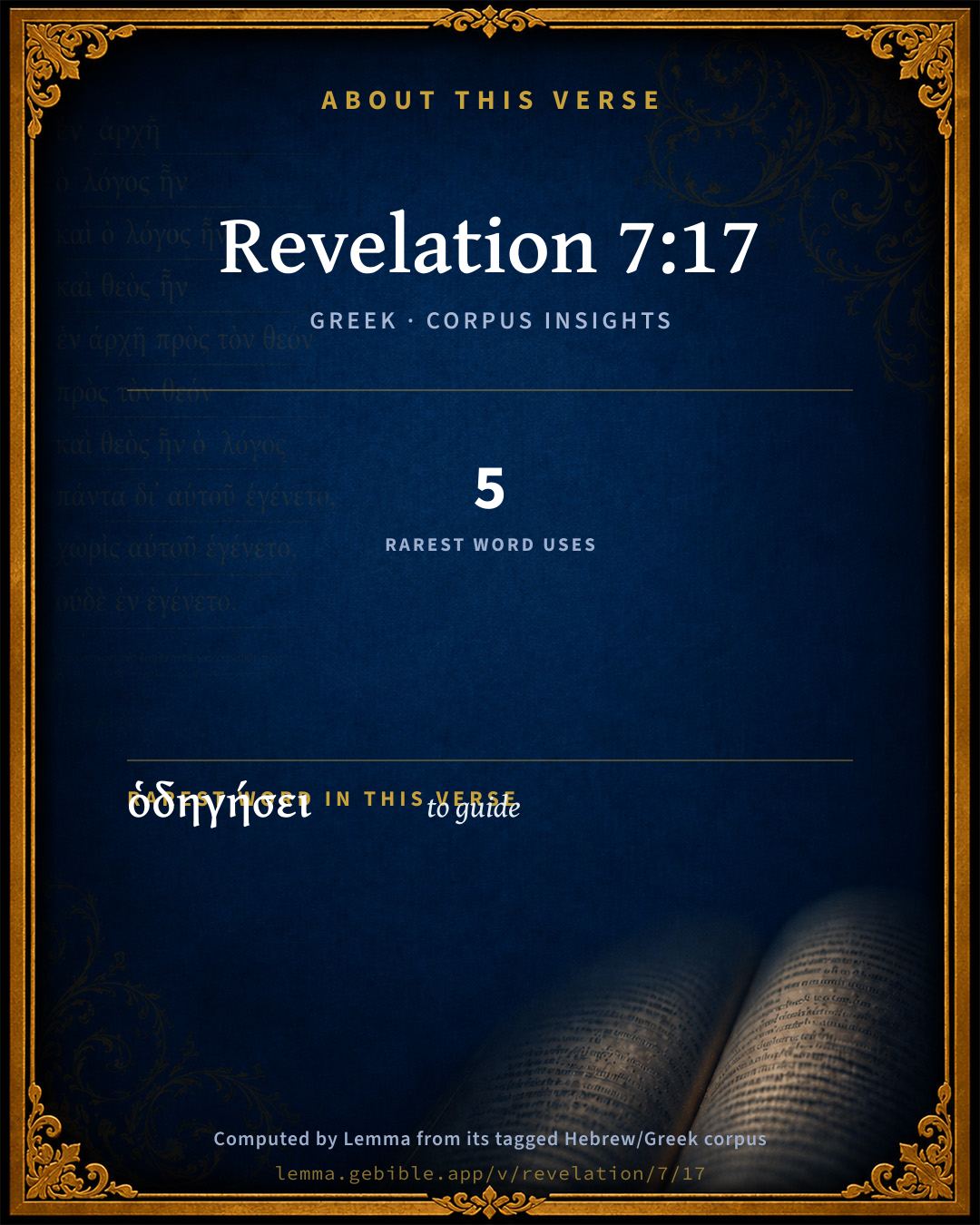
Revelation 7:17

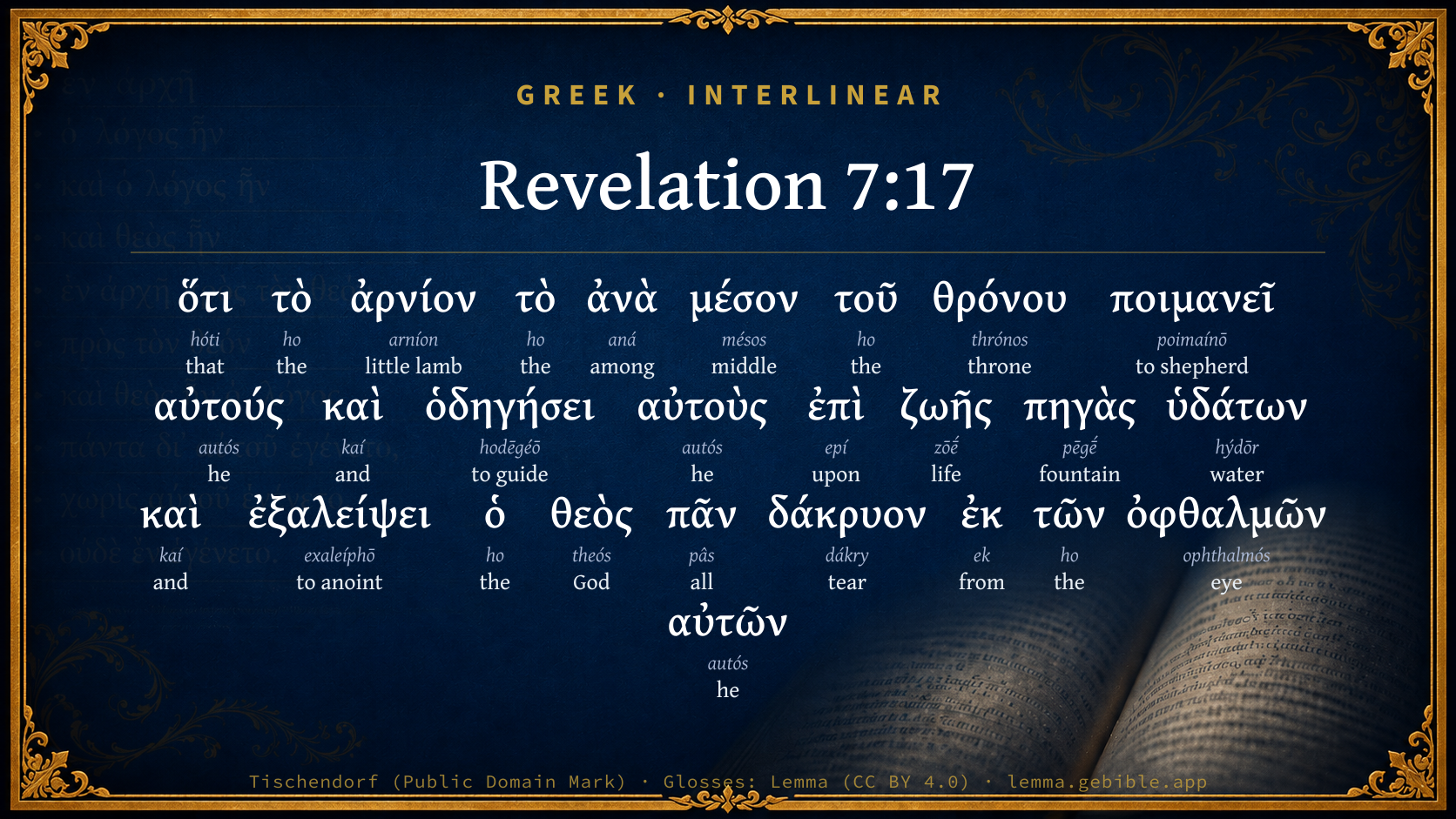
Greek (Tischendorf 8th ed.) Revelation 7:17 appears in the Greek New Testament. The text above is from the Tischendorf 8th edition. Each word links to its Strong’s number and a concise gloss. Click any word for its full Thayer’s Greek Lexicon entry.
Download image
Cite this verse

Revelation 7:17 (World English Bible). Public Domain. Lemma interlinear Bible study tool, https://lemma.gebible.app/v/revelation/7/17.

Show BibTeX & RIS
BibTeX
RIS
English Translation
for the Lamb who is in the midst of the throne shepherds them, and leads them to springs of waters of life. And God will wipe away every tear from their eyes."
World English Bible · Public Domain
Download a study sheet

One document with this verse’s original text, its word-by-word gloss line, the meaning frame, cross-references with their text, attributed commentary, and full source and license credits — printable, and it pastes into notes with its structure intact.

This verse Autodidact and up

Study sheet (.html) Plain text (.txt)

A passage Seminary Student

Up to 50 verses in one chapter. A passage sheet keeps up to 6 commentary sources and 12 cross-references per verse, in the order this page ranks them, and says so on the sheet whenever that leaves anything out. Ask for a single verse and you get the Autodidact verse sheet above.

Everything on this page stays free to read, with no account — the sheet is a download of what is already on screen, not access to it.

Want to remove ads? Support Godless Engineer
Compare translations 3

The same verse in 3 English versions, stacked beneath the original-language interlinear above. Click any original word for its lexicon entry.

Each is an independent rendering of the whole verse — the interlinear is not word-aligned to these translations.

Highlighted words mark where these versions differ — a whole-verse word diff, not a word-by-word alignment.

  • World English Bible Public Domain
    for the Lamb who is in the midst of the throne shepherds them, and leads them to springs of waters of life. And God will wipe away every tear from their eyes."
  • King James Version Public Domain
    For the Lamb which is in the midst of the throne shall feed them, and shall lead them unto living fountains of waters: and God shall wipe away all tears from their eyes.
  • unfoldingWord Literal Text CC BY-SA 4.0
    because the Lamb at the midst of the throne will shepherd them and guide them to springs of the waters of life, and God will wipe away every tear from their eyes.”

unfoldingWord Literal Text — © unfoldingWord, licensed CC BY-SA 4.0. Word-aligned USFM3 via Door43 (git.door43.org/unfoldingWord/en_ult).

Versions to compare (up to 4)

3 of 4 selected

Show all 19 translations

Every available English version of this verse, each an independent rendering of the whole verse.

  • World English Bible Public Domain
    for the Lamb who is in the midst of the throne shepherds them, and leads them to springs of waters of life. And God will wipe away every tear from their eyes."
  • Berean Standard Bible Public Domain
    For the Lamb in the center of the throne will be their shepherd. ‘He will lead them to springs of living water,’ and ‘God will wipe away every tear from their eyes.’”
  • Majority Standard Bible Public Domain
    For the Lamb in the center of the throne shepherds them. ‘He will lead them to springs of living water,’ and ‘God will wipe away every tear from their eyes.’”
  • King James Version Public Domain
    For the Lamb which is in the midst of the throne shall feed them, and shall lead them unto living fountains of waters: and God shall wipe away all tears from their eyes.
  • American Standard Version (1901) Public Domain
    for the Lamb that is in the midst of the throne shall be their shepherd, and shall guide them unto fountains of waters of life: and God shall wipe away every tear from their eyes.
  • Revised Version (1885) Public Domain
    for the Lamb which is in the midst of the throne shall be their shepherd, and shall guide them unto fountains of waters of life: and God shall wipe away every tear from their eyes.
  • Geneva Bible (1599) Public Domain
    For the Lambe, which is in the middes of the throne, shall gouerne them, and shall leade them vnto the liuely fountaines of waters, and God shall wipe away all teares from their eyes.
  • Douay-Rheims (1899) Public Domain
    For the Lamb, which is in the midst of the throne, shall rule them, and shall lead them to the fountains of the waters of life, and God shall wipe away all tears from their eyes.
  • Young's Literal Translation Public Domain
    because the Lamb that `is' in the midst of the throne shall feed them, and shall lead them unto living fountains of waters, and wipe away shall God every tear from their eyes.'
  • Literal Standard Version CC BY-SA 4.0
    because the Lamb that [is] in the midst of the throne will feed them, and will lead them to living fountains of waters, and God will wipe away every tear from their eyes.”
  • Unlocked Literal Bible CC BY-SA 4.0
    For the Lamb at the center of the throne will be their shepherd, and he will guide them to springs of living water, and God will wipe away every tear from their eyes.”
  • unfoldingWord Literal Text CC BY-SA 4.0
    because the Lamb at the midst of the throne will shepherd them and guide them to springs of the waters of life, and God will wipe away every tear from their eyes.”
  • Darby Bible Public Domain
    because the Lamb which is in the midst of the throne shall shepherd them, and shall lead them to fountains of waters of life, and God shall wipe away every tear from their eyes.
  • World Messianic Bible Public Domain
    for the Lamb who is in the middle of the throne shepherds them and leads them to springs of life-giving waters. And God will wipe away every tear from their eyes.”
  • Webster's Bible Public Domain
    For the Lamb who is in the midst of the throne will feed them, and will lead them to living fountains of waters: and God will wipe away all tears from their eyes.
  • Free Bible Version CC BY-SA 4.0
    because the Lamb who is at the center of the throne will be their shepherd, and will lead them to springs of living water, and God will wipe away every tear from their eyes.”
  • Bible in Basic English Public Domain
    For the Lamb who is on the high seat will be their keeper and their guide to fountains of living water: and God will make glad their eyes for ever.
  • Text-Critical English NT CC BY 4.0
    for the Lamb in the midst of the throne shepherds them; he leads them to springs of living water, and God will wipe away every tear from their eyes.”
  • Tyndale New Testament (1534) Public Domain
    For the lambe which ys in the myddes of the seate shall fede them and shall ledde them vnto fountaynes of lyuynge water and god shall wype awaye all teares from their eyes.

Literal Standard Version (2020), Covenant Press — licensed CC BY-SA 4.0. Text via the HelloAO Bible API (eBible.org). Unlocked Literal Bible (unfoldingWord) — licensed CC BY-SA 4.0. Text via the HelloAO Bible API (eBible.org). unfoldingWord Literal Text — © unfoldingWord, licensed CC BY-SA 4.0. Word-aligned USFM3 via Door43 (git.door43.org/unfoldingWord/en_ult). Free Bible Version, Dr. Jonathan Gallagher — licensed CC BY-SA 4.0. Text via the HelloAO Bible API (eBible.org).

Word by word

More ways to search: Search by grammar → Find every occurrence → Compare this word →

Practice this passage: Drill this verse → Learn its vocabulary →

ὁδηγήσει
hodēgéō
G3594
“to guide”
Verb, Future, Active, Indicative, 3rd person, Singular
Part of Speech
Verb
Tense
Future
Voice
Active
Mood
Indicative
Person
3rd person
Number
Singular
Full Thayer's Definition

Origin: from G3595

TDNT: 06:37,7

1. to be a guide, lead on one's way, to guide 2. to be a guide or a teacher a. to give guidance to
  1. ὅτι hóti G3754 “that” Conjunction
  2. τὸ ho G3588 “the” Article, Nominative, Singular, Neuter
  3. ἀρνίον arníon G721 “little lamb” Noun, Nominative, Singular, Neuter
  4. τὸ ho G3588 “the” Article, Nominative, Singular, Neuter
  5. ἀνὰ aná G303 “among” Preposition
  6. μέσον mésos G3319 “middle” Adjective, Accusative, Singular, Neuter
  7. τοῦ ho G3588 “the” Article, Genitive, Singular, Masculine
  8. θρόνου thrónos G2362 “throne” Noun, Genitive, Singular, Masculine
  9. ποιμανεῖ poimaínō G4165 “to shepherd” Verb, Future, Active, Indicative, 3rd person, Singular
  10. αὐτούς autós G846 “he” Personal pronoun, Accusative, Plural, Masculine
  11. καὶ kaí G2532 “and” Conjunction
  12. αὐτοὺς autós G846 “he” Personal pronoun, Accusative, Plural, Masculine
  13. ἐπὶ epí G1909 “upon” Preposition
  14. ζωῆς zōḗ G2222 “life” Noun, Genitive, Singular, Feminine
  15. πηγὰς pēgḗ G4077 “fountain” Noun, Accusative, Plural, Feminine
  16. ὑδάτων hýdōr G5204 “water” Noun, Genitive, Plural, Neuter
  17. καὶ kaí G2532 “and” Conjunction
  18. ἐξαλείψει exaleíphō G1813 “to anoint” Verb, Future, Active, Indicative, 3rd person, Singular
  19. ὁ ho G3588 “the” Article, Nominative, Singular, Masculine
  20. θεὸς theós G2316 “God” Noun, Nominative, Singular, Masculine
  21. πᾶν pâs G3956 “all” Adjective, Accusative, Singular, Neuter
  22. δάκρυον dákry G1144 “tear” Noun, Accusative, Singular, Neuter
  23. ἐκ ek G1537 “from” Preposition
  24. τῶν ho G3588 “the” Article, Genitive, Plural, Masculine
  25. ὀφθαλμῶν ophthalmós G3788 “eye” Noun, Genitive, Plural, Masculine
  26. αὐτῶν autós G846 “he” Personal pronoun, Genitive, Plural, Masculine

About this verse

These counts appear in no published source. They are computed here, from the morphology-tagged text and Lemma’s own curated glosses. What Lemma adds →

27
words
20
distinct lemmas
Revelation
section

Notable vocabulary

The rarest word here is ὁδηγήσει to guide G3594 — appearing just 5 times in the whole Greek New Testament.

Shared distinctive vocabulary

ὁδηγήσει to guide G3594 occurs in 5 verses of the Greek New Testament. Also found in:

Repetition

Words recur within this verse:

Cross-references

35

Topical passages linked to Revelation 7:17 in the Treasury of Scripture Knowledge — connected by theme and wording, ordered by reader-vote popularity; previews shown in the World English Bible.

  • John 7:37–38 Now on the last and greatest day of the feast, Jesus stood and cried out, "If anyone is thirsty, let him come to me and drink!
  • Psalms 36:8–9 They shall be abundantly satisfied with the abundance of your house. You will make them drink of the river of your pleasures.
  • John 4:14 but whoever drinks of the water that I will give him will never thirst again; but the water that I will give him will become in him a well of water springing up to eternal life."
  • Psalms 23:1–2 Yahweh is my shepherd: I shall lack nothing.
  • John 4:11 The woman said to him, "Sir, you have nothing to draw with, and the well is deep. From where then have you that living water?
  • Psalms 23:5 You prepare a table before me in the presence of my enemies. You anoint my head with oil. My cup runs over.
  • Revelation 22:1 He showed me a river of water of life, clear as crystal, proceeding out of the throne of God and of the Lamb,
  • Revelation 21:4 He will wipe away from them every tear from their eyes. Death will be no more; neither will there be mourning, nor crying, nor pain, any more. The first things have passed away."
  • Revelation 21:6 He said to me, "It is done! I am the Alpha and the Omega, the Beginning and the End. I will give freely to him who is thirsty from the spring of the water of life.
  • Isaiah 25:8 He has swallowed up death forever; and the Lord Yahweh will wipe away tears from off all faces; and the reproach of his people will he take away from off all the earth: for Yahweh has spoken it.
  • John 10:11 I am the good shepherd. The good shepherd lays down his life for the sheep.
  • John 10:14 I am the good shepherd. I know my own, and I'm known by my own;
  • Isaiah 60:20 Your sun shall no more go down, neither shall your moon withdraw itself; for Yahweh will be your everlasting light, and the days of your mourning shall be ended.
  • Psalms 28:9 Save your people, And bless your inheritance. Be their shepherd also, And bear them up forever.
  • Jeremiah 2:13 For my people have committed two evils: they have forsaken me, the spring of living waters, and hewed them out cisterns, broken cisterns, that can hold no water.
  • Ezekiel 34:23 I will set up one shepherd over them, and he shall feed them, even my servant David; he shall feed them, and he shall be their shepherd.
  • Matthew 2:6 'You Bethlehem, land of Judah, Are in no way least among the princes of Judah: For out of you shall come forth a governor, Who shall shepherd my people, Israel.'"
  • Isaiah 12:3 Therefore with joy you shall draw water out of the wells of salvation.
  • Isaiah 30:19 For the people shall dwell in Zion at Jerusalem; you shall weep no more; he will surely be gracious to you at the voice of your cry; when he shall hear, he will answer you.
  • Isaiah 35:6–7 Then shall the lame man leap as a hart, and the tongue of the mute shall sing; for in the wilderness shall waters break out, and streams in the desert.
  • Isaiah 35:10 and the ransomed of Yahweh shall return, and come with singing to Zion; and everlasting joy shall be on their heads: they shall obtain gladness and joy, and sorrow and sighing shall flee away.
  • Revelation 5:6 I saw in the midst of the throne and of the four living creatures, and in the midst of the elders, a Lamb standing, as though it had been slain, having seven horns, and seven eyes, which are the seven Spirits of God, sent out into all the earth.
  • Psalms 22:26 The humble shall eat and be satisfied. They shall praise Yahweh who seek after him. Let your hearts live forever.
  • Isaiah 25:6 In this mountain will Yahweh of Hosts make to all peoples a feast of fat things, a feast of wines on the lees, of fat things full of marrow, of wines on the lees well refined.
  • Isaiah 49:9 saying to those who are bound, Go forth; to those who are in darkness, Show yourselves. They shall feed in the ways, and on all bare heights shall be their pasture.
  • Micah 5:4 He shall stand, and shall shepherd in the strength of Yahweh, In the majesty of the name of Yahweh his God: And they will live, for then he will be great to the ends of the earth.
  • 1 Peter 5:2 Shepherd the flock of God which is among you, exercising the oversight, not under compulsion, but voluntarily, not for dishonest gain, but willingly;
  • Revelation 4:11 "Worthy are you, our Lord and God, the Holy One, to receive the glory, the honor, and the power, for you created all things, and because of your desire they existed, and were created!"
  • Song of Solomon 1:7–8 Tell me, you whom my soul loves, Where you graze your flock, Where you rest them at noon; For why should I be as one who is veiled Beside the flocks of your companions? Lover
  • Isaiah 30:25 There shall be on every lofty mountain, and on every high hill, brooks [and] streams of waters, in the day of the great slaughter, when the towers fall.
  • Jeremiah 31:9 They shall come with weeping; and with petitions will I lead them: I will cause them to walk by rivers of waters, in a straight way in which they shall not stumble; for I am a father to Israel, and Ephraim is my firstborn.
  • Micah 7:14 Shepherd your people with your staff, The flock of your heritage, Who dwell by themselves in a forest, In the midst of fertile pasture land, let them feed; In Bashan and Gilead, as in the days of old.
  • John 21:15–17 So when they had eaten their breakfast, Jesus said to Simon Peter, "Simon, son of Jonah, do you love me more than these?" He said to him, "Yes, Lord; you know that I have affection for you." He said to him, "Feed my lambs."
  • Acts 20:28 Take heed, therefore, to yourselves, and to all the flock, in which the Holy Spirit has made you overseers, to shepherd the assembly of the Lord and God which he purchased with his own blood.
  • Isaiah 40:11 He will feed his flock like a shepherd, he will gather the lambs in his arm, and carry them in his bosom, [and] will gently lead those who have their young.

Cross-references courtesy of OpenBible.info (CC BY 4.0).

Commentary

Notes on Revelation 7:17 from classic Christian and Jewish commentators (each source and its license shown beneath its notes). The classic Christian expositions comment on the surrounding passage and are grouped to its opening verse, so a note may address several verses; the Jewish commentaries on the Tanakh (Rashi and others) are per-verse, so they appear only where the commentator wrote on this verse.

Lemma curates 59 commentaries, every one of them public domain or Creative Commons licensed, each selected and text-cleaned for this edition rather than reprinted as found. About our sources →

MacLaren's Expositions of Holy Scripture

Alexander MacLaren

Psalms

TWO SHEPHERDS AND TWO FLOCKS

Psa 49:14. - Rev 7:17.

These two verses have a much closer parallelism in expression than appears in our Authorised Version. If you turn to the Revised Version you will find that it rightly renders the former of my texts, ‘Death shall be their shepherd,’ and the latter, ‘The Lamb which is in the midst of the throne shall be their Shepherd.’ The Old Testament Psalmist and the New Testament Seer have fallen upon the same image to describe death and the future, but with how different a use! The one paints a grim picture, all sunless and full of shadow; the other dips his pencil in brilliant colours, and suffuses his canvas with a glow as of molten sunlight. The difference between the two is partly due to the progress of revelation and the light cast on life and immortality by Christ through the Gospel. But it is much more due to the fact that the two writers have different classes in view. The one is speaking of men whose portion is in this life, the other of men who have washed their robes and made them white in the blood of the Lamb. And it is the characters of the persons concerned, much more than the degree of enlightenment possessed by the writers, that makes the difference between these two pictures. Life and death and the future are what each man makes of them for himself. We shall best deal with these two pictures if we take them separately, and let the gloom of the one enhance the glory of the other. They hang side by side, like a Rembrandt beside a Claude or a Turner, each intensifying by contrast the characteristics of the other. So let us look at the two-first, the grim picture drawn by the Psalmist; second, the sunny one drawn by the Seer. Now, with regard to the former,

I. The grim picture drawn by the Psalmist.

We too often forget that a psalmist is a poet, and misunderstand his spirit by treating his words as matter-of-fact prose. His imagination is at work, and our sympathetic imagination must be at work too, if we would enter into his meaning. Death a shepherd-what a grim and bold inversion of a familiar metaphor! If this psalm is, as is probable, of a comparatively late date, then its author was familiar with many sweet and tender strains of early singers, in which the blessed relation between a loving God and an obedient people was set forth under that metaphor. ‘The Lord is my Shepherd’ may have been ringing in his ears when he said, ‘Death is their shepherd.’ He lays hold of the familiar metaphor, and if I may so speak, turns it upside down, stripping it of all that is beautiful, tender, and gracious, and draping it in all that is harsh and terrible. And the very contrast between the sweet relation which it was originally used to express, and the opposite kind of one which he uses it to set forth, gives its tremendous force to the daring metaphor.

‘Death is their shepherd.’ Yes, but what manner of shepherd? Not one that gently leads his flock, but one that stalks behind the huddled sheep, and drives them fiercely, club in hand, on a path on which they would not willingly go. The unwelcome necessity, by which men that have their portion in this world are hounded and herded out of all their sunny pastures and abundant feeding, is the thought that underlies the image. It is accentuated, if we notice that in the former clause, ‘like sheep they are laid in the grave,’ the word rendered in the Authorised Version ‘laid,’ and in the Revised Version ‘appointed,’ is perhaps more properly read by many, ‘like sheep they are thrust down.’ There you have the picture-the shepherd stalking behind the helpless creatures, and coercing them on an unwelcome path.

Now that is the first thought that I suggest, that to one type of man, Death is an unwelcome necessity. It is, indeed, a necessity to us all, but necessities accepted cease to be painful; and necessities resisted-what do they become? Here is a man being swept down a river, the sound of the falls is in his ears, and he grasps at anything on the bank to hold by, but in vain. That is how some of us feel when we face the thought, and will feel more when we front the reality, of that awful ‘must.’ ‘Death shall be their shepherd,’ and coerce them into darkness. Ask yourself the question, Is the course of my life such as that the end of it cannot but be a grim necessity which I would do anything to avoid?

This first text suggests not only a shepherd but a fold: ‘Like sheep they are thrust down to the grave.’ Now I am not going to enter upon what would be quite out of place here: a critical discussion of the Old Testament conception of a future life. That conception varies, and is not the same in all parts of the book. But I may, just in a word, say that ‘the grave’ is by no means the adequate rendering of the thought of the Psalmist, and that ‘Hell’ is a still more inadequate rendering of it. He does not mean either the place where the body is deposited, or a place where there is punitive retribution for the wicked, but he means a dim region, or, if I might so say, a localised condition, in which all that have passed through this life are gathered, where personality and consciousness continue, but where life is faint, stripped of all that characterises it here, shadowy, unsubstantial, and where there is inactivity, absolute cessation of all the occupations to which men were accustomed. But there may be restlessness along with inactivity; may there not? And there is no such restlessness as the restlessness of compulsory idleness. That is the main idea that is in the Psalmist’s mind. He knows little about retribution, he knows still less about transmutation into a glorious likeness to that which is most glorious and divine. But he conceives a great, dim, lonely land, wherein are prisoned and penned all the lives that have been foamed away vainly on earth, and are now settled into a dreary monotony and a restless idleness. As one of the other books of the Old Testament puts it, it is a ‘land of the shadow of death, without order, and in which the light is as darkness.’

I know, of course, that all that is but the imperfect presentation of partially apprehended, and partially revealed, and partially revealable truth. But what I desire to fix upon is that one dreary thought of this fold, into which the grim shepherd has driven his flock, and where they lie cribbed and huddled together in utter inactivity. Carry that with you as a true, though incomplete thought.

Let me remind you, in the next place, with regard to this part of my subject, of the kind of men whom the grim shepherd drives into that grim fold. The psalm tells us that plainly enough. It is speaking of men who have their portion in this life, who ‘trust in their wealth, and boast themselves in the multitude of their riches . . . whose inward thought is that their house shall continue for ever . . . who call their lands after their own names.’ Of every such man it says: ‘when he dieth he shall carry nothing away’-none of the possessions, none of the forms of activity which were familiar to him here on earth. He will go into a state where he finds nothing which interests him, and nothing for him to do.

Must it not be so? If we let ourselves be absorbed and entangled by the affairs of this life, and permit our whole spirits to be bent in the direction of these transient things, what is to become of us when the things that must pass have passed, and when we come into a region where there are none of them to occupy us any more? What would some Manchester men do if they were in a condition of life where they could not go on ‘Change on Tuesdays and Fridays? What would some of us do if the professions and forms of mental activity in which we have been occupied as students and scholars were swept away? ‘Whether there be knowledge it shall cease; whether there be tongues they shall vanish away,’ and what are you going to do then, you men that have only lived for intellectual pursuits connected with this transient state? We are going to a world where there are no books, no pens nor ink, no trade, no dress, no fashion, no amusements; where there is nothing but things in which some of us have no interest, and a God who ‘is not in all our thoughts.’ Surely we shall be ‘fish out of water’ there. Surely we shall feel that we have been banned and banished from everything that we care about. Surely men that boasted themselves in their riches, and in the multitude of their wealth, will be necessarily condemned to inactivity. Life is continuous, and all on one plane. Surely if a man knows that he must some day, and may any day, be summoned to the other side of the world, he would be a wise man if he got his outfit ready, and made some effort to acquire the customs and the arts of the land to which he was going. Surely life here is mainly given to us that we may develop powers which will find their field of exercise yonder, and acquire characters which shall be in conformity with the conditions of that future life. Surely there can be no more tragic folly than the folly of letting myself be so absorbed and entangled by this present world, as that when the transient has passed, I shall feel homeless and desolate, and have nothing that I can do or care about amidst the activities of Eternity. Dear friend, should you feel homeless if you were taken, as you will be taken, into that world?

Turn now to

II. The sunny landscape drawn by the Seer.

Note the contrast presented by the shepherds. ‘Death shall be their shepherd.’ ‘The Lamb which is in the midst of the throne shall be their Shepherd.’ I need not occupy your time in trying to show, what has sometimes been doubted, that the radiant picture of the Apocalyptic Seer is dealing with nothing in the present, but with the future condition of certain men. I would just remind you that the words in which it is couched are to a large extent a quotation from ancient prophecy, a description of the divine watchfulness over the pilgrim’s return from captivity to the Land of Promise. But the quotation is wonderfully elevated and spiritualised in the New Testament vision; for instead of reading, as the Original does: ‘He that hath mercy on them shall lead them,’ we have here, ‘the Lamb which is in the midst of the Throne shall be their Shepherd,’ and instead of their being led merely to ‘the springs of water,’ here we read that He ‘leads them to the fountains of the water of life.’

We have to think, first, of that most striking, most significant and profound modification of the Old Testament words, which presents the Lamb as ‘the Shepherd.’ All Christ’s shepherding on earth and in heaven depends, as do all our hopes for heaven and earth, upon the fact of His sacrificial death. It is only because He is the ‘Lamb that was slain’ that He is either the ‘Lamb in the midst of the Throne,’ or the Shepherd of the flock. And we must make acquaintance with Him first in the character of ‘the Lamb of God which taketh away the sin of the world,’ before we can either follow in His footsteps as our Guide, or be compassed by His protection as our Shepherd.

He is the Lamb, and He is the Shepherd-that suggests not only that the sacrificial work of Jesus Christ is the basis of all His work for us on earth and in heaven, but the very incongruity of making One, who bears the same nature as the flock to be the Shepherd of the flock, is part of the beauty of the metaphor. It is His humanity that is our guide. It is His continual manhood, all through eternity and its glories, that makes Him the Shepherd of perfected souls. They follow Him because He is one of themselves, and He could not be the Shepherd unless he were the Lamb.

But then this Shepherd is not only gracious, sympathetic, kin to us by participation in a common nature, and fit to be our Guide because He has been our Sacrifice and the propitiation of our sins, but He is the Lamb ‘in the midst of the throne,’ wielding therefore all divine power, and standing-not as the rendering in our Bible leads an English reader to suppose, on the throne, but-in the middle point between it and the ring of worshippers, and so the Communicator to the outer circumference of all the blessings that dwell in the divine centre. He shall be their Shepherd, not coercing, not driving by violence, but leading to the fountains of the waters of life, gently and graciously. It is not compulsory energy which He exercises upon us, either on earth or in heaven, but it is the drawing of a divine attraction, sweet to put forth and sweet to yield to.

There is still another contrast. Death huddled and herded his reluctant sheep into a fold where they lay inactive but struggling and restless. Christ leads His flock into a pasture. He shall guide them ‘to the fountains of waters of life.’ I need not dwell at any length on the blessed particulars of that future, set forth here and in the context. But let me suggest them briefly. There is joyous activity. There is constant progression. He goeth before; they follow. The perfection of heaven begins at entrance into it, but it is a perfection which can be perfected, and is being perfected, through the ages of Eternity, and the picture of the Shepherd in front and the flock behind, is the true conception of all the progress of that future life. ‘They shall follow the Lamb whithersoever He goeth’-a sweet guidance, a glad following, a progressive conformity! ‘In the long years liker must they grow.’

Further, there is the communication of life more and more abundantly. Therefore there is the satisfaction of all desire, so that ‘they shall hunger no more, neither thirst any more.’ The pain of desire ceases because desire is no sooner felt than it is satisfied, the joy of desire continues, because its satisfaction enables us to desire more, and so, appetite and eating, desire and fruition, alternate in ceaseless reciprocity. To us, being every moment capable of more, more will be given; and ‘to-morrow shall be as this day, and much more abundant.’

There is one point more in regard to that pasture into which the Lamb leads the happy flock, and that is, the cessation of all pains and sorrows. Not only shall they ‘hunger no more, neither thirst any more’; but ‘the sun shall not smite them, nor any heat, and God shall wipe away all tears from their eyes.’ Here the Shepherd carried rod and staff, and sometimes had to strike the wandering sheep hard: there these are needed no more. Here He had sometimes to move them out of green pastures, and away from still waters, into valleys of the shadow of death; but ‘there,’ as one of the prophets has it: ‘they shall lie in a good fold, and in a fat pasture shall they feed.’

But now, we must note, finally, the other kind of men whom this other Shepherd leads into His pastures, ‘They have washed their robes and made them white in the blood of the Lamb.’ Aye! that is it. That is why He can lead them where He does lead them. Strange alchemy which out of two crimsons, the crimson of our sins and the crimson of His blood, makes one white! But it is so, and the only way by which we can ever be cleansed, either with the initial cleansing of forgiveness, or with the daily cleansing of continual purifying and approximation to the divine holiness, is by our bringing the foul garment of our stained personality and character into contact with the blood which, ‘shed for many,’ takes away their sins, and infused into their veins, cleanses them from all sin.

You have yourselves to bring about that contact. ‘They have washed their robes.’ And how did they do it? By faith in the Sacrifice first, by following the Example next. For it is not merely a forgiveness for the past, but a perfecting, progressive and gradual, for the future, that lies in that thought of washing their robes and making them white in the blood of the Lamb.

Dear brethren, life here and life hereafter are continuous. They are homogeneous, on one plane though an ascending one. The differences there are great-I was going to say, and it would be true, that the resemblances are greater. As we have been, we shall be. If we take Christ for our Shepherd here, and follow Him, though from afar and with faltering steps, amidst all the struggles and windings and rough ways of life, then and only then, will He be our Shepherd, to go with us through the darkness of death, to make it no reluctant expulsion from a place in which we would fain continue to be, but a tranquil and willing following of Him by the road which He has consecrated for ever, and deprived for ever of its solitude, because Himself has trod it.

Those two possibilities are before each of us. Either of them may be yours. One of them must be. Look on this picture and on this; and choose-God help you to choose aright-which of the two will describe your experience. Will you have Christ for your Shepherd, or will you have Death for your shepherd? The answer to that question lies in the answer to the other-have you washed your robes, and made them white in the blood of the Lamb; and are you following Him? You can settle the question which lot is to be yours, and only you can settle it. See that you settle it aright, and that you settle it soon.

END OF VOL. I.

Alexander MacLaren, Expositions of Holy Scripture (1904–1910) — public domain. Text from a community e-Sword module.

Bengel's Gnomon

Johann Albrecht Bengel

Rev 7:17. [87] ὍΤΙ) כי preceded by not, often has the meaning of but.—ἈΝᾺ ΜΈΣΟΝ ΤΟῦ ΘΡΌΝΟΥ) ἘΝ ΜΈΣῼ ΤΟῦ ΘΡΌΝΟΥ John saw ΤῸ ἈΡΝΊΟΝ: ch. Rev 5:7. In this place alone he says, ἈΝᾺ ΜΈΣΟΝ ΤΟῦ ΘΡΌΝΟΥ: comp. ἈΝᾺ ΜΈΣΟΝ, 1Co 6:5.—ἘΠῚ ΖΩῆς[88] ΠΗΓᾺς ὙΔΆΤΩΝ) The natural construction would be, ἘΠῚ ΠΗΓᾺς ὙΔΆΤΩΝ ΖΩῆς; but ΖΩῆς is put first for the sake of emphasis (as ΣΑΡΚῸς, 1Pe 3:21), and ΠΗΓᾺς ὙΔΆΤΩΝ is, as it were, one compound word, so that it may be, zu den Lebens-Wasser-brunnen. See App., Ed. ii.—ἐκ) Again see App., Ed. ii. Wolf joins ἈΠῸ and ἘΚ, below, ch. Rev 22:19. And thus in one sentence John may have written ἘΚ, and below ἈΠΌ.[89]

[87] Ver. 14. οἱ ἐρχόμενοι, those who are coming) Therefore their number is not yet complete, and for this very cause so much the less to be exactly defined (ver. 9).—ἐν τῷ αἵματι τοῦ ἀρνίου, in the blood of the Lamb) The number of this multitude cannot be reckoned; and therefore it comprises the blessed dead even of the Old Testament: and they have their own part also in the blood of the Lamb.—V. g.

[88] AB Vulg. read ζωῆς: Rec. Text, without old authorities, ζώσας. Cypr. changes the order, “fontes vitæ.”—E.

[89] ABCh Vulg. Cypr. 310, have ἐκ: Rec. Text, without good authority, ἀπό.—E.

Bengel's Gnomon of the New Testament — English translation (T&T Clark, Edinburgh, 1860) — public domain. Text from a community e-Sword module.

Expositor's Greek Testament

ed. W. Robertson Nicoll

Rev 7:17 . ζωῆς goes with ὑδάτων (“living waters”) though prefixed for emphasis, like σαρκὸς in 1Pe 3:21 ( cf. Rev 16:3 πᾶσα ψυχὴ ζωῆς ); a favourite Johannine idea. In Enoch xlii, xlviii, the fountains contain wisdom which is drunk by all the thirsty, though in the centre there is also “a fountain of righteousness which was inexhaustible”; elsewhere in the division of Sheol assigned to the spirits of the righteous there is “a bright spring of the water of life” (Rev 22:9 ) in accordance with the Pythagorean belief that the dead suffered from thirst in the underworld (Luk 16:24 , cf. Dieterich, 97 f.). In the familiar vignette of ancient Egyptian eschatology, the deceased kneels before Osiris who pours out to him the water of life (the motto being that the soul may live ); cf. Renouf’s “Hibb. Lect.,” p. 141, and for “living” waters as divine, R. S. 127. In the ideal realm of the good Shepherd-King Yima, Iranian belief saw neither hunger nor thirst for the faithful, and found no place for death ( cf. Rev 21:4 ) or falsehood (Rev 21:8 ) of any kind (passages and parallels in Böklen, 133 f.). ὁδηγήσει , a touch of local colour for Asiatic Christians, since sheep and shepherds were a common feature in the Lycos valley ( C. B. P. i. 40 42); but the heaven of the Apocalypse is, in Semitic fashion, pastoral or civic, with touches of Babylonian splendour, unlike some later apocalypses, e.g. , that of Peter (15 f.) where the Hellenic conception of Gods garden in the next world predominates (Dieterich, 19 f.). Briggs explains the variants σκηνώσει ἐπʼ αὐτούς (Rev 7:15 ) and σκ . μετʼ αὐτῶν (Rev 21:3 ), ἀπὸ τῶν ὀφθ . (Rev 21:4 ) and ἐκ τῶν ὀφθ . (Rev 7:17 ) as variant translations of בקרבם ישׁכן and מציניהם ; but, like ἐπὶ τὸ μέτωπον (Rev 13:16 ), ἐπὶ τῶν μετώπ . (Rev 7:3 , etc.), these are probably nothing more than rhetorical variations. Unlike the synoptic tradition ( e.g. , Mat 2:6 ) and the fourth Gospel (Joh 10:1 ; Joh 10:18 ), the Apocalypse confines Christ’s shepherding to the future life (see also Rev 2:26-27 ). In Isa 53:6-7 , the wayward roving habits of sheep express the temper of God’s people, whilst the patient submissiveness of a lamb for sacrifice denotes the function of God’s servant; in the Apocalypse, the latter (not the former) occurs. The saints are God’s flock in heaven, not on earth (contrast 1Pe 2:25 ; 1Pe 5:2 f.).

Whatever elements have been employed in the following series (Rev 7:8-11 .) of trumpet-visions, no adequate data exist to prove that John has edited a Jewish or Jewish-Christian source here any more than in 6. The vision, which forms the result of the breaking of the seventh seal (Rev 8:1-2 ), opens, after a prelude (Rev 7:2-5 ), in Rev 8:6 and does not close till Rev 11:19 ( cf. Rev 8:5 ).

The Expositor's Greek Testament, edited by W. Robertson Nicoll (1897–1910) — public domain. Text from a community e-Sword module.

Jamieson, Fausset & Brown

Robert Jamieson, A. R. Fausset & David Brown

in the midst of the throne--that is, in the middle point in front of the throne (Rev 5:6).

feed--Greek, "tend as a shepherd."

living fountains of water--A, B, Vulgate, and CYPRIAN read, (eternal) "life's fountains of waters." "Living" is not supported by the old authorities.

Next: Revelation Chapter 8

Jamieson, Fausset & Brown — Commentary Critical and Explanatory on the Whole Bible (1871) — public domain (CC PDM 1.0). Text via the HelloAO Bible API.

Adam Clarke's Commentary

Verse 17. The Lamb] The Lord Jesus, enthroned with his Father in ineffable glory.

Shall feed them] Shall communicate to them every thing calculated to secure, continue, and increase their happiness.

Living fountains of water] A spring in the Hebrew phraseology is termed living water, because constantly boiling up and running on. By these perpetual fountains we are to understand endless sources of comfort and happiness, which Jesus Christ will open out of his own infinite plenitude to all glorified souls. These eternal living fountains will make an infinite variety in the enjoyments of the blessed. There will be no sameness, and consequently no cloying with the perpetual enjoyment of the same things; every moment will open a new source of pleasure, instruction, and improvement; they shall make an eternal progression into the fulness of God. And as God is infinite, so his attributes are infinite; and throughout infinity more and more of those attributes will be discovered; and the discovery of each will be a new fountain or source of pleasure and enjoyment. These sources must be opening through all eternity, and yet, through all eternity, there will still remain, in the absolute perfections of the Godhead, an infinity of them to be opened! This is one of the finest images in the Bible.

God shall wipe away] In the most affectionate and fatherly manner, all tears from their eyes-all causes of distress and grief. They shall have pure, unmixed happiness. Reader, this is the happiness of those who are washed from their sins. Art thou washed? O, rest not till thou art prepared to appear before God and the Lamb.

IF these saints had not met with troubles and distresses, in all likelihood they had not excelled so much in righteousness and true holiness. When all avenues of worldly comfort are shut up, we are obliged to seek our all in God; and there is nothing sought from him that is not found in him.

Adam Clarke's Commentary on the Bible (1810–1826) — public domain. Text from a community e-Sword/MySword module.

Ellicott's Commentary for English Readers

(17) For the Lamb . . .—Translate, Because the Lamb which is in the midst of the throne shall tend them, and shall lead them to fountains of waters of life (or, life-springs of waters); and God shall wipe away every tear from their eyes. The Lamb is described as “the Lamb in the midst of the throne.” The writer told in Rev_5:6 that he had seen a Lamb in the midst of the throne. When he looked towards the throne, he saw the Lamb as the central object immediately in front of it. He who would draw near to the throne must pass the Lamb. The position which the Lamb held was one of significance, and is therefore repeated here. The Lamb will tend His people as a shepherd tends his flock (the word translated “feed” has this force), and will lead them to the springs of the water of life. The twenty-third Psalm rises at once to our minds. The Lord who was David’s shepherd (Psa_23:2), who was the Good Shepherd who sought and brought home the lost for whom He died (Luk_15:4; Joh_10:11), does not forget the shepherd’s work in heaven. He who made His people to drink of the brook in the way (Psa_110:7), who gave to those who came to Him the water which alone would quench their thirst (Joh_4:13-14; Joh_7:37-39), leads them now to the springs of the living water, and makes them drink of the river of His pleasures (Psa_36:8). Significantly enough the springs of this living water are in the throne itself (Rev_22:1). Ezekiel saw the stream issuing forth from the Temple (Eze_48:1), but in the city where there is no temple we are carried to the very throne of God, to find the well-spring of every gladness. In this emblem of the water we have another allusion to the Feast of Tabernacles. Among the ceremonies observed at the feast was that of the drawing water; the priest drew a vessel of water from the brook of Siloam, and poured it out in the temple-court by the altar of burnt offering, and the people sang the words, “With joy shall ye draw water out of the wells of salvation” (Isa_12:3). Here the Lamb, who is also the High Priest, leads His people to the springs of the water of life. Joy, too, is theirs; for God shall wipe away every tear from (or, out of) their eyes (Isa_25:8; Rev_21:4). In Isaiah it is said God shall wipe away tears from off all faces: here it is every tear. Thus shall all sorrow be removed from all: no tears shall gather in any eye, for the sources of sorrow will be cut off in the land where there is no more sin. None can weep again when it is God who wiped away their tears. Blessed are they that mourn, said Christ—blessed indeed in this, that God becomes their comforter. Only those who have wept can enjoy this consolation. Who would not shed life’s tears to have God’s hand to wipe them away!

A Bible Commentary for English Readers, edited by Charles John Ellicott (1878–1897) — public domain. Text from a community e-Sword module.

John Gill's Exposition

For the Lamb, which is in the midst of the throne,.... See Rev 5:6; not before the throne, as the great multitude are said to be, Rev 7:9; nor round about it, as the angels in Rev 7:11; but in the midst of it, being equal to him that sits upon it; sitting on the same throne with him, and having the same power and authority, he

shall feed them as a shepherd his flock; for this Lamb is a Shepherd, and this great multitude are his flock; whom he will feed in this state, not by his ministers, word, and ordinances, as now; but in person, and with the rich discoveries of himself, and of his love, signified by a feast, by new wine in his Father's kingdom, and his own, and by eating and drinking at his table, in the kingdom appointed by him to his followers; and hence it is they shall never hunger more: or "shall rule them", as the Vulgate Latin version renders it; for the same word signifies "to feed", and "to rule", as a king rules his subjects; Christ will now be visibly King of saints, and King over all the earth, and will reign before his ancients gloriously; and, in these days of his, Judah shall be saved, and Israel shall dwell safely under his power and protection:

and shall lead them unto living fountains of water; by "water" is meant the grace, love, and free favour of God in Christ, that pure river of water of life, which proceeds from the throne of God, and of the Lamb, from divine sovereignty; and with which the saints in this state shall be sweetly and fully solaced and refreshed; and hence they shall never thirst more: and this is said to be "living", because not only refreshing and reviving, but because it will last for ever; the love of God is from everlasting to everlasting; and it is signified by "fountains", to denote the abundance of it, even as it will be perceived and enjoyed by the saints now; for these waters will not be only up to the ankles, and knees, but a broad river to swim in, which cannot be passed over; and hither will Christ lead his people, which is, one branch of his office as a Shepherd; and which shows his care of them, and affection for them.

And God shall wipe away all tear, from their eyes; or "out of their eyes", as the Alexandrian copy reads; see Isa 25:8. The sense is, that that which is now the occasion of tears will cease, as the sin and corruptions of God's people, which now are the cause of many tears; as also Satan's temptations, the hidings of God's face, and the various afflictions of this life, and the persecutions of the men of the world; there will be no more of either of these; all will be made to cease; see Rev 21:4; and in the room of them full and everlasting joy will take place, Isa 35:10. Mr. Daubuz thinks, that the whole of this chapter belongs to the sixth seal, and that the promises in it are such as were to be accomplished at the opening of the seventh, and do not belong to the millennium state; but had their fulfilment in the times of Constantine, who he supposes is the angel that came from the east, who restrained the persecutors of the church, and introduced a general peace in church and state; and as he came with the seal of the living God, which he understands of the cross of Christ, he put upon his standard, and on the shields of his soldiers, so he sealed the servants of God on their foreheads with it, by allowing them to make a public profession of a crucified Christ, and by protecting them in that profession, even men of all nations, Jews and Gentiles; and particularly he thinks the innumerable palm bearing company may design the council of Nice, gathered by him, which consisted of the representatives of the whole Christian church in the several nations of the world, who had great honour, freedom, and immunities conferred upon them; and that the angels are the Christian magistrates, submitting to the Christian religion, and defending the church, which was now come out of the great tribulation of Heathen persecution, and had temples and places of public worship opened for them; in which they had full liberty to serve the Lord continually, without interruption; and were secure from all affliction and persecution, and were filled with joy and gladness; and the Lamb, by the means of Constantine, as Christ's vicar and servant, he declared himself to be, fed and protected the church in peace and quietness; all which are accomplished during the rest, or "silence", under the next seal; and which I should very readily agree to, since this interpretation carries on the thread of the prophetic history without any interruption, were it not for the description of the palm bearing company, both as to quantity and quality, and the declaration of the happy state of those come out of great tribulation, which I think cannot be made to suit with any imperfect state of the church on earth, without greatly lowering the sense of the expressions used; however, if anyone prefers this exposition to what is given, I am not much averse unto it.

Next: Revelation Chapter 8

John Gill's Exposition of the Whole Bible (1746–1763) — public domain (CC PDM 1.0). Text via the HelloAO Bible API.

Trapp's Complete Commentary

John Trapp

17 For the Lamb which is in the midst of the throne shall feed them, and shall lead them unto living fountains of waters: and God shall wipe away all tears from their eyes.

Ver. 17. Shall feed them and lead them] An allusion to Psa 23:2, where David seems to resemble powerful and flourishing doctrine to green pastures, and the secret and sweet comforts of the sacraments to the still waters.

And God shall wipe away] A metaphor from a nurse, which not only suckleth her dear child crying for hunger, but also wipes off the tears.

John Trapp, A Commentary or Exposition upon All the Books of the Old and New Testament (1647–1656) — public domain. Text from a community e-Sword module.

Albert Barnes' Notes on the Bible

For the Lamb, which is in the midst of the throne - notes on Rev 5:6. He is still the great agent in promoting the happiness of the redeemed in heaven.

Shall feed them - Rather, shall exercise over them the office of a shepherd - ποιμανεῖ poimainō. This includes much more than mere feeding. It embraces all the care which a shepherd takes of his flock - watching them, providing for them, guarding them from danger. Compare Psa 23:1-2, Psa 23:5; Psa 36:8. See this fully illustrated in the notes on Isa 40:11.

And shall lead them unto living fountains of waters - Living fountains refer to running streams, as contrasted with standing water and stagnant pools. See the notes on Joh 4:10. The allusion is undoubtedly to the happiness of heaven, represented as fresh and everflowing, like streams in the desert. No image of happiness, perhaps, is more vivid, or would be more striking to an Oriental, than that of such fountains flowing in sandy and burning wastes. The word “living” here must refer to the fact that that happiness will be perennial. These fountains will always bubble; these streams will never dry up. The thirst for salvation will always be gratified; the soul will always be made happy.

And God shall wipe away all tears from their eyes - This is a new image of happiness taken from another place in Isaiah Isa 25:8, “The Lord God will wipe away tears from off all faces.” The expression is one of exquisite tenderness and beauty. The poet Burns said that he could never read this without being affected to weeping. Of all the negative descriptions of heaven, there is no one perhaps that would be better adapted to produce consolation than this. This is a world of weeping - a vale of tears. Philosophers have sought a brief definition of man, and have sought in vain. Would there be any better description of him, as representing the reality of his condition here, than to say that he is one who weeps? Who is there of the human family that has not shed a tear? Who that has not wept over the grave of a friend; over his own losses and cares; over his disappointments; over the treatment he has received from others; over his sins; over the follies, vices, and woes of his fellow-men?

And what a change would it make in our world if it could be said that henceforward not another tear would be shed; not a head would ever be bowed again in grief! Yet this is to be the condition of heaven. In that world there is to be no pain, no disappointment, no bereavement. No friend is to lie in dreadful agony on a sick-bed; no grave is to be opened to receive a parent, a wife, a child; no gloomy prospect of death is to draw tears of sorrow from the eyes. To that blessed world, when our eyes run down with tears, are we permitted to look forward; and the prospect of such a world should contribute to wipe away our tears here - for all our sorrows will soon be over. As already remarked, there was a beautiful propriety, at a time when such calamities impended over the church and the world - when there was such a certainty of persecution and sorrow - in permitting the mind to rest on the contemplation of these happy scenes in heaven, where all the redeemed, in white robes, and with palms of victory in their hands, would be gathered before the throne. To us also now, amidst the trials of the present life - when friends leave us; when sickness comes; when our hopes are blasted; when calumnies and reproaches come upon us; when, standing on the verge of the grave, and looking down into the cold tomb, the eyes pour forth floods of tears - it is a blessed privilege to be permitted to look forward to that brighter scene in heaven, where not a pang shall ever be felt, and not a tear shall ever be shed.

Albert Barnes' Notes on the Bible (1834–1885) — public domain. Text from a community e-Sword/MySword module.

Haydock's Catholic Bible Commentary

The Lamb, which is in the midst of the throne, God and man, shall rule [1] them as a shepherd does his flock. By the Greek, And shall lead them unto fountains of living waters; [2] literally, to the fountains of life of waters; shall bless them with everlasting happiness. (Witham) --- He represents the happiness of the saints, under the idea of being exempt from all the wants and evils of this life. For we are not able, according to truth itself, to conceive the happiness that is prepared for us; wherefore we must content ourselves with considering what it is not, rather than what it is. He, nevertheless, seems to compare heaven to a temple or palace, in which we observe ministers and servants all in their proper order, his counselors (if we may be allowed the expression) and friends seated in presence of their prince, and the souls of the just singing the praises of the Most High. (Car.)

===============================

[BIBLIOGRAPHY]

Reget eos, Greek: poimanei, &c.

===============================

[BIBLIOGRAPHY]

Ad vitæ fontes aquarum, Greek: epi zoes pegas udaton; not Greek: zosas, as in some manuscripts.

====================

George Leo Haydock (1774–1849), Haydock's Catholic Family Bible and Commentary, 1859 edition — public domain. Excludes Psalms (Douay-Rheims chapter numbering differs from Protestant) and Deuterocanonical books (Catholic canon only).

Matthew Poole's English Annotations

For the Lamb which is in the midst of the throne; Christ, the Lamb mentioned Rev 5:6.

Shall feed them, &c.; shall take care of them, to satisfy and to protect them, and give them the best supplies, and both make them to forget their former sorrows, and prevent any timher cause of sorrow and affliction to them. A perfect description of the glorious and happy state of saints in heaven. For wherein lieth the happiness of heaven, but in a freedom from all the evils that encumber us in this life, and the enjoyment of all the happiness we are capable of, and being ever with the Lord Jesus Christ, under his influence and conduct? So as I cannot agree with Mr. Mede, or any of those who think this vision and these phrases describe any happy, peaceable state of the church in this life, after the throwing down of antichrist; but do think that John was showed this great reward of martyrs, to encourage the church of God under all those evils they were to suffer under antichrist and the beast, in that period of time which is described mystically upon the opening of the seventh seal, which we now come to in the next chapter.

Matthew Poole's English Annotations on the Holy Bible (1683–1685) — public domain. Text from a community e-Sword/MySword module.

Whedon's Commentary on the Bible

Daniel D. Whedon

17. In the midst of the throne—In the central point of the circle comprehended in the more extended sense of the word throne. For the term seems to mean not the seat only, but the entire royal space.

Feed them—Will shepherd them, performing all the office of a shepherd to guard, protect, guide, fold, fodder, and water them.

Living fountains of waters—Greek, ζωης πηγας υδατων, life’s fountains of waters. In the New Jerusalem, Rev_22:1, there flows “a river of the water of life… proceeding out of the throne of God and of the Lamb.” But in the rural regions of the “new earth” are many springs of the water of life, where the Lamb shall shepherd his flock, watering them at the fountains of immortality.

All tears—When the fountain of immortality is opened the fountain of tears is closed. For, as in Rev_21:4, where this promise is repeated, with death all pain, all sorrow disappear, and the eye forever forgets to weep. And he who thus forever banishes our tears is no less than our loving Father, God.

The application of this chapter to the establishment of Christianity under Constantine in the Roman empire, as made by the over-historical interpreters, as Newton and Elliott, seems scarce to need a refutation. It appears inapplicable, both in position and in nature. In position, for there is nothing in the train of the narrative to bring us to the event. The four first seals are plainly correlative, and, though following in time-order, are not chronological. Equally unchronological is the martyr-cry of the fifth seal, or the mundane dissolution of the sixth. We have no bridge to carry us over to the age of Constantine. Nor in nature, for it is a heavenly, not an earthly, scene. It is in the spirit-world, before the divine throne, and not at the court of Constantine. Standing where it does, if it be made to figure any earthly event, it is so little specific that it might just as well figure any other period of religious triumph as the age of Constantine; as, for instance, the Reformation, or Wesleyan and Whitefieldian revival. As a counter picture to the dark scenes of the six seals it has its perfect place and nature. Far distant in time as its literal fulfilment is, it is ever present to the eye of vivid faith. Amid the gain-sayings of a profane world and the trials of our earthly life, this vision dawns directly before the eye of our soul, with its consolations and its glory.

Thy saints in all this glorious war

Shall conquer, though they die;

They see the triumph from afar,

By faith they bring it nigh!

Daniel D. Whedon (gen. ed.), Commentary on the Old and New Testaments (1874–1909) — public domain. Text from a community e-Sword module.

The Pulpit Commentary

For the Lamb which is in the midst-of the throne shall feed them; shall be their Shepherd. Compare the description of the position of the Lamb given in Rev_5:6. The position here indicated is the same as that there described. The Lamb is between the throne and those surrounding it, towards the middle of the throne. Christ is set forth in the character of Shepherd, as in Joh_10:11 and Joh_21:16. And shall lead them unto living fountains of waters; and shall guide them unto fountains of waters of life (Revised Version). "Of life" is an addition to the passage as found in Isaiah. (cf. Joh_7:37-39, where the expression is used of the Holy Spirit) And God shall wipe away all tears from their eyes. A reference to the tribulation of ver. 14.

The Pulpit Commentary (1880–1919), ed. H.D.M. Spence-Jones & Joseph S. Exell — public domain. Text from a community e-Sword module.

John Wesley's Explanatory Notes

For the Lamb will feed them - With eternal peace and joy; so that they shall hunger no more. And will lead them to living fountains of water - The comforts of the Holy Ghost; so that they shall thirst no more. Neither shall they suffer or grieve any more; for God "will wipe away all tears from their eyes."

John Wesley, Explanatory Notes Upon the Whole Bible (1754–1765) — public domain. Text via the GEBible commentary corpus.

Scofield Reference Notes

C. I. Scofield

God

Adonai Jehovah. Isa 25:8.

The Scofield Reference Bible (1917 edition), notes by C. I. Scofield — public domain. Text from a community e-Sword module.

The People's New Testament

B. W. Johnson

17. For the Lamb which is in the midst of the throne shall feed them. God and the Lamb shall bestow upon them every blessing and remove every sorrow.

The Meaning. —What do the symbols of this vision signify? It is evident that they indicate that four destructive agencies were to be checked and restrained until some great work of the gospel was accomplished. The work to be wrought is symbolized by two multitudes, one numbered, the other countless, both of them saved and praising God for salvation. The first company is composed of Jews, while the second and larger company is composed of Gentiles. In the fourteenth chapter we find again a company of one hundred and forty-four thousand with the Lamb upon Mt. Zion, evidently, from the same number, to be associated with these. We are there told that they were “virgins,” a term whose spiritual signification is that they had never been defiled by idolatry, and they were “the first fruits” unto the Lamb These marks, as well as the literal statement here that they were of the tribes of Israel, identify them as the Jewish members of the Church. These had never been guilty of idolatrous fornication, and had been the first fruits of Christianity. Jews were the original first fruits, and they were represented by the Jewish Christian element. The thought, as it appears to me, is to bring before the mind that at this period of triumph there were the Jewish and the Gentile elements. I am aware that many commentators have held that the one hundred and forty-four thousand refers to spiritual Israel. All Christians belong to this spiritual Israel, but it is evident that a different meaning is intended here. 1. Those sealed are taken out of the tribes of Israel. They are a remnant, while the great body of the membership of the tribes is left unsealed. 2. The Gentile Christians are named immediately after. Observe the marks of the countless multitude of the Gentiles saved: 1. They are clothed in white robes. White robes are the mark of triumph. 2. They have palms in their hands. Palms belong to victors. 3. They join in a song of praise to the Lamb as the author of their salvation. This is evidently a heavenly picture, representing a great triumph of the saints immediately after the events last described. The subsequent portion of the chapter is in harmony. “Who are these,” it asked, “arrayed in white garments?” The reply shows these, who have come through the (there is an article in the Greek) great tribulation of a suffering and persecuted church, are permitted to witness its justification and victory. The whole is a picture of a great triumph of the church, triumphant on earth, and its triumphant sufferers enjoying the final reward on high. The meaning is that those who have suffered and wrought during the long period of tribulation covering the first three centuries of the church have won their triumph on earth, in the victory of the church, and the final reward in heaven.

It only remains to ask, whether before the “four winds” were loosed and after the great persecution of the fifth seal, such a triumph was won. I have already shown that the opening of the sixth seal refers to the overthrow of the old Paganism. I will state briefly that at the end of the third century Paganism was dominant, persecuting, seeking to “abolish the Christian name.” At the end of the fourth century the civilized world was Christian.

The Four Winds. —I have already indicated that I regard the Four Angels with the Four Winds which are held back from hurting the earth until this great sealing is effected, four mighty agencies of destruction which were soon to sweep in fury upon the Roman Empire, “the earth” of John's vision. This will be explained more fully in the next chapter. Until this sealing, the mighty triumph, is effected, the four winds are held. It is significant that we will find following close upon the triumph of Christianity the Roman Empire utterly overthrown by four agencies, symbolized when four angels blow their trumpets under the seventh seal. It was part of the providence of God that these agencies should be restrained until the empire was converted to Christianity. Indeed, to this providence we may attribute the fact that Europe at this day and for a thousand years, as well as the descendants of Europeans in America, acknowledge the Christian faith. Had the overwhelming hordes of northern barbarians rushed down upon the civilized world before the new faith had been firmly planted, it could hardly have survived the wreck of empires and civilization; but, deeply rooted in the hearts of the vanquished, when all else was lost, Christianity rose above the ruins of the past and pointed the ferocious invaders to the Cross of Christ. The conquerors, in their new lands, laid aside the Paganism of their fathers and accepted a new religion from those whom they had vanquished. The new nations that emerge from the darkness of the Middle Ages, seated in the vast boundaries of the old Roman Empire, all acknowledge the Christian faith.

B. W. Johnson's The People's New Testament with Notes (1889–1891) — public domain. Electronic text from the Christian Classics Ethereal Library (CCEL) ThML edition.

Cambridge Greek Testament for Schools and Colleges

17. ζωῆς. Text. Rec[279] ζώσας with 1.

[279] Rec. Textus Receptus as printed by Scrivener.

The two Visions in this Chapter, 1–8, 9–17, each introduced by the same phrase “After this,” seem to belong (the former perhaps does belong) to the interval between the openings of the Sixth Seal and the Seventh, and so to extend this interval very considerably beyond the others. Both are really episodical.

Cambridge Greek Testament for Schools and Colleges (Cambridge University Press, 1896; 21 vols, various authors incl. Carr, Maclear, Plummer, Farrar, Lumby, Moule, M. R. James, Simcox) — public domain. Text from a community e-Sword module.

Vincent's Word Studies in the New Testament

Marvin R. Vincent

In the midst [ανα μεσον] . See on chapter Rev 5:6.

Shall feed [ποιμανει] . See on shall be shepherd of, Mt 2:6; Act 20:28; 1Pe 5:2. Compare Psa 23:1.

Shall lead [οδηγησει] . See on Luk 6:39.

Living fountains of waters [ζωσας πηγας υδατων] . For the participle living, read zwhv of life, and render as Rev., fountains of waters of life. Compare Psa 23:2. In the Greek order, of life stands first as emphatic. All tears [παν δακρυον] . Rev., correctly, every tear. (Compare Isa 25:8.

Marvin R. Vincent, Word Studies in the New Testament (1887–1900) — public domain. Text from a community e-Sword/MySword module.

Lesson kit

Teaching starters — assembled from the data on this page, not authored interpretation. Every prompt links to the verse data it draws on. Edit before teaching.

Revelation, in the Revelation, opens this verse with 27 words (20 distinct Greek lemmas). Its most distinctive word is hodēgéō (“to guide”). A historical commentator’s framing appears above. Read the whole chapter for the surrounding context.

Discussion questions

  1. The word hodēgéō carries the sense “to guide.” How does it shape the verse?
  2. Matthew 15:14 shares the word «to guide» with this verse. How do the two illuminate each other?
  3. “the” occurs 5× in this one verse. What is the effect of the repetition?
  4. The translations on this page render this verse differently — a whole-verse word diff, not a word-by-word alignment. What might account for the different wordings?
  5. Reading how MacLaren's Expositions of Holy Scripture and Bengel's Gnomon read this verse, where do the two commentators agree and where do they part?

Things to notice

Reading settings

Reading text

Shown beneath each verse's original-language words.

Old Testament
Old Testament edition

Read the OT as the Masoretic Hebrew (MT) or the Greek Septuagint (LXX).

English shown for the Greek Septuagint (in the Hebrew ↔ Greek comparison).

Comparing translations? Open the Compare panel on any verse page to stack up to four side by side.