Daniel 2:22

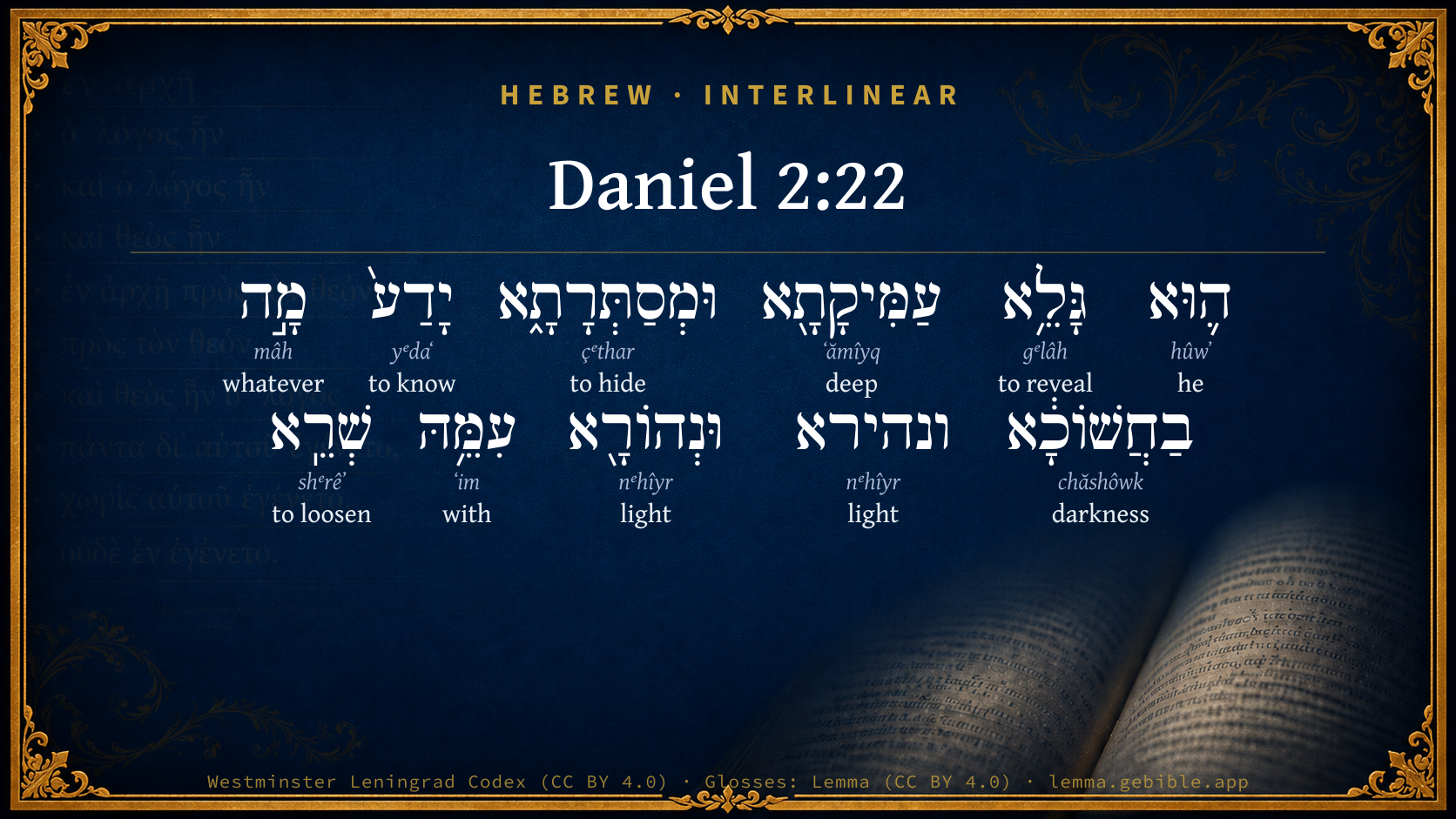
Hebrew (Westminster Leningrad Codex) Daniel 2:22 appears in the Hebrew Old Testament. The text above is from the Westminster Leningrad Codex. Each word links to its Strong’s number, a concise gloss, and parsing drawn from the Open Scriptures Hebrew Bible morphology. Click any word for its full Brown-Driver-Briggs (BDB) entry.
Download image
Cite this verse

Daniel 2:22 (World English Bible). Public Domain. Lemma interlinear Bible study tool, https://lemma.gebible.app/v/daniel/2/22.

Show BibTeX & RIS
BibTeX
RIS
English Translation
he reveals the deep and secret things; he knows what is in the darkness, and the light dwells with him.
World English Bible · Public Domain
Highlights
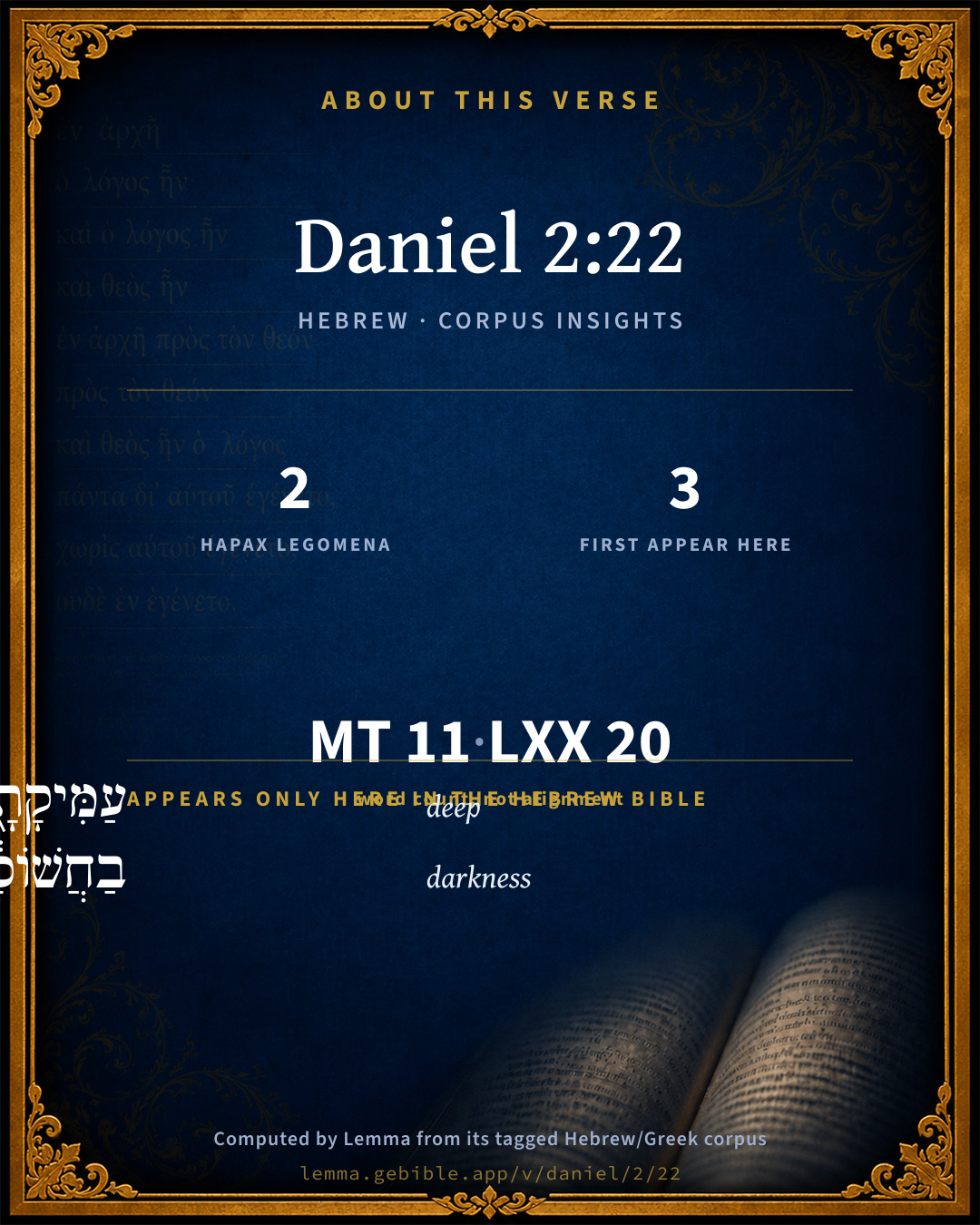
  • 2 hapax legomena — only here in the Hebrew Bible
  • 3 first appearances in the Hebrew Bible
Full analysis ↓
Download a study sheet

One document with this verse’s original text, its word-by-word gloss line, the meaning frame, cross-references with their text, attributed commentary, and full source and license credits — printable, and it pastes into notes with its structure intact.

This verse Autodidact and up

Study sheet (.html) Plain text (.txt)

A passage Seminary Student

Up to 50 verses in one chapter. A passage sheet keeps up to 6 commentary sources and 12 cross-references per verse, in the order this page ranks them, and says so on the sheet whenever that leaves anything out. Ask for a single verse and you get the Autodidact verse sheet above.

Everything on this page stays free to read, with no account — the sheet is a download of what is already on screen, not access to it.

Want to remove ads? Support Godless Engineer
Compare translations 3

The same verse in 3 English versions, stacked beneath the original-language interlinear above. Click any original word for its lexicon entry.

Each is an independent rendering of the whole verse — the interlinear is not word-aligned to these translations.

Highlighted words mark where these versions differ — a whole-verse word diff, not a word-by-word alignment.

  • World English Bible Public Domain
    he reveals the deep and secret things; he knows what is in the darkness, and the light dwells with him.
  • King James Version Public Domain
    He revealeth the deep and secret things: he knoweth what is in the darkness, and the light dwelleth with him.
  • unfoldingWord Literal Text CC BY-SA 4.0
    He reveals the deep and hidden things; he knows what is in the darkness, and the light dwells with him.

unfoldingWord Literal Text — © unfoldingWord, licensed CC BY-SA 4.0. Word-aligned USFM3 via Door43 (git.door43.org/unfoldingWord/en_ult).

Versions to compare (up to 4)

3 of 4 selected

Show all 18 translations

Every available English version of this verse, each an independent rendering of the whole verse.

  • World English Bible Public Domain
    he reveals the deep and secret things; he knows what is in the darkness, and the light dwells with him.
  • Berean Standard Bible Public Domain
    He reveals the deep and hidden things; He knows what lies in darkness, and light dwells with Him.
  • Majority Standard Bible Public Domain
    He reveals the deep and hidden things; He knows what lies in darkness, and light dwells with Him.
  • King James Version Public Domain
    He revealeth the deep and secret things: he knoweth what is in the darkness, and the light dwelleth with him.
  • American Standard Version (1901) Public Domain
    he revealeth the deep and secret things; he knoweth what is in the darkness, and the light dwelleth with him.
  • Revised Version (1885) Public Domain
    he revealeth the deep and secret things: he knoweth what is in the darkness, and the light dwelleth with him.
  • Geneva Bible (1599) Public Domain
    Hee discouereth the deepe and secrete things: he knoweth what is in darkenes, and the light dwelleth with him.
  • Douay-Rheims (1899) Public Domain
    He revealeth deep and hidden things, and knoweth what is in darkness: and light is with him.
  • Young's Literal Translation Public Domain
    He is revealing deep and hidden things; He hath known what `is' in darkness, and light with Him hath dwelt.
  • Literal Standard Version CC BY-SA 4.0
    He is revealing deep and hidden things; He has known what [is] in darkness, and light has dwelt with Him.
  • Unlocked Literal Bible CC BY-SA 4.0
    He reveals the deep and hidden things because he knows what is in the darkness, and the light lives with him.
  • unfoldingWord Literal Text CC BY-SA 4.0
    He reveals the deep and hidden things; he knows what is in the darkness, and the light dwells with him.
  • Darby Bible Public Domain
    It is he that revealeth the deep and secret things; He knoweth what is in the darkness, and the light dwelleth with him.
  • World Messianic Bible Public Domain
    He reveals the deep and secret things. He knows what is in the darkness, and the light dwells with him.
  • Webster's Bible Public Domain
    He revealeth the deep and secret things: he knoweth what is in the darkness, and the light dwelleth with him.
  • Free Bible Version CC BY-SA 4.0
    He reveals deep, mysterious things. He knows what lies in darkness, and light lives in his presence.
  • Bible in Basic English Public Domain
    He is the unveiler of deep and secret things: he has knowledge of what is in the dark, and the light has its living-place with him.
  • JPS Tanakh (1917) Public Domain
    He revealeth the deep and secret things; He knoweth what is in the darkness, and the light dwelleth with Him.

Literal Standard Version (2020), Covenant Press — licensed CC BY-SA 4.0. Text via the HelloAO Bible API (eBible.org). Unlocked Literal Bible (unfoldingWord) — licensed CC BY-SA 4.0. Text via the HelloAO Bible API (eBible.org). unfoldingWord Literal Text — © unfoldingWord, licensed CC BY-SA 4.0. Word-aligned USFM3 via Door43 (git.door43.org/unfoldingWord/en_ult). Free Bible Version, Dr. Jonathan Gallagher — licensed CC BY-SA 4.0. Text via the HelloAO Bible API (eBible.org).

Word by word

More ways to search: Search by grammar → Find every occurrence → Compare this word →

Practice this passage: Drill this verse → Learn its vocabulary →

עַמִּיקָתָ֖א
ʻămîyq
H5994
“deep · the”
Adjective, A + Particle, Definite Article
Part of Speech
Adjective + Particle
Type
Definite Article
Full BDB Definition

Origin: corresponding to H6012

TWOT: 2916

deep (adjective) - deep things, deep mysteries (substantive)
  1. ה֛וּא hûwʼ H1932 “he” Adjective, P
  2. גָּלֵ֥א gᵉlâh H1541 “revealing” Adjective, V
  3. וּמְסַתְּרָתָ֑א çᵉthar H5642 “and · hidden · the” Adjective, C + Verb, Piel, Participle Passive, Feminine, Plural, Determined + Particle, Definite Article
  4. יָדַע֙ yᵉdaʻ H3046 “knowing” Adjective, V
  5. מָ֣ה mâh H4101 “whatever” Adjective, P, Feminine
  6. בַחֲשׁוֹכָ֔א chăshôwk H2816 “in/at · darkness · the” Adjective, R + Noun, Common, Masculine, Singular, Determined + Particle, Definite Article
  7. ונהירא nᵉhîyr H5094 “and · light · the” Adjective, C + Noun, Common, Masculine, Singular, Determined + Particle, Definite Article
  8. וּנְהוֹרָ֖א nᵉhîyr H5094 “and · light · the” Adjective, C + Noun, Common, Masculine, Singular, Determined + Particle, Definite Article
  9. עִמֵּ֥הּ ʻim H5974 “with · him” Adjective, R + Suffix, Personal, 3rd Person, Masculine, Singular
  10. שְׁרֵֽא shᵉrêʼ H8271 “loosened” Adjective, V, Singular

About this verse

These counts appear in no published source. They are computed here, from the morphology-tagged text and Lemma’s own curated glosses. What Lemma adds →

11
words
10
distinct lemmas
Prophets
section

Notable vocabulary

2 hapax legomena — words that appear only here in the entire Hebrew Bible:

  • עַמִּיקָתָ֖א deep H5994
  • בַחֲשׁוֹכָ֔א darkness H2816

First appearance in Scripture

These words make their first canonical appearance in the Hebrew Bible here:

  • עַמִּיקָתָ֖א deep H5994
  • בַחֲשׁוֹכָ֔א darkness H2816
  • ונהירא light H5094

Shared distinctive vocabulary

וּמְסַתְּרָתָ֑א to hide H5642 occurs in 2 verses of the Hebrew Bible. Also found in:

Grammatical profile

  • 6 adjectives
  • 5 particles

Verb forms

  • וּמְסַתְּרָתָ֑א Piel · Participle Passive

Repetition

A word recurs within this verse — often emphatic in Hebrew:

  • ונהירא light H5094 ×2

Hebrew & Septuagint length

In English translation the verse runs 20 words from the Hebrew and 17 from the Septuagint (LXX English) — closely comparable.

A rough comparison of the two English renderings, which tokenize alike — not a word-level alignment.

Word counts can differ between the Hebrew and the Greek without any difference in meaning — e.g. the Hebrew direct-object marker אֵת has no separate Greek word, and Greek often adds the article ὁ.

In the original languages it is 11 Hebrew tokens and 20 Greek tokens — but the two are counted differently (Hebrew bundles its prefixes and suffixes into one token; the Greek is in lemma form), so that isn’t a like-for-like length.

Cross-references

32

Topical passages linked to Daniel 2:22 in the Treasury of Scripture Knowledge — connected by theme and wording, ordered by reader-vote popularity; previews shown in the World English Bible.

  • Job 12:22 He uncovers deep things out of darkness, And brings out to light the shadow of death.
  • 1 John 1:5 This is the message which we have heard from him and announce to you, that God is light, and in him is no darkness at all.
  • Jeremiah 23:24 Can any hide himself in secret places so that I shall not see him? says Yahweh. Don't I fill heaven and earth? says Yahweh.
  • James 1:17 Every good gift and every perfect gift is from above, coming down from the Father of lights, with whom can be no variation, nor turning shadow.
  • Psalms 25:14 The friendship of Yahweh is with those who fear him. He will show them his covenant.
  • Psalms 139:11–12 If I say, "Surely the darkness will overwhelm me; The light around me will be night;"
  • Hebrews 4:13 There is no creature that is hidden from his sight, but all things are naked and laid open before the eyes of him with whom we have to do.
  • Daniel 5:11 There is a man in your kingdom, in whom is the spirit of the holy gods; and in the days of your father light and understanding and wisdom, like the wisdom of the gods, were found in him; and the king Nebuchadnezzar your father, the king, [I say], your father, made him master of the magicians, enchanters, Chaldeans, and soothsayers;
  • Psalms 36:9 For with you is the spring of life. In your light shall we see light.
  • 1 Corinthians 2:9–11 But as it is written, "Things which an eye didn't see, and an ear didn't hear, Which didn't enter into the heart of man, These God has prepared for those who love him."
  • 1 Timothy 6:16 who alone has immortality, dwelling in unapproachable light; whom no man has seen, nor can see: to whom be honor and eternal power. Amen.
  • Isaiah 45:7 I form the light, and create darkness; I make peace, and create evil. I am Yahweh, who does all these things.
  • Luke 12:2–3 But there is nothing covered up, that will not be revealed, nor hidden, that will not be known.
  • Daniel 2:11 It is a rare thing that the king requires, and there is no other who can show it before the king, except the gods, whose dwelling is not with flesh.
  • Genesis 41:25–28 Joseph said to Pharaoh, "The dream of Pharaoh is one. What God is about to do he has declared to Pharaoh.
  • Job 26:6 Sheol is naked before God, And Abaddon has no covering.
  • Isaiah 41:22 Let them bring forth, and declare to us what shall happen: declare you the former things, what they are, that we may consider them, and know the latter end of them; or show us things to come.
  • Daniel 2:28–29 but there is a God in heaven who reveals secrets, and he has made known to the king Nebuchadnezzar what shall be in the latter days. Your dream, and the visions of your head on your bed, are these:
  • 1 Corinthians 4:5 Therefore judge nothing before the time, until the Lord comes, who will both bring to light the hidden things of darkness, and reveal the counsels of the hearts. Then each man will get his praise from God.
  • Ephesians 3:5 which in other generations was not made known to the children of men, as it has now been revealed to his holy apostles and prophets in the Spirit;
  • Psalms 104:2 He covers himself with light as with a garment. He stretches out the heavens like a curtain.
  • Daniel 5:14 I have heard of you, that the spirit of the gods is in you, and that light and understanding and excellent wisdom are found in you.
  • John 8:12 Again, therefore, Jesus spoke to them, saying, "I am the light of the world. He who follows me will not walk in the darkness, but will have the light of life."
  • John 21:17 He said to him the third time, "Simon, son of Jonah, do you have affection for me?" Peter was grieved because he asked him the third time, "Do you have affection for me?" He said to him, "Lord, you know everything. You know that I have affection for you." Jesus said to him, "Feed my sheep.
  • Genesis 37:5–9 Joseph dreamed a dream, and he told it to his brothers, and they hated him all the more.
  • Genesis 41:16 Joseph answered Pharaoh, saying, "It isn't in me. God will give Pharaoh an answer of peace."
  • Isaiah 41:26 Who has declared it from the beginning, that we may know? and before, that we may say, [He is] right? yes, there is none who declares, yes, there is none who shows, yes, there is none who hears your words.
  • Isaiah 42:9 Behold, the former things have happened, and new things do I declare. Before they spring forth I tell you of them.
  • Matthew 13:13 Therefore I speak to them in parables, because seeing they don't see, and hearing, they don't hear, neither do they understand.
  • John 1:9 The true light that enlightens everyone was coming into the world.
  • John 12:45–46 He who sees me sees him who sent me.
  • Romans 16:25–26

Cross-references courtesy of OpenBible.info (CC BY 4.0).

Hebrew and Greek witnesses Masoretic Hebrew ↔ Greek Septuagint

The same verse in the two great witnesses to the Old Testament, shown verse-for-verse.

These are two independent witnesses, not word-aligned to each other, and the Septuagint is shown in lemma (dictionary) form.

Hebrew Daniel 2:22 Masoretic · Westminster Leningrad Codex

ה֛וּא גָּלֵ֥א עַמִּיקָתָ֖א וּמְסַתְּרָתָ֑א יָדַע֙ מָ֣ה בַחֲשׁוֹכָ֔א ונהירא וּנְהוֹרָ֖א עִמֵּ֥הּ שְׁרֵֽא

he reveals the deep and secret things; he knows what is in the darkness, and the light dwells with him.

World English Bible · Public Domain

Greek LXX Daniel 2:22 Septuagint · lemma form

ἀνακαλύπτω ὁ βαθύς καί σκοτεινός καί γιγνώσκω ὁ ἐν ὁ σκότος καί ὁ ἐν ὁ φῶς καί παρά αὐτός κατάλυσις

he reveals deep and secret matters; knowing what is in darkness, and the light is with him.

LXX2012 (modern English Septuagint) · Public Domain

On this verse, The Pulpit Commentary discusses the Septuagint’s reading. Read the note in Commentary ↓

Hebrew: Westminster Leningrad Codex (CC BY 4.0). Greek: Septuagint (public domain); English from LXX2012 (modern English Septuagint) (Public Domain). How the Septuagint differs from the Hebrew →

Commentary

Notes on Daniel 2:22 from classic Christian and Jewish commentators (each source and its license shown beneath its notes). The classic Christian expositions comment on the surrounding passage and are grouped to its opening verse, so a note may address several verses; the Jewish commentaries on the Tanakh (Rashi and others) are per-verse, so they appear only where the commentator wrote on this verse.

Lemma curates 59 commentaries, every one of them public domain or Creative Commons licensed, each selected and text-cleaned for this edition rather than reprinted as found. About our sources →

Trapp's Complete Commentary

John Trapp

Dan 2:22 He revealeth the deep and secret things: he knoweth what [is] in the darkness, and the light dwelleth with him.

Ver. 22. He revealeth the deep and secret things.] Daniel hath never done, but is incessant and unsatisfiable in praising God; and although there was haste of answering the king’s expectation, yet he shall stay till God have his due.

He knoweth what is in the dark.] See Psa 139:12.

John Trapp, A Commentary or Exposition upon All the Books of the Old and New Testament (1647–1656) — public domain. Text from a community e-Sword module.

Ibn Ezra

Rabbi Abraham ibn Ezra

[Daniel 2:22] Hu (הוּא - He): [He] reveals deep (ʿammiqata - עַמִּיקָתָא) and hidden (umesatt'rata - וּמְסַתְּרָתָא) things that man cannot know, when His servants implore Him – like me, [for] He revealed to me the secret of the dream.

[Daniel 2:22] Yadaʿ mah vachashokha (יָדַע מָה בַחֲשׁוֹכָא - He knows what is in the darkness): The opposite of man [who does not fully know what is hidden in darkness/potentiality]. And according to my opinion, the meaning is: What has the potential/power (b'choach - בְּכֹחַ) to come into being. Similar to [Job 28:11]: “and hidden things (v'taʿalumah - וְתַעֲלֻמָה) He brings forth to light (yotzi or - יוֹצִיא אוֹר)”....

And the meaning of “And light (un'hora - וּנְהוֹרָא) dwells (sh're - שְׁרֵא) with Him”: Everything is before Him as if [already] done/actualized (k'maʿaseh - כְּמַעֲשֶׂה)....

And the word sh're (שְׁרֵא - dwells) is like [the Hebrew] choneh (חוֹנֶה - dwells/encamps)....

And [the word] n'hora (נְהוֹרָא - light) is like [the Hebrew word in Job 3:4]: “and let no light (n'harah - נְהָרָה) shine upon it”. And similarly [related conceptually or etymologically is the word] ha-minharot (הַמִּנְהָרוֹת - the tunnels/burrows) [Judges 6:2].

Ibn Ezra on the Tanakh — English translations: “Sefaria Community Translation” (CC0 1.0 (public-domain dedication)); “Yalkut, Sifsei Chachomim Chumash, Metsudah Publications, 2009” (CC BY 4.0); and “Commentary of Ibn Ezra on Isaiah - trans. by M. Friedlander, 1873” (public domain). Text via Sefaria.

Geneva Bible (1599)

Geneva Bible translators

He showeth that man hath neither wisdom nor knowledge, but very dark blindness and ignorance of himself: for it cometh only of God, that man understandeth anything.

Geneva Bible (1599) marginal notes — public domain. Text via Bolls.life.

Jamieson, Fausset & Brown

Robert Jamieson, A. R. Fausset & David Brown

revealeth-- (Job 12:22). So spiritually (Eph 1:17-18).

knoweth what is in . . . darkness-- (Psa 139:11-12; Heb 4:13).

light . . . him-- (Jam 1:17; Jo1 1:4). Apocalypse (or "revelation") signifies a divine, prophecy a human, activity. Compare Co1 14:6, where the two are distinguished. The prophet is connected with the outer world, addressing to the congregation the words with which the Spirit of God supplies him; he speaks in the Spirit, but the apocalyptic seer is in the Spirit in his whole person (Rev 1:10; Rev 4:2). The form of the apocalyptic revelation (the very term meaning that the veil that hides the invisible world is taken off) is subjectively either the dream, or, higher, the vision. The interpretation of Nebuchadnezzar's dream was a preparatory education to Daniel himself. By gradual steps, each revelation preparing him for the succeeding one, God fitted him for disclosures becoming more and more special. In the second and fourth chapters he is but an interpreter of Nebuchadnezzar's dreams; then he has a dream himself, but it is only a vision in a dream of the night (Dan 7:1-2); then follows a vision in a waking state (Dan 8:1-3); lastly, in the two final revelations (Dan 9:20; Dan 10:4-5) the ecstatic state is no longer needed. The progression in the form answers to the progression in the contents of his prophecy; at first general outlines, and these afterwards filled up with minute chronological and historical details, such as are not found in the Revelation of John, though, as became the New Testament, the form of revelation is the highest, namely, clear waking visions [AUBERLEN].

Jamieson, Fausset & Brown — Commentary Critical and Explanatory on the Whole Bible (1871) — public domain (CC PDM 1.0). Text via the HelloAO Bible API.

John Calvin's Commentaries

He pursues the same sentiment, and confirms it, — that all mortals receive from God’s Spirit whatever intelligence and light they enjoy; but he proceeds a step further in this verse than in the last. He had said generally, that, men receive wisdom and understanding by God’s good will; but here he speaks specially; for when a man’s understanding is rare and unusual, there God’s gift shines forth more clearly; as if he had said — God not only distributes to every one according to the measure of his own liberality, whatever acuteness and ingenuity they possess, but he adorns some with such intelligence that they appear as his interpreters. He speaks, therefore, here, specially of the gift of prophecy; as if he had said, God’s goodness is conspicuous, not only in the ordinary prudence of mankind, for no one is so made as to be unable to discover between justice and injustice, and to form some plan for regulating his life; but in Prophets there is something extraordinary, which renders God’s wisdom more surprising. Whence, then, do Prophets obtain the power of prophesying concerning hidden events, and penetrating above the heavens, and surpassing all bounds? Is this common to all men? Surely this far exceeds the ordinary ability of man, while the Prophet here teaches that; God’s beneficence and power deserve more praise, because he reveals hidden and secret things; and in this sense he adds — light dwells with God; as if he had said, — God differs very much from us, since we are involved in many clouds and mists; but to God all things are clear; he has no occasion to hesitate, or inquire, and has no need to be hindered through ignorance. Now, we fully understand the Prophet’s meaning.

Let us learn from this passage to attribute to God that praise which the greater part of the world claims to itself with sacrilegious audacity, though God shews it to belong to himself. Whatever understanding or judgment we may possess, we should remember that it was first received from God. Hence, also, if we have but a small portion of common sense, we are still equally indebted to God, for we should be like stocks or stones unless by his secret instinct he endued us with understanding. But if any one excels others, and obtains the admiration of all men, he ought still modestly to submit himself to God, and acknowledge himself the more bound to him, because he has received more than others. For who knows himself fully but God? The more, therefore, he excels in understanding, the more he will lay aside all claims of his own, and extol the beneficence of God. Thirdly, let, us learn that the understanding of spiritual things is a rare and singular gift of the Holy Spirit, in which God’s power shines forth conspicuously. Let us guard against that diabolical pride by which we see almost; the whole world to be swollen and intoxicated. And in this respect we should chiefly glorify God, as he has not, only adorned us with ordinary foresight, enabling us to discern between good and evil, but raised us above the ordinary level of human nature, and so enlightened us that we can understand things far exceeding our capacities. When Daniel pronounces light to be with God, we must supply a tacit antithesis; since he indicates, as I have already said, that men are surrounded by thick darkness, and grope about in obscurity. The habitation of men is here obliquely contrasted with the sanctuary of God; as if the Prophet had said, there is no pure and perfect light but in God alone. Hence, when we remain in our natural state, we must necessarily wander in darkness, or at least be obscured by many clouds. These words naturally lead us not to rest satisfied in our own position, but to seek from God that light in which he only dwells. Meanwhile, we should remember how God dwells in light unapproachable, (1 Timothy 6:16,) unless he deigns to stretch forth his hand to us. Hence, if we desire to become partakers of this divine light, let us be, on our guard against audacity, and mindful of our ignorance; let; us seek God’s illumination. Thus his light will not be inaccessible to us, when, by his Spirit, he shall conduct us beyond the skies. He afterwards adds —

John Calvin's Commentaries (1540-1563) — public domain. Text from the Calvin Translation Society English edition (1840s-50s) via the Christian Classics Ethereal Library (ccel.org). Calvin's coverage is partial (roughly two-thirds of the Bible); uncommented books and verses are honest gaps, never fabricated. The 19th-century editor's footnotes and remarks are omitted so the notes are faithfully Calvin's own voice.

Ellicott's Commentary for English Readers

(22) He revealeth.—Comp. Job_12:22.

He knoweth.—Comp. Psa_139:12.

The light dwelleth.—Perhaps “illumination” rather than “light” expresses the actual meaning. Man himself requires illumination from an external source. This source is God, the “sun of man’s soul,” in Whom light dwells as if He were a palace, and in “His light do we see light” (Psa_36:9).

A Bible Commentary for English Readers, edited by Charles John Ellicott (1878–1897) — public domain. Text from a community e-Sword module.

The Cambridge Bible for Schools and Colleges

gen. ed. J. J. S. Perowne

22. He revealeth, &c.] Cf. Job_12:22, ‘Who revealeth deep things out of darkness.’

light] physical light (cf. 1Ti_6:16), but suggesting and implying fulness of intellectual light; cf. 1Jn_1:7 (of spiritual light).

The Cambridge Bible for Schools and Colleges (gen. ed. J. J. S. Perowne; Cambridge University Press, 1878–1918) — public domain. Text from a community e-Sword module.

John Gill's Exposition

He revealeth the deep and secret things,.... The purposes of his own heart, which are the deep things of God, and the secrets that belong to him, and which are opened in providence by the execution of them; the "arcana imperii", or secrets of state, committed to men designed for government; the secrets or mysteries of grace, the deep things of the Gospel, made known to Gospel ministers; and particularly the deep and impenetrable secret of the king's dream, and the interpretation of it, revealed to Daniel:

he knoweth what is in the darkness; the actions of men committed in darkness; the schemes that are drawn in the privy councils and cabinets of princes; yea, the thoughts of men's hearts, which he in the utmost recesses of them, as well as their dreams in the night season; and particularly this of the king's, and which must have been buried in darkness, had he not revealed it:

and the light dwelleth with him; he is light itself, and the Father of lights; the light of nature, grace, and glory, is with him, and from him; the light of the word, the light of prophecy, and the light of the glorious Gospel; and also the Light of the world, the sun of righteousness, the Messiah; and of him some of the ancient Jews interpret this passage. R. Aba Serungia (p), mentioning this passage, "and the light dwelleth with him", adds, this is the King Messiah, as it is said, "arise, shine", &c.; and his commentator (q) observes, that the sense of it is, he (God) retains the Messiah with himself, and does not send him forth unto us; see Psa 43:3, and elsewhere (r), in answer to the question, what is the name of the Messiah? among others, this is said, his name is Light, as it is said, "and the light dwelleth with him": and this is a name that is often given to Christ, and he takes to himself in the New Testament; see Joh 1:7 where he is called the "Light", that Light, the true Light, and the Light of the world; as he is both of Jews and Gentiles, even of all his people throughout the world: indeed, the light of nature, which every man has, is from him, as the Creator of all; and the light of grace, and the increase of it, which any are favoured with, is given by him; and all the light of knowledge in divine things, and of spiritual joy and comfort, beams from him the sun of righteousness: the light of the latter day, which will be so very great, as to be as the light of seven days, and to make the sun and moon unnecessary in a figurative sense, will be owing to him; as well as all that light of life and glory, the saints shall possess to all eternity, will be communicated through him: and Christ, who is this light, "dwells" with God; he who is the same with the divine Word, was with God, and dwells with him to all eternity; in the fulness of time this Word or Light was made flesh, or was clothed with it, and dwelt with men; when it was, that be came a light into the world, of which he often speaks; and having done his work, ascended to heaven, and now dwells with God in human nature; and will come again, and dwell with men on earth a thousand years, when he will be the light of the New Jerusalem state; and, after that, will take his people with him to heavens, and dwell with God, and they with him, for evermore. This shows that this Light, or the divine "Logos", is a person distinct from God the Father, with whom he dwells; that he is an eternal one, God never being without this Light and Word; and that he is all abiding light to his saints, and will be for evermore.

(p) In Bereshit Rabba, sect. 1. fol. 1, 3. (q) Auctor. Yade Moseh in ib. (r) Echa Rabbati, fol. 50. 2.

John Gill's Exposition of the Whole Bible (1746–1763) — public domain (CC PDM 1.0). Text via the HelloAO Bible API.

Albert Barnes' Notes on the Bible

He revealeth the deep and secret things - Things which are too profound for man to fathom by his own power, and which are concealed or hidden until he makes them known. What is said here is an advance on what was affirmed in the previous verse, and relates to another kind of knowledge. “That” related to such knowledge as was not properly beyond the grasp of the human intellect when unaided in any supernatural manner, and affirmed that even then all discoveries and inventions are to be traced to God; “this” refers to a species of knowledge which lies beyond any natural compass of the human powers, and in which a supernatural influence is needed - such things as the Chaldeans and astrologers claimed the power of disclosing. The assertion here is, that when the highest human wisdom showed itself insufficient for the exigency, God was able to disclose those deep truths which it was desirable for man to understand. Applied generally, this refers to the truths made known by revelation - truths which man could never have discovered by his unaided powers.

He knoweth what is in the darkness - What appears to man to be involved in darkness, and on which no light seems to shine. This may refer not only to what is concealed from man in the literal darkness of night, but to all that is mysterious; all that lies beyond the range of human inquiry; all that pertains to unseen worlds. An immensely large portion of the universe lies wholly beyond the range of human investigation at present, and is, of course, dark to man.

And the light dwelleth with him - The word rendered “dwelleth” (שׁרא sherēl) means, properly, to loose, to unbind, to solve, as e. g., hard questions, Dan 5:16; and is then applied to travelers who unbind the loads of their beasts to put up for the night, and then it comes to mean to put up for the night, to lodge, to dwell. Hence, the meaning is, that the light abides with God; it is there as in its appropriate dwelling-place; he is in the midst of it: all is light about him; light when it is sent out goes from him; when it is gathered together, its appropriate place is with him. Compare Job 38:19-20 :

“Where is the way where light dwelleth?

And as for darkness, where is the place thereof?

That thou shouldest take it to the bound thereof,

And that thou shouldest know the paths to the house thereof?”

See the note at that passage. Compare also 1Ti 6:16 : “Dwelling in the light which no man can approach unto.” 1Jo 1:5 : “God is light, and in him is no darkness at all.”

Albert Barnes' Notes on the Bible (1834–1885) — public domain. Text from a community e-Sword/MySword module.

Matthew Poole's English Annotations

The deep and secret things; both of nature, wherein are infinite depths and secrets: and of men’s hearts and counsels, which are very close, deep, and secret, saying in themselves, Who can see us? and the deep and secret things of grace, and the mysteries of Christ’s kingdom: all this is comfortable to the saints, and glorious to God.

He knoweth what is in the darkness, and it dwelleth with him, and he in it. He sees and foresees the most hidden things. Daniel points at the king’s dream in the night, which he only gave the king, and then took it from him, and then gave it Daniel for him again.

Matthew Poole's English Annotations on the Holy Bible (1683–1685) — public domain. Text from a community e-Sword/MySword module.

The Pulpit Commentary

He revealeth the deep and secret things; he knoweth what is in the darkness, and the light dwelleth with him. The rendering of the Septuagint as it stands differs somewhat from the Massoretic text, "Revealing deep things and dark, and knowing the things which are in the darkness and the things which are in the light, and with him is a dwelling-place (katalusiv)." There is doubt as to the exact force of this last word; the last element in it suggests "solution." This meaning seems to have been given to it generally; for Paulus Tellensis renders it shari, which means a "solution," but as it is derived from shera, which means "to dwell," he retains the double meaning The reading of Kreysig is decidedly to be preferred, omitting ta ("the things which") before "in the light," and kai, "and," after. The rendering then would be, "in light is with him the dwelling-place." This rendering harmonizes the LXX completely with the Massoretic. The other versions call for no remark. There is difference hero between the Q"rl and K"thib. The Q"ri reads nehora, "light," a Chaldee or Western Aramaic form; the K"thib again is, neheera, the Eastern Aramaic form. God is not only the God of nature, of providence, and of man, but also of revelation. He can make known to man what otherwise man could never know. He is the very Source of all light and enlightenment. We may compare this statement with that of Paul in 1Ti_6:16; he speaks of God as "dwelling in light which no man can approach unto." It seems to us the words of the Old Testament song convey a loftier idea of God than does the Pauline statement perhaps it is even loftier than the cognate phrase of the Apostle John, (1Jn_1:5) "God is light, and in him is no darkness at all." We may compare, in regard to this whole verse, Psa_139:12, "The darkness hideth not from thee; but the night shineth as the day: the darkness and the tight are both alike to thee," where neheera is used as in the passage before us. Daniel ascribes to Jehovah all the powers of all the gods of Babylon.

Ver. 22 (last clause).

Divine omniscience.

God knows what is darkness to us, because in him dwells the eternal light which penetrates all darkness. This supreme knowledge is essential to his perfection. Without it infinite power and perfect goodness could only issue in fearful disasters to the universe; and therefore the order and progress of all things bear witness to its existence. Consider

I THE FACT OF THE DIVINE OMNISCIENCE AND WHAT THIS IMPLIES.

1. The knowledge of God comprehends all things. None are too great for its grasp, none too small for its notice. The regions of the telescope and of the microscope come equally under its notice (Job_28:24; Luk_12:6, Luk_12:7)

2. It penetrates the deepest mysteries. Our most secret thoughts are known to God, and he knows us better than we know ourselves (Psa_139:1; Heb_4:13)

3. It reaches forward to the whole future. God"s knowledge of the future can be to some extent explained on two grounds.

(1) His perfect knowledge of the present must carry with it the knowledge of the future as far as the present contains the germs cf the future. (Act_15:18)

(2) His eternal nature is not limited by our conditions of time, so that he sees all things, not in succession, but in one immediate view. (2Pe_3:8)

II THE PRACTICAL INFERENCES TO BE DRAWN FROM A CONSIDERATION OF THE DIVINE OMNISCIENCE.

1. It should lead to sincerity. The hypocrisy which may seem to help us in our relations with me, is useless before God. The really important question is, not What does the world think of us? but What is our character in the sight of God? because our life and all its destinies depend on him (Ecc_12:14)

1. It should strengthen our faith in the providential care of God. He must know better than we know; therefore it is foolish to fear and wrong to complain. We must even expect that, with his supreme knowledge, he will not act just as we should act with our very imperfect knowledge. (Job_34:33)

2. It should encourage our hope in the ultimate well-being of the universe. No one would commence a work if he knew it would end in failure. No benevolent pessimist would create a universe. Before be made the world, God foresaw the fall of man; before he sent his Son, he saw how sadly he would be rejected. If he so acted, knowing all the future, it must bare been because he knew that, after all the sin and sorrow, righteousness and peace would finally triumph, so that the ultimate blessedness of existence should amply compensate for all its earlier misery. (Isa_53:11)

3. It should lead us to seek our highest knowledge in him. All true discovery comes by revelation. "He revealeth the deep and secret things." In his mind are the archetypal ideas of all things. The knowledge of God is the highest knowledge.

The Pulpit Commentary (1880–1919), ed. H.D.M. Spence-Jones & Joseph S. Exell — public domain. Text from a community e-Sword module.

Scofield Reference Notes

C. I. Scofield

revealeth

See margin, Gen 41:45. (See Scofield "Gen 41:45"),; Dan 4:9; Job 15:8; Psa 25:14; Pro 3:32; Mat 6:6.

The Scofield Reference Bible (1917 edition), notes by C. I. Scofield — public domain. Text from a community e-Sword module.

Rashi

Rabbi Shlomo Yitzchaki (Rashi)

He reveals the profound [as translated,] He reveals the profound.

and secret things for He revealed this profound thing to me.

Rashi on the Tanakh — English translations: “The Judaica Press complete Tanach with Rashi, translated by A. J. Rosenberg” (CC BY 4.0); “Pentateuch with Rashi's commentary by M. Rosenbaum and A.M. Silbermann, 1929-1934” (public domain); “The Metsudah Tanach series, Lakewood, N.J” (CC BY 4.0); and “The Book of Joshua, Metsudah Publications, 1997” (CC BY 4.0). Text via Sefaria.

Lesson kit

Teaching starters — assembled from the data on this page, not authored interpretation. Every prompt links to the verse data it draws on. Edit before teaching.

Daniel, in the Prophets, opens this verse with 11 words (10 distinct Hebrew lemmas). Its most distinctive word is ʻămîyq (“deep”). A historical commentator’s framing appears above. Read the whole chapter for the surrounding context.

Discussion questions

  1. How does “deep” (ʻămîyq) shape what this verse is saying?
  2. 2 words here appear nowhere else in the Hebrew Bible. Why might the author reach for such rare wording?
  3. 3 words make their first appearance in Scripture here. What does this debut establish?
  4. How does Ezra 5:12, which shares the word «to hide», read alongside this verse?
  5. What does the repetition of “light” (2× in this one verse) do in this verse?
  6. The translations on this page render this verse differently — a whole-verse word diff, not a word-by-word alignment. What might account for the different wordings?
  7. «וּמְסַתְּרָתָ֑א» is a Piel Participle Passive verb. How does that grammatical form shape the action described?
  8. Compare how Trapp's Complete Commentary and Ibn Ezra read this verse. Where do they agree or differ?

Things to notice

  • 2 words in this verse appear nowhere else in the Hebrew Bible.
  • 3 words make their first canonical appearance in Scripture here.
  • This verse counts 11 Hebrew ↔ 20 Greek words.
  • These translations choose different wording for 8 words in this verse.
  • “light” occurs 2× in this single verse.

Reading settings

Reading text

Shown beneath each verse's original-language words.

Old Testament
Old Testament edition

Read the OT as the Masoretic Hebrew (MT) or the Greek Septuagint (LXX).

English shown for the Greek Septuagint (in the Hebrew ↔ Greek comparison).

Comparing translations? Open the Compare panel on any verse page to stack up to four side by side.