
Jeremiah 30:9

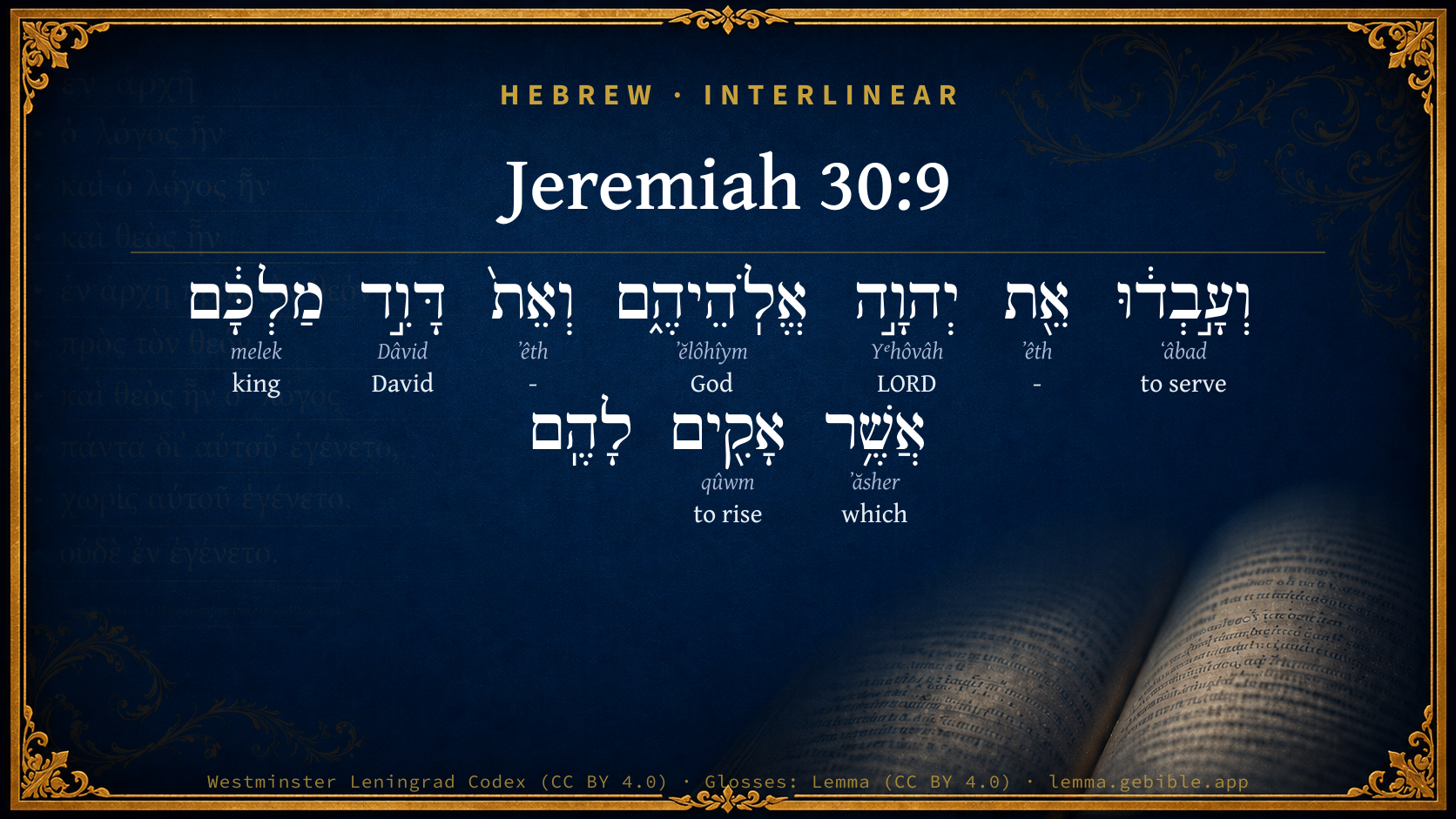
Hebrew (Westminster Leningrad Codex) Jeremiah 30:9 appears in the Hebrew Old Testament. The text above is from the Westminster Leningrad Codex. Each word links to its Strong’s number, a concise gloss, and parsing drawn from the Open Scriptures Hebrew Bible morphology. Click any word for its full Brown-Driver-Briggs (BDB) entry.
Download image
Cite this verse

Jeremiah 30:9 (World English Bible). Public Domain. Lemma interlinear Bible study tool, https://lemma.gebible.app/v/jeremiah/30/9.

Show BibTeX & RIS
BibTeX
RIS
English Translation
but they shall serve Yahweh their God, and David their king, whom I will raise up to them.
World English Bible · Public Domain
Download a study sheet

One document with this verse’s original text, its word-by-word gloss line, the meaning frame, cross-references with their text, attributed commentary, and full source and license credits — printable, and it pastes into notes with its structure intact.

This verse Autodidact and up

Study sheet (.html) Plain text (.txt)

A passage Seminary Student

Up to 50 verses in one chapter. A passage sheet keeps up to 6 commentary sources and 12 cross-references per verse, in the order this page ranks them, and says so on the sheet whenever that leaves anything out. Ask for a single verse and you get the Autodidact verse sheet above.

Everything on this page stays free to read, with no account — the sheet is a download of what is already on screen, not access to it.

Want to remove ads? Support Godless Engineer
Compare translations 3

The same verse in 3 English versions, stacked beneath the original-language interlinear above. Click any original word for its lexicon entry.

Each is an independent rendering of the whole verse — the interlinear is not word-aligned to these translations.

Highlighted words mark where these versions differ — a whole-verse word diff, not a word-by-word alignment.

  • World English Bible Public Domain
    but they shall serve Yahweh their God, and David their king, whom I will raise up to them.
  • King James Version Public Domain
    But they shall serve the LORD their God, and David their king, whom I will raise up unto them.
  • unfoldingWord Literal Text CC BY-SA 4.0
    But they will worship Yahweh their God and serve David their king, whom I will make king over them.

unfoldingWord Literal Text — © unfoldingWord, licensed CC BY-SA 4.0. Word-aligned USFM3 via Door43 (git.door43.org/unfoldingWord/en_ult).

Versions to compare (up to 4)

3 of 4 selected

Show all 18 translations

Every available English version of this verse, each an independent rendering of the whole verse.

  • World English Bible Public Domain
    but they shall serve Yahweh their God, and David their king, whom I will raise up to them.
  • Berean Standard Bible Public Domain
    Instead, they will serve the LORD their God and David their king, whom I will raise up for them.
  • Majority Standard Bible Public Domain
    Instead, they will serve the LORD their God and David their king, whom I will raise up for them.
  • King James Version Public Domain
    But they shall serve the LORD their God, and David their king, whom I will raise up unto them.
  • American Standard Version (1901) Public Domain
    but they shall serve Jehovah their God, and David their king, whom I will raise up unto them.
  • Revised Version (1885) Public Domain
    but they shall serve the LORD their God, and David their king, whom I will raise up unto them.
  • Geneva Bible (1599) Public Domain
    But they shall serue the Lord their God, and Dauid their King, whom I will raise vp vnto them.
  • Douay-Rheims (1899) Public Domain
    But they shall serve the Lord their God, and David their king, whom I will raise up to them.
  • Young's Literal Translation Public Domain
    And they have served Jehovah their God, And David their king whom I raise up to them.
  • Literal Standard Version CC BY-SA 4.0
    And they have served their God YHWH, || And David their king whom I raise up to them.
  • Unlocked Literal Bible CC BY-SA 4.0
    But they will worship Yahweh their God and serve David their king, whom I will make king over them.
  • unfoldingWord Literal Text CC BY-SA 4.0
    But they will worship Yahweh their God and serve David their king, whom I will make king over them.
  • Darby Bible Public Domain
    But they shall serve Jehovah their God, and David their king, whom I will raise up unto them.
  • World Messianic Bible Public Domain
    but they will serve the LORD their God, and David their king, whom I will raise up to them.
  • Webster's Bible Public Domain
    But they shall serve the LORD their God, and David their king, whom I will raise up to them.
  • Free Bible Version CC BY-SA 4.0
    They will serve the Lord their God, and their king, David's descendant whom I will give them.
  • Bible in Basic English Public Domain
    But they will be servants to the Lord their God and to David their king, whom I will give back to them.
  • JPS Tanakh (1917) Public Domain
    But they shall serve the LORD their God, and David their king, whom I will raise up unto them.

Literal Standard Version (2020), Covenant Press — licensed CC BY-SA 4.0. Text via the HelloAO Bible API (eBible.org). Unlocked Literal Bible (unfoldingWord) — licensed CC BY-SA 4.0. Text via the HelloAO Bible API (eBible.org). unfoldingWord Literal Text — © unfoldingWord, licensed CC BY-SA 4.0. Word-aligned USFM3 via Door43 (git.door43.org/unfoldingWord/en_ult). Free Bible Version, Dr. Jonathan Gallagher — licensed CC BY-SA 4.0. Text via the HelloAO Bible API (eBible.org).

Word by word

More ways to search: Search by grammar → Find every occurrence → Compare this word →

Practice this passage: Drill this verse → Learn its vocabulary →

וְעָ֣בְד֔וּ
ʻâbad
H5647
“and · to serve”
Conjunction + Verb, Qal, Sequential Perfect, 3rd Person, Common, Plural
Part of Speech
Conjunction + Verb
Stem
Qal
Form
Sequential Perfect
Person
3rd Person
Gender
Common
Number
Plural
Full BDB Definition

Origin: a primitive root

TWOT: 1553

to work, serve - (Qal) - to labour, work, do work - to work for another, serve another by labour - to serve as subjects - to serve (God) - to serve (with Levitical service) - (Niphal) - to be worked, be tilled (of land) - to make oneself a servant - (Pual) to be worked - (Hiphil) - to compel to labour or work, cause to labour, cause to serve - to cause to serve as subjects - (Hophal) to be led or enticed to serve
  1. אֵ֖ת ʼêth H853 “-” Particle, Direct Object
  2. יְהוָ֣ה Yᵉhôvâh H3068 “LORD” Noun, Proper
  3. אֱלֹֽהֵיהֶ֑ם ʼĕlôhîym H430 “God(s) · their” Noun, Common, Masculine, Plural, Construct + Suffix, Personal, 3rd Person, Masculine, Plural
  4. וְאֵת֙ ʼêth H853 “and · -” Conjunction + Particle, Direct Object
  5. דָּוִ֣ד Dâvid H1732 “David” Noun, Proper
  6. מַלְכָּ֔ם melek H4428 “king · their” Noun, Common, Masculine, Singular, Construct + Suffix, Personal, 3rd Person, Masculine, Plural
  7. אֲשֶׁ֥ר ʼăsher H834 “which” Particle, Relative
  8. אָקִ֖ים qûwm H6965 “to rise” Verb, Hiphil, Imperfect, 1st Person, Common, Singular

About this verse

These counts appear in no published source. They are computed here, from the morphology-tagged text and Lemma’s own curated glosses. What Lemma adds →

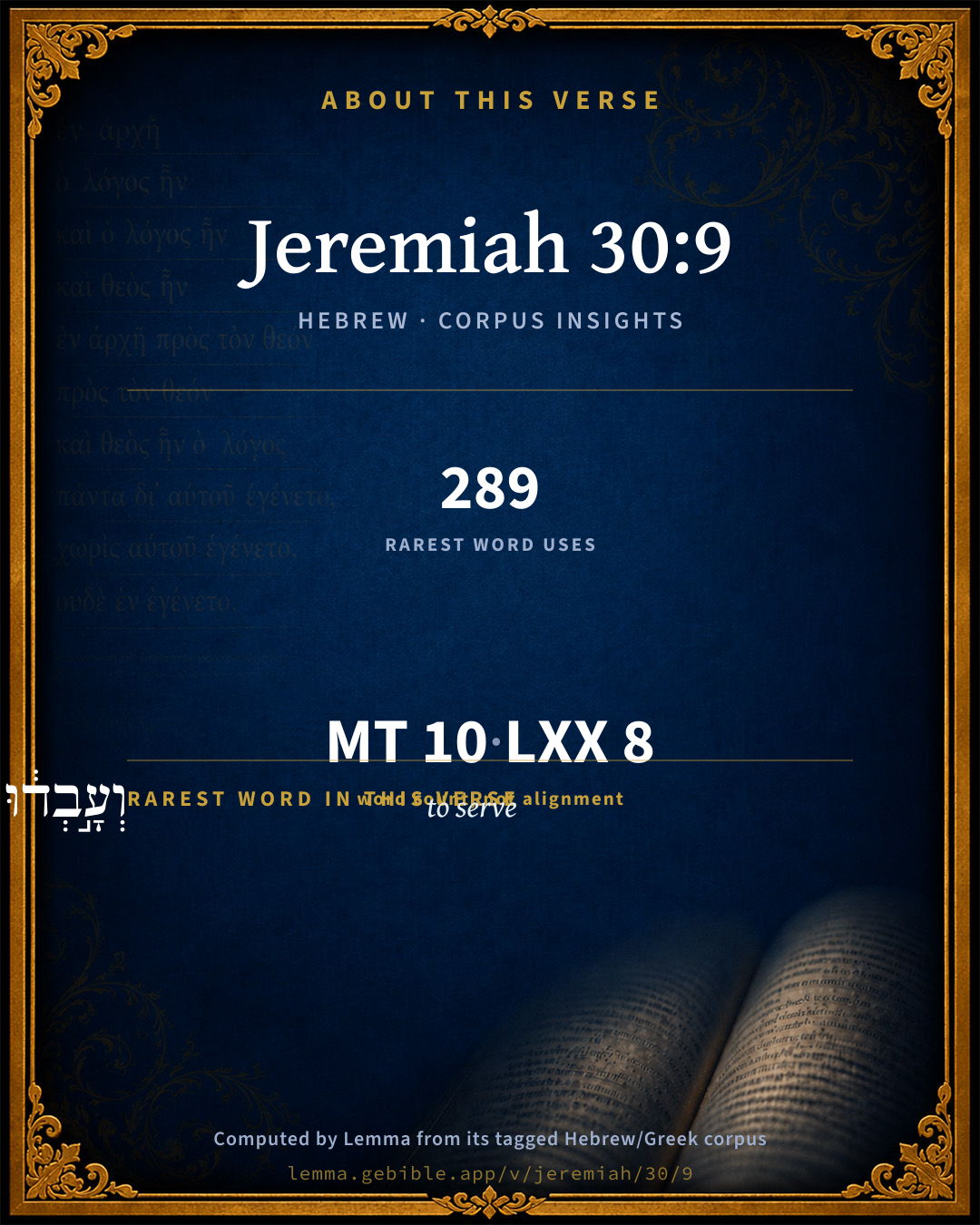
10
words
8
distinct lemmas
Prophets
section

Grammatical profile

  • 2 verbs
  • 4 nouns
  • 1 preposition
  • 3 particles

Verb forms

  • וְעָ֣בְד֔וּ Qal · Sequential Perfect
  • אָקִ֖ים Hiphil · Imperfect

Hebrew & Septuagint length

In the original languages it is 10 Hebrew tokens and 8 Greek tokens — but the two are counted differently (Hebrew bundles its prefixes and suffixes into one token; the Greek is in lemma form), so that isn’t a like-for-like length.

Cross-references

9

Topical passages linked to Jeremiah 30:9 in the Treasury of Scripture Knowledge — connected by theme and wording, ordered by reader-vote popularity; previews shown in the World English Bible.

  • Hosea 3:5 Afterward the children of Israel shall return, and seek Yahweh their God, and David their king, and shall come with trembling to Yahweh and to his blessings in the last days.
  • Isaiah 55:3–5 Turn your ear, and come to me; hear, and your soul shall live: and I will make an everlasting covenant with you, even the sure mercies of David.
  • Luke 1:69 And has raised up a horn of salvation for us in the house of his servant David
  • Ezekiel 37:23–25 neither shall they defile themselves any more with their idols, nor with their detestable things, nor with any of their transgressions; but I will save them out of all their dwelling-places, in which they have sinned, and will cleanse them: so shall they be my people, and I will be their God.
  • Acts 13:34 "Concerning that he raised him up from the dead, now no more to return to corruption, he has spoken thus: 'I will give you the holy and sure blessings of David.'
  • Jeremiah 23:5 Behold, the days come, says Yahweh, that I will raise to David a righteous Branch, and he shall reign as king and deal wisely, and shall execute justice and righteousness in the land.
  • Ezekiel 34:23–24 I will set up one shepherd over them, and he shall feed them, even my servant David; he shall feed them, and he shall be their shepherd.
  • Acts 2:30 Therefore, being a prophet, and knowing that God had sworn with an oath to him that of the fruit of his body, according to the flesh, he would raise up the Christ to sit on his throne,
  • Acts 13:23 From this man's seed, God has brought salvation to Israel according to his promise,

Cross-references courtesy of OpenBible.info (CC BY 4.0).

Hebrew and Greek witnesses Masoretic Hebrew ↔ Greek Septuagint

The same verse in the two great witnesses to the Old Testament, shown verse-for-verse.

These are two independent witnesses, not word-aligned to each other, and the Septuagint is shown in lemma (dictionary) form.

Hebrew Jeremiah 30:9 Masoretic · Westminster Leningrad Codex

וְעָ֣בְד֔וּ אֵ֖ת יְהוָ֣ה אֱלֹֽהֵיהֶ֑ם וְאֵת֙ דָּוִ֣ד מַלְכָּ֔ם אֲשֶׁ֥ר אָקִ֖ים לָהֶֽם

but they shall serve Yahweh their God, and David their king, whom I will raise up to them.

World English Bible · Public Domain

Greek LXX Structure differs

In the Septuagint, Jeremiah is about an eighth shorter than the Hebrew and arranges its material differently — the Oracles Against the Nations (Hebrew chapters 46–51) appear in the middle of the Greek book, after 25:13. Because the chapter and verse boundaries do not line up, a verse-for-verse comparison with the Hebrew is not shown.

A verse-for-verse comparison isn’t shown here because the chapters and verses don’t line up. Switch to the LXX edition with the MT / LXX toggle above to read the Greek directly.

Hebrew: Westminster Leningrad Codex (CC BY 4.0). Greek: Septuagint (public domain); English from a public-domain English Septuagint. How the Septuagint differs from the Hebrew →

Targum (Aramaic paraphrase)

1

The Targum is the ancient Jewish Aramaic paraphrase of the Hebrew Scriptures — an interpretive translation, not the Hebrew text itself. Onkelos (literal) and Pseudo-Jonathan (expansive) render the Torah, and Jonathan the Prophets. Coverage is partial: where no permissively-licensed English translation exists for a verse, only the Aramaic is shown. This is verse-level text, not a word-by-word alignment to the Hebrew.

  1. Targum Jonathan Prophets (Joshua–Malachi)
    וְיִפְלְחוּן קֳדָם יְיָ אֱלָהָהוֹן וְיִשְׁתַּמְעוּן לִמְשִׁיחָא בַר דָוִד מַלְכֵּהוֹן דַאֲקֵים לְהוֹן:

    (no public-domain English translation for this verse)

    Targum Jonathan — Aramaic: “Mikraot Gedolot” (public domain). English: “Sefaria Community Translation” (CC0 1.0 (public-domain dedication)); “London "Chaldee Paraphrase," 1871” (public domain). Text via Sefaria.

Commentary

Notes on Jeremiah 30:9 from classic Christian and Jewish commentators (each source and its license shown beneath its notes). The classic Christian expositions comment on the surrounding passage and are grouped to its opening verse, so a note may address several verses; the Jewish commentaries on the Tanakh (Rashi and others) are per-verse, so they appear only where the commentator wrote on this verse.

Lemma curates 59 commentaries, every one of them public domain or Creative Commons licensed, each selected and text-cleaned for this edition rather than reprinted as found. About our sources →

Trapp's Complete Commentary

John Trapp

Jer 30:9 But they shall serve the LORD their God, and David their king, whom I will raise up unto them.

Ver. 9. But they shall serve the Lord their God.] "Without fear, in holiness and righteousness before him all the days of their lives." {Luk 1:74-75 Joh 8:12; Joh 8:31-36,Rom 8:1-4}

And David their king,] i.e., Zerubbabel of David’s line, {Hag 2:23} but especially Christ, the King of saints, as the Jewish doctors also expound it.

Whom I will raise up to them.] To be Messiah the Prince. {Dan 9:25} Christ the Lord. {Act 5:31}

John Trapp, A Commentary or Exposition upon All the Books of the Old and New Testament (1647–1656) — public domain. Text from a community e-Sword module.

Tyndale Open Study Notes

Tyndale Open Resources

30:9 After the Exile, the Israelites cast aside their persistent worship of idols and truly served the Lord their God. • The Lord would provide a king, also a descendant of David, who would be called the Messiah (Isa 55:3-4; Ezek 34:23; 37:24; Hos 3:5; Luke 1:69; Acts 2:30; 13:22-23).

Tyndale Open Study Notes — © Tyndale Open Resources, licensed CC BY-SA 4.0. Text via the HelloAO Bible API.

Geneva Bible (1599)

Geneva Bible translators

That is, Messiah which should come of the stock of David, according to the flesh and should be the true pastor, as Ezek. 34:23, who is set forth and his kingdom that should be everlasting in the person of David, Hos. 3:5.

Geneva Bible (1599) marginal notes — public domain. Text via Bolls.life.

Jamieson, Fausset & Brown

Robert Jamieson, A. R. Fausset & David Brown

Instead of serving strangers (Jer 30:8), they shall serve the Lord, their rightful King in the theocracy (Eze 21:27).

David, their king--No king of David's seed has held the scepter since the captivity; for Zerubbabel, though of David's line, never claimed the title of "king." The Son of David, Messiah, must therefore be meant; so the Targum (compare Isa 55:3-4; Eze 34:23-24; Eze 37:24; Hos 3:5; Rom 11:25-32). He was appointed to the throne of David (Isa 9:7; Luk 1:32). He is here joined with Jehovah as claiming equal allegiance. God is our "King," only when we are subject to Christ; God rules us not immediately, but through His Son (Joh 5:22-23, Joh 5:27).

raise up--applied to the judges whom God raised up as deliverers of Israel out of the hand of its oppressors (Jdg 2:16; Jdg 3:9). So Christ was raised up as the antitypical Deliverer (Psa 2:6; Luk 1:69; Act 2:30; Act 13:23).

Jamieson, Fausset & Brown — Commentary Critical and Explanatory on the Whole Bible (1871) — public domain (CC PDM 1.0). Text via the HelloAO Bible API.

Adam Clarke's Commentary

Verse 9. But they shall serve the Lord their God, and David their King] This must refer to the times of the Messiah; and hence the Chaldee has, "They shall obey the Lord their God, וישת מאון למשיחה בר דוד veyishta meun limschicha bar David, and they shall obey the Messiah, the Son of David." This is a very remarkable version; and shows that it was a version, not according to the letter, but according to their doctrine and their expectation. David was long since dead; and none of his descendants ever reigned over them after the Babylonish captivity, nor have they since been a regal nation. Zerubbabel, under the Persians, and the Asmoneans, can be no exception to this. They have been no nation since; they are no nation now; and it is only in the latter days that they can expect to be a nation, and that must be a Christian nation.

Christ is promised under the name of his progenitor, David, Isa 55:3-4; Eze 34:23-24; Eze 37:24-25; Ho 3:5.

Adam Clarke's Commentary on the Bible (1810–1826) — public domain. Text from a community e-Sword/MySword module.

John Calvin's Commentaries

The former promise would have been defective had not this clause been added; for it would not be enough for men to live as they please, and to have liberty promised them, except a regular order be established. It would, indeed, be better for us to be wild beasts, and to wander in forests, than to live without government and laws; for we know how furious are the passions of men. Unless, therefore, there be some restraint, the condition of wild beasts would be better and more desirable than ours. Liberty, then, would ever bring ruin with it, were it not bridled and connected with regular government. I therefore said that this verse was added, that the Jews might know that God cared for their welfare; for he promises that nothing would be wanting to them. It is then a true and real happiness, when not only liberty is granted to us, but also when God prescribes to us a certain rule and sets up good order, that there may be no confusion. Hence Jeremiah, after having promised a return to the people into their own country, and promised also that the yoke would be shaken off from their neck, makes this addition, that having served strangers they would be now under the government of God and of their own king. Now this subjection is better than all the ruling powers of the world; that is, when God is pleased to rule over us, and undertakes the care of our safety, and performs the office of a Governor.

We hence see that the design of the Prophet was to comfort the faithful, not only with the promise of liberty, but also with this addition, that in order that nothing might be wanting to their complete happiness, God himself would rule over them. Serve, then, shall they their God The word king is added, because God designed that his people should be governed by a king, not that the king would sit in the place of God, but added as his minister. Now this was said a long time after the death of David; for David was dead many years before Jeremiah was born: nor did he live again in order that he might rule over the people; but the name of David is to be taken here for any one that might succeed him.

Now, as God had made a covenant with David, and promised that there would be always one of his posterity to sit on his throne, hence the Prophet here, in mentioning David, refers to all the kings until Christ: and yet no one after that time succeeded him, for the kingdom was abolished before the death of Jeremiah; and when the people returned into their own country there was no regal power, for Zerubbabel obtained only a precarious dignity, and by degrees that royal progeny vanished away; and though there were seventy chosen from the seed of David, yet there was no scepter, no crown, no throne. It is therefore necessary to apply this prophecy to Christ; for the crown was broken and trodden under foot, as Ezekiel says, until the lawful king came. He intimated that there was no king to be for a long time, when he said,

“Cast down, cast down, cast down the crown.” (Ezekiel 21:27)

He therefore commanded the name of a king to be abolished, together with all its symbols, and that not for a short time but for ages, even until he came forth who had a just right to the crown or the royal diadem. We hence see that this passage cannot be otherwise explained than by referring to Christ, and that he is called David, as the Jews were always wont to call him before Christ appeared in the world; for they called the Messiah, whom they expected, the Son of David. We now understand the meaning of the Prophet.

But we may hence gather a very useful doctrine, even this, — that nothing is better for us than to be in subjection to God; for our liberty would become that of wild beasts were God to allow us to live according to our own humor and inclinations. Liberty, then, will ever be destructive to us, until God undertakes the care of us, and prepares and forms us, that we may bear his yoke. Hence, when we obey God, we possess true and real happiness. When, therefore, we pray, let us learn not to separate these two things which ought necessarily to be joined together, even that God would deliver us from the tyranny of the ungodly, and also that he would himself rule over us. And this doctrine is suitable to our time: for if God were now only to break down the tyranny of the Pope and deliver his own people, and suffer them to wander here and there, so as to allow every one to follow his own will as his law, how dreadful would be the confusion! It is better that the devil should rule men under any sort of government, than that they should be set free without any law, without any restraint. Our time, indeed, sufficiently proves, that these two things have not, without reason, been joined together; that is, that God would become the liberator of his people, so as to shake off the yoke of miserable bondage and to break their chains, and also that he would be a king to govern his people.

But we ought also carefully to notice what follows, — that God would not otherwise govern his Church than by a king. He designed to give an instance, or a prelude, of this very thing under the Law, when he chose David and his posterity. But to us especially belongs this promise; for the Jews, through their ingratitude, did not taste of the fruit of this promise: God deprived them of this invaluable benefit, which they might justly and with certainty have expected. As the favor which they have lost has now been transferred to us, what Jeremiah teaches here, as I have said, properly belongs to us; that is, that God is not our king except we obey Christ, whom he has set over us, and by whom he would have us to be governed. Whosoever, then, boast that they willingly bear the yoke of God, and at the same time reject the yoke of Christ, are condemned by this very prophecy; for it is not God’s will to rule uninterveniently, so to speak, his Church; but his will is that Christ, called here David, should be king; unless, indeed, we accuse Jeremiah of stating an untruth, we must apply the word David to the person of Christ. Since it is so, God then will not otherwise rule over us than by Christ, even to the end of the world; we must obey him and render him service.

He adds, Whom I will raise up It was also the office and work of God to raise up Christ, according to what is said in the second Psalm,

“I have anointed my King.”

We must always come to the fountain of God’s mercy, if we would enjoy the blessings of Christ, according to what is said,

“God so loved the world, that he gave his only begotten Son.”

We shall, indeed, find in Christ whatever is necessary for our salvation; but whence have we Christ, except from the infinite goodness of God? When he pitied us, he designed to save us by his only begotten Son. Salvation then is laid up for us in Christ, and is not to be sought anywhere else: but we ought, ever to remember that this salvation flows from the mercy of God, so that Christ is to be viewed as a testimony and a pledge of God’s paternal favor towards us. This is the reason why the Prophet expressly adds, that God would raise up a king to rule over his people. It follows —

John Calvin's Commentaries (1540-1563) — public domain. Text from the Calvin Translation Society English edition (1840s-50s) via the Christian Classics Ethereal Library (ccel.org). Calvin's coverage is partial (roughly two-thirds of the Bible); uncommented books and verses are honest gaps, never fabricated. The 19th-century editor's footnotes and remarks are omitted so the notes are faithfully Calvin's own voice.

Ellicott's Commentary for English Readers

(9) David their king . . .—The name of the old hero-king appears as that of the new representative of the house who is to restore the kingdom. There is to be a second David for Israel, a true king answering to the ideal which he imperfectly represented. Zerubbabel, in whom some interpreters have seen the fulfilment of Jeremiah’s words, was, in his measure, another partial representative of such a king (Hag_2:21-23). The same mode of speech appears in Hos_3:5, Isa. Leviticus , 4, and was probably deliberately reproduced by Jeremiah.

A Bible Commentary for English Readers, edited by Charles John Ellicott (1878–1897) — public domain. Text from a community e-Sword module.

The Cambridge Bible for Schools and Colleges

gen. ed. J. J. S. Perowne

9. the Lord their God, and David their king] For the whole expression as uniting Jehovah and the Messiah, cp. Hos_3:5, and for the Messiah spoken of elsewhere also under the name David, Eze_34:23 f., Eze_37:24 f.

The Cambridge Bible for Schools and Colleges (gen. ed. J. J. S. Perowne; Cambridge University Press, 1878–1918) — public domain. Text from a community e-Sword module.

John Gill's Exposition

But they shall serve the Lord their God,.... And him only, in a spiritual manner, in righteousness and true holiness, with reverence and godly fear; having respect to all his precepts and ordinances, and every branch of religious worship; joining themselves to Gospel churches, and worshipping along with them, before them, and in the midst of them; see Rev 3:9;

and David their king; not literally, who shall be raised up from the dead, and reign over them, which Kimchi supposes possible, though he does not assert it; nor his successors called by his name, as the kings of Egypt were called Pharaohs and Ptolemies, and the Roman emperors Caesars, of which we have no instance; nor were there any kings of David's line upon the throne of Israel after the Babylonish captivity, until the Messiah came, and who is the Person here meant; and so the Targum paraphrases it,

"and they shall hearken to, or obey, Messiah the son of David their king;''

and Kimchi owns that it may be interpreted of Messiah the son of David, whose name is called David, as it is in many prophecies, Eze 34:23; and this prophecy is understood of the Messiah by several Jewish writers (s); and in the Talmud (t) it is said,

"the holy blessed God will raise up unto thee another David; as it is said, "and they shall serve the Lord their God, and David their king, whom I will raise up unto them"; it is not said, "he hath raised up", but "I will raise up";''

and Christ is called David, not only because he is his son, but because he is his antitype. David was a type of Christ in his birth and parentage; the son of Jesse, born of mean parents, and at Bethlehem; in his outward form, ruddy and beautiful; in his inward character, a man of holiness, wisdom, and courage; in his offices of shepherd, prophet, and king; in his afflictions and sorrows, and in his wars and victories. The same Person is here meant as in the former clause, "the Lord their God"; since it is Jehovah that is here speaking; and he does not say "they shall serve me", but "the Lord their God"; and since the same service is to be yielded to David as to the Lord their God; and who is, in his divine nature, the Lord God, and so the object of all religious worship and service; and, in his human nature, of the seed of David; and by office a King, appointed by his Father, and owned by his people, as King of saints; so the words may be rendered, "they shall serve the Lord their God, even David their King"; see Tit 2:13;

whom I will raise up unto them; which is said of him in all his offices, Jer 23:5; and is expressive of his constitution as Mediator; and includes the Father's pitching upon him, appointing him, calling him, fitting and qualifying him, and sending him in the fulness of time, under this character, as a Mediator, Redeemer, and Saviour; all which was for the good of his people; as a favour to them, for their profit and advantage: his incarnation is for them; his obedience, sufferings, and death; his righteousness, and the salvation he wrought out; he is raised up, and sent to them to bless them, with all spiritual blessings that are in him, Act 3:26.

(s) R. Albo in Sepher lkkarim, l. 2. c. 28. Abarbinel in loc. & in Mashmiah Jeshuab, fol. 35. 4. (t) T. Bab. Sanhedrin, fol. 98. 2.

John Gill's Exposition of the Whole Bible (1746–1763) — public domain (CC PDM 1.0). Text via the HelloAO Bible API.

Albert Barnes' Notes on the Bible

David their king - See Jer 23:5-6; i. e., Messiah.

Albert Barnes' Notes on the Bible (1834–1885) — public domain. Text from a community e-Sword/MySword module.

Haydock's Catholic Bible Commentary

David. That is, Christ, of the house of David. (Challoner) (Ezechiel xxxvii. 24., and Osee iii. 5.) --- Grotius and some modern Jews, in opposition to their ancestors, (Chaldean; Kimchi, &c.) and to all Christians, would understand Zorobabel, though he was never possessed of the title or authority of king. (Calmet) --- The prophecy may allude to him, but it is fulfilled only in Christ. (Theodoret)

George Leo Haydock (1774–1849), Haydock's Catholic Family Bible and Commentary, 1859 edition — public domain. Excludes Psalms (Douay-Rheims chapter numbering differs from Protestant) and Deuterocanonical books (Catholic canon only).

Matthew Poole's English Annotations

Who is here meant by David is not well agreed. Some think this promise was fulfilled in the rule of Zorobabel, and those after the captivity of Babylon, of the family of David, who ruled over the Jews, though not under the style of kings; others think that Christ is intended, as in the other parallel prophecies, Eze 34:23; 37:22; Hos 3:5, and that the deliverance here promised was spiritual; and indeed unless we so understand it, it will be hard to assign a time when the promise of the former and this verse was made good, for upon the return from the captivity to the coming of Christ, and from his time to this day, other nations have served themselves upon the Jews, and they have been in perpetual servitude, first to the Persians, then to the Grecians, then to the Romans, in servitude to whom they were at the coming of Christ, and soon after miserably subdued by them, and since that time almost all nations have served themselves of the Jews. Either therefore this prophecy must be understood in a spiritual sense of the kingdom of Christ, under which the Jews that received him were made spiritually free; or else there is a time yet to come, when this ancient people of God shall be restored to a further civil liberty than they have enjoyed ever since the captivity of Babylon, and be more fully converted to Christ than they yet are; towards which sense many texts of Scripture, besides this, look; particularly Rom 11:25,26.

Matthew Poole's English Annotations on the Holy Bible (1683–1685) — public domain. Text from a community e-Sword/MySword module.

Whedon's Commentary on the Bible

Daniel D. Whedon

9. David their king — The divine David — the Messiah — the antetypal David.

Daniel D. Whedon (gen. ed.), Commentary on the Old and New Testaments (1874–1909) — public domain. Text from a community e-Sword module.

The Pulpit Commentary

David their king; viz. the "righteous Branch" or "Plant" of Jer_23:5.

The Pulpit Commentary (1880–1919), ed. H.D.M. Spence-Jones & Joseph S. Exell — public domain. Text from a community e-Sword module.

John Wesley's Explanatory Notes

But - Either this must be understood of the kingdom of Christ, under which the Jews that received him were made spiritually free: or there is a time yet to come, when this ancient people of God shall be restored to a farther civil liberty than they have enjoyed ever since the captivity of Babylon.

John Wesley, Explanatory Notes Upon the Whole Bible (1754–1765) — public domain. Text via the GEBible commentary corpus.

Lesson kit

Teaching starters — assembled from the data on this page, not authored interpretation. Every prompt links to the verse data it draws on. Edit before teaching.

Jeremiah, in the Prophets, opens this verse with 10 words (8 distinct Hebrew lemmas). Its most distinctive word is ʻâbad (“to serve”). A historical commentator’s framing appears above. Read the whole chapter for the surrounding context.

Discussion questions

  1. The word ʻâbad carries the sense “to serve.” How does it shape the verse?
  2. How does Hosea 3:5, which shares this passage’s theme, read alongside this verse?
  3. The translations on this page render this verse differently — a whole-verse word diff, not a word-by-word alignment. What might account for the different wordings?
  4. «וְעָ֣בְד֔וּ» is a Qal Sequential Perfect verb. How does that grammatical form shape the action described?
  5. Compare how Trapp's Complete Commentary and Tyndale Open Study Notes read this verse. Where do they agree or differ?

Things to notice

Reading settings

Reading text

Shown beneath each verse's original-language words.

Old Testament
Old Testament edition

Read the OT as the Masoretic Hebrew (MT) or the Greek Septuagint (LXX).

English shown for the Greek Septuagint (in the Hebrew ↔ Greek comparison).

Comparing translations? Open the Compare panel on any verse page to stack up to four side by side.