
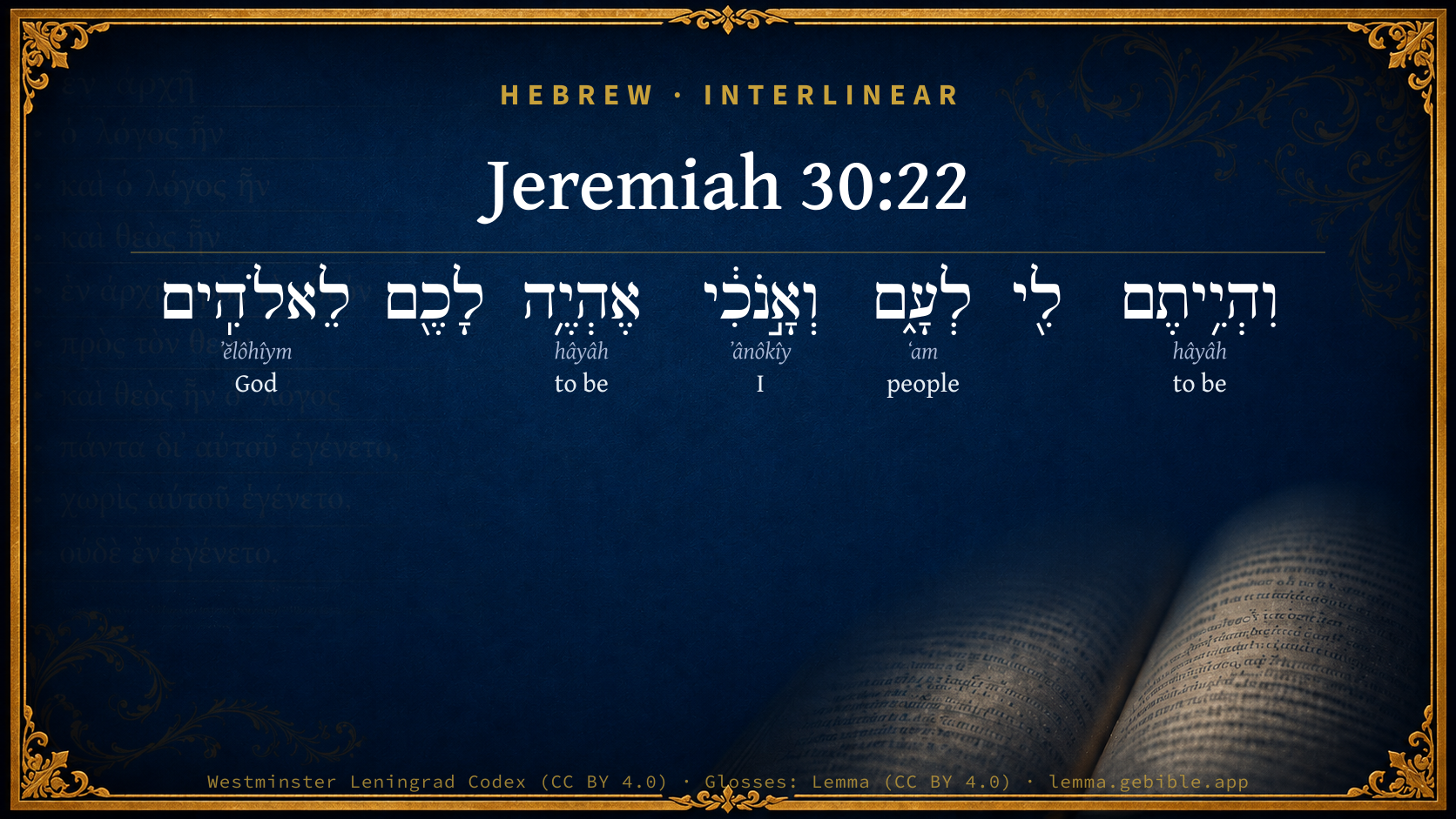
Jeremiah 30:22

Hebrew (Westminster Leningrad Codex) Jeremiah 30:22 appears in the Hebrew Old Testament. The text above is from the Westminster Leningrad Codex. Each word links to its Strong’s number, a concise gloss, and parsing drawn from the Open Scriptures Hebrew Bible morphology. Click any word for its full Brown-Driver-Briggs (BDB) entry.
Download image
Cite this verse

Jeremiah 30:22 (World English Bible). Public Domain. Lemma interlinear Bible study tool, https://lemma.gebible.app/v/jeremiah/30/22.

Show BibTeX & RIS
BibTeX
RIS
English Translation
You shall be my people, and I will be your God.
World English Bible · Public Domain
Download a study sheet

One document with this verse’s original text, its word-by-word gloss line, the meaning frame, cross-references with their text, attributed commentary, and full source and license credits — printable, and it pastes into notes with its structure intact.

This verse Autodidact and up

Study sheet (.html) Plain text (.txt)

A passage Seminary Student

Up to 50 verses in one chapter. A passage sheet keeps up to 6 commentary sources and 12 cross-references per verse, in the order this page ranks them, and says so on the sheet whenever that leaves anything out. Ask for a single verse and you get the Autodidact verse sheet above.

Everything on this page stays free to read, with no account — the sheet is a download of what is already on screen, not access to it.

Want to remove ads? Support Godless Engineer
Compare translations 3

The same verse in 3 English versions, stacked beneath the original-language interlinear above. Click any original word for its lexicon entry.

Each is an independent rendering of the whole verse — the interlinear is not word-aligned to these translations.

Highlighted words mark where these versions differ — a whole-verse word diff, not a word-by-word alignment.

  • World English Bible Public Domain
    You shall be my people, and I will be your God.
  • King James Version Public Domain
    And ye shall be my people, and I will be your God.
  • unfoldingWord Literal Text CC BY-SA 4.0
    Then you will be my people, and I will be your God.

unfoldingWord Literal Text — © unfoldingWord, licensed CC BY-SA 4.0. Word-aligned USFM3 via Door43 (git.door43.org/unfoldingWord/en_ult).

Versions to compare (up to 4)

3 of 4 selected

Show all 18 translations

Every available English version of this verse, each an independent rendering of the whole verse.

  • World English Bible Public Domain
    You shall be my people, and I will be your God.
  • Berean Standard Bible Public Domain
    “And you will be My people, and I will be your God.”
  • Majority Standard Bible Public Domain
    “And you will be My people, and I will be your God.”
  • King James Version Public Domain
    And ye shall be my people, and I will be your God.
  • American Standard Version (1901) Public Domain
    And ye shall be my people, and I will be your God.
  • Revised Version (1885) Public Domain
    And ye shall be my people, and I will be your God.
  • Geneva Bible (1599) Public Domain
    And ye shall be my people, and I will bee your God.
  • Douay-Rheims (1899) Public Domain
    And you shall be my people: and I will be your God.
  • Young's Literal Translation Public Domain
    And ye have been to Me for a people, And I am to you for God.
  • Literal Standard Version CC BY-SA 4.0
    “And you have been to Me for a people, || And I am to you for God.”
  • Unlocked Literal Bible CC BY-SA 4.0
    Then you will be my people, and I will be your God.
  • unfoldingWord Literal Text CC BY-SA 4.0
    Then you will be my people, and I will be your God.
  • Darby Bible Public Domain
    And ye shall be my people, and I will be your God.
  • World Messianic Bible Public Domain
    “You shall be my people, and I will be your God.
  • Webster's Bible Public Domain
    And ye shall be my people, and I will be your God.
  • Free Bible Version CC BY-SA 4.0
    You will be my people, and I will be your God.
  • Bible in Basic English Public Domain
    And you will be my people, and I will be your God.
  • JPS Tanakh (1917) Public Domain
    And ye shall be My people, and I will be your God.

Literal Standard Version (2020), Covenant Press — licensed CC BY-SA 4.0. Text via the HelloAO Bible API (eBible.org). Unlocked Literal Bible (unfoldingWord) — licensed CC BY-SA 4.0. Text via the HelloAO Bible API (eBible.org). unfoldingWord Literal Text — © unfoldingWord, licensed CC BY-SA 4.0. Word-aligned USFM3 via Door43 (git.door43.org/unfoldingWord/en_ult). Free Bible Version, Dr. Jonathan Gallagher — licensed CC BY-SA 4.0. Text via the HelloAO Bible API (eBible.org).

Word by word

More ways to search: Search by grammar → Find every occurrence → Compare this word →

Practice this passage: Drill this verse → Learn its vocabulary →

וְאָ֣נֹכִ֔י
ʼânôkîy
H595
“and · I”
Conjunction + Pronoun, Personal, 1st Person, Common, Singular
Part of Speech
Conjunction + Pronoun
Type
Personal
Person
1st Person
Gender
Common
Number
Singular
Full BDB Definition

Origin: a primitive pronoun

TWOT: 130

I (first person singular)
  1. וִהְיִ֥יתֶם hâyâh H1961 “and · to be” Conjunction + Verb, Qal, Sequential Perfect, 2nd Person, Masculine, Plural
  2. לְעָ֑ם ʻam H5971 “to/for · people” Preposition + Noun, Common, Masculine, Singular, Absolute
  3. אֶהְיֶ֥ה hâyâh H1961 “to be” Verb, Qal, Imperfect, 1st Person, Common, Singular
  4. לֵאלֹהִֽים ʼĕlôhîym H430 “to/for · God(s)” Preposition + Noun, Common, Masculine, Plural, Absolute

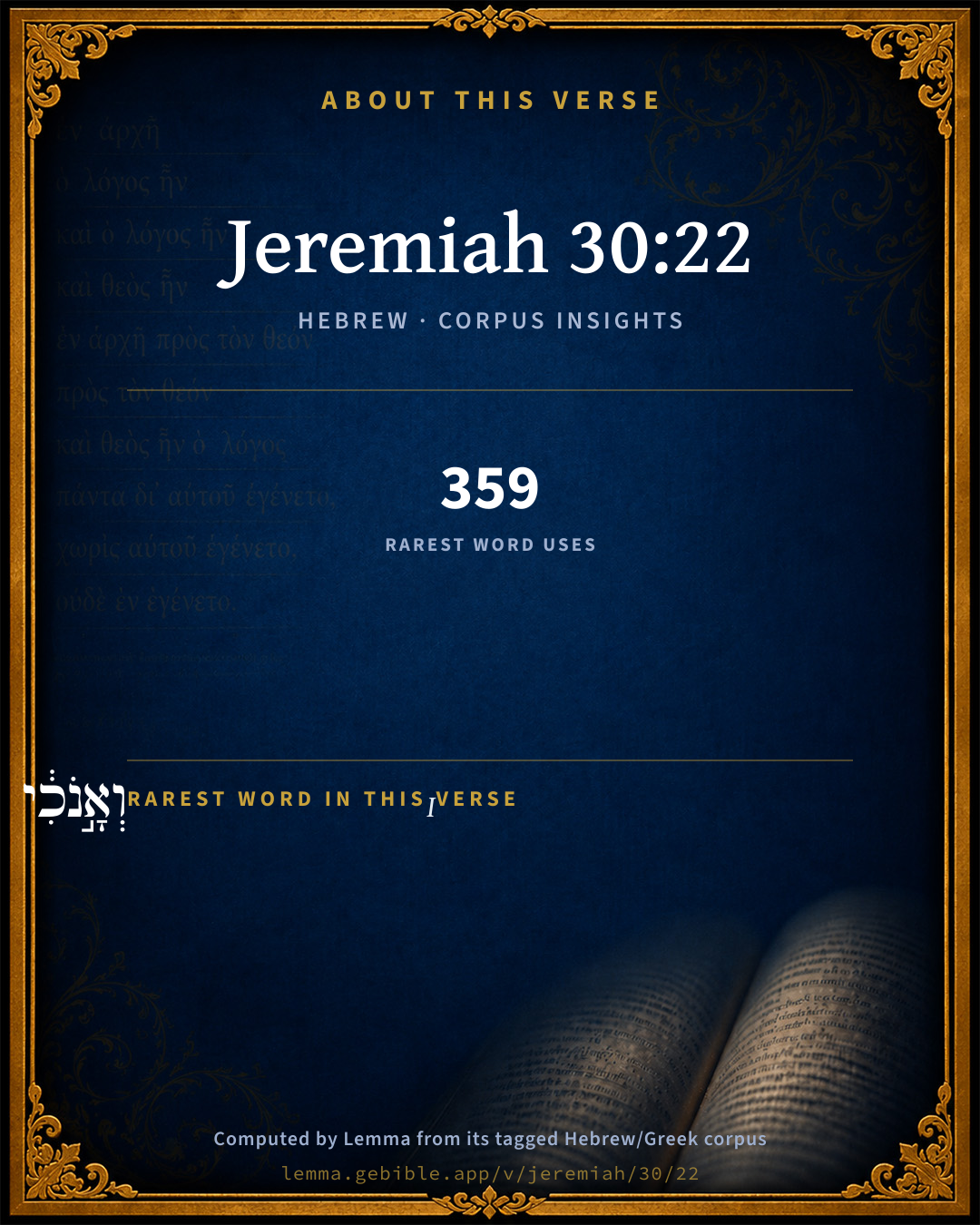
About this verse

These counts appear in no published source. They are computed here, from the morphology-tagged text and Lemma’s own curated glosses. What Lemma adds →

7
words
4
distinct lemmas
Prophets
section

Grammatical profile

  • 2 verbs
  • 2 nouns
  • 1 pronoun
  • 2 prepositions

Verb forms

  • וִהְיִ֥יתֶם Qal · Sequential Perfect
  • אֶהְיֶ֥ה Qal · Imperfect

Repetition

A word recurs within this verse — often emphatic in Hebrew:

  • וִהְיִ֥יתֶם to be H1961 ×2

Cross-references

14

Topical passages linked to Jeremiah 30:22 in the Treasury of Scripture Knowledge — connected by theme and wording, ordered by reader-vote popularity; previews shown in the World English Bible.

  • Jeremiah 24:7 I will give them a heart to know me, that I am Yahweh: and they shall be my people, and I will be their God; for they shall return to me with their whole heart.
  • Jeremiah 31:33 But this is the covenant that I will make with the house of Israel after those days, says Yahweh: I will put my law in their inward parts, and in their heart will I write it; and I will be their God, and they shall be my people:
  • Ezekiel 36:28 You shall dwell in the land that I gave to your fathers; and you shall be my people, and I will be your God.
  • Revelation 21:3 I heard a loud voice out of heaven saying, "Behold, God's dwelling is with people, and he will dwell with them, and they will be his people, and God himself will be with them as their God.
  • Zechariah 13:9 I will bring the third part into the fire, And will refine them as silver is refined, And will test them like gold is tested. They will call on my name, and I will hear them. I will say, 'It is my people;' And they will say, 'Yahweh is my God.'"
  • Jeremiah 31:1 At that time, says Yahweh, will I be the God of all the families of Israel, and they shall be my people.
  • Hebrews 8:10 "For this is the covenant that I will make with the house of Israel. After those days," says the Lord; "I will put my laws into their mind, I will also write them on their heart. I will be to them a God, And they will be to me a people.
  • Jeremiah 32:38 and they shall be my people, and I will be their God:
  • Ezekiel 37:27 My tent also shall be with them; and I will be their God, and they shall be my people.
  • Hosea 2:23 I will sow her to me in the earth; And I will have mercy on her who had not obtained mercy; And I will tell those who were not my people, 'You are my people;' And they will say, 'My God!'"
  • Deuteronomy 26:17–19 You have declared Yahweh this day to be your God, and that you would walk in his ways, and keep his statutes, and his commandments, and his ordinances, and listen to his voice:
  • Song of Solomon 2:16 My beloved is mine, and I am his. He browses among the lilies.
  • Ezekiel 11:20 that they may walk in my statutes, and keep my ordinances, and do them: and they shall be my people, and I will be their God.
  • Matthew 22:32 'I am the God of Abraham, and the God of Isaac, and the God of Jacob?' God is not the God of the dead, but of the living."

Cross-references courtesy of OpenBible.info (CC BY 4.0).

Hebrew and Greek witnesses Masoretic Hebrew ↔ Greek Septuagint

The same verse in the two great witnesses to the Old Testament, shown verse-for-verse.

These are two independent witnesses, not word-aligned to each other, and the Septuagint is shown in lemma (dictionary) form.

Hebrew Jeremiah 30:22 Masoretic · Westminster Leningrad Codex

וִהְיִ֥יתֶם לִ֖י לְעָ֑ם וְאָ֣נֹכִ֔י אֶהְיֶ֥ה לָכֶ֖ם לֵאלֹהִֽים

You shall be my people, and I will be your God.

World English Bible · Public Domain

Greek LXX Structure differs

In the Septuagint, Jeremiah is about an eighth shorter than the Hebrew and arranges its material differently — the Oracles Against the Nations (Hebrew chapters 46–51) appear in the middle of the Greek book, after 25:13. Because the chapter and verse boundaries do not line up, a verse-for-verse comparison with the Hebrew is not shown.

A verse-for-verse comparison isn’t shown here because the chapters and verses don’t line up. Switch to the LXX edition with the MT / LXX toggle above to read the Greek directly.

On this verse, The Pulpit Commentary discusses the Septuagint’s reading. Read the note in Commentary ↓

Hebrew: Westminster Leningrad Codex (CC BY 4.0). Greek: Septuagint (public domain); English from a public-domain English Septuagint. How the Septuagint differs from the Hebrew →

Targum (Aramaic paraphrase)

1

The Targum is the ancient Jewish Aramaic paraphrase of the Hebrew Scriptures — an interpretive translation, not the Hebrew text itself. Onkelos (literal) and Pseudo-Jonathan (expansive) render the Torah, and Jonathan the Prophets. Coverage is partial: where no permissively-licensed English translation exists for a verse, only the Aramaic is shown. This is verse-level text, not a word-by-word alignment to the Hebrew.

  1. Targum Jonathan Prophets (Joshua–Malachi)
    וּתְהוֹן קֳדָמַי לְעַם וַאֲנָא אֶהֱוֵי לְכוֹן לֶאֱלָהּ:

    (no public-domain English translation for this verse)

    Targum Jonathan — Aramaic: “Mikraot Gedolot” (public domain). English: “Sefaria Community Translation” (CC0 1.0 (public-domain dedication)); “London "Chaldee Paraphrase," 1871” (public domain). Text via Sefaria.

Commentary

Notes on Jeremiah 30:22 from classic Christian and Jewish commentators (each source and its license shown beneath its notes). The classic Christian expositions comment on the surrounding passage and are grouped to its opening verse, so a note may address several verses; the Jewish commentaries on the Tanakh (Rashi and others) are per-verse, so they appear only where the commentator wrote on this verse.

Lemma curates 59 commentaries, every one of them public domain or Creative Commons licensed, each selected and text-cleaned for this edition rather than reprinted as found. About our sources →

Trapp's Complete Commentary

John Trapp

Jer 30:22 And ye shall be my people, and I will be your God.

Ver. 22. And ye shall be my people, and I will be your God,] sc., Through Christ, and by his mediation. As for those that are not in covenant with God by Christ, as the devil will one day sweep them, so meanwhile,

John Trapp, A Commentary or Exposition upon All the Books of the Old and New Testament (1647–1656) — public domain. Text from a community e-Sword module.

Tyndale Open Study Notes

Tyndale Open Resources

30:22 The Lord wanted to establish a nation whose people were totally committed to worshiping him as the one true God (Exod 6:7; Ezek 36:38).

Tyndale Open Study Notes — © Tyndale Open Resources, licensed CC BY-SA 4.0. Text via the HelloAO Bible API.

Jamieson, Fausset & Brown

Robert Jamieson, A. R. Fausset & David Brown

ye shall be my people, &c.--The covenant shall be renewed between God and His people through Messiah's mediation (Jer 30:21; Jer 31:1, Jer 31:33; Jer 32:38; Eze 11:20; Eze 36:28).

Jamieson, Fausset & Brown — Commentary Critical and Explanatory on the Whole Bible (1871) — public domain (CC PDM 1.0). Text via the HelloAO Bible API.

Adam Clarke's Commentary

Verse 22. Ye shall be my people] The old covenant shall be renewed.

Adam Clarke's Commentary on the Bible (1810–1826) — public domain. Text from a community e-Sword/MySword module.

John Calvin's Commentaries

As this verse and what occurs in the first verse of the next chapter are materially the same, they shall be both explained here. God then says that the Jews would become a people to him, and that he would become a God to them. This mode of speaking is what we meet with everywhere in the Prophets; and it is very expressive, and includes the whole of true happiness. For when have we life, except when we become the people of God? We ought also to bear in mind that saying of the Psalmist,

“Blessed are the people whose God is Jehovah.” (Psalm 144:15)

It confirms what I have just said, that a happy life is complete in all its parts, when God promises to be a God to us and takes us as his people. The Prophets, therefore, do not without reason so often inculcate this truth; for though nothing else might be wanting to us that could be expected, yet until we feel assured that God is a Father to us, and that we are his people, whatever happiness we may have, it will only end in misery.

But the Prophet expresses himself more fully, when he says, At that time, that is, when God restored his Church, will I be a God to all the families of Israel They had been so scattered, that they were not one body; but God promises the gathering of that Church, from which the ten tribes had fallen off, when they revolted from the family of David. I cannot proceed farther now.

John Calvin's Commentaries (1540-1563) — public domain. Text from the Calvin Translation Society English edition (1840s-50s) via the Christian Classics Ethereal Library (ccel.org). Calvin's coverage is partial (roughly two-thirds of the Bible); uncommented books and verses are honest gaps, never fabricated. The 19th-century editor's footnotes and remarks are omitted so the notes are faithfully Calvin's own voice.

John Gill's Exposition

And ye shall be my people,.... For many hundred years the people of the Jews have been called "Loammi" or, "ye are not my people", Hos 1:9; but now being converted, the covenant of God's grace shall be renewed, and a fresh manifestation and application of it made unto them; and they partaking of the grace of it, shall appear to be, and shall be, called the people of God, and shall behave as such, and fear and worship the Lord:

and I will be your God; will manifest his love to them, bestow his favours upon them, and take them under his care and protection. This is a summary of the covenant of grace, which will visibly take place when those people shall turn to the Lord, Rom 11:26.

John Gill's Exposition of the Whole Bible (1746–1763) — public domain (CC PDM 1.0). Text via the HelloAO Bible API.

Matthew Poole's English Annotations

God in these words declares that in that day he would renew his covenant with Israel, (at least the true Israelites,) and they should be his people to serve and to obey him, and he would be their God to protect and bless them with all temporal and all spiritual blessings.

Matthew Poole's English Annotations on the Holy Bible (1683–1685) — public domain. Text from a community e-Sword/MySword module.

The Pulpit Commentary

This verse is omitted in the Septuagint, and (unless the existence of later insertions is denied altogether) is all but certainly due to a later hand. (comp. Jer_7:23) Comp. on vers. 10, 11.

The Pulpit Commentary (1880–1919), ed. H.D.M. Spence-Jones & Joseph S. Exell — public domain. Text from a community e-Sword module.

Lesson kit

Teaching starters — assembled from the data on this page, not authored interpretation. Every prompt links to the verse data it draws on. Edit before teaching.

Jeremiah, in the Prophets, opens this verse with 7 words (4 distinct Hebrew lemmas). Its most distinctive word is ʼânôkîy (“I”). A historical commentator’s framing appears above. Read the whole chapter for the surrounding context.

Discussion questions

  1. How does “I” (ʼânôkîy) shape what this verse is saying?
  2. Jeremiah 24:7 shares this passage’s theme. How do the two illuminate each other?
  3. “to be” occurs 2× in this one verse. What is the effect of the repetition?
  4. These translations render this verse differently. What is at stake in choosing one wording over another?
  5. The verb «וִהְיִ֥יתֶם» is Qal Sequential Perfect. How does its form color the action?
  6. Reading how Trapp's Complete Commentary and Tyndale Open Study Notes read this verse, where do the two commentators agree and where do they part?

Things to notice

  • These translations choose different wording for 2 words in this verse.
  • “to be” occurs 2× in this single verse.
  • 4 distinct Hebrew lemmas span 7 words in this verse.

Reading settings

Reading text

Shown beneath each verse's original-language words.

Old Testament
Old Testament edition

Read the OT as the Masoretic Hebrew (MT) or the Greek Septuagint (LXX).

English shown for the Greek Septuagint (in the Hebrew ↔ Greek comparison).

Comparing translations? Open the Compare panel on any verse page to stack up to four side by side.