
Psalms 119:122

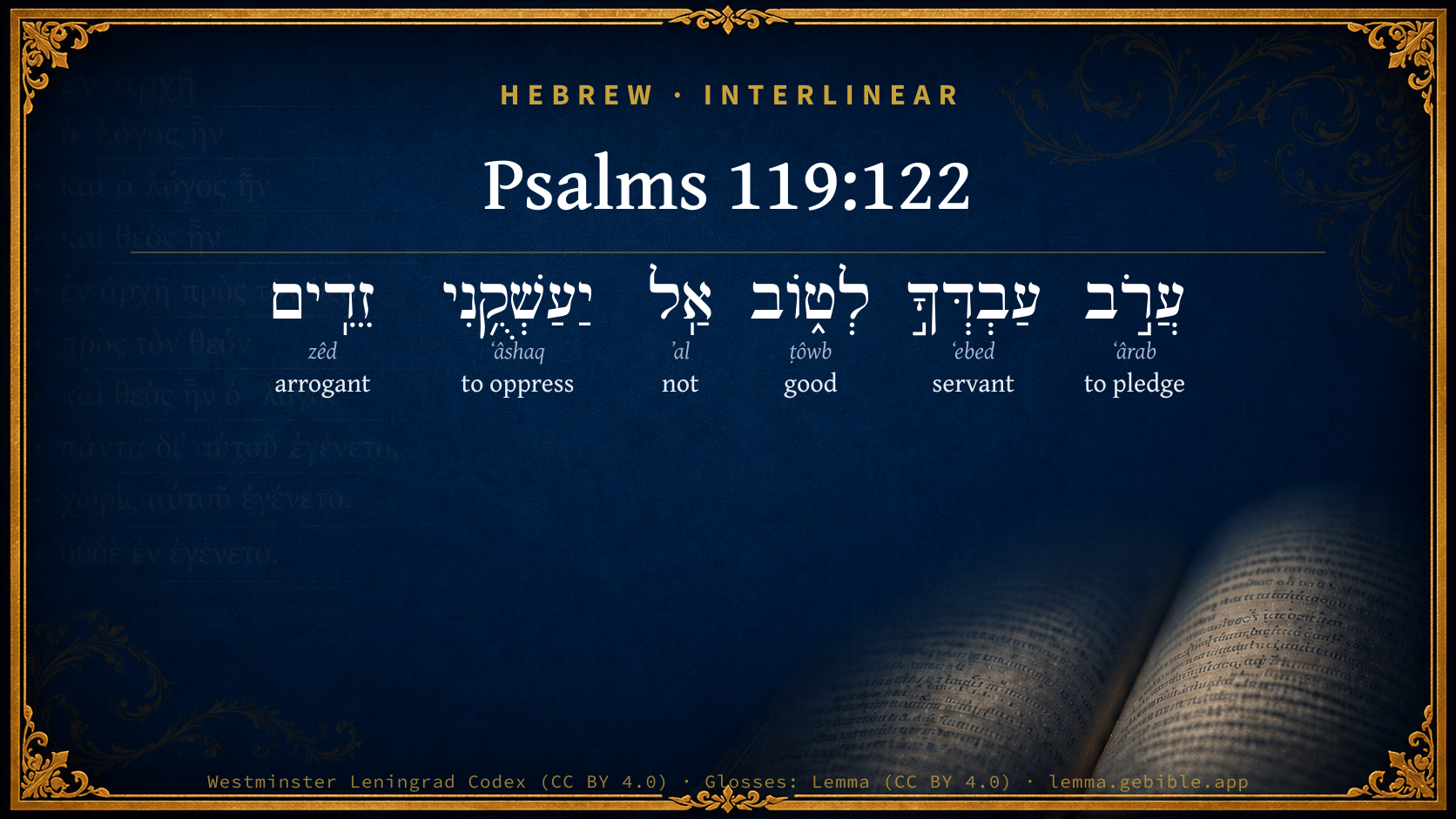
Hebrew (Westminster Leningrad Codex) Psalms 119:122 appears in the Hebrew Old Testament. The text above is from the Westminster Leningrad Codex. Each word links to its Strong’s number, a concise gloss, and parsing drawn from the Open Scriptures Hebrew Bible morphology. Click any word for its full Brown-Driver-Briggs (BDB) entry.
Download image
Cite this verse

Psalms 119:122 (World English Bible). Public Domain. Lemma interlinear Bible study tool, https://lemma.gebible.app/v/psalms/119/122.

Show BibTeX & RIS
BibTeX
RIS
English Translation
Ensure your servant's well-being. Don't let the proud oppress me.
World English Bible · Public Domain
Download a study sheet

One document with this verse’s original text, its word-by-word gloss line, the meaning frame, cross-references with their text, attributed commentary, and full source and license credits — printable, and it pastes into notes with its structure intact.

This verse Autodidact and up

Study sheet (.html) Plain text (.txt)

A passage Seminary Student

Up to 50 verses in one chapter. A passage sheet keeps up to 6 commentary sources and 12 cross-references per verse, in the order this page ranks them, and says so on the sheet whenever that leaves anything out. Ask for a single verse and you get the Autodidact verse sheet above.

Everything on this page stays free to read, with no account — the sheet is a download of what is already on screen, not access to it.

Want to remove ads? Support Godless Engineer
Compare translations 3

The same verse in 3 English versions, stacked beneath the original-language interlinear above. Click any original word for its lexicon entry.

Each is an independent rendering of the whole verse — the interlinear is not word-aligned to these translations.

Highlighted words mark where these versions differ — a whole-verse word diff, not a word-by-word alignment.

  • World English Bible Public Domain
    Ensure your servant's well-being. Don't let the proud oppress me.
  • King James Version Public Domain
    Be surety for thy servant for good: let not the proud oppress me.
  • unfoldingWord Literal Text CC BY-SA 4.0
    Be surety for your servant for good; do not let the arrogant oppress me.

unfoldingWord Literal Text — © unfoldingWord, licensed CC BY-SA 4.0. Word-aligned USFM3 via Door43 (git.door43.org/unfoldingWord/en_ult).

Versions to compare (up to 4)

3 of 4 selected

Show all 17 translations

Every available English version of this verse, each an independent rendering of the whole verse.

  • World English Bible Public Domain
    Ensure your servant's well-being. Don't let the proud oppress me.
  • Berean Standard Bible Public Domain
    Ensure Your servant’s well-being; do not let the arrogant oppress me.
  • Majority Standard Bible Public Domain
    Ensure Your servant’s well-being; do not let the arrogant oppress me.
  • King James Version Public Domain
    Be surety for thy servant for good: let not the proud oppress me.
  • American Standard Version (1901) Public Domain
    Be surety for thy servant for good: Let not the proud oppress me.
  • Revised Version (1885) Public Domain
    Be surety for thy servant for good: let not the proud oppress me.
  • Geneva Bible (1599) Public Domain
    Answere for thy seruant in that, which is good, and let not the proude oppresse me.
  • Young's Literal Translation Public Domain
    Make sure Thy servant for good, Let not the proud oppress me.
  • Literal Standard Version CC BY-SA 4.0
    Make Your servant sure for good, || Do not let the proud oppress me.
  • Unlocked Literal Bible CC BY-SA 4.0
    Guarantee the welfare of your servant; do not let the proud oppress me.
  • unfoldingWord Literal Text CC BY-SA 4.0
    Be surety for your servant for good; do not let the arrogant oppress me.
  • Darby Bible Public Domain
    Be surety for thy servant for good; let not the proud oppress me.
  • World Messianic Bible Public Domain
    Ensure your servant’s well-being. Don’t let the proud oppress me.
  • Webster's Bible Public Domain
    Be surety for thy servant for good: let not the proud oppress me.
  • Free Bible Version CC BY-SA 4.0
    Please promise you'll take care of me, your servant. Don't let these arrogant people mistreat me.
  • Bible in Basic English Public Domain
    Take your servant's interests into your keeping; let me not be crushed by the men of pride.
  • JPS Tanakh (1917) Public Domain
    Be surety for Thy servant for good; let not the proud oppress me.

Literal Standard Version (2020), Covenant Press — licensed CC BY-SA 4.0. Text via the HelloAO Bible API (eBible.org). Unlocked Literal Bible (unfoldingWord) — licensed CC BY-SA 4.0. Text via the HelloAO Bible API (eBible.org). unfoldingWord Literal Text — © unfoldingWord, licensed CC BY-SA 4.0. Word-aligned USFM3 via Door43 (git.door43.org/unfoldingWord/en_ult). Free Bible Version, Dr. Jonathan Gallagher — licensed CC BY-SA 4.0. Text via the HelloAO Bible API (eBible.org).

Word by word

More ways to search: Search by grammar → Find every occurrence → Compare this word →

Practice this passage: Drill this verse → Learn its vocabulary →

About this verse

These counts appear in no published source. They are computed here, from the morphology-tagged text and Lemma’s own curated glosses. What Lemma adds →

6
words
6
distinct lemmas
Wisdom
section

Notable vocabulary

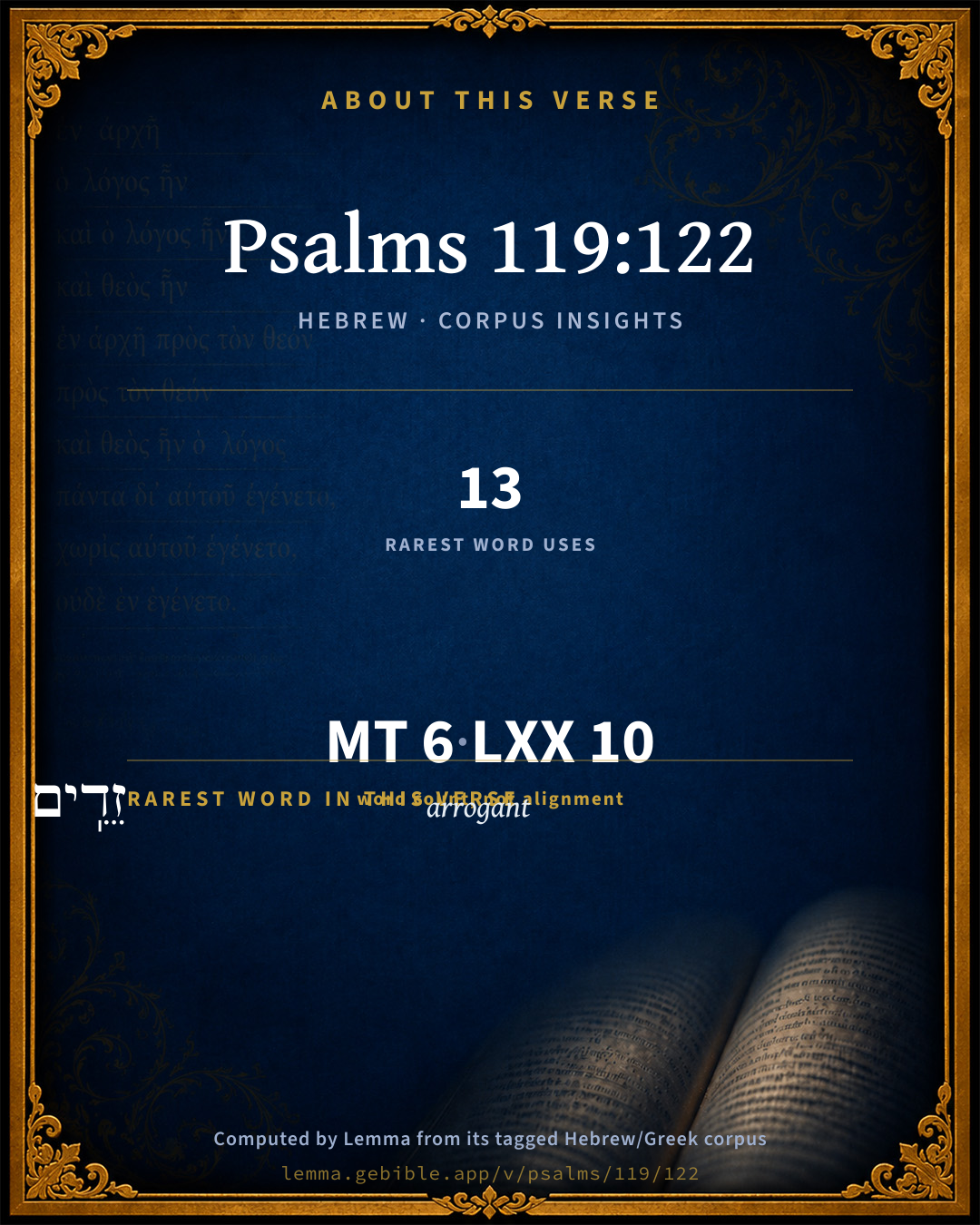
The rarest word here is זֵדִֽים arrogant H2086 — appearing just 13 times in the whole Hebrew Bible.

Shared distinctive vocabulary

זֵדִֽים arrogant H2086 occurs in 13 verses of the Hebrew Bible. Also found in:

Grammatical profile

  • 2 verbs
  • 1 noun
  • 2 adjectives
  • 1 particle

Verb forms

  • עֲרֹ֣ב Qal · Imperative
  • יַעַשְׁקֻ֥נִי Qal · Jussive

Hebrew & Septuagint length

In English translation the verse runs 10 words from the Hebrew and 12 from the Septuagint (LXX English) — closely comparable.

A rough comparison of the two English renderings, which tokenize alike — not a word-level alignment.

Word counts can differ between the Hebrew and the Greek without any difference in meaning — e.g. the Hebrew direct-object marker אֵת has no separate Greek word, and Greek often adds the article ὁ.

In the original languages it is 6 Hebrew tokens and 10 Greek tokens — but the two are counted differently (Hebrew bundles its prefixes and suffixes into one token; the Greek is in lemma form), so that isn’t a like-for-like length.

Cross-references

8

Topical passages linked to Psalms 119:122 in the Treasury of Scripture Knowledge — connected by theme and wording, ordered by reader-vote popularity; previews shown in the World English Bible.

  • Hebrews 7:22 By so much has Jesus become the collateral of a better covenant.
  • Psalms 119:21 You have rebuked the proud who are cursed, Who wander from your commandments.
  • Job 17:3 "Now give a pledge, be collateral for me with yourself. Who is there who will strike hands with me?
  • Proverbs 22:26–27 Don't you be one of those who strike hands, Of those who are collateral for debts.
  • Isaiah 38:14 Like a swallow [or] a crane, so did I chatter; I did moan as a dove; my eyes fail [with looking] upward: Lord, I am oppressed, be my collateral.
  • Genesis 43:9 I will be collateral for him. From my hand will you require him. If I don't bring him to you, and set him before you, then let me bear the blame forever,
  • Psalms 36:11 Don't let the foot of pride come against me. Don't let the hand of the wicked drive me away.
  • Philemon 1:18–19 But if he has wronged you at all, or owes you anything, put that to my account.

Cross-references courtesy of OpenBible.info (CC BY 4.0).

Hebrew and Greek witnesses Masoretic Hebrew ↔ Greek Septuagint

The same verse in the two great witnesses to the Old Testament, shown verse-for-verse.

You’re reading Greek Psalm 118 (Hebrew Psalm 119). The Septuagint counts the superscription, so verse numbers can differ from the Hebrew — chapter-level alignment, not verse-by-verse. Numbering follows Rahlfs.

These are two independent witnesses, not word-aligned to each other, and the Septuagint is shown in lemma (dictionary) form.

Hebrew Psalms 119:122 Masoretic · Westminster Leningrad Codex

עֲרֹ֣ב עַבְדְּךָ֣ לְט֑וֹב אַֽל יַעַשְׁקֻ֥נִי זֵדִֽים

Ensure your servant's well-being. Don't let the proud oppress me.

World English Bible · Public Domain

Greek LXX Greek Psalm 118:122 Septuagint · lemma form

ἐκδέχομαι ὁ δοῦλος σύ εἰς ἀγαθός μή συκοφαντέω ἐγώ ὑπερήφανος

Receive your servant for good: let not the proud accuse me falsely.

LXX2012 (modern English Septuagint) · Public Domain

On this verse, John Gill's Exposition discusses the Septuagint’s reading. Read the note in Commentary ↓

Hebrew: Westminster Leningrad Codex (CC BY 4.0). Greek: Septuagint (public domain); English from LXX2012 (modern English Septuagint) (Public Domain). How the Septuagint differs from the Hebrew →

Commentary

Notes on Psalms 119:122 from classic Christian and Jewish commentators (each source and its license shown beneath its notes). The classic Christian expositions comment on the surrounding passage and are grouped to its opening verse, so a note may address several verses; the Jewish commentaries on the Tanakh (Rashi and others) are per-verse, so they appear only where the commentator wrote on this verse.

Lemma curates 59 commentaries, every one of them public domain or Creative Commons licensed, each selected and text-cleaned for this edition rather than reprinted as found. About our sources →

Trapp's Complete Commentary

John Trapp

Psa 119:122 Be surety for thy servant for good: let not the proud oppress me.

Ver. 122. Be surety for thy servant for good] Obi vadimonium; appear for me, and nonsuit all accusations against me; or, undertake for me that I shall keep thy laws, as I have said and sworn to do: Sis fide iussor meus. Some observe that this is the only verse throughout the whole psalm wherein the word is not mentioned under the name of law, judgments, statutes,or the like terms. And they make this note upon it; where the law faileth there Christ is a surety of a better testament. There are that render the words thus: Dulcify or delight thy servant in good, that is, make him joyful and comfortable in the pursuit and practice of that which is good, Oblecta servum (Muscul.).

John Trapp, A Commentary or Exposition upon All the Books of the Old and New Testament (1647–1656) — public domain. Text from a community e-Sword module.

J. A. Alexander on Psalms

Joseph Addison Alexander

122. (Psa 119:122) Be surety for thy servant for good; let not the proud oppress me. The sense and construction of the first verb are precisely the same as in Gen 43:9; Gen 44:32. Compare Job 17:3, and see my note on Isa 38:14. It means not merely take me under thy protection, but become answerable for me, stand between me and those who, under any pretext, even that of legal right, may seek to oppress me. For good, i.e. for my good, for my safety or deliverance. Compare Deu 6:24; Deu 10:13; Deu 30:9. This is noted in the masora as the only verse in which the word of God, or some equivalent expression, is not found.

Joseph Addison Alexander, The Psalms Translated and Explained (1850) — public domain. Text from a community e-Sword module.

Geneva Bible (1599)

Geneva Bible translators

Put thyself between mine enemies and me, as if thou were my pledge.

Geneva Bible (1599) marginal notes — public domain. Text via Bolls.life.

Adam Clarke's Commentary

Verse 122. Be surety for thy servant] ערב arob, give a pledge or token that thou wilt help me in times of necessity. Or, Be bail for thy servant. What a word is this! Pledge thyself for me, that thou wilt produce me safely at the judgment of the great day. Then sustain and keep me blameless till the coming of Christ. Neither of these two verses has any of the ten words in reference to God's law or attributes. The judgment and the justice refer to the psalmist's own conduct in Ps 119:121. The hundred and twenty-second has no word of the kind.

Adam Clarke's Commentary on the Bible (1810–1826) — public domain. Text from a community e-Sword/MySword module.

John Calvin's Commentaries

122. Become surety for thy servant for good. This prayer is almost similar to that of the preceding verse; for I prefer translating the Hebrew verb ערוב, arob, by Become surety for, to rendering, as others do, Delight thy servant in good, or Make thy servant to delight in good According to this second version, the words are a prayer that God would rejoice his servant with his benefits. There is a third translation, by which they become a prayer that God would inspire his heart with the love and desire of rectitude; for true perfection consists in our taking pleasure in justice and uprightness. But as from the last clause of the verse it is obvious that David here desires succor against his enemies, the verb Become surety is the more appropriate rendering ערב This verb signifies to be pleasant, acceptable. So Bucer has translated the first part of the verse, oblecta servum tuum bono; and indeed the Chaldee has given the same sense to the verb, for it is rendered by בסים, make merry. But the other meaning which it has, viz. to become surety, is evidently more suitable; for the expression Be surety for thy servant for good, corresponds very well with the previous and subsequent petitions, which are for deliverance from the hands of the enemy.” — Phillips.

John Calvin's Commentaries (1540-1563) — public domain. Text from the Calvin Translation Society English edition (1840s-50s) via the Christian Classics Ethereal Library (ccel.org). Calvin's coverage is partial (roughly two-thirds of the Bible); uncommented books and verses are honest gaps, never fabricated. The 19th-century editor's footnotes and remarks are omitted so the notes are faithfully Calvin's own voice.

Ellicott's Commentary for English Readers

AIN.

(122) Be surety.—Just as Judah became surety for the safety of Benjamin (Gen_43:9), so the psalmist asks God to be answerable for the servant who had been faithful to the covenant, and stand between him and the attacks of the proud. So Hezekiah (Isa_38:14) asks God to “undertake” for him against the threat of death. There is also, no doubt, the further thought that the Divine protection would vindicate the profession which the loyal servant makes of his obedience, as in Job_17:3, where God is summoned as the only possible guarantee of the sufferer’s innocence. This and Psa_119:132 are the only verses not actually mentioning, under one of its terms, the Law.

A Bible Commentary for English Readers, edited by Charles John Ellicott (1878–1897) — public domain. Text from a community e-Sword module.

The Cambridge Bible for Schools and Colleges

gen. ed. J. J. S. Perowne

122. Be surety for thy servant for good] “Guarantee Thy servant’s welfare” (Kay). Cp. Gen_43:9; Job_17:3; Isa_38:14. P.B.V. make thou thy servant to delight in that which is good follows Targ., Syr. and Kimchi, in explaining the verb from the sense which it bears in Psa_104:34 and elsewhere, but this cannot be the meaning. Coverdale was unfortunately misled by Münster’s dulce fac servo tuo id quod est bonum to substitute this rendering in the Great Bible of 1539 for the correct rendering which he had given in 1535, “Be thou suertie for thy servant to do him good.”

The Cambridge Bible for Schools and Colleges (gen. ed. J. J. S. Perowne; Cambridge University Press, 1878–1918) — public domain. Text from a community e-Sword module.

John Gill's Exposition

It is time for thee, Lord, to work,.... To send the Messiah, to work righteousness; to fulfil the law, and vindicate the honour of it, broken by men. It was always a notion of the Jews that the time of the Messiah's coming would be when it was a time of great wickedness in the earth; and which seems to agree with the word of God, and was true in fact; see Mal 2:17. Or to arise and have mercy on Zion, for which there is a fixed time: and its seems as if it would be when religion greatly declines, and profaneness abounds; when love is waxen cold, and there is no faith in the earth; and when the days are like those of Noah and Lot, Luk 17:26; or to take vengeance on wicked men, by sending down his judgments on them now, as well as he will punish them hereafter; for which a time is appointed, though no man knows of it. The words may be rendered, "it is time to work for the Lord" (o); so the Septuagint version; to which agrees the Targum,

"it is time to do the will of the Lord;''

and the Syriac and Arabic versions, "it is time to worship the Lord". It is proper, in declining times, for good men to bestir themselves and be in action, to attempt the revival of religion, to do all that in them lies to support the cause of God, and to vindicate his honour and glory;

for they have made void thy law; the whole word of God, the Scriptures; as atheists and deists, who deny the authority of them; Pharisees, who preferred their oral law to the written word, and by the traditions of the elders made it of none effect; Papists, by their unwritten traditions, and denying the common people the reading of the Scriptures in their mother tongue; and all false teachers, who wrest the Scriptures, and put false glosses on them, and handle the word of God deceitfully; and all profane sinners, who bid defiance to the law, and, as much as in them lies, abrogate it, and set up a law of their own, and frame mischief by it: or the law of faith may be meant; the Gospel of Christ, and the several truths of it, which are opposed, contradicted, and blasphemed by men of corrupt minds; and particularly the doctrine of justification by faith in Christ's righteousness; which are made void by the doctrine of works; and even the law itself is made void by the same: for not those that maintain the doctrine of Christ's righteousness, but those that establish their own, make void the law; presenting a righteousness to it, which is not answerable to its demands, Rom 3:31.

(o) "tempus est agendi pro Deo", Gussetius, p. 649. "Tempus faciendi Domino", Pagninus, Montanus, Musculus.

John Gill's Exposition of the Whole Bible (1746–1763) — public domain (CC PDM 1.0). Text via the HelloAO Bible API.

Albert Barnes' Notes on the Bible

Be surety for thy servant for good - On the meaning of the word here rendered “be surety,” see the notes at Job 17:3, and the notes at Isa 38:14, in both which places the same Hebrew word occurs: In Isaiah it is rendered “undertake for me.” The word means, properly, “to mix, to mingle;” hence, to braid, to interweave; then, to exchange, to barter. Then it means to mix or intermingle interests; to unite ourselves with others so that their interests come to be our own; and hence, to take one under our protection, to become answerable for, to be a surety for: as, when one endorses a note for another, he mingles his own interest, reputation, and means with his. So Christ becomes the security or surety - ἔγγυος enguos - of his people, Heb 7:22. The prayer here is, that God would, so to speak, mix or mingle his cause and that of the psalmist together, and that he would then protect the common cause as his own; or, that he would become a “pledge” or “surety” for the safety of the psalmist. This now, through the Mediator, we have a right to ask at the hand of God; and when God makes our cause his own, we must be safe.

Let not the proud oppress me - See the notes at Psa 119:51. Let them not triumph over me, and crush me.

Albert Barnes' Notes on the Bible (1834–1885) — public domain. Text from a community e-Sword/MySword module.

Matthew Poole's English Annotations

Do thou undertake and plead my cause against all mine enemies, as a surety rescues the poor persecuted debtor from the hands of a severe creditor.

For good; for my safety and comfort.

Matthew Poole's English Annotations on the Holy Bible (1683–1685) — public domain. Text from a community e-Sword/MySword module.

The Treasury of David

Charles H. Spurgeon

Ver. 122. Be surety for thy servant for good. What David prays to God to be for him, that Christ is for all his people: Heb 7:22. He drew nigh to God, struck hands with him, gave his word and bond to pay the debts of his people; put himself in their law place and stead, and became responsible to law and justice for them; engaged to make satisfaction for their sins, to bring in everlasting righteousness for their justification, and to preserve and keep them, and bring them safe to eternal glory and happiness; and this was being a surety for them for good. John Gill.

Ver. 122. Be surety for thy servant for good. There are three expositions of this clause, as noting the end, the cause, the event.

1. Undertake for me, ut sire bonus et justus, so Rabbi Arama on the place; surety for me that I may be good. Theodoret expounds it, "Undertake that I shall make good my resolution of keeping thy law." He that joins, undertakes; though we have precepts and without God's undertaking we shall never be able to perform our duty.

2. Undertake for me to help me in doing good; so some read it: would not take his part in an evil cause. To commend a wrong to God's protection, is to provoke him to hasten our punishment, to us serve under our oppressors; but, when we have a good cause, and good conscience, he will own us. We cannot expect he should maintain us and bear us out in the Devil's service, wherein we have entangled selves by our own sin.

3. Be with me for good: so it is often rendered: "Shew me a token for good" (Ps 86:17); "Pray not for this people for good" (Jer 11:14); so, "Remember me, O my God, for good" (Ne 13:31). So here "Be surety for thy servant for good." Thomas Manton.

Ver. 122. Be surety for thy servant for good. It is the prayer Hezekiah in his trouble, "O Lord, I am oppressed, "undertake for, (Isa 38:14); it is the prayer of Job for a "daysman" to between him and God (Job 9:33); it is the cry of the church before Incarnation for the appearance of a Divine Mediator; it is the confidence of every faithful soul since that blessed time in the perpetual of our Great High Priest in heaven, which is to us the pledge of blessedness. Agellius and Cocceius, in Neale and Littledale.

Ver. 122. Be surety for thy servant for good. His meaning is, thou knowest how unjustly I am calumniated and evil spoken of in parts: where I am not present or where I may not answer for myself, answer thou for me. William Cowper.

Ver. 122. Be surety for thy servant for good. The keen eye of world may possibly not be able to affix any blot upon my outward confession; but, "if thou, Lord, shouldest mark iniquities; O Lord, who shall stand?" The debt is continually accumulating, and the prospect of payment as distant as ever. I might well expect to be "left to my oppressors, "I should pay all that was due unto my Lord. But behold! "Where is the fury of the oppressor?" Isa 51:13. The surety is found the debt is paid the ransom is accepted the sinner is free. There was a voice heard heaven "Deliver him from going down to the pit: I have found a ransom", Job 33:24. The Son of God himself became Surety for a stranger, and "smarted for it, "Pr 11:15. At an infinite cost the cost of his precious blood he delivered me from "mine oppressors" sin Satan world death hell. Charles Bridges.

Ver. 122. Some observe that this is the only verse throughout the whole psalm wherein the Word is not mentioned under the name of "law "judgments, ""statutes, "or the like terms, and they make this note it, "Where the Law faileth, there Christ is a surety of a better testament. There are those that render the words thus, "Dulcify, or, delight thy servant good, "that is, make him joyful and comfortable in the pursuit and of that which is good. John Trapp.

Ver. 122.

1. Suretyship entreated.

2. Good expected.

3. Obligation acknowledged: "thy servant."

Ver. 122 (first clause). After explaining the Psalmist's meaning as shown in the preceding verse, this sentence may be used for a sermon upon the Suretyship of Christ, by a reference to Heb 7:22.

1. A Surety for good wanted the deeply felt, though, perhaps, undefined want of a sin burdened soul.

(a) The mere statement of a gratuitous pardon on the part

of God is not thoroughly believable to such a soul,

nor, if it could be believed in, would it give peace to

the conscience. For, on the one hand, the pardon could

not be perceived as just, nor as consistent with God's

necessary hatred of sin, yet the conscience demands

this perception; on the other hand, mere pardon does

not show how the obligation to a perfect fulfilment of

God's law, as righteousness, can be met, yet the

conscience demands to see this before it can be

satisfied to realize peace Luther's experience.

(b) Now the Scriptures tell us that God "justifies the

ungodly, "and that his "righteousness" is declared in

his justifying sinners: Ro 3:25. He can forgive

sins with justice. He can treat sinners as righteous

persons, and yet bo righteous in doing so. How? By a

Surety. Therefore, a Surety is the real want.

2. A Surety existent. Jesus is the Surety.

(a) He undertook to bear our obligation to the law's

penalty, and fulfilled it in death. Thus pardon, though

mercy to us, is an act of justice to Christ.

(b) He undertook our obligation to a perfect obedience, and

satisfied for that in his fulfilment of the law; thus

for God to treat us as righteous is only just to

Christ.

(c) God has shown his satisfaction with the office of

Christ, and with his work, by the resurrection and

glorification of Christ. Hence a well accredited and

efficient Surety exists.

3. A Surety nigh at hand.

(a) In the gospel, Christ as Surety comes to the sinner as

truly as though he himself left his throne and came in

his own person.

(b) Thus, he is so close that a sinner has but to receive

the gospel into his heart and he receives Christ.

(c) Christ received as a Surety is the Surety for whosoever

receives him. J.F.

Psalms 119:123*

Charles H. Spurgeon's The Treasury of David (1869–1885) — public domain. Psalms only. Text from a community e-Sword/MySword module.

The Pulpit Commentary

Be surety for thy servant for good. (comp. Job_17:3 Isa_38:14) "For good" means "so that it may be well with him." Let not the proud oppress me (comp. vers. 51, 69, 78, 85, etc.).

The Pulpit Commentary (1880–1919), ed. H.D.M. Spence-Jones & Joseph S. Exell — public domain. Text from a community e-Sword module.

John Wesley's Explanatory Notes

Surety - Do thou undertake and plead my cause.

John Wesley, Explanatory Notes Upon the Whole Bible (1754–1765) — public domain. Text via the GEBible commentary corpus.

Rashi

Rabbi Shlomo Yitzchaki (Rashi)

Be surety Heb. ערב, garantis in French, to vouch for. Be a guarantor for me against the evil (i.e., be a guarantor that I keep Your precepts).

Rashi on the Tanakh — English translations: “The Judaica Press complete Tanach with Rashi, translated by A. J. Rosenberg” (CC BY 4.0); “Pentateuch with Rashi's commentary by M. Rosenbaum and A.M. Silbermann, 1929-1934” (public domain); “The Metsudah Tanach series, Lakewood, N.J” (CC BY 4.0); and “The Book of Joshua, Metsudah Publications, 1997” (CC BY 4.0). Text via Sefaria.

Lesson kit

Teaching starters — assembled from the data on this page, not authored interpretation. Every prompt links to the verse data it draws on. Edit before teaching.

Psalms, in the Wisdom, opens this verse with 6 words (6 distinct Hebrew lemmas). Its most distinctive word is zêd (“arrogant”). A historical commentator’s framing appears above. Read the whole chapter for the surrounding context.

Discussion questions

  1. What does “arrogant” (zêd) contribute to the verse as a whole?
  2. Psalms 19:13 shares the word «arrogant» with this verse. How do the two illuminate each other?
  3. The translations on this page render this verse differently — a whole-verse word diff, not a word-by-word alignment. What might account for the different wordings?
  4. The verb «עֲרֹ֣ב» is Qal Imperative. How does its form color the action?
  5. Reading how Trapp's Complete Commentary and J. A. Alexander on Psalms read this verse, where do the two commentators agree and where do they part?

Things to notice

Reading settings

Reading text

Shown beneath each verse's original-language words.

Old Testament
Old Testament edition

Read the OT as the Masoretic Hebrew (MT) or the Greek Septuagint (LXX).

English shown for the Greek Septuagint (in the Hebrew ↔ Greek comparison).

Comparing translations? Open the Compare panel on any verse page to stack up to four side by side.