Isaiah 10:22

Hebrew (Westminster Leningrad Codex) Isaiah 10:22 appears in the Hebrew Old Testament. The text above is from the Westminster Leningrad Codex. Each word links to its Strong’s number, a concise gloss, and parsing drawn from the Open Scriptures Hebrew Bible morphology. Click any word for its full Brown-Driver-Briggs (BDB) entry.
Download image
Cite this verse

Isaiah 10:22 (World English Bible). Public Domain. Lemma interlinear Bible study tool, https://lemma.gebible.app/v/isaiah/10/22.

Show BibTeX & RIS
BibTeX
RIS
English Translation
For though your people, Israel, be as the sand of the sea, [only] a remnant of them shall return: a destruction [is] determined, overflowing with righteousness.
World English Bible · Public Domain
Download a study sheet

One document with this verse’s original text, its word-by-word gloss line, the meaning frame, cross-references with their text, attributed commentary, and full source and license credits — printable, and it pastes into notes with its structure intact.

This verse Autodidact and up

Study sheet (.html) Plain text (.txt)

A passage Seminary Student

Up to 50 verses in one chapter. A passage sheet keeps up to 6 commentary sources and 12 cross-references per verse, in the order this page ranks them, and says so on the sheet whenever that leaves anything out. Ask for a single verse and you get the Autodidact verse sheet above.

Everything on this page stays free to read, with no account — the sheet is a download of what is already on screen, not access to it.

Want to remove ads? Support Godless Engineer
Compare translations 3

The same verse in 3 English versions, stacked beneath the original-language interlinear above. Click any original word for its lexicon entry.

Each is an independent rendering of the whole verse — the interlinear is not word-aligned to these translations.

Highlighted words mark where these versions differ — a whole-verse word diff, not a word-by-word alignment.

  • World English Bible Public Domain
    For though your people, Israel, be as the sand of the sea, [only] a remnant of them shall return: a destruction [is] determined, overflowing with righteousness.
  • King James Version Public Domain
    For though thy people Israel be as the sand of the sea, yet a remnant of them shall return: the consumption decreed shall overflow with righteousness.
  • unfoldingWord Literal Text CC BY-SA 4.0
    For though your people, Israel, is like the sand of the sea, a remnant of it will return. Destruction has been decreed, overflowing righteousness.

unfoldingWord Literal Text — © unfoldingWord, licensed CC BY-SA 4.0. Word-aligned USFM3 via Door43 (git.door43.org/unfoldingWord/en_ult).

Versions to compare (up to 4)

3 of 4 selected

Show all 18 translations

Every available English version of this verse, each an independent rendering of the whole verse.

  • World English Bible Public Domain
    For though your people, Israel, be as the sand of the sea, [only] a remnant of them shall return: a destruction [is] determined, overflowing with righteousness.
  • Berean Standard Bible Public Domain
    Though your people, O Israel, be like the sand of the sea, only a remnant will return. Destruction has been decreed, overflowing with righteousness.
  • Majority Standard Bible Public Domain
    Though your people, O Israel, be like the sand of the sea, only a remnant will return. Destruction has been decreed, overflowing with righteousness.
  • King James Version Public Domain
    For though thy people Israel be as the sand of the sea, yet a remnant of them shall return: the consumption decreed shall overflow with righteousness.
  • American Standard Version (1901) Public Domain
    For though thy people, Israel, be as the sand of the sea, `only' a remnant of them shall return: a destruction `is' determined, overflowing with righteousness.
  • Revised Version (1885) Public Domain
    For though thy people Israel be as the sand of the sea, only a remnant of them shall return: a consumption is determined, overflowing with righteousness.
  • Geneva Bible (1599) Public Domain
    For though thy people, O Israel, be as the sand of the sea, yet shall the remnant of them returne. The consumption decreed shall ouerflow with righteousnesse.
  • Douay-Rheims (1899) Public Domain
    For if thy people, O Israel, shall be as the sand of the sea, a remnant of them shall be converted, the consumption abridged shall overflow with justice.
  • Young's Literal Translation Public Domain
    For though thy people Israel be as the sand of the sea, A remnant doth return of it, A consumption determined, Overflowing `with' righteousness.
  • Literal Standard Version CC BY-SA 4.0
    For though your people Israel be as the sand of the sea, || A remnant of it returns, || A consumption determined, || Overflowing [with] righteousness.
  • Unlocked Literal Bible CC BY-SA 4.0
    For though your people, Israel, are like the sand of the seashore, only a remnant of them will return. Destruction is decreed, as overflowing righteousness demands.
  • unfoldingWord Literal Text CC BY-SA 4.0
    For though your people, Israel, is like the sand of the sea, a remnant of it will return. Destruction has been decreed, overflowing righteousness.
  • Darby Bible Public Domain
    For though thy people Israel be as the sand of the sea, [only] a remnant of them shall return: the consumption determined shall overflow in righteousness.
  • World Messianic Bible Public Domain
    For though your people, Israel, are like the sand of the sea, only a remnant of them will return. A destruction is determined, overflowing with righteousness.
  • Webster's Bible Public Domain
    For though thy people Israel be as the sand of the sea, yet a remnant of them shall return: the consumption decreed shall overflow with righteousness.
  • Free Bible Version CC BY-SA 4.0
    Israel, even though your people are as numerous as sand on the seashore, only a remnant will return. The Lord has rightly decided to destroy his people.
  • Bible in Basic English Public Domain
    For though your people, O Israel, are as the sand of the sea, only a small number will come back: for the destruction is fixed, overflowing in righteousness.
  • JPS Tanakh (1917) Public Domain
    For though thy people, O Israel, be as the sand of the sea, only a remnant of them shall return; an extermination is determined, overflowing with righteousness.

Literal Standard Version (2020), Covenant Press — licensed CC BY-SA 4.0. Text via the HelloAO Bible API (eBible.org). Unlocked Literal Bible (unfoldingWord) — licensed CC BY-SA 4.0. Text via the HelloAO Bible API (eBible.org). unfoldingWord Literal Text — © unfoldingWord, licensed CC BY-SA 4.0. Word-aligned USFM3 via Door43 (git.door43.org/unfoldingWord/en_ult). Free Bible Version, Dr. Jonathan Gallagher — licensed CC BY-SA 4.0. Text via the HelloAO Bible API (eBible.org).

Word by word

More ways to search: Search by grammar → Find every occurrence → Compare this word →

Practice this passage: Drill this verse → Learn its vocabulary →

כִּלָּי֥וֹן
killâyôwn
H3631
“pining”
Noun, Common, Masculine, Singular, Absolute
Part of Speech
Noun
Type
Common
Gender
Masculine
Number
Singular
State
Absolute
Full BDB Definition

Origin: from H3615

TWOT: 982c

completion, destruction, consumption, annihilation - failing, pining
  1. כִּ֣י kîy H3588 “that” Conjunction
  2. אִם ʼim H518 “if” Conjunction
  3. יִהְיֶ֞ה hâyâh H1961 “to be” Verb, Qal, Imperfect, 3rd Person, Masculine, Singular
  4. עַמְּךָ֤ ʻam H5971 “people · your” Noun, Common, Masculine, Singular, Construct + Suffix, Personal, 2nd Person, Masculine, Singular
  5. יִשְׂרָאֵל֙ Yisrâʼêl H3478 “Israel” Noun, Proper
  6. כְּח֣וֹל chôwl H2344 “like/as · sand of” Preposition + Noun, Common, Masculine, Singular, Construct
  7. הַיָּ֔ם yâm H3220 “the · sea” Particle, Definite Article + Noun, Common, Masculine, Singular, Absolute
  8. שְׁאָ֖ר shᵉʼâr H7605 “remnant” Noun, Common, Masculine, Singular, Absolute
  9. יָשׁ֣וּב shûwb H7725 “to return” Verb, Qal, Imperfect, 3rd Person, Masculine, Singular
  10. חָר֖וּץ chârats H2782 “sharpened” Verb, Qal, Participle Passive, Masculine, Singular, Absolute
  11. שׁוֹטֵ֥ף shâṭaph H7857 “washing” Verb, Qal, Participle Active, Masculine, Singular, Absolute
  12. צְדָקָֽה tsᵉdâqâh H6666 “righteousness” Noun, Common, Feminine, Singular, Absolute

About this verse

These counts appear in no published source. They are computed here, from the morphology-tagged text and Lemma’s own curated glosses. What Lemma adds →

14
words
13
distinct lemmas
Prophets
section

Notable vocabulary

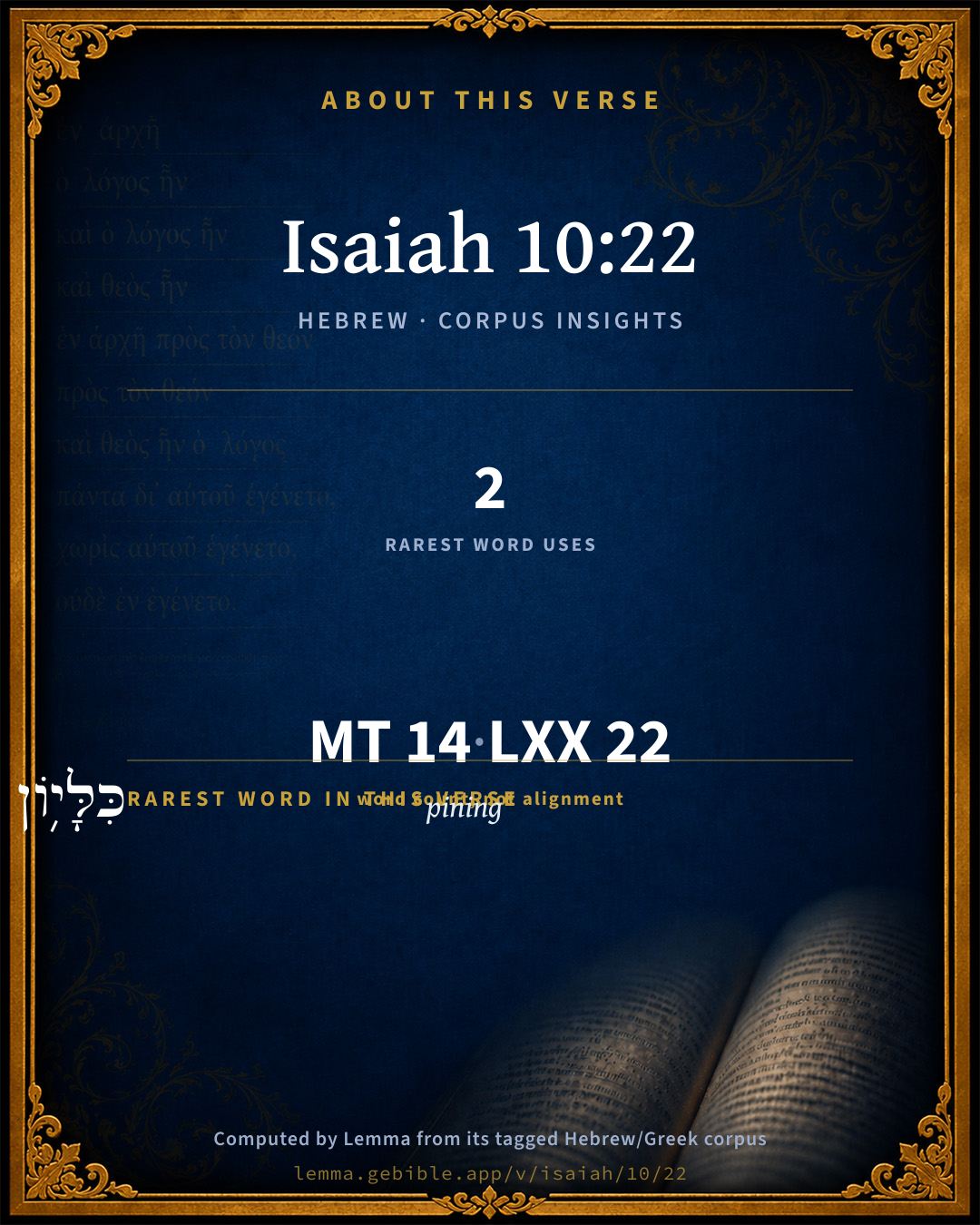
The rarest word here is כִּלָּי֥וֹן pining H3631 — appearing just 2 times in the whole Hebrew Bible.

Shared distinctive vocabulary

כִּלָּי֥וֹן pining H3631 occurs in 2 verses of the Hebrew Bible. Also found in:

Grammatical profile

  • 4 verbs
  • 7 nouns
  • 1 preposition
  • 2 conjunctions

Verb forms

  • יִהְיֶ֞ה Qal · Imperfect
  • יָשׁ֣וּב Qal · Imperfect
  • חָר֖וּץ Qal · Participle Passive
  • שׁוֹטֵ֥ף Qal · Participle Active

Hebrew & Septuagint length

In English translation the verse runs 26 words from the Hebrew and 20 from the Septuagint (LXX English) — closely comparable.

A rough comparison of the two English renderings, which tokenize alike — not a word-level alignment.

Word counts can differ between the Hebrew and the Greek without any difference in meaning — e.g. the Hebrew direct-object marker אֵת has no separate Greek word, and Greek often adds the article ὁ.

In the original languages it is 14 Hebrew tokens and 22 Greek tokens — but the two are counted differently (Hebrew bundles its prefixes and suffixes into one token; the Greek is in lemma form), so that isn’t a like-for-like length.

Cross-references

15

Topical passages linked to Isaiah 10:22 in the Treasury of Scripture Knowledge — connected by theme and wording, ordered by reader-vote popularity; previews shown in the World English Bible.

  • Romans 9:27–28 Isaiah cries concerning Israel, "If the number of the children of Israel are as the sand of the sea, It is the remnant who will be saved;
  • Isaiah 6:13 If there are yet a tenth in it, It also shall in turn be eaten up: As a terebinth, and as an oak, whose stock remains, when they are felled; So the holy seed is its stock."
  • Daniel 9:27 He shall make a firm covenant with many for one week: and in the midst of the week he shall cause the sacrifice and the offering to cease; and on the wing of abominations [shall come] one who makes desolate; and even to the full end, and that determined, shall [wrath] be poured out on the desolate.
  • Romans 11:5–6 Even so then at this present time also there is a remnant according to the election of grace.
  • Revelation 20:8 and he will come out to deceive the nations which are in the four corners of the earth, Gog and Magog, to gather them together to the war; the number of whom is as the sand of the sea.
  • Genesis 18:25 Be it far from you to do things like that, to kill the righteous with the wicked, that so the righteous should be as the wicked. May that be far from you. Shouldn't the Judge of all the earth do right?"
  • 1 Kings 4:20 Judah and Israel were many as the sand which is by the sea in multitude, eating and drinking and making merry.
  • Isaiah 6:11 Then I said, "Lord, how long?" He answered, "Until cities are waste without inhabitant, And houses without man, And the land becomes utterly waste,
  • Isaiah 8:8 and it shall sweep onward into Judah; it shall overflow and pass through; it shall reach even to the neck; and the stretching out of its wings shall fill the breadth of your land, Immanuel.
  • Isaiah 27:10–11 For the fortified city is solitary, a habitation deserted and forsaken, like the wilderness: there shall the calf feed, and there shall he lie down, and consume the branches of it.
  • Isaiah 28:15–22 Because you have said, We have made a covenant with death, and with Sheol are we at agreement; when the overflowing scourge shall pass through, it shall not come to us; for we have made lies our refuge, and under falsehood have we hid ourselves:
  • Hosea 1:10 Yet the number of the children of Israel will be as the sand of the sea, which can't be measured nor numbered; and it will come to pass that, in the place where it was said to them, 'You are not my people,' they will be called 'sons of the living God.'
  • Acts 17:31 because he has appointed a day in which he will judge the world in righteousness by the man whom he has ordained; of which he has given assurance to all men, in that he has raised him from the dead."
  • Romans 2:5 But according to your hardness and unrepentant heart you are treasuring up for yourself wrath in the day of wrath, revelation, and of the righteous judgment of God;
  • Romans 3:5–6 But if our unrighteousness commends the righteousness of God, what will we say? Is God unrighteous who inflicts wrath? I speak like men do.

Cross-references courtesy of OpenBible.info (CC BY 4.0).

Hebrew and Greek witnesses Masoretic Hebrew ↔ Greek Septuagint

The same verse in the two great witnesses to the Old Testament, shown verse-for-verse.

These are two independent witnesses, not word-aligned to each other, and the Septuagint is shown in lemma (dictionary) form.

Hebrew Isaiah 10:22 Masoretic · Westminster Leningrad Codex

כִּ֣י אִם יִהְיֶ֞ה עַמְּךָ֤ יִשְׂרָאֵל֙ כְּח֣וֹל הַיָּ֔ם שְׁאָ֖ר יָשׁ֣וּב בּ֑וֹ כִּלָּי֥וֹן חָר֖וּץ שׁוֹטֵ֥ף צְדָקָֽה

For though your people, Israel, be as the sand of the sea, [only] a remnant of them shall return: a destruction [is] determined, overflowing with righteousness.

World English Bible · Public Domain

Greek LXX Isaiah 10:22 Septuagint · lemma form

καί ἐάν γίγνομαι ὁ λαός ἰσραήλ ὡς ὁ ἄμμος ὁ θάλασσα ὁ καταλείμμα αὐτός σώζω λόγος γάρ συντελέω καί συντέμνω ἐν δικαιοσύνη

And though the people of Israel be as the sand of the sea, a remnant of them shall be saved.

LXX2012 (modern English Septuagint) · Public Domain

On this verse, Adam Clarke's Commentary discusses the Septuagint’s reading. Read the note in Commentary ↓

Hebrew: Westminster Leningrad Codex (CC BY 4.0). Greek: Septuagint (public domain); English from LXX2012 (modern English Septuagint) (Public Domain). How the Septuagint differs from the Hebrew →

Targum (Aramaic paraphrase)

1

The Targum is the ancient Jewish Aramaic paraphrase of the Hebrew Scriptures — an interpretive translation, not the Hebrew text itself. Onkelos (literal) and Pseudo-Jonathan (expansive) render the Torah, and Jonathan the Prophets. Coverage is partial: where no permissively-licensed English translation exists for a verse, only the Aramaic is shown. This is verse-level text, not a word-by-word alignment to the Hebrew.

  1. Targum Jonathan Prophets (Joshua–Malachi)
    אֲרֵי אִם יְהֵי עַמָךְ יִשְׂרָאֵל סַגִי כְּחָלָא דְיַמָא שְׁאָר דְלָא חֲטוֹ וּדְתָבוּ מֵחֲטָאָה יִתְעַבְדוּן לְהוֹן גְבוּרָן דְמִתְגַבְּרִין וּמְדַבְּרָן בְּזָכוּ:

    Though thy people Israel be as the sand of the sea, a remnant which hath not sinned, but hath turned away from sin, for them mighty things shall be done, which shall prevail, even those which speak in righteousness.

    Targum Jonathan — Aramaic: “Mikraot Gedolot” (public domain). English: “Sefaria Community Translation” (CC0 1.0 (public-domain dedication)); “London "Chaldee Paraphrase," 1871” (public domain). Text via Sefaria.

Commentary

Notes on Isaiah 10:22 from classic Christian and Jewish commentators (each source and its license shown beneath its notes). The classic Christian expositions comment on the surrounding passage and are grouped to its opening verse, so a note may address several verses; the Jewish commentaries on the Tanakh (Rashi and others) are per-verse, so they appear only where the commentator wrote on this verse.

Lemma curates 59 commentaries, every one of them public domain or Creative Commons licensed, each selected and text-cleaned for this edition rather than reprinted as found. About our sources →

Adam Clarke's Commentary

Verse 22. For though thy people Israel] I have endeavoured to keep to the letter of the text as nearly as I can in this obscure passage; but it is remarkable that neither the Septuagint, nor St. Paul, Ro 9:28, who, except in a few words of no great importance, follows them nearly in this place, nor any one of the ancient Versions, take any notice of the word שטף shoteph, overflowing; which seems to give an idea not easily reconcilable with those with which it is here joined. I. S. Maerlius (Schol. Philolog. ad Selecta S. Cod. loca) conjectures that the two last letters of this word are by mistake transposed, and that the true reading is שפט shophet, judging, with strict justice. The Septuagint might think this sufficiently expressed by εν δικαιοσυνη, in righteousness. One MS., with St. Paul and Septuagint Alex., omits בו bo in Isa 10:22; sixty-nine of Kennicott's and seventeen of De Rossi's MSS. and eight editions, omit כל col, all, in Isa 10:23; and so St. Paul, Ro 9:28.

The learned Dr. Bagot, dean of Christ Church, Oxford, afterwards Bishop of Bristol and Norwich, in some observations on this place, which he has been so kind as to communicate to me, and which will appear in their proper light when he himself shall give them to the public, renders the word כליון kilayon by accomplishment, and makes it refer to the predictions of Moses; the blessing and the curse which he laid before the people, both conditional, and depending on their future conduct. They had by their disobedience incurred those judgments which were now to be fully executed upon them. His translation is, The accomplishment determined overflows with justice; for it is accomplished, and that which is determined the Lord God of hosts doeth in the midst of the land. - L. Some think that the words might be paraphrased thus: The determined destruction of the Jews shall overflow with righteousness, (צדקה tsedakah,) justification, the consequence of the Gospel of Christ being preached and believed on in the world. After the destruction of Jerusalem this word or doctrine of the Lord had free course, - did run, and was glorified.

Adam Clarke's Commentary on the Bible (1810–1826) — public domain. Text from a community e-Sword/MySword module.

Trapp's Complete Commentary

John Trapp

Isa 10:22 For though thy people Israel be as the sand of the sea, [yet] a remnant of them shall return: the consumption decreed shall overflow with righteousness.

Ver. 22. Yet a remnant of them shall return,] i.e., Shall be saved from Sennacherib, but especially from Satan, that old man slayer. {Rom 9:27; Rom 9:29; Rom 11:5} The greater part of the Jews were then cut off by the Assyrians; and so they are spiritually still by the evil spirits which hold them in their hardness of heart, and hinder them from embracing the Christian faith. But this befalleth them by God’s holy decree {Rom 9:27-28} and just judgment.

The consumption decreed shall overflow with righteousness,] i.e., The utter destruction of this perverse people, both temporal and spiritual, {Rom 9:27} for the generality of them, is not to be accounted cruelty, but overflowing righteousness. For God could not in justice but thus rigorously deal with them; and then for his promise sake to Abraham, Isaac, and Jacob, reserving a "remnant," show favour to them again.

John Trapp, A Commentary or Exposition upon All the Books of the Old and New Testament (1647–1656) — public domain. Text from a community e-Sword module.

Tyndale Open Study Notes

Tyndale Open Resources

10:22 God had similarly promised descendants as numerous as the sand of the seashore to Abraham (Gen 22:17). • rightly decided to destroy: God’s decision was a just response to the people’s persistent wickedness.

Tyndale Open Study Notes — © Tyndale Open Resources, licensed CC BY-SA 4.0. Text via the HelloAO Bible API.

Geneva Bible (1599)

Geneva Bible translators

This small number which seemed to be consumed, and yet according to God’s decree is saved, shall be sufficient to fill all the world with righteousness.

Geneva Bible (1599) marginal notes — public domain. Text via Bolls.life.

Jamieson, Fausset & Brown

Robert Jamieson, A. R. Fausset & David Brown

yet--rather in the sense in which Paul quotes it (Rom 9:27), "Though Israel be now numerous as the sand, a remnant only of them shall return"--the great majority shall perish. The reason is added, Because "the consumption (fully completed destruction) is decreed (literally, decided on, brought to an issue), it overfloweth (Isa 30:28; Isa 8:8) with justice"; that is, the infliction of just punishment (Isa 5:16) [MAURER].

Jamieson, Fausset & Brown — Commentary Critical and Explanatory on the Whole Bible (1871) — public domain (CC PDM 1.0). Text via the HelloAO Bible API.

Ellicott's Commentary for English Readers

(22) Though thy people Israel be as the sand of the sea.—The word “remnant” has, however, its aspect of severity as well as of promise. Men are not to expect that they, the hypocrites and evil-doers, shall escape their punishment. The promise of restoration is for the remnant only. (Comp. St. Paul’s application of the text in Rom_9:27-28).

The consumption decreed shall overflow with righteousness.—Literally, a finished (or final) work, decisive, overflowing with righteousness. A like phrase meets us again in Isa_28:22; Dan_9:27. The “finished work” is that of God’s judgment, and it “overflows with righteousness” at once punitive and corrective.

A Bible Commentary for English Readers, edited by Charles John Ellicott (1878–1897) — public domain. Text from a community e-Sword module.

The Cambridge Bible for Schools and Colleges

gen. ed. J. J. S. Perowne

22. “For though thy population, O Israel, should be as the sand of the sea, (only) a remnant in it shall turn (and be saved).” (Cf. Hos_1:10; Gen_22:17.)

the consumption decreed … righteousness] Render: extermination is decreed overflowing in righteousness. The “extermination” is the judgment which reduces the teeming population of Israel to a mere remnant; this will be an overwhelming manifestation of Jehovah’s judicial righteousness (see on ch. Isa_1:27). It seems impossible to take this clause in a consolatory sense, as if the verb “decreed” expressed the limitation fixed for the judgment. The very similar phraseology of the next verse, compared with ch. Isa_28:22, shews that the threatening aspect of the decree is prominent.

Isa_10:23. The verse reads: For an extermination and a decisive work is the Lord Jehovah of Hosts about to execute in the midst of the whole earth (or land): cf. ch. Isa_28:22. The phrase “extermination and decisive work” is repeated in Dan_9:27 (cf. Dan_11:36). The word for “decisive” is from the verb rendered “decreed” in last verse.

Isa_10:24-27. In view of this ultimate prospect, the prophet turns with a message of consolation to the believing kernel of the nation.

The Cambridge Bible for Schools and Colleges (gen. ed. J. J. S. Perowne; Cambridge University Press, 1878–1918) — public domain. Text from a community e-Sword module.

John Gill's Exposition

For the Lord God of hosts shall make a consumption,.... Not of the land of Judea, as at the destruction of Jerusalem; but the meaning is, that he that is Lord of all, who does what he pleases in the armies above and below, will execute and accomplish a precise and absolute decree of his, concerning the salvation of the remnant of his people; which is his decree of election, and that standing sure, not upon the foot of works, but his own sovereign will: hence their salvation is sure and certain, and not precarious;

even determined, in the midst of all the land; that is, the determined decree should be executed in the several parts of the land of Judea, where this remnant was; for which reason the Gospel was preached in the several cities of Judah, in order to accomplish it, both by Christ and his apostles.

John Gill's Exposition of the Whole Bible (1746–1763) — public domain (CC PDM 1.0). Text via the HelloAO Bible API.

Albert Barnes' Notes on the Bible

For though ... - In this verse, and in Isa 10:23. the prophet expresses positively the idea that “but” a remnant of the people should be preserved amidst the calamities. He had said Isa 10:20-21, that a remnant should return to God. He now carries forward the idea, and states that only a remnant should be preserved out of the multitude, however great it was. Admitting that the number was then very great, yet the great mass of the nation would be cut off, and only a small portion would remain.

Thy people Israel - Or rather, ‘thy people, O Israel,’ making it a direct address to the Jews, rather than to God.

Be as the sand of the sea - The sands of the sea cannot be numbered, and hence, the expression is used in the Bible to denote a number indefinitely great: Psa 119:18; Gen 22:17; Gen 41:49; Jos 11:4; Jdg 7:12; 1Sa 13:5, ...

Yet a remnant - The word “yet” has been supplied by the translators, and evidently obscures the sense. The idea is, that a remnant only - a very small portion of the whole, should be preserved. Though they were exceedingly numerous as a nation, yet the mass of the nation would be cut off, or carried into captivity, and only a few would be left.

Shall return - That is, shall be saved from destruction, and return by repentance unto God, Isa 10:21. Or, if it has reference to the approaching captivity of the nation, it means that but a few of them would return from captivity to the land of their fathers.

The consumption - The general sense of this is plain. The prophet is giving a reason why only a few of them would return, and he says, that the judgment which God had determined on was inevitable, and would overflow the land in justice. As God had determined this, their numbers availed nothing, but the consumption would be certainly accomplished. The word “consumption” כליון kilāyôn from כלה kâlâh to complete, to finish, to waste away, vanish, disappear) denotes a languishing, or wasting away, as in disease; and then “destruction,” or that which “completes” life and prosperity. It denotes such a series of judgments as would be a “completion” of the national prosperity, or as should terminate it entirely.

Decreed - צריץ chârı̂yts. The word used here is derived from חרץ chârats, to sharpen, or bring to a point; to rend, tear, lacerate; to be quick, active, diligent; and then to decide, determine, decree; because that which is decreed is brought to a point, or issue. - “Taylor.” It evidently means here, that it was fixed upon or decreed in the mind of God, and that being thus decreed, it must certainly take place.

Shall overflow - שׁטף shoṭēph. This word is usually applied to an inundation, when a stream rises above its banks and overflows the adjacent land; Isa 30:28; Isa 66:12; Psa 78:20. Here it means evidently, that the threatened judgment would spread like an overflowing river through the land, and would accomplish the devastation which God had determined.

With righteousness - With justice, or in the infliction of justice. justice would abound or overflow, and the consequence would be, that the nation would be desolated.

Albert Barnes' Notes on the Bible (1834–1885) — public domain. Text from a community e-Sword/MySword module.

Haydock's Catholic Bible Commentary

Converted. This was partly verified in the children of Israel who remained after the devastations of the Assyrians, in the time of king Ezechias: and partly in the conversion of a remnant of the Jews to the faith of Christ. (Challoner) --- 4 Kings xviii. 3., and Romans ix. 27. The apostle follows the Septuagint, (Calmet) "and if the people of Israel be." --- Converted. Septuagint, "saved, for perfecting the word and abridging in justice. Because God, the Lord of hosts, will make an abridged word in the universe." (Haydock) --- As the apostle has explained this passage, "every other interpretation must cease." (St. Jerome) --- The few who were converted under Ezechias were a figure of those who should embrace the faith of Christ. (Calmet) --- Consumption. That is, the number of them cut short, and reduced to few, shall flourish in the abundance of justice. (Challoner) --- Hebrew, "the desolation is decreed, justice shall overflow." God will treat all with rigour, Nahum i. 8. The incredulous Jews shall be rejected, ver. 23., and Romans ix.

George Leo Haydock (1774–1849), Haydock's Catholic Family Bible and Commentary, 1859 edition — public domain. Excludes Psalms (Douay-Rheims chapter numbering differs from Protestant) and Deuterocanonical books (Catholic canon only).

Matthew Poole's English Annotations

Israel; or, O Israel; to whom by an apostrophe he directeth his speech.

A remnant; or, a remnant only, as before; for that this is a threatening in respect of some, as well as a promise in respect of others, is evident from the rest of this and from the following verse.

The consumption decreed shall overflow; the destruction of the people of Israel was already decreed or determined (as it is in the next verse) by the fixed counsel of God, and therefore must needs be executed, and like a deluge overflow them.

With righteousness, as this word is rendered, Rom 9:28; the preposition in or with being here understood, as it is every where. And this is added, to show, that although this judgment of God may seem very severe, yet it is most just, not only by the laws of strict and rigid justice, but even by the rules of equity and clemency, as this word oft signifies, inasmuch as he hath spared a considerable remnant of them, when he might have destroyed, them utterly. And so this word is added as a reason why a remnant, and why but a remnant, should return, because God would both glorify his justice, and manifest his mercy. And in this mixed sense the apostle seems to expound this place, Rom 9:27,28.

Matthew Poole's English Annotations on the Holy Bible (1683–1685) — public domain. Text from a community e-Sword/MySword module.

Whedon's Commentary on the Bible

Daniel D. Whedon

22. The use of the word remnant, though connected with a threatening, is attended with promise.

Though thy people Israel be as the sand of the sea — So numerous as to be impossible to count them, yet only a “remnant” shall return — This is the threatening. But they, the few, shall certainly “return,” and in penitence. This is the promise. A visible Church shall remain, even on the plains of Babylon. And St. Paul (Rom_11:12) reveals a mystery contained in this promise, namely, its enlargement in the upheaval of the Gentile world, whose destiny was so long unexplained. Israel’s abasement becomes thus the occasion of the riches of the Gentiles. Israel revolts. Its consumption is decreed — determined on in the divine mind — and through the fidelity of the few a great world of new people shall be brought in. The consumption is the result of an overflow with righteousness.

Daniel D. Whedon (gen. ed.), Commentary on the Old and New Testaments (1874–1909) — public domain. Text from a community e-Sword module.

The Pulpit Commentary

Vers. 22, 23. These verses are exegetical of the term "remnant," and bring out its full force. The promise had been made to Abraham that his seed should be "like the sand of the sea for multitude". (Gen_22:17) This promise had been fulfilled; (1Ki_4:20) but now the sins of the people would produce a reversal of it. It would be a remnant, and only a remnant, of the nation that would escape. Judah would have to make a fresh start as from a new beginning. (see Ezr_2:64)

The consumption decreed shall overflow with righteousness; rather, the consummation (Dan_9:27) determined on is one that overflows with righteousness. (comp. Isa_28:22) The prophet means that God is about to visit the land in such a spirit of severe justice that it cannot be expected that more than a remnant will survive the awful visitation.

The Pulpit Commentary (1880–1919), ed. H.D.M. Spence-Jones & Joseph S. Exell — public domain. Text from a community e-Sword module.

John Wesley's Explanatory Notes

A remnant - Or, a remnant only. The consumption - The destruction of Israel was already decreed by the fixed counsel of God, and therefore must needs be executed, and like a deluge overflow them. Righteousness - With justice, and yet with clemency, inasmuch as he has spared a considerable remnant of them, when he might have destroyed them utterly.

John Wesley, Explanatory Notes Upon the Whole Bible (1754–1765) — public domain. Text via the GEBible commentary corpus.

Keil & Delitzsch

C. F. Keil & F. Delitzsch

To Him the remnant of Israel would turn, but only the remnant. "For if thy people were even as the sea-sand, the remnant thereof will turn: destruction is firmly determined, flowing away righteousness. For the Lord, Jehovah of hosts, completes the finishing stroke and that which is firmly determined, within the whole land." As the words are not preceded by any negative clause, ci 'im are not combined in the sense of sed or nisi; but they belong to two sentences, and signify nam si (for if). If the number of the Israelites were the highest that had been promised, only the remnant among them, or of them (bō partitive, like the French en), would turn, or, as the nearer definition ad Deum is wanting here, come back to their right position. With regard to the great mass, destruction was irrevocably determined (râchatz, τέμνειν, then to resolve upon anything, ἀποτόμως, Kg1 20:40); and this destruction "overflowed with righteousness," or rather "flowed on (shōtēph, as in Isa 28:18) righteousness," i.e., brought forth righteousness as it flowed onwards, so that it was like a swell of the penal righteousness of God (shâtaph, with the accusative, according to Ges. 138, Anm. 2). That cillâyōn is not used here in the sense of completion any more than in Deu 28:65, is evident from Isa 10:23, where câlâh (fem. of câleh, that which vanishes, then the act of vanishing, the end) is used interchangeably with it, and necherâtzâh indicates judgment as a thing irrevocably decided (as in Isa 28:22, and borrowed from these passages in Dan 9:27; Dan 11:36). Such a judgment of extermination the almighty Judge had determined to carry fully out (‛ōseh in the sense of a fut. instans) within all the land (b'kereb, within, not b'thok, in the midst of), that is to say, one that would embrace the whole land and all the people, and would destroy, if not every individual without exception, at any rate the great mass, except a very few.

Keil & Delitzsch — Biblical Commentary on the Old Testament (1861–1891) — public domain (CC PDM 1.0). Text via the HelloAO Bible API. (Old Testament only.)

J. A. Alexander on Isaiah

Joseph Addison Alexander

The Prophet now explains the use of the word ‘remnant’, and shows that the threatening which it involves is not inconsistent with the ancient promises. “For though thy people, oh Israel (or Jacob), shall be like the sand of the sea (in multitude), (only) a remnant of them shall return. A consumption is decreed, overflowing (with) righteousness.” The first clause relates to a certain event, but one still future (though thy people shall be or is to be). There seems, as Calvin says, to be allusion to the promises given to the Patriarchs (e. g. Gen 13:16; Gen 22:17), and repeated by the Prophets, (e.g. Hos 1:10) the fulfillment of which might have seemed to be precluded by the threatening in v. 21 to prevent which false conclusion, Isaiah here repeats the threatening with the promise, ‘though thy people shall indeed be numerous, yet’ etc. The name Israel may be understood as that of the nation; but there is more force in the language if we suppose an apostrophe to Israel or Jacob as the common ancestor, thus keeping up a distinct allusion to the ancient promises. ‘Thy people’ will then mean thy posterity, not the ten tribes exclusively, nor Judah exclusively, but the whole race without distinction. The return predicted is not merely that from the Babylonish exile, but a return to God by true repentance and conversion as the only means of salvation. That a remnant only should escape, implies of course a general destruction, which is positively foretold in the last clause.

Joseph Addison Alexander, The Prophecies of Isaiah (1846–1847; New York: Scribner, 1870–1878) — public domain. Text from a community e-Sword module.

unfoldingWord translationNotes

Door43 World Missions Community

your people, Israel, are

Here "your" is singular. Possible interpretations are 1) God is speaking to Isaiah and "your" refers to Isaiah. AT: "your people Israel are" or 2) Isaiah or God is speaking to the nation of Israel and "your" refers to the nation. AT: "your people, O Israel, are" (See: Forms of You)

are like the sand of the seashore

This emphasizes that there were a great number of people of Israel. AT: "are too many to count, like the sand on the seashore" (See: Simile)

Destruction is decreed

This can be stated in active form. AT: "Yahweh has decreed that he will destroy most of those who live in Israel" (See: Active or Passive and Assumed Knowledge and Implicit Information)

as overflowing righteousness demands

This can be translated as a new sentence. AT: "This must be done for the sake of perfect righteousness" or "Yahweh must do this because he is completely righteous"

carry out the destruction determined throughout the land

This can be translated in active form. Possible meanings are 1) AT: "destroy everything in the land just as he has determined to do" or 2) AT: "destroy the people in the land just as he has determined to do." (See: Active or Passive)

determined

"decided"

translationWords

people of God

Israel

remnant

decree

righteous

lord

Yahweh of hosts

unfoldingWord translationNotes — © Distant Shores Media and the Door43 World Missions Community, licensed CC BY-SA 4.0. Source: git.door43.org/Door43/en_tn.

Rashi

Rabbi Shlomo Yitzchaki (Rashi)

For if your people The prophet says to Hezekiah, If your people are like the sand of the sea, the remnant of them that return to do good, will wash away the destruction sentenced to come upon them, and prevent it from coming, through the righteousness with which they will behave.

Rashi on the Tanakh — English translations: “The Judaica Press complete Tanach with Rashi, translated by A. J. Rosenberg” (CC BY 4.0); “Pentateuch with Rashi's commentary by M. Rosenbaum and A.M. Silbermann, 1929-1934” (public domain); “The Metsudah Tanach series, Lakewood, N.J” (CC BY 4.0); and “The Book of Joshua, Metsudah Publications, 1997” (CC BY 4.0). Text via Sefaria.

Ibn Ezra

Rabbi Abraham ibn Ezra

For though, etc. Although Israel should in those days be as numerous as the sand of the sea, only those that will return to God will remain; for destruction, which is decreed—חרוץ, decreed; comp. חרצת, thou hast decreed (1 Kings 20:40)—by God, will come like a river, overflowing with righteousness.

Ibn Ezra on the Tanakh — English translations: “Sefaria Community Translation” (CC0 1.0 (public-domain dedication)); “Yalkut, Sifsei Chachomim Chumash, Metsudah Publications, 2009” (CC BY 4.0); and “Commentary of Ibn Ezra on Isaiah - trans. by M. Friedlander, 1873” (public domain). Text via Sefaria.

Lesson kit

Teaching starters — assembled from the data on this page, not authored interpretation. Every prompt links to the verse data it draws on. Edit before teaching.

Isaiah, in the Prophets, opens this verse with 14 words (13 distinct Hebrew lemmas). Its most distinctive word is killâyôwn (“pining”). A historical commentator’s framing appears above. Read the whole chapter for the surrounding context.

Discussion questions

  1. The word killâyôwn carries the sense “pining.” How does it shape the verse?
  2. Deuteronomy 28:65 shares the word «pining» with this verse. How do the two illuminate each other?
  3. These translations render this verse differently; the difference is in the English rendering, not the original. What questions does that raise?
  4. The verb «יִהְיֶ֞ה» is Qal Imperfect. How does its form color the action?
  5. Reading how Adam Clarke's Commentary and Trapp's Complete Commentary read this verse, where do the two commentators agree and where do they part?

Things to notice

Reading settings

Reading text

Shown beneath each verse's original-language words.

Old Testament
Old Testament edition

Read the OT as the Masoretic Hebrew (MT) or the Greek Septuagint (LXX).

English shown for the Greek Septuagint (in the Hebrew ↔ Greek comparison).

Comparing translations? Open the Compare panel on any verse page to stack up to four side by side.